

- Industry Size (2026)
- USD 153.07 Mn
- Forecast (2036)
- USD 254.12 Mn
- CAGR (2026 to 2036)
- 5.2%
Marine Trenchers Market Size, Market Forecast and Outlook By FMI
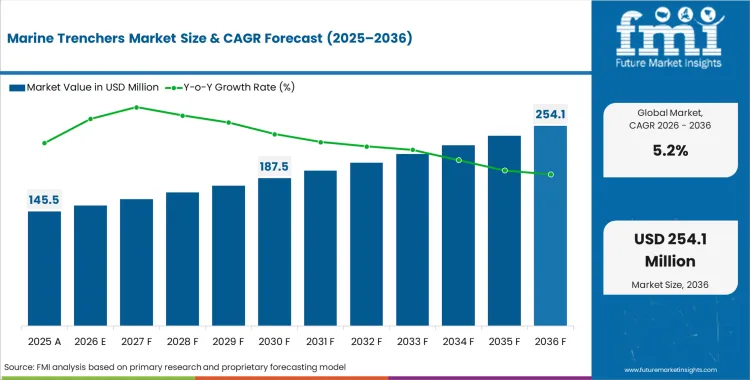
The marine trenchers market was valued at USD 145.50 million in 2025, projected to reach USD 153.07 million in 2026, and is forecast to expand to USD 254.12 million by 2036 at a 5.2% CAGR. Offshore pipeline and cable installation projects for energy and telecommunications infrastructure are sustaining procurement of specialized subsea trenching equipment. Deepwater field development and subsea cable routing for offshore wind farms are defining the technical specifications that govern trencher design and fleet deployment schedules.
Summary of Marine Trenchers Market
- Market Snapshot
- The marine trenchers market is valued at USD 145.50 million in 2025 and is projected to reach USD 254.12 million by 2036.
- The industry is expected to grow at a 5.2% CAGR from 2026 to 2036, creating an incremental opportunity of USD 101.05 million.
- The market is a specialized offshore construction equipment category where procurement is governed by pipeline burial regulations, cable installation project timelines, and seabed geological survey specifications.
- Demand and Growth Drivers
- Offshore oil and gas pipeline burial regulations in the North Sea and Gulf of Mexico mandate trencher-assisted installation to meet minimum cover depth compliance requirements.
- Offshore wind farm interconnector and export cable installation projects are creating a growing demand channel for precision cable trenching equipment.
- Subsea telecommunications trunk cable routing across oceanic corridors sustains long-term fleet utilization for cable-specific trenching vessels.
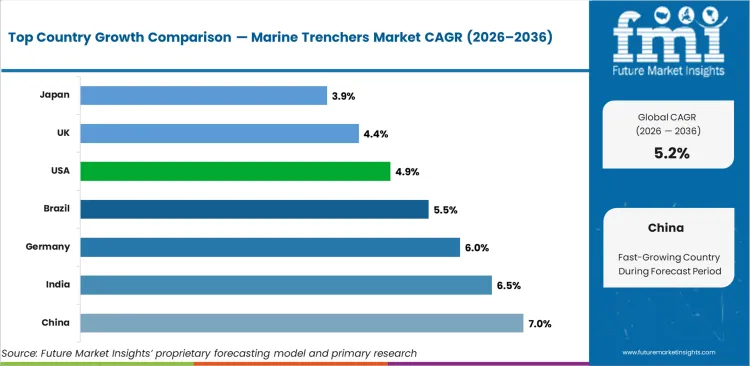
- Among key countries, China leads at 7% CAGR, followed by India at 6.5%, Germany at 6%, the United States at 4.9%, and United Kingdom at 4.4%.
- Product and Segment View
- The market covers subsea trenching equipment used for pipeline burial, cable installation, and seabed protection operations in offshore environments.
- Applications span offshore oil and gas pipeline protection, subsea telecommunications cable routing, and tidal energy cable installation.
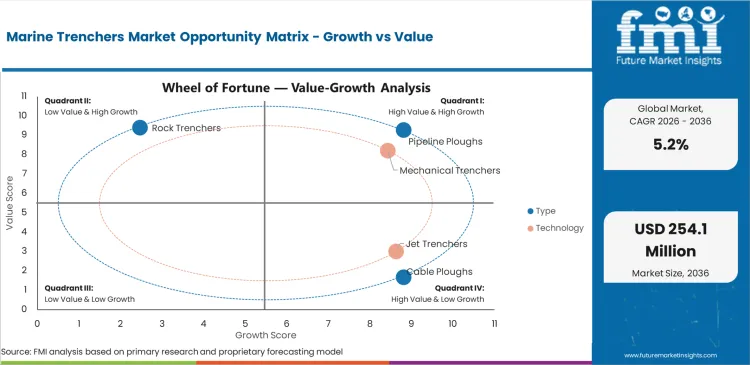
- Pipeline Ploughs lead by Type with 40% share in 2026, driven by regulatory-mandated pipeline burial depth compliance in major offshore energy provinces.
- Mechanical Trenchers account for 55% of the Technology segment in 2026, due to operational versatility across varied seabed soil conditions.
- The scope includes pipeline ploughs, cable ploughs, rock trenchers, and associated deployment systems; it excludes dredging equipment, pipe-laying vessels, and surface trenching machinery.
- Geography and Competitive Outlook
- China and India lead growth at 7% and 6.5% CAGR, driven by offshore energy field development and subsea cable network expansion.
- Northern Europe represents a mature but active market where North Sea pipeline maintenance and offshore wind cable installation sustain fleet utilization rates.
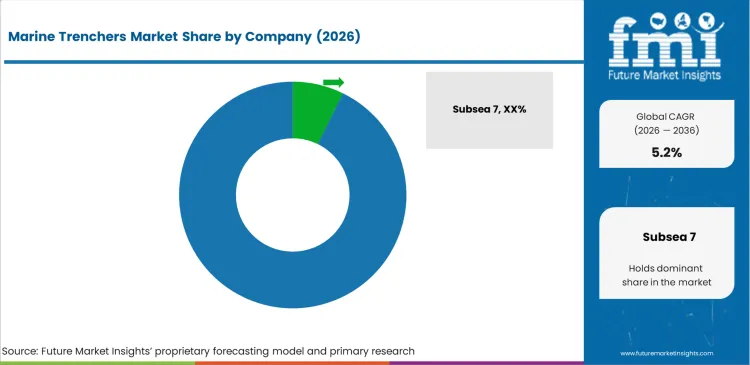
- Competition is defined by trencher depth capability, vessel fleet availability, and project execution track record, with key players including Subsea 7, EMAS Offshore, Boskalis Westminster, TechnipFMC, McDermott International.
Marine Trenchers Market Key Takeaways
| Metric | Details |
|---|---|
| Industry Size (2026) | USD 153.07 Million |
| Industry Value (2036) | USD 254.12 Million |
| CAGR (2026-2036) | 5.2% |
Source: Future Market Insights, 2026
As per FMI, the marine trenchers market is shaped by the intersection of offshore oil and gas pipeline burial requirements and the expanding subsea cable installation demand from offshore wind and telecommunications projects. Mechanical trenchers maintain the largest technology share due to their ability to operate across a wider range of seabed soil conditions compared to jet trenching systems. FMI analysts note that pipeline ploughs retain the leading type share because pipeline protection regulations in the North Sea and Gulf of Mexico mandate burial depth compliance for hydrocarbon transport lines. The growing pipeline of offshore wind interconnector cables and subsea telecom trunk routes is creating incremental demand for cable-specific trenching equipment designed for precision burial in varied seabed geologies.
Country-level growth mirrors offshore energy investment and subsea cable installation activity. China leads at 7% CAGR, driven by offshore gas field development and a growing subsea cable network for coastal energy distribution. India follows at 6.5%, supported by offshore oil and gas expansion and emerging offshore wind pilot projects. Germany registers 6%, reflecting North Sea pipeline protection compliance and offshore wind interconnector cable installation demand. Brazil advances at 5.5% from pre-salt deepwater field development. United States maintains 4.9% growth, and United Kingdom tracks 4.4%. Japan registers 3.9% CAGR through 2036.
Marine Trenchers Market Definition
Marine trenchers are specialized subsea construction machines designed to excavate trenches on the seabed for the burial and protection of pipelines, cables, and umbilicals. Available as pipeline ploughs, cable ploughs, and rock trenchers, these machines operate using mechanical cutting, jetting, or combined methods depending on seabed geology. The primary function is to achieve regulatory-compliant burial depth for offshore energy transport lines and subsea communication cables.
Marine Trenchers Market Inclusions
Market scope includes pipeline ploughs, cable ploughs, rock trenchers, and associated subsea deployment systems. Technology coverage spans mechanical and jet trenching methods. Global and regional market sizing covers the forecast period from 2026 to 2036 with segment breakdowns by Type, Technology, and End Use Industry.
Marine Trenchers Market Exclusions
The scope excludes dredging vessels, pipe-laying barges, subsea ROVs used solely for inspection, surface-level trenching machinery, and onshore pipeline trenchers. Backfill equipment operated independently of trenching systems is also excluded.
Marine Trenchers Market Research Methodology
- Primary Research: Analysts engaged with subsea installation project managers, offshore pipeline engineers, and cable laying vessel operators to map the procurement decision gates and technical qualification criteria shaping marine trenchers purchasing cycles.
- Desk Research: Data collection aggregated offshore project licence databases, subsea cable route registries, and pipeline installation compliance records from public and institutional sources covering the 2021 to 2025 historical period.
- Market-Sizing and Forecasting: Baseline values derive from a bottom-up aggregation of trencher fleet deployment days, project-level contract values, and offshore installation vessel utilization rates, applying region-specific adoption curves to project demand through 2036.
- Data Validation and Update Cycle: Projections are tested against publicly reported expenditure guidance from subsea installation contractors and offshore energy project operator capital expenditure filings and reconciled quarterly.
Why is the Marine Trenchers Market Growing?
The Marine Trenchers market is experiencing significant growth driven by the rising demand for subsea infrastructure development, particularly in the oil and gas industry. The market is supported by the increasing need for efficient and reliable seabed trenching solutions for the installation of pipelines and cables in offshore environments. Technological advancements have enhanced the precision, durability, and operational efficiency of marine trenching equipment, allowing for deeper and more complex trenching operations.
Investments in offshore energy projects, including oil, gas, and renewable energy sectors, are further fueling market growth. Additionally, stringent safety regulations and the need to minimize environmental impact have encouraged the adoption of advanced trenching technologies.
As offshore exploration and energy transmission projects expand globally, demand for trenching equipment that ensures operational reliability, reduced downtime, and enhanced cost-effectiveness is projected to rise Continuous improvements in trenching technology and increased focus on sustainable offshore operations are expected to drive long-term growth in the Marine Trenchers market.
Segmental Analysis
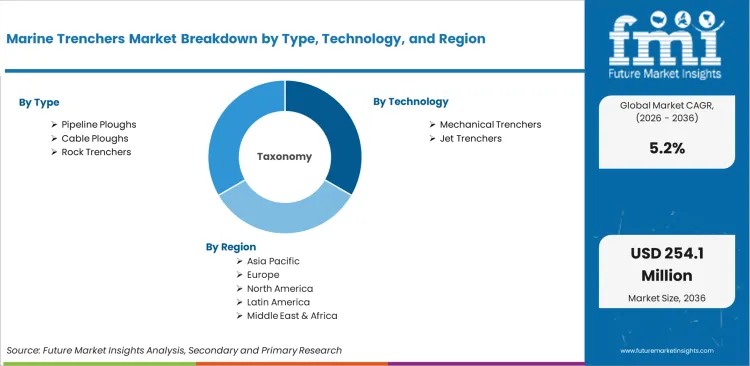
The marine trenchers market is segmented by type, technology, end use industry, and geographic regions. By type, marine trenchers market is divided into Pipeline Ploughs, Cable Ploughs, and Rock Trenchers. In terms of technology, marine trenchers market is classified into Mechanical Trenchers and Jet Trenchers. Based on end use industry, marine trenchers market is segmented into Oil & Gas, Telecommunication, and Tidal Energy. Regionally, the marine trenchers industry is classified into North America, Latin America, Western Europe, Eastern Europe, Balkan & Baltic Countries, Russia & Belarus, Central Asia, East Asia, South Asia & Pacific, and the Middle East & Africa.
Insights into the Pipeline Ploughs Type Segment
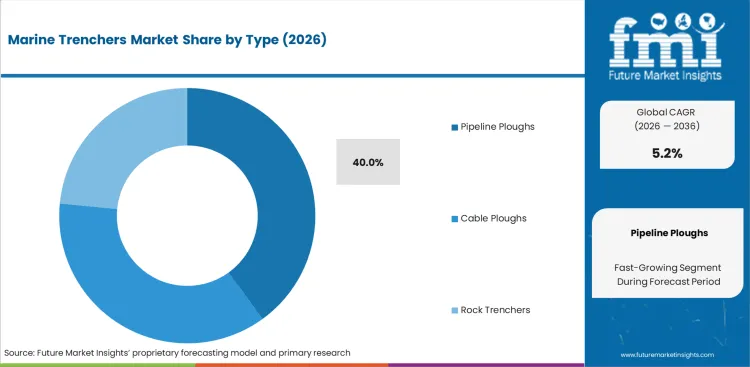
The Pipeline Ploughs segment is projected to hold 40.00% of the Marine Trenchers market revenue share in 2026, making it the leading type segment. This growth is attributed to the high efficiency of pipeline ploughs in creating continuous trenches for subsea pipelines, enabling rapid deployment over long distances.
The segment has benefited from technological enhancements that allow precise depth control and minimal disruption to seabed structures, which is critical for sensitive offshore environments. The increasing complexity of pipeline installations and the demand for reliable subsea infrastructure have reinforced the adoption of pipeline ploughs.
Additionally, the ability to integrate with real-time monitoring systems ensures safe and efficient operations, supporting its dominance in the market The segment continues to grow as offshore energy projects expand and the need for durable and scalable trenching solutions increases.
Insights into the Mechanical Trenchers Technology Segment
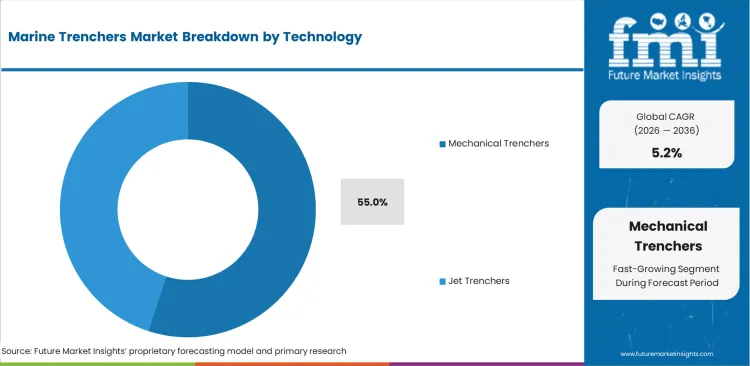
The Mechanical Trenchers segment is expected to capture 55.00% of the Marine Trenchers market revenue share in 2026, establishing it as the leading technology segment. The growth of this segment is driven by the high versatility and robust performance of mechanical trenchers in various seabed conditions.
Mechanical trenchers offer superior control, efficiency, and adaptability for different soil types, making them ideal for large-scale offshore projects. The segment has gained traction due to improvements in cutter designs, propulsion systems, and automation features, which enhance operational reliability and reduce maintenance requirements.
The increasing adoption of mechanical trenchers for pipeline and cable installation projects, combined with the rising focus on minimizing environmental impact during trenching operations, has strengthened this segment’s market position The continued expansion of offshore energy and infrastructure projects is expected to sustain the growth of mechanical trenchers.
Insights into the Oil & Gas End-Use Industry Segment
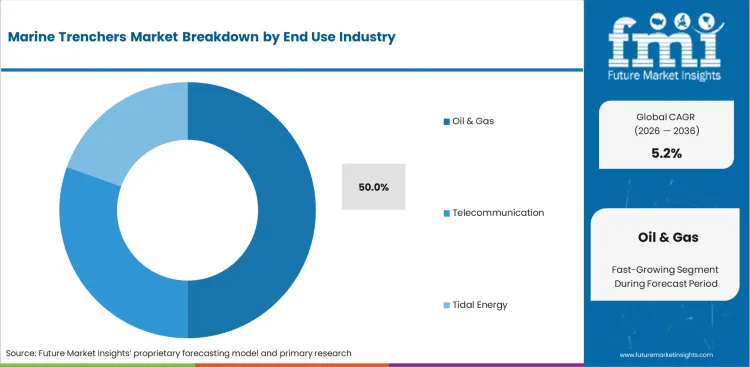
The Oil & Gas end-use industry segment is anticipated to account for 50.00% of the Marine Trenchers market revenue in 2026, making it the dominant industry segment. The growth of this segment is driven by the rising demand for subsea pipeline installations to support offshore exploration, production, and transportation of hydrocarbons.
Marine trenchers provide efficient, precise, and safe solutions for pipeline deployment in challenging offshore environments, reducing operational risks and project timelines. Technological advancements in trenching equipment, including automation and real-time monitoring, have further enhanced efficiency, ensuring compliance with safety and environmental standards.
The expansion of offshore oil and gas exploration activities globally, coupled with the increasing focus on energy security, is fueling the adoption of advanced trenching technologies The Oil & Gas segment continues to lead the market as operators prioritize reliable and cost-effective solutions for subsea infrastructure development.
Market Overview
A trench is a type of excavation or depression on the subsea terrain or surface of the earth. Trenchers are construction equipments that are used to dig trenches, especially for applications such as installing water or other fluid pipelines, laying electric cables, and others. In the marine industry, different types of waterproof trenchers are used for various applications known as marine trenchers.
Marine trenchers are used to digging a trench under the sea for laying underwater pipes and cables. These marine equipment work commonly on two types of technologies including - jet trenching and mechanical trenching. With increasing marine construction activities, leading players are increasingly emphasizing on launches novel application-specific marine trenchers such as cable ploughs, pipeline ploughs, and rock trenchers. This is expected to drive the demand for marine trenchers in the global market.
In addition to this, increasing introduction of novel marine trenchers with integrated innovative technologies such as telematics and advanced operating systems allowing the operator to operate the trencher from above the water surface is expected to bolster the sales in the market over the forthcoming years.
Analysis of Marine Trenchers Market By Key Countries
.webp "Top Country Growth Comparison Marine Trenchers Market Cagr (2026 2036)")
| Country | CAGR |
|---|---|
| China | 7.0% |
| India | 6.5% |
| Germany | 6.0% |
| Brazil | 5.5% |
| USA | 4.9% |
| UK | 4.4% |
| Japan | 3.9% |
Country-wise Analysis
The Marine Trenchers Market is expected to register a CAGR of 5.2% during the forecast period, exhibiting varied country level momentum. China leads with the highest CAGR of 7.0%, followed by India at 6.5%. Developed markets such as Germany, France, and the UK continue to expand steadily, while the USA is likely to grow at consistent rates. Japan posts the lowest CAGR at 3.9%, yet still underscores a broadly positive trajectory for the global Marine Trenchers Market. In 2026, Germany held a dominant revenue in the Western Europe market and is expected to grow with a CAGR of 6.0%. The USA Marine Trenchers Market is estimated to be valued at USD 50.7 million in 2026 and is anticipated to reach a valuation of USD 50.7 million by 2036. Sales are projected to rise at a CAGR of 0.0% over the forecast period between 2026 and 2036. While Japan and South Korea markets are estimated to be valued at USD 7.4 million and USD 4.0 million respectively in 2026.
Key Players in the Marine Trenchers Market
- Subsea 7
- EMAS Offshore
- Boskalis Westminster
- TechnipFMC
- McDermott International
- Van Oord
- Allseas Group
- Saipem
- JFD Global Ltd.
Scope of the Report
| Metric | Value |
|---|---|
| Quantitative Units | USD 153.07 Million to USD 254.12 Million, at a CAGR of 5.2% |
| Market Definition | Marine trenchers are specialized subsea construction machines designed to excavate trenches on the seabed for the burial and protection of pipelines, cables, and umbilicals. Available as pipeline ploughs, cable ploughs, and rock trenchers, these machines operate using mechanical cutting, jetting, or combined methods depending on seabed geology. |
| Segmentation | Type: Pipeline Ploughs, Cable Ploughs, Rock Trenchers; Technology: Mechanical Trenchers, Jet Trenchers; End Use Industry: Oil & Gas, Telecommunication, Tidal Energy |
| Regions Covered | North America, Latin America, Europe, East Asia, South Asia, Oceania, Middle East & Africa |
| Countries Covered | China, India, Germany, Brazil, United States, United Kingdom, Japan, and 40 plus countries |
| Key Companies Profiled | Subsea 7, EMAS Offshore, Boskalis Westminster, TechnipFMC, McDermott International, Van Oord, Allseas Group, Saipem, JFD Global Ltd. |
| Forecast Period | 2026 to 2036 |
| Approach | Forecasting models apply a bottom-up methodology starting with installed base metrics and cross-validate projections against reported industry expenditure volumes. |
Marine Trenchers Market by Segments
Type:
- Pipeline Ploughs
- Cable Ploughs
- Rock Trenchers
Technology:
- Mechanical Trenchers
- Jet Trenchers
End Use Industry:
- Oil & Gas
- Telecommunication
- Tidal Energy
Region:
- North America
- USA
- Canada
- Mexico
- Latin America
- Brazil
- Chile
- Rest of Latin America
- Western Europe
- Germany
- UK
- Italy
- Spain
- France
- Nordic
- BENELUX
- Rest of Western Europe
- Eastern Europe
- Russia
- Poland
- Hungary
- Balkan & Baltic
- Rest of Eastern Europe
- East Asia
- China
- Japan
- South Korea
- South Asia and Pacific
- India
- ASEAN
- Australia & New Zealand
- Rest of South Asia and Pacific
- Middle East & Africa
- Kingdom of Saudi Arabia
- Other GCC Countries
- Turkiye
- South Africa
- Other African Union
- Rest of Middle East & Africa
Bibliography
- 1. International Energy Agency. (2025). Offshore Energy Outlook 2025. IEA.
- 2. International Cable Protection Committee. (2025). ICPC Recommendation No. 14: Submarine Cable Route Planning and Protection. ICPC.
- 3. Organisation for Economic Co-operation and Development. (2025). Ocean Economy Database: Offshore Infrastructure Investment. OECD.
- 4. European Commission. (2025). EU Offshore Renewable Energy Strategy: Progress Report. European Commission.
- 5. International Maritime Organization. (2025). IMO Guidelines for Subsea Installation Operations. IMO.
- 6. TechnipFMC plc. (2025). TechnipFMC Annual Report 2025. TechnipFMC.
This bibliography is provided for reader reference. The full Future Market Insights report contains the complete reference list with primary research documentation.
Frequently Asked Questions
How large is the demand for Marine Trenchers in the global market in 2026?
Demand for Marine Trenchers in the global market is estimated to be valued at USD 153.07 Million in 2026.
What will be the market size of Marine Trenchers in the global market by 2036?
Market size for Marine Trenchers is projected to reach USD 254.12 Million by 2036.
What is the expected demand growth for Marine Trenchers in the global market between 2026 and 2036?
Demand for Marine Trenchers is expected to grow at a CAGR of 5.2% between 2026 and 2036.
Which Type is poised to lead global sales by 2026?
Pipeline Ploughs accounts for 40% share in 2026.
How is the Technology segment structured in this market?
Mechanical Trenchers leads the Technology segment with 55% share in 2026.
What is driving demand in China?
China leads growth at 7% CAGR through 2036, driven by offshore gas field development and coastal energy cable network expansion.
What is India's growth outlook in this report?
India is projected to grow at a CAGR of 6.5% during 2026 to 2036.
What is Marine Trenchers and what is it mainly used for?
Marine trenchers are subsea construction machines that excavate seabed trenches for pipeline and cable burial. They are primarily used in offshore oil and gas, telecommunications, and offshore wind energy projects to achieve regulatory burial depth compliance.
Preview the report firsthand - request a free sample
Get SampleGet the brochure for pricing and purchase details.
Get PDFTable of Content
- Executive Summary
- Global Market Outlook
- Demand-side Trends
- Supply-side Trends
- Technology Roadmap Analysis
- Analysis and Recommendations
- Market Overview
- Market Coverage / Taxonomy
- Market Definition / Scope / Limitations
- Research Methodology
- Chapter Orientation
- Analytical Lens and Working Hypotheses
- Market Structure, Signals, and Trend Drivers
- Benchmarking and Cross-market Comparability
- Market Sizing, Forecasting, and Opportunity Mapping
- Research Design and Evidence Framework
- Desk Research Programme (Secondary Evidence)
- Company Annual and Sustainability Reports
- Peer-reviewed Journals and Academic Literature
- Corporate Websites, Product Literature, and Technical Notes
- Earnings Decks and Investor Briefings
- Statutory Filings and Regulatory Disclosures
- Technical White Papers and Standards Notes
- Trade Journals, Industry Magazines, and Analyst Briefs
- Conference Proceedings, Webinars, and Seminar Materials
- Government Statistics Portals and Public Data Releases
- Press Releases and Reputable Media Coverage
- Specialist Newsletters and Curated Briefings
- Sector Databases and Reference Repositories
- FMI Internal Proprietary Databases and Historical Market Datasets
- Subscription Datasets and Paid Sources
- Social Channels, Communities, and Digital Listening Inputs
- Additional Desk Sources
- Expert Input and Fieldwork (Primary Evidence)
- Primary Modes
- Qualitative Interviews and Expert Elicitation
- Quantitative Surveys and Structured Data Capture
- Blended Approach
- Why Primary Evidence is Used
- Field Techniques
- Interviews
- Surveys
- Focus Groups
- Observational and In-context Research
- Social and Community Interactions
- Stakeholder Universe Engaged
- C-suite Leaders
- Board Members
- Presidents and Vice Presidents
- R&D and Innovation Heads
- Technical Specialists
- Domain Subject-matter Experts
- Scientists
- Physicians and Other Healthcare Professionals
- Governance, Ethics, and Data Stewardship
- Research Ethics
- Data Integrity and Handling
- Primary Modes
- Tooling, Models, and Reference Databases
- Desk Research Programme (Secondary Evidence)
- Data Engineering and Model Build
- Data Acquisition and Ingestion
- Cleaning, Normalisation, and Verification
- Synthesis, Triangulation, and Analysis
- Quality Assurance and Audit Trail
- Market Background
- Market Dynamics
- Drivers
- Restraints
- Opportunity
- Trends
- Scenario Forecast
- Demand in Optimistic Scenario
- Demand in Likely Scenario
- Demand in Conservative Scenario
- Opportunity Map Analysis
- Product Life Cycle Analysis
- Supply Chain Analysis
- Investment Feasibility Matrix
- Value Chain Analysis
- PESTLE and Porter’s Analysis
- Regulatory Landscape
- Regional Parent Market Outlook
- Production and Consumption Statistics
- Import and Export Statistics
- Market Dynamics
- Global Market Analysis 2021 to 2025 and Forecast, 2026 to 2036
- Historical Market Size Value (USD Million) Analysis, 2021 to 2025
- Current and Future Market Size Value (USD Million) Projections, 2026 to 2036
- Y-o-Y Growth Trend Analysis
- Absolute $ Opportunity Analysis
- Global Market Pricing Analysis 2021 to 2025 and Forecast 2026 to 2036
- Global Market Analysis 2021 to 2025 and Forecast 2026 to 2036, By Type
- Introduction / Key Findings
- Historical Market Size Value (USD Million) Analysis By Type , 2021 to 2025
- Current and Future Market Size Value (USD Million) Analysis and Forecast By Type , 2026 to 2036
- Pipeline Ploughs
- Cable Ploughs
- Rock Trenchers
- Pipeline Ploughs
- Y-o-Y Growth Trend Analysis By Type , 2021 to 2025
- Absolute $ Opportunity Analysis By Type , 2026 to 2036
- Global Market Analysis 2021 to 2025 and Forecast 2026 to 2036, By Technology
- Introduction / Key Findings
- Historical Market Size Value (USD Million) Analysis By Technology, 2021 to 2025
- Current and Future Market Size Value (USD Million) Analysis and Forecast By Technology, 2026 to 2036
- Mechanical Trenchers
- Jet Trenchers
- Mechanical Trenchers
- Y-o-Y Growth Trend Analysis By Technology, 2021 to 2025
- Absolute $ Opportunity Analysis By Technology, 2026 to 2036
- Global Market Analysis 2021 to 2025 and Forecast 2026 to 2036, By End Use Industry
- Introduction / Key Findings
- Historical Market Size Value (USD Million) Analysis By End Use Industry, 2021 to 2025
- Current and Future Market Size Value (USD Million) Analysis and Forecast By End Use Industry, 2026 to 2036
- Oil & Gas
- Telecommunication
- Tidal Energy
- Oil & Gas
- Y-o-Y Growth Trend Analysis By End Use Industry, 2021 to 2025
- Absolute $ Opportunity Analysis By End Use Industry, 2026 to 2036
- Global Market Analysis 2021 to 2025 and Forecast 2026 to 2036, By Region
- Introduction
- Historical Market Size Value (USD Million) Analysis By Region, 2021 to 2025
- Current Market Size Value (USD Million) Analysis and Forecast By Region, 2026 to 2036
- North America
- Latin America
- Western Europe
- Eastern Europe
- East Asia
- South Asia and Pacific
- Middle East & Africa
- Market Attractiveness Analysis By Region
- North America Market Analysis 2021 to 2025 and Forecast 2026 to 2036, By Country
- Historical Market Size Value (USD Million) Trend Analysis By Market Taxonomy, 2021 to 2025
- Market Size Value (USD Million) Forecast By Market Taxonomy, 2026 to 2036
- By Country
- USA
- Canada
- Mexico
- By Type
- By Technology
- By End Use Industry
- By Country
- Market Attractiveness Analysis
- By Country
- By Type
- By Technology
- By End Use Industry
- Key Takeaways
- Latin America Market Analysis 2021 to 2025 and Forecast 2026 to 2036, By Country
- Historical Market Size Value (USD Million) Trend Analysis By Market Taxonomy, 2021 to 2025
- Market Size Value (USD Million) Forecast By Market Taxonomy, 2026 to 2036
- By Country
- Brazil
- Chile
- Rest of Latin America
- By Type
- By Technology
- By End Use Industry
- By Country
- Market Attractiveness Analysis
- By Country
- By Type
- By Technology
- By End Use Industry
- Key Takeaways
- Western Europe Market Analysis 2021 to 2025 and Forecast 2026 to 2036, By Country
- Historical Market Size Value (USD Million) Trend Analysis By Market Taxonomy, 2021 to 2025
- Market Size Value (USD Million) Forecast By Market Taxonomy, 2026 to 2036
- By Country
- Germany
- UK
- Italy
- Spain
- France
- Nordic
- BENELUX
- Rest of Western Europe
- By Type
- By Technology
- By End Use Industry
- By Country
- Market Attractiveness Analysis
- By Country
- By Type
- By Technology
- By End Use Industry
- Key Takeaways
- Eastern Europe Market Analysis 2021 to 2025 and Forecast 2026 to 2036, By Country
- Historical Market Size Value (USD Million) Trend Analysis By Market Taxonomy, 2021 to 2025
- Market Size Value (USD Million) Forecast By Market Taxonomy, 2026 to 2036
- By Country
- Russia
- Poland
- Hungary
- Balkan & Baltic
- Rest of Eastern Europe
- By Type
- By Technology
- By End Use Industry
- By Country
- Market Attractiveness Analysis
- By Country
- By Type
- By Technology
- By End Use Industry
- Key Takeaways
- East Asia Market Analysis 2021 to 2025 and Forecast 2026 to 2036, By Country
- Historical Market Size Value (USD Million) Trend Analysis By Market Taxonomy, 2021 to 2025
- Market Size Value (USD Million) Forecast By Market Taxonomy, 2026 to 2036
- By Country
- China
- Japan
- South Korea
- By Type
- By Technology
- By End Use Industry
- By Country
- Market Attractiveness Analysis
- By Country
- By Type
- By Technology
- By End Use Industry
- Key Takeaways
- South Asia and Pacific Market Analysis 2021 to 2025 and Forecast 2026 to 2036, By Country
- Historical Market Size Value (USD Million) Trend Analysis By Market Taxonomy, 2021 to 2025
- Market Size Value (USD Million) Forecast By Market Taxonomy, 2026 to 2036
- By Country
- India
- ASEAN
- Australia & New Zealand
- Rest of South Asia and Pacific
- By Type
- By Technology
- By End Use Industry
- By Country
- Market Attractiveness Analysis
- By Country
- By Type
- By Technology
- By End Use Industry
- Key Takeaways
- Middle East & Africa Market Analysis 2021 to 2025 and Forecast 2026 to 2036, By Country
- Historical Market Size Value (USD Million) Trend Analysis By Market Taxonomy, 2021 to 2025
- Market Size Value (USD Million) Forecast By Market Taxonomy, 2026 to 2036
- By Country
- Kingdom of Saudi Arabia
- Other GCC Countries
- Turkiye
- South Africa
- Other African Union
- Rest of Middle East & Africa
- By Type
- By Technology
- By End Use Industry
- By Country
- Market Attractiveness Analysis
- By Country
- By Type
- By Technology
- By End Use Industry
- Key Takeaways
- Key Countries Market Analysis
- USA
- Pricing Analysis
- Market Share Analysis, 2025
- By Type
- By Technology
- By End Use Industry
- Canada
- Pricing Analysis
- Market Share Analysis, 2025
- By Type
- By Technology
- By End Use Industry
- Mexico
- Pricing Analysis
- Market Share Analysis, 2025
- By Type
- By Technology
- By End Use Industry
- Brazil
- Pricing Analysis
- Market Share Analysis, 2025
- By Type
- By Technology
- By End Use Industry
- Chile
- Pricing Analysis
- Market Share Analysis, 2025
- By Type
- By Technology
- By End Use Industry
- Germany
- Pricing Analysis
- Market Share Analysis, 2025
- By Type
- By Technology
- By End Use Industry
- UK
- Pricing Analysis
- Market Share Analysis, 2025
- By Type
- By Technology
- By End Use Industry
- Italy
- Pricing Analysis
- Market Share Analysis, 2025
- By Type
- By Technology
- By End Use Industry
- Spain
- Pricing Analysis
- Market Share Analysis, 2025
- By Type
- By Technology
- By End Use Industry
- France
- Pricing Analysis
- Market Share Analysis, 2025
- By Type
- By Technology
- By End Use Industry
- India
- Pricing Analysis
- Market Share Analysis, 2025
- By Type
- By Technology
- By End Use Industry
- ASEAN
- Pricing Analysis
- Market Share Analysis, 2025
- By Type
- By Technology
- By End Use Industry
- Australia & New Zealand
- Pricing Analysis
- Market Share Analysis, 2025
- By Type
- By Technology
- By End Use Industry
- China
- Pricing Analysis
- Market Share Analysis, 2025
- By Type
- By Technology
- By End Use Industry
- Japan
- Pricing Analysis
- Market Share Analysis, 2025
- By Type
- By Technology
- By End Use Industry
- South Korea
- Pricing Analysis
- Market Share Analysis, 2025
- By Type
- By Technology
- By End Use Industry
- Russia
- Pricing Analysis
- Market Share Analysis, 2025
- By Type
- By Technology
- By End Use Industry
- Poland
- Pricing Analysis
- Market Share Analysis, 2025
- By Type
- By Technology
- By End Use Industry
- Hungary
- Pricing Analysis
- Market Share Analysis, 2025
- By Type
- By Technology
- By End Use Industry
- Kingdom of Saudi Arabia
- Pricing Analysis
- Market Share Analysis, 2025
- By Type
- By Technology
- By End Use Industry
- Turkiye
- Pricing Analysis
- Market Share Analysis, 2025
- By Type
- By Technology
- By End Use Industry
- South Africa
- Pricing Analysis
- Market Share Analysis, 2025
- By Type
- By Technology
- By End Use Industry
- USA
- Market Structure Analysis
- Competition Dashboard
- Competition Benchmarking
- Market Share Analysis of Top Players
- By Regional
- By Type
- By Technology
- By End Use Industry
- Competition Analysis
- Competition Deep Dive
- Subsea 7
- Overview
- Product Portfolio
- Profitability by Market Segments (Product/Age /Sales Channel/Region)
- Sales Footprint
- Strategy Overview
- Marketing Strategy
- Product Strategy
- Channel Strategy
- EMAS Offshore
- Boskalis Westminster
- TechnipFMC
- McDermott International
- Van Oord
- Allseas Group
- Saipem
- JFD Global Ltd.
- Subsea 7
- Competition Deep Dive
- Assumptions & Acronyms Used


