

- Industry Size (2026)
- USD 3.58 Bn
- Forecast (2036)
- USD 5.94 Bn
- CAGR (2026 to 2036)
- 5.2%
Marine HVAC System Market Size, Market Forecast and Outlook By FMI
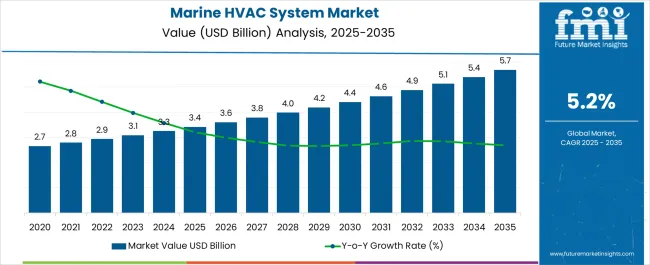
The marine HVAC system market was valued at USD 3.40 billion in 2025, projected to reach USD 3.58 billion in 2026, and is forecast to expand to USD 5.94 billion by 2036 at a 5.2% CAGR. Expanding cruise vessel order books, tightening crew habitability standards under the Maritime Labour Convention, and rising cargo temperature control requirements are sustaining procurement of marine heating, ventilation, air conditioning, and refrigeration systems. FMI is of the opinion that the convergence of energy efficiency mandates under IMO EEXI and growing passenger comfort expectations on cruise and ferry vessels is compelling HVAC system designers to deliver higher cooling and heating capacity per kilowatt of energy consumed.
Summary of Marine HVAC System Market
- Market Overview
- The market is valued at USD 3.40 billion in 2025 and is projected to reach USD 5.94 billion by 2036.
- The industry is expected to grow at a 5.2% CAGR from 2026 to 2036, creating an incremental opportunity of USD 2.36 billion.
- The market is a vessel-construction-driven climate control category where cruise fleet expansion, crew habitability regulations, and cargo temperature management requirements define HVAC system specification and installation volumes.
- Demand and Growth Drivers
- Expanding cruise vessel order books and ferry fleet modernization programs are driving premium marine HVAC procurement with higher capacity and energy efficiency specifications than previous fleet generations.
- Maritime Labour Convention habitability standards mandate minimum ventilation, temperature, and humidity levels for crew quarters, creating compliance-driven retrofit demand across the existing fleet.
- Cargo temperature control requirements for pharmaceutical, chemical, and perishable goods transport are expanding the scope of vessel HVAC systems beyond accommodation spaces into cargo hold climate management.
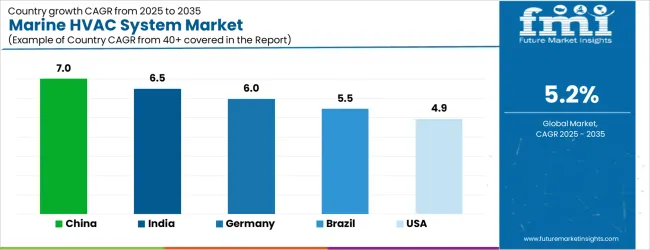
- Among key countries, China leads at 7.0% CAGR, followed by India at 6.5%, Germany at 6.0%, Brazil at 5.5%, the USA at 4.9%, the UK at 4.4%, and Japan at 3.9%.
- Product and Segment View
- The market covers marine heating, ventilation, air conditioning, and refrigeration systems including all water, all air, and hybrid configurations for vessel and offshore platform applications.
- Area of application spans engine rooms, cargo holds, deck spaces, galleys, tender garages, and accommodation zones, each with distinct thermal load and ventilation requirements.
- All Water Systems lead by Type with 40.2% share in 2026, reflecting compact piping distribution and precise zone-level temperature control suited to vessel spatial constraints.
- Passenger Vessels lead by Type of Vessel with 32.2% share in 2026, driven by premium cabin and public area climate control specifications on cruise ships and ferries.
- Scope includes all permanently installed marine HVAC systems and excludes shore-side port HVAC, standalone fish processing refrigeration, and container reefer units.
- Geography and Competitive Outlook
- China and India are the fastest-growing markets driven by newbuilding HVAC installation volumes and ferry fleet expansion programs.
- Germany leads marine HVAC engineering innovation, while the United States sustains demand through cruise fleet refurbishment and retrofit cycles.
- Competition is shaped by energy efficiency ratings, zone control precision, and classification society type approval, with key players including Daikin Industries, Carrier Corporation, Bronswerk Marine, Dometic Group, Johnson Controls, Heinen & Hopman, and Kongsberg Maritime.
- Analyst Opinion at FMI
- Nikhil Kaitwade, Principal Consultant for Industrial Equipment at Future Market Insights, opines: 'In my analysis, the marine HVAC market is being squeezed between rising cooling capacity demands from larger cruise vessels and stricter energy consumption limits under IMO EEXI frameworks. HVAC system designers that cannot demonstrate measurable improvements in cooling output per kilowatt of shipboard energy consumed will lose specification position on new cruise and ferry builds where energy efficiency directly affects vessel CII ratings. The aftermarket retrofit opportunity is concentrated in Maritime Labour Convention compliance upgrades for crew quarters on older cargo vessels where existing ventilation systems fall below updated habitability thresholds.'
- Strategic Implications / Executive Takeaways
- HVAC manufacturers must deliver documented improvements in cooling capacity per kilowatt of energy consumed to maintain specification position on cruise and ferry newbuilds where IMO EEXI and CII frameworks constrain total vessel energy budgets.
- Fleet operators should prioritize Maritime Labour Convention ventilation compliance retrofits for crew quarters on cargo vessels approaching classification survey deadlines to avoid detention risk.
- System designers must develop modular HVAC architectures that allow phased installation during vessel construction to align with shipyard assembly sequences and reduce commissioning timelines.
Marine HVAC System Market Key Takeaways
| Metric | Details |
|---|---|
| Industry Size (2026) | USD 3.58 billion |
| Industry Value (2036) | USD 5.94 billion |
| CAGR (2026-2036) | 5.2% |
Source: Future Market Insights, 2026
All water HVAC systems command the largest technology share because their compact piping distribution and zone-level temperature control capability suit the spatial constraints of vessel interiors. Passenger vessels lead the vessel-type segmentation as cruise ship and ferry operators specify premium climate control systems across cabins, public areas, and crew quarters to meet both comfort and regulatory standards. Engine room ventilation remains the largest single-area application, driven by mandatory heat extraction rates specified in classification society rules to protect machinery and maintain safe working conditions.
China leads with a 7.0% CAGR, driven by cruise ship construction activity and cargo vessel newbuilding volume requiring factory-fitted HVAC installations. India follows at 6.5%, supported by naval vessel climate control specifications and ferry fleet expansion. Germany registers 6.0% growth tied to its marine HVAC engineering expertise through companies like Novenco and Heinen & Hopman. Brazil posts 5.5% as offshore support vessel construction generates HVAC demand. The United States tracks at 4.9% reflecting cruise fleet refurbishment cycles, the United Kingdom at 4.4% with ferry fleet modernization, and Japan at 3.9% sustained by domestic shipbuilding HVAC integration.
Marine HVAC System Market Definition
Marine HVAC systems encompass the heating, ventilation, air conditioning, and refrigeration equipment installed on commercial vessels, naval ships, cruise liners, and offshore platforms to maintain habitable environmental conditions, protect cargo, and ensure machinery cooling compliance. Core technology types include all water systems, all air systems, and air-and-water hybrid systems serving engine rooms, cargo holds, accommodation spaces, and specialized operational areas.
Marine HVAC System Market Inclusions
Market scope covers marine air conditioning, ventilation, heating, and refrigeration systems across all water, all air, and air-and-water configurations. Coverage spans passenger vessels, service vessels, cruise ships, ferries, cargo carriers, tankers, fishing vessels, and offshore platforms. Regional and country-level market sizes for 2026 to 2036 are included.
Marine HVAC System Market Exclusions
The scope excludes shore-side port building HVAC systems, standalone marine refrigeration units for fish processing not integrated into vessel HVAC, and portable air conditioning units not permanently installed. Container reefer units are also excluded unless integrated into vessel-level climate control networks.
Marine HVAC System Market Research Methodology
- Primary Research: Analysts engaged with procurement managers, operations engineers, and industry supply chain directors to identify the decision triggers, specification requirements, and budget allocation patterns governing equipment and technology upgrades.
- Desk Research: Data collection aggregated publicly available regulatory filings, government procurement records, trade association publications, and company annual reports and investor presentations.
- Market-Sizing and Forecasting: Baseline values derive from a bottom-up aggregation of product-level shipment volumes and average selling prices, applying region-specific adoption curves to project demand through the forecast period.
- Data Validation and Update Cycle: Projections are cross-validated against publicly reported company revenue guidance, government statistical agency databases, and trade body shipment records.
Why is the Marine HVAC System Market Growing?
The Marine HVAC System market is experiencing consistent growth, driven by the increasing demand for efficient heating, ventilation, and air conditioning solutions across commercial and passenger vessels. Rising emphasis on energy efficiency, operational reliability, and environmental compliance is encouraging adoption of advanced HVAC systems in marine applications. Modern vessels are being equipped with systems that optimize temperature, humidity, and air quality, ensuring comfort for passengers and crew while meeting regulatory standards for emissions and energy consumption.
Integration of smart controls, automation, and energy recovery technologies is enhancing system performance and reducing operational costs. The expansion of the global cruise and ferry industry, coupled with growing offshore operations, has increased the requirement for robust HVAC solutions capable of operating in challenging maritime environments.
Investments in vessel modernization and retrofitting programs further support market growth As environmental regulations and operational efficiency requirements become more stringent, the Marine HVAC System market is expected to witness sustained expansion, driven by technological innovation, intelligent system integration, and the growing need for reliable marine climate control solutions.
Segmental Analysis
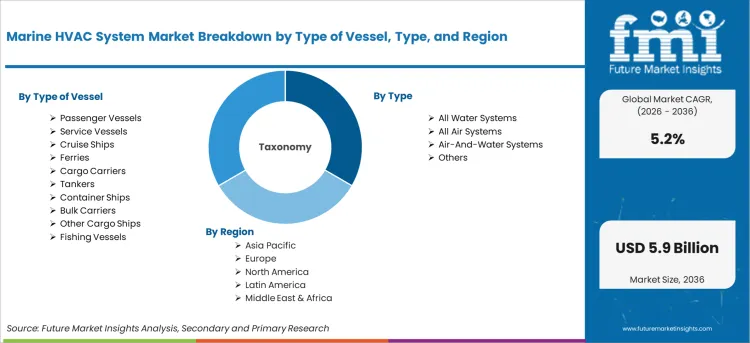
The marine hvac system market is segmented by type of vessel, type, area of application, technology, capacity, distribution, and geographic regions. By type of vessel, marine hvac system market is divided into Passenger Vessels, Service Vessels, Cruise Ships, Ferries, Cargo Carriers, Tankers, Container Ships, Bulk Carriers, Other Cargo Ships, Fishing Vessels, Personal Watercraft & Sailboats, and Others. In terms of type, marine hvac system market is classified into All Water Systems, All Air Systems (High Or Low-Pressure), Air-And-Water Systems, and Others. Based on area of application, marine hvac system market is segmented into Engine Room, Cargo Hold, Deck, Galley, Tender Garage, and Others.
By technology, marine hvac system market is segmented into Marine Air Conditioning, Marine Ventilation Systems, Marine Heating Systems, and Marine Refrigeration Systems. By capacity, marine hvac system market is segmented into 11-100 RT, Less Than 10 RT, and More Than 100 RT. By distribution, marine hvac system market is segmented into Centralized, Decentralized, and Combined. Regionally, the marine hvac system industry is classified into North America, Latin America, Western Europe, Eastern Europe, Balkan & Baltic Countries, Russia & Belarus, Central Asia, East Asia, South Asia & Pacific, and the Middle East & Africa.
Insights into the Passenger Vessels Type of Vessel Segment
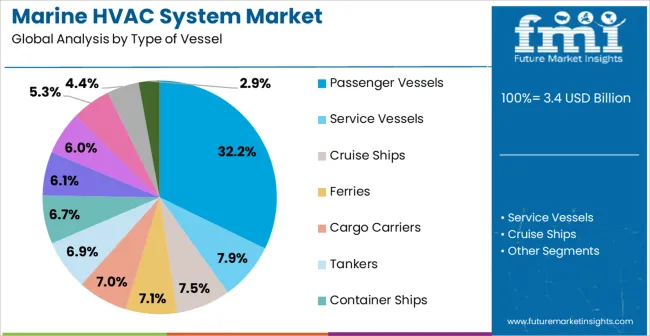
The passenger vessels segment is projected to hold 32.2% of the market revenue in 2026, establishing it as the leading vessel type. Growth is being driven by the increasing number of cruise ships, ferries, and other passenger vessels requiring advanced climate control to ensure passenger comfort and safety. HVAC systems in these vessels must maintain optimal indoor air quality, temperature, and humidity, despite varying external weather conditions and high occupancy loads.
The adoption of energy-efficient and low-maintenance solutions is being prioritized to reduce operational costs and comply with maritime environmental regulations. Integration with smart building management and automation systems allows real-time monitoring and adaptive control, enhancing system performance. Passenger vessels are also incorporating HVAC solutions to address noise reduction, vibration control, and space optimization requirements.
Continuous innovation in marine HVAC design, including compact modular units and corrosion-resistant components, supports the increasing demand for reliable and sustainable climate control systems As the global passenger vessel fleet expands and modernizes, the passenger vessels segment is expected to maintain market leadership.
Insights into the All Water Systems Type Segment
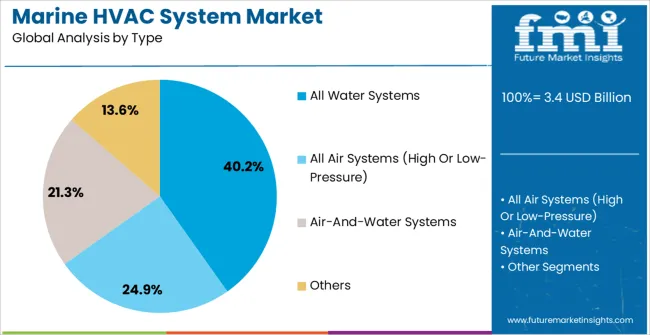
The all water systems segment is anticipated to account for 40.2% of the market revenue in 2026, making it the leading system type. Its growth is being driven by the ability to provide comprehensive heating, cooling, and ventilation functions using water as the primary medium, which enhances energy efficiency and reduces operational complexity. All water HVAC systems enable uniform temperature control, flexibility in zoning, and simplified maintenance, which are critical for marine environments.
Integration with energy recovery units and smart control systems further optimizes performance and minimizes energy consumption. The use of water as a heat transfer medium allows for safer operation in confined spaces, reducing fire hazards and supporting compliance with maritime safety standards.
Growing investments in energy-efficient marine infrastructure and vessel retrofitting programs are further supporting adoption As shipowners and operators prioritize reliable, scalable, and environmentally compliant climate control solutions, all water systems are expected to remain the preferred choice in marine HVAC applications, driving continued market growth.
Insights into the Engine Room Area of Application Segment
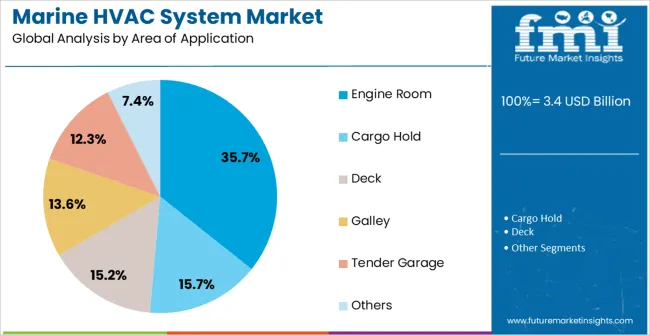
The engine room segment is projected to hold 35.7% of the market revenue in 2026, establishing it as the leading area of application. Growth is being driven by the critical need for effective heat and ventilation management in engine rooms to ensure operational efficiency, safety, and equipment longevity. Engine room HVAC systems maintain optimal temperature and humidity conditions, preventing overheating, corrosion, and equipment failure.
Integration with intelligent monitoring systems enables real-time performance tracking, fault detection, and adaptive control, which enhances safety and operational reliability. Energy-efficient designs reduce fuel consumption and contribute to overall vessel sustainability. As maritime operators increasingly adopt advanced propulsion systems and auxiliary equipment, the requirement for robust climate control solutions in engine rooms is intensifying.
Regulatory compliance with marine safety and emission standards further reinforces demand With the expansion of commercial and passenger fleets, coupled with technological innovations in HVAC components and control systems, the engine room segment is expected to sustain its leading position as a critical application area in the Marine HVAC System market.
Market Overview
Marine HVAC System Market: Introduction
As the climatic condition at oversea is relatively humid and warm so marine HVAC system is of great importance to control the on-board temperatures and humidity in any marine vessel, such as cruise ship, cargo ships, warship or offshore marine facility and platforms.
Moreover, as the humid surrounding degrades the efficiency of the people on board and also corrode the cargo, machinery, and equipment of the ship increasing the maintenance cost, to avoid this HVAC system become a necessity for the marine industry these days. HVAC system contributes a lot towards the maintenance of the fresh, clean air of desired temperature and humidity for the crew, passengers as well as machinery.
Marine HVAC systems are different from most of the land HVAC systems, as the marine HVAC systems are generally water cooled and not air cooled. It may be due to the fact that, on a ship, there is limited availability of space and abundance of water.
Moreover, in luxury ships such as cruise, the expectation of passenger is to have an experience of a lifetime. Which include high expectation towards the luxury and comfort and the indoor climate is part of the overall impression. In short, an effective HVAC system is a key contributor to the comfortable journey as well as successful vessel operation.
Analysis of Marine HVAC System Market By Key Countries
.webp "Top Country Growth Comparison Marine Hvac System Market Cagr (2026 2036)")
| Country | CAGR |
|---|---|
| China | 7.0% |
| India | 6.5% |
| Germany | 6.0% |
| Brazil | 5.5% |
| USA | 4.9% |
| UK | 4.4% |
| Japan | 3.9% |
Source: FMI analysis based on primary research and proprietary forecasting model
Country-wise Analysis
The Marine HVAC System Market is expected to register a CAGR of 5.2% during the forecast period, exhibiting varied country level momentum. China leads with the highest CAGR of 7.0%, followed by India at 6.5%. Developed markets such as Germany, France, and the UK continue to expand steadily, while the USA is likely to grow at consistent rates. Japan posts the lowest CAGR at 3.9%, yet still underscores a broadly positive trajectory for the global Marine HVAC System Market. In 2024, Germany held a dominant revenue in the Western Europe market and is expected to grow with a CAGR of 6.0%. The USA Marine HVAC System Market is estimated to be valued at USD 1.2 billion in 2026 and is anticipated to reach a valuation of USD 1.2 billion by 2036. Sales are projected to rise at a CAGR of 0.0% over the forecast period between 2026 and 2036. While Japan and South Korea markets are estimated to be valued at USD 186.3 million and USD 97.8 million respectively in 2026.
Key Players in the Marine HVAC System Market
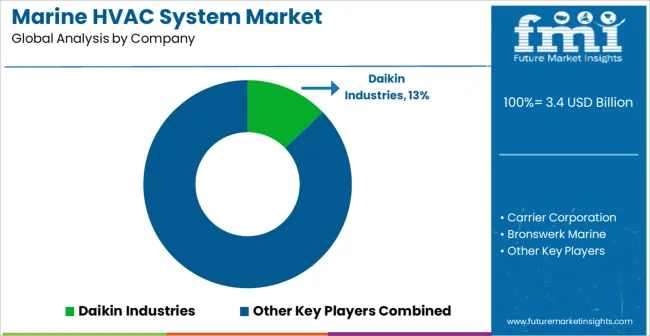
- Daikin Industries
- Carrier Corporation
- Bronswerk Marine
- Dometic Group
- Johnson Controls
- Frigomar
- Horn Media Group
- GEA Farm Technologies
- AF Group
- NADI Airtechnics
- Kongsberg Maritime
- TMD Marine
- Webasto
- Novenco
- Marcotex
- Ma Inc
- Heinen & Hopman
Scope of the Report
| Metric | Value |
|---|---|
| Quantitative Units | USD 3.58 billion to USD 5.94 billion, at a CAGR of 5.2% |
| Market Definition | Marine HVAC systems encompass the heating, ventilation, air conditioning, and refrigeration equipment installed on commercial vessels, naval ships, cruise liners, and offshore platforms to maintain ha... |
| Segmentation | Type of Vessel: Passenger Vessels, Service Vessels, Cruise Ships, Ferries, Cargo Carriers, Tankers, Container Ships, Fishing Vessels, Others; Type: All Water Systems, All Air Systems, Air-And-Water Systems, Others; Area of Application: Engine Room, Cargo Hold, Deck, Galley, Tender Garage, Others; Technology: Marine Air Conditioning, Marine Ventilation Systems, Marine Heating Systems, Marine Refrigeration Systems |
| Regions Covered | North America, Latin America, Europe, East Asia, South Asia, Oceania, Middle East & Africa |
| Countries Covered | China, India, Germany, Brazil, USA, UK, Japan, and 40 plus countries |
| Key Companies Profiled | Daikin Industries, Carrier Corporation, Bronswerk Marine, Dometic Group, Johnson Controls, Frigomar, Kongsberg Maritime, Heinen & Hopman, Webasto, Novenco |
| Forecast Period | 2026 to 2036 |
| Approach | Forecasting models apply a bottom-up methodology starting with global installed base metrics and product-level demand curves, cross-validated against publicly reported revenue and trade data. |
Marine HVAC System Market by Segments
Type of Vessel:
- Passenger Vessels
- Service Vessels
- Cruise Ships
- Ferries
- Cargo Carriers
- Tankers
- Container Ships
- Bulk Carriers
- Other Cargo Ships
- Fishing Vessels
- Personal Watercraft & Sailboats
- Others
Type:
- All Water Systems
- All Air Systems (High Or Low-Pressure)
- Air-And-Water Systems
- Others
Area of Application:
- Engine Room
- Cargo Hold
- Deck
- Galley
- Tender Garage
- Others
Technology:
- Marine Air Conditioning
- Marine Ventilation Systems
- Marine Heating Systems
- Marine Refrigeration Systems
Capacity:
- 11-100 RT
- Less Than 10 RT
- More Than 100 RT
Region:
- North America
- USA
- Canada
- Mexico
- Latin America
- Brazil
- Chile
- Rest of Latin America
- Western Europe
- Germany
- UK
- Italy
- Spain
- France
- Nordic
- BENELUX
- Rest of Western Europe
- Eastern Europe
- Russia
- Poland
- Hungary
- Balkan & Baltic
- Rest of Eastern Europe
- East Asia
- China
- Japan
- South Korea
- South Asia and Pacific
- India
- ASEAN
- Australia & New Zealand
- Rest of South Asia and Pacific
- Middle East & Africa
- Kingdom of Saudi Arabia
- Other GCC Countries
- Turkiye
- South Africa
- Other African Union
- Rest of Middle East & Africa
Bibliography
- International Maritime Organization. (2024). Maritime Labour Convention: Accommodation, Ventilation, and Habitability Standards. IMO.
- International Association of Classification Societies. (2024). Unified Requirements for HVAC and Ventilation on Ships. IACS.
- Cruise Lines International Association. (2024). Global Cruise Fleet Expansion and Newbuild Report. CLIA.
- European Maritime Safety Agency. (2024). Crew Living and Working Conditions Compliance Report. EMSA.
- American Society of Heating, Refrigerating and Air-Conditioning Engineers. (2024). ASHRAE Handbook: HVAC Applications for Marine Environments. ASHRAE.
- Organisation for Economic Co-operation and Development. (2024). Shipbuilding and Marine Equipment Technology Outlook. OECD.
This bibliography is provided for reader reference. The full Future Market Insights report contains the complete reference list with primary research documentation.
Frequently Asked Questions
How large is the demand for Marine HVAC System in the global market in 2026?
Demand for marine HVAC systems in the global market is estimated to be valued at USD 3.58 billion in 2026.
What will be the market size by 2036?
Market size for marine HVAC systems is projected to reach USD 5.94 billion by 2036.
What is the expected demand growth between 2026 and 2036?
Demand is expected to grow at a CAGR of 5.2% between 2026 and 2036.
Which Type is poised to lead by 2026?
All Water Systems account for 40.2% share in 2026, reflecting compact piping distribution and precise zone-level temperature control capability suited to vessel interiors.
How significant are Passenger Vessels in driving demand?
Passenger Vessels hold 32.2% share in 2026 as cruise ship and ferry operators specify premium cabin and public area climate control systems.
What is driving demand in China?
Cruise ship construction activity and cargo vessel newbuilding volume requiring factory-fitted HVAC installations sustain procurement growth.
What is India's growth outlook in this report?
India is projected to grow at a CAGR of 6.5% during 2026 to 2036.
Preview the report firsthand - request a free sample
Get SampleGet the brochure for pricing and purchase details.
Get PDFTable of Content
- Executive Summary
- Global Market Outlook
- Demand-side Trends
- Supply-side Trends
- Technology Roadmap Analysis
- Analysis and Recommendations
- Market Overview
- Market Coverage / Taxonomy
- Market Definition / Scope / Limitations
- Research Methodology
- Chapter Orientation
- Analytical Lens and Working Hypotheses
- Market Structure, Signals, and Trend Drivers
- Benchmarking and Cross-market Comparability
- Market Sizing, Forecasting, and Opportunity Mapping
- Research Design and Evidence Framework
- Desk Research Programme (Secondary Evidence)
- Company Annual and Sustainability Reports
- Peer-reviewed Journals and Academic Literature
- Corporate Websites, Product Literature, and Technical Notes
- Earnings Decks and Investor Briefings
- Statutory Filings and Regulatory Disclosures
- Technical White Papers and Standards Notes
- Trade Journals, Industry Magazines, and Analyst Briefs
- Conference Proceedings, Webinars, and Seminar Materials
- Government Statistics Portals and Public Data Releases
- Press Releases and Reputable Media Coverage
- Specialist Newsletters and Curated Briefings
- Sector Databases and Reference Repositories
- FMI Internal Proprietary Databases and Historical Market Datasets
- Subscription Datasets and Paid Sources
- Social Channels, Communities, and Digital Listening Inputs
- Additional Desk Sources
- Expert Input and Fieldwork (Primary Evidence)
- Primary Modes
- Qualitative Interviews and Expert Elicitation
- Quantitative Surveys and Structured Data Capture
- Blended Approach
- Why Primary Evidence is Used
- Field Techniques
- Interviews
- Surveys
- Focus Groups
- Observational and In-context Research
- Social and Community Interactions
- Stakeholder Universe Engaged
- C-suite Leaders
- Board Members
- Presidents and Vice Presidents
- R&D and Innovation Heads
- Technical Specialists
- Domain Subject-matter Experts
- Scientists
- Physicians and Other Healthcare Professionals
- Governance, Ethics, and Data Stewardship
- Research Ethics
- Data Integrity and Handling
- Primary Modes
- Tooling, Models, and Reference Databases
- Desk Research Programme (Secondary Evidence)
- Data Engineering and Model Build
- Data Acquisition and Ingestion
- Cleaning, Normalisation, and Verification
- Synthesis, Triangulation, and Analysis
- Quality Assurance and Audit Trail
- Market Background
- Market Dynamics
- Drivers
- Restraints
- Opportunity
- Trends
- Scenario Forecast
- Demand in Optimistic Scenario
- Demand in Likely Scenario
- Demand in Conservative Scenario
- Opportunity Map Analysis
- Product Life Cycle Analysis
- Supply Chain Analysis
- Investment Feasibility Matrix
- Value Chain Analysis
- PESTLE and Porter’s Analysis
- Regulatory Landscape
- Regional Parent Market Outlook
- Production and Consumption Statistics
- Import and Export Statistics
- Market Dynamics
- Global Market Analysis 2021 to 2025 and Forecast, 2026 to 2036
- Historical Market Size Value (USD Million) Analysis, 2021 to 2025
- Current and Future Market Size Value (USD Million) Projections, 2026 to 2036
- Y-o-Y Growth Trend Analysis
- Absolute $ Opportunity Analysis
- Global Market Pricing Analysis 2021 to 2025 and Forecast 2026 to 2036
- Global Market Analysis 2021 to 2025 and Forecast 2026 to 2036, By Type of Vessel:
- Introduction / Key Findings
- Historical Market Size Value (USD Million) Analysis By Type of Vessel: , 2021 to 2025
- Current and Future Market Size Value (USD Million) Analysis and Forecast By Type of Vessel: , 2026 to 2036
- Passenger Vessels
- Service Vessels
- Cruise Ships
- Ferries
- Cargo Carriers
- Tankers
- Container Ships
- Bulk Carriers
- Other Cargo Ships
- Fishing Vessels
- Personal Watercraft & Sailboats
- Passenger Vessels
- Y-o-Y Growth Trend Analysis By Type of Vessel: , 2021 to 2025
- Absolute $ Opportunity Analysis By Type of Vessel: , 2026 to 2036
- Global Market Analysis 2021 to 2025 and Forecast 2026 to 2036, By Type
- Introduction / Key Findings
- Historical Market Size Value (USD Million) Analysis By Type, 2021 to 2025
- Current and Future Market Size Value (USD Million) Analysis and Forecast By Type, 2026 to 2036
- All Water Systems
- All Air Systems
- Air-And-Water Systems
- Others
- All Water Systems
- Y-o-Y Growth Trend Analysis By Type, 2021 to 2025
- Absolute $ Opportunity Analysis By Type, 2026 to 2036
- Global Market Analysis 2021 to 2025 and Forecast 2026 to 2036, By Area of Application
- Introduction / Key Findings
- Historical Market Size Value (USD Million) Analysis By Area of Application, 2021 to 2025
- Current and Future Market Size Value (USD Million) Analysis and Forecast By Area of Application, 2026 to 2036
- Engine Room
- Cargo Hold
- Deck
- Galley
- Tender Garage
- Others
- Engine Room
- Y-o-Y Growth Trend Analysis By Area of Application, 2021 to 2025
- Absolute $ Opportunity Analysis By Area of Application, 2026 to 2036
- Global Market Analysis 2021 to 2025 and Forecast 2026 to 2036, By Technology
- Introduction / Key Findings
- Historical Market Size Value (USD Million) Analysis By Technology, 2021 to 2025
- Current and Future Market Size Value (USD Million) Analysis and Forecast By Technology, 2026 to 2036
- Marine Air Conditioning
- Marine Ventilation Systems
- Marine Heating Systems
- Marine Refrigeration Systems
- Marine Air Conditioning
- Y-o-Y Growth Trend Analysis By Technology, 2021 to 2025
- Absolute $ Opportunity Analysis By Technology, 2026 to 2036
- Global Market Analysis 2021 to 2025 and Forecast 2026 to 2036, By Capacity
- Introduction / Key Findings
- Historical Market Size Value (USD Million) Analysis By Capacity, 2021 to 2025
- Current and Future Market Size Value (USD Million) Analysis and Forecast By Capacity, 2026 to 2036
- 11-100 RT
- Less Than 10 RT
- More Than 100 RT
- 11-100 RT
- Y-o-Y Growth Trend Analysis By Capacity, 2021 to 2025
- Absolute $ Opportunity Analysis By Capacity, 2026 to 2036
- Global Market Analysis 2021 to 2025 and Forecast 2026 to 2036, By Region
- Introduction
- Historical Market Size Value (USD Million) Analysis By Region, 2021 to 2025
- Current Market Size Value (USD Million) Analysis and Forecast By Region, 2026 to 2036
- North America
- Latin America
- Western Europe
- Eastern Europe
- East Asia
- South Asia and Pacific
- Middle East & Africa
- Market Attractiveness Analysis By Region
- North America Market Analysis 2021 to 2025 and Forecast 2026 to 2036, By Country
- Historical Market Size Value (USD Million) Trend Analysis By Market Taxonomy, 2021 to 2025
- Market Size Value (USD Million) Forecast By Market Taxonomy, 2026 to 2036
- By Country
- USA
- Canada
- Mexico
- By Type of Vessel:
- By Type
- By Area of Application
- By Technology
- By Capacity
- By Country
- Market Attractiveness Analysis
- By Country
- By Type of Vessel:
- By Type
- By Area of Application
- By Technology
- By Capacity
- Key Takeaways
- Latin America Market Analysis 2021 to 2025 and Forecast 2026 to 2036, By Country
- Historical Market Size Value (USD Million) Trend Analysis By Market Taxonomy, 2021 to 2025
- Market Size Value (USD Million) Forecast By Market Taxonomy, 2026 to 2036
- By Country
- Brazil
- Chile
- Rest of Latin America
- By Type of Vessel:
- By Type
- By Area of Application
- By Technology
- By Capacity
- By Country
- Market Attractiveness Analysis
- By Country
- By Type of Vessel:
- By Type
- By Area of Application
- By Technology
- By Capacity
- Key Takeaways
- Western Europe Market Analysis 2021 to 2025 and Forecast 2026 to 2036, By Country
- Historical Market Size Value (USD Million) Trend Analysis By Market Taxonomy, 2021 to 2025
- Market Size Value (USD Million) Forecast By Market Taxonomy, 2026 to 2036
- By Country
- Germany
- UK
- Italy
- Spain
- France
- Nordic
- BENELUX
- Rest of Western Europe
- By Type of Vessel:
- By Type
- By Area of Application
- By Technology
- By Capacity
- By Country
- Market Attractiveness Analysis
- By Country
- By Type of Vessel:
- By Type
- By Area of Application
- By Technology
- By Capacity
- Key Takeaways
- Eastern Europe Market Analysis 2021 to 2025 and Forecast 2026 to 2036, By Country
- Historical Market Size Value (USD Million) Trend Analysis By Market Taxonomy, 2021 to 2025
- Market Size Value (USD Million) Forecast By Market Taxonomy, 2026 to 2036
- By Country
- Russia
- Poland
- Hungary
- Balkan & Baltic
- Rest of Eastern Europe
- By Type of Vessel:
- By Type
- By Area of Application
- By Technology
- By Capacity
- By Country
- Market Attractiveness Analysis
- By Country
- By Type of Vessel:
- By Type
- By Area of Application
- By Technology
- By Capacity
- Key Takeaways
- East Asia Market Analysis 2021 to 2025 and Forecast 2026 to 2036, By Country
- Historical Market Size Value (USD Million) Trend Analysis By Market Taxonomy, 2021 to 2025
- Market Size Value (USD Million) Forecast By Market Taxonomy, 2026 to 2036
- By Country
- China
- Japan
- South Korea
- By Type of Vessel:
- By Type
- By Area of Application
- By Technology
- By Capacity
- By Country
- Market Attractiveness Analysis
- By Country
- By Type of Vessel:
- By Type
- By Area of Application
- By Technology
- By Capacity
- Key Takeaways
- South Asia and Pacific Market Analysis 2021 to 2025 and Forecast 2026 to 2036, By Country
- Historical Market Size Value (USD Million) Trend Analysis By Market Taxonomy, 2021 to 2025
- Market Size Value (USD Million) Forecast By Market Taxonomy, 2026 to 2036
- By Country
- India
- ASEAN
- Australia & New Zealand
- Rest of South Asia and Pacific
- By Type of Vessel:
- By Type
- By Area of Application
- By Technology
- By Capacity
- By Country
- Market Attractiveness Analysis
- By Country
- By Type of Vessel:
- By Type
- By Area of Application
- By Technology
- By Capacity
- Key Takeaways
- Middle East & Africa Market Analysis 2021 to 2025 and Forecast 2026 to 2036, By Country
- Historical Market Size Value (USD Million) Trend Analysis By Market Taxonomy, 2021 to 2025
- Market Size Value (USD Million) Forecast By Market Taxonomy, 2026 to 2036
- By Country
- Kingdom of Saudi Arabia
- Other GCC Countries
- Turkiye
- South Africa
- Other African Union
- Rest of Middle East & Africa
- By Type of Vessel:
- By Type
- By Area of Application
- By Technology
- By Capacity
- By Country
- Market Attractiveness Analysis
- By Country
- By Type of Vessel:
- By Type
- By Area of Application
- By Technology
- By Capacity
- Key Takeaways
- Key Countries Market Analysis
- USA
- Pricing Analysis
- Market Share Analysis, 2025
- By Type of Vessel:
- By Type
- By Area of Application
- By Technology
- By Capacity
- Canada
- Pricing Analysis
- Market Share Analysis, 2025
- By Type of Vessel:
- By Type
- By Area of Application
- By Technology
- By Capacity
- Mexico
- Pricing Analysis
- Market Share Analysis, 2025
- By Type of Vessel:
- By Type
- By Area of Application
- By Technology
- By Capacity
- Brazil
- Pricing Analysis
- Market Share Analysis, 2025
- By Type of Vessel:
- By Type
- By Area of Application
- By Technology
- By Capacity
- Chile
- Pricing Analysis
- Market Share Analysis, 2025
- By Type of Vessel:
- By Type
- By Area of Application
- By Technology
- By Capacity
- Germany
- Pricing Analysis
- Market Share Analysis, 2025
- By Type of Vessel:
- By Type
- By Area of Application
- By Technology
- By Capacity
- UK
- Pricing Analysis
- Market Share Analysis, 2025
- By Type of Vessel:
- By Type
- By Area of Application
- By Technology
- By Capacity
- Italy
- Pricing Analysis
- Market Share Analysis, 2025
- By Type of Vessel:
- By Type
- By Area of Application
- By Technology
- By Capacity
- Spain
- Pricing Analysis
- Market Share Analysis, 2025
- By Type of Vessel:
- By Type
- By Area of Application
- By Technology
- By Capacity
- France
- Pricing Analysis
- Market Share Analysis, 2025
- By Type of Vessel:
- By Type
- By Area of Application
- By Technology
- By Capacity
- India
- Pricing Analysis
- Market Share Analysis, 2025
- By Type of Vessel:
- By Type
- By Area of Application
- By Technology
- By Capacity
- ASEAN
- Pricing Analysis
- Market Share Analysis, 2025
- By Type of Vessel:
- By Type
- By Area of Application
- By Technology
- By Capacity
- Australia & New Zealand
- Pricing Analysis
- Market Share Analysis, 2025
- By Type of Vessel:
- By Type
- By Area of Application
- By Technology
- By Capacity
- China
- Pricing Analysis
- Market Share Analysis, 2025
- By Type of Vessel:
- By Type
- By Area of Application
- By Technology
- By Capacity
- Japan
- Pricing Analysis
- Market Share Analysis, 2025
- By Type of Vessel:
- By Type
- By Area of Application
- By Technology
- By Capacity
- South Korea
- Pricing Analysis
- Market Share Analysis, 2025
- By Type of Vessel:
- By Type
- By Area of Application
- By Technology
- By Capacity
- Russia
- Pricing Analysis
- Market Share Analysis, 2025
- By Type of Vessel:
- By Type
- By Area of Application
- By Technology
- By Capacity
- Poland
- Pricing Analysis
- Market Share Analysis, 2025
- By Type of Vessel:
- By Type
- By Area of Application
- By Technology
- By Capacity
- Hungary
- Pricing Analysis
- Market Share Analysis, 2025
- By Type of Vessel:
- By Type
- By Area of Application
- By Technology
- By Capacity
- Kingdom of Saudi Arabia
- Pricing Analysis
- Market Share Analysis, 2025
- By Type of Vessel:
- By Type
- By Area of Application
- By Technology
- By Capacity
- Turkiye
- Pricing Analysis
- Market Share Analysis, 2025
- By Type of Vessel:
- By Type
- By Area of Application
- By Technology
- By Capacity
- South Africa
- Pricing Analysis
- Market Share Analysis, 2025
- By Type of Vessel:
- By Type
- By Area of Application
- By Technology
- By Capacity
- USA
- Market Structure Analysis
- Competition Dashboard
- Competition Benchmarking
- Market Share Analysis of Top Players
- By Regional
- By Type of Vessel:
- By Type
- By Area of Application
- By Technology
- By Capacity
- Competition Analysis
- Competition Deep Dive
- Daikin Industries
- Overview
- Product Portfolio
- Profitability by Market Segments (Product/Age /Sales Channel/Region)
- Sales Footprint
- Strategy Overview
- Marketing Strategy
- Product Strategy
- Channel Strategy
- Carrier Corporation
- Bronswerk Marine
- Dometic Group
- Johnson Controls
- Frigomar
- Horn Media Group
- GEA Farm Technologies
- AF Group
- NADI Airtechnics
- Kongsberg Maritime
- TMD Marine
- Webasto
- Novenco
- Marcotex
- Ma Inc
- Heinen & Hopman
- Daikin Industries
- Competition Deep Dive
- Assumptions & Acronyms Used


