

- Market Size (2026)
- USD 6.8 Bn
- Forecast (2036)
- USD 12.0 Bn
- CAGR (2026 to 2036)
- 5.7%
How big is Defense HVAC Systems Market in 2026?
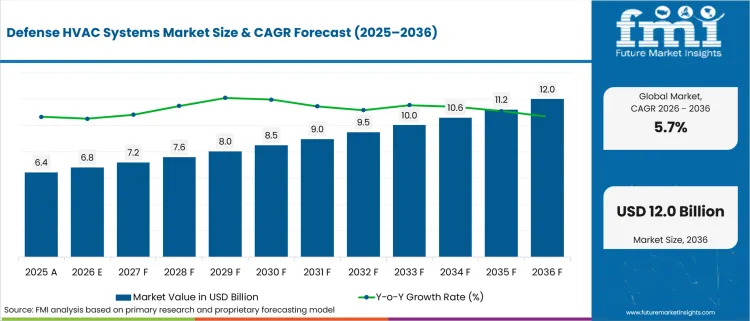
USD 6.8 billion in 2026 and USD 12.0 billion by 2036 at a 5.7% CAGR.
Demand for Defense HVAC Systems Market is projected to expand at 5.7% CAGR between 2026 and 2036. FMI estimates that Defense HVAC Systems Market revenue will rise from USD 6.8 billion in 2026 to USD 12.0 billion by 2036, with a reported CAGR of 5.7%. The value pool includes air conditioning, heating, ventilation and environmental control units and filtration and integrated platform systems and portable or deployable equipment sold for defense use. Published values and growth rates are rounded.
Demand advances when new sensors, power electronics, computing racks and crew protection requirements consume the remaining thermal margin of a platform. Aircraft programs require compact environmental control and cooling assemblies, linking the category with the Aircraft Air Conditioning Units Market and the Aircraft Cooling Turbines Market. Land and naval buyers place more weight on dust loading, salt corrosion, pressure control and redundancy and depot-level service. Country procurement cycles determine when these technical needs convert into orders.
Key Takeaways of Defense HVAC Systems Market
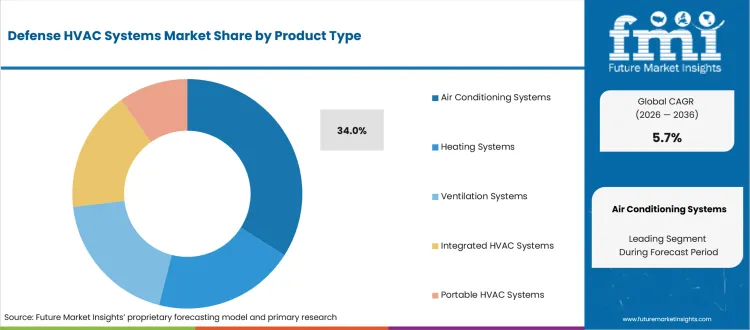
- Air Conditioning Systems lead Product Type with a 34.0% share in 2026, reflecting their direct role in crew protection and electronics heat rejection.
- Military Ground Vehicles hold 32.0% of Application demand because armored and tactical platforms combine high internal heat loads with tight size, weight, and power limits.
- Defense Forces account for 38.0% of End User demand, while Direct Sales lead Distribution Channel at 43.0%.
- Land-Based Defense Platforms represent 37.0% of Platform Type demand, supported by armored vehicles and mobile command units.
- Qualification risk centers on environmental testing, electromagnetic compatibility, acoustic limits and CBRN pressure drop and refrigerant transition and long-term spare-part support.
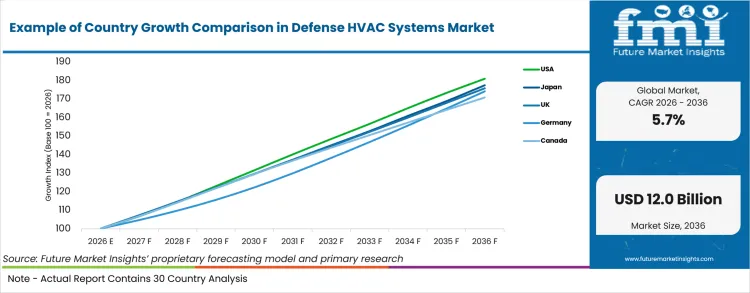
- USA records the highest profiled country CAGR at 6.1%, followed by Japan at 5.9% and the UK at 5.8%.
- RTX Corporation, Honeywell International Inc., Liebherr Group and AMETEK Inc. and Leonardo DRS compete through platform-qualified air and thermal and marine HVAC capabilities.
Analyst Perspective
"Defense HVAC is purchased as a mission subsystem. The buyer is balancing heat rejection against vehicle power, aircraft weight, shipboard space and acoustic limits and filtration pressure drop and maintainability. Suppliers gain an advantage when they prove cooling capacity at worst-case ambient conditions, integrate controls with platform power management, and support the same configuration through depot repair and spare parts. The next value pool sits in systems that cool crews and mission electronics without expanding the logistics burden."
- Nikhil Kaitwade, Principal Consultant, Future Market Insights
How is the Defense HVAC Systems Market segmented?
The Defense HVAC Systems Market is segmented by Product Type, Application, End User, Distribution Channel, Platform Type and Region.
The market is segmented by product type into air conditioning systems, environmental control units (ECUs), precision air conditioning systems, heating systems, electric heating systems, fuel-based heating systems, ventilation systems, filtration and air handling units, CBRN ventilation systems, integrated HVAC systems, modular HVAC systems, packaged HVAC systems, portable HVAC systems, mobile cooling units, and deployable shelter HVAC systems.
By application, it covers military ground vehicles, armored fighting vehicles, tactical trucks, naval defense platforms, destroyers and frigates, submarines, military aircraft, fighter aircraft, military transport aircraft, military bases and facilities, command centers, barracks and training facilities, deployable military shelters, field hospitals, and temporary command posts.
Based on end user, the market includes defense forces, the army, the air force, defense OEMs, vehicle manufacturers, aerospace manufacturers, naval shipbuilders, surface ship builders, submarine builders, government defense agencies, defense infrastructure authorities, defense procurement agencies, maintenance, repair and overhaul providers, military equipment MRO providers, and aerospace MRO providers.
By distribution channel, it is divided into direct sales, defense contracts, OEM supply agreements, authorized defense distributors, regional defense distributors, global defense suppliers, system integrators, defense system integrators, platform integration providers, government procurement, public defense tenders, framework agreements, aftermarket suppliers, spare parts suppliers, and MRO service providers.
By platform type, the market covers land-based defense platforms, armored vehicles, mobile command units, naval platforms, surface combatants, submarines, airborne platforms, fixed-wing aircraft, rotary-wing aircraft, military infrastructure, defense installations, command centers, portable and expeditionary systems, field shelters, and mobile medical units.
Why do air conditioning systems lead the product type category?
Air Conditioning Systems hold a 34.0% share in 2026.
- Environmental Control Units (ECUs) suit tactical vehicles and deployable shelters that need a rugged, self-contained source of cooling. Precision Air Conditioning Systems fit command centers and electronics spaces where temperature stability matters more than broad comfort cooling. Heating Systems remain essential for cold-weather readiness. Electric Heating Systems work where vehicle or facility power is dependable, while Fuel-Based Heating Systems retain a role in remote camps that must operate independently of the electrical bus. Ventilation Systems remove heat and contaminants with lower energy use when ambient conditions permit. Filtration & Air Handling Units support larger facilities and shipboard distribution, while CBRN Ventilation Systems add sealed-zone pressurization and filtered air for collective protection.
- Integrated HVAC Systems combine cooling, heating, ventilation and filtration and control into a platform-level architecture. Modular HVAC Systems shorten replacement time and permit capacity changes. Packaged HVAC Systems fit bases, workshops, and transportable structures that need factory-assembled equipment. Portable HVAC Systems and Mobile Cooling Units cover maintenance lines, temporary operating zones, or damaged fixed capacity. Deployable Shelter HVAC Systems are sized around tent or container loads, generator capacity, setup time and transport volume. This requirement intersects with the CBRN Protection Equipment Market when filtered air, positive pressure, and contamination control become part of the same system specification.
Why do military ground vehicles lead the application category?
Military Ground Vehicles account for a 32.0% share in 2026.
Armored cabins trap crew heat and electronics heat inside a small protected volume, while external air can carry dust or chemical hazards. The HVAC package competes with weapons, sensors, batteries and communications for power and space. Armored Fighting Vehicles therefore require rugged cooling under shock and vibration. Tactical Trucks place more weight on modularity, fleet commonality, service access and lower acquisition cost.
Why do defense forces lead the end user category?
Defense Forces hold a 38.0% share in 2026
Defense OEMs purchase HVAC as part of a new platform or major upgrade. Vehicle Manufacturers focus on packaging, vibration, dust and electrical integration. Aerospace Manufacturers focus on weight, altitude performance, airworthiness and power management. Naval Shipbuilders coordinate chilled water, air handling, controls and noise and compartment layout. Surface Ship Builders require redundancy and corrosion protection. Submarine Builders add atmosphere control, low acoustic signature, and long maintenance intervals.
Why do direct sales lead the distribution channel category?
Direct Sales represent a 43.0% share in 2026.
Authorized Defense Distributors supply approved parts where the original manufacturer needs local coverage. Regional Defense Distributors shorten lead times and handle smaller fleets. Global Defense Suppliers coordinate multinational programs and common parts. System Integrators combine HVAC with power, controls, filtration or shelter systems. Defense System Integrators manage mission-level interfaces, while Platform Integration Providers resolve mechanical, electrical and software and ducting constraints during installation.
Why do land-based defense platforms lead the platform type category?
Land-Based Defense Platforms account for a 37.0% share in 2026.
Naval Platforms use larger distributed HVAC networks. Surface Combatants need redundant chillers, air handling, filtration and zone control. Submarines require low-noise machinery and close integration with atmosphere management. Airborne Platforms place a premium on low weight and high reliability. Fixed-Wing Aircraft must manage altitude and pressurization effects, while Rotary-Wing Aircraft face vibration, limited installation volume and changing hover or forward-flight loads. Electrified land platforms increase auxiliary electrical demand and thermal density, connecting the market with the Military Vehicle Electrification Market.
What are the drivers, restraints and opportunities in the Defense HVAC Systems Market?
- Driver: Higher electronics density and more demanding crew-protection requirements increase the heat load that platform-qualified HVAC systems must remove.
- Restraint: Size, weight, power and noise and shock and electromagnetic compatibility and CBRN pressure drop and long qualification cycles can delay replacement or redesign.
- Opportunity: Electrified ECUs, lower-global-warming refrigerants, variable-speed controls and hybrid liquid-air cooling and modular replacement and condition-based maintenance can reduce fuel and support burden.
More processing power raises sensible heat, while sealed cabins and collective protection reduce the ability to use untreated outside air. HVAC then becomes part of the platform power budget and survivability plan. MIL-STD-810 environmental tailoring, MIL-STD-461 electromagnetic requirements, and service-specific design criteria make evidence from representative operating conditions more valuable than a nominal catalog rating.
A larger compressor may exceed the electrical allocation. A higher airflow rate can add noise or disrupt pressure balance. A new refrigerant can alter component availability and service procedures. Broader USA and European refrigerant transitions influence the supply chain even where defense exemptions, legacy fleets, or program-specific rules apply. Each change can require new testing, documentation, training and spare-part provisioning.
Variable-speed compressors and fans can match load instead of running at one fixed point. Integrated controls can coordinate HVAC with power management. Liquid cooling can capture heat close to dense electronics, while air systems manage occupied zones. Modular ECUs can be replaced without redesigning the shelter or vehicle. These gains are most valuable where the Smart Vents & Airflow Control Systems Market supplies sensing and zone-level airflow logic that can be adapted to defense-grade qualification and cybersecurity requirements.
How do country-level CAGRs compare in the Defense HVAC Systems Market?
| Country | CAGR |
|---|---|
| USA | 6.1% |
| Japan | 5.9% |
| UK | 5.8% |
| Germany | 5.7% |
| Canada | 5.5% |
| Australia | 5.4% |
| South Korea | 5.3% |
The profiled country rates occupy a narrow band from 5.3% to 6.1%, which points to a qualification-led market rather than a short replacement cycle. USA and Japan sit at the upper end as aircraft, naval, and base-modernization programs pull through new systems and sustainment. The UK and Germany follow through readiness, procurement reform, and infrastructure work. Canada, Australia, and South Korea remain close behind. Demand shaped by climate extremes and local integration and fleet support.
How does the Defense HVAC Systems Market vary by country?
- USA: Aircraft and naval modernization raise the need for integrated power and thermal management, while the large installed base supports depot repair, spares and retrofit programs. Buyers expect traceable qualification and long configuration support.
- Japan: F-35 deployment, frigate construction, island-base resilience and humid maritime exposure support compact systems with corrosion control and reliable filtration and predictable lifecycle service.
- UK: The Strategic Defence Review places emphasis on warfighting readiness and faster acquisition. HVAC suppliers gain relevance when they can support naval, air, land and estate requirements with documented availability and maintenance evidence.
- Germany: Accelerated defense procurement and infrastructure investment support land-platform and installation demand. The European refrigerant transition also affects component selection, technician capability, and service planning.
- Canada: Arctic operations make heating capacity, condensation control, cold-start reliability and remote maintainability central. Northern hubs, tactical aircraft, armored platforms and future undersea capability widen the addressable system mix.
- Australia: Hot, humid northern conditions and salt exposure raise cooling and corrosion requirements. Naval expansion, littoral operations, and defense-estate investment increase the value of local sustainment and stocked spares.
- South Korea: Domestic ship, aircraft, and ground-platform programs favor close integration with local manufacturing and MRO. Systems must handle humid summers, cold winters, and disciplined configuration control across production and service.
Who are the notable companies in the Defense HVAC Systems Market?
RTX Corporation, Honeywell International Inc., Carrier Global Corporation and Daikin Industries Ltd.
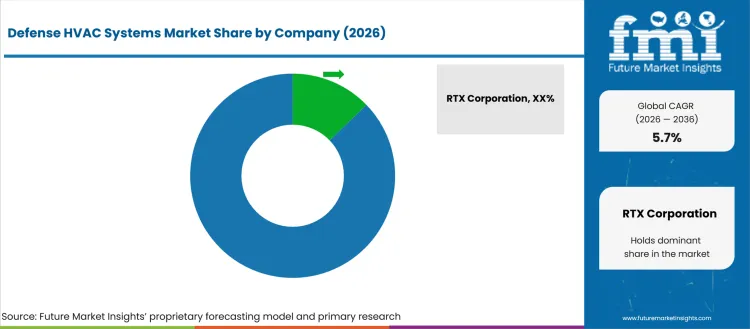
Competition is defined by qualification depth and platform access. Aircraft suppliers integrate cooling with power, pressurization, filtration and avionics. Naval suppliers work through chilled-water plants, air handling, refrigeration and noise control and corrosion protection. Defense-estate providers compete through equipment breadth, controls, service coverage and federal procurement access. A durable commercial position comes from retaining the same approved configuration through production, depot repair, and spare-part supply.
- RTX Corporation and Honeywell International Inc. have public evidence of integrated aircraft power and thermal systems. Liebherr Group supports air management and equipment cooling for military aircraft. AMETEK Inc. provides thermal-management components and custom subsystems.
- Leonardo DRS documents USA Navy marine HVAC and air-handling capability. Carrier Global Corporation and Johnson Controls International plc address marine or federal applications, while Daikin Industries Ltd. and Trane Technologies plc serve defense installations. Mitsubishi Electric Corporation contributes broad HVAC and hydronic-system capability, with public evidence weighted toward facility-class applications.
How do companies compare in the Defense HVAC Systems Market?
| Company | Documented capability | Primary role |
|---|---|---|
| RTX Corporation | Integrated aircraft environmental control, power and thermal management, including EPACS. | Aircraft platform integrator |
| Honeywell International Inc. | Air supply, pressurization, filtration and high-density cooling and integrated power and thermal management. | Aircraft systems supplier |
| Carrier Global Corporation | Marine chillers, air handling units, corrosion-protected HVAC and federal solution coverage. | Marine and facility HVAC |
| Daikin Industries Ltd. | Federal procurement access, equipment supply, replacement projects and service for government sites. | Defense installation HVAC |
| Johnson Controls International plc | Marine and Navy HVAC or refrigeration design, service, overhaul and controls and federal building systems. | Naval service and facilities |
| Liebherr Group | Environmental control, air management, and equipment cooling for fixed-wing or rotary-wing defense aircraft. | Aircraft ECS specialist |
| Trane Technologies plc | Defense-facility HVAC, controls, precise temperature or humidity projects and mission-critical thermal management. | Defense estate and precision cooling |
| Mitsubishi Electric Corporation | Broad climate, hydronic, and control-system portfolio; public evidence reviewed is concentrated in facility-scale HVAC. | Broad HVAC supplier |
| AMETEK Inc. | Custom thermal systems, heat exchangers, liquid cooling and valves and rugged components for aerospace or defense. | Component and subsystem specialist |
| Leonardo DRS | Navy marine HVAC, air handling units, refrigeration and controls and qualification and lifecycle support. | Naval platform specialist |
What are the key developments in the Defense HVAC Systems Market?
- In February 2025, RTX Corporation announced that its enhanced power and cooling system had reached readiness for aircraft integration after ground demonstration work. The system is intended to provide added electrical power and thermal capacity for advanced aircraft loads.
- In February 2025, Trane Technologies plc expanded its thermal-management portfolio with liquid-cooling and coolant-distribution capability for high-density, mission-critical environments. The development is relevant to command facilities and defense computing spaces where rack heat exceeds conventional room-cooling limits.
- In June 2025, Honeywell International Inc. announced selection of its Attune thermal-management system for a future assault aircraft program. The selection links environmental control with the thermal demands of next-generation rotorcraft electronics.
- In July 2026, Liebherr Group announced that its Farnborough Airshow display would include electrical environmental-control systems and air-management solutions for civil and military aircraft.
What is included in the Defense HVAC Systems Market report scope?
| Coverage field | Report scope |
|---|---|
| Market breakdown | Product Type, Application, End User and Distribution Channel and Platform Type and Region |
| Quantitative Units | Revenue in USD Billion and CAGR in %. |
| Market Definition | Revenue includes first-sale manufacturer or system-supplier revenue from air conditioning, heating, ventilation and environmental control and filtration and air handling and integrated HVAC and portable or deployable HVAC equipment sold for defense platforms and facilities or field systems. Standalone civilian HVAC revenue and refrigeration equipment outside the defined defense application are excluded. |
| Regions Covered | North America; Latin America; Western Europe; Eastern Europe; East Asia; South Asia and Pacific; Middle East and Africa |
| Countries Covered | USA, Japan, UK and Germany and Canada and Australia and South Korea and more than twenty-five additional countries in the full report |
| Key Companies Profiled | RTX Corporation; Honeywell International Inc.; Carrier Global Corporation; Daikin Industries Ltd.; Johnson Controls International plc; Liebherr Group; Trane Technologies plc; Mitsubishi Electric Corporation; AMETEK Inc.; Leonardo DRS |
| Forecast Period | 2026 to 2036 |
| Approach | Hybrid bottom-up and top-down sizing using supplier revenue, platform deliveries, installed-base service demand and equipment content and price checks and defense procurement indicators and buyer-side validation. |
How was the Defense HVAC Systems Market research conducted?
| Method | Approach |
|---|---|
| Primary Research | FMI engages defense HVAC manufacturers, environmental-control suppliers, platform OEMs and system integrators and defense-facility engineers and procurement professionals and MRO providers and subject-matter experts. |
| Desk Research | The review covers official defense budgets, procurement releases, military standards and environmental regulation and government policy and company filings and first-party product documentation and official company announcements and relevant technical guidance. |
| Market Sizing and Forecasting | The model reconciles supplier revenue, platform deliveries, HVAC content per platform and installed-base replacement and service and spare-part demand and product mix and channel structure and price levels and country program indicators. |
| Data Validation | Supplier-side findings are cross-checked with defense buyers, integrators, MRO organizations and platform evidence and country-level procurement signals. |
How is the Defense HVAC Systems Market segmented by category?
Defense HVAC Systems Market segmented by Product Type:
- Air Conditioning Systems
- Environmental Control Units (ECUs)
- Precision Air Conditioning Systems
- Heating Systems
- Electric Heating Systems
- Fuel-Based Heating Systems
- Ventilation Systems
- Filtration & Air Handling Units
- CBRN Ventilation Systems
- Integrated HVAC Systems
- Modular HVAC Systems
- Packaged HVAC Systems
- Portable HVAC Systems
- Mobile Cooling Units
- Deployable Shelter HVAC Systems
Defense HVAC Systems Market segmented by Application:
- Military Ground Vehicles
- Armored Fighting Vehicles
- Tactical Trucks
- Naval Defense Platforms
- Destroyers & Frigates
- Submarines
- Military Aircraft
- Fighter Aircraft
- Military Transport Aircraft
- Military Bases & Facilities
- Command Centers
- Barracks & Training Facilities
- Deployable Military Shelters
- Field Hospitals
- Temporary Command Posts
Defense HVAC Systems Market segmented by End User:
- Defense Forces
- Army
- Air Force
- Defense OEMs
- Vehicle Manufacturers
- Aerospace Manufacturers
- Naval Shipbuilders
- Surface Ship Builders
- Submarine Builders
- Government Defense Agencies
- Defense Infrastructure Authorities
- Defense Procurement Agencies
- Maintenance, Repair & Overhaul (MRO) Providers
- Military Equipment MRO
- Aerospace MRO
Defense HVAC Systems Market segmented by Distribution Channel:
- Direct Sales
- Defense Contracts
- OEM Supply Agreements
- Authorized Defense Distributors
- Regional Defense Distributors
- Global Defense Suppliers
- System Integrators
- Defense System Integrators
- Platform Integration Providers
- Government Procurement
- Public Defense Tenders
- Framework Agreements
- Aftermarket Suppliers
- Spare Parts Suppliers
- MRO Service Providers
Defense HVAC Systems Market segmented by Platform Type:
- Land-Based Defense Platforms
- Armored Vehicles
- Mobile Command Units
- Naval Platforms
- Surface Combatants
- Submarines
- Airborne Platforms
- Fixed-Wing Aircraft
- Rotary-Wing Aircraft
- Military Infrastructure
- Defense Installations
- Command Centers
- Portable & Expeditionary Systems
- Field Shelters
- Mobile Medical Units
Defense HVAC Systems Market segmented by Region:
- North America
- Latin America
- Western Europe
- Eastern Europe
- East Asia
- South Asia and Pacific
- Middle East and Africa
Which sources support the Defense HVAC Systems Market analysis?
- Whole Building Design Guide, UFC 3-410-01: Heating, Ventilating and Air Conditioning Systems and published July 28 and 2025; Change 1 dated January 23 and 2026.
- USA Department of Defense ASSIST, MIL-STD-810H: Environmental Engineering Considerations and Laboratory Tests, January 31 and 2019.
- USA Department of Defense ASSIST, MIL-STD-461H: Control of Electromagnetic Interference Characteristics of Subsystems and Equipment, April 17 and 2026.
- Naval Sea Systems Command, VSD Collective Protection System, accessed July 31 and 2026.
- USA Army, New Tech Ensures Efficient Collective Protection for Warfighters, May 12 and 2026.
- USA Army, NSRDEC Deploys Energy-Efficient Tents for Testing, October 31 and 2013.
- USA Environmental Protection Agency, Technology Transitions HFC Restrictions by Sector, accessed July 31 and 2026.
- European Union, Regulation (EU) 2024/573 on fluorinated greenhouse gases, February 7 and 2024.
- USA Department of Defense, Background Briefing on FY 2026 Defense Budget, June 26 and 2025.
- Ministry of Defense, Japan, FY2026 Defense Budget overview and December 26 and 2025.
- UK Government, Strategic Defence Review 2025: Making Britain Safer, June 2 and 2025.
- German Federal Government, Federal Budget 2026, accessed July 31 and 2026.
- Department of National Defence, Canada, Our North and Strong and Free: A Renewed Vision for Canada’s Defence and April 8 and 2024.
- Australian Department of Defence, 2026 National Defence Strategy and Integrated Investment Program, April 2026.
- Ministry of National Defense, Republic of Korea, 2026 Defense Budget and accessed July 31 and 2026.
- RTX Corporation, EPACS power and thermal management system ready for aircraft integration, February 28 and 2025.
- Honeywell International Inc., thermal-management system selected for a future assault aircraft program, June 15 and 2025.
- Liebherr Group, Solutions for the Aviation of Tomorrow at Farnborough Airshow 2026, July 13 and 2026.
- AMETEK Inc., Airtechnology thermal-management systems for aerospace and defense, June 2025.
- Leonardo DRS, Marine HVAC Systems and Air Handling Units, accessed July 31 and 2026.
- Carrier Global Corporation, Marine HVAC Solutions, accessed July 31 and 2026.
- Daikin Industries Ltd., Government HVAC Solutions and federal procurement access, accessed July 31 and 2026.
- Johnson Controls International plc, Marine and Navy HVAC and refrigeration services, accessed July 31 and 2026.
- Trane Technologies plc, Thermal-management system capabilities expanded for mission-critical environments, February 4 and 2025.
- Mitsubishi Electric Corporation, hydronic HVAC capability expansion in Europe, April 3 and 2024.
This bibliography is provided for reader reference and is not exhaustive. The full report contains the complete reference list and detailed citations.
What questions does this report answer?
- What is the Defense HVAC Systems Market size in 2026, and what value is forecast for 2036?
- Which mission, platform, and environmental requirements support demand for defense HVAC systems?
- Why do Air Conditioning Systems lead the Product Type category?
- Why do Military Ground Vehicles account for the largest Application share?
- How do aircraft, naval, land and facility and deployable HVAC requirements differ?
- How do country growth rates compare across USA, Japan, UK and Germany and Canada and Australia and South Korea?
- Which suppliers document aircraft, naval, marine and federal or defense-infrastructure capability?
- How do qualification, refrigerant transition, power limits and noise and maintenance requirements restrain adoption?
- What should procurement teams evaluate before selecting a defense HVAC system or environmental control unit?
Frequently Asked Questions
How big is the Defense HVAC Systems Market in 2026?
The defense HVAC systems market is valued at USD 6.8 billion in 2026 and is forecast to reach USD 12.0 billion by 2036, growing at a 5.7% CAGR as electronics density and crew-protection requirements raise the heat load platform-qualified systems must remove.
What is the CAGR of the Defense HVAC Systems Market from 2026 to 2036?
The defense HVAC systems market grows at a CAGR of 5.7% between 2026 and 2036, rising from USD 6.8 billion to USD 12.0 billion as aircraft, naval, land and facility programs replace legacy equipment with qualified, power-integrated environmental control systems.
Which product type leads the Defense HVAC Systems Market?
Air Conditioning Systems lead the defense HVAC systems market by product type with a 34.0% share in 2026, reflecting their direct role in crew protection and in rejecting heat generated by dense onboard electronics and power systems.
How much will the Defense HVAC Systems Market add between 2026 and 2036?
The defense HVAC systems market is set to add USD 5.2 billion between 2026 and 2036, growing from USD 6.8 billion to USD 12.0 billion as aircraft, naval and land-platform modernization programs expand demand for qualified thermal-management equipment.
Who are the leading companies in the Defense HVAC Systems Market?
Ten companies lead the defense HVAC systems market, including RTX Corporation, Honeywell International, Carrier Global, Daikin Industries and Leonardo DRS, competing through platform-qualified aircraft, naval, marine and defense-installation HVAC capabilities supported by depot repair and long-term spare-part programs.
Preview the report firsthand - request a free sample
Get SampleGet the brochure for pricing and purchase details.
Get PDFTable of Content
- Key Takeaways
- Market Size and CAGR
- Top Growth Driver
- Fastest Growing Segment
- Leading Region
- Key Companies
- Emerging Opportunities
- Executive Summary
- Global Market Outlook
- Demand-side Trends
- Supply-side Trends
- Technology Roadmap Analysis
- Analysis and Recommendations
- Analyst Perspective (What is happening? Why now? What should investors know?)
- Key Questions Answered
- How large is the market?
- What is the CAGR?
- What are key trends?
- Which region dominates?
- Who are the leaders?
- Market Overview
- Market Coverage / Taxonomy
- Market Definition / Scope / Limitations
- Research Methodology
- Chapter Orientation
- Analytical Lens and Working Hypotheses
- Market Structure, Signals, and Trend Drivers
- Benchmarking and Cross-market Comparability
- Market Sizing, Forecasting, and Opportunity Mapping
- Research Design and Evidence Framework
- Desk Research Programme (Secondary Evidence)
- Expert Input and Fieldwork (Primary Evidence)
- Tooling, Models, and Reference Databases
- Data Engineering and Model Build
- Quality Assurance and Audit Trail
- Market Background
- Market Dynamics (Drivers, Restraints, Opportunity, Trends)
- Scenario Forecast (Optimistic, Likely, Conservative)
- Impact Analysis
- AI Impact
- Sustainability Impact
- Regulatory Impact
- Technology Impact
- Consumer / Buyer Analysis
- Purchase Drivers
- Adoption Barriers
- Buyer Journey
- Opportunity Map Analysis
- Product Life Cycle Analysis
- Supply Chain Analysis
- Investment Feasibility Matrix
- Value Chain Analysis
- PESTLE and Porter's Analysis
- Regulatory Landscape
- Regional Parent Market Outlook
- Production and Consumption Statistics
- Import and Export Statistics
- Global Market Analysis and Forecast, 2021 to 2036
- Historical Market Size Value (USD Billion) Analysis, 2021 to 2025
- Current and Future Market Size Value (USD Billion) Projections, 2026 to 2036
- Y-o-Y Growth Trend Analysis
- Absolute $ Opportunity Analysis
- Global Market Pricing Analysis, 2021 to 2036
- Global Market Analysis and Forecast, By Product Type, 2021 to 2036
- Introduction / Key Findings
- Historical Market Size Value (USD Billion) Analysis By Product Type, 2021 to 2025
- Current and Future Market Size Value (USD Billion) Analysis and Forecast By Product Type, 2026 to 2036
- Air Conditioning Systems
- Environmental Control Units (ECUs)
- Precision Air Conditioning Systems
- Heating Systems
- Electric Heating Systems
- Fuel-Based Heating Systems
- Ventilation Systems
- Filtration & Air Handling Units
- CBRN Ventilation Systems
- Integrated HVAC Systems
- Modular HVAC Systems
- Packaged HVAC Systems
- Portable HVAC Systems
- Mobile Cooling Units
- Deployable Shelter HVAC Systems
- Air Conditioning Systems
- Y-o-Y Growth Trend Analysis By Product Type, 2021 to 2025
- Absolute $ Opportunity Analysis By Product Type, 2026 to 2036
- Global Market Analysis and Forecast, By Application, 2021 to 2036
- Introduction / Key Findings
- Historical Market Size Value (USD Billion) Analysis By Application, 2021 to 2025
- Current and Future Market Size Value (USD Billion) Analysis and Forecast By Application, 2026 to 2036
- Military Ground Vehicles
- Armored Fighting Vehicles
- Tactical Trucks
- Naval Defense Platforms
- Destroyers & Frigates
- Submarines
- Military Aircraft
- Fighter Aircraft
- Military Transport Aircraft
- Military Bases & Facilities
- Command Centers
- Barracks & Training Facilities
- Deployable Military Shelters
- Field Hospitals
- Temporary Command Posts
- Military Ground Vehicles
- Y-o-Y Growth Trend Analysis By Application, 2021 to 2025
- Absolute $ Opportunity Analysis By Application, 2026 to 2036
- Global Market Analysis and Forecast, By End User, 2021 to 2036
- Introduction / Key Findings
- Historical Market Size Value (USD Billion) Analysis By End User, 2021 to 2025
- Current and Future Market Size Value (USD Billion) Analysis and Forecast By End User, 2026 to 2036
- Defense Forces
- Army
- Air Force
- Defense OEMs
- Vehicle Manufacturers
- Aerospace Manufacturers
- Naval Shipbuilders
- Surface Ship Builders
- Submarine Builders
- Government Defense Agencies
- Defense Infrastructure Authorities
- Defense Procurement Agencies
- Maintenance, Repair & Overhaul (MRO) Providers
- Military Equipment MRO
- Aerospace MRO
- Defense Forces
- Y-o-Y Growth Trend Analysis By End User, 2021 to 2025
- Absolute $ Opportunity Analysis By End User, 2026 to 2036
- Global Market Analysis and Forecast, By Distribution Channel, 2021 to 2036
- Introduction / Key Findings
- Historical Market Size Value (USD Billion) Analysis By Distribution Channel, 2021 to 2025
- Current and Future Market Size Value (USD Billion) Analysis and Forecast By Distribution Channel, 2026 to 2036
- Direct Sales
- Defense Contracts
- OEM Supply Agreements
- Authorized Defense Distributors
- Regional Defense Distributors
- Global Defense Suppliers
- System Integrators
- Defense System Integrators
- Platform Integration Providers
- Government Procurement
- Public Defense Tenders
- Framework Agreements
- Aftermarket Suppliers
- Spare Parts Suppliers
- MRO Service Providers
- Direct Sales
- Y-o-Y Growth Trend Analysis By Distribution Channel, 2021 to 2025
- Absolute $ Opportunity Analysis By Distribution Channel, 2026 to 2036
- Global Market Analysis and Forecast, By Platform Type, 2021 to 2036
- Introduction / Key Findings
- Historical Market Size Value (USD Billion) Analysis By Platform Type, 2021 to 2025
- Current and Future Market Size Value (USD Billion) Analysis and Forecast By Platform Type, 2026 to 2036
- Land-Based Defense Platforms
- Armored Vehicles
- Mobile Command Units
- Naval Platforms
- Surface Combatants
- Submarines
- Airborne Platforms
- Fixed-Wing Aircraft
- Rotary-Wing Aircraft
- Military Infrastructure
- Defense Installations
- Command Centers
- Portable & Expeditionary Systems
- Field Shelters
- Mobile Medical Units
- Land-Based Defense Platforms
- Y-o-Y Growth Trend Analysis By Platform Type, 2021 to 2025
- Absolute $ Opportunity Analysis By Platform Type, 2026 to 2036
- Global Market Analysis and Forecast, By Region, 2021 to 2036
- Introduction
- Historical Market Size Value (USD Billion) Analysis By Region, 2021 to 2025
- Current Market Size Value (USD Billion) Analysis and Forecast By Region, 2026 to 2036
- North America
- Latin America
- Western Europe
- Eastern Europe
- East Asia
- South Asia and Pacific
- Middle East & Africa
- Market Attractiveness Analysis By Region
- North America Market Analysis and Forecast, By Country, 2021 to 2036
- Historical Market Size Value (USD Billion) Trend Analysis By Market Taxonomy, 2021 to 2025
- Market Size Value (USD Billion) Forecast By Market Taxonomy, 2026 to 2036
- By Country
- USA
- Canada
- By Product Type
- By Application
- By End User
- By Distribution Channel
- By Platform Type
- By Country
- Market Attractiveness Analysis
- By Country
- By Product Type
- By Application
- By End User
- By Distribution Channel
- By Platform Type
- Key Takeaways
- Latin America Market Analysis and Forecast, By Country
- Historical Market Size Value (USD Billion) Trend Analysis By Market Taxonomy, 2021 to 2025
- Market Size Value (USD Billion) Forecast By Market Taxonomy, 2026 to 2036
- By Country
- Brazil
- Mexico
- Chile
- Rest of Latin America
- By Product Type
- By Application
- By End User
- By Distribution Channel
- By Platform Type
- By Country
- Market Attractiveness Analysis
- By Country
- By Product Type
- By Application
- By End User
- By Distribution Channel
- By Platform Type
- Key Takeaways
- Western Europe Market Analysis and Forecast, By Country
- Historical Market Size Value (USD Billion) Trend Analysis By Market Taxonomy, 2021 to 2025
- Market Size Value (USD Billion) Forecast By Market Taxonomy, 2026 to 2036
- By Country
- Germany
- UK
- Italy
- Spain
- France
- Nordic
- BENELUX
- Rest of Western Europe
- By Product Type
- By Application
- By End User
- By Distribution Channel
- By Platform Type
- By Country
- Market Attractiveness Analysis
- By Country
- By Product Type
- By Application
- By End User
- By Distribution Channel
- By Platform Type
- Key Takeaways
- Eastern Europe Market Analysis and Forecast, By Country
- Historical Market Size Value (USD Billion) Trend Analysis By Market Taxonomy, 2021 to 2025
- Market Size Value (USD Billion) Forecast By Market Taxonomy, 2026 to 2036
- By Country
- Russia
- Poland
- Hungary
- Balkan & Baltic
- Rest of Eastern Europe
- By Product Type
- By Application
- By End User
- By Distribution Channel
- By Platform Type
- By Country
- Market Attractiveness Analysis
- By Country
- By Product Type
- By Application
- By End User
- By Distribution Channel
- By Platform Type
- Key Takeaways
- East Asia Market Analysis and Forecast, By Country
- Historical Market Size Value (USD Billion) Trend Analysis By Market Taxonomy, 2021 to 2025
- Market Size Value (USD Billion) Forecast By Market Taxonomy, 2026 to 2036
- By Country
- China
- Japan
- South Korea
- By Product Type
- By Application
- By End User
- By Distribution Channel
- By Platform Type
- By Country
- Market Attractiveness Analysis
- By Country
- By Product Type
- By Application
- By End User
- By Distribution Channel
- By Platform Type
- Key Takeaways
- South Asia and Pacific Market Analysis and Forecast, By Country
- Historical Market Size Value (USD Billion) Trend Analysis By Market Taxonomy, 2021 to 2025
- Market Size Value (USD Billion) Forecast By Market Taxonomy, 2026 to 2036
- By Country
- India
- ASEAN
- Australia & New Zealand
- Rest of South Asia and Pacific
- By Product Type
- By Application
- By End User
- By Distribution Channel
- By Platform Type
- By Country
- Market Attractiveness Analysis
- By Country
- By Product Type
- By Application
- By End User
- By Distribution Channel
- By Platform Type
- Key Takeaways
- Middle East & Africa Market Analysis and Forecast, By Country
- Historical Market Size Value (USD Billion) Trend Analysis By Market Taxonomy, 2021 to 2025
- Market Size Value (USD Billion) Forecast By Market Taxonomy, 2026 to 2036
- By Country
- Kingdom of Saudi Arabia
- Other GCC Countries
- Türkiye
- South Africa
- Other African Union
- Rest of Middle East & Africa
- By Product Type
- By Application
- By End User
- By Distribution Channel
- By Platform Type
- By Country
- Market Attractiveness Analysis
- By Country
- By Product Type
- By Application
- By End User
- By Distribution Channel
- By Platform Type
- Key Takeaways
- Key Countries Market Analysis
- USA
- Pricing Analysis
- Market Share Analysis, 2025
- By Product Type
- By Application
- By End User
- By Distribution Channel
- By Platform Type
- Canada
- Pricing Analysis
- Market Share Analysis, 2025
- By Product Type
- By Application
- By End User
- By Distribution Channel
- By Platform Type
- Mexico
- Pricing Analysis
- Market Share Analysis, 2025
- By Product Type
- By Application
- By End User
- By Distribution Channel
- By Platform Type
- Brazil
- Pricing Analysis
- Market Share Analysis, 2025
- By Product Type
- By Application
- By End User
- By Distribution Channel
- By Platform Type
- Chile
- Pricing Analysis
- Market Share Analysis, 2025
- By Product Type
- By Application
- By End User
- By Distribution Channel
- By Platform Type
- Germany
- Pricing Analysis
- Market Share Analysis, 2025
- By Product Type
- By Application
- By End User
- By Distribution Channel
- By Platform Type
- UK
- Pricing Analysis
- Market Share Analysis, 2025
- By Product Type
- By Application
- By End User
- By Distribution Channel
- By Platform Type
- Italy
- Pricing Analysis
- Market Share Analysis, 2025
- By Product Type
- By Application
- By End User
- By Distribution Channel
- By Platform Type
- Spain
- Pricing Analysis
- Market Share Analysis, 2025
- By Product Type
- By Application
- By End User
- By Distribution Channel
- By Platform Type
- France
- Pricing Analysis
- Market Share Analysis, 2025
- By Product Type
- By Application
- By End User
- By Distribution Channel
- By Platform Type
- India
- Pricing Analysis
- Market Share Analysis, 2025
- By Product Type
- By Application
- By End User
- By Distribution Channel
- By Platform Type
- ASEAN
- Pricing Analysis
- Market Share Analysis, 2025
- By Product Type
- By Application
- By End User
- By Distribution Channel
- By Platform Type
- Australia & New Zealand
- Pricing Analysis
- Market Share Analysis, 2025
- By Product Type
- By Application
- By End User
- By Distribution Channel
- By Platform Type
- China
- Pricing Analysis
- Market Share Analysis, 2025
- By Product Type
- By Application
- By End User
- By Distribution Channel
- By Platform Type
- Japan
- Pricing Analysis
- Market Share Analysis, 2025
- By Product Type
- By Application
- By End User
- By Distribution Channel
- By Platform Type
- South Korea
- Pricing Analysis
- Market Share Analysis, 2025
- By Product Type
- By Application
- By End User
- By Distribution Channel
- By Platform Type
- Russia
- Pricing Analysis
- Market Share Analysis, 2025
- By Product Type
- By Application
- By End User
- By Distribution Channel
- By Platform Type
- Poland
- Pricing Analysis
- Market Share Analysis, 2025
- By Product Type
- By Application
- By End User
- By Distribution Channel
- By Platform Type
- Hungary
- Pricing Analysis
- Market Share Analysis, 2025
- By Product Type
- By Application
- By End User
- By Distribution Channel
- By Platform Type
- Kingdom of Saudi Arabia
- Pricing Analysis
- Market Share Analysis, 2025
- By Product Type
- By Application
- By End User
- By Distribution Channel
- By Platform Type
- Türkiye
- Pricing Analysis
- Market Share Analysis, 2025
- By Product Type
- By Application
- By End User
- By Distribution Channel
- By Platform Type
- South Africa
- Pricing Analysis
- Market Share Analysis, 2025
- By Product Type
- By Application
- By End User
- By Distribution Channel
- By Platform Type
- USA
- Market Structure Analysis
- Competition Dashboard
- Competition Benchmarking
- Market Share Analysis of Top Players
- By Regional
- By Product Type
- By Application
- By End User
- By Distribution Channel
- By Platform Type
- Emerging Startups
- Innovation Benchmarking
- Competition Analysis
- Competition Deep Dive
- RTX Corporation
- Overview
- Product Portfolio
- Profitability by Market Segments
- Sales Footprint
- Strategy Overview
- Marketing Strategy
- Product Strategy
- Channel Strategy
- Honeywell International Inc.
- Carrier Global Corporation
- Daikin Industries Ltd.
- Johnson Controls International plc
- Liebherr Group
- Trane Technologies plc
- Mitsubishi Electric Corporation
- AMETEK Inc.
- Leonardo DRS
- RTX Corporation
- Case Studies
- Success Stories
- Recent Developments
- Competition Deep Dive
- Assumptions & Acronyms Used


