

- Industry Size (2026)
- USD 531.48 Mn
- Forecast (2036)
- USD 735.34 Mn
- CAGR (2026 to 2036)
- 3.3%
Demand for HVAC Blower and Fan Systems in USA Market Size, Market Forecast and Outlook By FMI
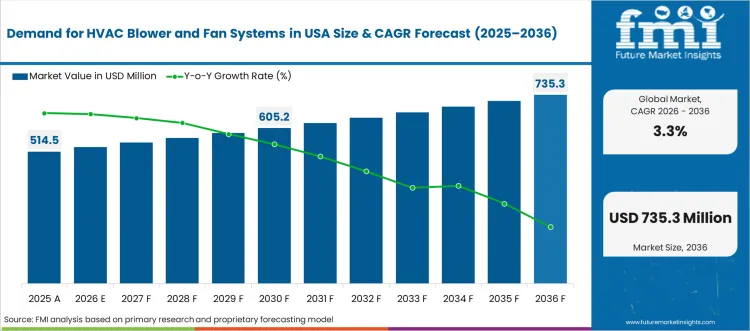
Demand for HVAC blower and fan systems in the USA was valued at USD 514.50 million in 2025, projected to reach USD 531.48 million in 2026, and is forecast to expand to USD 735.34 million by 2036 at a 3.3% CAGR. FMI projects that the convergence of DOE energy efficiency standards tightening, commercial building retrofit activity, and the ongoing AC-to-EC motor technology transition sustains value growth across the mature US HVAC fan installed base.
Summary of Demand for HVAC Blower and Fan Systems in USA
- Market Snapshot
- Demand for HVAC blower and fan systems in the USA is valued at USD 514.50 million in 2025 and is projected to reach USD 735.34 million by 2036.
- The market is expected to grow at a 3.3% CAGR from 2026 to 2036, creating an incremental opportunity of USD 203.86 million.
- The market operates as a mature replacement and code-compliance-driven equipment category where DOE efficiency mandates and AC-to-EC motor transitions drive value growth.
- Demand and Growth Drivers
- Demand is sustained by ASHRAE 90.1 and DOE efficiency standards that mandate fan efficiency grades legacy AC motor systems cannot meet.
- Data center construction and commercial building activity in western and southern states generate new installation demand.
- Aging commercial building HVAC systems in the Northeast create steady retrofit procurement volumes.
- Among key regions, the West leads at 3.8% CAGR, followed by the South at 3.4%, the Northeast at 3.1%, and the Midwest at 2.7%.
- Product and Segment View
- The market includes centrifugal fans, backward inclined fans, axial fans, and mixed-flow blower assemblies for HVAC applications.
- Centrifugal leads by product type with 42.0% share in 2026.
- Industrial leads by end use with 48.0% share in 2026.
- The scope excludes process fans outside HVAC, standalone exhaust fans, and electronic cooling devices.
- Geography and Competitive Outlook
- The West represents the fastest-growing region driven by data center and commercial construction, while the Northeast anchors mature retrofit demand.
- Competition is shaped by EC motor efficiency, drop-in retrofit compatibility, and noise reduction performance, with key players including Johnson Controls International, Loren Cook Company, Ziehl-Abegg SE, and Air System Components.
- Vendor differentiation centers on legacy ductwork compatibility for the large retrofit market.
- Analyst Opinion at FMI
- Nikhil Kaitwade, Principal Consultant at Future Market Insights, opines: 'In my analysis, I have observed that the US HVAC fan market is experiencing a regulatory-driven value uplift that masks modest volume growth beneath a more compelling revenue story. DOE and ASHRAE efficiency mandates are forcing specification upgrades from legacy AC motor fans to EC motor alternatives that cost 30% to 50% more per unit but deliver measurable energy savings. Building owners who delay this transition face compounding energy cost penalties and code compliance risk during the next renovation permit cycle. The procurement decision is becoming less optional with each tightening of state energy codes.'
- Strategic Implications / Executive Takeaways
- HVAC contractors should proactively present EC motor fan retrofit proposals to commercial building owners with quantified energy savings projections, converting awareness of efficiency regulations into actionable procurement decisions before code compliance deadlines.
- Fan manufacturers must expand product lines to include drop-in EC motor replacement units compatible with legacy ductwork and mounting configurations prevalent in the existing US commercial building stock.
- Data center facility managers in the West and South regions should specify high-efficiency backward inclined fan systems in new construction to meet the airflow volume requirements of high-density server installations while minimizing power consumption per cubic foot of air moved.
Demand for HVAC Blower and Fan Systems in USA Key Takeaways
| Metric | Details |
|---|---|
| Industry Size (2026) | USD 531.48 million |
| Industry Value (2036) | USD 735.34 million |
| CAGR (2026-2036) | 3.3% |
Source: Future Market Insights, 2026
The USA HVAC fan market benefits from dual growth channels: new construction installations driven by commercial and data center building activity, and retrofit procurement generated by aging fan systems requiring replacement with higher-efficiency EC motor alternatives. ASHRAE 90.1 energy performance standards and state-level building codes increasingly mandate fan efficiency grades that legacy AC motor systems cannot meet, converting voluntary efficiency upgrades into code-compliance requirements during renovation projects. This regulatory ratchet creates a procurement floor that sustains equipment demand independent of broader construction cycle fluctuations.
The West region leads national expansion at a 3.8% CAGR through 2036, driven by data center construction and commercial building activity in western metropolitan areas. The South follows at 3.4%, fueled by population-driven commercial construction and year-round cooling demand requiring continuous fan operation. The Northeast registers 3.1% growth anchored by aging commercial building HVAC retrofit programs. The Midwest tracks at 2.7% with steady industrial ventilation replacement demand.
Demand for HVAC Blower and Fan Systems in USA Market Definition
HVAC blower and fan systems for the US market comprise centrifugal fans, axial fans, backward inclined fans, and mixed-flow blower assemblies installed within heating, ventilation, and air conditioning infrastructure. These systems serve as air movement components in commercial HVAC installations, industrial ventilation systems, and residential forced-air equipment deployed across diverse US climate zones from arid western states to humid southeastern regions.
Demand for HVAC Blower and Fan Systems in USA Market Inclusions
Market scope covers centrifugal blowers, axial fans, backward inclined fans, mixed-flow blower units, and associated motor drive assemblies sold for HVAC applications within the United States. Coverage spans regional market sizes for the 2026 to 2036 forecast period, segmented by product type, end use, and US Census region.
Demand for HVAC Blower and Fan Systems in USA Market Exclusions
The scope excludes process fans for industrial manufacturing outside HVAC, standalone exhaust fans not integrated into HVAC systems, and computer or electronic thermal management cooling fans.
Demand for HVAC Blower and Fan Systems in USA Market Research Methodology
- Primary Research: Analysts conducted structured interviews with HVAC contractors, commercial building facility managers, and industrial ventilation engineers across US regions to map fan specification requirements and replacement cycles.
- Desk Research: Publicly available ASHRAE standards, DOE energy efficiency requirements, HVAC equipment shipment statistics from AHRI, and fan manufacturer annual reports provided foundational benchmarks.
- Market-Sizing and Forecasting: Baseline values derive from a bottom-up aggregation of HVAC fan and blower unit shipments and average selling prices, applying building construction activity and equipment replacement cycle assumptions across US regions.
- Data Validation and Update Cycle: Projections are tested against AHRI equipment certification data and cross-referenced with commercial and residential construction activity indicators from the US Census Bureau.
Why is the Demand for HVAC Blower and Fan Systems in USA Growing?
The demand for HVAC blower and fan systems in the USA is growing due to the increasing need for energy-efficient, reliable, and high-performance heating, ventilation, and air conditioning (HVAC) solutions across residential, commercial, and industrial applications. These systems are crucial for maintaining optimal indoor air quality, temperature control, and comfort in buildings. As the demand for more sustainable and energy-efficient HVAC systems rises, blower and fan systems are being upgraded to meet these needs. The growth in construction activities, especially in green building initiatives, is further fueling this demand.
Key drivers for growth include the rising adoption of energy-efficient systems to reduce operational costs, the ongoing trend towards smart building technologies, and the growing awareness about indoor air quality and comfort. Technological advancements in fan and blower system designs are also improving energy consumption, noise reduction, and performance, making these systems more appealing to both new construction projects and retrofitting existing buildings. Furthermore, the increasing implementation of regulations and codes aimed at reducing energy consumption and environmental impact is driving the adoption of advanced HVAC blower and fan systems.
Despite the strong growth outlook, challenges such as high initial installation costs, maintenance concerns, and the complexity of retrofitting older buildings may pose obstacles. Nevertheless, the increasing demand for energy-efficient, environmentally friendly HVAC solutions is expected to drive steady growth in the HVAC blower and fan systems industry in the USA through 2035.
What is the Segment-Wise Analysis of Demand for HVAC Blower and Fan Systems in USA?
Demand for HVAC blower and fan systems in the USA is segmented by product type, end use, and region. By product type, centrifugal fans lead with 42% of the demand, followed by backward inclined fan-based, axial, and other product types. In terms of end use, industrial applications dominate with 48% of the demand, followed by commercial and residential sectors. Regionally, demand is distributed across West USA, South USA, Northeast USA, and Midwest USA.
How Does Centrifugal Fan-based System Lead the Demand for HVAC Blower and Fan Systems in USA?
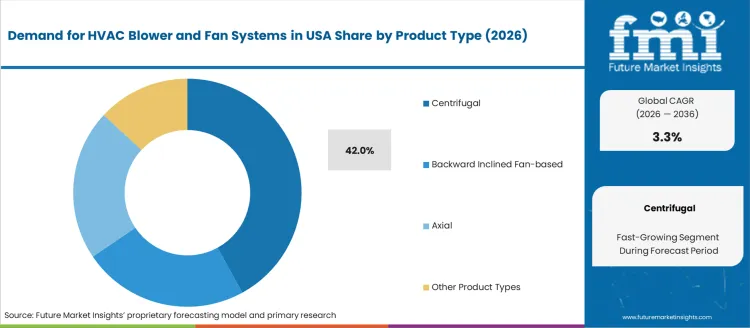
Centrifugal fans account for 42% of the demand for HVAC blower and fan systems in the USA, driven by their efficiency and versatility across various industrial, commercial, and residential applications. These fans are highly preferred for their ability to generate high-pressure airflow, making them ideal for large-scale ventilation systems and industrial processes that require consistent air handling. Their compact design and reliability in maintaining stable airflow, even in demanding environments, enhance their popularity. The centrifugal fan-based system’s capability to handle higher static pressures and operate effectively in harsh conditions contributes to its strong industry position. As the demand for energy-efficient and high-performance air handling systems continues to rise, centrifugal fans remain the leading choice in HVAC applications, especially in industries seeking reliable, long-lasting solutions. Their ability to efficiently handle air movement in various sectors ensures their continued dominance in the industry.
How Does Industrial End Use Lead the Demand for HVAC Blower and Fan Systems in USA?
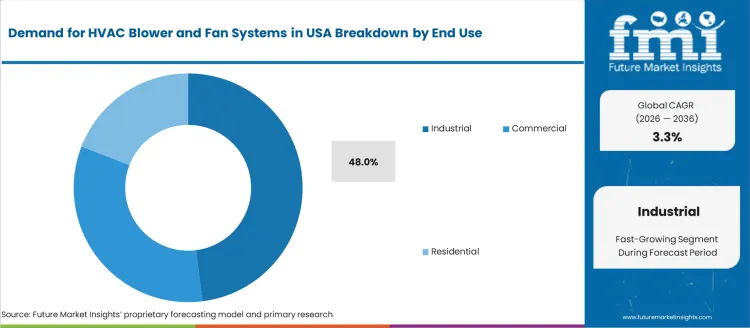
Industrial applications account for 48% of the demand for HVAC blower and fan systems in the USA, driven by the critical need for effective ventilation, cooling, and air circulation in manufacturing and processing environments. HVAC systems are essential for maintaining air quality, temperature control, and ensuring the safety of workers in sectors such as pharmaceuticals, food processing, and chemical manufacturing. The growing emphasis on energy-efficient systems and sustainable operations in industrial settings is further driving demand for advanced HVAC blower and fan solutions. These systems help industries optimize energy usage while maintaining optimal working conditions. As industrial operations continue to expand and integrate automation, the need for reliable, energy-efficient HVAC systems will remain high. This growing focus on reducing operational costs and improving air quality solidifies industrial applications as the leading segment, ensuring its continued dominance in the demand for HVAC blower and fan systems across the USA.
What are the Key Trends, Drivers, and Restraints in Demand for HVAC Blower and Fan Systems in USA?
Demand for HVAC blower and fan systems in USA is rising as heating, ventilation, and air conditioning systems become more ubiquitous across residential, commercial, and industrial buildings. Blowers and fans are essential for air circulation, ventilation, and climate control, making them critical in new construction, renovation, and retrofitting projects. The growing emphasis on energy efficiency and indoor air quality is driving demand for advanced blower systems that deliver consistent airflow while reducing power consumption and noise. Urbanization, rising construction of commercial complexes and residential buildings, and stricter building codes regarding ventilation and HVAC standards support growth. Restraints include high installation and maintenance costs, the need for periodic servicing or replacement, and competition from alternative ventilation or cooling solutions such as passive ventilation, natural ventilation, or newer HVAC technologies which may reduce reliance on conventional blower based systems.
Why is Demand for HVAC Blower and Fan Systems Growing in USA?
The demand is growing as more residential and commercial buildings require reliable HVAC systems to ensure thermal comfort and air circulation across diverse climate zones in USA. As the building stock ages and renovations increase, many properties upgrade HVAC components, including blower and fan units, leading to replacement driven demand. Rising awareness about indoor air quality and health especially in urban and densely populated regions pushes building owners and facility managers to invest in efficient ventilation solutions. Growth in commercial real estate, data centers, offices, and multi family housing boosts demand for HVAC blowers and fans. The trend toward energy efficient and smart buildings, combined with regulatory pressures on energy consumption and emissions, further fuels adoption. As a result, HVAC blower and fan systems remain a core component of modern HVAC installations.
How are Technological and Industry Innovations Driving HVAC Blower and Fan System Demand in USA?
Technological advances are making blower and fan systems more efficient, quieter, and smarter, which increases their appeal. Manufacturers are developing energy efficient blower units that reduce power consumption yet maintain optimal airflow and ventilation a key requirement under modern energy codes in USA. Innovations include variable speed motors, improved blade and airflow designs, and integration with smart building management systems for automated control of ventilation, temperature, and air quality. Such systems can adapt to occupancy, air quality sensors, and climate conditions improving energy efficiency and user comfort. For industrial and commercial applications, improved materials and design enhance durability and reduce maintenance needs. These improvements make HVAC blower and fan systems more attractive to building owners and facility managers seeking long term performance, energy savings, and compliance with building and environmental standards.
What are the Key Challenges and Risks That Could Limit HVAC Blower and Fan System Demand in USA?
High upfront costs for quality blower systems and installation may deter budget conscious buyers. Maintenance and servicing including periodic cleaning, filter replacement, and motor servicing add to lifetime costs, which may discourage some property owners. Competition from alternative HVAC and ventilation technologies, such as passive ventilation systems, heat recovery ventilators, or advanced HVAC drives, may reduce demand for traditional blower fan setups. Environmental regulations and energy codes may favor smaller, more efficient systems or decentralized cooling/ventilation solutions, making large blower systems less advantageous. Increasing use of renewable or low energy building designs that emphasize natural ventilation or localized climate control could limit adoption of conventional blower based HVAC systems.
What is the Regional Demand Outlook for HVAC Blower and Fan Systems in USA?
.webp "Top Country Growth Comparison Demand For Hvac Blower And Fan Systems In Usa Cagr (2026 2036)")
| Region | CAGR (%) |
|---|---|
| West USA | 3.8% |
| South USA | 3.4% |
| Northeast USA | 3.1% |
| Midwest USA | 2.7% |
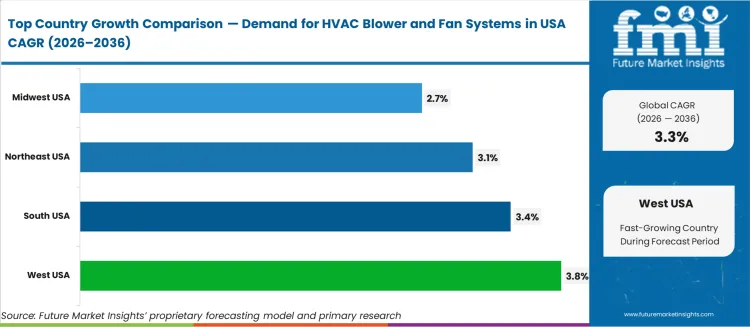
Demand for HVAC blower and fan systems in the USA is growing steadily, with West USA leading at a 3.8% CAGR, driven by strong commercial and residential construction, as well as a focus on energy-efficient solutions. South USA follows with a 3.4% CAGR, fueled by the region's hot climate and the increasing adoption of energy-efficient HVAC systems in both new builds and retrofitting projects. Northeast USA shows a 3.1% CAGR, supported by the need to upgrade older buildings and meet stricter energy efficiency regulations. Midwest USA experiences a 2.7% CAGR, with steady growth driven by the region’s manufacturing sector and the need for year-round HVAC solutions.
How is Demand for HVAC Blower and Fan Systems Growing in West USA?
West USA leads the demand for HVAC blower and fan systems, growing at a 3.8% CAGR. The region’s robust commercial and residential construction sectors are major drivers of growth, with cities like Los Angeles and San Francisco undergoing significant infrastructure development. As urbanization increases, the demand for HVAC systems that provide enhanced air circulation, comfort, and energy savings is growing. The rising focus on sustainability and energy-efficient building technologies in West USA is boosting the adoption of advanced HVAC systems. The demand for green building solutions and eco-friendly HVAC components is accelerating, as both new constructions and retrofitting projects prioritize energy-saving systems. Stringent energy efficiency regulations also play a significant role in driving growth, as both residential and commercial sectors aim to meet sustainability goals. As consumers and businesses continue to prioritize energy-efficient solutions, HVAC blower and fan systems are expected to see steady growth in West USA.
Why is Demand for HVAC Blower and Fan Systems Rising in South USA?
South USA is experiencing a steady demand for HVAC blower and fan systems, with a 3.4% CAGR. The region's hot climate makes HVAC systems essential, particularly in residential and commercial buildings where cooling requirements are high. As the population grows and urbanization accelerates in cities like Houston, Dallas, and Miami, the need for reliable and energy-efficient HVAC solutions is increasing. The demand for HVAC blower and fan systems is further driven by a strong construction sector, where energy-efficient cooling and heating systems are being prioritized. As consumers adopt smart home technologies, there is also rising demand for HVAC systems that integrate with automation platforms, offering greater control over energy use and comfort. With a focus on sustainable, green building practices, both residential and commercial developments are adopting advanced HVAC solutions to meet energy efficiency goals. The growing trend toward energy-conscious living continues to propel demand for HVAC systems in the South.
How is Demand for HVAC Blower and Fan Systems Expanding in Northeast USA?
Northeast USA is seeing steady demand for HVAC blower and fan systems, with a 3.1% CAGR. The region’s older building stock, especially in cities like New York and Boston, requires significant upgrades to meet modern energy efficiency standards. With cold winters and fluctuating temperatures, HVAC systems are crucial for maintaining comfort, increasing demand for efficient heating and cooling solutions. Retrofitting existing buildings with energy-efficient HVAC blower and fan systems is a key growth driver in this region. There is also a growing focus on sustainability, as both residential and commercial properties prioritize eco-friendly, low-energy solutions. Stricter building codes and regulations regarding energy efficiency are pushing the adoption of advanced HVAC systems that offer improved air circulation and lower operational costs. As the demand for smart, energy-efficient solutions rises, especially for temperature control and air quality in urban areas, the HVAC sector in Northeast USA is expected to continue expanding steadily.
Why is Demand for HVAC Blower and Fan Systems Growing in Midwest USA?
Midwest USA is experiencing moderate demand for HVAC blower and fan systems, with a 2.7% CAGR. The region’s manufacturing and industrial sectors are key drivers, where HVAC systems are essential for maintaining air quality and controlling temperatures in factories and commercial buildings. The fluctuating climate in the Midwest, with cold winters and hot summers, increases the demand for efficient heating and cooling systems that can handle extreme temperatures year-round. While growth is slower compared to other regions, steady population growth and urban expansion in cities like Chicago and Detroit contribute to the demand for HVAC blower and fan systems. The growing focus on energy efficiency is driving the adoption of advanced HVAC solutions, especially in new construction and building retrofits. As businesses and homeowners seek to reduce energy costs and improve indoor comfort, the demand for these systems is expected to grow steadily. HVAC systems that promote both heating and cooling efficiency will continue to be in demand in this region.
What is the Competitive Landscape of HVAC Blower and Fan Systems Demand in USA?
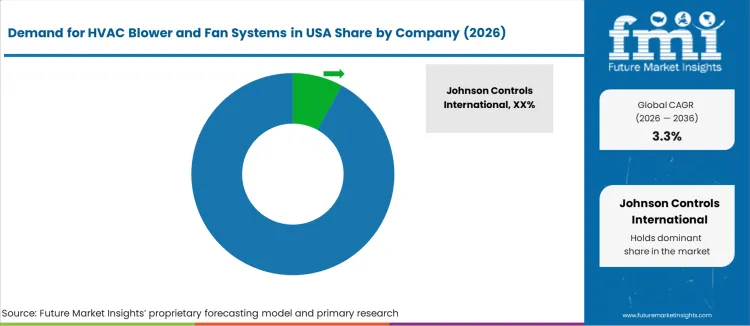
Demand for HVAC blower and fan systems in the USA is rising, driven by increasing construction activity, industrial expansion, and the growing focus on energy-efficient and sustainable heating, ventilation, and air conditioning solutions. HVAC systems are essential for maintaining indoor air quality and temperature control in residential, commercial, and industrial settings. As energy efficiency becomes a higher priority, consumers and businesses are increasingly opting for advanced blower and fan systems that reduce energy consumption while ensuring reliable performance. Johnson Controls International and Ziehl-Abegg SE are recognized for their advanced technologies and high-performance systems. They focus on delivering customized solutions that prioritize energy efficiency and quiet operation, catering to both commercial and industrial needs. Air System Components, Inc. and Vent-Axia Group Limited target specific niches, with a strong emphasis on cost-effective solutions and localized manufacturing. These companies continue to innovate by integrating smart technologies and sustainable materials into their products. As competition intensifies, the key to success lies in offering versatile, energy-efficient, and high-performance blower and fan systems that meet the evolving demands of the HVAC industry.
Key Players in USA HVAC Blower and Fan Systems Demand
- Loren Cook Company
- Johnson Controls International
- Ziehl-Abegg SE
- Air System Components, Inc.
- Vent-Axia Group Limited
Scope of the Report
| Metric | Value |
|---|---|
| Quantitative Units | USD 531.48 million to USD 735.34 million, at a CAGR of 3.3% |
| Market Definition | HVAC blower and fan systems for the US market comprise centrifugal fans, axial fans, backward inclined fans, and mixed-flow blower assemblies installed within heating, ventilation, and air conditioning infrastructure. These systems serve as air movement components in commercial HVAC installations, industrial ventilation systems, and residential forced-air equipment deployed across diverse US climate zones from arid western states to humid southeastern regions. |
| Product Type Segmentation | Centrifugal, Backward Inclined Fan-based, Axial, Other Product Types |
| End Use Segmentation | Industrial, Commercial, Residential |
| Regions Covered | North America, Latin America, Europe, East Asia, South Asia, Oceania, Middle East & Africa |
| Countries Covered | West USA, South USA, Northeast USA, Midwest USA, and 40 plus countries |
| Key Companies Profiled | Johnson Controls International, Loren Cook Company, Ziehl-Abegg SE, Air System Components, Inc., Vent-Axia Group Limited |
| Forecast Period | 2026 to 2036 |
| Approach | Baseline values derive from a bottom-up aggregation of HVAC fan and blower unit shipments and average selling prices, applying building construction activity and equipment replacement cycle assumptions across US regions. |
USA HVAC Blower and Fan Systems Demand by Key Segments
Product Type
- Centrifugal
- Backward Inclined Fan-based
- Axial
- Other Product Types
End Use
- Industrial
- Commercial
- Residential
Region
- West USA
- South USA
- Northeast USA
- Midwest USA
Bibliography
- Air-Conditioning, Heating, and Refrigeration Institute (AHRI). (2025). AHRI Equipment Certification Statistics: Fan and Blower Category. AHRI.
- American Society of Heating, Refrigerating and Air-Conditioning Engineers. (2024). ASHRAE Standard 90.1: Energy Standard for Buildings. ASHRAE.
- United States Department of Energy. (2024). DOE Energy Conservation Standards: Commercial and Industrial Fan Efficiency. DOE.
- Johnson Controls International. (2025). Johnson Controls Annual Report: Building Technologies Revenue in North America. JCI.
- US Census Bureau. (2025). Construction Spending: Commercial and Industrial Building Activity. Census Bureau.
- International Energy Agency. (2024). IEA Energy Efficiency: Building Sector HVAC Energy Consumption in North America. IEA.
This bibliography is provided for reader reference. The full Future Market Insights report contains the complete reference list with primary research documentation.
Frequently Asked Questions
How large is the demand for HVAC fans in the USA in 2026?
Demand is estimated at USD 531.48 million in 2026.
What will the market size be by 2036?
Market size is projected to reach USD 735.34 million by 2036.
What is the expected CAGR?
3.3% CAGR between 2026 and 2036.
Which Product Type leads by 2026?
Centrifugal accounts for 42.0% share in 2026.
How significant is Industrial end use?
Industrial holds 48.0% of end use share.
Which region grows fastest?
The West leads at 3.8% CAGR driven by data center and commercial construction.
What drives demand in the Northeast?
Aging commercial building HVAC retrofit programs sustain a 3.1% CAGR.
Preview the report firsthand - request a free sample
Get SampleGet the brochure for pricing and purchase details.
Get PDFTable of Content
- Executive Summary
- Global Market Outlook
- Demand-side Trends
- Supply-side Trends
- Technology Roadmap Analysis
- Analysis and Recommendations
- Market Overview
- Market Coverage / Taxonomy
- Market Definition / Scope / Limitations
- Research Methodology
- Chapter Orientation
- Analytical Lens and Working Hypotheses
- Market Structure, Signals, and Trend Drivers
- Benchmarking and Cross-market Comparability
- Market Sizing, Forecasting, and Opportunity Mapping
- Research Design and Evidence Framework
- Desk Research Programme (Secondary Evidence)
- Company Annual and Sustainability Reports
- Peer-reviewed Journals and Academic Literature
- Corporate Websites, Product Literature, and Technical Notes
- Earnings Decks and Investor Briefings
- Statutory Filings and Regulatory Disclosures
- Technical White Papers and Standards Notes
- Trade Journals, Industry Magazines, and Analyst Briefs
- Conference Proceedings, Webinars, and Seminar Materials
- Government Statistics Portals and Public Data Releases
- Press Releases and Reputable Media Coverage
- Specialist Newsletters and Curated Briefings
- Sector Databases and Reference Repositories
- FMI Internal Proprietary Databases and Historical Market Datasets
- Subscription Datasets and Paid Sources
- Social Channels, Communities, and Digital Listening Inputs
- Additional Desk Sources
- Expert Input and Fieldwork (Primary Evidence)
- Primary Modes
- Qualitative Interviews and Expert Elicitation
- Quantitative Surveys and Structured Data Capture
- Blended Approach
- Why Primary Evidence is Used
- Field Techniques
- Interviews
- Surveys
- Focus Groups
- Observational and In-context Research
- Social and Community Interactions
- Stakeholder Universe Engaged
- C-suite Leaders
- Board Members
- Presidents and Vice Presidents
- R&D and Innovation Heads
- Technical Specialists
- Domain Subject-matter Experts
- Scientists
- Physicians and Other Healthcare Professionals
- Governance, Ethics, and Data Stewardship
- Research Ethics
- Data Integrity and Handling
- Primary Modes
- Tooling, Models, and Reference Databases
- Desk Research Programme (Secondary Evidence)
- Data Engineering and Model Build
- Data Acquisition and Ingestion
- Cleaning, Normalisation, and Verification
- Synthesis, Triangulation, and Analysis
- Quality Assurance and Audit Trail
- Market Background
- Market Dynamics
- Drivers
- Restraints
- Opportunity
- Trends
- Scenario Forecast
- Demand in Optimistic Scenario
- Demand in Likely Scenario
- Demand in Conservative Scenario
- Opportunity Map Analysis
- Product Life Cycle Analysis
- Supply Chain Analysis
- Investment Feasibility Matrix
- Value Chain Analysis
- PESTLE and Porter’s Analysis
- Regulatory Landscape
- Regional Parent Market Outlook
- Production and Consumption Statistics
- Import and Export Statistics
- Market Dynamics
- Global Market Analysis 2021 to 2025 and Forecast, 2026 to 2036
- Historical Market Size Value (USD Million) Analysis, 2021 to 2025
- Current and Future Market Size Value (USD Million) Projections, 2026 to 2036
- Y-o-Y Growth Trend Analysis
- Absolute $ Opportunity Analysis
- Global Market Pricing Analysis 2021 to 2025 and Forecast 2026 to 2036
- Global Market Analysis 2021 to 2025 and Forecast 2026 to 2036, By Product Type
- Introduction / Key Findings
- Historical Market Size Value (USD Million) Analysis By Product Type , 2021 to 2025
- Current and Future Market Size Value (USD Million) Analysis and Forecast By Product Type , 2026 to 2036
- Centrifugal
- Backward Inclined Fan-based
- Axial
- Other Product Types
- Centrifugal
- Y-o-Y Growth Trend Analysis By Product Type , 2021 to 2025
- Absolute $ Opportunity Analysis By Product Type , 2026 to 2036
- Global Market Analysis 2021 to 2025 and Forecast 2026 to 2036, By End Use
- Introduction / Key Findings
- Historical Market Size Value (USD Million) Analysis By End Use, 2021 to 2025
- Current and Future Market Size Value (USD Million) Analysis and Forecast By End Use, 2026 to 2036
- Industrial
- Commercial
- Residential
- Industrial
- Y-o-Y Growth Trend Analysis By End Use, 2021 to 2025
- Absolute $ Opportunity Analysis By End Use, 2026 to 2036
- Global Market Analysis 2021 to 2025 and Forecast 2026 to 2036, By Region
- Introduction
- Historical Market Size Value (USD Million) Analysis By Region, 2021 to 2025
- Current Market Size Value (USD Million) Analysis and Forecast By Region, 2026 to 2036
- North America
- Latin America
- Western Europe
- Eastern Europe
- East Asia
- South Asia and Pacific
- Middle East & Africa
- Market Attractiveness Analysis By Region
- North America Market Analysis 2021 to 2025 and Forecast 2026 to 2036, By Country
- Historical Market Size Value (USD Million) Trend Analysis By Market Taxonomy, 2021 to 2025
- Market Size Value (USD Million) Forecast By Market Taxonomy, 2026 to 2036
- By Country
- USA
- Canada
- Mexico
- By Product Type
- By End Use
- By Country
- Market Attractiveness Analysis
- By Country
- By Product Type
- By End Use
- Key Takeaways
- Latin America Market Analysis 2021 to 2025 and Forecast 2026 to 2036, By Country
- Historical Market Size Value (USD Million) Trend Analysis By Market Taxonomy, 2021 to 2025
- Market Size Value (USD Million) Forecast By Market Taxonomy, 2026 to 2036
- By Country
- Brazil
- Chile
- Rest of Latin America
- By Product Type
- By End Use
- By Country
- Market Attractiveness Analysis
- By Country
- By Product Type
- By End Use
- Key Takeaways
- Western Europe Market Analysis 2021 to 2025 and Forecast 2026 to 2036, By Country
- Historical Market Size Value (USD Million) Trend Analysis By Market Taxonomy, 2021 to 2025
- Market Size Value (USD Million) Forecast By Market Taxonomy, 2026 to 2036
- By Country
- Germany
- UK
- Italy
- Spain
- France
- Nordic
- BENELUX
- Rest of Western Europe
- By Product Type
- By End Use
- By Country
- Market Attractiveness Analysis
- By Country
- By Product Type
- By End Use
- Key Takeaways
- Eastern Europe Market Analysis 2021 to 2025 and Forecast 2026 to 2036, By Country
- Historical Market Size Value (USD Million) Trend Analysis By Market Taxonomy, 2021 to 2025
- Market Size Value (USD Million) Forecast By Market Taxonomy, 2026 to 2036
- By Country
- Russia
- Poland
- Hungary
- Balkan & Baltic
- Rest of Eastern Europe
- By Product Type
- By End Use
- By Country
- Market Attractiveness Analysis
- By Country
- By Product Type
- By End Use
- Key Takeaways
- East Asia Market Analysis 2021 to 2025 and Forecast 2026 to 2036, By Country
- Historical Market Size Value (USD Million) Trend Analysis By Market Taxonomy, 2021 to 2025
- Market Size Value (USD Million) Forecast By Market Taxonomy, 2026 to 2036
- By Country
- China
- Japan
- South Korea
- By Product Type
- By End Use
- By Country
- Market Attractiveness Analysis
- By Country
- By Product Type
- By End Use
- Key Takeaways
- South Asia and Pacific Market Analysis 2021 to 2025 and Forecast 2026 to 2036, By Country
- Historical Market Size Value (USD Million) Trend Analysis By Market Taxonomy, 2021 to 2025
- Market Size Value (USD Million) Forecast By Market Taxonomy, 2026 to 2036
- By Country
- India
- ASEAN
- Australia & New Zealand
- Rest of South Asia and Pacific
- By Product Type
- By End Use
- By Country
- Market Attractiveness Analysis
- By Country
- By Product Type
- By End Use
- Key Takeaways
- Middle East & Africa Market Analysis 2021 to 2025 and Forecast 2026 to 2036, By Country
- Historical Market Size Value (USD Million) Trend Analysis By Market Taxonomy, 2021 to 2025
- Market Size Value (USD Million) Forecast By Market Taxonomy, 2026 to 2036
- By Country
- Kingdom of Saudi Arabia
- Other GCC Countries
- Turkiye
- South Africa
- Other African Union
- Rest of Middle East & Africa
- By Product Type
- By End Use
- By Country
- Market Attractiveness Analysis
- By Country
- By Product Type
- By End Use
- Key Takeaways
- Key Countries Market Analysis
- USA
- Pricing Analysis
- Market Share Analysis, 2025
- By Product Type
- By End Use
- Canada
- Pricing Analysis
- Market Share Analysis, 2025
- By Product Type
- By End Use
- Mexico
- Pricing Analysis
- Market Share Analysis, 2025
- By Product Type
- By End Use
- Brazil
- Pricing Analysis
- Market Share Analysis, 2025
- By Product Type
- By End Use
- Chile
- Pricing Analysis
- Market Share Analysis, 2025
- By Product Type
- By End Use
- Germany
- Pricing Analysis
- Market Share Analysis, 2025
- By Product Type
- By End Use
- UK
- Pricing Analysis
- Market Share Analysis, 2025
- By Product Type
- By End Use
- Italy
- Pricing Analysis
- Market Share Analysis, 2025
- By Product Type
- By End Use
- Spain
- Pricing Analysis
- Market Share Analysis, 2025
- By Product Type
- By End Use
- France
- Pricing Analysis
- Market Share Analysis, 2025
- By Product Type
- By End Use
- India
- Pricing Analysis
- Market Share Analysis, 2025
- By Product Type
- By End Use
- ASEAN
- Pricing Analysis
- Market Share Analysis, 2025
- By Product Type
- By End Use
- Australia & New Zealand
- Pricing Analysis
- Market Share Analysis, 2025
- By Product Type
- By End Use
- China
- Pricing Analysis
- Market Share Analysis, 2025
- By Product Type
- By End Use
- Japan
- Pricing Analysis
- Market Share Analysis, 2025
- By Product Type
- By End Use
- South Korea
- Pricing Analysis
- Market Share Analysis, 2025
- By Product Type
- By End Use
- Russia
- Pricing Analysis
- Market Share Analysis, 2025
- By Product Type
- By End Use
- Poland
- Pricing Analysis
- Market Share Analysis, 2025
- By Product Type
- By End Use
- Hungary
- Pricing Analysis
- Market Share Analysis, 2025
- By Product Type
- By End Use
- Kingdom of Saudi Arabia
- Pricing Analysis
- Market Share Analysis, 2025
- By Product Type
- By End Use
- Turkiye
- Pricing Analysis
- Market Share Analysis, 2025
- By Product Type
- By End Use
- South Africa
- Pricing Analysis
- Market Share Analysis, 2025
- By Product Type
- By End Use
- USA
- Market Structure Analysis
- Competition Dashboard
- Competition Benchmarking
- Market Share Analysis of Top Players
- By Regional
- By Product Type
- By End Use
- Competition Analysis
- Competition Deep Dive
- Johnson Controls International
- Overview
- Product Portfolio
- Profitability by Market Segments (Product/Age /Sales Channel/Region)
- Sales Footprint
- Strategy Overview
- Marketing Strategy
- Product Strategy
- Channel Strategy
- Loren Cook Company
- Ziehl-Abegg SE
- Air System Components, Inc.
- Vent-Axia Group Limited
- Johnson Controls International
- Competition Deep Dive
- Assumptions & Acronyms Used


