

- Industry Size (2026)
- USD 75.00 Mn
- Forecast (2036)
- USD 96.95 Mn
- CAGR (2026 to 2036)
- 2.6%
Demand for HVAC Blower and Fan Systems in Japan Market Size, Market Forecast and Outlook By FMI
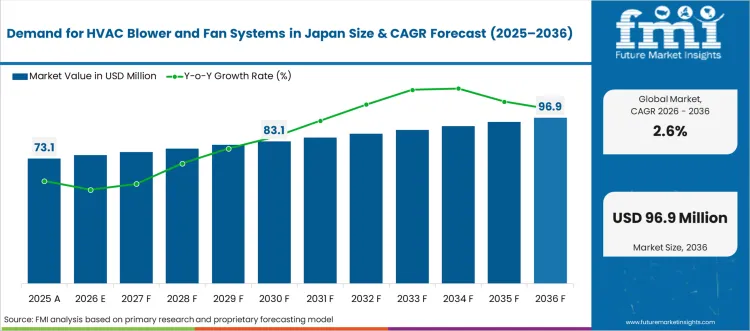
Demand for HVAC blower and fan systems in Japan was valued at USD 73.10 million in 2025, projected to reach USD 75.00 million in 2026, and is forecast to expand to USD 96.95 million by 2036 at a 2.6% CAGR. As per FMI, Japan's mature HVAC infrastructure generates steady replacement demand while building energy efficiency regulations drive specification upgrades toward high-efficiency EC motor fan systems that command higher unit values than legacy AC motor equivalents.
Summary of Demand for HVAC Blower and Fan Systems in Japan
- Market Snapshot
- Demand for HVAC blower and fan systems in Japan is valued at USD 73.10 million in 2025 and is projected to reach USD 96.95 million by 2036.
- The market is expected to grow at a 2.6% CAGR from 2026 to 2036, creating an incremental opportunity of USD 21.95 million.
- The market operates as a mature replacement-driven equipment category where AC-to-EC motor technology transition drives value growth above volume growth.
- Demand and Growth Drivers
- Demand is sustained by replacement cycles across Japan's mature HVAC infrastructure base, with building owners upgrading legacy AC motor fans to EC motor alternatives.
- Building energy conservation targets create specification-driven procurement upgrades that raise average unit values.
- Commercial building renovation activity in metropolitan areas generates steady HVAC equipment retrofit demand.
- Among key regions, Kyushu & Okinawa leads at 3.3% CAGR, followed by Kanto at 3.0%, Kansai at 2.7%, and Chubu at 2.3%.
- Product and Segment View
- The market includes centrifugal fans, backward inclined fans, axial fans, and mixed-flow blower assemblies for HVAC applications.
- Centrifugal leads by product type with 42.0% share in 2026.
- Industrial leads by end use with 48.0% share in 2026.
- The scope excludes process fans outside HVAC, standalone exhaust fans, and electronic cooling devices.
- Geography and Competitive Outlook
- Kanto (Tokyo) represents the largest value market from commercial building density, while Kyushu & Okinawa demonstrates the fastest growth from year-round ventilation demand.
- Competition is shaped by EC motor efficiency, noise reduction, and legacy ductwork compatibility, with key players including Johnson Controls International, Loren Cook Company, Ziehl-Abegg SE, and Air System Components.
- Technology differentiation centers on EC motor integration and IoT-enabled predictive maintenance capability.
- Analyst Opinion at FMI
- Nikhil Kaitwade, Principal Consultant at Future Market Insights, opines: 'In my analysis, I have observed that Japan's HVAC fan market presents a value growth opportunity disguised as a mature replacement market. While unit volumes grow modestly, the transition from AC to EC motor fan systems raises average selling prices by 30% to 50% per unit, creating a revenue growth rate that exceeds volume growth. Building owners who delay this motor technology transition face compounding energy cost penalties as Japan's electricity prices remain elevated. The procurement decision is increasingly economic rather than regulatory: EC fans pay for themselves within 24 to 36 months through energy savings alone.'
- Strategic Implications / Executive Takeaways
- HVAC system integrators should position EC motor fan upgrades as cost-reduction projects with quantifiable energy savings payback periods rather than regulatory compliance expenditures, accelerating building owner approval of retrofit capital budgets.
- Fan manufacturers must maintain compatibility with legacy Japanese ductwork configurations to capture the retrofit market, as building owners will not approve combined fan replacement and ductwork modification projects when fan-only upgrades deliver sufficient efficiency gains.
- Commercial building facility managers in Kanto and Kansai should schedule fan replacement programs to coincide with planned HVAC maintenance shutdowns, minimizing operational disruption while capturing energy efficiency improvements before the next building energy audit cycle.
Demand for HVAC Blower and Fan Systems in Japan Key Takeaways
| Metric | Details |
|---|---|
| Industry Size (2026) | USD 75.00 million |
| Industry Value (2036) | USD 96.95 million |
| CAGR (2026-2036) | 2.6% |
Source: Future Market Insights, 2026
The Japanese HVAC fan market is characterized by a mature installed base where replacement and retrofit procurement dominates new installation demand. Building owners are upgrading legacy AC motor fan systems to electronically commutated (EC) motor alternatives that deliver measurable energy savings aligned with Japan's building energy conservation targets. This technology transition raises average selling prices per unit while maintaining stable volume demand, creating a value growth trajectory that exceeds the modest unit volume growth rate.
Kyushu and Okinawa lead regional expansion at a 3.3% CAGR through 2036, driven by subtropical climate conditions requiring year-round ventilation and cooling fan operation. Kanto follows at 3.0%, fueled by Tokyo metropolitan commercial building renovation activity. Kansai registers 2.7% growth anchored by Osaka commercial district HVAC modernization. Chubu expands at 2.3% driven by manufacturing facility ventilation requirements. Tohoku tracks at 2.0%, and the rest of Japan at 1.9%.
Demand for HVAC Blower and Fan Systems in Japan Market Definition
HVAC blower and fan systems for the Japanese market comprise centrifugal fans, axial fans, backward inclined fans, and mixed-flow blower assemblies installed within heating, ventilation, and air conditioning infrastructure to move conditioned air through ductwork and building spaces. These systems serve as the primary air movement components in commercial HVAC installations, industrial ventilation systems, and residential forced-air heating and cooling equipment deployed across Japan's diverse climate zones.
Demand for HVAC Blower and Fan Systems in Japan Market Inclusions
Market scope covers centrifugal blowers, axial fans, backward inclined fans, mixed-flow blower units, and associated motor drive assemblies sold for HVAC applications within Japan. Coverage spans regional market sizes for the 2026 to 2036 forecast period, segmented by product type, end use, and sub-national region.
Demand for HVAC Blower and Fan Systems in Japan Market Exclusions
The scope excludes process fans used in industrial manufacturing operations outside HVAC applications, standalone exhaust fans not integrated into HVAC systems, and computer cooling fans or other electronic thermal management devices.
Demand for HVAC Blower and Fan Systems in Japan Market Research Methodology
- Primary Research: Analysts conducted structured interviews with HVAC system integrators, commercial building facility managers, and industrial ventilation engineers in Japan to map fan specification requirements and replacement cycles.
- Desk Research: Publicly available building code energy efficiency requirements, HVAC equipment shipment statistics from JRAIA, and fan manufacturer annual reports provided foundational benchmarks.
- Market-Sizing and Forecasting: Baseline values derive from a bottom-up aggregation of HVAC fan and blower unit shipments and average selling prices, applying building construction activity and equipment replacement cycle assumptions.
- Data Validation and Update Cycle: Projections are tested against Japan Refrigeration and Air Conditioning Industry Association equipment shipment data and cross-referenced with commercial construction activity indicators.
What Is Driving the Demand for HVAC Blower and Fan Systems in Japan Across Historical and Future Growth Cycles?
Demand for HVAC blower and fan systems in Japan expanded in parallel with growth in HVAC installations across commercial buildings, apartments, offices, and schools. Widespread adoption of ventilation and air-conditioning in post-war urban development increased use of blower and fan components in air-handling units (AHUs), duct systems, and packaged HVAC equipment. Industrial facilities, retail outlets, and public buildings adopted ventilation fans to maintain indoor air quality under Japan’s dense urban and humid climate conditions. Demand relied on mechanical reliability, standardized fan performance, and compatibility with domestic HVAC brands. Procurement followed building construction cycles, system upgrades, and maintenance-driven replacement intervals. Japanese HVAC suppliers, often integrated with broader HVAC manufacturers, provided many of these blower and fan systems under well-established supply-chain relationships.
Future demand for blower and fan systems in Japan is expected to grow under increasing regulatory pressure for energy efficiency, indoor air quality standards, and compact building design. National policies promoting energy efficient buildings and reduced greenhouse-gas emissions drive adoption of more efficient, inverter-controlled fan systems and compact AHU units. Urban redevelopment, smaller apartments and mixed-use buildings create demand for space-saving, low-noise blower solutions. Smart-building and IoT integration encourage variable-speed, demand-controlled ventilation to optimize airflow, reduce energy consumption, and meet air-quality regulations. Demand also rises in data centers, cleanrooms, and specialized facilities where precise airflow and cooling control are essential. Growth will depend on improvements in fan motor efficiency, digital controls, and modular HVAC integration across varied building types nationwide.
What Is the Demand for HVAC Blower and Fan Systems in Japan by Product Type and End Use?
The demand for HVAC blower and fan systems in Japan is shaped by factory ventilation needs, dense commercial building stock, and strict indoor air quality control practices. Centrifugal systems lead by product type due to their ability to maintain pressure across long duct networks. Industrial use leads by end use because manufacturing plants, clean rooms, and process facilities require continuous airflow control. Procurement is driven by mechanical contractors, plant engineering firms, and building services integrators. Import reliance remains present for high efficiency motors and control inverters. Substitution pressure exists from compact axial units in low pressure layouts. Demand stability is supported by ongoing factory upgrades and commercial retrofitting programs.
Why do centrifugal systems account for 42% of the demand for HVAC blower and fan systems in Japan by product type?
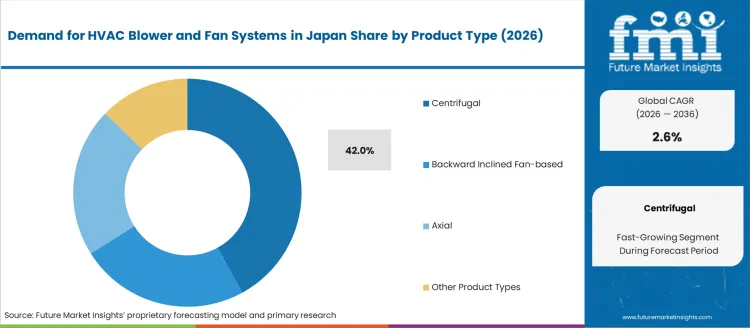
Centrifugal systems account for 42% of the demand for HVAC blower and fan systems in Japan by product type, reflecting their suitability for high pressure and long duct ventilation. Consumption intensity is driven by factories, hospitals, large office buildings, and underground facilities that require steady airflow over extended distances. Usage remains stable because centrifugal units maintain performance under variable load and continuous operation. Procurement is led by HVAC system integrators and industrial equipment suppliers. Price sensitivity remains moderate because pressure stability affects overall system efficiency. Specification control emphasizes impeller balance, casing strength, vibration resistance, and airflow uniformity under continuous duty.
Centrifugal systems also generate steady repeat demand through plant expansion projects and scheduled equipment replacement. Repeat utilization remains predictable as fans operate across multiyear service cycles. Buyers favor standardized housing sizes to simplify duct compatibility and maintenance access. Margin structure remains controlled under competitive bidding among regional and international fan manufacturers. Regulatory exposure centers on energy efficiency labeling and workplace ventilation standards. Import reliance persists for precision bearings and variable frequency drives. Substitution pressure from backward inclined fan designs exists in space constrained installations.
Why does industrial use represent 48.0% of the demand for HVAC blower and fan systems in Japan by end use?
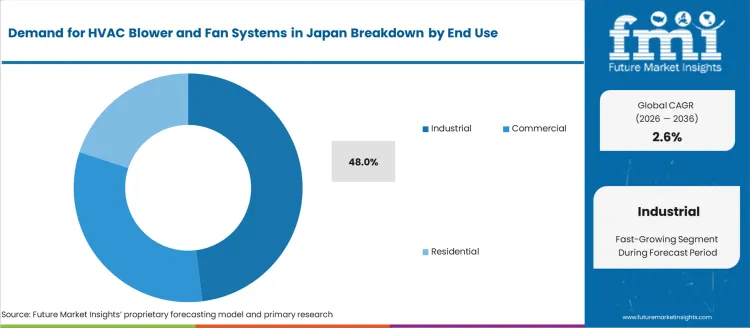
Industrial use represents 48.0% of the demand for HVAC blower and fan systems in Japan by end use, reflecting heavy airflow requirements across manufacturing and processing facilities. Consumption intensity is driven by automotive plants, electronics factories, pharmaceuticals, and food processing units where air movement supports temperature control and contamination management. Usage remains stable because ventilation is tied to continuous production operation. Procurement is dominated by plant engineering teams and industrial project contractors. Price sensitivity remains moderate because airflow failure directly disrupts production. Specification control emphasizes corrosion resistance, thermal endurance, continuous runtime stability, and compatibility with automated control systems.
Industrial HVAC fan demand also generates consistent repeat volume through factory modernization and capacity additions. Repeat utilization remains predictable as older ventilation systems are replaced to meet updated safety and efficiency standards. Buyers favor robust designs that minimize downtime and unscheduled maintenance. Margin structure remains controlled under long term supply agreements. Regulatory exposure remains elevated due to occupational safety, emissions handling, and energy use compliance. Import reliance persists for specialty coatings and high efficiency motor assemblies. Substitution pressure from commercial grade systems remains limited due to lower durability ratings.
What Is Driving the Demand for HVAC Blower and Fan Systems in Japan Indoor Air Control and Building Renewal?
Demand for HVAC blower and fan systems in Japan reflects dense building stock, humid summers, and strict indoor air control standards. Offices, rail stations, hospitals, and data rooms require continuous airflow for temperature balance and equipment protection. Residential towers rely on compact high static pressure fans for limited duct space. Energy efficiency rules guide motor selection and variable speed operation. Earthquake resilience planning favors systems that restart smoothly after power recovery. Urban heat island effects raise cooling load across long summer periods. Demand follows renovation cycles in aging buildings, public facility upgrades, and replacement of legacy motors with quiet assemblies.
How Is Urban Commercial Retrofitting Influencing Blower and Fan Demand in Japan?
Urban retrofitting programs across Japan replace aging ventilation in offices, retail blocks, and transport facilities. Older buildings require higher pressure fans to overcome narrow shafts and extended duct routing. Property owners focus on noise reduction to suit mixed residential and commercial zones. Variable airflow control supports changing occupancy patterns through the day. Maintenance teams favor modular fan walls that allow service without system shutdown. Demand rises through mandatory energy audits tied to renovation permits. Equipment selection aligns with fire safety codes and smoke exhaust performance. This retrofit driven cycle creates steady orders independent of new construction volume across business districts.
Why Do Hospitals, Cleanrooms, and Laboratories Shape System Specifications in Japan?
Medical and research facilities in Japan depend on precise airflow control to manage infection risk and particulate concentration. Operating rooms, isolation wards, and pharmaceutical suites require stable pressure differentials across zones. Blower systems must sustain constant volume under filter loading changes. Vibration control protects imaging equipment and sensitive instruments. Quiet operation supports patient recovery and staff concentration. Redundant fan arrays secure airflow during maintenance or electrical disturbance. Procurement teams specify corrosion resistant materials for chemical exposure environments. Demand links to hospital rebuilding programs, biosafety compliance, and expansion of diagnostic and biologic production capacity within regulated indoor environments nationwide today operations.
How Do Energy Policy, Noise Control, and Service Access Limit System Choices in Japan?
HVAC blower and fan deployment in Japan faces boundaries set by power consumption targets, acoustic limits, and service accessibility in compact buildings. Utility cost discipline drives adoption of high efficiency motors with inverter control. Neighborhood noise rules restrict night time operation levels for rooftop units. Tight equipment rooms complicate bearing service and belt replacement. Skilled maintenance labor remains limited in regional cities. Import lead times affect spare availability during peak summer demand. These constraints narrow acceptable product design choices. Buyers prioritize long life bearings, sealed motors, and remote monitoring features to secure stable operation under dense urban conditions nationwide today.
What is the Demand for HVAC Blower and Fan Systems in Japan by Region?
.webp "Top Country Growth Comparison Demand For Hvac Blower And Fan Systems In Japan Cagr (2026 2036)")
| Region | CAGR (%) |
|---|---|
| Kyushu & Okinawa | 3.3% |
| Kanto | 3.0% |
| Kansai | 2.7% |
| Chubu | 2.3% |
| Tohoku | 2.0% |
| Rest of Japan | 1.9% |
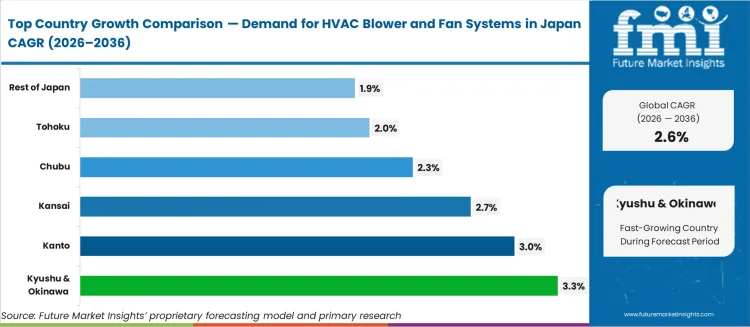
The demand for HVAC blower and fan systems in Japan is increasing at a steady pace across building services and industrial facilities, led by Kyushu and Okinawa at a 3.3% CAGR. Growth in this region is supported by resort infrastructure development, hotel refurbishments, and rising cooling demand in coastal climates. Kanto follows at 3.0%, driven by dense commercial buildings, office retrofits, and consistent replacement demand in data centers and transit infrastructure. Kansai records 2.7% growth, reflecting stable consumption across retail complexes and healthcare facilities. Chubu at 2.3% shows moderate uptake linked to manufacturing plant ventilation upgrades. Tohoku and the Rest of Japan, at 2.0% and 1.9%, reflect slower growth shaped by lower construction intensity, reduced cooling load requirements, and longer equipment replacement cycles.
How Are Coastal Climate Conditions Influencing HVAC Blower and Fan Demand in Kyushu and Okinawa?
Demand for HVAC blower and fan systems in Kyushu and Okinawa is advancing at a CAGR of 3.3% through 2036, supported by warm climate conditions, rising use of air conditioning in residential buildings, and steady growth in hospitality construction. Resorts, hospitals, and shopping facilities require continuous air circulation for comfort control. Equipment replacement cycles remain stable due to humidity driven wear on ventilation components. Growth reflects rising indoor cooling needs, consistent maintenance spending, and expansion of tourism linked infrastructure across coastal urban centers.
- Resort facilities sustain continuous equipment installation demand
- High humidity increases ventilation equipment replacement cycles
- Hospital construction supports steady system integration
- Retail space expansion adds commercial airflow requirements
Why Is High Building Density Sustaining HVAC Blower and Fan Growth in Kanto?
Demand for HVAC blower and fan systems in Kanto is rising at a CAGR of 3.0% through 2036, driven by dense commercial buildings, large scale residential towers, and heavy reliance on centralized air handling systems. Data centers, office complexes, and transport hubs require continuous air circulation for operational stability. Retrofit activity remains strong across aging building stock. Growth reflects strict indoor air quality control practices, steady real estate renovation activity, and strong demand for energy efficient airflow management across metropolitan infrastructure.
- Data centers anchor high capacity air handling demand
- Office building retrofits sustain equipment replacement
- Transport hubs require continuous airflow management
- Energy efficiency standards shape system upgrade decisions
What Is Supporting Balanced HVAC Airflow Equipment Adoption Across Kansai?
Demand for HVAC blower and fan systems in Kansai is progressing at a CAGR of 2.7% through 2036, supported by steady commercial construction, residential air conditioning penetration, and routine public building upgrades. Shopping malls, schools, and healthcare facilities rely on balanced airflow systems for thermal comfort. Equipment sales remain aligned with new construction and structured replacement schedules. Growth reflects stable urban development, controlled infrastructure spending, and ongoing demand for mid capacity air circulation equipment across mixed use properties.
- Educational buildings support routine system procurement
- Healthcare facilities apply steady airflow modernization
- Residential cooling supports consistent unit installations
- Public infrastructure renovation guides procurement timing
How Is Industrial and Logistics Activity Shaping HVAC Blower and Fan Demand in Chubu?
Demand for HVAC blower and fan systems in Chubu is advancing at a CAGR of 2.3% through 2036, supported by warehouse construction, factory ventilation needs, and controlled growth in commercial real estate. Manufacturing plants require airflow systems for temperature regulation and worker comfort. Distribution centers apply ventilation for heat management across storage areas. Growth reflects steady industrial output, selective automation driven airflow requirements, and phased equipment replacement programs across logistics corridors.
- Manufacturing plants require continuous temperature regulation
- Distribution centers rely on ventilation for heat control
- Factory safety standards support steady airflow equipment usage
- Selective automation shapes demand for controlled air handling
Why Is Public Infrastructure Investment Influencing HVAC Airflow Equipment Growth in Tohoku?
Demand for HVAC blower and fan systems in Tohoku is advancing at a CAGR of 2.0% through 2036, supported by public facility renovation, healthcare infrastructure maintenance, and stable residential replacement demand. Regional schools, civic buildings, and medical centers apply preventive maintenance programs for ventilation systems. New project activity remains limited. Growth reflects public budget allocation cycles, climate driven heating ventilation needs, and stable equipment servicing demand across essential service infrastructure.
- Public buildings rely on preventive ventilation maintenance
- Healthcare centers support stable system servicing
- Heating season airflow demand shapes winter replacement cycles
- Budget based procurement controls installation pace
How Is Small City Development Guiding HVAC Blower and Fan Demand in Rest of Japan?
Demand for HVAC blower and fan systems in Rest of Japan is advancing at a CAGR of 1.9% through 2036, supported by small commercial buildings, residential air conditioning use, and limited industrial facility upgrades. Independent retail outlets, clinics, and community housing projects rely on compact airflow equipment for basic thermal comfort. Large centralized systems remain limited. Growth remains steady and guided by household construction activity, periodic renovation projects, and gradual equipment replacement across small urban and semi-rural districts.
- Small commercial buildings rely on compact ventilation units
- Residential renovation supports routine equipment replacement
- Clinics and community centers anchor essential airflow demand
- Household construction activity shapes gradual installation growth
What Is Driving the Demand for HVAC Blower and Fan Systems in Japan and Which Companies Shape Building Integration
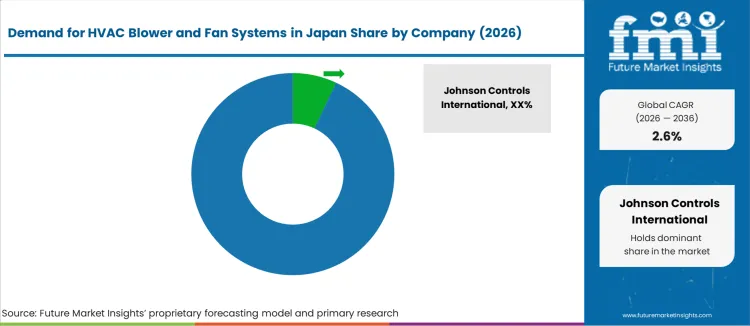
The demand for HVAC blower and fan systems in Japan is shaped by urban high rise construction, data center expansion, and strict indoor air quality control across commercial and healthcare buildings. Daikin Industries holds a central domestic position through integrated air handling units, variable air volume systems, and precision air systems used in offices, hospitals, and clean environments. Mitsubishi Electric supports demand through ventilation fans, commercial air handling modules, and building automation linked airflow control used in public and private infrastructure. Panasonic contributes through compact ventilation systems used in residential towers, schools, and retail facilities. These domestic suppliers anchor large scale deployment through close ties with construction firms, mechanical contractors, and prefectural building authorities.
Johnson Controls International participates through building management integrated blower and fan systems used in large commercial complexes and industrial facilities. Ziehl Abegg SE supports selected high efficiency fan installations used in data centers and transport ventilation projects. Loren Cook Company and Air System Components serve niche demand through industrial fans used in factories and process ventilation. Vent Axia Group Limited remains limited to imported specialty ventilation applications. System selection in Japan is governed by airflow efficiency, noise control in dense urban settings, seismic mounting compliance, and long cycle durability. Buyer preference favors suppliers with domestic service coverage, fast parts availability, and integration with Japanese building control systems. Demand visibility tracks commercial redevelopment, hospital modernization, data center construction, and tightening ventilation standards for public buildings.
Key Players in the HVAC Blower and Fan Systems in Japan
- Loren Cook Company
- Johnson Controls International
- Ziehl-Abegg SE
- Air System Components, Inc.
- Vent-Axia Group Limited
Scope of the Report
| Metric | Value |
|---|---|
| Quantitative Units | USD 75.00 million to USD 96.95 million, at a CAGR of 2.6% |
| Market Definition | HVAC blower and fan systems for the Japanese market comprise centrifugal fans, axial fans, backward inclined fans, and mixed-flow blower assemblies installed within heating, ventilation, and air conditioning infrastructure to move conditioned air through ductwork and building spaces. These systems serve as the primary air movement components in commercial HVAC installations, industrial ventilation systems, and residential forced-air heating and cooling equipment deployed across Japan's diverse climate zones. |
| Product Type Segmentation | Centrifugal, Backward Inclined Fan-based, Axial, Other Product Types |
| End Use Segmentation | Industrial, Commercial, Residential |
| Regions Covered | North America, Latin America, Europe, East Asia, South Asia, Oceania, Middle East & Africa |
| Countries Covered | Kyushu & Okinawa, Kanto, Kansai, Chubu, Tohoku, Rest of Japan, and 40 plus countries |
| Key Companies Profiled | Johnson Controls International, Loren Cook Company, Ziehl-Abegg SE, Air System Components, Inc., Vent-Axia Group Limited |
| Forecast Period | 2026 to 2036 |
| Approach | Baseline values derive from a bottom-up aggregation of HVAC fan and blower unit shipments and average selling prices, applying building construction activity and equipment replacement cycle assumptions. |
HVAC Blower and Fan Systems in Japan Segmentation
Product Type:
- Centrifugal
- Backward Inclined Fan-based
- Axial
- Other Product Types
End Use:
- Industrial
- Commercial
- Residential
Region:
- Kyushu & Okinawa
- Kanto
- Kansai
- Chubu
- Tohoku
- Rest of Japan
Bibliography
- Japan Refrigeration and Air Conditioning Industry Association (JRAIA). (2025). HVAC Equipment Shipment Statistics: Fan and Blower Category. JRAIA.
- Ministry of Economy, Trade and Industry, Japan. (2024). Top Runner Program: Energy Efficiency Standards for HVAC Equipment. METI.
- Ministry of Land, Infrastructure, Transport and Tourism. (2024). Building Energy Conservation Act: Commercial Building Compliance Requirements. MLIT.
- Johnson Controls International. (2025). Johnson Controls Annual Report: Building Technologies Revenue in Asia-Pacific. JCI.
- International Energy Agency. (2024). IEA Energy Efficiency: Building Sector HVAC Energy Consumption Analysis. IEA.
- Ziehl-Abegg SE. (2025). Ziehl-Abegg Annual Report: EC Motor Fan Revenue and Technology Development. Ziehl-Abegg.
This bibliography is provided for reader reference. The full Future Market Insights report contains the complete reference list with primary research documentation.
Frequently Asked Questions
How large is the demand for HVAC fans in Japan in 2026?
Demand is estimated at USD 75.00 million in 2026.
What will the market size be by 2036?
Market size is projected to reach USD 96.95 million by 2036.
What is the expected CAGR?
2.6% CAGR between 2026 and 2036.
Which Product Type leads by 2026?
Centrifugal accounts for 42.0% share in 2026.
How significant is the Industrial end use?
Industrial holds 48.0% of end use share.
Which region grows fastest?
Kyushu & Okinawa leads at 3.3% CAGR from year-round ventilation demand.
What drives demand in Kanto?
Tokyo metropolitan commercial building renovation activity sustains a 3.0% CAGR.
Preview the report firsthand - request a free sample
Get SampleGet the brochure for pricing and purchase details.
Get PDFTable of Content
- Executive Summary
- Global Market Outlook
- Demand-side Trends
- Supply-side Trends
- Technology Roadmap Analysis
- Market Coverage / Taxonomy
- Market Definition / Scope / Limitations
- Research Methodology
- Chapter Orientation
- Analytical Lens and Working Hypotheses
- Market Structure, Signals, and Trend Drivers
- Benchmarking and Cross-market Comparability
- Market Sizing, Forecasting, and Opportunity Mapping
- Research Design and Evidence Framework
- Desk Research Programme (Secondary Evidence)
- Company Annual and Sustainability Reports
- Peer-reviewed Journals and Academic Literature
- Corporate Websites, Product Literature, and Technical Notes
- Earnings Decks and Investor Briefings
- Statutory Filings and Regulatory Disclosures
- Technical White Papers and Standards Notes
- FMI Internal Proprietary Databases and Historical Market Datasets
- Subscription Datasets and Paid Sources
- Social Channels, Communities, and Digital Listening Inputs
- Additional Desk Sources
- Expert Input and Fieldwork (Primary Evidence)
- Primary Modes
- Qualitative Interviews and Expert Elicitation
- Quantitative Surveys and Structured Data Capture
- Blended Approach
- Why Primary Evidence is Used
- Field Techniques
- Interviews
- Surveys
- Focus Groups
- Observational and In-context Research
- Social and Community Interactions
- Stakeholder Universe Engaged
- C-suite Leaders
- Board Members
- Presidents and Vice Presidents
- R&D and Innovation Heads
- Technical Specialists
- Domain Subject-matter Experts
- Scientists
- Physicians and Other Healthcare Professionals
- Governance, Ethics, and Data Stewardship
- Research Ethics
- Data Integrity and Handling
- Primary Modes
- Tooling, Models, and Reference Databases
- Desk Research Programme (Secondary Evidence)
- Data Engineering and Model Build
- Data Acquisition and Ingestion
- Cleaning, Normalisation, and Verification
- Synthesis, Triangulation, and Analysis
- Quality Assurance and Audit Trail
- Market Background
- Market Dynamics
- Drivers
- Restraints
- Opportunity
- Trends
- Scenario Forecast
- Demand in Optimistic Scenario
- Demand in Likely Scenario
- Demand in Conservative Scenario
- Opportunity Map Analysis
- Product Life Cycle Analysis
- Supply Chain Analysis
- Investment Feasibility Matrix
- Value Chain Analysis
- PESTLE and Porter’s Analysis
- Regulatory Landscape
- Regional Parent Market Outlook
- Production and Consumption Statistics
- Import and Export Statistics
- Market Dynamics
- Global Market Analysis 2021 to 2025 and Forecast, 2026 to 2036
- Historical Market Size Value (USD Million) Analysis, 2021 to 2025
- Current and Future Market Size Value (USD Million) Projections, 2026 to 2036
- Y-o-Y Growth Trend Analysis
- Absolute $ Opportunity Analysis
- Global Market Pricing Analysis 2021 to 2025 and Forecast 2026 to 2036
- Global Market Analysis 2021 to 2025 and Forecast 2026 to 2036, By Product Type
- Introduction / Key Findings
- Historical Market Size Value (USD Million) Analysis By Product Type , 2021 to 2025
- Current and Future Market Size Value (USD Million) Analysis and Forecast By Product Type , 2026 to 2036
- Centrifugal
- Backward Inclined Fan-based
- Axial
- Other Product Types
- Centrifugal
- Y-o-Y Growth Trend Analysis By Product Type , 2021 to 2025
- Absolute $ Opportunity Analysis By Product Type , 2026 to 2036
- Global Market Analysis 2021 to 2025 and Forecast 2026 to 2036, By End Use
- Introduction / Key Findings
- Historical Market Size Value (USD Million) Analysis By End Use, 2021 to 2025
- Current and Future Market Size Value (USD Million) Analysis and Forecast By End Use, 2026 to 2036
- Industrial
- Commercial
- Residential
- Industrial
- Y-o-Y Growth Trend Analysis By End Use, 2021 to 2025
- Absolute $ Opportunity Analysis By End Use, 2026 to 2036
- Global Market Analysis 2021 to 2025 and Forecast 2026 to 2036, By Region
- Introduction
- Historical Market Size Value (USD Million) Analysis By Region, 2021 to 2025
- Current Market Size Value (USD Million) Analysis and Forecast By Region, 2026 to 2036
- North America
- Latin America
- Western Europe
- Eastern Europe
- East Asia
- South Asia and Pacific
- Middle East & Africa
- Market Attractiveness Analysis By Region
- North America Market Analysis 2021 to 2025 and Forecast 2026 to 2036, By Country
- Historical Market Size Value (USD Million) Trend Analysis By Market Taxonomy, 2021 to 2025
- Market Size Value (USD Million) Forecast By Market Taxonomy, 2026 to 2036
- By Country
- USA
- Canada
- Mexico
- By Product Type
- By End Use
- By Country
- Market Attractiveness Analysis
- By Country
- By Product Type
- By End Use
- Key Takeaways
- Latin America Market Analysis 2021 to 2025 and Forecast 2026 to 2036, By Country
- Historical Market Size Value (USD Million) Trend Analysis By Market Taxonomy, 2021 to 2025
- Market Size Value (USD Million) Forecast By Market Taxonomy, 2026 to 2036
- By Country
- Brazil
- Chile
- Rest of Latin America
- By Product Type
- By End Use
- By Country
- Market Attractiveness Analysis
- By Country
- By Product Type
- By End Use
- Key Takeaways
- Western Europe Market Analysis 2021 to 2025 and Forecast 2026 to 2036, By Country
- Historical Market Size Value (USD Million) Trend Analysis By Market Taxonomy, 2021 to 2025
- Market Size Value (USD Million) Forecast By Market Taxonomy, 2026 to 2036
- By Country
- Germany
- UK
- Italy
- Spain
- France
- Nordic
- BENELUX
- Rest of Western Europe
- By Product Type
- By End Use
- By Country
- Market Attractiveness Analysis
- By Country
- By Product Type
- By End Use
- Key Takeaways
- Eastern Europe Market Analysis 2021 to 2025 and Forecast 2026 to 2036, By Country
- Historical Market Size Value (USD Million) Trend Analysis By Market Taxonomy, 2021 to 2025
- Market Size Value (USD Million) Forecast By Market Taxonomy, 2026 to 2036
- By Country
- Russia
- Poland
- Hungary
- Balkan & Baltic
- Rest of Eastern Europe
- By Product Type
- By End Use
- By Country
- Market Attractiveness Analysis
- By Country
- By Product Type
- By End Use
- Key Takeaways
- East Asia Market Analysis 2021 to 2025 and Forecast 2026 to 2036, By Country
- Historical Market Size Value (USD Million) Trend Analysis By Market Taxonomy, 2021 to 2025
- Market Size Value (USD Million) Forecast By Market Taxonomy, 2026 to 2036
- By Country
- China
- Japan
- South Korea
- By Product Type
- By End Use
- By Country
- Market Attractiveness Analysis
- By Country
- By Product Type
- By End Use
- Key Takeaways
- South Asia and Pacific Market Analysis 2021 to 2025 and Forecast 2026 to 2036, By Country
- Historical Market Size Value (USD Million) Trend Analysis By Market Taxonomy, 2021 to 2025
- Market Size Value (USD Million) Forecast By Market Taxonomy, 2026 to 2036
- By Country
- India
- ASEAN
- Australia & New Zealand
- Rest of South Asia and Pacific
- By Product Type
- By End Use
- By Country
- Market Attractiveness Analysis
- By Country
- By Product Type
- By End Use
- Key Takeaways
- Middle East & Africa Market Analysis 2021 to 2025 and Forecast 2026 to 2036, By Country
- Historical Market Size Value (USD Million) Trend Analysis By Market Taxonomy, 2021 to 2025
- Market Size Value (USD Million) Forecast By Market Taxonomy, 2026 to 2036
- By Country
- Kingdom of Saudi Arabia
- Other GCC Countries
- Turkiye
- South Africa
- Other African Union
- Rest of Middle East & Africa
- By Product Type
- By End Use
- By Country
- Market Attractiveness Analysis
- By Country
- By Product Type
- By End Use
- Key Takeaways
- Key Countries Market Analysis
- USA
- Pricing Analysis
- Market Share Analysis, 2025
- By Product Type
- By End Use
- Canada
- Pricing Analysis
- Market Share Analysis, 2025
- By Product Type
- By End Use
- Mexico
- Pricing Analysis
- Market Share Analysis, 2025
- By Product Type
- By End Use
- Brazil
- Pricing Analysis
- Market Share Analysis, 2025
- By Product Type
- By End Use
- Chile
- Pricing Analysis
- Market Share Analysis, 2025
- By Product Type
- By End Use
- Germany
- Pricing Analysis
- Market Share Analysis, 2025
- By Product Type
- By End Use
- UK
- Pricing Analysis
- Market Share Analysis, 2025
- By Product Type
- By End Use
- Italy
- Pricing Analysis
- Market Share Analysis, 2025
- By Product Type
- By End Use
- Spain
- Pricing Analysis
- Market Share Analysis, 2025
- By Product Type
- By End Use
- France
- Pricing Analysis
- Market Share Analysis, 2025
- By Product Type
- By End Use
- India
- Pricing Analysis
- Market Share Analysis, 2025
- By Product Type
- By End Use
- ASEAN
- Pricing Analysis
- Market Share Analysis, 2025
- By Product Type
- By End Use
- Australia & New Zealand
- Pricing Analysis
- Market Share Analysis, 2025
- By Product Type
- By End Use
- China
- Pricing Analysis
- Market Share Analysis, 2025
- By Product Type
- By End Use
- Japan
- Pricing Analysis
- Market Share Analysis, 2025
- By Product Type
- By End Use
- South Korea
- Pricing Analysis
- Market Share Analysis, 2025
- By Product Type
- By End Use
- Russia
- Pricing Analysis
- Market Share Analysis, 2025
- By Product Type
- By End Use
- Poland
- Pricing Analysis
- Market Share Analysis, 2025
- By Product Type
- By End Use
- Hungary
- Pricing Analysis
- Market Share Analysis, 2025
- By Product Type
- By End Use
- Kingdom of Saudi Arabia
- Pricing Analysis
- Market Share Analysis, 2025
- By Product Type
- By End Use
- Turkiye
- Pricing Analysis
- Market Share Analysis, 2025
- By Product Type
- By End Use
- South Africa
- Pricing Analysis
- Market Share Analysis, 2025
- By Product Type
- By End Use
- USA
- Market Structure Analysis
- Competition Dashboard
- Competition Benchmarking
- Market Share Analysis of Top Players
- By Regional
- By Product Type
- By End Use
- Competition Analysis
- Competition Deep Dive
- Johnson Controls International
- Overview
- Product Portfolio
- Profitability by Market Segments (Product/Age /Sales Channel/Region)
- Sales Footprint
- Strategy Overview
- Marketing Strategy
- Product Strategy
- Channel Strategy
- Loren Cook Company
- Ziehl-Abegg SE
- Air System Components, Inc.
- Vent-Axia Group Limited
- Johnson Controls International
- Competition Deep Dive
- Assumptions & Acronyms Used


