

- Industry Size (2025)
- USD 25.8 Mn
- Forecast (2035)
- USD 41.8 Mn
- CAGR (2025 to 2035)
- 5.0%
Demand for Endoscopic Closure Systems in Japan Forecast and Outlook 2025 to 2035
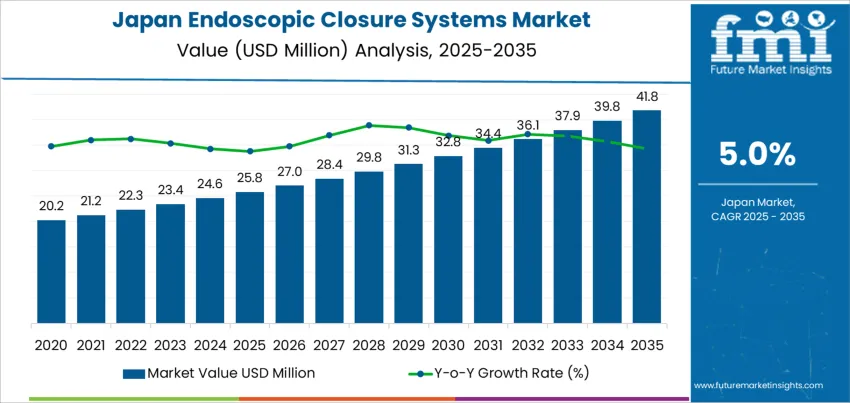
In 2025, demand for endoscopic closure systems in Japan is valued at USD 25.8 million and is projected to reach USD 41.8 million by 2035 at a CAGR of 5.0%. Early growth is tied to rising procedure volumes in gastrointestinal endoscopy, driven by cancer screening programs, ulcer management, and minimally invasive therapeutic interventions. Hospitals prioritize closure devices to reduce post-procedure bleeding and shorten recovery time. Clip-based systems dominate routine use due to clinician familiarity and procedural reliability. Adoption is strongest in university hospitals and regional medical centers that handle complex resections and high case throughput. Procurement aligns closely with endoscopy suite utilization rather than capital equipment cycles.
After 2030, demand growth in Japan reflects deeper use in advanced therapeutic endoscopy rather than expansion in basic diagnostics. Market value rises from about USD 32.8 million in 2030 toward USD 41.8 million by 2035 as submucosal dissection, full-thickness resection, and bariatric endoscopic techniques gain wider clinical acceptance. Device selection increasingly emphasizes closure strength, deployment precision, and compatibility with narrow-lumen scopes. Aging patient profiles raise procedural risk, which increases reliance on dependable closure for safety assurance. Supplier competition centers on jaw geometry, rotational control, and tactile feedback during deployment. Long-term growth is guided by procedural complexity and reimbursement stability rather than unit expansion alone.
Quick Stats of the Demand for Endoscopic Closure Systems in Japan
- Demand for Endoscopic Closure Systems in Japan Value (2025): USD 25.8 million
- Demand for Endoscopic Closure Systems in Japan Forecast Value (2035): USD 41.8 million
- Demand for Endoscopic Closure Systems in Japan Forecast CAGR (2025–2035): 5.0%
- Demand for Endoscopic Closure Systems in Japan Leading Product Type: Endoscopic Vacuum-Assisted Closure Systems (25%)
- Demand for Endoscopic Closure Systems in Japan Key Growth Regions: Kyushu & Okinawa, Kanto, Kansai, Chubu, Tohoku, Rest of Japan
- Demand for Endoscopic Closure Systems in Japan Top Players: CooperSurgical Inc., USA Endoscopy, Life Partners Europe, Ovesco Endoscopy AG, Apollo Endosurgery, Inc.
What is the Demand Forecast for Endoscopic Closure Systems in Japan through 2035?
Endoscopic closure systems in Japan are tightly linked to minimally invasive procedure volumes rather than to broader capital equipment cycles, giving this category a clinically anchored growth profile. Demand increases from USD 25.8 million in 2025 to USD 27.0 million by 2026 and USD 28.4 million by 2027, reaching USD 31.3 million by 2030 and adding USD 5.5 million from the 2025 base. This phase reflects steady expansion in gastrointestinal endoscopy, bariatric procedures, and therapeutic interventions where defect closure, perforation management, and post-resection sealing are critical. Growth is supported by rising colorectal screening, higher detection of early-stage lesions, and procedural shifts from open surgery to endoscopic intervention.
From 2030 to 2035, the market expands from USD 31.3 million to USD 41.8 million, adding USD 10.5 million in the second half of the decade. This back weighted acceleration reflects deeper adoption of advanced clip systems, over-the-scope devices, and tissue approximation technologies in complex endoscopic resections. Demand also strengthens as Japans aging population drives higher volumes of bleeding control, ulcer management, and therapeutic endoscopy. As procedure complexity rises and closure reliability becomes a primary determinant of patient outcomes and hospital risk management, endoscopic closure systems shift from procedural accessories into core safety-enabling devices, sustaining long-term demand growth.
Endoscopic Closure Systems Industry in Japan Key Takeaways
| Metric | Value |
|---|---|
| Industry Value (2025) | USD 25.8 million |
| Forecast Value (2035) | USD 41.8 million |
| Forecast CAGR (2025–2035) | 5.0% |
How Is the Market for Endoscopic Closure Systems Emerging in Japan?
Demand for endoscopic closure systems in Japan has increased as minimally invasive procedures have become more standard in hospitals and surgical clinics. As more treatments shift from open surgery to endoscopic techniques for gastrointestinal, urological, and laparoscopic procedures, the need for devices that seal incisions or perforations reliably has risen. Traditional suturing or stapling methods are often less suitable for endoscopic access. Clinicians and hospitals adopted closure systems to reduce patient recovery time, lower risk of infection, and support same-day discharge. This shift has driven steady uptake across tertiary hospitals and specialized clinics in urban centers, where patient volumes and procedural frequency justify adoption of advanced devices.
Future demand in Japan will depend on broader diffusion of endoscopic care, aging population healthcare needs, and technology improvements in closure devices. As demographic pressures increase demand for minimally invasive procedures especially among elderly patients — hospitals will adopt endoscopic closure systems to minimise surgical risk and recovery burden. Development of devices compatible with more complex anatomies and enhanced biocompatible materials will expand applications across gastroenterology, thoracic, and bariatric surgeries. Barriers include high upfront cost for devices, training requirements for surgical teams, and regulatory approval processes for new closure technologies. Market growth will depend on balancing safety, cost-effectiveness, and clinical outcomes while expanding beyond major hospital centers.
How Are Product Type and Procedure Structuring the Demand for Endoscopic Closure Systems in Japan?
The demand for endoscopic closure systems in Japan is structured by product type and clinical procedure. Endoscopic vacuum assisted closure systems account for 25% of total demand, followed by endoscopic clips, overstitch suturing systems, cardiac septal defect occluders, and other specialized closure devices. By procedure, GI bleeding management represents 35.0% of total usage, followed by post endoscopic mucosal resection closure, perforation and fistula repair, anastomotic leak repair, bariatric surgery, and gastroesophageal reflux disease repair. Demand behavior is shaped by complication management needs, minimally invasive treatment preference, clinical safety standards, and procedural success rates. These segments reflect how device functionality and therapeutic urgency guide system adoption across tertiary hospitals and gastrointestinal specialty centers in Japan.
Why Do Endoscopic Vacuum Assisted Closure Systems Lead Product Demand in Japan?
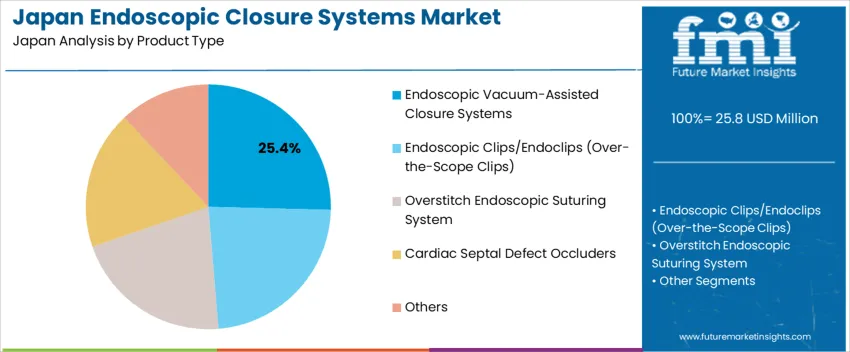
Endoscopic vacuum assisted closure systems account for 25% of total endoscopic closure system demand in Japan due to their effectiveness in managing complex gastrointestinal defects, leaks, and infected cavities. These systems apply controlled negative pressure to promote tissue granulation, remove fluids, and accelerate wound healing within the gastrointestinal tract. Their use is well established in the treatment of anastomotic leaks, perforations, and post surgical wound complications where conventional clipping may not provide adequate sealing. Japanese tertiary hospitals rely on vacuum assisted systems for advanced defect management under minimally invasive protocols.
These systems also reduce the need for repeat open surgical intervention, which supports faster recovery and shorter hospital stays. Clinical confidence has strengthened through expanding procedural experience and documented success rates across upper and lower GI applications. Compatibility with standard endoscopic platforms further simplifies integration into existing endoscopy units. These therapeutic effectiveness, procedural adaptability, and reduced surgical burden factors sustain vacuum assisted closure systems as the leading product segment in the Japan endoscopic closure demand structure.
Why Does GI Bleeding Management Dominate Procedure Demand in Japan?
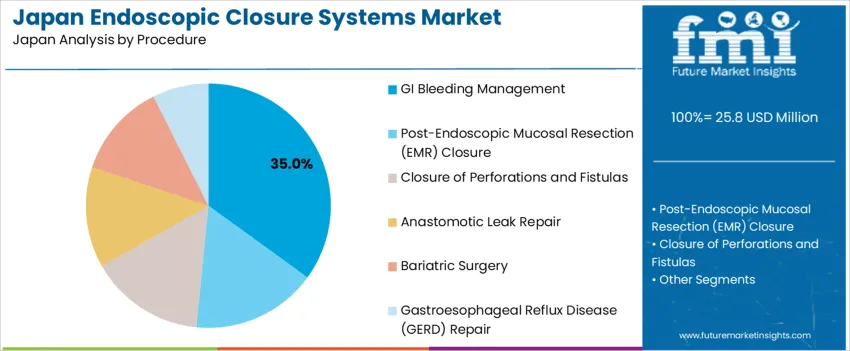
GI bleeding management accounts for 35.0% of total endoscopic closure system demand in Japan due to the high prevalence of gastric ulcers, colorectal lesions, antithrombotic drug usage, and an aging patient population. Endoscopic closure devices are routinely used to achieve hemostasis following bleeding ulcers, polypectomy procedures, and tumor resections. Rapid and reliable bleeding control is critical to prevent shock, reduce transfusion needs, and limit repeat hospitalization in elderly patients with multiple comorbidities.
National screening programs for colorectal and gastric cancer have increased the volume of endoscopic interventions, which directly raises post procedural bleeding risk. Closure systems enable immediate defect sealing after therapeutic endoscopy, reducing delayed bleeding events. Gastroenterology departments across Japan emphasize early endoscopic intervention over surgical management for bleeding cases. These population demographics, screening intensity, and clinical protocol preferences position GI bleeding management as the dominant application segment for endoscopic closure systems in Japan.
Why Are Endoscopic Closure Systems in Japan Seen as Core Tools for Organ Preservation Rather Than Post-Procedure Accessories?
Demand for endoscopic closure systems in Japan is driven by the clinical priority placed on organ preservation and minimally invasive intervention. Japans aging population presents high surgical risk, which accelerates preference for endoscopic resection over open procedures in gastrointestinal, pulmonary, and urological care. Closure systems are required to restore tissue integrity after mucosal dissection, polyp removal, and perforation management. Physicians treat closure as part of the therapeutic act rather than a finishing step. This mindset makes clips, suturing devices, and tissue sealants integral to primary endoscopic workflows.
How Do Early Cancer Screening and Preventive Resection Shape Procedure Volume?
Japan operates one of the most active screening environments for gastric and colorectal cancer. High detection rates at early stages lead to frequent endoscopic submucosal dissections where artificial wounds must be securely closed. Preventive polyp management is routine in outpatient settings. This creates steady procedural demand for reliable and repeatable closure performance. Hospitals prioritize systems that work consistently across variable lesion sizes and anatomical curvature. Preventive medicine philosophy, not emergency intervention, anchors the base demand for closure systems within daily endoscopy suites.
What Training Intensity, Device Standardization, and Reimbursement Control Limit Rapid Product Turnover?
Endoscopic closure system adoption in Japan is moderated by long clinical training curves and strict device standardization inside hospitals. Surgeons and endoscopists undergo repeated skill certification before switching closure platforms. Hospitals limit device variety to streamline inventory and protocol control. National reimbursement structures cap procedural pricing, restricting aggressive premium device upgrades. Even technically superior systems face slow conversion unless they demonstrate measurable reductions in complication rates. These institutional controls stabilize demand but slow disruptive shifts between competing closure technologies.
How Are Robotic Endoscopy, Complex Suturing, and Tissue Engineering Reshaping Future Demand?
Future demand in Japan is moving toward robotic-assisted endoscopy and advanced suturing systems capable of closing deeper, irregular, and multi-directional defects. Closure platforms with enhanced articulation and force control support complex resections in aging, fragile tissue. Integration with tissue adhesives and bio-absorbable scaffolds is increasing to support regenerative healing rather than mechanical closure alone. AI-guided lesion mapping also tightens precision requirements on closure placement. These shifts indicate that endoscopic closure demand is evolving toward regenerative precision rather than simple defect sealing.
What is the Demand for Endoscopic Closure Systems in Japan by Region?
| Region | CAGR (%) |
|---|---|
| Kyushu & Okinawa | 6.2% |
| Kanto | 5.7% |
| Kansai | 5.0% |
| Chubu | 4.4% |
| Tohoku | 3.9% |
| Rest of Japan | 3.7% |
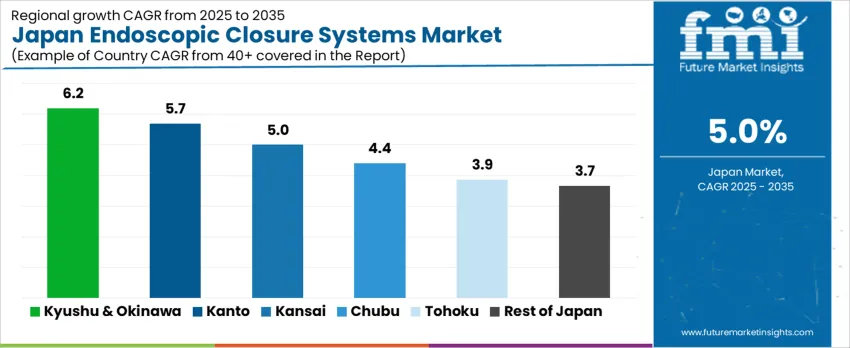
The demand for endoscopic closure systems in Japan is expanding steadily across regions, led by Kyushu & Okinawa at a 6.2% CAGR. Growth in this region is supported by rising gastrointestinal procedure volumes, expansion of regional hospitals, and increasing adoption of minimally invasive surgical techniques. Kanto follows at 5.7%, driven by large tertiary hospitals, advanced endoscopy centers, and strong procedural throughput. Kansai records 5.0% growth, supported by established medical infrastructure and steady demand from urban healthcare facilities. Chubu at 4.4% reflects moderate uptake linked to hospital modernization. Tohoku and Rest of Japan, at 3.9% and 3.7%, show slower growth shaped by lower population density and fewer high volume endoscopy centers.
How Is Clinical Modernization Advancing Demand in Kyushu And Okinawa?
Clinical expansion in Kyushu and Okinawa is advancing at a CAGR of 6.2% through 2035 for endoscopic closure system demand, supported by hospital capacity addition, rising gastrointestinal procedure volumes, and growing adoption of minimally invasive surgery. Regional medical centers expand therapeutic endoscopy services for ulcer bleeding, perforation repair, and post resection closure. Medical tourism contributes incremental case load in selected coastal hospitals. Aging population trends strengthen long term procedural volume. Demand remains procedure driven, with procurement tied to endoscopy suite utilization, physician training programs, and steady expansion of advanced gastroenterology services.
- Regional hospitals expand therapeutic endoscopy capacity
- Ulcer and perforation repair supports steady device usage
- Medical tourism adds incremental procedural demand
- Aging population sustains long term treatment volume
What Is Sustaining High Adoption Across Kanto?
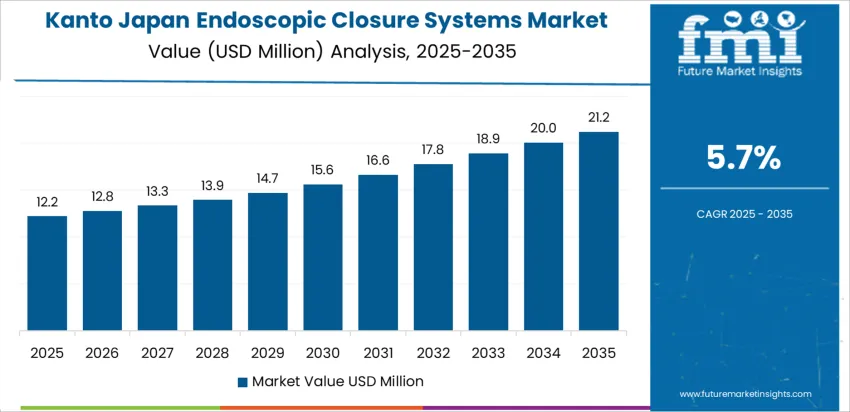
Metropolitan healthcare concentration in Kanto supports a CAGR of 5.7% through 2035 for endoscopic closure system demand, driven by dense networks of university hospitals, advanced surgical centers, and clinical research institutions. High endoscopy workloads in colorectal resections, polypectomy, and bariatric diagnostics increase closure system usage. Robotic assisted endoscopic procedures also expand device application. Clinical trials strengthen early adoption of next generation closure platforms. Demand remains innovation led and referral driven, with procurement shaped by complex case volumes, reimbursement alignment, and continuous technology evaluation across large academic medical facilities.
- University hospitals anchor complex procedural volumes
- Colorectal and bariatric cases drive consistent usage
- Robotic endoscopy expands clinical application scope
- Clinical trials support early system adoption
Why Is Kansai Emerging as a Consistent Secondary Market?
Regional medical specialization in Kansai supports a CAGR of 5.0% through 2035 for endoscopic closure system demand, shaped by trauma care centers, digestive disease hospitals, and expanding outpatient endoscopy networks. Gastrointestinal bleeding management and mucosal defect closure represent major procedure drivers. Rehabilitation hospitals also contribute post surgical endoscopic demand. Distributor networks improve device availability for mid sized hospitals. Demand remains recovery focused and referral based, with procurement aligned to predictable GI intervention volumes and stepwise expansion of therapeutic endoscopy capabilities across urban and suburban hospital systems.
- Digestive disease centers drive core procedural usage
- Trauma care supports emergency closure demand
- Outpatient endoscopy expands post resection applications
- Distributor networks improve regional supply coverage
How Is Industrial Population Healthcare Shaping Growth in Chubu?
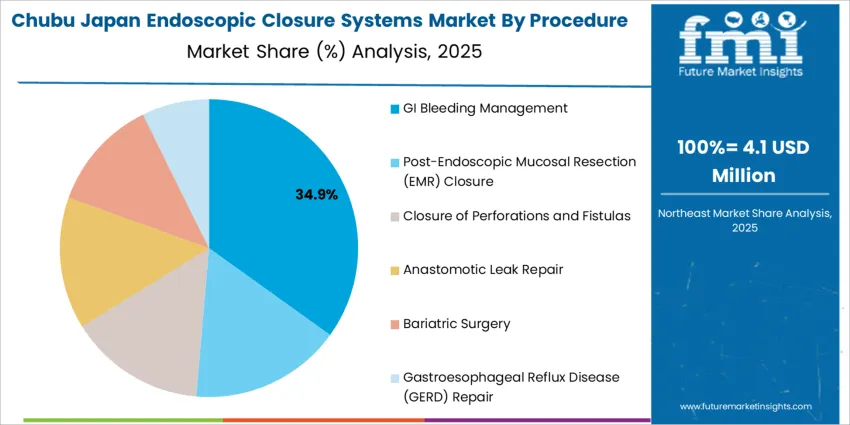
Workforce driven healthcare demand in Chubu supports a CAGR of 4.4% through 2035 for endoscopic closure system demand, influenced by occupational health coverage, industrial hospital investment, and steady chronic disease incidence. Manufacturing population density contributes to consistent gastrointestinal diagnostic workloads. Mid sized hospitals adopt closure systems for emergency endoscopy and surgical backup. Employer health programs improve procedural access and treatment continuity. Demand remains treatment driven rather than innovation driven, with purchasing behavior tied to hospital budget planning, emergency care readiness, and predictable endoscopy suite throughput across industrial population clusters.
- Occupational healthcare sustains diagnostic procedure volumes
- Emergency endoscopy drives closure system adoption
- Employer insurance improves treatment access
- Hospital budgets guide controlled procurement
What Is Guiding Gradual Endoscopic Device Uptake in Tohoku?
Regional hospital consolidation in Tohoku supports a CAGR of 3.9% through 2035 for endoscopic closure system demand, shaped by aging rural populations, chronic disease management needs, and stepwise expansion of specialty surgical services. Orthopedic and cardiovascular care dominates hospital resources, while GI endoscopy grows at a measured pace. Basic closure devices are adopted before advanced clip systems. Limited specialist density moderates rapid technology penetration. Demand remains necessity driven and clinically focused, aligned with essential ulcer treatment, biopsy closure, and routine diagnostic endoscopy services.
- Aging rural population sustains baseline GI procedures
- Public hospitals guide phased device adoption
- Basic closure tools dominate early stage usage
- Specialist availability limits rapid advanced penetration
Why Does the Rest of Japan Show Stable but Slower Growth?
Community level healthcare delivery across the rest of Japan reflects a CAGR of 3.7% through 2035 for endoscopic closure system demand, supported by municipal hospitals, stable outpatient diagnostics, and national insurance reimbursement continuity. Procedures focus on routine ulcer management, biopsy site closure, and standard polypectomy. Advanced endoscopy cases are often referred to major metros. Device procurement centers on safety compliance and cost control rather than feature upgrades. Demand remains steady and necessity oriented, with predictable ordering patterns tied to routine diagnostic care and essential therapeutic endoscopy coverage.
- Municipal hospitals anchor essential procedure volume
- Routine ulcer and biopsy closure drives device usage
- Referral patterns shift advanced cases to metros
- Cost control governs procurement behavior
What Is Driving the Demand for Endoscopic Closure Systems in Japan and Who Are the Key Players Shaping the Market?
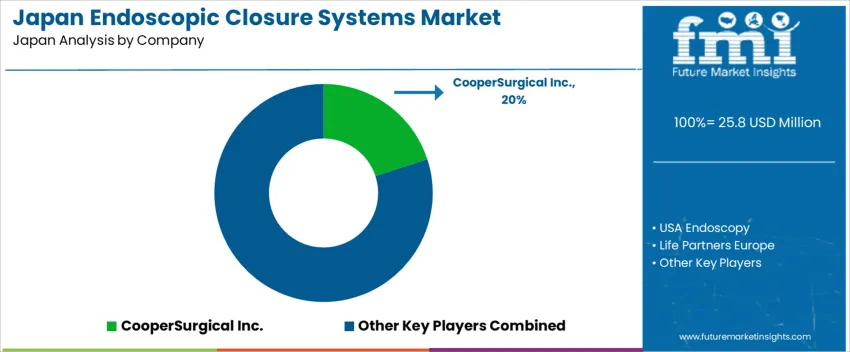
Demand for endoscopic closure systems in Japan is rising as medical practitioners increasingly adopt minimally invasive procedures for gastrointestinal (GI) conditions, bariatric surgery, and other internal interventions. Japan’s aging population and corresponding rise in GI disorders and chronic conditions contribute to rising procedural volumes. Patients and hospitals favor lower risk, faster recovery interventions, making endoscopic closure techniques more attractive than traditional open surgeries. Advances in closure technologies, including over the scope clips, suturing systems, and other closure devices, improve safety and procedural success, supporting broader adoption across hospitals and specialized clinics. The growing emphasis on shorter hospital stays, lower complication rates, and cost efficiency reinforces demand for reliable closure systems.
Major suppliers active in the Japanese market include CooperSurgical Inc., USA Endoscopy, Life Partners Europe, Ovesco Endoscopy AG, and Apollo Endosurgery, Inc. These firms supply a range of closure devices clips, suturing systems, and closure kits used in GI endoscopy, polypectomy, perforation repair, and other therapeutic procedures. Firms such as CooperSurgical and Ovesco offer widely used clip systems. Apollo Endosurgery and USA Endoscopy introduce suturing based closure technologies. Life Partners Europe adds to the diversity of device options. Through their portfolios, regulatory certifications, and supply networks, these companies shape accessibility and standard of care in endoscopic closure procedures across Japan.
Key Players in Endoscopic Closure Systems in Japan
- CooperSurgical Inc.
- USA Endoscopy
- Life Partners Europe
- Ovesco Endoscopy AG
- Apollo Endosurgery, Inc.
Scope of the Report
| Items | Values |
|---|---|
| Quantitative Units (2025) | USD million |
| Product Type | Endoscopic Vacuum-Assisted Closure Systems, Endoscopic Clips/Endoclips (Over-the-Scope Clips), Overstitch Endoscopic Suturing System, Cardiac Septal Defect Occluders, Others |
| Procedure | GI Bleeding Management, Post-Endoscopic Mucosal Resection (EMR) Closure, Closure of Perforations and Fistulas, Anastomotic Leak Repair, Bariatric Surgery, Gastroesophageal Reflux Disease (GERD) Repair |
| Region | Kyushu & Okinawa, Kanto, Kansai, Chubu, Tohoku, Rest of Japan |
| Key Companies Profiled | CooperSurgical Inc., USA Endoscopy, Life Partners Europe, Ovesco Endoscopy AG, Apollo Endosurgery, Inc. |
| Additional Attributes | Dollar by sales by product type, procedure, and region, procedural complexity, device reliability, deployment precision, compatibility with narrow-lumen scopes, clinical adoption rate, hospital endoscopy suite utilization, regulatory compliance, training intensity, and reimbursement alignment |
Endoscopic Closure Systems in Japan Segmentation
Product Type:
- Endoscopic Vacuum-Assisted Closure Systems
- Endoscopic Clips/Endoclips (Over-the-Scope Clips)
- Overstitch Endoscopic Suturing System
- Cardiac Septal Defect Occluders
- Others
Procedure:
- GI Bleeding Management
- Post-Endoscopic Mucosal Resection (EMR) Closure
- Closure of Perforations and Fistulas
- Anastomotic Leak Repair
- Bariatric Surgery
- Gastroesophageal Reflux Disease (GERD) Repair
Region:
- Kyushu & Okinawa
- Kanto
- Kansai
- Chubu
- Tohoku
- Rest of Japan
Frequently Asked Questions
How big is the demand for endoscopic closure systems in Japan in 2025?
The demand for endoscopic closure systems in Japan is estimated to be valued at USD 25.8 million in 2025.
What will be the size of endoscopic closure systems in Japan in 2035?
The market size for the endoscopic closure systems in Japan is projected to reach USD 41.8 million by 2035.
How much will be the demand for endoscopic closure systems in Japan growth between 2025 and 2035?
The demand for endoscopic closure systems in Japan is expected to grow at a 5.0% CAGR between 2025 and 2035.
What are the key product types in the endoscopic closure systems in Japan?
The key product types in endoscopic closure systems in Japan are endoscopic vacuum-assisted closure systems, endoscopic clips/endoclips (over-the-scope clips), overstitch endoscopic suturing system, cardiac septal defect occluders and others.
Which procedure segment is expected to contribute significant share in the endoscopic closure systems in Japan in 2025?
In terms of procedure, gi bleeding management segment is expected to command 35.0% share in the endoscopic closure systems in Japan in 2025.
Preview the report firsthand - request a free sample
Get SampleGet the brochure for pricing and purchase details.
Get PDFTable of Content
- Executive Summary
- Japan Market Outlook
- Demand-side Trends
- Supply-side Trends
- Technology Roadmap Analysis
- Analysis and Recommendations
- Market Overview
- Market Coverage / Taxonomy
- Market Definition / Scope / Limitations
- Market Background
- Market Dynamics
- Drivers
- Restraints
- Opportunity
- Trends
- Scenario Forecast
- Demand in Optimistic Scenario
- Demand in Likely Scenario
- Demand in Conservative Scenario
- Opportunity Map Analysis
- Product Life Cycle Analysis
- Supply Chain Analysis
- Investment Feasibility Matrix
- Value Chain Analysis
- PESTLE and Porter’s Analysis
- Regulatory Landscape
- Regional Parent Market Outlook
- Production and Consumption Statistics
- Import and Export Statistics
- Market Dynamics
- Japan Market Analysis 2020 to 2024 and Forecast, 2025 to 2035
- Historical Market Size Value (USD Million) Analysis, 2020 to 2024
- Current and Future Market Size Value (USD Million) Projections, 2025 to 2035
- Y-o-Y Growth Trend Analysis
- Absolute $ Opportunity Analysis
- Japan Market Pricing Analysis 2020 to 2024 and Forecast 2025 to 2035
- Japan Market Analysis 2020 to 2024 and Forecast 2025 to 2035, By Product Type
- Introduction / Key Findings
- Historical Market Size Value (USD Million) Analysis By Product Type , 2020 to 2024
- Current and Future Market Size Value (USD Million) Analysis and Forecast By Product Type , 2025 to 2035
- Endoscopic Vacuum-Assisted Closure Systems
- Endoscopic Clips/Endoclips (Over-the-Scope Clips)
- Overstitch Endoscopic Suturing System
- Cardiac Septal Defect Occluders
- Others
- Y-o-Y Growth Trend Analysis By Product Type , 2020 to 2024
- Absolute $ Opportunity Analysis By Product Type , 2025 to 2035
- Japan Market Analysis 2020 to 2024 and Forecast 2025 to 2035, By Procedure
- Introduction / Key Findings
- Historical Market Size Value (USD Million) Analysis By Procedure, 2020 to 2024
- Current and Future Market Size Value (USD Million) Analysis and Forecast By Procedure, 2025 to 2035
- GI Bleeding Management
- Post-Endoscopic Mucosal Resection (EMR) Closure
- Closure of Perforations and Fistulas
- Anastomotic Leak Repair
- Bariatric Surgery
- Gastroesophageal Reflux Disease (GERD) Repair
- Y-o-Y Growth Trend Analysis By Procedure, 2020 to 2024
- Absolute $ Opportunity Analysis By Procedure, 2025 to 2035
- Market Structure Analysis
- Competition Dashboard
- Competition Benchmarking
- Market Share Analysis of Top Players
- By Regional
- By Product Type
- By Procedure
- Competition Analysis
- Competition Deep Dive
- CooperSurgical Inc.
- Overview
- Product Portfolio
- Profitability by Market Segments (Product/Age /Sales Channel/Region)
- Sales Footprint
- Strategy Overview
- Marketing Strategy
- Product Strategy
- Channel Strategy
- USA Endoscopy
- Life Partners Europe
- Ovesco Endoscopy AG
- Apollo Endosurgery, Inc.
- CooperSurgical Inc.
- Competition Deep Dive
- Assumptions & Acronyms Used
- Research Methodology


