

- Industry Size (2025)
- USD 111.6 Mn
- Forecast (2035)
- USD 158.9 Mn
- CAGR (2025 to 2035)
- 3.6%
Demand for Palletizing Systems in Japan Forecast and Outlook 2025 to 2035
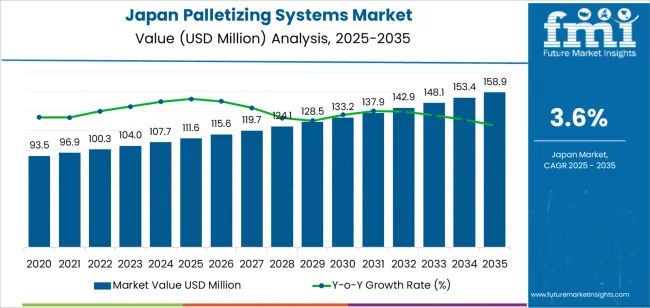
The demand for palletizing systems in Japan is valued at USD 111.6 million in 2025 and is projected to reach USD 158.9 million by 2035, reflecting a compound annual growth rate of 3.6%. Growth is shaped by steady automation needs across food processing, consumer goods, chemicals and logistics operations. As production lines expand throughput and require consistent stacking accuracy, palletizing systems remain central to packaging efficiency. Both robotic and conventional units retain relevance as manufacturers balance flexibility, load stability and floor space optimization. Routine upgrades and integration of higher-speed handling equipment further support adoption, reinforcing stable demand throughout the forecast window.
The growth curve shows a gradual upward pattern, beginning at USD 93.5 million in earlier years and rising to USD 111.6 million in 2025 before progressing toward USD 158.9 million by 2035. Yearly increases follow predictable spacing, with values moving from USD 115.6 million in 2026 to USD 119.7 million in 2027 and continuing through USD 137.9 million in 2031 and USD 148.1 million in 2033. This uniform progression reflects a mature automation segment driven by regular replacement cycles and incremental expansion across production facilities. As palletizing roles diversify and uptime expectations increase, demand for reliable stacking and handling systems maintains consistent momentum across Japan’s industrial and warehousing landscape.
Quick Stats of the Demand for Palletizing Systems in Japan:
- Demand for Palletizing Systems in Japan Value (2025): USD 111.6 million
- Demand for Palletizing Systems in Japan Forecast Value (2035): USD 158.9 million
- Demand for Palletizing Systems in Japan Forecast CAGR (2025 to 2035): 3.6%
- Demand for Palletizing Systems in Japan Leading Type: Floor Level Palletizers (26%)
- Demand for Palletizing Systems in Japan Key Growth Regions: Kyushu & Okinawa, Kanto, Kinki, Chubu
- Demand for Palletizing Systems in Japan Top Players: ABB Flexible Automation Inc, KUKA Roboter GmbH, ABC Packaging, Intelligrated Inc, Cermex Group
What is the Growth Forecast for Demand for Palletizing Systems in Japan through 2035?
Demand in Japan for palletizing systems is projected to grow from USD 111.6 million in 2025 to USD 158.9 million by 2035, representing a compound annual growth rate (CAGR) of approximately 3.6%. Starting at USD 93.5 million in 2020, the value rises steadily to USD 111.6 million in 2025, driven by growth in automated warehousing, logistics modernisation, and manufacturing automation. Between 2025 and 2030, demand increases to about USD 133.2 million, supported by upgrades in materialhandling systems and rising ecommerce fulfilment needs. From 2030 to 2035 the value continues its upward trend, reaching USD 158.9 million as robotics, smart palletising solutions and integration with Industry 4.0 architectures become mainstream.
Over the forecast decade the uplift of USD 47.3 million is supported by both volume growth and highervalue system upgrades. In the early part of the period (20252030), growth is largely volumeled as more facilities install palletizing systems to replace manual or semiautomated solutions. In the latter half (20302035), value growth becomes increasingly important driven by advanced palletising systems with higher throughput, multiformat capability, enhanced robotics and IoT connectivity boosting average selling prices. Suppliers focusing on highspec, automated and flexible palletising solutions are best placed to capture the bulk of demand as the market transitions from USD 111.6 million to USD 158.9 million by 2035.
Palletizing Systems Industry in Japan Key Takeaways
| Metric | Value |
|---|---|
| Industry Value (2025) | USD 111.6 million |
| Forecast Value (2035) | USD 158.9 million |
| Forecast CAGR (2025 to 2035) | 3.6% |
What Is Driving the Demand for Palletizing Systems in Japan?
The demand for palletizing systems in Japan arises from different sets of drivers when comparing historical and future scenarios. Historically, the demand was driven by stable manufacturing output in sectors such as food & beverage, automotive parts and consumer goods, which required efficient pallet handling at end-of-line packaging. Companies sought automated palletizing cells to replace manual stacking, improve throughput and reduce injury risk. The logistics networks supporting domestic and export flows added incremental uptake of palletizing machines as distribution volumes grew steadily.
Looking ahead, future growth is being shaped by labour-shortage pressures, e-commerce expansion and logistics modernisation in Japan. With a declining workforce and tighter hours for drivers, logistics operators and manufacturers are investing in palletizing systems that integrate robotics, vision systems and flexible patterns for mixed SKU pallets. The growth of direct-to-consumer channels and smaller batch sizes increases demand for palletizing solutions that can switch formats quickly. While high capital cost and integration complexity remain constraints, the urgency of automation and supply-chain agility points to continued expansion in demand for palletizing systems in Japan.
What Factors Are Affecting the Demand for Palletizing Systems in Japan in Terms of Type and Application?
The demand for palletizing systems in Japan is shaped by the types of palletizers used across production environments and the applications that determine how goods are organized for transport. Types include floor level palletizers, high-level palletizers and robotic palletizers, each offering different handling speeds, footprint requirements and integration options. Applications span case, pail, bulk and bag palletizing, reflecting diverse product formats in manufacturing, food processing and materials handling. As facilities emphasize predictable stacking, stable load formation and efficient end-of-line operations, the combination of palletizer type and application requirement influences equipment selection across Japan.
What Drives the Leading Demand for Floor Level Palletizers in Japan?
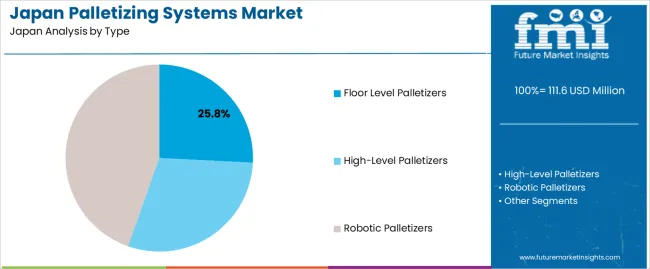
Floor level palletizers account for 26% of total demand across palletizer types in Japan. Their leading share reflects the suitability of these systems for facilities needing dependable performance with manageable installation requirements. Floor level units operate at accessible heights, allowing straightforward maintenance and integration into existing layouts without extensive structural changes. Many producers value the balance of controlled throughput and predictable stacking patterns. These systems suit small and medium operations that handle varied product lines and prioritize equipment that offers steady, user-friendly operation while supporting daily production schedules.
Demand for floor level palletizers grows as manufacturers adopt systems that limit downtime and maintain consistent load formation without complex control requirements. Facilities working with mixed case sizes rely on these units for their adaptable design and precise orientation control. The systems support reliable pallet stability and help streamline shipping preparation. Their compact footprint serves locations with limited space while ensuring strong load integrity during transport. As companies refine end-of-line workflows to maintain steady performance, floor level palletizers continue to hold a central role across Japan.
What Drives the Leading Demand for Case Palletizer Applications in Japan?
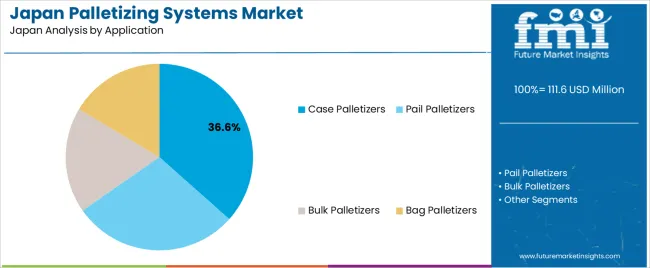
Case palletizers account for 36.6% of total demand across application categories in Japan. Their leading position reflects widespread reliance on boxed goods across consumer products, food processing and industrial materials. Case palletizing supports predictable load geometry, enabling efficient stacking, stable shipping and simplified warehouse handling. Many operations use standardized case dimensions, which align well with automated case palletizing systems. These characteristics contribute to steady adoption among facilities that prioritize orderly stacking and consistent pallet quality for downstream logistics activities.
Demand for case palletizers continues to rise as production lines increase output and require end-of-line equipment capable of managing consistent case flow. The systems help reduce manual handling while supporting uniform patterns that optimize pallet space. Facilities rely on them to maintain reliable throughput during peak cycles and support efficient load preparation. Their compatibility with automated conveyors and packing systems enhances workflow continuity. As Japan’s packaged goods sector maintains stable demand, case palletizing remains the primary application shaping palletizing system use across the country.
What Is Shaping the Demand for Palletizing Systems in Japan?
Demand for palletizing systems in Japan is influenced by labour shortages, rising automation in manufacturing and logistics, and the country’s emphasis on compact, precise and space-efficient machinery. Companies in food processing, chemicals, electronics and warehouse operations adopt palletizing lines to maintain productivity with a shrinking workforce. At the same time, high installation costs, strict safety standards and limited floor space shape how quickly firms upgrade legacy handling systems. These conditions define the current trajectory of palletizing system adoption in Japan.
How Are Japan’s Labour Shortages and Compact-Factory Layouts Shaping Palletizing Needs?
Japan’s ongoing labour shortage pushes manufacturers and logistics operators to automate end-of-line tasks. Many facilities operate in compact urban sites, so palletizing systems must be space-efficient, low vibration and easy to integrate with existing conveyors. Japanese firms also expect repeatable movement accuracy suited to electronics, chemical packaging and food processing. As factories modernise to maintain output with fewer workers, demand rises for palletizers that deliver steady throughput, minimal manual handling and compatibility with Japan’s dense industrial layouts.
Where Are Practical Growth Opportunities for Palletizing Systems in Japan?
Opportunity emerges in mid-sized factories upgrading older handling equipment, regional logistics hubs adopting robotics and food processors investing in hygienic palletizing cells. Japan’s surge in parcel throughput and warehouse automation expands demand for robotic palletizers that handle mixed SKU loads. Compact palletizers designed for narrow aisles, low-ceiling warehouses and urban distribution centres also hold potential. Vendors offering short-footprint layouts, quick setup, and local service support can address needs specific to Japanese production and distribution sites.
What Factors Are Restraining Wider Adoption of Palletizing Systems in Japan?
Cost remains a significant restraint, as many Japanese SMEs operate on tight budgets and hesitate to invest in fully automated lines. Limited floor space in older plants complicates installation, requiring structural changes that increase expense. Strict safety requirements and careful integration with existing equipment extend project timelines. Some operations with frequent product changeovers still rely on manual labour due to setup complexity. These conditions reduce the pace at which palletizing systems achieve broad penetration across Japan’s manufacturing and logistics sectors.
What is the Demand for Palletizing Systems in Japan by Region?
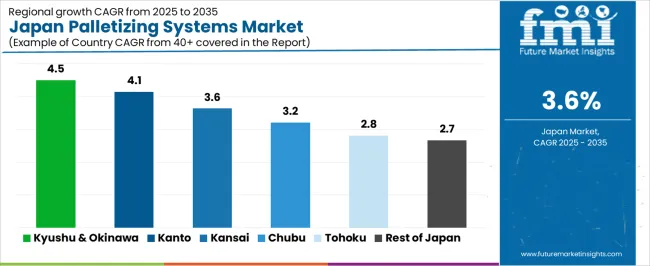
| Region | CAGR (%) |
|---|---|
| Kyushu & Okinawa | 4.5% |
| Kanto | 4.1% |
| Kinki | 3.6% |
| Chubu | 3.2% |
| Tohoku | 2.8% |
| Rest of Japan | 2.7% |
Demand for palletizing systems in Japan is rising steadily across regions, with Kyushu and Okinawa leading at 4.5%. Growth in this region reflects the expansion of food processing, logistics, and manufacturing facilities that rely on automated pallet handling. Kanto follows at 4.1%, supported by dense industrial clusters and widespread adoption of automation solutions in packaging and warehousing. Kinki records 3.6%, shaped by strong commercial activity and consistent investment in material handling upgrades. Chubu grows at 3.2%, influenced by its automotive and electronics production base, where palletizing systems support throughput. Tohoku reaches 2.8% as regional factories modernize operations. The rest of Japan posts 2.7%, indicating stable but moderate adoption across smaller industrial zones.
How Is Kyushu & Okinawa Driving Demand for Palletizing Systems?
Kyushu & Okinawa is projected to grow at a CAGR of 4.5% through 2035 in demand for palletizing systems. Fukuoka and surrounding industrial regions are increasingly adopting robotic and semi-automatic palletizers for food, beverage, and pharmaceutical production. Rising focus on operational efficiency, labor reduction, and warehouse automation drives adoption. Manufacturers provide high-quality systems suitable for various product sizes and weights. Distributors ensure accessibility across urban, semi-urban, and industrial facilities. Expansion in industrial production, packaging automation, and logistics modernization supports steady adoption of palletizing systems in Kyushu & Okinawa.
- Fukuoka industrial facilities adopt robotic and semi-automatic palletizers.
- Operational efficiency and labor reduction drive regional adoption trends.
- Systems support multiple product sizes and weights for production.
- Distributors ensure access across urban and industrial facilities.
How Is Kanto Supporting Demand for Palletizing Systems?
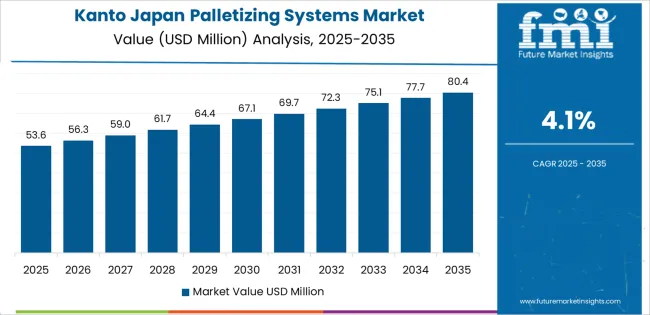
Kanto is projected to grow at a CAGR of 4.1% through 2035 in demand for palletizing systems. Tokyo and neighboring prefectures are increasingly adopting automated palletizers for food, beverage, and industrial production lines. Rising demand for labor efficiency, packaging optimization, and warehouse automation drives adoption. Manufacturers provide systems suitable for various product dimensions and weights. Distributors ensure availability across urban industrial and warehouse facilities. Expansion in manufacturing, logistics, and packaging technology supports steady adoption of palletizing systems across Kanto.
- Tokyo and neighboring regions adopt automated palletizers for production.
- Labor efficiency and packaging optimization drive regional adoption trends.
- Systems support multiple product sizes and weights in production.
- Distributors ensure access across urban industrial and warehouse facilities.
How Is Kinki Contributing to Demand for Palletizing Systems?
Kinki is projected to grow at a CAGR of 3.6% through 2035 in demand for palletizing systems. Osaka, Kyoto, and surrounding areas are gradually adopting robotic and semi-automatic palletizers for food, beverage, and industrial operations. Rising demand for labor reduction, operational efficiency, and process automation drives adoption. Manufacturers provide systems suitable for multiple product types and packaging formats. Distributors ensure accessibility across urban and semi-urban industrial regions. Industrial growth, logistics modernization, and packaging upgrades support steady adoption of palletizing systems across Kinki.
- Osaka and Kyoto adopt robotic and semi-automatic palletizers for production.
- Labor reduction and operational efficiency drive regional adoption trends.
- Systems suitable for multiple product types and packaging formats.
- Distributors ensure access across urban and semi-urban facilities.
How Is Chubu Contributing to Demand for Palletizing Systems?
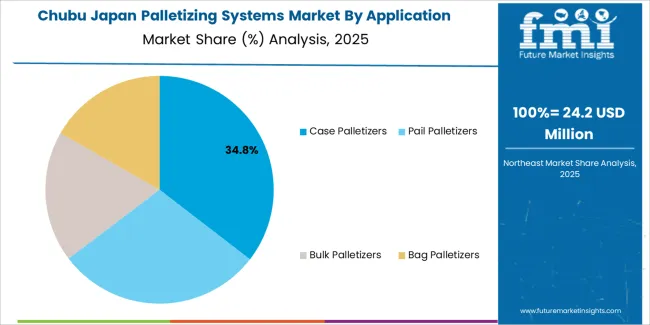
Chubu is projected to grow at a CAGR of 3.2% through 2035 in demand for palletizing systems. Nagoya and surrounding regions are increasingly adopting automated palletizers for food, beverage, and industrial production. Rising focus on warehouse automation, labor efficiency, and packaging productivity drives adoption. Manufacturers supply palletizing systems compatible with diverse product sizes and weights. Distributors ensure accessibility across urban and semi-urban facilities. Industrial expansion, logistics upgrades, and production modernization support steady adoption of palletizing systems across Chubu.
- Nagoya adopts automated palletizers for food, beverage, and industrial production.
- Warehouse automation and labor efficiency drive regional adoption trends.
- Systems compatible with diverse product sizes and weights in production.
- Distributors ensure access across urban and semi-urban facilities.
How Is Tohoku Contributing to Demand for Palletizing Systems?
Tohoku is projected to grow at a CAGR of 2.8% through 2035 in demand for palletizing systems. Sendai and surrounding areas are gradually adopting robotic and semi-automatic palletizers for industrial, food, and beverage production lines. Rising demand for operational efficiency, labor reduction, and process automation drives adoption. Manufacturers provide systems suitable for various product sizes and packaging requirements. Distributors ensure availability across urban and semi-urban industrial facilities. Industrial growth, packaging automation, and logistics modernization support steady adoption of palletizing systems across Tohoku.
- Sendai adopts robotic and semi-automatic palletizers for industrial production.
- Operational efficiency and labor reduction drive regional adoption trends.
- Systems suitable for various product sizes and packaging requirements.
- Distributors ensure availability across urban and semi-urban industrial sites.
How Is Rest of Japan Supporting Demand for Palletizing Systems?
The Rest of Japan is projected to grow at a CAGR of 2.7% through 2035 in demand for palletizing systems. Smaller towns and rural industrial regions gradually adopt automated and robotic palletizers for food, beverage, and industrial production. Rising demand for labor efficiency, warehouse optimization, and operational productivity drives adoption. Manufacturers supply systems compatible with various product types and packaging formats. Distributors ensure accessibility across urban, semi-urban, and rural industrial facilities. Industrial expansion, packaging modernization, and logistics upgrades support steady adoption of palletizing systems across the Rest of Japan.
- Rural regions adopt robotic and automated palletizers for production lines.
- Labor efficiency and warehouse optimization drive regional adoption trends.
- Systems compatible with multiple product types and packaging formats.
- Distributors ensure access across urban, semi-urban, and rural facilities.
What Is Driving the Demand for Palletizing Systems in Japan and Who Are the Key Players Shaping the Industry?
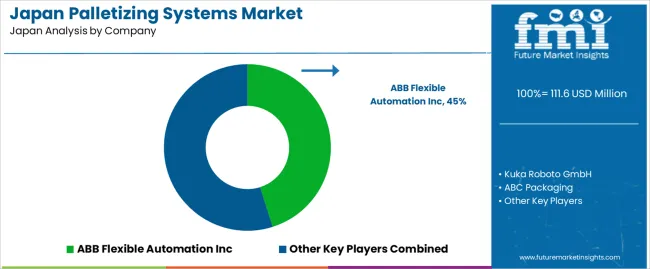
The demand for palletizing systems in Japan is rising as manufacturers and logistics operators respond to persistent labour shortages, growing e-commerce activity and the need for greater end-of-line efficiency. Japan’s ageing workforce and high operating costs encourage companies to automate manual pallet loading to maintain throughput and improve workplace safety. Food, beverage and consumer goods producers increasingly depend on palletizing solutions that handle frequent product changes, varied packaging formats and rapid order cycles. Logistics providers also adopt palletizing systems to manage expanding parcel volumes and reduce human error in distribution centres. As factories modernise under digital transformation initiatives, palletizers become central to integrated production lines, supporting data-driven operations and consistent output quality. These trends collectively strengthen demand across Japanese industrial and logistics environments.
Key players shaping Japan’s palletizing system landscape include global suppliers and influential domestic automation firms. International manufacturers such as ABB Flexible Automation Inc, KUKA Roboter GmbH, ABC Packaging, Intelligrated Inc and Cermex Group supply robotic and conventional palletizing lines used by major Japanese producers. Domestic firms such as Fuji Robotics and Murata Machinery hold strong positions by offering machines tailored to Japan’s space-constrained facilities, local service expectations and industry-specific needs. These Japanese companies provide customised systems with energy-efficient operation, compact footprints and high reliability suited to local factory layouts. Their presence ensures that competition reflects both global technology leadership and domestic engineering strength, balancing imported capabilities with home-grown solutions across the palletizing segment.
Key Players in Demand for Palletizing Systems in Japan
- ABB Flexible Automation Inc
- KUKA Roboto GmbH
- ABC Packaging
- Intelligrated Inc
- Cermex Group
Report Scope for Demand for Palletizing Systems in Japan
| Items | Values |
|---|---|
| Quantitative Units (2025) | USD million |
| Type | Floor Level Palletizers, High-Level Palletizers, Robotic Palletizers |
| Application | Case Palletizers, Pail Palletizers, Bulk Palletizers, Bag Palletizers |
| Technology | Semi-automated Palletizing, Automatic Palletizing |
| End-Use Industry | Food and Beverage, E-Commerce and Retail, Pharmaceuticals, Consumer Goods, Automotive, Other End-Use Industry |
| Region | Kyushu & Okinawa, Kanto, Kinki, Chubu, Tohoku, Rest of Japan |
| Countries Covered | Japan |
| Key Companies Profiled | ABB Flexible Automation Inc, KUKA Roboter GmbH, ABC Packaging, Intelligrated Inc, Cermex Group, Fuji Robotics, Murata Machinery |
| Additional Attributes | Dollar by sales by type, application, technology, and end-use industry; regional CAGR and adoption trends; usage in food processing, e-commerce, pharmaceuticals, and industrial logistics; volume vs. value contribution over forecast period; growth in robotics, smart palletizing, IoT-enabled systems, and flexible automation; projected increase to USD 158.9 million by 2035; challenges include high capital cost, space constraints, integration complexity, and labor adoption pressures; opportunities in mid-sized factories, regional hubs, and compact automated solutions. |
Demand for Palletizing Systems in Japan Segmentation
Type:
- Floor Level Palletizers
- High-Level Palletizers
- Robotic Palletizers
Application:
- Case Palletizers
- Pail Palletizers
- Bulk Palletizers
- Bag Palletizers
Technology:
- Semi-automated Palletizing
- Automatic Palletizing
End-Use Industry:
- Food and Beverage
- E-Commerce and Retail
- Pharmaceuticals
- Consumer Goods
- Automotive
- Other End-Use Industry
Region
- Kyushu & Okinawa
- Kanto
- Kinki
- Chubu
- Tohoku
- Rest of Japan
Frequently Asked Questions
How big is the demand for palletizing systems in japan in 2025?
The demand for palletizing systems in japan is estimated to be valued at USD 111.6 million in 2025.
What will be the size of palletizing systems in japan in 2035?
The market size for the palletizing systems in japan is projected to reach USD 158.9 million by 2035.
How much will be the demand for palletizing systems in japan growth between 2025 and 2035?
The demand for palletizing systems in japan is expected to grow at a 3.6% CAGR between 2025 and 2035.
What are the key product types in the palletizing systems in japan?
The key product types in palletizing systems in japan are floor level palletizers, high-level palletizers and robotic palletizers.
Which application segment is expected to contribute significant share in the palletizing systems in japan in 2025?
In terms of application, case palletizers segment is expected to command 36.6% share in the palletizing systems in japan in 2025.
Preview the report firsthand - request a free sample
Get SampleGet the brochure for pricing and purchase details.
Get PDFTable of Content
- Executive Summary
- Japan Market Outlook
- Demand-side Trends
- Supply-side Trends
- Technology Roadmap Analysis
- Analysis and Recommendations
- Market Overview
- Market Coverage / Taxonomy
- Market Definition / Scope / Limitations
- Market Background
- Market Dynamics
- Drivers
- Restraints
- Opportunity
- Trends
- Scenario Forecast
- Demand in Optimistic Scenario
- Demand in Likely Scenario
- Demand in Conservative Scenario
- Opportunity Map Analysis
- Product Life Cycle Analysis
- Supply Chain Analysis
- Investment Feasibility Matrix
- Value Chain Analysis
- PESTLE and Porter’s Analysis
- Regulatory Landscape
- Regional Parent Market Outlook
- Production and Consumption Statistics
- Import and Export Statistics
- Market Dynamics
- Japan Market Analysis 2020 to 2024 and Forecast, 2025 to 2035
- Historical Market Size Value (USD Million) Analysis, 2020 to 2024
- Current and Future Market Size Value (USD Million) Projections, 2025 to 2035
- Y-o-Y Growth Trend Analysis
- Absolute $ Opportunity Analysis
- Japan Market Pricing Analysis 2020 to 2024 and Forecast 2025 to 2035
- Japan Market Analysis 2020 to 2024 and Forecast 2025 to 2035, By Type
- Introduction / Key Findings
- Historical Market Size Value (USD Million) Analysis By Type , 2020 to 2024
- Current and Future Market Size Value (USD Million) Analysis and Forecast By Type , 2025 to 2035
- Floor Level Palletizers
- High-Level Palletizers
- Robotic Palletizers
- Y-o-Y Growth Trend Analysis By Type , 2020 to 2024
- Absolute $ Opportunity Analysis By Type , 2025 to 2035
- Japan Market Analysis 2020 to 2024 and Forecast 2025 to 2035, By Application
- Introduction / Key Findings
- Historical Market Size Value (USD Million) Analysis By Application, 2020 to 2024
- Current and Future Market Size Value (USD Million) Analysis and Forecast By Application, 2025 to 2035
- Case Palletizers
- Pail Palletizers
- Bulk Palletizers
- Bag Palletizers
- Y-o-Y Growth Trend Analysis By Application, 2020 to 2024
- Absolute $ Opportunity Analysis By Application, 2025 to 2035
- Japan Market Analysis 2020 to 2024 and Forecast 2025 to 2035, By Technology
- Introduction / Key Findings
- Historical Market Size Value (USD Million) Analysis By Technology, 2020 to 2024
- Current and Future Market Size Value (USD Million) Analysis and Forecast By Technology, 2025 to 2035
- Semi-automated Palletizing
- Automatic Palletizing
- Y-o-Y Growth Trend Analysis By Technology, 2020 to 2024
- Absolute $ Opportunity Analysis By Technology, 2025 to 2035
- Japan Market Analysis 2020 to 2024 and Forecast 2025 to 2035, By End-Use Industry
- Introduction / Key Findings
- Historical Market Size Value (USD Million) Analysis By End-Use Industry, 2020 to 2024
- Current and Future Market Size Value (USD Million) Analysis and Forecast By End-Use Industry, 2025 to 2035
- Food and Beverage
- E-Commerce and Retail
- Pharmaceuticals
- Consumer Goods
- Automotive
- Other End-Use Industry
- Y-o-Y Growth Trend Analysis By End-Use Industry, 2020 to 2024
- Absolute $ Opportunity Analysis By End-Use Industry, 2025 to 2035
- Market Structure Analysis
- Competition Dashboard
- Competition Benchmarking
- Market Share Analysis of Top Players
- By Regional
- By Type
- By Application
- By Technology
- By End-Use Industry
- Competition Analysis
- Competition Deep Dive
- ABB Flexible Automation Inc
- Overview
- Product Portfolio
- Profitability by Market Segments (Product/Age /Sales Channel/Region)
- Sales Footprint
- Strategy Overview
- Marketing Strategy
- Product Strategy
- Channel Strategy
- Kuka Roboto GmbH
- ABC Packaging
- Intelligrated Inc
- Cermex Group
- ABB Flexible Automation Inc
- Competition Deep Dive
- Assumptions & Acronyms Used
- Research Methodology


