

- Industry Size (2026)
- USD 158.51 Mn
- Forecast (2036)
- USD 273.33 Mn
- CAGR (2026 to 2036)
- 5.6%
Abdominal Closure Systems Market Size, Market Forecast and Outlook By FMI
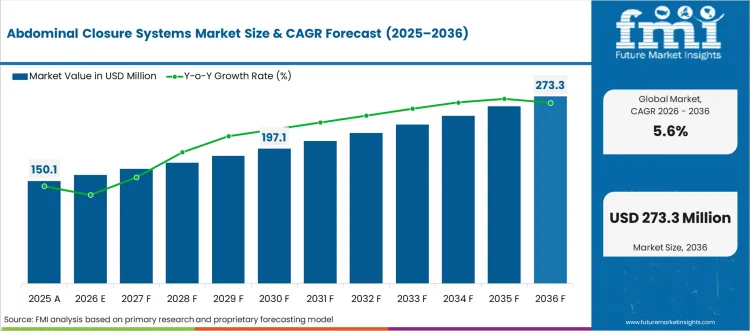
The Abdominal Closure Systems market was valued at USD 150.10 million in 2025, projected to reach USD 158.51 million in 2026, and is forecast to expand to USD 273.33 million by 2036 at a 5.6% CAGR. As per FMI, the absolute dollar opportunity across the forecast period amounts to USD 114.82 million, reflecting steady conversion of latent demand into measurable procurement activity across end-use buyer segments.
Summary of Abdominal Closure Systems Market
- Market Snapshot
- The market is valued at USD 150.10 million in 2025 and is projected to reach USD 273.33 million by 2036.
- The industry is expected to grow at a 5.6% CAGR from 2026 to 2036, creating an incremental opportunity of USD 114.82 million.
- The market remains a specification-driven category where product performance, regulatory compliance, and supply chain reliability define competitive positioning.
- Demand and Growth Drivers
- Demand is rising as end-use sectors face tightening performance specifications and compliance requirements that favour qualified product sources.
- Technology upgrade cycles and capacity expansion programmes across primary verticals are accelerating procurement schedules.
- Growth is further supported by expanding capacity in Asia Pacific and policy incentive frameworks in North America and Europe.
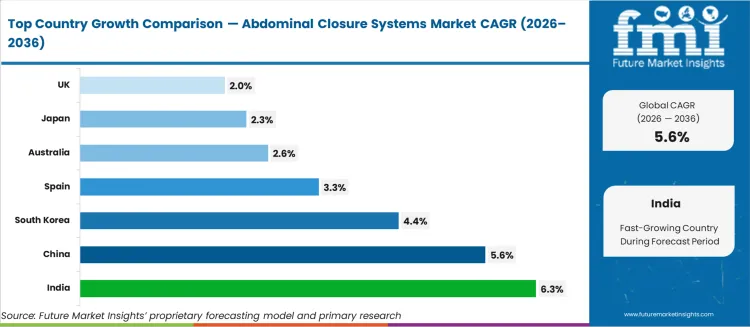
- Among key countries, India at 6.3%, China at 5.6%, South Korea at 4.4%, Spain at 3.3%, Australia at 2.6%, Japan at 2.3%, UK at 2%.
- Product and Segment View
- The market includes abdominal closure systems are surgical devices designed to achieve fascial approximation and wound closure following open and laparoscopic abdominal procedures, including temporary closure systems for damage control surgery and definitive closure devices for elective operations.
- Laparoscopic Abdominal Closure Devices leads by Product with 81.6% share in 2026.
- Trauma Surgery leads by Indication with 46.8% share in 2026.
- Scope includes market scope includes global and regional revenue sizing for abdominal closure systems segmented by product, indication, and end user.
- Geography and Competitive Outlook
- India and China are the fastest-growing markets, while mature economies sustain high-value demand through established procurement channels.
- Competition is shaped by product specification compliance, distribution network breadth, and supplier qualification track records.
- Key players include Medtronic, ACell Inc., neoSurgical, Teleflex Incorporated, AbSolutions Med, Inc., Suturion AB.
- Analyst Opinion at FMI
- Sabyasachi Ghosh, Principal Consultant at Future Market Insights, opines: 'In my analysis, I have observed that the Abdominal Closure Systems market is transitioning from commodity procurement to specification-driven sourcing structures. Buyers delaying alignment with updated qualification frameworks risk supply disruptions as certified suppliers prioritize long-term contract holders. Capital allocation toward qualified capacity and regional distribution infrastructure will define competitive positioning through the forecast period.'
- Strategic Implications / Executive Takeaways
- Suppliers must secure product qualification certifications ahead of procurement cycle deadlines to qualify for multi-year contract awards.
- Capital project directors should prioritize capacity expansion in high-growth geographies where demand density and incentive frameworks reduce payback periods.
- Product development teams must invest in next-generation specification compliance capabilities to maintain competitiveness.
Based on FMI's report, the growing volume of laparoscopic and open abdominal surgical procedures globally is the structural demand driver for abdominal closure systems. Laparoscopic abdominal closure devices that enable fascial defect repair through trocar port sites are gaining specification preference over manual suturing techniques, as they reduce operative time and lower incisional hernia recurrence rates documented in clinical registries. FMI opines that trauma surgery centres managing damage control laparotomy patients represent the highest-acuity procurement channel, where temporary abdominal closure systems and negative pressure wound therapy integration address open abdomen management requirements. Transplantation surgery programmes procuring closure systems for donor site and recipient abdominal wall reconstruction add a specialized but growing vertical.
All tracked country markets reflect differentiated growth trajectories. India leads at 6.3% CAGR, propelled by expanding laparoscopic surgery adoption across tier-2 hospital networks and growing trauma centre infrastructure. China leads at 5.6% CAGR, supported by hospital surgical volume growth and medical device localization procurement mandates. South Korea leads at 4.4% CAGR, driven by advanced surgical technique adoption rates and medical device regulatory fast-track approvals. Spain leads at 3.3% CAGR, backed by NHS hospital network surgical equipment procurement cycles and laparoscopic training centre expansion. Australia leads at 2.6% CAGR, sustained by Medicare-funded surgical procedure volume growth and hospital equipment standardization programmes. Japan leads at 2.3% CAGR, driven by aging population surgical volume increases and robotic surgery integration driving closure device specification upgrades. UK registers a 2% pace, supported by NHS trust surgical equipment procurement frameworks and NICE-guided surgical technique adoption.
Abdominal Closure Systems Market Key Takeaways
| Metric | Details |
|---|---|
| Industry Size (2026) | USD 158.51 million |
| Industry Value (2036) | USD 273.33 million |
| CAGR (2026-2036) | 5.6% |
Source: Future Market Insights, 2026
Abdominal Closure Systems Market Definition
Abdominal closure systems are surgical devices designed to achieve fascial approximation and wound closure following open and laparoscopic abdominal procedures, including temporary closure systems for damage control surgery and definitive closure devices for elective operations. The market covers laparoscopic abdominal closure devices and traction-based closure systems used across trauma surgery, laparoscopic procedures, and transplantation surgery. Primary procurement is driven by hospital surgical volume, surgeon technique preference, and clinical evidence for incisional hernia prevention.
Abdominal Closure Systems Market Inclusions
Market scope includes global and regional revenue sizing for abdominal closure systems segmented by product, indication, and end user. Coverage spans laparoscopic and traction-based devices across trauma, laparoscopy, and transplantation surgical verticals with a 2026 to 2036 forecast period and country-level analysis.
Abdominal Closure Systems Market Exclusions
The scope excludes standard surgical sutures, skin staplers, and wound dressings without fascial closure functionality. Hernia mesh implants and tissue adhesives are excluded. Complete surgical instrument trays and operating room capital equipment fall outside the valuation boundary.
Abdominal Closure Systems Market Research Methodology
- Primary Research: Analysts engaged with procurement leads, product specification engineers, and supply chain managers to map purchase decision triggers and qualification requirements.
- Desk Research: Data collection phases aggregated regulatory standards documentation, industry association publications, and company disclosure filings.
- Market-Sizing and Forecasting: Baseline values derive from a bottom-up aggregation of product shipments and contract values, applying region-specific adoption curves to project demand velocity.
- Data Validation and Update Cycle: Projections are tested against publicly reported revenue guidance from leading suppliers and cross-referenced with trade association data.
Key Industry Highlights
Increasing Focus of Key Players on Receiving Regulatory Approvals for Launch of New Products to the Market
Surgical procedures have become increasingly sophisticated recent years, these factor has led to an increase in demand for advanced closure system that offer enhanced safety, with minimal complication. Development and introduction of these products that has improved clinical need can aid them to hold strong position in the market.
Emphasis on development of new products enable companies to incorporate advanced features that can address the limitations of the existing systems. For developing new products manufacturers can emphasize on using new materials, focus on factors that can reduce infection rates, improve ease of use of surgeons.
These innovations not only enhance product performance but also provides benefits to the healthcare providers which aid their product appealing and stay ahead in the growing competitive market.
For instance, in January 2026, AbSolutions Med, Inc., a privately held medical device company received FDA breakthrough device designation for its REBUILD Bioabsorbable abdominal wall closure device. This product supports intrinsic tissue healing and eliminate long term foreign bodies.
Therefore, the growing focus of key players on development and introduction of new product to the market allows them to be relevant and visible in the market and provides them with the opportunities to build their reputation as an innovator.
Growing use of Biodegradable Materials in Abdominal Closure System Surges the Market Growth
Patient safety increases through the use of biodegradable materials, mainly due to reduced risks from foreign body reactions and from complications associated with permanent sutures. This, in turn, improves patient outcomes and acceptance. Use of biodegradable material enables no longer need for follow-up surgery related to suture removal, which increases patient convenience.
Biodegradable materials further allow for faster healing of wounds with less scar formation which makes it attractive for both to the patients and surgeons seeking the best outcome. Many of the biodegradable materials consist of antimicrobial properties, which reduces the possibility of post-surgery infections and increasing the safety of the patients.
Ongoing research and development regarding new biodegradable materials is improving their performance and applicability, thus encouraging wider adoptions in surgical settings. In addition, increased regulatory support of advanced biodegradable solutions further fuels the innovation in the market.
Furthermore, rise in obesity rates and other related health disorders contributes to rise in number of abdominal surgeries, which contributes to increase in demand for efficient and safe closure methods. These are few of the factors that are contributing to the growth of the market in near future.
Growing Focus on Researchers on Innovating New Products and Filings Patents Propels the Market Opportunities
The growing demand for minimally invasive surgical techniques has urged demand for high-performance closure solutions that has minimal recovery times for patients. Growing emphasis of researchers on the development of biodegradable and antimicrobial materials for preventing the chances of infection in patients significantly contributes to the growth of the market.
Continuous innovation can enable the researcher to come up with a premium product that addresses specific challenges of both the patients and the surgeons, improving their market position and ensuring long-term success within the rapidly changing healthcare environment. For instance, in October 2022, Celso BAGAOISAN, Suresh PAI and Brad LABARBERA filed a patent for laparoscopic fascial closure system. This patent application is a continuation of United States Pat. Application No. 16/591,480, filed Oct. 2, 2019. This tissue closure device assists in retrieving the suture during suturing procedure.
These growing emphasis of researchers towards innovation of new product line for the surgical procedures significantly contribute to the growth of the market.
Surgical Complications Associated with Abdominal Closure System Hinders the Growth of the Market
Surgical complications regarding the systems for abdominal closure include infection, wound dehiscence, and hernias that hampers the growth of the market through creating skepticism among healthcare providers. Improper placement or excessive pressure can lead to organ damage whose prolonged use can result in skin necrosis due to ischemia. In some cases patients can witness fistula formulation if gastrointestinal structures are stresses.
Beyond physical complication patients can also witness psychological distress due to prolonged exposure to an open abdomen or closure device. These complications can prolong hospitalization time, add additional surgeries to the patients, which can lead to increased healthcare costs.
These factors also tend to tarnish the reputation of certain products or techniques. These fear of potential complication limits the willingness of healthcare professionals to adopt innovative solutions.
This complications also leave the patients and health professionals with the perception that new products lack reliability and encourage them to better opt for traditional and established practices. Thus, the factors such as reputational damage, ingrained resistance to change, further hinders the growth of the abdominal closure systems market.
2021 to 2025 Global Abdominal Closure Systems Sales Outlook Compared to Demand Forecast from 2026 to 2036
Abdominal closure systems are a class of medical devices used in the treatment and management of surgical wounds. They include retention sutures, mesh, adhesive strips, and vacuum-assisted closure.
Increase in number of population suffering from various diseases that are related to gastrointestinal have led to surge in demand for abdominal closure systems. Moreover, increased focus of manufacturers on introduction of synthetic and biologic meshes that can provide better support to the abdominal wall with reduced complications further augmented their market growth.
Increase in trauma cases due to accidents, improvement in surgical techniques, and better understanding of the physiological response of abdominal surgery has significantly contributes to its growth. In addition, continuous efforts taken by manufacturers on improvement of these techniques for better outcomes of the patients has further anticipated its market growth.
The market is witnessing growth owing to uptick in number of surgeries, increasing age of the population, and awareness regarding the benefits associated with advanced closure techniques fueling the market growth of abdominal closure systems. All these factors have led to a growing demand for more innovative and efficient solutions, thereby luring large investments in research and development.
The future sales outlook of the abdominal closure systems continues to be brilliant owing to the continuous technological advancement, including bioengineered materials and smart closure systems. Moreover, the market is also going to witness a substantial surge in demand, owing to an increased need for time-saving management of wounds and improvement of surgical outcomes.
Abdominal closure systems form part of the important modern surgical practice as healthcare systems continue their emphasis on patient safety and recovery. These are few of the factors that are propelling the growth of the market.
Market Concentration
Tier 1 companies comprise market leaders with a market revenue of above USD 100 million capturing significant market share of 51.6% in global market. These market leaders are characterized by high production capacity and a wide product portfolio. These market leaders are distinguished by their extensive expertise in manufacturing and reconditioning across multiple packaging formats and a broad geographical reach, underpinned by a robust consumer base.
They provide a wide range of series including reconditioning, recycling, and manufacturing utilizing the latest technology and meeting the regulatory standards providing the highest quality. Prominent companies within tier 1 include ACell Inc., 3M (Solventum), and neoSurgical.
Tier 2 companies include mid-size players with revenue of USD 50 to 100 million having presence in specific regions and highly influencing the local market and holds around 28.6% market share. These are characterized by a strong presence overseas and strong market knowledge. These market players have good technology and ensure regulatory compliance but may not have advanced technology and global reach. Prominent companies in tier 2 include Teleflex Incorporated, Medtronic etc.
Finally, Tier 3 companies, act as suppliers to the established market players. They are essential for the market as they specialize in specific products and cater to niche markets, adding diversity to the industry.
Country-wise Insights
The section below covers the industry analysis for the abdominal closure systems market for different countries. Market demand analysis on key countries in several regions of the globe, including North America, Asia Pacific, Europe, and others, is provided. The United States is anticipated to remain at the forefront in North America, with a maximum value share through 2036.
.webp "Top Country Growth Comparison Abdominal Closure Systems Market Cagr (2026 2036)")
| Countries | Value CAGR (2026 to 2036) |
|---|---|
| UK | 2.0% |
| China | 5.6% |
| Japan | 2.3% |
| South Korea | 4.4% |
| India | 6.3% |
| Spain | 3.3% |
| Australia | 2.6% |
Growing Advancements in Abdominal Closure System Anticipates the growth of the market in the United States
United States Abdominal Closure Systems market is poised to exhibit a CAGR of 1.7% during the forecast period. Currently, it holds the highest share in the North American market, and the trend is expected to continue during the forecast period.
The introduction of vacuum-assisted closure technology revolutionized advanced wound management due to the encouragement of healing and minimization of infection rates, making it a favorable option among surgeons. The other development of bioengineered materials like advanced meshes incorporates increased durability and biocompatibility, ensuring better patient outcomes. This allows for easier application and adjusted tension to minimize complications such as dehiscence.
Improved training programs and clinical guidelines have also facilitated the uptake of these advanced systems by healthcare professionals, leading to their increased use in surgical practice. This growing advancements such as introduction of advanced technology, and bioengineered materials, significantly contributes to its increased adoption among healthcare professionals.
Besides this, studies and development programs always come up with new findings that help overcome a certain problem involved in the management of wounds, thus adding to the list of items available in the market. In view of the growing importance of patient safety and shorter hospital recovery times, these advances are bound to facilitate improvement not only in surgical outcomes but also in the overall adoption of minimally invasive techniques that in turn increases the demand for abdominal closure systems in the United States market.
Increase in Number of Surgical Procedures Anticipates the Growth of the Market in China
Chinese abdominal closure system market is anticipated to grow at a CAGR of 5.6% throughout the forecast period.
Improved accessibility to healthcare, increase in aging population, increase in total number of both elective and emergency surgeries are continuously on the rise. This growing accessibility leads to an increase in diagnosed conditions from the simplest operations to abdominal ones that require surgical intervention.
With the continuously growing number of surgeries, especially abdominal surgeries, the abdominal closure devices has become indispensable for effective management of wounds. These systems minimize the chances of complication, such as infections and dehiscence of wounds-critical for patient recovery. Therefore, the growing emphasis of healthcare professionals on improving surgical outcomes and safety of the patient further anticipates the growth of the advanced closure system.
This increasing numbers of surgical procedures in China indicate a greater requirement for abdominal closure systems, providing manufacturers an opportunity to introduce new technologies and promotes overall market growth.
Growing Technological Advancements in Abdominal Closure System Products Anticipates the Market Growth in Germany
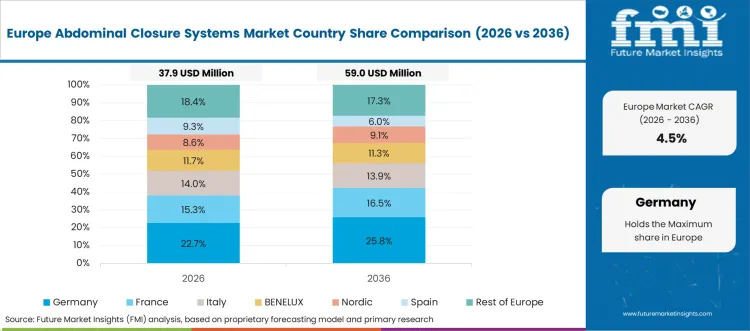
Germany is expected to have a strong foothold when it comes to technology innovation. In 2023 the country is projected to account for a significant share of the abdominal closure systems market. Innovations such as bioengineered meshes, smart closure devices, and vacuum-assisted systems emerge as an effective solutions to common complications linked with infections and wound dehiscence.
With Germany's strong emphasis on high-class health care and patient safety, demand arises for these sophisticated products. While healthcare providers seek to adopt recent technologies that improve surgical outcomes, R&D investments provide an opening to introduce advanced solutions that meet clinical needs.
In addition, collaboration between academia and industry ensures that the pace of innovation increases, with new products supported by sound research and clinical evidence. This does not only build credibility for the products but also helps in engendering trust among healthcare professionals and patients. With continued R&D yielding innovative solutions, the abdominal closure systems market in Germany is expected to register significant growth.
Category-wise Insights
The section contains information about the leading segments in the industry. By product, the laparoscopic abdominal closure devices segment is estimated to grow at a CAGR of 4.8% throughout 2036.
Several Advantages Provided by Laparoscopic Abdominal Closure Devices Segment aid it to dominate the Abdominal Closure Systems Market in terms of Value
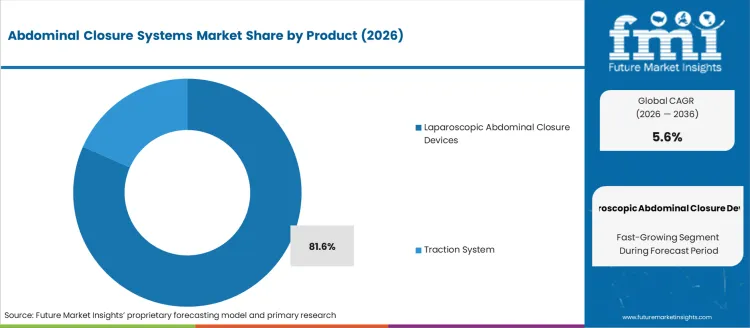
| Product | Laparoscopic Abdominal Closure Devices |
|---|---|
| Value Share (2026) | 81.6% |
The laparoscopic abdominal closure devices assist in performing surgeries that are minimally invasive. They offer several advantages such as reduced recovery time, less post-operative pain, and shorter hospitalization. These devices also improve precision in closing the incisions and reduce tissue trauma, which gives better patient outcomes.
The expanding acceptance of laparoscopic procedures into the various surgical disciplines has created a demand for specific closure solutions to meet these needs. Advances in the technology of the laparoscopic devices-by both material and design further enhance their effectiveness and reliability.
The emphasis on patient safety and improved outcomes following surgery is likely to continue to drive interest by healthcare providers in the features of laparoscopic closure devices. Therefore, the continuously growing popularity of laparoscopic abdominal closure devices anticipates their future market growth
Increase in Number of People Undergoing Traumatic Surgeries has aided it to hold dominant Position of the Abdominal Closure Systems Market
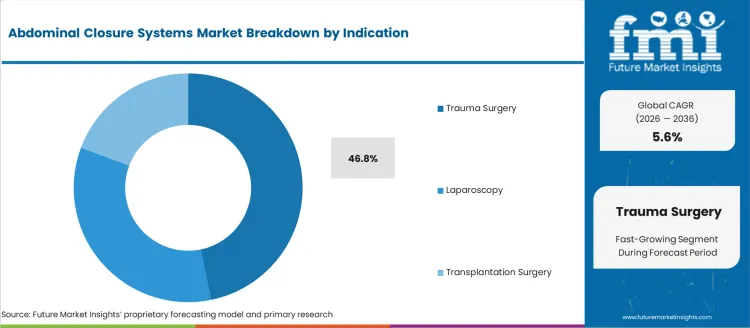
| Indication | Trauma surgery |
|---|---|
| Value Share (2036) | 46.8% |
The trauma surgery segment is forecast to account for a significant revenue in the abdominal closure systems market by 2036 end. It is also poised to expand at a lucrative CAGR during the forecast period.
Trauma surgery currently holds the largest share in the abdominal closure system market, owing to the increasing incidence of traumatic injuries needing urgent surgical interventions. Growing number of road traffic accidents, falls, and violence continue to be leading concerns.
The nature of trauma surgery is generally complex in wounds, involving the need for rapid stabilization of the abdominal cavity. Robust closure systems minimize complications such as infection and dehiscence. In trauma cases, there is great urgency, so devices that can be applied fast and effectively will see higher utilization of the special closure solution.
New technologies for closing the abdomen, such as vacuum-assisted closure devices, improve the outcomes from trauma surgery and further increase their adoption. Along with this a growing focus on effective improvements in patient safety and faster patient recovery times, contribute to the growing application of abdominal sutures in trauma surgeries.
Competitive Landscape
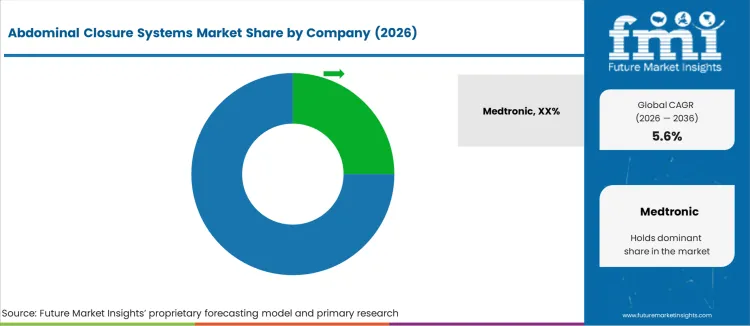
Substantial investments are seen in the abdominal closure systems industry towards research and development in order to drive innovations. Many of the key players are also focusing on receiving regulatory approvals for launch of their products to the market. Another key strategic focus of these companies is to actively look for strategic collaborations for expansion of their product portfolios.
Scope of the Report
| Metric | Value |
|---|---|
| Quantitative Units | USD 158.51 million to USD 273.33 million, at a CAGR of 5.6% |
| Market Definition | Abdominal closure systems are surgical devices designed to achieve fascial approximation and wound closure following open and laparoscopic abdominal procedures, including temporary closure systems for damage control surgery and definitive closure devices for elective operations. The market covers laparoscopic abdominal closure devices and traction-based closure systems used across trauma surgery, laparoscopic procedures, and transplantation surgery. |
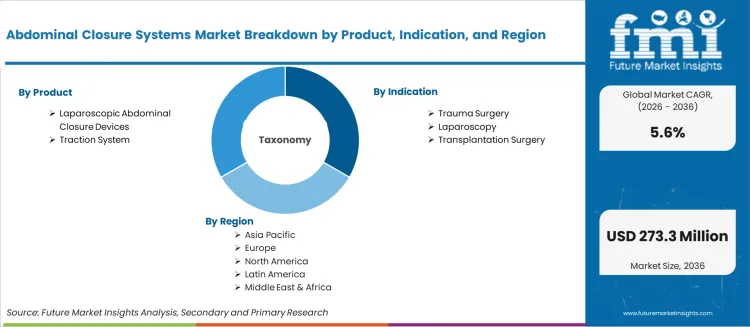
| Segmentation | Product: Laparoscopic Abdominal Closure Devices, Traction System; Indication: Trauma Surgery, Laparoscopy, Transplantation Surgery; End User: Hospitals, Ambulatory Surgical Centers, Trauma and Emergency Centers |
| Regions Covered | North America, Latin America, Europe, East Asia, South Asia, Oceania, Middle East & Africa |
| Countries Covered | India, China, South Korea, Spain, Australia, Japan, UK, and 40 plus countries |
| Key Companies Profiled | Medtronic, ACell Inc., neoSurgical, Teleflex Incorporated, AbSolutions Med, Inc., Suturion AB |
| Forecast Period | 2026 to 2036 |
| Approach | Forecasting models apply a bottom-up methodology starting with global installed base and consumption metrics, projecting conversion rates to advanced specifications. |
Key Segments of Abdominal Closure Systems Industry
By Product:
In terms of Product, the industry is divided into laparoscopic abdominal closure devices and traction system
By Indication:
The industry is classified by indication as trauma surgery, laparoscopy and transplantation surgery.
By End User:
The industry is classified by hospitals, ambulatory surgical centers and trauma & emergency centers
By Region:
Key countries of North America, Latin America, Western Europe, Eastern Europe, East Asia, South Asia and Pacific, and Middle East and Africa (MEA) have been covered in the report.
Bibliography
- 1. World Health Organization. (2024). Global guidelines for surgical safety and wound closure: Updated recommendations. WHO.
- 2. Medtronic plc. (2025). Annual Report 2024: Surgical innovations segment review. Medtronic.
- 3. European Association for Endoscopic Surgery. (2024). EAES clinical guidelines: Trocar site closure after laparoscopic surgery. EAES.
- 4. National Institute for Health and Care Excellence. (2024). NICE interventional procedures guidance: Abdominal wall closure techniques. NICE.
- 5. American College of Surgeons. (2024). ACS NSQIP best practices: Incisional hernia prevention through optimal closure technique. ACS.
This bibliography is provided for reader reference. The full Future Market Insights report contains the complete reference list with primary research documentation.
Frequently Asked Questions
How large is the demand for Abdominal Closure Systems in the global market in 2026?
Demand for Abdominal Closure Systems in the global market is estimated to be valued at USD 158.51 million in 2026.
What will be the market size of Abdominal Closure Systems in the global market by 2036?
Market size for Abdominal Closure Systems is projected to reach USD 273.33 million by 2036.
What is the expected demand growth for Abdominal Closure Systems between 2026 and 2036?
Demand for Abdominal Closure Systems is expected to grow at a CAGR of 5.6% between 2026 and 2036.
Which Product is poised to lead global sales by 2026?
Laparoscopic Abdominal Closure Devices accounts for 81.6% in 2026 based on established procurement patterns across primary end-use sectors.
What is driving demand in India?
India leads with a 6.3% CAGR through 2036, driven by expanding capacity, policy support, and growing end-user adoption.
What is the China growth outlook in this report?
China is projected to grow at a CAGR of 5.6% during 2026 to 2036.
What is Abdominal Closure Systems and what is it mainly used for?
Abdominal closure systems are surgical devices designed to achieve fascial approximation and wound closure following open and laparoscopic abdominal procedures, including temporary closure systems for damage control surgery and definitive closure devices for elective operations. The market covers laparoscopic abdominal closure devices and traction-based closure systems used across trauma surgery, laparoscopic procedures, and transplantation surgery.
How does FMI build and validate the Abdominal Closure Systems forecast?
Forecasting models apply a bottom-up methodology starting with global installed base metrics and cross-validate projections against quarterly industry revenue volumes and primary research inputs.
Preview the report firsthand - request a free sample
Get SampleGet the brochure for pricing and purchase details.
Get PDFTable of Content
- Executive Summary
- Global Market Outlook
- Demand-side Trends
- Supply-side Trends
- Technology Roadmap Analysis
- Analysis and Recommendations
- Market Overview
- Market Coverage / Taxonomy
- Market Definition / Scope / Limitations
- Research Methodology
- Chapter Orientation
- Analytical Lens and Working Hypotheses
- Market Structure, Signals, and Trend Drivers
- Benchmarking and Cross-market Comparability
- Market Sizing, Forecasting, and Opportunity Mapping
- Research Design and Evidence Framework
- Desk Research Programme (Secondary Evidence)
- Company Annual and Sustainability Reports
- Peer-reviewed Journals and Academic Literature
- Corporate Websites, Product Literature, and Technical Notes
- Earnings Decks and Investor Briefings
- Statutory Filings and Regulatory Disclosures
- Technical White Papers and Standards Notes
- Trade Journals, Industry Magazines, and Analyst Briefs
- Conference Proceedings, Webinars, and Seminar Materials
- Government Statistics Portals and Public Data Releases
- Press Releases and Reputable Media Coverage
- Specialist Newsletters and Curated Briefings
- Sector Databases and Reference Repositories
- FMI Internal Proprietary Databases and Historical Market Datasets
- Subscription Datasets and Paid Sources
- Social Channels, Communities, and Digital Listening Inputs
- Additional Desk Sources
- Expert Input and Fieldwork (Primary Evidence)
- Primary Modes
- Qualitative Interviews and Expert Elicitation
- Quantitative Surveys and Structured Data Capture
- Blended Approach
- Why Primary Evidence is Used
- Field Techniques
- Interviews
- Surveys
- Focus Groups
- Observational and In-context Research
- Social and Community Interactions
- Stakeholder Universe Engaged
- C-suite Leaders
- Board Members
- Presidents and Vice Presidents
- R&D and Innovation Heads
- Technical Specialists
- Domain Subject-matter Experts
- Scientists
- Physicians and Other Healthcare Professionals
- Governance, Ethics, and Data Stewardship
- Research Ethics
- Data Integrity and Handling
- Primary Modes
- Tooling, Models, and Reference Databases
- Desk Research Programme (Secondary Evidence)
- Data Engineering and Model Build
- Data Acquisition and Ingestion
- Cleaning, Normalisation, and Verification
- Synthesis, Triangulation, and Analysis
- Quality Assurance and Audit Trail
- Market Background
- Market Dynamics
- Drivers
- Restraints
- Opportunity
- Trends
- Scenario Forecast
- Demand in Optimistic Scenario
- Demand in Likely Scenario
- Demand in Conservative Scenario
- Opportunity Map Analysis
- Product Life Cycle Analysis
- Supply Chain Analysis
- Investment Feasibility Matrix
- Value Chain Analysis
- PESTLE and Porter’s Analysis
- Regulatory Landscape
- Regional Parent Market Outlook
- Production and Consumption Statistics
- Import and Export Statistics
- Market Dynamics
- Global Market Analysis 2021 to 2025 and Forecast, 2026 to 2036
- Historical Market Size Value (USD Million) Analysis, 2021 to 2025
- Current and Future Market Size Value (USD Million) Projections, 2026 to 2036
- Y-o-Y Growth Trend Analysis
- Absolute $ Opportunity Analysis
- Global Market Pricing Analysis 2021 to 2025 and Forecast 2026 to 2036
- Global Market Analysis 2021 to 2025 and Forecast 2026 to 2036, By Product
- Introduction / Key Findings
- Historical Market Size Value (USD Million) Analysis By Product , 2021 to 2025
- Current and Future Market Size Value (USD Million) Analysis and Forecast By Product , 2026 to 2036
- Laparoscopic Abdominal Closure Devices
- Traction System
- Laparoscopic Abdominal Closure Devices
- Y-o-Y Growth Trend Analysis By Product , 2021 to 2025
- Absolute $ Opportunity Analysis By Product , 2026 to 2036
- Global Market Analysis 2021 to 2025 and Forecast 2026 to 2036, By Indication
- Introduction / Key Findings
- Historical Market Size Value (USD Million) Analysis By Indication, 2021 to 2025
- Current and Future Market Size Value (USD Million) Analysis and Forecast By Indication, 2026 to 2036
- Trauma Surgery
- Laparoscopy
- Transplantation Surgery
- Trauma Surgery
- Y-o-Y Growth Trend Analysis By Indication, 2021 to 2025
- Absolute $ Opportunity Analysis By Indication, 2026 to 2036
- Global Market Analysis 2021 to 2025 and Forecast 2026 to 2036, By End User
- Introduction / Key Findings
- Historical Market Size Value (USD Million) Analysis By End User, 2021 to 2025
- Current and Future Market Size Value (USD Million) Analysis and Forecast By End User, 2026 to 2036
- Hospitals
- Ambulatory
- Surgical Centers
- Trauma & Emergency Centers
- Hospitals
- Y-o-Y Growth Trend Analysis By End User, 2021 to 2025
- Absolute $ Opportunity Analysis By End User, 2026 to 2036
- Global Market Analysis 2021 to 2025 and Forecast 2026 to 2036, By Region
- Introduction
- Historical Market Size Value (USD Million) Analysis By Region, 2021 to 2025
- Current Market Size Value (USD Million) Analysis and Forecast By Region, 2026 to 2036
- North America
- Latin America
- Western Europe
- Eastern Europe
- East Asia
- South Asia and Pacific
- Middle East & Africa
- Market Attractiveness Analysis By Region
- North America Market Analysis 2021 to 2025 and Forecast 2026 to 2036, By Country
- Historical Market Size Value (USD Million) Trend Analysis By Market Taxonomy, 2021 to 2025
- Market Size Value (USD Million) Forecast By Market Taxonomy, 2026 to 2036
- By Country
- USA
- Canada
- Mexico
- By Product
- By Indication
- By End User
- By Country
- Market Attractiveness Analysis
- By Country
- By Product
- By Indication
- By End User
- Key Takeaways
- Latin America Market Analysis 2021 to 2025 and Forecast 2026 to 2036, By Country
- Historical Market Size Value (USD Million) Trend Analysis By Market Taxonomy, 2021 to 2025
- Market Size Value (USD Million) Forecast By Market Taxonomy, 2026 to 2036
- By Country
- Brazil
- Chile
- Rest of Latin America
- By Product
- By Indication
- By End User
- By Country
- Market Attractiveness Analysis
- By Country
- By Product
- By Indication
- By End User
- Key Takeaways
- Western Europe Market Analysis 2021 to 2025 and Forecast 2026 to 2036, By Country
- Historical Market Size Value (USD Million) Trend Analysis By Market Taxonomy, 2021 to 2025
- Market Size Value (USD Million) Forecast By Market Taxonomy, 2026 to 2036
- By Country
- Germany
- UK
- Italy
- Spain
- France
- Nordic
- BENELUX
- Rest of Western Europe
- By Product
- By Indication
- By End User
- By Country
- Market Attractiveness Analysis
- By Country
- By Product
- By Indication
- By End User
- Key Takeaways
- Eastern Europe Market Analysis 2021 to 2025 and Forecast 2026 to 2036, By Country
- Historical Market Size Value (USD Million) Trend Analysis By Market Taxonomy, 2021 to 2025
- Market Size Value (USD Million) Forecast By Market Taxonomy, 2026 to 2036
- By Country
- Russia
- Poland
- Hungary
- Balkan & Baltic
- Rest of Eastern Europe
- By Product
- By Indication
- By End User
- By Country
- Market Attractiveness Analysis
- By Country
- By Product
- By Indication
- By End User
- Key Takeaways
- East Asia Market Analysis 2021 to 2025 and Forecast 2026 to 2036, By Country
- Historical Market Size Value (USD Million) Trend Analysis By Market Taxonomy, 2021 to 2025
- Market Size Value (USD Million) Forecast By Market Taxonomy, 2026 to 2036
- By Country
- China
- Japan
- South Korea
- By Product
- By Indication
- By End User
- By Country
- Market Attractiveness Analysis
- By Country
- By Product
- By Indication
- By End User
- Key Takeaways
- South Asia and Pacific Market Analysis 2021 to 2025 and Forecast 2026 to 2036, By Country
- Historical Market Size Value (USD Million) Trend Analysis By Market Taxonomy, 2021 to 2025
- Market Size Value (USD Million) Forecast By Market Taxonomy, 2026 to 2036
- By Country
- India
- ASEAN
- Australia & New Zealand
- Rest of South Asia and Pacific
- By Product
- By Indication
- By End User
- By Country
- Market Attractiveness Analysis
- By Country
- By Product
- By Indication
- By End User
- Key Takeaways
- Middle East & Africa Market Analysis 2021 to 2025 and Forecast 2026 to 2036, By Country
- Historical Market Size Value (USD Million) Trend Analysis By Market Taxonomy, 2021 to 2025
- Market Size Value (USD Million) Forecast By Market Taxonomy, 2026 to 2036
- By Country
- Kingdom of Saudi Arabia
- Other GCC Countries
- Turkiye
- South Africa
- Other African Union
- Rest of Middle East & Africa
- By Product
- By Indication
- By End User
- By Country
- Market Attractiveness Analysis
- By Country
- By Product
- By Indication
- By End User
- Key Takeaways
- Key Countries Market Analysis
- USA
- Pricing Analysis
- Market Share Analysis, 2025
- By Product
- By Indication
- By End User
- Canada
- Pricing Analysis
- Market Share Analysis, 2025
- By Product
- By Indication
- By End User
- Mexico
- Pricing Analysis
- Market Share Analysis, 2025
- By Product
- By Indication
- By End User
- Brazil
- Pricing Analysis
- Market Share Analysis, 2025
- By Product
- By Indication
- By End User
- Chile
- Pricing Analysis
- Market Share Analysis, 2025
- By Product
- By Indication
- By End User
- Germany
- Pricing Analysis
- Market Share Analysis, 2025
- By Product
- By Indication
- By End User
- UK
- Pricing Analysis
- Market Share Analysis, 2025
- By Product
- By Indication
- By End User
- Italy
- Pricing Analysis
- Market Share Analysis, 2025
- By Product
- By Indication
- By End User
- Spain
- Pricing Analysis
- Market Share Analysis, 2025
- By Product
- By Indication
- By End User
- France
- Pricing Analysis
- Market Share Analysis, 2025
- By Product
- By Indication
- By End User
- India
- Pricing Analysis
- Market Share Analysis, 2025
- By Product
- By Indication
- By End User
- ASEAN
- Pricing Analysis
- Market Share Analysis, 2025
- By Product
- By Indication
- By End User
- Australia & New Zealand
- Pricing Analysis
- Market Share Analysis, 2025
- By Product
- By Indication
- By End User
- China
- Pricing Analysis
- Market Share Analysis, 2025
- By Product
- By Indication
- By End User
- Japan
- Pricing Analysis
- Market Share Analysis, 2025
- By Product
- By Indication
- By End User
- South Korea
- Pricing Analysis
- Market Share Analysis, 2025
- By Product
- By Indication
- By End User
- Russia
- Pricing Analysis
- Market Share Analysis, 2025
- By Product
- By Indication
- By End User
- Poland
- Pricing Analysis
- Market Share Analysis, 2025
- By Product
- By Indication
- By End User
- Hungary
- Pricing Analysis
- Market Share Analysis, 2025
- By Product
- By Indication
- By End User
- Kingdom of Saudi Arabia
- Pricing Analysis
- Market Share Analysis, 2025
- By Product
- By Indication
- By End User
- Turkiye
- Pricing Analysis
- Market Share Analysis, 2025
- By Product
- By Indication
- By End User
- South Africa
- Pricing Analysis
- Market Share Analysis, 2025
- By Product
- By Indication
- By End User
- USA
- Market Structure Analysis
- Competition Dashboard
- Competition Benchmarking
- Market Share Analysis of Top Players
- By Regional
- By Product
- By Indication
- By End User
- Competition Analysis
- Competition Deep Dive
- Medtronic
- Overview
- Product Portfolio
- Profitability by Market Segments (Product/Age /Sales Channel/Region)
- Sales Footprint
- Strategy Overview
- Marketing Strategy
- Product Strategy
- Channel Strategy
- ACell Inc.
- neoSurgical
- Teleflex Incorporated
- 3M
- AbSolutions Med, Inc.
- Suturion AB
- Medtronic
- Competition Deep Dive
- Assumptions & Acronyms Used


