

- Industry Size (2026)
- USD 1.70 Bn
- Forecast (2036)
- USD 3.07 Bn
- CAGR (2026 to 2036)
- 6.1%
Cranial Closure And Fixation Devices Market size, market forecast and outlook by FMI
The cranial closure and fixation devices market was valued at USD 1.60 billion in 2025, projected to reach USD 1.70 billion in 2026, and is forecast to expand to USD 3.07 billion by 2036 at a 6.1% CAGR. Rising neurosurgical procedure volumes driven by increasing brain cancer incidence, expanding craniosynostosis correction programmes, and growing access to neurosurgical care in emerging markets are sustaining demand for cranial closure and fixation hardware. The transition from stainless steel to titanium and absorbable polymer fixation systems reflects clinical preference for reduced imaging artifact and elimination of secondary removal procedures.
Summary of Cranial Closure And Fixation Devices Market
- The market is forecast to touch USD 3.07 billion by 2036.
- Annual growth of 6.1% is projected across the 2026-2036 forecast horizon.
- In 2025, market value was pegged at USD 1.60 billion.
- The forecast period unlocks an incremental opportunity worth USD 1.37 billion.
- Screws lead by product type with 35.2% share in 2026 as the foundational fastener component in all cranial plating and fixation systems.
- Titanium leads by material with 36.5% share in 2026 due to biocompatibility, MRI transparency, and mechanical strength for permanent cranial fixation.
- Brain cancer holds 29.6% share by indication in 2026 as post-craniotomy closure following tumour resection is the highest-volume single-procedure category.
- Demand is rising as neurosurgical procedure volumes increase due to growing brain cancer incidence, expanding craniosynostosis correction programmes, and improved access to neurosurgical care in emerging markets.
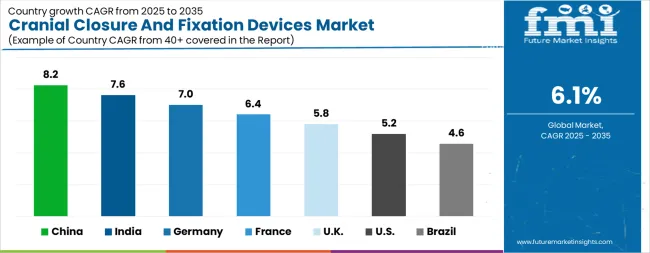
- Among key countries, India leads at 7.6% CAGR, followed by Germany at 7.0%, France at 6.4%, the UK at 5.8%, the USA at 5.2%, and Brazil at 4.6%.
As per FMI, the cranial closure and fixation devices market is shaped by the convergence of rising neurosurgical case volumes and material science advancement. Screws dominate product type at 35.2% share as the foundational fastener in all cranial plating systems. Titanium leads materials at 36.5% share due to its biocompatibility, imaging transparency, and mechanical strength for permanent fixation. FMI analysts observe that absorbable polymer fixation systems are the fastest-growing material segment in paediatric craniosynostosis correction, where the elimination of secondary removal surgery reduces both clinical risk and healthcare cost. Brain cancer remains the leading indication at 29.6% share as post-craniotomy closure following tumour resection constitutes the highest-volume single-procedure category for cranial fixation hardware.
All major markets reflect accelerated deployment parameters. India sets a 7.6% CAGR, Germany sets a 7.0% CAGR, France sets a 6.4% CAGR, UK sets a 5.8% CAGR, USA sets a 5.2% CAGR, and Brazil sets a 4.6% CAGR. India leads at 7.6% CAGR as expanding neurosurgical infrastructure and medical tourism drive procedure volumes. Germany at 7.0% reflects its advanced neurosurgical centre density and medical device regulatory leadership. France at 6.4% benefits from its centralized neurosurgical referral network. The UK at 5.8% sustains growth through NHS neurosurgical service expansion. The USA at 5.2% maintains steady replacement and upgrade demand across its mature neurosurgical base. Brazil at 4.6% invests in public hospital neurosurgical capacity.
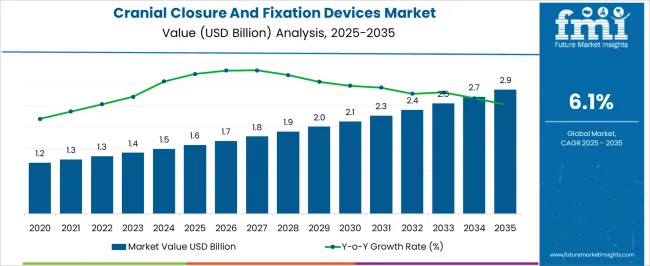
Cranial Closure And Fixation Devices Market key takeaways
| Metric | Details |
|---|---|
| Industry Size (2026) | USD 1.70 billion |
| Industry Value (2036) | USD 3.07 billion |
| CAGR (2026-2036) | 6.1% |
Source: Future Market Insights, 2026
Cranial Closure And Fixation Devices Market definition
Cranial closure and fixation devices are surgical implants used to reattach cranial bone flaps and reconstruct cranial defects following neurosurgical procedures including craniotomy, craniectomy, and cranial vault remodelling. Product categories span self-drilling screws in multiple sizes, straight and contoured fixation plates, cranial flap tube clamps, titanium and absorbable mesh, and bone cement for defect reconstruction. Materials include titanium, absorbable polymers, non-absorbable polymers, and stainless steel.
Cranial Closure And Fixation Devices Market inclusions
Market scope includes all cranial closure and fixation hardware sold for neurosurgical use, covering screws, plates, mesh, clamps, and bone cement across all material types. Regional and country-level market sizes, forecast period 2026 to 2036, and segment breakdowns by product type, indication, material, and end user are fully incorporated.
Cranial Closure And Fixation Devices Market exclusions
The scope excludes spinal fixation devices, maxillofacial plating systems, neurosurgical instruments and powered tools, cranial shunt systems, and neuromonitoring equipment.
Cranial Closure And Fixation Devices Market research methodology
- Primary Research: Analysts conducted interviews with neurosurgeons, hospital procurement directors, medical device sales managers, and neuro-oncology centre administrators to map device selection criteria and procurement patterns.
- Desk Research: Data collection aggregated neurosurgical procedure volume databases, medical device regulatory approval registries, hospital purchasing consortium data, and device manufacturer annual reports.
- Market-Sizing and Forecasting: Baseline values derive from a bottom-up aggregation of neurosurgical procedure volumes by indication and region, applying per-procedure device utilization rates and material-specific pricing.
- Data Validation and Update Cycle: Projections are tested against publicly reported revenue data from cranial fixation device manufacturers and cross-referenced with neurosurgical procedure volume statistics from major hospital systems.
Why is the Cranial Closure And Fixation Devices Market Growing?
The Cranial Closure and Fixation Devices market is witnessing significant growth, driven by the rising prevalence of neurosurgical procedures, including craniotomies and cranial reconstruction surgeries. Increasing incidences of brain tumors, traumatic injuries, and congenital cranial defects are contributing to higher demand for reliable closure and fixation solutions. The market is further supported by technological advancements in minimally invasive surgical techniques, which enhance precision, reduce operative time, and improve patient outcomes.
Growing adoption of advanced materials and customizable devices is enabling surgeons to achieve optimal cranial stability and aesthetic results. The integration of imaging and navigation systems with cranial fixation solutions is improving surgical accuracy and reducing postoperative complications. Increasing investments in healthcare infrastructure, neurosurgery centers, and training programs are further boosting market expansion.
Regulatory support for medical devices, coupled with rising awareness among healthcare providers about improved patient outcomes and reduced recovery time, is shaping market dynamics As the demand for safe and effective cranial closure solutions grows globally, the market is poised for sustained expansion.
Segmental Analysis
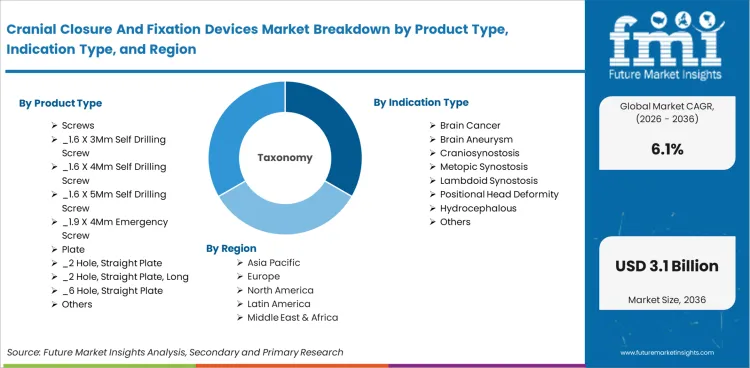
The cranial closure and fixation devices market is segmented by product type, indication type, material type, end-user, and geographic regions. By product type, cranial closure and fixation devices market is divided into Screws, 1.6 X 3Mm Self Drilling Screw, 1.6 X 4Mm Self Drilling Screw, 1.6 X 5Mm Self Drilling Screw, 1.9 X 4Mm Emergency Screw, Plate, 2 Hole, Straight Plate, 2 Hole, Straight Plate, Long, 6 Hole, Straight Plate, Others, Cranial Flap Tube Clamps, Mesh, Bone Cement, and Others (Patient Specific Implants).
In terms of indication type, cranial closure and fixation devices market is classified into Brain Cancer, Brain Aneurysm, Craniosynostosis, Metopic Synostosis, Lambdoid Synostosis, Positional Head Deformity, Hydrocephalous, and Others (Head Trauma, Birth Defects, Brain Biopsy). Based on material type, cranial closure and fixation devices market is segmented into Titanium, Absorbable, Non-Absorbable, and Stainless Steel. By end-user, cranial closure and fixation devices market is segmented into Hospitals and Cancer Research Institute. Regionally, the cranial closure and fixation devices industry is classified into North America, Latin America, Western Europe, Eastern Europe, Balkan & Baltic Countries, Russia & Belarus, Central Asia, East Asia, South Asia & Pacific, and the Middle East & Africa.
Insights into the Screws Product Type Segment
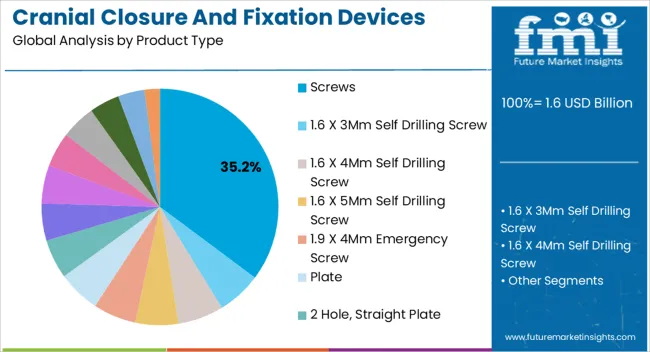
The screws product type segment is projected to hold 35.2% of the market revenue in 2026, making it the leading product type. Growth in this segment is driven by the proven mechanical stability and ease of application offered by screws during cranial closure procedures. Screws provide secure fixation of cranial plates, minimizing micromovements and ensuring optimal bone healing.
Their versatility in accommodating various cranial anatomies and compatibility with standard surgical instruments has strengthened their adoption among neurosurgeons. Technological improvements, such as self-tapping designs and bioactive coatings, enhance performance and reduce postoperative complications.
Screws are also cost-effective compared to alternative fixation methods, making them a preferred choice in both hospital and specialty clinics As the demand for minimally invasive and precise neurosurgical procedures continues to rise, screws are expected to maintain their leading position, supported by advancements in material science, design, and surgical techniques, ensuring improved patient outcomes and consistent clinical results.
Insights into the Brain Cancer Indication Type Segment
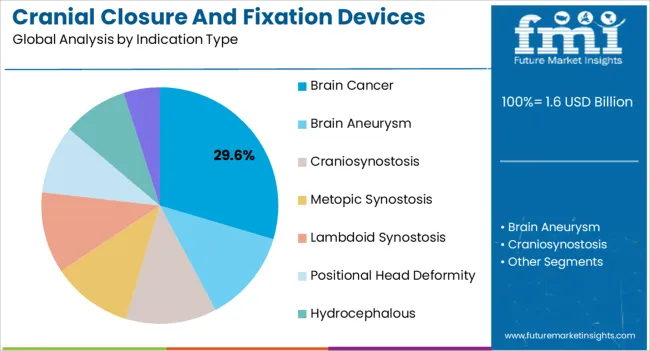
The brain cancer indication type segment is expected to account for 29.6% of the market revenue in 2026, establishing it as the leading indication. Growth in this segment is driven by the increasing incidence of primary and metastatic brain tumors worldwide, which require surgical intervention followed by cranial closure. Advanced fixation devices are being leveraged to ensure structural integrity and stability post-tumor resection, reducing the risk of complications and promoting faster recovery.
Customizable cranial plates and screws allow for precise adaptation to patient anatomy, enhancing both functional and aesthetic outcomes. Rising awareness among neurosurgeons about innovative closure techniques and improvements in patient safety are further supporting adoption.
Investments in specialized neurosurgery centers, as well as clinical training and education programs, are accelerating the use of fixation devices in brain cancer surgeries As the demand for efficient, reliable, and safe cranial closure solutions increases in oncological neurosurgery, the brain cancer segment is expected to remain a key growth driver within the market.
Insights into the Titanium Material Type Segment
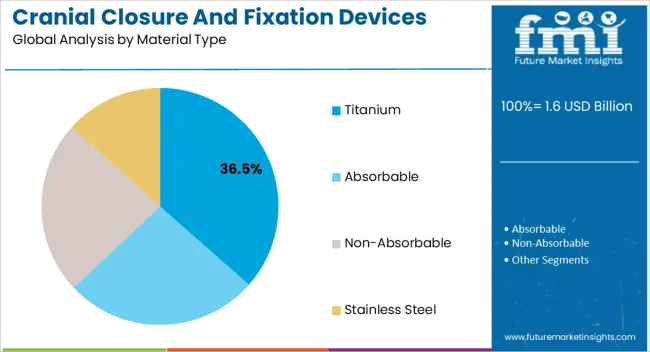
The titanium material type segment is projected to hold 36.5% of the market revenue in 2026, making it the leading material category. Growth is being driven by titanium’s excellent biocompatibility, strength-to-weight ratio, and corrosion resistance, which ensure reliable cranial fixation and long-term durability. Titanium devices allow for secure bone stabilization while minimizing the risk of inflammatory reactions or implant rejection.
Their radiolucency enables clear postoperative imaging without interference, supporting accurate clinical assessment. Advances in titanium processing, including 3D printing and surface treatments, have improved device customization and surgical ease. The combination of mechanical strength and lightweight design facilitates faster patient recovery and enhanced surgical outcomes.
As healthcare providers increasingly prioritize patient safety, long-term implant performance, and minimally invasive techniques, titanium is expected to remain the preferred material type Its widespread clinical adoption and compatibility with modern cranial closure technologies reinforce its market-leading position.
Market Overview
Cranial Closure And Fixation Devices Market Overview
Cranium is an important part of the body, which acts as a hard protective covering of the brain and also helps in maintaining the size and shape of the head. In some situation due to early closure of the sutures, there are some abnormalities arises that are named as craniosynostosis. In craniosynostosis, the closure of the sutures takes place at a very early age, which results in the disruptive shape of the head. However, there are surgeries related to fixing these problems. The procedure under these surgeries includes the cranial closure fixation system.
Furthermore, there are many other conditions where cranial closure and fixation devices are being used such as skull fractures, hydrocephalus, brain tumors, hematomas, other trauma injuries, and infections. The brain is an important part of human body to perform major vital functions of the body and its exposure to the environment may lead to further infections that can be complicated later.
This in turn, makes the cranial closure device an important after brain surgery. To get access to the bone inside a section of the brain is cut opened accordingly as per the operating part of the skull. The cut open section of the brain is named as bone flap that may be large or small in size as per the requirement of the surgery. After the surgery, the bone flap is placed again at the same place to cover the brain with the help of the cranial closure and fixation system, which includes plates, screws, and meshes.
Analysis of Cranial Closure And Fixation Devices Market By Key Countries
.webp "Top Country Growth Comparison Cranial Closure And Fixation Devices Market Cagr (2026 2036)")
| Country | CAGR |
|---|---|
| China | 8.2% |
| India | 7.6% |
| Germany | 7.0% |
| France | 6.4% |
| UK | 5.8% |
| USA | 5.2% |
| Brazil | 4.6% |
Source: FMI analysis based on primary research and proprietary forecasting model
Country-wise Analysis
The Cranial Closure And Fixation Devices Market is expected to register a CAGR of 6.1% during the forecast period, exhibiting varied country level momentum. China leads with the highest CAGR of 8.2%, followed by India at 7.6%. Developed markets such as Germany, France, and the UK continue to expand steadily, while the USA is likely to grow at consistent rates. Brazil posts the lowest CAGR at 4.6%, yet still underscores a broadly positive trajectory for the global Cranial Closure And Fixation Devices Market. In 2024, Germany held a dominant revenue in the Western Europe market and is expected to grow with a CAGR of 7.0%. The USA Cranial Closure And Fixation Devices Market is estimated to be valued at USD 579.2 million in 2026 and is anticipated to reach a valuation of USD 960.2 million by 2036. Sales are projected to rise at a CAGR of 5.2% over the forecast period between 2026 and 2036. While Japan and South Korea markets are estimated to be valued at USD 80.7 million and USD 47.2 million respectively in 2026.
Key Players in the Cranial Closure And Fixation Devices Market
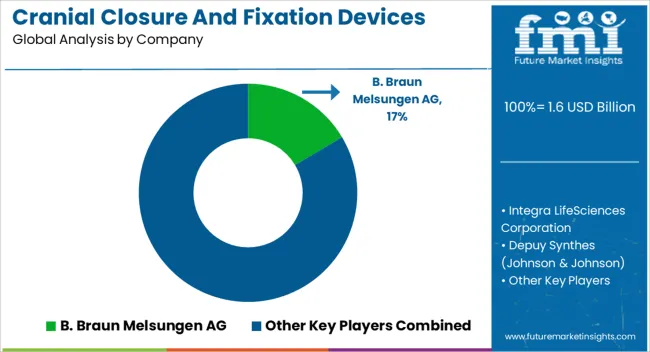
- B. Braun Melsungen AG
- Integra LifeSciences Corporation
- Depuy Synthes (Johnson & Johnson)
- Medtronic Plc.
- Stryker Corporation
- Zimmer Biomet Holding Inc.
- Evonos GmbH & Co. KG
- Changzhou Huida Medical Instrument Co. Ltd.
- Jeil Medical Corporation
- KLS Martin
Scope of the Report
| Metric | Value |
|---|---|
| Quantitative Units | USD 1.70 billion to USD 3.07 billion, at a CAGR of 6.1% |
| Market Definition | Cranial closure and fixation devices encompass surgical implants including screws, plates, mesh, clamps, and bone cement for cranial bone flap reattachment and defect reconstruction following neurosurgical procedures. |
| Product Type Segmentation | Screws, Plates, Cranial Flap Tube Clamps, Mesh, Bone Cement, Others |
| Indication Segmentation | Brain Cancer, Brain Aneurysm, Craniosynostosis, Metopic Synostosis, Lambdoid Synostosis, Positional Head Deformity, Hydrocephalous, Others |
| Material Segmentation | Titanium, Absorbable, Non-Absorbable, Stainless Steel |
| End User Segmentation | Hospitals, Cancer Research Institutes |
| Regions Covered | North America, Latin America, Europe, East Asia, South Asia, Oceania, Middle East & Africa |
| Countries Covered | India, Germany, France, UK, USA, Brazil, and 40 plus countries |
| Key Companies Profiled | B. Braun Melsungen AG, Integra LifeSciences Corporation, Depuy Synthes (Johnson & Johnson), Medtronic Plc., Stryker Corporation, Zimmer Biomet Holding Inc., Evonos GmbH & Co. KG, Changzhou Huida Medical Instrument Co. Ltd., Jeil Medical Corporation, KLS Martin |
| Forecast Period | 2026 to 2036 |
| Approach | Forecasting models apply a bottom-up methodology starting with neurosurgical procedure volumes by indication, applying per-procedure device utilization rates, cross-validated against device manufacturer revenue and hospital procurement data. |
Cranial Closure And Fixation Devices Market by Segments
Product Type:
- Screws
- 1.6 X 3Mm Self Drilling Screw
- 1.6 X 4Mm Self Drilling Screw
- 1.6 X 5Mm Self Drilling Screw
- 1.9 X 4Mm Emergency Screw
- Plate
- 2 Hole, Straight Plate
- 2 Hole, Straight Plate, Long
- 6 Hole, Straight Plate
- Others
- Cranial Flap Tube Clamps
- Mesh
- Bone Cement
- Others (Patient Specific Implants)
Indication Type:
- Brain Cancer
- Brain Aneurysm
- Craniosynostosis
- Metopic Synostosis
- Lambdoid Synostosis
- Positional Head Deformity
- Hydrocephalous
- Others (Head Trauma, Birth Defects, Brain Biopsy)
Material Type:
- Titanium
- Absorbable
- Non-Absorbable
- Stainless Steel
End-User:
- Hospitals
- Cancer Research Institute
Region:
- North America
- USA
- Canada
- Mexico
- Latin America
- Brazil
- Chile
- Rest of Latin America
- Western Europe
- Germany
- UK
- Italy
- Spain
- France
- Nordic
- BENELUX
- Rest of Western Europe
- Eastern Europe
- Russia
- Poland
- Hungary
- Balkan & Baltic
- Rest of Eastern Europe
- East Asia
- China
- Japan
- South Korea
- South Asia and Pacific
- India
- ASEAN
- Australia & New Zealand
- Rest of South Asia and Pacific
- Middle East & Africa
- Kingdom of Saudi Arabia
- Other GCC Countries
- Turkiye
- South Africa
- Other African Union
- Rest of Middle East & Africa
Bibliography
- 1. World Health Organization. (2024). Global cancer observatory: Brain and central nervous system cancer incidence and surgical intervention data. WHO IARC.
- 2. USA Food and Drug Administration. (2024). 510(k) premarket notification database: Cranial fixation devices. FDA.
- 3. European Medicines Agency. (2024). Medical device regulation: Cranial implant classification and conformity requirements. EMA.
- 4. National Institute for Health and Care Excellence. (2024). Neurosurgical procedures: Clinical guidance and device utilization standards. NICE UK.
- 5. Ministry of Health and Family Welfare, Government of India. (2024). National programme for prevention and control of cancer: Neurosurgical infrastructure report. MoHFW India.
- 6. International Society for Pediatric Neurosurgery. (2024). Craniosynostosis management: Fixation device selection guidelines. ISPN.
This bibliography is provided for reader reference. The full Future Market Insights report contains the complete reference list with primary research documentation.
Frequently Asked Questions
How large is the demand for cranial closure and fixation devices in the global market in 2026?
Demand for cranial closure and fixation devices in the global market is estimated to be valued at USD 1.70 billion in 2026.
What will be the market size of cranial closure and fixation devices by 2036?
Market size for cranial closure and fixation devices is projected to reach USD 3.07 billion by 2036.
What is the expected demand growth between 2026 and 2036?
Demand for cranial closure and fixation devices is expected to grow at a CAGR of 6.1% between 2026 and 2036.
Which product type is poised to lead global sales by 2026?
Screws account for 35.2% share in 2026 as the foundational fastener in all cranial plating and fixation systems used across neurosurgical indications.
Which material leads the market in 2026?
Titanium holds 36.5% share in 2026 due to biocompatibility, MRI imaging transparency, and mechanical strength for permanent cranial fixation applications.
What is driving demand in India?
Expanding neurosurgical infrastructure and growing medical tourism are driving cranial fixation device procurement in India at 7.6% CAGR through 2036.
What is included in the scope of this report?
The market covers all cranial fixation hardware including screws, plates, mesh, clamps, and bone cement, with breakdowns by product type, indication, material, and end user.
Preview the report firsthand - request a free sample
Get SampleGet the brochure for pricing and purchase details.
Get PDFTable of Content
- Executive Summary
- Global Market Outlook
- Demand-side Trends
- Supply-side Trends
- Technology Roadmap Analysis
- Analysis and Recommendations
- Market Overview
- Market Coverage / Taxonomy
- Market Definition / Scope / Limitations
- Research Methodology
- Chapter Orientation
- Analytical Lens and Working Hypotheses
- Market Structure, Signals, and Trend Drivers
- Benchmarking and Cross-market Comparability
- Market Sizing, Forecasting, and Opportunity Mapping
- Research Design and Evidence Framework
- Desk Research Programme (Secondary Evidence)
- Company Annual and Sustainability Reports
- Peer-reviewed Journals and Academic Literature
- Corporate Websites, Product Literature, and Technical Notes
- Earnings Decks and Investor Briefings
- Statutory Filings and Regulatory Disclosures
- Technical White Papers and Standards Notes
- Trade Journals, Industry Magazines, and Analyst Briefs
- Conference Proceedings, Webinars, and Seminar Materials
- Government Statistics Portals and Public Data Releases
- Press Releases and Reputable Media Coverage
- Specialist Newsletters and Curated Briefings
- Sector Databases and Reference Repositories
- FMI Internal Proprietary Databases and Historical Market Datasets
- Subscription Datasets and Paid Sources
- Social Channels, Communities, and Digital Listening Inputs
- Additional Desk Sources
- Expert Input and Fieldwork (Primary Evidence)
- Primary Modes
- Qualitative Interviews and Expert Elicitation
- Quantitative Surveys and Structured Data Capture
- Blended Approach
- Why Primary Evidence is Used
- Field Techniques
- Interviews
- Surveys
- Focus Groups
- Observational and In-context Research
- Social and Community Interactions
- Stakeholder Universe Engaged
- C-suite Leaders
- Board Members
- Presidents and Vice Presidents
- R&D and Innovation Heads
- Technical Specialists
- Domain Subject-matter Experts
- Scientists
- Physicians and Other Healthcare Professionals
- Governance, Ethics, and Data Stewardship
- Research Ethics
- Data Integrity and Handling
- Primary Modes
- Tooling, Models, and Reference Databases
- Desk Research Programme (Secondary Evidence)
- Data Engineering and Model Build
- Data Acquisition and Ingestion
- Cleaning, Normalisation, and Verification
- Synthesis, Triangulation, and Analysis
- Quality Assurance and Audit Trail
- Market Background
- Market Dynamics
- Drivers
- Restraints
- Opportunity
- Trends
- Scenario Forecast
- Demand in Optimistic Scenario
- Demand in Likely Scenario
- Demand in Conservative Scenario
- Opportunity Map Analysis
- Product Life Cycle Analysis
- Supply Chain Analysis
- Investment Feasibility Matrix
- Value Chain Analysis
- PESTLE and Porter’s Analysis
- Regulatory Landscape
- Regional Parent Market Outlook
- Production and Consumption Statistics
- Import and Export Statistics
- Market Dynamics
- Global Market Analysis 2021 to 2025 and Forecast, 2026 to 2036
- Historical Market Size Value (USD Million) Analysis, 2021 to 2025
- Current and Future Market Size Value (USD Million) Projections, 2026 to 2036
- Y-o-Y Growth Trend Analysis
- Absolute $ Opportunity Analysis
- Global Market Pricing Analysis 2021 to 2025 and Forecast 2026 to 2036
- Global Market Analysis 2021 to 2025 and Forecast 2026 to 2036, By Product Type
- Introduction / Key Findings
- Historical Market Size Value (USD Million) Analysis By Product Type , 2021 to 2025
- Current and Future Market Size Value (USD Million) Analysis and Forecast By Product Type , 2026 to 2036
- Screws
- 1.6 X 3Mm Self Drilling Screw
- 1.6 X 4Mm Self Drilling Screw
- 1.6 X 5Mm Self Drilling Screw
- 1.9 X 4Mm Emergency Screw
- Plate
- 2 Hole, Straight Plate
- 2 Hole, Straight Plate, Long
- 6 Hole, Straight Plate
- Others
- Cranial Flap Tube Clamps
- Mesh
- Bone Cement
- Others
- Screws
- Y-o-Y Growth Trend Analysis By Product Type , 2021 to 2025
- Absolute $ Opportunity Analysis By Product Type , 2026 to 2036
- Global Market Analysis 2021 to 2025 and Forecast 2026 to 2036, By Indication Type
- Introduction / Key Findings
- Historical Market Size Value (USD Million) Analysis By Indication Type, 2021 to 2025
- Current and Future Market Size Value (USD Million) Analysis and Forecast By Indication Type, 2026 to 2036
- Brain Cancer
- Brain Aneurysm
- Craniosynostosis
- Metopic Synostosis
- Lambdoid Synostosis
- Positional Head Deformity
- Hydrocephalous
- Others
- Brain Cancer
- Y-o-Y Growth Trend Analysis By Indication Type, 2021 to 2025
- Absolute $ Opportunity Analysis By Indication Type, 2026 to 2036
- Global Market Analysis 2021 to 2025 and Forecast 2026 to 2036, By Material Type
- Introduction / Key Findings
- Historical Market Size Value (USD Million) Analysis By Material Type, 2021 to 2025
- Current and Future Market Size Value (USD Million) Analysis and Forecast By Material Type, 2026 to 2036
- Titanium
- Absorbable
- Non-Absorbable
- Stainless Steel
- Titanium
- Y-o-Y Growth Trend Analysis By Material Type, 2021 to 2025
- Absolute $ Opportunity Analysis By Material Type, 2026 to 2036
- Global Market Analysis 2021 to 2025 and Forecast 2026 to 2036, By End-User
- Introduction / Key Findings
- Historical Market Size Value (USD Million) Analysis By End-User, 2021 to 2025
- Current and Future Market Size Value (USD Million) Analysis and Forecast By End-User, 2026 to 2036
- Hospitals
- Cancer Research Institute
- Hospitals
- Y-o-Y Growth Trend Analysis By End-User, 2021 to 2025
- Absolute $ Opportunity Analysis By End-User, 2026 to 2036
- Global Market Analysis 2021 to 2025 and Forecast 2026 to 2036, By Region
- Introduction
- Historical Market Size Value (USD Million) Analysis By Region, 2021 to 2025
- Current Market Size Value (USD Million) Analysis and Forecast By Region, 2026 to 2036
- North America
- Latin America
- Western Europe
- Eastern Europe
- East Asia
- South Asia and Pacific
- Middle East & Africa
- Market Attractiveness Analysis By Region
- North America Market Analysis 2021 to 2025 and Forecast 2026 to 2036, By Country
- Historical Market Size Value (USD Million) Trend Analysis By Market Taxonomy, 2021 to 2025
- Market Size Value (USD Million) Forecast By Market Taxonomy, 2026 to 2036
- By Country
- USA
- Canada
- Mexico
- By Product Type
- By Indication Type
- By Material Type
- By End-User
- By Country
- Market Attractiveness Analysis
- By Country
- By Product Type
- By Indication Type
- By Material Type
- By End-User
- Key Takeaways
- Latin America Market Analysis 2021 to 2025 and Forecast 2026 to 2036, By Country
- Historical Market Size Value (USD Million) Trend Analysis By Market Taxonomy, 2021 to 2025
- Market Size Value (USD Million) Forecast By Market Taxonomy, 2026 to 2036
- By Country
- Brazil
- Chile
- Rest of Latin America
- By Product Type
- By Indication Type
- By Material Type
- By End-User
- By Country
- Market Attractiveness Analysis
- By Country
- By Product Type
- By Indication Type
- By Material Type
- By End-User
- Key Takeaways
- Western Europe Market Analysis 2021 to 2025 and Forecast 2026 to 2036, By Country
- Historical Market Size Value (USD Million) Trend Analysis By Market Taxonomy, 2021 to 2025
- Market Size Value (USD Million) Forecast By Market Taxonomy, 2026 to 2036
- By Country
- Germany
- UK
- Italy
- Spain
- France
- Nordic
- BENELUX
- Rest of Western Europe
- By Product Type
- By Indication Type
- By Material Type
- By End-User
- By Country
- Market Attractiveness Analysis
- By Country
- By Product Type
- By Indication Type
- By Material Type
- By End-User
- Key Takeaways
- Eastern Europe Market Analysis 2021 to 2025 and Forecast 2026 to 2036, By Country
- Historical Market Size Value (USD Million) Trend Analysis By Market Taxonomy, 2021 to 2025
- Market Size Value (USD Million) Forecast By Market Taxonomy, 2026 to 2036
- By Country
- Russia
- Poland
- Hungary
- Balkan & Baltic
- Rest of Eastern Europe
- By Product Type
- By Indication Type
- By Material Type
- By End-User
- By Country
- Market Attractiveness Analysis
- By Country
- By Product Type
- By Indication Type
- By Material Type
- By End-User
- Key Takeaways
- East Asia Market Analysis 2021 to 2025 and Forecast 2026 to 2036, By Country
- Historical Market Size Value (USD Million) Trend Analysis By Market Taxonomy, 2021 to 2025
- Market Size Value (USD Million) Forecast By Market Taxonomy, 2026 to 2036
- By Country
- China
- Japan
- South Korea
- By Product Type
- By Indication Type
- By Material Type
- By End-User
- By Country
- Market Attractiveness Analysis
- By Country
- By Product Type
- By Indication Type
- By Material Type
- By End-User
- Key Takeaways
- South Asia and Pacific Market Analysis 2021 to 2025 and Forecast 2026 to 2036, By Country
- Historical Market Size Value (USD Million) Trend Analysis By Market Taxonomy, 2021 to 2025
- Market Size Value (USD Million) Forecast By Market Taxonomy, 2026 to 2036
- By Country
- India
- ASEAN
- Australia & New Zealand
- Rest of South Asia and Pacific
- By Product Type
- By Indication Type
- By Material Type
- By End-User
- By Country
- Market Attractiveness Analysis
- By Country
- By Product Type
- By Indication Type
- By Material Type
- By End-User
- Key Takeaways
- Middle East & Africa Market Analysis 2021 to 2025 and Forecast 2026 to 2036, By Country
- Historical Market Size Value (USD Million) Trend Analysis By Market Taxonomy, 2021 to 2025
- Market Size Value (USD Million) Forecast By Market Taxonomy, 2026 to 2036
- By Country
- Kingdom of Saudi Arabia
- Other GCC Countries
- Turkiye
- South Africa
- Other African Union
- Rest of Middle East & Africa
- By Product Type
- By Indication Type
- By Material Type
- By End-User
- By Country
- Market Attractiveness Analysis
- By Country
- By Product Type
- By Indication Type
- By Material Type
- By End-User
- Key Takeaways
- Key Countries Market Analysis
- USA
- Pricing Analysis
- Market Share Analysis, 2025
- By Product Type
- By Indication Type
- By Material Type
- By End-User
- Canada
- Pricing Analysis
- Market Share Analysis, 2025
- By Product Type
- By Indication Type
- By Material Type
- By End-User
- Mexico
- Pricing Analysis
- Market Share Analysis, 2025
- By Product Type
- By Indication Type
- By Material Type
- By End-User
- Brazil
- Pricing Analysis
- Market Share Analysis, 2025
- By Product Type
- By Indication Type
- By Material Type
- By End-User
- Chile
- Pricing Analysis
- Market Share Analysis, 2025
- By Product Type
- By Indication Type
- By Material Type
- By End-User
- Germany
- Pricing Analysis
- Market Share Analysis, 2025
- By Product Type
- By Indication Type
- By Material Type
- By End-User
- UK
- Pricing Analysis
- Market Share Analysis, 2025
- By Product Type
- By Indication Type
- By Material Type
- By End-User
- Italy
- Pricing Analysis
- Market Share Analysis, 2025
- By Product Type
- By Indication Type
- By Material Type
- By End-User
- Spain
- Pricing Analysis
- Market Share Analysis, 2025
- By Product Type
- By Indication Type
- By Material Type
- By End-User
- France
- Pricing Analysis
- Market Share Analysis, 2025
- By Product Type
- By Indication Type
- By Material Type
- By End-User
- India
- Pricing Analysis
- Market Share Analysis, 2025
- By Product Type
- By Indication Type
- By Material Type
- By End-User
- ASEAN
- Pricing Analysis
- Market Share Analysis, 2025
- By Product Type
- By Indication Type
- By Material Type
- By End-User
- Australia & New Zealand
- Pricing Analysis
- Market Share Analysis, 2025
- By Product Type
- By Indication Type
- By Material Type
- By End-User
- China
- Pricing Analysis
- Market Share Analysis, 2025
- By Product Type
- By Indication Type
- By Material Type
- By End-User
- Japan
- Pricing Analysis
- Market Share Analysis, 2025
- By Product Type
- By Indication Type
- By Material Type
- By End-User
- South Korea
- Pricing Analysis
- Market Share Analysis, 2025
- By Product Type
- By Indication Type
- By Material Type
- By End-User
- Russia
- Pricing Analysis
- Market Share Analysis, 2025
- By Product Type
- By Indication Type
- By Material Type
- By End-User
- Poland
- Pricing Analysis
- Market Share Analysis, 2025
- By Product Type
- By Indication Type
- By Material Type
- By End-User
- Hungary
- Pricing Analysis
- Market Share Analysis, 2025
- By Product Type
- By Indication Type
- By Material Type
- By End-User
- Kingdom of Saudi Arabia
- Pricing Analysis
- Market Share Analysis, 2025
- By Product Type
- By Indication Type
- By Material Type
- By End-User
- Turkiye
- Pricing Analysis
- Market Share Analysis, 2025
- By Product Type
- By Indication Type
- By Material Type
- By End-User
- South Africa
- Pricing Analysis
- Market Share Analysis, 2025
- By Product Type
- By Indication Type
- By Material Type
- By End-User
- USA
- Market Structure Analysis
- Competition Dashboard
- Competition Benchmarking
- Market Share Analysis of Top Players
- By Regional
- By Product Type
- By Indication Type
- By Material Type
- By End-User
- Competition Analysis
- Competition Deep Dive
- B. Braun Melsungen AG
- Overview
- Product Portfolio
- Profitability by Market Segments (Product/Age /Sales Channel/Region)
- Sales Footprint
- Strategy Overview
- Marketing Strategy
- Product Strategy
- Channel Strategy
- Integra LifeSciences Corporation
- Depuy Synthes (Johnson & Johnson)
- Medtronic Plc.
- Stryker Corporation
- Zimmer Biomet Holding Inc.
- Evonos GmbH & Co. KG
- Changzhou Huida Medical Instrument Co. Ltd.
- Jeil Medical Corporation
- KLS Martin
- B. Braun Melsungen AG
- Competition Deep Dive
- Assumptions & Acronyms Used


