

- Industry Size (2025)
- USD 17.5 Bn
- Forecast (2035)
- USD 57.1 Bn
- CAGR (2025 to 2035)
- 12.5%
Demand for Video Intercom Devices in USA 2025 to 2035
The USA video intercom device demand is valued at USD 17.5 billion in 2025 and is projected to reach USD 57.1 billion by 2035, reflecting a CAGR of 12.5%. Growth is driven by rising residential security priorities, smart home adoption, and expanded deployment in commercial buildings and multifamily housing. Integration with mobile applications and cloud-based monitoring increases system functionality and user convenience.
Door and entrance systems lead product adoption due to their essential role in access control and visitor verification. High-definition cameras, two-way voice communication, and motion-triggered alerts improve situational awareness in urban and suburban environments. Buyers prioritize compatibility with digital locks, home automation hubs, and Wi-Fi connectivity to streamline remote access management.
Quick Stats for USA Video Intercom Device Demand
- USA Video Intercom Device Sales Value (2025): USD 17.5 billion
- USA Video Intercom Device Forecast Value (2035): USD 57.1 billion
- USA Video Intercom Device Forecast CAGR (2025 to 2035): 12.5%
- Leading Product in USA Video Intercom Device Demand: Door/Entrance System
- Key Growth Regions in USA Video Intercom Device Demand: West USA, South USA, Northeast USA
- Top Players in USA Video Intercom Device Demand: DoorBird (Bird Home Automation GmbH), Samsung Electronics, ABB Group, Fermax Electronica, Legrand

What is the Growth Forecast for Video Intercom Device Industry in USA through 2035?
The West, South, and Northeast regions show strong demand based on dense housing development and heightened emphasis on security infrastructure. Key suppliers include DoorBird (Bird Home Automation GmbH), Samsung Electronics, ABB Group, Fermax Electronica, and Legrand. Their strategies focus on enhanced encryption, durable outdoor designs, and modular systems that support scalable upgrades in both residential and commercial security installations.
Demand for video intercom devices in the United States increases steadily through the next decade due to a sustained shift toward connected security and smart-home integration. The early phase of the period shows faster gains driven by residential installations and adoption in multi-family housing. Commercial buildings add consistent volume because physical security upgrades remain mandatory across retail, healthcare, education, and public infrastructure. Growth in the latter years reflects higher device replacement rates, improved compatibility with cloud-based access control, and adoption of AI-enabled verification features.
The contribution from residential versus commercial users evolves over time. Commercial settings deliver stable recurring demand, while residential adoption remains sensitive to renovation cycles and consumer discretionary spending. Later-period growth remains supported by integration with broader smart-security ecosystems rather than rate of new installations alone. Regulatory emphasis on controlled entry in critical facilities lifts demand further in institutional environments.
The decade exhibits balanced improvement without sharp surges or declines. Early gains stem from first-time deployment, while later gains depend on system upgrades and networked interoperability. The overall trajectory reflects rising prioritization of safety and remote access solutions across diverse USA property segments.
USA Video Intercom Device Key Takeaways
| Metric | Value |
|---|---|
| USA Video Intercom Device Sales Value (2025) | USD 17.5 billion |
| USA Video Intercom Device Forecast Value (2035) | USD 57.1 billion |
| USA Video Intercom Device Forecast CAGR (2025-2035) | 12.5% |
Why is the Demand for Video Intercom Devices in the USA Growing?
Demand for video intercom devices in the USA is rising as residential and commercial properties adopt more advanced security and access control measures. Homeowners favor video intercoms to monitor entry points and communicate with visitors remotely, especially in gated communities, apartment buildings and multi-family dwellings. Security concerns and desire for convenience support this trend. Office buildings and corporate campuses install video intercom systems to manage visitors, control access and maintain logs of entries and exits. Such devices help reception areas reduce unauthorized access and improve building safety. Retail stores and small businesses adopt video intercoms to monitor back-door entries and ensure secure deliveries.
Advancements in smart home and building automation increase integration of video intercom devices with mobile apps, cloud storage and remote monitoring. Users appreciate receiving notifications on smartphones, seeing live video feeds and granting access from anywhere. Constraints include initial installation cost and requirement for reliable internet connectivity to support remote features. Some apartment buildings and older structures may need wiring upgrades or retrofit effort, which may delay adoption. Privacy concerns may also influence user acceptance in shared or rental properties.
Which Products and Technologies Lead Demand for Video Intercom Devices in the United States?
Demand for video intercom devices in the United States reflects the need for controlled property access, family monitoring, and safety within residential and commercial environments. Adoption rises in multi-unit housing, office complexes, and independent homes with a focus on entry authentication and monitoring of visitors or sensitive areas. Growth aligns with rising smart home installation rates and integrated security ecosystems that connect mobile devices and indoor stations.
By Product, Door and Entrance Systems Hold the Largest Share

Door and entrance systems account for 45.0%. These devices provide front-entry monitoring with visual confirmation and two-way communication, supporting secure access control in USA homes, apartments, and business facilities. Handheld devices hold 40.0%. Portability and wireless communication enable monitoring of children, caregivers, or entry points without fixed indoor panels. Baby monitoring systems represent 15.0%. Night vision capabilities and room-to-room audio maintain steady demand within households with infants or vulnerable dependents. Product usage in the United States centers on convenience, occupant privacy, and integration with alarms, smart locks, and mobile alert functions used across housing and private commercial locations.
Key Points:
- Front-entry systems remain core to residential and office security
- Handheld devices support flexible indoor monitoring
- Baby monitoring systems serve specific caregiving needs
By Technology, IP-Based Devices Lead Demand
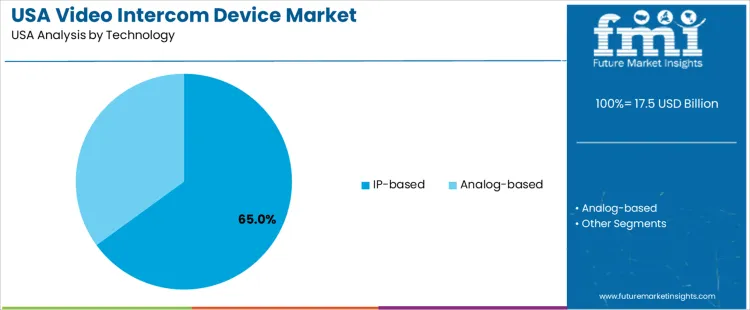
IP-based systems represent 65.0%. Video streaming quality, mobile connectivity, remote door unlocking, and integration with home security hubs guide adoption across USA smart property segments. Cloud recording and encrypted communication strengthen device value for users addressing unauthorized access risks. Analog-based systems hold 35.0%. Cost-sensitive users continue purchasing wired models in older building installations where replacement cycles proceed gradually. Technology choices reflect USA priorities for networked automation, access flexibility, and reduction in unnecessary visitor interactions supported by real-time monitoring and smartphone communication.
Key Points:
- IP-based systems support mobile access and integrated control
- Analog systems continue in legacy building infrastructure
- Connectivity features guide consumer and commercial preferences
What are the Key Dynamics in the Video Intercom Device Industry?
Growth of residential security upgrades, expansion of multifamily housing construction and increased adoption in commercial facilities drive demand.
In the United States, homeowners integrate video intercom devices into smart entry systems to monitor visitors and improve household safety. Multifamily apartment developments include networked access control to support tenant convenience and property management oversight. Small businesses use video entry stations to manage deliveries and visitor appointments in controlled reception areas. Schools and healthcare facilities apply video access screening as part of threat-prevention protocols. Retailers offer bundled devices through smart home aisles, which strengthens availability to consumers upgrading door security. These everyday applications support steady procurement in both new construction and retrofit markets.
Cost sensitivity among budget households, connectivity issues in older buildings and privacy concerns restrain widespread adoption.
Entry-level units still represent a notable upfront investment for renters or single-family homes with limited discretionary spending. Existing structures with outdated wiring or limited network coverage may require additional electrical work, slowing retrofit decisions. Some users express caution about recorded video stored in mobile apps and cloud services, leading to selective use in privacy-sensitive environments. Small operators in low-risk areas sometimes rely on standard doorbells, delaying transitions to video-based systems. These conditions limit faster penetration across all residential categories.
Shift toward smart home integration, increased use in contactless visitor management and rising interest in wireless installation options define key trends.
Devices connect with mobile apps, voice assistants and home automation hubs to centralize control and enable remote responses. Contactless access screening gained traction as consumers and property managers reduced physical interaction during entry procedures. Battery-powered and Wi-Fi enabled models support flexible installation that avoids major remodeling work. Commercial buyers seek interoperable platforms that link intercoms with surveillance cameras and electronic locks through unified dashboards. Tenant self-service features support package delivery verification in apartment buildings. These developments indicate consistent demand for video intercom devices across the United States guided by security expectations, convenience preferences and seamless system connectivity.
Analysis of the Demand for Video Intercom Devices in the USA by Region
Demand for video intercom devices in the United States rises through 2035 as residential, commercial, and institutional properties upgrade access-management systems to strengthen occupant safety and remote-entry control. Security installers integrate network-based intercoms with video monitoring, smart-lock automation, and cloud-recording tools. Growth aligns with real-estate modernization, gated-community expansion, and rising adoption of apartment security platforms. Builders include connected-entry hardware in new multi-unit developments. West USA records 14.4% CAGR, South USA reaches 12.9%, Northeast USA posts 11.5%, and Midwest USA sustains 10.0%. Procurement benchmarks emphasize cybersecurity, device durability, multi-unit scalability, and installation-service responsiveness.
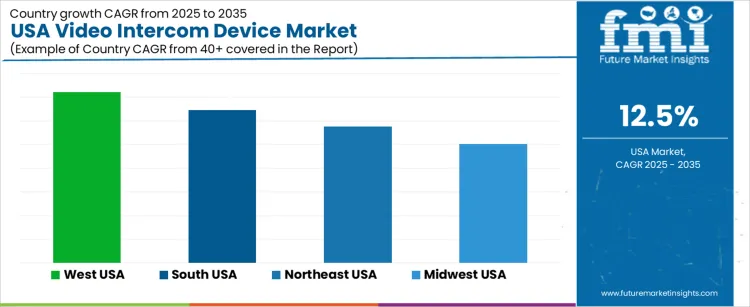
| Region | CAGR (2025-2035) |
|---|---|
| West USA | 14.4% |
| South USA | 12.9% |
| Northeast USA | 11.5% |
| Midwest USA | 10.0% |
How is the West USA driving demand for video intercom devices?
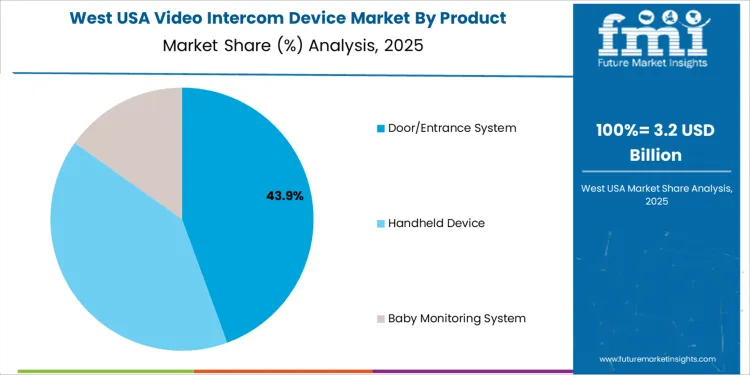
West USA reaches 14.4% CAGR due to high-density urban housing, strong technology uptake, and widespread integration with smart-home networks across California, Washington, and Nevada. Multi-family housing developers adopt cloud-enabled intercoms that provide residents mobile access control and monitored visitor entry without staffed reception. Commercial buildings install video entry panels that support remote visitor approval from facility-management centers.
Public agencies upgrade school and municipal access points to refine perimeter awareness. Network contractors emphasize encrypted connectivity through structured-cabling upgrades that protect data flows across large buildings. Buyers focus on compatibility with smart-lock systems, building-management platforms, and electric-strike configurations supporting fire-safety compliance. Real-estate owners evaluate lifecycle service agreements that guarantee firmware updates and rapid hardware replacement.
- Strong adoption in multi-unit developments and gated residences
- Smart-home system alignment guiding device specifications
- Remote-management features valued by commercial operators
- Lifecycle service assurance influencing procurement
How is the South USA shaping demand?

South USA posts 12.9% CAGR, influenced by suburban housing growth across Texas, Florida, and Georgia and increased installation of controlled-access systems in residential communities. Security integrators deploy IP-based intercoms along perimeter gates and lobby entry points to improve visitor verification. Retail chains and distribution centers implement access monitoring that connects site managers with main security dashboards.
Severe-weather resilience becomes a purchasing requirement for outdoor stations installed in high-humidity and coastal environments. Property-management firms prioritize ease of onboarding for frequent tenant turnover. Procurement decisions reflect attention to visibility quality during nighttime conditions, integration with surveillance cameras, and support for bilingual display interfaces in diverse communities.
- Gated-community expansion strengthening volume demand
- Retail and logistics adoption supporting workplace safety
- Weather-resistant hardware required for outdoor placement
- Operational simplicity important for transient occupancy
How is the Northeast USA influencing adoption patterns?
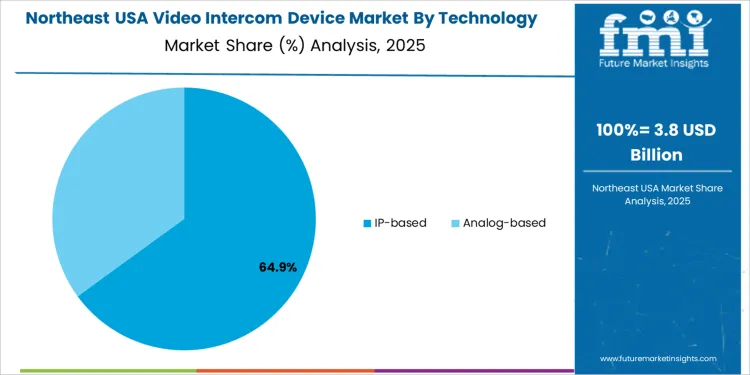
Northeast USA advances at 11.5% CAGR driven by dense apartment markets in New York, New Jersey, and Massachusetts and modernization of existing building-entry infrastructure. Facility owners transition from audio-only access to video-verified entry as part of ongoing renovations. Universities and hospitals incorporate centralized control rooms that connect intercom feeds across multiple buildings. Compact lobby spaces encourage selection of slim wall-mounted panels with advanced authentication. Procurement evaluates encryption strength and identity-verification accuracy that meets enterprise-security protocols. Regional installers design solutions that accommodate older building wiring through PoE upgrades. Building owners track maintenance reliability to minimize downtime during high visitor flow.
- Entry-security modernization across aging structures
- Healthcare and university networks expanding multi-site monitoring
- Slim designs fitting historical and compact building layouts
- Cybersecurity reliability guiding selection standards
How is the Midwest USA contributing to growth?
Midwest USA records 10.0% CAGR, supported by manufacturing facilities, educational institutions, and senior-living communities across Illinois, Ohio, and Michigan adopting controlled-access video entry. Operators use intercom platforms to limit unauthorized facility entry while maintaining efficient visitor routing. Senior residences deploy systems that allow remote family check-in through secure video links. Agricultural facilities adopt rugged enclosures suitable for industrial environmental exposure. Procurement emphasizes value durability through vandal-resistant construction suited to high-traffic access points. Regional distribution partners maintain inventory for rapid replacement and support teams provide on-site wiring assistance for legacy infrastructure upgrades.
- Controlled-access improvements in industrial and institutional sites
- Remote monitoring supporting senior-care communication
- Rugged hardware meeting durability expectations
- Local installer networks sustaining operational continuity
What is the competitive landscape of demand for video intercom devices in the United States?
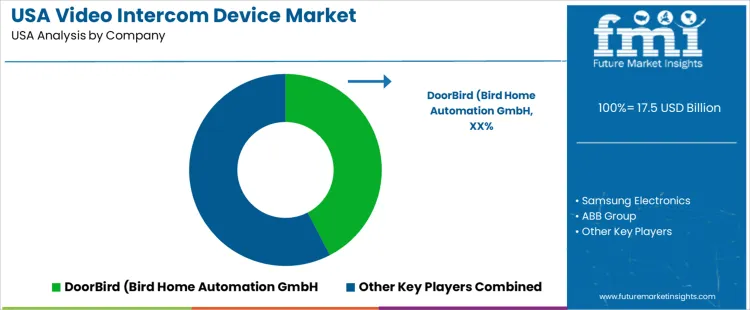
Demand for video intercom devices in the United States aligns with residential security upgrades, smart-home integration, and building-access management for multifamily properties. Procurement priorities include reliable connectivity, clear audio-visual performance, cybersecurity safeguards, and compatibility with established automation ecosystems used by USA homeowners, property managers, and builders.
Samsung Electronics competes in mainstream consumer channels with intercom functions linked to broader appliance and home-monitoring ecosystems. ABB Group supplies access terminals and communication stations appropriate for commercial buildings and gated communities where structured wiring and system management coverage drive purchasing decisions.
Fermax Electronica participates through audio-visual entry systems installed in urban developments and hospitality spaces that require reliable call response and visitor credentialing. Legrand maintains distribution through electrical-contractor networks and multifamily property channels where standardized installation and building renovation cycles shape sales volumes. Competitive differentiation centers on secure network architecture, ease of installation within existing wiring, long-term firmware support, and interoperability with USA smart-security devices. Providers capable of continuous feature updates, strong channel support, and documented device-level protection achieve better alignment with USA demand for video intercom solutions.
Key Players in USA Video Intercom Device Demand
- DoorBird (Bird Home Automation GmbH
- Samsung Electronics
- ABB Group
- Fermax Electronica
- Legrand
Scope of the Report
| Items | Values |
|---|---|
| Quantitative Units | USD billion |
| Product | Door/Entrance System, Handheld Device, Baby Monitoring System |
| Technology | IP-based, Analog-based |
| Vertical | Residential, Government, Commercial, Manufacturing/Industrial |
| Regions Covered | West USA, South USA, Northeast USA, Midwest USA |
| Key Companies Profiled | DoorBird (Bird Home Automation GmbH), Samsung Electronics, ABB Group, Fermax Electronica, Legrand |
| Additional Attributes | Dollar sales by product, technology, and vertical categories; accelerated adoption of IP-based systems driven by smart home upgrades; increased deployments in multi-dwelling residences, enterprise access control, and government facility security; channel insights including home improvement retail and system integrators; competitive landscape focused on cloud integration, mobile connectivity, and video analytics in entrance communication. |
USA Video Intercom Device Demand by Segments
Product:
- Door/Entrance System
- Handheld Device
- Baby Monitoring System
Technology:
- IP-based
- Analog-based
Vertical:
- Residential
- Government
- Commercial
- Manufacturing/Industrial
Region:
- West USA
- South USA
- Northeast USA
- Midwest USA
Frequently Asked Questions
How big is the demand for video intercom device in USA in 2025?
The demand for video intercom device in USA is estimated to be valued at USD 17.5 billion in 2025.
What will be the size of video intercom device in USA in 2035?
The market size for the video intercom device in USA is projected to reach USD 57.1 billion by 2035.
How much will be the demand for video intercom device in USA growth between 2025 and 2035?
The demand for video intercom device in USA is expected to grow at a 12.5% CAGR between 2025 and 2035.
What are the key product types in the video intercom device in USA?
The key product types in video intercom device in USA are door/entrance system, handheld device and baby monitoring system.
Which technology segment is expected to contribute significant share in the video intercom device in USA in 2025?
In terms of technology, ip-based segment is expected to command 65.0% share in the video intercom device in USA in 2025.
Preview the report firsthand - request a free sample
Get SampleGet the brochure for pricing and purchase details.
Get PDFTable of Content
- Executive Summary
- USA Market Outlook
- Demand-side Trends
- Supply-side Trends
- Technology Roadmap Analysis
- Analysis and Recommendations
- Market Overview
- Market Coverage / Taxonomy
- Market Definition / Scope / Limitations
- Market Background
- Market Dynamics
- Drivers
- Restraints
- Opportunity
- Trends
- Scenario Forecast
- Demand in Optimistic Scenario
- Demand in Likely Scenario
- Demand in Conservative Scenario
- Opportunity Map Analysis
- Product Life Cycle Analysis
- Supply Chain Analysis
- Investment Feasibility Matrix
- Value Chain Analysis
- PESTLE and Porter’s Analysis
- Regulatory Landscape
- Regional Parent Market Outlook
- Production and Consumption Statistics
- Import and Export Statistics
- Market Dynamics
- USA Market Analysis 2020 to 2024 and Forecast, 2025 to 2035
- Historical Market Size Value (USD Million) Analysis, 2020 to 2024
- Current and Future Market Size Value (USD Million) Projections, 2025 to 2035
- Y-o-Y Growth Trend Analysis
- Absolute $ Opportunity Analysis
- USA Market Pricing Analysis 2020 to 2024 and Forecast 2025 to 2035
- USA Market Analysis 2020 to 2024 and Forecast 2025 to 2035, By Product
- Introduction / Key Findings
- Historical Market Size Value (USD Million) Analysis By Product , 2020 to 2024
- Current and Future Market Size Value (USD Million) Analysis and Forecast By Product , 2025 to 2035
- Door/Entrance System
- Handheld Device
- Baby Monitoring System
- Y-o-Y Growth Trend Analysis By Product , 2020 to 2024
- Absolute $ Opportunity Analysis By Product , 2025 to 2035
- USA Market Analysis 2020 to 2024 and Forecast 2025 to 2035, By Technology
- Introduction / Key Findings
- Historical Market Size Value (USD Million) Analysis By Technology, 2020 to 2024
- Current and Future Market Size Value (USD Million) Analysis and Forecast By Technology, 2025 to 2035
- IP-based
- Analog-based
- Y-o-Y Growth Trend Analysis By Technology, 2020 to 2024
- Absolute $ Opportunity Analysis By Technology, 2025 to 2035
- USA Market Analysis 2020 to 2024 and Forecast 2025 to 2035, By Vertical
- Introduction / Key Findings
- Historical Market Size Value (USD Million) Analysis By Vertical, 2020 to 2024
- Current and Future Market Size Value (USD Million) Analysis and Forecast By Vertical, 2025 to 2035
- Residential
- Government
- Commercial
- Manufacturing/Industrial
- Y-o-Y Growth Trend Analysis By Vertical, 2020 to 2024
- Absolute $ Opportunity Analysis By Vertical, 2025 to 2035
- Market Structure Analysis
- Competition Dashboard
- Competition Benchmarking
- Market Share Analysis of Top Players
- By Regional
- By Product
- By Technology
- By Vertical
- Competition Analysis
- Competition Deep Dive
- DoorBird (Bird Home Automation GmbH
- Overview
- Product Portfolio
- Profitability by Market Segments (Product/Age /Sales Channel/Region)
- Sales Footprint
- Strategy Overview
- Marketing Strategy
- Product Strategy
- Channel Strategy
- Samsung Electronics
- ABB Group
- Fermax Electronica
- Legrand
- DoorBird (Bird Home Automation GmbH
- Competition Deep Dive
- Assumptions & Acronyms Used
- Research Methodology


