

- Industry Size (2025)
- USD 0.6 Bn
- Forecast (2035)
- USD 1.0 Bn
- CAGR (2025 to 2035)
- 4.7%
Demand for Snap-Lock Closure in Japan 2025 to 2035
The Japan snap-lock closure demand is valued at USD 0.6 billion in 2025 and is forecasted to reach USD 1.0 billion by 2035, reflecting a CAGR of 4.7%. Demand is driven by increasing consumption of packaged food, beverages, household chemicals, and personal-care products requiring resealable pack formats. Convenience, spill-prevention, and extended product usability reinforce continued utilization of closure systems across retail packaging. Plastic closures lead due to compatibility with PET and HDPE containers, lightweight construction, and established manufacturing capacity for custom geometries. Growth is supported by hygiene considerations and the expansion of consumer goods offered in portable or multi-serve packaging. Design updates include improved grip, tighter sealing profiles, and reduced resin usage to support recycling objectives.
Kyushu & Okinawa and Kanto record the highest usage because of their concentration of food-processing facilities, bottling lines, and logistics networks aligned with high-volume consumer distribution. These regions also reflect accelerated adoption of recyclable packaging components in response to brand and regulatory sustainability requirements. Key suppliers include Yoshino Kogyosho Co., Ltd., Takemoto Yohki Co., Ltd., Nihon Tokan Package Co., Ltd., Nissei Plastic Industrial Co., Ltd., and Albéa Japan. Their products support beverages, condiments, household-care goods, and personal-care formulations with closures designed for repeat opening while maintaining product protection across storage and transport conditions.
Quick Stats for Japan Snap-Lock Closure Demand
- Japan Snap-Lock Closure Sales Value (2025): USD 0.6 billion
- Japan Snap-Lock Closure Forecast Value (2035): USD 1.0 billion
- Japan Snap-Lock Closure Forecast CAGR (2025–2035): 4.7%
- Leading Material Type in Japan Snap-Lock Closure Demand: Plastic
- Key Growth Regions in Japan Snap-Lock Closure Demand: Kyushu & Okinawa, Kanto
- Top Players in Japan Snap-Lock Closure Demand: Yoshino Kogyosho Co., Ltd., Takemoto Yohki Co., Ltd., Nihon Tokan Package Co., Ltd., Nissei Plastic Industrial Co., Ltd., Albéa Japan
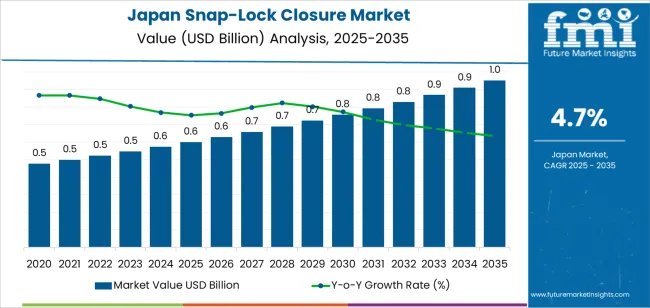
What is the Growth Forecast for Snap-Lock Closure Industry in Japan through 2035?
Demand for snap-lock closures in Japan reflects a mix of acceleration linked to packaging-design updates and deceleration tied to industry maturity in high-volume consumer categories. Early-period growth is driven by product safety priorities in food and household goods, where tamper-evident and child-resistant closures support incremental expansion. Convenience packaging in ready-to-use formats accelerates adoption, particularly within sauces, condiments, and personal-care refills. These applications introduce moderate upward movement in growth momentum as brands refresh closures to improve usability and prevent spillage.
Deceleration appears in segments where packaging redesign cycles are gradual and long replacement intervals limit rapid uptake. Strong recycling expectations encourage refill-station formats and lightweight alternatives that may reduce demand growth for new closure units. Industrial cost-efficiency initiatives also constrain frequent closure modification. The pattern therefore shows short bursts of acceleration when safety and convenience standards tighten, followed by slower phases as packaging-line upgrades stabilize. Growth remains steady but not rapid, highlighting a system where innovation timing and material-efficiency policies determine shifts in the rate of demand progression.
Japan Snap-Lock Closure Key Takeaways
| Metric | Value |
|---|---|
| Japan Snap-Lock Closure Sales Value (2025) | USD 0.6 billion |
| Japan Snap-Lock Closure Forecast Value (2035) | USD 1.0 billion |
| Japan Snap-Lock Closure Forecast CAGR (2025-2035) | 4.7% |
Why is the Demand for Snap-Lock Closures in Japan Growing?
Demand for snap-lock closures in Japan is increasing because food, personal care and household product manufacturers require packaging that is easy to open and securely resealable for everyday use. Single-person households and busy consumers prefer portioned and ready-to-use products where snap-lock closures help maintain freshness and prevent leakage after first opening. Growth in convenience foods, including chilled items and snack packs, supports wider use of rigid and semi-rigid containers featuring snap-lock systems. Retailers and e-commerce distributors favour packaging that withstands transport handling and offers reliable sealing without additional wrapping, which strengthens demand in logistics and delivery channels.
Packaging suppliers introduce lightweight closure designs and structures compatible with mono-material recycling streams, aligning with Japan’s circular economy goals and established sorting infrastructure. Manufacturers also adopt snap-lock closures in child-resistant packaging for health-and-wellness products where safety and compliance are essential. Constraints include higher tooling and unit cost compared with simple lids, as well as the need for specialized filling-line adjustments in existing facilities. Some brands delay conversion to snap-lock solutions until consumer testing confirms strong functional preference and packaging budgets allow the upgrade.
Which Material Types and Applications Lead Demand for Snap-Lock Closures in Japan?
Demand for snap-lock closures in Japan reflects secure fastening needs across packaging, construction, and logistics settings. Performance priorities focus on repeatable locking strength, resistance to handling stress, and reliable sealing in humid conditions common in Japan’s distribution systems. Adoption in consumer goods emphasizes ease of opening and closing, while industrial users require durable fasteners that maintain assembly stability. Design flexibility, lightweight structure, and compliance with food-contact rules influence procurement in flexible packaging.
By Material Type, Plastic Holds the Largest Share
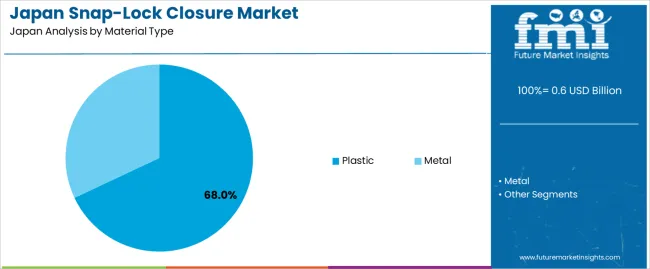
Plastic closures account for 68.0%, supported by molding flexibility, corrosion resistance, and productivity benefits in high-volume manufacturing. Plastic variants are widely used in consumer packaging and transport applications requiring secure resealability and weight reduction. Metal closures represent 32.0%, serving building components and industrial tasks that demand elevated mechanical strength and longer service life. Selection criteria in Japan emphasize compatibility with existing automation and green targets, including improved recyclability in polyolefin-based formats. Material decisions reflect end-use handling requirements and efficiency goals in manufacturing across automotive, electronics, and packaging industries.
Key points:
- Plastic dominates due to cost efficiency and secure resealability.
- Metal supports high-load and structural fastening uses.
- Design customization influences material selection across sectors.
By Application, Bags Hold the Largest Share
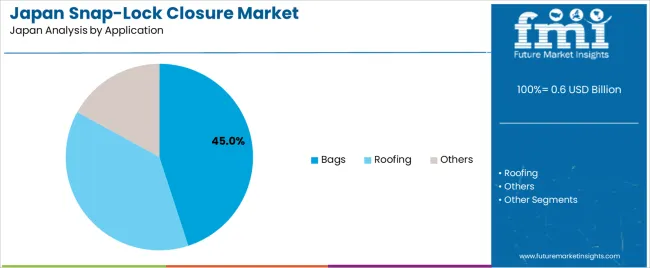
Bags represent 45.0%, driven by strong usage in retail packaging, household storage, and moisture-protected food wrapping. Japanese consumers value resealable closures that maintain freshness and prevent leakage during transport. Roofing accounts for 38.0%, supported by construction practices that depend on secure mechanical locking resistant to wind and water intrusion. Others represent 17.0%, applied in hardware, transport packaging, and assembly components requiring controlled fastening. Application demand reflects Japan’s emphasis on user convenience, durability in built environments, and reliable sealing performance across consumer and professional use cases.
Key points:
- Bags lead due to strong use in packaged foods and storage.
- Roofing applications require high weather resistance.
- Industrial handling supports specialty fastening formats.
What are the Drivers, Restraints, and Key Trends of the Demand for Snap-Lock Closures in Japan?
Growth of convenience packaging in beverages and condiments, increased product safety expectations and expansion of single-portion formats are driving demand.
In Japan, snap-lock closures support strong use in bottled teas, flavored waters and sports drinks that dominate convenience-store beverage sales. Consumers prioritize quick-open, spill-resistant caps for on-the-go consumption during commuting and travel, reinforcing demand for easy-seal closures. Condiment packaging such as sauces and dressings uses snap-lock closures to improve controlled dispensing in home kitchens where compact storage and cleanliness matter. Single-portion and refill bottles continue to gain popularity in urban households with limited space, sustaining consistent procurement among major bottlers. Manufacturers serving personal care and household cleaning categories rely on secure closures to prevent leakage during transport in densely packed retail environments and parcel delivery.
Pressure to reduce single-use plastics, limited recyclability for certain closure-bottle combinations and cautious adoption in premium categories restrain demand.
Japan’s resource recycling policies encourage container light weighting and simplified material structures, which can influence closure specifications. Some snap-lock designs use multiple materials that complicate sorting in municipal recycling streams, reducing alignment with green objectives. Premium cosmetics and high-end beverages often choose threaded or specialty dispensing closures to achieve more elegant aesthetics, limiting snap-lock use in value-differentiated product lines. Rising material costs linked to imported polymers may also slow replacement of existing closure systems in cost-sensitive offerings. These regulatory and industry influences create measured, category-specific adoption patterns.
Shift toward tethered closures for collection efficiency, increased customization for vending-machine compatibility and rising interest in closures optimized for refill pouches define key trends.
Manufacturers are advancing tethered closure designs that remain attached to bottles during disposal to improve recovery rates and meet recycling-sorting requirements. Beverage producers are adjusting closure geometry to function smoothly within Japan’s large vending-machine infrastructure, reducing misalignment during automated dispensing. Refill pouches for detergents, shampoos and liquid soaps are prompting demand for closures engineered for repeated opening and secure resealing, particularly in urban apartments where refilling reduces storage waste. Packaging teams also explore reduced-label bottle designs that coordinate with compatible closures to simplify recycling. These trends signal steady, ecofriendly-aligned demand for snap-lock closures across Japan’s beverage, household and personal care sectors.
Analysis of the Demand for Snap-Lock Closures in Japan by Region
Demand for snap-lock closures in Japan reflects packaging needs in beverages, household liquids, health and beauty products, and pharmaceutical dispensing. Procurement decisions reflect sealing reliability, child-safe control features, and ease of re-closure in frequent-use categories. Material selection aligns with recyclability guidelines and compatibility with established bottling equipment. Kyushu & Okinawa leads at 5.9% CAGR, followed by Kanto (5.4%), Kinki (4.8%), Chubu (4.2%), Tohoku (3.7%), and Rest of Japan (3.5%).
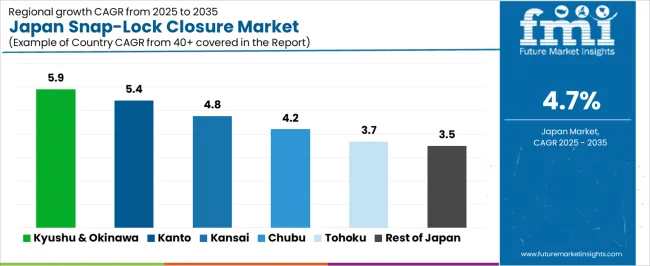
| Region | CAGR (2025-2035) |
|---|---|
| Kyushu & Okinawa | 5.9% |
| Kanto | 5.4% |
| Kinki | 4.8% |
| Chubu | 4.2% |
| Tohoku | 3.7% |
| Rest of Japan | 3.5% |
How is Kyushu & Okinawa driving demand for snap-lock closures?
Kyushu & Okinawa posts 5.9% CAGR, supported by beverages, daily household liquid products, and travel-oriented retail channels. PET bottles with snap-lock closures remain common across convenience stores and vending locations where portable packaging supports hydration needs in warm climates. HDPE closures enable secure transport of detergents and cleaning liquids used in residential and hospitality sectors. Product safety influences closure preference for pharmaceutical and OTC liquid containers distributed through hospital-linked pharmacies. Packaging converters rely on reliable sealing geometry to maintain bottle-cap alignment during high-humidity storage and logistics. Procurement teams evaluate durability, hand-feel, and controlled-force opening to prevent unintended spillage in portable consumption. Resin sourcing through ports maintains stable supply for closure molding operations.
- Beverage and household-care liquids supporting closure volumes
- Tourism retail requiring spill-resistant packaging
- Hospital distribution shaping safety-closure requirements
- Ports strengthening resin availability and logistics continuity
How is Kanto shaping demand for snap-lock closures?
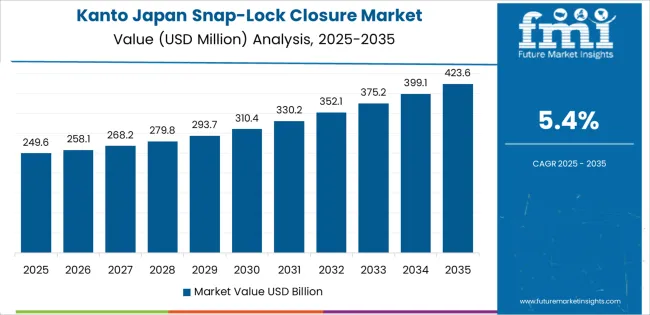
Kanto records 5.4% CAGR, driven by dense retail networks and high-volume filling lines supplying bottled beverages and personal-care products. Tokyo-area plants prioritize closures that enable rapid changeover and consistent sealing under automated conditions. Pharmacy channels distribute liquid supplements and hygiene solutions, requiring child-safe snap closures aligned with compliance protocols. Consumer preference for neat handling supports tight-fit closures designed to prevent leaks in handbags and commuter storage. Urban waste-sorting infrastructure promotes closure compatibility with PET and HDPE bottle recycling. Procurement standards focus on torque-free closure engagement, maintaining usability across diversified bottle neck sizes.
- High-volume automation requiring reliable sealing efficiency
- Commuter-focused purchases supporting re-closure needs
- Healthcare distribution guiding safety features
- Recycling considerations influencing resin choice
How is Kinki influencing demand for snap-lock closures?
Kinki reaches 4.8% CAGR, supported by consumer goods manufacturing and household-care product distribution across Osaka and Kyoto. Personal-care packaging utilizes snap-lock closures for shampoos, lotions, and cleansers requiring dependable opening-force control. Grocery retail channels reinforce demand for family-size beverage bottles used in frequent-use settings. Buyers evaluate thread accuracy and repeatable closure tightness to prevent product degradation in high-touch environments. Packaging plants maintain existing closure feed-systems, favoring designs aligned with current capping machinery and minimal downtime.
- Household and personal-care packaging sustaining closure demand
- Retail handling shaping durability and sealing standards
- Installed equipment influencing closure geometry
- Focus on consistent opening feel for repeated daily use
How is Chubu contributing to demand for snap-lock closures?
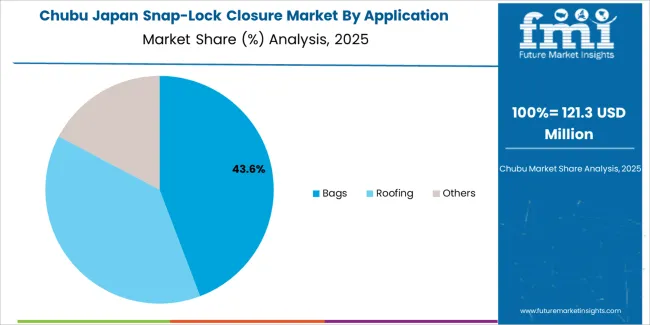
Chubu posts 4.2% CAGR, influenced by packaging supply for food and drink consumed in industrial hubs across Aichi and Shizuoka. Hydration products for workers maintain PET closure needs tailored for portable use in factory settings. Household chemical bottling supports HDPE closure adoption with grip-friendly shapes enabling safe opening with gloves. Procurement emphasizes closure alignment performance during transport across long distribution distances. Product-safety features enhance sealing during temperature variation in warehouse storage.
- Workplace consumption sustaining bottle closure usage
- Grip-focused closures aiding safe handling
- Distance-based logistics shaping durability needs
- Dimensional accuracy preventing leakage in storage
How is Tohoku shaping demand for snap-lock closures?
Tohoku grows at 3.7% CAGR, driven by bottled beverages and personal-care items distributed over wide routes. Seasonal weather shifts require closures maintaining sealing security in cold storage. Municipal ecofriendly programs encourage lightweight closure models that reduce material use while preserving strength. Packaging teams validate closure performance for vending and kiosk placements in commuter areas.
- Seasonal conditions influencing sealing requirements
- Vending distribution guiding closure reliability
- Lightweight options supporting material reduction
- Regional logistics affecting design priorities
How is the Rest of Japan adopting snap-lock closures?
Rest of Japan expands at 3.5% CAGR, supported by local retail channels and moderate beverage throughput. Buyers emphasize cost stability and compatibility with standard PET bottling. Retailers favor closures that maintain clean appearance under repeated customer handling. Material alignment with recycling collection systems informs closure specification.
- Small-scale retail maintaining baseline demand
- Cost-aligned procurement supporting standard formats
- Shelf handling influencing visual durability
- Recycling access shaping resin selection
What is the competitive landscape of demand for snap-lock closures in Japan?
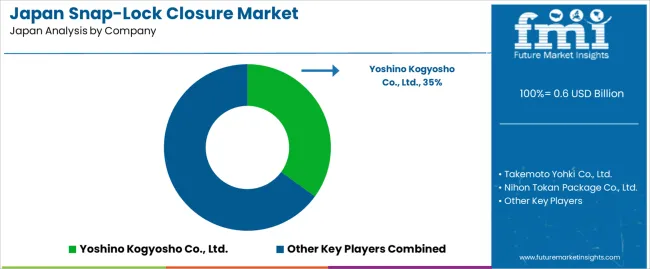
Demand for snap-lock closures in Japan is guided by packaging-component suppliers supporting rigid containers used for sauces, personal care, and household-chemical products. Yoshino Kogyosho Co., Ltd. holds an estimated 35.0% share, supported by controlled hinge-molding precision and reliable closure engagement during repeated opening cycles. Its components provide uniform sealing pressure and smooth cap operation suited to Japan’s retail handling conditions. Takemoto Yohki Co., Ltd. maintains strong participation in personal-care packaging where stable dimensional accuracy and clean visual presentation are priorities for local consumer brands. Nihon Tokan Package Co., Ltd. contributes share through closures integrated into condiment and beverage packaging lines, ensuring consistent capping performance at high throughput speeds.
Nissei Plastic Industrial Co., Ltd. supports demand through proprietary molding technologies that deliver durable hinge structures and steady resin-flow control during mass production. Albéa Japan adds selective supply in premium personal-care closures designed for controlled snap engagement and enhanced product usability. Competition in Japan focuses on seal reliability, hinge durability, tactile opening response, alignment with recyclability systems, and dependable national distribution. Demand remains steady as Japanese fillers require precisely molded snap-lock components that maintain product protection and user convenience in domestic packaging applications.
Key Players in Japan Snap-Lock Closure Demand
- Yoshino Kogyosho Co., Ltd.
- Takemoto Yohki Co., Ltd.
- Nihon Tokan Package Co., Ltd.
- Nissei Plastic Industrial Co., Ltd.
- Albéa Japan
Scope of the Report
| Items | Values |
|---|---|
| Quantitative Units | USD billion |
| Material Type | Plastic, Metal |
| Application | Bags, Roofing, Others |
| Regions Covered | Kyushu & Okinawa, Kanto, Kinki, Chubu, Tohoku, Rest of Japan |
| Key Companies Profiled | Yoshino Kogyosho Co., Ltd., Takemoto Yohki Co., Ltd., Nihon Tokan Package Co., Ltd., Nissei Plastic Industrial Co., Ltd., Albéa Japan |
| Additional Attributes | Adoption influenced by packaging automation in food and personal care sectors; demand growth from flexible packaging and resealable consumer goods; expansion in construction fasteners and roofing accessories using metal closures; alignment with eco-friendly trends and lightweight packaging initiatives in Japan’s FMCG sector. |
Japan Snap-Lock Closure Demand by Segments
Material Type:
- Plastic
- Metal
Application:
- Bags
- Roofing
- Others
Region:
- Kyushu & Okinawa
- Kanto
- Kinki
- Chubu
- Tohoku
- Rest of Japan
Frequently Asked Questions
How big is the demand for snap-lock closure in Japan in 2025?
The demand for snap-lock closure in Japan is estimated to be valued at USD 0.6 billion in 2025.
What will be the size of snap-lock closure in Japan in 2035?
The market size for the snap-lock closure in Japan is projected to reach USD 1.0 billion by 2035.
How much will be the demand for snap-lock closure in Japan growth between 2025 and 2035?
The demand for snap-lock closure in Japan is expected to grow at a 4.7% CAGR between 2025 and 2035.
What are the key product types in the snap-lock closure in Japan?
The key product types in snap-lock closure in Japan are plastic and metal.
Which application segment is expected to contribute significant share in the snap-lock closure in Japan in 2025?
In terms of application, bags segment is expected to command 45.0% share in the snap-lock closure in Japan in 2025.
Preview the report firsthand - request a free sample
Get SampleGet the brochure for pricing and purchase details.
Get PDFTable of Content
- Executive Summary
- Japan Market Outlook
- Demand-side Trends
- Supply-side Trends
- Technology Roadmap Analysis
- Analysis and Recommendations
- Market Overview
- Market Coverage / Taxonomy
- Market Definition / Scope / Limitations
- Market Background
- Market Dynamics
- Drivers
- Restraints
- Opportunity
- Trends
- Scenario Forecast
- Demand in Optimistic Scenario
- Demand in Likely Scenario
- Demand in Conservative Scenario
- Opportunity Map Analysis
- Product Life Cycle Analysis
- Supply Chain Analysis
- Investment Feasibility Matrix
- Value Chain Analysis
- PESTLE and Porter’s Analysis
- Regulatory Landscape
- Regional Parent Market Outlook
- Production and Consumption Statistics
- Import and Export Statistics
- Market Dynamics
- Japan Market Analysis 2020 to 2024 and Forecast, 2025 to 2035
- Historical Market Size Value (USD Million) Analysis, 2020 to 2024
- Current and Future Market Size Value (USD Million) Projections, 2025 to 2035
- Y-o-Y Growth Trend Analysis
- Absolute $ Opportunity Analysis
- Japan Market Pricing Analysis 2020 to 2024 and Forecast 2025 to 2035
- Japan Market Analysis 2020 to 2024 and Forecast 2025 to 2035, By Material Type
- Introduction / Key Findings
- Historical Market Size Value (USD Million) Analysis By Material Type , 2020 to 2024
- Current and Future Market Size Value (USD Million) Analysis and Forecast By Material Type , 2025 to 2035
- Plastic
- Metal
- Y-o-Y Growth Trend Analysis By Material Type , 2020 to 2024
- Absolute $ Opportunity Analysis By Material Type , 2025 to 2035
- Japan Market Analysis 2020 to 2024 and Forecast 2025 to 2035, By Application
- Introduction / Key Findings
- Historical Market Size Value (USD Million) Analysis By Application, 2020 to 2024
- Current and Future Market Size Value (USD Million) Analysis and Forecast By Application, 2025 to 2035
- Bags
- Roofing
- Others
- Y-o-Y Growth Trend Analysis By Application, 2020 to 2024
- Absolute $ Opportunity Analysis By Application, 2025 to 2035
- Market Structure Analysis
- Competition Dashboard
- Competition Benchmarking
- Market Share Analysis of Top Players
- By Regional
- By Material Type
- By Application
- Competition Analysis
- Competition Deep Dive
- Yoshino Kogyosho Co., Ltd.
- Overview
- Product Portfolio
- Profitability by Market Segments (Product/Age /Sales Channel/Region)
- Sales Footprint
- Strategy Overview
- Marketing Strategy
- Product Strategy
- Channel Strategy
- Takemoto Yohki Co., Ltd.
- Nihon Tokan Package Co., Ltd.
- Nissei Plastic Industrial Co., Ltd.
- Albéa Japan
- Yoshino Kogyosho Co., Ltd.
- Competition Deep Dive
- Assumptions & Acronyms Used
- Research Methodology


