

- Industry Size (2026)
- USD 2.0 Bn
- Forecast (2036)
- USD 4.3 Bn
- CAGR (2026 to 2036)
- 8.5%
Japan Destination Wedding Market Forecast and Outlook 2026 to 2036
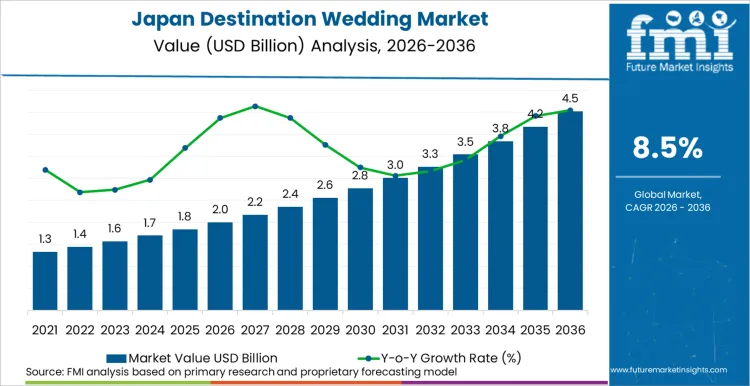
The Japan destination wedding sector is on track to achieve a valuation of USD 4.3 billion by 2036, expanding from USD 2.0 billion in 2026 at a CAGR of 8.5%. As per Future Market Insights, expansion is structurally underpinned by Okinawa's global recognition as a premier wedding destination, the growing acceptance of non-traditional wedding formats (photo weddings, micro-weddings), and the increasing flow of inbound couples from China, South Korea, Taiwan, and Southeast Asia choosing Japan as a destination wedding venue.
The Japan National Tourism Organization (JNTO) reported that inbound visitors to Japan reached 36.9 million in 2024, a record high, with Okinawa specifically gaining international recognition as a top destination. This inbound tourism surge compels wedding venue operators, planners, and hospitality companies to develop multilingual, culturally-adaptive wedding packages that serve both Japanese domestic couples seeking unique experiences and international couples attracted to Japan's aesthetic and cultural appeal. Simultaneously, the Japanese wedding industry is structurally evolving as matchmaking agencies vertically integrate into wedding service delivery, blurring the traditional boundary between partner matching and celebration.
Minako Teruya, Marketing Manager of the Okinawa Convention and Visitors Bureau (OCVB), stated: 'This acknowledgement highlights the growing appreciation of Okinawa's unique blend of rich cultural heritage, natural beauty and warm local hospitality.' This confirms that Okinawa's designation as a top global destination for 2026 by Expedia directly validates its positioning as a premier wedding destination. FMI opines that Okinawa's combination of subtropical beach settings, Ryukyu cultural heritage, and proximity to major Asian source markets creates a competitive advantage that is difficult for other Japanese regions to replicate in the destination wedding segment.
The competitive landscape in 2025 and 2026 has been defined by vertical integration and cross-border collaboration. IBJ Inc., a major Japanese matchmaking and marriage agency, initiated a tender offer for Decollte Holdings in December 2025, a leader in the 'photo wedding' and pre-wedding photography market, signaling vertical integration from matchmaking to wedding services. Watabe Wedding Corporation launched a partnership with the South Korean luxury bridal brand CHOIJAEHOON in December 2025, beginning exclusive distribution of four specialized dress designs modified with traditional Japanese obi-style sashes for the Japanese market.
Okinawa was named one of the world's top destinations for 2026 by Expedia, reinforcing its wedding destination brand equity. The JNTO continued its destination wedding promotion targeting South Korean, Taiwanese, and Chinese couples through 2025. As per FMI, this combination of matchmaking-to-wedding vertical integration, cross-border bridal fashion collaboration, and Okinawa's global brand elevation confirms that the Japan destination wedding market is professionalizing and internationalizing at an accelerating pace.
Key Takeaways
The Japan destination wedding market is shaped by a power structure where traditional wedding companies (Watabe Wedding, T&G, Novarese) control the domestic ceremony segment, while regional tourism bodies (OCVB, Hokkaido Tourism Organization) and international hotel chains (Hilton, Hyatt, Ritz-Carlton) control the inbound destination wedding segment. FMI analysts observe that IBJ's acquisition of Decollte Holdings creates a vertically integrated matchmaking-to-wedding pipeline that is unique to the Japanese market.
Pricing asymmetry in the Japan destination wedding market exists between photo weddings (USD 3,000 to 8,000 for photography-only packages without ceremony) and full destination wedding celebrations in Okinawa or Kyoto (USD 30,000 to 100,000+ including ceremony, reception, and multi-day guest accommodation). As per FMI, photo weddings are the fastest-growing format segment, driven by couples who forgo traditional ceremonies but invest in professional destination photography as a memory asset.
Sourcing fragility is concentrated in venue availability in Okinawa and Kyoto during peak wedding seasons (October to December, March to May). Chapel-style beachfront wedding venues in Okinawa operate at near-full capacity during peak periods, with bookings required 12 to 18 months in advance. FMI is of the opinion that new venue development in Okinawa's northern region and Kerama Islands will partially alleviate capacity constraints by 2028.
Brand and compliance risks center on cross-cultural service delivery for inbound destination weddings. International couples (particularly Chinese and Korean) require Mandarin or Korean-speaking wedding coordinators, culturally adapted catering, and legal marriage registration support that varies by municipality. Watabe Wedding's CHOIJAEHOON partnership addresses the Korean market cultural adaptation requirement.
Geographic leverage within Japan is concentrated in Okinawa, which commands over 40% of Japan's destination wedding revenue, followed by Kyoto, Hokkaido, and Karuizawa. Okinawa's subtropical climate enables year-round outdoor ceremonies, while Kyoto attracts couples seeking traditional Japanese cultural settings. Hokkaido serves the winter wedding and lavender field summer wedding segments. FMI analysts note that smaller islands (Miyako, Ishigaki) are emerging as ultra-exclusive micro-wedding destinations.
The executive reframing for the Japan destination wedding market is that the market boundary has expanded beyond traditional ceremonies to include photo weddings, experiential hospitality, and matchmaking-integrated services. FMI analysts emphasize that wedding industry executives must evaluate the total wedding lifecycle, from matchmaking to photography to ceremony to honeymoon, as an integrated revenue opportunity rather than discrete service categories.
Summary of Japan Destination Wedding Market
What Is Growth Outlook for Japan Destination Wedding Market as per Future Market Insights Projection?
Future Market Insights projects the Japan destination wedding market to expand at a CAGR of 8.5% from 2026 to 2036, increasing from USD 2.0 Billion in 2026 to USD 4.3 Billion by 2036.
FMI Research Approach: FMI proprietary forecasting model based on JNTO inbound visitor data, Okinawa wedding venue booking rates, and photo wedding format adoption tracking.
How Do FMI Analysts Perceive Japan Destination Wedding Market to Evolve?
FMI analysts perceive the market evolving toward vertically integrated matchmaking-to-wedding services, photo wedding format proliferation, and inbound destination wedding growth from Chinese, Korean, and Taiwanese source markets.
FMI Research Approach: IBJ-Decollte acquisition filings and OCVB destination marketing data.
Which Country Holds Largest Share in Global Japan Destination Wedding Market?
Japan is the sole country in this market scope, with Okinawa commanding the largest destination wedding revenue share, followed by Kyoto and Hokkaido.
FMI Research Approach: FMI prefecture-level revenue modeling by wedding venue capacity and ceremony count data.
How Large Will Japan Destination Wedding Market Be by 2036?
The Japan destination wedding market is projected to reach USD 4.3 Billion by 2036.
FMI Research Approach: FMI long-term revenue forecast derived from inbound tourism growth projections and wedding format diversification modeling.
What Is Definition of Japan Destination Wedding Market?
The Japan destination wedding market includes revenue from wedding ceremonies, receptions, photo weddings, pre-wedding photography, and associated hospitality services conducted at destination venues within Japan for couples traveling from their home region, including both domestic Japanese couples and inbound international couples.
FMI Research Approach: FMI market taxonomy and inclusion-exclusion framework.
What Are Globally Unique Trends Shaping Japan Destination Wedding Market?
Globally unique trends include matchmaking agency vertical integration into wedding services (IBJ-Decollte), cross-border Korean bridal fashion collaboration (Watabe-CHOIJAEHOON), and Okinawa's global destination brand elevation through Expedia 2026 ranking.
FMI Research Approach: IBJ tender offer filings and Watabe Wedding partnership announcements.
Japan Destination Wedding Market Key Takeaways
| Metric | Details |
|---|---|
| Industry Size (2026) | USD 2.0 Billion |
| Industry Value (2036) | USD 4.3 Billion |
| CAGR (2026 to 2036) | 8.5% |
Source: Future Market Insights (FMI) analysis, based on proprietary forecasting model and primary research
Footprint of the Japan Wedding Tourism Industry in the Asia Pacific Region (2025)
| Category | Details |
|---|---|
| Market Value | Japan’s wedding tourism industry is valued at USD9 billion, contributing approximately 20% of the Asia-Pacific wedding tourism market, which is projected to be worth USD45 billion. |
| Position in Asia-Pacific | Japan ranks among the top three wedding tourism destinations in the region, alongside Thailand and Bali (Indonesia). |
| Domestic Market Share | Domestic destination weddings account for 60% of Japan's wedding tourism revenue, largely driven by Kyoto, Okinawa, and Hokkaido. |
| International Market Share | International weddings contribute 40%, attracting couples from China, South Korea, Southeast Asia, and the USA. |
| Competitive Edge | Known for its blend of traditional Shinto ceremonies, cherry blossom themes, and modern luxury, Japan competes with tropical destinations like Bali and Thailand by offering unique cultural experiences. |
| Top Wedding Seasons | Spring and autumn dominate, benefiting from cherry blossoms and colorful foliage, while tropical destinations like Bali thrive year-round. |
| Key Venue Types | Traditional shrines, luxury resorts, scenic gardens, and mountaintop venues, which differentiate Japan from other Asia-Pacific destinations. |
Japan would be among the wedding tourism markets in the Asia-Pacific area, with a significant proportion of the overall value of the region. From close collaboration, some of the Asia-Pacific wedding destinations are positioned back-to-back between Thailand and Bali; while rich in cultural heritage, stunning landscapes, and detailing are found in Japan.
While tropical destinations like Bali and Thailand attract couples with year-round sunny weather and beachfront ceremonies, Japan offers a more diverse and unique experience. Kyoto's historic shrines and temples, Okinawa's tropical resorts, and Hokkaido's scenic gardens and snowy landscapes cater to couples seeking a blend of tradition and modern luxury.
This makes Japan a magnet for international couples, especially those from China, South Korea, and Southeast Asia. Some popular trends include Shinto-style ceremonies and cherry blossom-themed weddings that take place in the spring. These are some experiences that outshine their tropical counterparts, mainly because they reflect tradition and offer unique aesthetics for couples who emphasize these factors.
More recent trends are the intimate ceremonies and destination elopements that make Japan more appealing. It boasts mountaintop venues and private gardens as stunning, serene venues that are very hard to reproduce elsewhere. So, Japan expands its reach into the already saturated Asia-Pacific wedding tourism market while offering an unbeatable mix of culture and landscapes. diversity.
Analysis of Japan Destination Wedding Market Categories by Wedding Type and Services
Western-Style Weddings Set to Lead Market Share
Western-style weddings are projected to capture 60% of Japan's destination wedding market in 2025, reflecting the global trend of combining Western traditions with Japanese cultural elements. This fusion appeals to international couples seeking to incorporate the elegance of Western wedding attire and ceremonies within the serene, picturesque settings that Japan is known for. Venues such as Kyoto's shrines, which become world-class icons, and the serene gardens of Nara are increasingly being utilised to create an unforgettable experience whereby the old blends seamlessly with the new.
For instance, companies like Destination wedding Japan and Knot Wedding Japan are at the forefront of offering such hybrid ceremonies. They specialize in tailoring bespoke wedding experiences where couples will spend their special day with vows being exchanged in traditional Western attire, such as bridal gowns and tuxedos, while surrounded by the beauty of sacred spaces in Japan, including shrines and temples.
Knot Wedding has become very popular among international couples, proposing full-service packages on customized ceremonies, both of Western and Shinto natures. Companies that serve the European and North American markets combine destination wedding planning with the rich cultural heritage of Japan.
On the contrary, traditional Shinto weddings have always been considered the favorite and have a hold of 40% of market share. Still in high demand, these wedding ceremonies are greatly in demand with regard to cultures in Kyoto, Nara, and Ise. The main reason for people choosing a Shinto ceremony lies in the originality it allows; it connects the couple back to rituals over a thousand years old.
Many wedding planners, such as Ivy Bridal and Shinto Wedding Japan, specialize in traditional Japanese ceremonies with rituals like sakazuki and vows before the kami. Providers offer packages in which couples can wear traditional kimonos and enjoy intimate ceremonies with sacred blessings from Shinto priests.
Full-Service Wedding Planning Dominates the Market
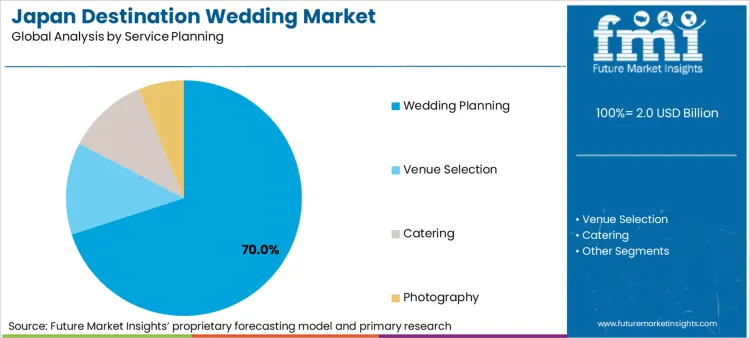
Full-service planning is expected to compose 70% of the destination wedding market share in Japan. This encompasses comprehensive wedding planning of everything from venue to catering and photography, all taken care of by the planning company. Some leading wedding planning companies such as The Kyoto Wedding Company include in their full-service wedding packages an all-inclusive type whereby every little detail is taken care of so that couples won't need to worry about anything on the wedding day.
These companies shine through in providing tailored services, including every detail-from luxury venues in iconic locations to custom-made attire for weddings and floral arrangements. All this is incorporated into the couple's dream without any hassle and is extremely appealing to an international clientele who may not be familiar with local supplies and regulations.
One example is The Kyoto Wedding Company, which offers luxury weddings in Kyoto. They have full-service packages that include venue selection, guest accommodations, and even traditional Japanese cultural experiences, such as tea ceremonies and kimono fittings. Their clients are usually seeking an upscale, culturally rich wedding experience that will allow them to immerse themselves in the traditions of Japan while still receiving the comfort and ease of a Western-style wedding.
Competitive Landscape and Strategic Outlook of the Japan Destination Wedding Market
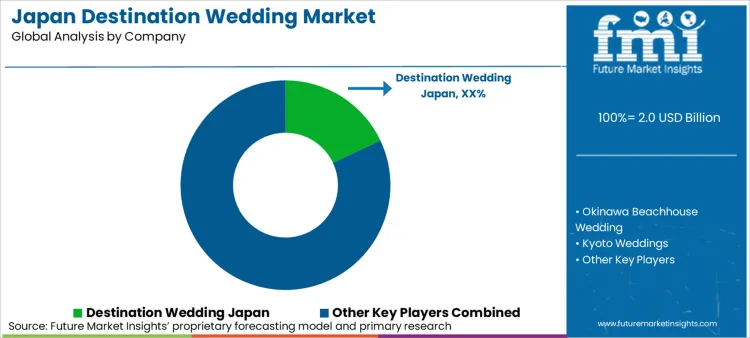
The Japan destination wedding market is moderately fragmented, with leading operators such as Destination wedding Japan, Okinawa Beachhouse Wedding, Kyoto Weddings, and Hitchbird Wedding Company holding significant shares. Smaller players are tapping into niche markets by offering unique venues and custom services.
Recent Developments:
- In December 2025, IBJ Inc. initiated a tender offer for Decollte Holdings, a leader in Japan's photo wedding and pre-wedding photography market, signaling vertical integration from matchmaking to wedding service delivery.
- In December 2025, Watabe Wedding Corporation launched a partnership with South Korean luxury bridal brand CHOIJAEHOON, distributing four specialized dress designs modified with traditional Japanese obi-style sashes for the Japanese market.
- In early 2026, Okinawa was named one of the world's top destinations for 2026 by Expedia, reinforcing its positioning as a premier destination wedding location.
How Small and Niche Players are Performing in Japan’s Wedding Tourism Industry
Small and niche players are gong well in Japan's wedding tourism, thanks to their own unique services on offer that are culturally immersive and personalized, catering to small niched markets. These distinguish themselves by focusing on the country's rich traditions, aesthetic beautiful sceneries, and tailormade experiences, targeting customers from both domestic and international backgrounds.
Companies such as Kyoto Dream Weddings are involved with smaller-scale Shinto-style weddings. They themselves hold events inside historic shrines, which couples find very traditionally deep rooted. Their knowledge in managing communication with local priests for authentic attire ensures originality. Such boutique planners, such as Sakura Bliss Events, would conduct cherry blossom-themed spring weddings where every aspect of the arrangement helps revive the essence of Japan's most famous sakura season.
Small businesses in Okinawa, such as Island Serenity Weddings, offer beach weddings that take advantage of secluded locations and locally sourced decorations that are beautiful with the tropics. Hokkaido Elegance, on the other hand, focuses on winter weddings, which also take place against the snowy backdrop and cozy venues for couples who want something more from tropical Asia-Pacific destinations.
Most niche players focus on sustainability by sourcing locally, eco-friendly decorations, and minimal waste. Combining creativity, authenticity, and attention to detail, they are well-positioned to create a significant niche in Japan's competitive wedding tourism market and attract couples who want truly one-of-a-kind celebrations.
Market Definition
The Japan destination wedding market represents revenue generated from wedding ceremonies, receptions, photo weddings, pre-wedding photography, and associated hospitality services conducted at destination venues within Japan. The market measures the value of venue hire, ceremony officiating, catering, photography, bridal fashion, guest accommodation, and wedding planning services for couples traveling to a destination within Japan.
Inclusions cover destination wedding ceremonies (chapel, shrine, garden, beach), photo weddings (photography-only packages without ceremony), pre-wedding and engagement photography sessions, destination wedding venue hire and catering, bridal fashion and accessory rental and sales, guest accommodation blocks at destination hotels, and wedding planning and coordination services. Inbound international destination wedding revenue is included.
Exclusions include standard local weddings where the couple resides in the same municipality as the venue, funeral and memorial services, corporate events at wedding venues, and standalone honeymoon travel not bundled with a wedding package. Matchmaking agency subscription revenue (before wedding booking) is outside the scope unless vertically integrated with wedding service delivery.
Scope of Report
| Items | Values |
|---|---|
| Quantitative Units (2026) | USD 2.0 Billion |
| Product Type | Full Destination Weddings, Photo Weddings, Micro-Weddings, Pre-Wedding Photography, Inbound International Weddings |
| Material Type | Chapel Ceremony, Shrine Ceremony (Shinzen-Shiki), Garden and Outdoor, Beach Ceremony, Restaurant Wedding |
| End-Use / Channel | Wedding Companies (Watabe, T&G, Novarese), Hotel and Resort Direct, Regional Tourism Body Programs, Online Wedding Platforms (Zexy, Hanayume), International Wedding Planners |
| Regions Covered | Okinawa, Kyoto, Hokkaido, Karuizawa, Tokyo, Kobe, Miyako and Ishigaki Islands |
| Countries Covered | Japan (inbound from China, South Korea, Taiwan, Hong Kong, Southeast Asia) |
| Key Companies Profiled | Watabe Wedding, IBJ Inc., Decollte Holdings, T&G Inc., Novarese, Plan Do See, Best Bridal, Okinawa Watabe Wedding |
| Additional Attributes | Revenue analysis by format type and source market, photo wedding adoption tracking, Okinawa venue capacity analysis, inbound wedding couple nationality breakdown, and matchmaking-to-wedding conversion rate monitoring |
Top Segments Studied in the Japan Destination Wedding Market Report
By Product Type:
- Full Destination Wedding Ceremonies
- Photo Weddings (Photography Only)
- Micro-Weddings (Under 20 Guests)
- Pre-Wedding and Engagement Photography
- Inbound International Destination Weddings
By Material Type:
- Chapel Ceremonies
- Shrine Ceremonies (Shinzen-Shiki)
- Garden and Outdoor Ceremonies
- Beach and Waterfront Ceremonies
- Restaurant and Venue Weddings
By Region:
- Okinawa
- Kyoto
- Hokkaido
- Karuizawa and Nagano
- Tokyo
- Miyako and Ishigaki Islands
Bibliography
- Japan National Tourism Organization. (2025, January). 2024 inbound visitor statistics. JNTO.
- Okinawa Convention and Visitors Bureau. (2026, January). Expedia 2026 top destination ranking. Breaking Travel News.
- IBJ Inc. (2025, December). Decollte Holdings tender offer announcement. IBJ Investor Relations.
- Watabe Wedding Corporation. (2025, December). CHOIJAEHOON bridal partnership launch. Watabe Wedding.
Frequently Asked Questions
What is the current market size for Japan Destination Wedding?
The market is valued at USD 2.0 Billion in 2026, driven by Okinawa's global brand elevation, photo wedding format growth, and inbound international wedding demand.
What is the projected CAGR?
The market is projected to grow at a CAGR of 8.5% from 2026 to 2036.
Which regions lead destination weddings in Japan?
Okinawa leads with over 40% of destination wedding revenue, followed by Kyoto for traditional cultural weddings and Hokkaido for seasonal nature weddings.
What are the primary market drivers?
Photo wedding format adoption, Okinawa's global destination recognition, and inbound wedding tourism from China and South Korea are the primary drivers.
Who are the leading operators?
Watabe Wedding, IBJ (post-Decollte acquisition), T&G, and Novarese are key players, differentiating through destination venue networks, photo wedding expertise, and cross-cultural service capability.
Preview the report firsthand - request a free sample
Get SampleGet the brochure for pricing and purchase details.
Get PDFTable of Content
- Executive Summary
- Global Market Outlook
- Demand-side Trends
- Supply-side Trends
- Technology Roadmap Analysis
- Analysis and Recommendations
- Market Overview
- Market Coverage / Taxonomy
- Market Definition / Scope / Limitations
- Research Methodology
- Chapter Orientation
- Analytical Lens and Working Hypotheses
- Market Structure, Signals, and Trend Drivers
- Benchmarking and Cross-market Comparability
- Market Sizing, Forecasting, and Opportunity Mapping
- Research Design and Evidence Framework
- Desk Research Programme (Secondary Evidence)
- Company Annual and Sustainability Reports
- Peer-reviewed Journals and Academic Literature
- Corporate Websites, Product Literature, and Technical Notes
- Earnings Decks and Investor Briefings
- Statutory Filings and Regulatory Disclosures
- Technical White Papers and Standards Notes
- Trade Journals, Industry Magazines, and Analyst Briefs
- Conference Proceedings, Webinars, and Seminar Materials
- Government Statistics Portals and Public Data Releases
- Press Releases and Reputable Media Coverage
- Specialist Newsletters and Curated Briefings
- Sector Databases and Reference Repositories
- FMI Internal Proprietary Databases and Historical Market Datasets
- Subscription Datasets and Paid Sources
- Social Channels, Communities, and Digital Listening Inputs
- Additional Desk Sources
- Expert Input and Fieldwork (Primary Evidence)
- Primary Modes
- Qualitative Interviews and Expert Elicitation
- Quantitative Surveys and Structured Data Capture
- Blended Approach
- Why Primary Evidence is Used
- Field Techniques
- Interviews
- Surveys
- Focus Groups
- Observational and In-context Research
- Social and Community Interactions
- Stakeholder Universe Engaged
- C-suite Leaders
- Board Members
- Presidents and Vice Presidents
- R&D and Innovation Heads
- Technical Specialists
- Domain Subject-matter Experts
- Scientists
- Physicians and Other Healthcare Professionals
- Governance, Ethics, and Data Stewardship
- Research Ethics
- Data Integrity and Handling
- Primary Modes
- Tooling, Models, and Reference Databases
- Desk Research Programme (Secondary Evidence)
- Data Engineering and Model Build
- Data Acquisition and Ingestion
- Cleaning, Normalisation, and Verification
- Synthesis, Triangulation, and Analysis
- Quality Assurance and Audit Trail
- Market Background
- Market Dynamics
- Drivers
- Restraints
- Opportunity
- Trends
- Scenario Forecast
- Demand in Optimistic Scenario
- Demand in Likely Scenario
- Demand in Conservative Scenario
- Opportunity Map Analysis
- Product Life Cycle Analysis
- Supply Chain Analysis
- Investment Feasibility Matrix
- Value Chain Analysis
- PESTLE and Porter’s Analysis
- Regulatory Landscape
- Regional Parent Market Outlook
- Production and Consumption Statistics
- Import and Export Statistics
- Market Dynamics
- Global Market Analysis 2021 to 2025 and Forecast, 2026 to 2036
- Historical Market Size Value (USD Million) Analysis, 2021 to 2025
- Current and Future Market Size Value (USD Million) Projections, 2026 to 2036
- Y-o-Y Growth Trend Analysis
- Absolute $ Opportunity Analysis
- Global Market Pricing Analysis 2021 to 2025 and Forecast 2026 to 2036
- Global Market Analysis 2021 to 2025 and Forecast 2026 to 2036, By Wedding Type
- Introduction / Key Findings
- Historical Market Size Value (USD Million) Analysis By Wedding Type , 2021 to 2025
- Current and Future Market Size Value (USD Million) Analysis and Forecast By Wedding Type , 2026 to 2036
- Beach Wedding
- Mountain Wedding
- Vineyard Wedding
- Castle Wedding
- City Wedding
- Beach Wedding
- Y-o-Y Growth Trend Analysis By Wedding Type , 2021 to 2025
- Absolute $ Opportunity Analysis By Wedding Type , 2026 to 2036
- Global Market Analysis 2021 to 2025 and Forecast 2026 to 2036, By Service Planning
- Introduction / Key Findings
- Historical Market Size Value (USD Million) Analysis By Service Planning, 2021 to 2025
- Current and Future Market Size Value (USD Million) Analysis and Forecast By Service Planning, 2026 to 2036
- Wedding Planning
- Venue Selection
- Catering
- Photography
- Wedding Planning
- Y-o-Y Growth Trend Analysis By Service Planning, 2021 to 2025
- Absolute $ Opportunity Analysis By Service Planning, 2026 to 2036
- Global Market Analysis 2021 to 2025 and Forecast 2026 to 2036, By Region
- Introduction
- Historical Market Size Value (USD Million) Analysis By Region, 2021 to 2025
- Current Market Size Value (USD Million) Analysis and Forecast By Region, 2026 to 2036
- North America
- Latin America
- Western Europe
- Eastern Europe
- East Asia
- South Asia and Pacific
- Middle East & Africa
- Market Attractiveness Analysis By Region
- North America Market Analysis 2021 to 2025 and Forecast 2026 to 2036, By Country
- Historical Market Size Value (USD Million) Trend Analysis By Market Taxonomy, 2021 to 2025
- Market Size Value (USD Million) Forecast By Market Taxonomy, 2026 to 2036
- By Country
- USA
- Canada
- Mexico
- By Wedding Type
- By Service Planning
- By Country
- Market Attractiveness Analysis
- By Country
- By Wedding Type
- By Service Planning
- Key Takeaways
- Latin America Market Analysis 2021 to 2025 and Forecast 2026 to 2036, By Country
- Historical Market Size Value (USD Million) Trend Analysis By Market Taxonomy, 2021 to 2025
- Market Size Value (USD Million) Forecast By Market Taxonomy, 2026 to 2036
- By Country
- Brazil
- Chile
- Rest of Latin America
- By Wedding Type
- By Service Planning
- By Country
- Market Attractiveness Analysis
- By Country
- By Wedding Type
- By Service Planning
- Key Takeaways
- Western Europe Market Analysis 2021 to 2025 and Forecast 2026 to 2036, By Country
- Historical Market Size Value (USD Million) Trend Analysis By Market Taxonomy, 2021 to 2025
- Market Size Value (USD Million) Forecast By Market Taxonomy, 2026 to 2036
- By Country
- Germany
- UK
- Italy
- Spain
- France
- Nordic
- BENELUX
- Rest of Western Europe
- By Wedding Type
- By Service Planning
- By Country
- Market Attractiveness Analysis
- By Country
- By Wedding Type
- By Service Planning
- Key Takeaways
- Eastern Europe Market Analysis 2021 to 2025 and Forecast 2026 to 2036, By Country
- Historical Market Size Value (USD Million) Trend Analysis By Market Taxonomy, 2021 to 2025
- Market Size Value (USD Million) Forecast By Market Taxonomy, 2026 to 2036
- By Country
- Russia
- Poland
- Hungary
- Balkan & Baltic
- Rest of Eastern Europe
- By Wedding Type
- By Service Planning
- By Country
- Market Attractiveness Analysis
- By Country
- By Wedding Type
- By Service Planning
- Key Takeaways
- East Asia Market Analysis 2021 to 2025 and Forecast 2026 to 2036, By Country
- Historical Market Size Value (USD Million) Trend Analysis By Market Taxonomy, 2021 to 2025
- Market Size Value (USD Million) Forecast By Market Taxonomy, 2026 to 2036
- By Country
- China
- Japan
- South Korea
- By Wedding Type
- By Service Planning
- By Country
- Market Attractiveness Analysis
- By Country
- By Wedding Type
- By Service Planning
- Key Takeaways
- South Asia and Pacific Market Analysis 2021 to 2025 and Forecast 2026 to 2036, By Country
- Historical Market Size Value (USD Million) Trend Analysis By Market Taxonomy, 2021 to 2025
- Market Size Value (USD Million) Forecast By Market Taxonomy, 2026 to 2036
- By Country
- India
- ASEAN
- Australia & New Zealand
- Rest of South Asia and Pacific
- By Wedding Type
- By Service Planning
- By Country
- Market Attractiveness Analysis
- By Country
- By Wedding Type
- By Service Planning
- Key Takeaways
- Middle East & Africa Market Analysis 2021 to 2025 and Forecast 2026 to 2036, By Country
- Historical Market Size Value (USD Million) Trend Analysis By Market Taxonomy, 2021 to 2025
- Market Size Value (USD Million) Forecast By Market Taxonomy, 2026 to 2036
- By Country
- Kingdom of Saudi Arabia
- Other GCC Countries
- Turkiye
- South Africa
- Other African Union
- Rest of Middle East & Africa
- By Wedding Type
- By Service Planning
- By Country
- Market Attractiveness Analysis
- By Country
- By Wedding Type
- By Service Planning
- Key Takeaways
- Key Countries Market Analysis
- USA
- Pricing Analysis
- Market Share Analysis, 2025
- By Wedding Type
- By Service Planning
- Canada
- Pricing Analysis
- Market Share Analysis, 2025
- By Wedding Type
- By Service Planning
- Mexico
- Pricing Analysis
- Market Share Analysis, 2025
- By Wedding Type
- By Service Planning
- Brazil
- Pricing Analysis
- Market Share Analysis, 2025
- By Wedding Type
- By Service Planning
- Chile
- Pricing Analysis
- Market Share Analysis, 2025
- By Wedding Type
- By Service Planning
- Germany
- Pricing Analysis
- Market Share Analysis, 2025
- By Wedding Type
- By Service Planning
- UK
- Pricing Analysis
- Market Share Analysis, 2025
- By Wedding Type
- By Service Planning
- Italy
- Pricing Analysis
- Market Share Analysis, 2025
- By Wedding Type
- By Service Planning
- Spain
- Pricing Analysis
- Market Share Analysis, 2025
- By Wedding Type
- By Service Planning
- France
- Pricing Analysis
- Market Share Analysis, 2025
- By Wedding Type
- By Service Planning
- India
- Pricing Analysis
- Market Share Analysis, 2025
- By Wedding Type
- By Service Planning
- ASEAN
- Pricing Analysis
- Market Share Analysis, 2025
- By Wedding Type
- By Service Planning
- Australia & New Zealand
- Pricing Analysis
- Market Share Analysis, 2025
- By Wedding Type
- By Service Planning
- China
- Pricing Analysis
- Market Share Analysis, 2025
- By Wedding Type
- By Service Planning
- Japan
- Pricing Analysis
- Market Share Analysis, 2025
- By Wedding Type
- By Service Planning
- South Korea
- Pricing Analysis
- Market Share Analysis, 2025
- By Wedding Type
- By Service Planning
- Russia
- Pricing Analysis
- Market Share Analysis, 2025
- By Wedding Type
- By Service Planning
- Poland
- Pricing Analysis
- Market Share Analysis, 2025
- By Wedding Type
- By Service Planning
- Hungary
- Pricing Analysis
- Market Share Analysis, 2025
- By Wedding Type
- By Service Planning
- Kingdom of Saudi Arabia
- Pricing Analysis
- Market Share Analysis, 2025
- By Wedding Type
- By Service Planning
- Turkiye
- Pricing Analysis
- Market Share Analysis, 2025
- By Wedding Type
- By Service Planning
- South Africa
- Pricing Analysis
- Market Share Analysis, 2025
- By Wedding Type
- By Service Planning
- USA
- Market Structure Analysis
- Competition Dashboard
- Competition Benchmarking
- Market Share Analysis of Top Players
- By Regional
- By Wedding Type
- By Service Planning
- Competition Analysis
- Competition Deep Dive
- Destination Wedding Japan
- Overview
- Product Portfolio
- Profitability by Market Segments (Product/Age /Sales Channel/Region)
- Sales Footprint
- Strategy Overview
- Marketing Strategy
- Product Strategy
- Channel Strategy
- Okinawa Beachhouse Wedding
- Kyoto Weddings
- Hitchbird Wedding Company
- 37 Frames
- Ayaka Ishimura Wedding & Design
- Destination Wedding Japan
- Competition Deep Dive
- Assumptions & Acronyms Used


