

- Industry Size (2026)
- USD 2.2 Bn
- Forecast (2036)
- USD 5.5 Bn
- CAGR (2026 to 2036)
- 9.6%
Wedding Car Rental Services Market Forecast and Outlook 2026 to 2036
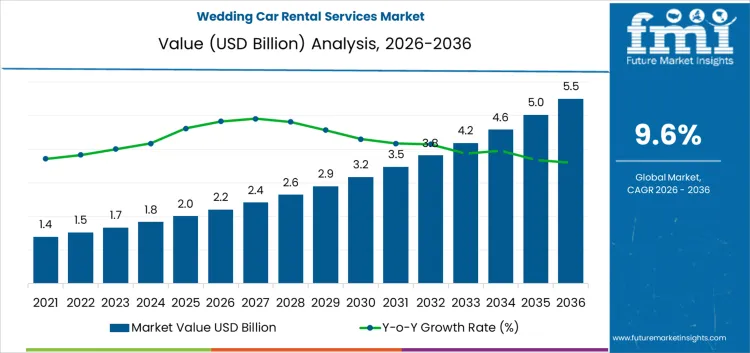
A move from USD 2.2 billion in 2026 to USD 5.5 billion by 2036 places the wedding car rental services market on a 9.6% CAGR path. This business is driven by occasions rather than by everyday transport needs, and usage is tied directly to ceremony scale and celebration spending. Demand therefore rises and falls with marriage volumes, seasonal calendars, and household confidence in discretionary spending. Urban centers account for a large share of bookings because they concentrate venues, hotels, and specialized service providers. High end fleets and themed vehicles are positioned where customers are willing to pay for visual impact rather than for practical mobility.
Destination weddings and resort locations shape a second layer of demand that differs from local city markets. In these settings, rentals are often bundled with event planning services, photography, and venue packages rather than booked independently. Fleet utilization depends on weekend concentration and peak season timing, which creates uneven revenue flow across the year. Operators manage profitability through pricing for peak dates and by rotating vehicles across multiple cities. The market expands through growth in celebration spending and event driven travel, not through any change in daily transportation behavior.
Quick Stats for Wedding Car Rental Services Market
- Wedding Car Rental Services Market Value (2026): USD 2.2 billion
- Wedding Car Rental Services Market Forecast Value (2036): USD 5.5 billion
- Wedding Car Rental Services Market Forecast CAGR 2026 to 2036: 9.6%
- Leading Service Type in Wedding Car Rental Services Market: Luxury car rentals
- Leading Booking Channel in Wedding Car Rental Services Market: Online reservation platforms
- Key Growth Regions in Wedding Car Rental Services Market: Asia Pacific, North America, Europe
- Top Players in Wedding Car Rental Services Market: Enterprise Rent A Car, Hertz Global Holdings, Avis Budget Group, Sixt SE, Royalty Exotic Cars, Limo Finder, Wedding Car Hire Association
What is the Growth Forecast for Wedding Car Rental Services Market through 2036?
The wedding car rental services market grows in a rhythm dictated more by calendars and social customs than by transport economics. Around USD 1.2 billion at the start of the period, the market moves to roughly USD 1.4 billion and then to about USD 1.8 billion as recovery in event activity and deferred weddings restores booking volumes. By the time it reaches around USD 2.2 billion and then USD 2.7 billion, demand is already showing its structural pattern: highly seasonal, heavily concentrated on weekends, and clustered around specific months in each region. Utilization rates are uneven, with vehicles often idle on weekdays and fully booked on peak dates. Growth in this phase comes mainly from higher booking counts and slightly broader geographic participation rather than from higher prices per event.
As the market moves through the USD 3.0 to 3.8 billion range and then into roughly USD 4.3 to 4.9 billion, expansion is shaped by how offerings are packaged rather than by fleet size alone. Couples choose providers based on appearance, availability on the exact date, and bundled pricing that includes decoration, chauffeur service, and time blocks, not on technical specifications of the vehicle. The mix of luxury sedans, vintage cars, and premium SUVs keeps the price ladder wide and the category fragmented. Approaching USD 5.5 billion, growth is still driven by event volume and package upselling rather than by structural consolidation. The business remains local, calendar-driven, and logistics-heavy, with success depending more on fleet presentation and scheduling discipline than on scale economics.
Wedding Car Rental Services Market Key Takeaways
| Metric | Value |
|---|---|
| Market Value (2026) | USD 2.2 billion |
| Forecast Value (2036) | USD 5.5 billion |
| Forecast CAGR 2026 to 2036 | 9.6% |
How Are Wedding Car Rental Services Catering to Premium and Themed Experiences?
Wedding car rental services are increasingly adopted to provide luxury, customized, and themed transportation options for couples and event planners. Historically, standard sedans or traditional vehicles dominated wedding transportation, limiting personalization and visual appeal. Modern rental services offer premium cars, classic vehicles, and themed fleets with decorative customization, chauffeur services, and package integration to enhance the overall wedding experience. Event planners, rental agencies, and hospitality providers prioritize vehicle aesthetics, reliability, and flexibility in service offerings. Early adoption focused on high-end weddings and destination events, while current demand spans mainstream weddings, corporate wedding planners, and themed celebrations, driven by the desire for memorable experiences, social media visibility, and personalization trends. Vehicle quality, service reliability, and customization options influence supplier selection.
Changing consumer expectations, social media influence, and preference for personalized experiences are shaping market growth. Compared with standard transportation options, premium and themed wedding rentals emphasize curated aesthetics, seamless service, and experiential value. Cost structures depend on vehicle type, service duration, and customization features, concentrating margins among providers capable of delivering consistent, high-quality experiences. Couples and wedding planners adopt these services to enhance ceremony appeal, provide comfortable transportation, and create lasting impressions. By 2036, premium and themed wedding car rentals are expected to become a key segment in event planning services, supporting personalized experiences, elevated service standards, and memorable celebrations.
What Factors Are Shaping the Demand for Wedding Car Rental Services, Segment wise by Service Type and Booking Channel, in 2026?
The wedding car rental services market in 2026 is segmented by service type and by booking channel. By service offering, demand is divided into luxury car rentals, classic car rentals, limousine services, and vintage vehicle rentals, each appealing to different style preferences, group sizes, and ceremonial roles. By booking channel, demand is organized around online reservation platforms, offline agencies, event planner tie ups, and direct chauffeur services, which differ in price transparency, trust building, and coordination scope. These segments reflect how couples and families balance visual impact, reliability, and convenience when arranging transport for tightly scheduled, high visibility events.
Why Do Luxury Car Rentals Dominate Service Demand?
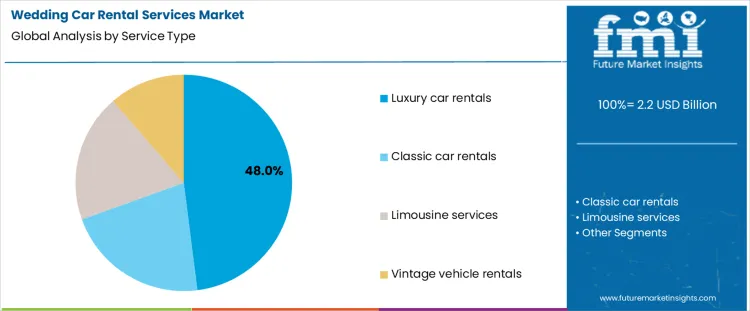
Luxury car rentals account for about 48% of demand in 2026, reflecting their broad appeal across modern wedding styles. These vehicles provide a premium look without the maintenance or sourcing challenges associated with rare vintage models. Availability is higher, fleets are easier to standardize, and reliability is generally better, which reduces the risk of last minute issues. Many couples also prefer brands that are immediately recognizable and photograph well, which favors contemporary luxury sedans and SUVs. Pricing is high enough to signal prestige yet still accessible to a wide portion of the wedding market. This balance between aspiration, availability, and operational reliability keeps luxury rentals as the largest service category.
Classic, limousine, and vintage services address more specific preferences. Classic and vintage cars appeal to themed or traditional weddings, but their limited supply and higher maintenance risk restrict scale. Limousines suit larger wedding parties, yet their visual impact has become less distinctive over time. These options remain important for differentiation, but they do not match the consistent, high volume pull of modern luxury fleets that can be deployed across many bookings and cities with predictable service standards.
Why Do Online Reservation Platforms Lead Booking Behavior?
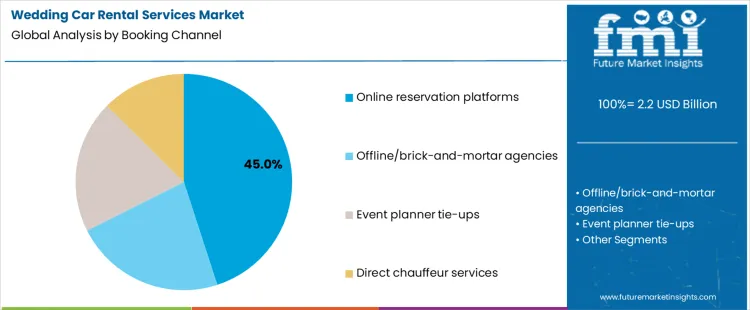
Online reservation platforms represent about 45% of demand in 2026 because they match how couples research and compare wedding services. Visual browsing, price comparison, and availability checks can all be done quickly without visiting offices. Reviews and ratings reduce trust barriers in a category where reliability matters more than experimentation. For operators, online platforms also simplify lead management and scheduling. Seasonal demand peaks can be handled without proportional increases in staff. This efficiency and transparency explain why digital channels have become the primary booking route.
Offline agencies, event planners, and direct chauffeur arrangements still play roles in complex or high budget weddings. Planners handle bundled services and coordination, while offline agencies serve customers who prefer face to face negotiation. Direct chauffeur services are used for specific, high touch arrangements. These channels remain relevant, but their reach is narrower and less scalable. As a result, while they contribute to premium or specialized bookings, online platforms continue to capture the largest share of total transaction volume.
How Are the Key Dynamics of Experience Focus, Planning Friction, and Premium Service Bundling Reshaping the Wedding Car Rental Services Market through 2036?
The category is being shaped by how weddings are curated as experiences rather than by transport needs alone. Couples increasingly treat arrival and departure moments as part of the visual and social narrative of the event. At the same time, booking and coordination remain fragmented across vendors, which creates planning friction and uncertainty. This opens space for rental providers to bundle vehicles with drivers, decoration, timing coordination, and contingency support. The result is a market driven by event choreography and risk management, where differentiation comes from reliability and presentation as much as from the vehicle itself.
Why Is the Shift Toward Experience Led Weddings Driving the Wedding Car Rental Services Market?
Demand is anchored in how weddings are staged and documented. Social media, professional photography, and cinematic videography have turned the wedding journey into a visible part of the event story. The car is no longer just transport but a prop that signals style, status, or theme. Vintage, luxury, or themed vehicles are chosen to match the overall aesthetic. In multi venue or destination weddings, coordinated transport also reduces schedule risk. Once couples and planners view arrival and departure as scripted moments, renting a dedicated vehicle becomes part of the standard checklist. Volume then follows the growth of curated, high involvement wedding formats rather than guest count alone.
What Coordination Complexity and Market Fragmentation Are Limiting Smoother Scaling?
The main barrier is execution risk. Wedding schedules are tight, locations change, and delays have cascading effects. Many rental providers are small, local operators with limited fleets and informal processes, which increases the chance of last minute issues. Booking platforms, planners, decorators, and venues often operate in silos, making coordination dependent on manual follow ups. Cancellations, weather, or traffic disruptions further complicate commitments. From the buyer side, comparing reliability is difficult because quality is only proven on the day. These factors keep the market fragmented and make buyers cautious, even when willingness to pay for a premium experience is high.
How Are Bundled Event Services and Platform Based Booking Changing the Structure of This Market?
The opportunity is shifting toward integration. More planners and rental companies are offering packages that include vehicle, chauffeur, decoration, timing coordination, and backup options under one contract. This reduces interface risk for couples and allows providers to charge for assurance, not just for the car. Online platforms and wedding marketplaces are also starting to standardize discovery and booking, which favors operators that can deliver consistent service across dates and locations. Over time, competition moves from who has the most distinctive car to who can reliably deliver a complete, stress free arrival and departure experience within a coordinated event plan.
What is the Demand for Wedding Car Rental Services by Country?
| Country | CAGR (%) |
|---|---|
| USA | 8.9% |
| UK | 8.5% |
| China | 10.2% |
| India | 10.8% |
| Brazil | 9.2% |
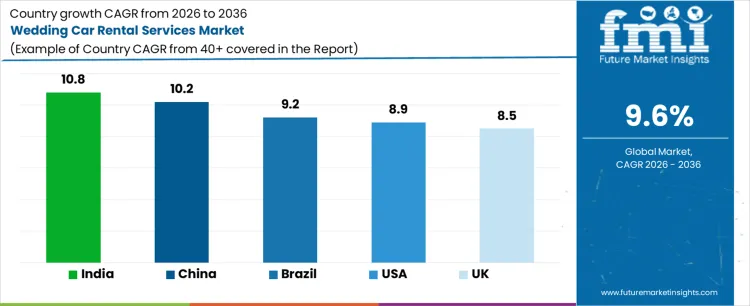
Demand for wedding car rental services is rising as couples and event planners seek premium, convenient, and personalized transportation options for ceremonies and celebrations. India leads with a 10.8% CAGR, driven by growing wedding budgets, increasing demand for luxury vehicles, and expansion of professional rental services. China follows at 10.2%, supported by rising middle-class incomes and adoption of customized wedding experiences. Brazil records 9.2% growth, shaped by cultural emphasis on wedding celebrations and preference for elegant transport. The USA grows at 8.9%, influenced by high demand for specialized vehicles in weddings. The UK shows 8.5% CAGR, reflecting steady adoption of car rental services for wedding events and celebrations.
How is the United States experiencing growth in the wedding car rental services market?
United States is experiencing growth at a CAGR of 8.9%, supported by the large number of weddings and the overall size of the wedding industry, which collectively drive strong demand for luxury and classic car rentals. Metropolitan areas such as New York, Los Angeles, and Chicago host thousands of weddings annually, creating concentrated demand for chauffeur-driven vehicles for ceremonies and receptions. Investments focus on fleet variety, maintenance, and partnerships with venue operators. Growth reflects consistent annual wedding volumes, evolving consumer preferences for premium transportation, and integration with modern event experiences.
- Number of weddings and size of wedding industry drive adoption.
- Urban centers host concentrated wedding activity.
- Fleet variety and reliability guide investment.
- Venue partnerships enhance service value.
How is the United Kingdom witnessing growth in the wedding car rental services market?
United Kingdom is witnessing growth at a CAGR of 8.5%, fueled by high spending on celebrations and social events, particularly in London, Edinburgh, and Bath. Couples increasingly allocate significant portions of their wedding budgets to transportation, ensuring premium vehicles complement lavish venues and reception setups. Demand is concentrated in affluent urban neighborhoods and heritage locations. Investments focus on luxury fleet maintenance, customized packages, and high-end chauffeur services. Growth reflects the cultural trend of investing in elaborate celebrations and enhancing the overall wedding experience with stylish transportation.
- Spending on celebrations and social events drives adoption.
- Affluent urban neighborhoods concentrate demand.
- Premium fleet maintenance guides investment.
- Customized chauffeur services enhance value.
How is China experiencing growth in the wedding car rental services market?
China is experiencing growth at a CAGR of 10.2%, supported by tourism and destination wedding activity in cities like Shanghai, Guangzhou, and Hangzhou. Couples increasingly choose scenic resorts, historical landmarks, and luxury hotels for wedding ceremonies, creating demand for high-end vehicles for photoshoots, processions, and guest transport. Urban tourist districts and resort clusters concentrate rental activity. Investments prioritize specialized vehicle availability, reliable scheduling, and partnerships with destination venues. Growth reflects rising popularity of destination weddings, integration of photography services, and enhanced guest experiences through luxury transport.
- Tourism and destination wedding activity drive adoption.
- Resort and historical landmark areas concentrate demand.
- Specialized vehicle availability guides investment.
- Venue partnerships enhance guest experiences.
How is India witnessing growth in the wedding car rental services market?
India is experiencing growth at a CAGR of 10.8%, driven by urban population and hotel/venue density in cities such as Mumbai, Delhi, and Bengaluru. Dense urban centers host numerous wedding venues, luxury hotels, and banquet halls, creating concentrated demand for premium wedding cars. Investments focus on fleet variety, operational efficiency, and integration with venue services. Growth reflects the need for reliable transportation across densely populated areas, seamless coordination with event schedules, and high demand from metropolitan weddings.
- Urban population and hotel/venue density drive adoption.
- High-density cities concentrate demand.
- Fleet variety and operational efficiency guide investment.
- Venue integration enhances service quality.
How is Brazil experiencing growth in the wedding car rental services market?
Brazil is experiencing growth at a CAGR of 9.2%, fueled by the presence of wedding planners and event companies in São Paulo, Rio de Janeiro, and Brasília. Professional planners coordinate elaborate ceremonies, requiring reliable luxury and themed vehicles for bridal parties and guest transport. Demand is concentrated in urban centers where wedding planning companies operate and offer bundled services. Investments focus on partnerships with planners, fleet aesthetics, and flexible service packages. Growth reflects structured wedding coordination, reliance on professional event management, and increasing adoption of curated vehicle experiences.
- Presence of wedding planners and event companies drives adoption.
- Urban wedding planning hubs concentrate demand.
- Planner partnerships and flexible packages guide investment.
- Fleet aesthetics and themed vehicles enhance appeal.
Wedding Car Rental Services Market: How Are Providers Differentiating Through Fleet Selection and Event Services?
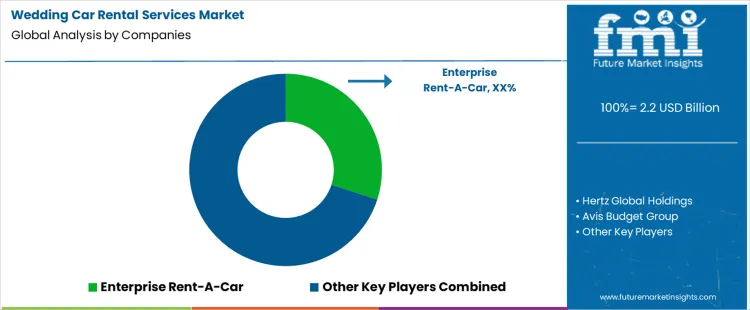
Competition in the wedding car rental market is shaped by fleet variety, customization options, and regional presence. Enterprise Rent-A-Car offers luxury and specialty vehicles with extensive branch networks, facilitating convenient pickup and drop-off for wedding events. Hertz Global Holdings provides premium sedans and executive cars, often bundled with insurance and roadside support, targeting couples seeking reliability and brand recognition. Avis Budget Group delivers luxury and specialty vehicles through global operations, offering optional wedding packages and décor services. Sixt SE supplies high-end and convertible vehicles designed for upscale weddings, emphasizing style and comfort.
Royalty Exotic Cars focuses on exotic and high-visibility vehicles for clients seeking unique, standout transportation. Limo Finder connects users with local limousine and classic car providers, emphasizing flexibility and vehicle variety. Wedding Car Hire Association and similar regional networks coordinate vintage, classic, and specialty vehicles for local markets. Other regional operators provide chauffeur services, themed décor, and bespoke packages tailored to ceremony requirements. Competitive differentiation arises from fleet quality, vehicle exclusivity, service customization, availability of chauffeurs, and ability to align with specific wedding themes. Companies combining diverse fleets with reliable service networks maintain relevance across both mass-market and premium wedding segments.
Key Players in the Wedding Car Rental Services Market
- Enterprise Rent-A-Car
- Hertz Global Holdings
- Avis Budget Group
- Sixt SE
- Royalty Exotic Cars
- Limo Finder
- Wedding Car Hire Association (regional networks)
Scope of the Report
| Items | Values |
|---|---|
| Quantitative Units (2026) | USD billion |
| Service Type | Luxury Car Rentals, Classic Car Rentals, Limousine Services, Vintage Vehicle Rentals |
| Booking Channel | Online Reservation Platforms, Offline/Brick-and-Mortar Agencies, Event Planner Tie-Ups, Direct Chauffeur Services |
| Regions Covered | Asia Pacific, Europe, North America, Latin America, Middle East & Africa |
| Countries Covered | China, Japan, South Korea, India, Australia & New Zealand, ASEAN, Germany, United Kingdom, France, Italy, Spain, Nordic, BENELUX, United States, Canada, Mexico, Brazil, Chile, Saudi Arabia, Turkey, South Africa, and other regional markets |
| Key Companies Profiled | Enterprise Rent A Car, Hertz Global Holdings, Avis Budget Group, Sixt SE, Royalty Exotic Cars, Limo Finder, Wedding Car Hire Association (regional networks) |
| Additional Attributes | Dollar sales by service type and booking channel; luxury car rentals as the leading service; online platforms as the largest booking route; demand driven by wedding volumes, destination events, and premium experience focus; procurement shaped by peak-date availability, fleet presentation, and service bundling; growth remains seasonal, calendar-driven, and locally executed rather than scale-led. |
Wedding Car Rental Services Market Segmentation
Service Type:
- Luxury car rentals
- Classic car rentals
- Limousine services
- Vintage vehicle rentals
Booking Channel:
- Online reservation platforms
- Offline/brick-and-mortar agencies
- Event planner tie-ups
- Direct chauffeur services
Region
- Asia Pacific
- China
- Japan
- South Korea
- India
- Australia & New Zealand
- ASEAN
- Rest of Asia Pacific
- Europe
- Germany
- United Kingdom
- France
- Italy
- Spain
- Nordic
- BENELUX
- Rest of Europe
- North America
- United States
- Canada
- Mexico
- Latin America
- Brazil
- Chile
- Rest of Latin America
- Middle East & Africa
- Kingdom of Saudi Arabia
- Other GCC Countries
- Turkey
- South Africa
- Other African Union
- Rest of Middle East & Africa
Bibliography
- United Nations Conference on Trade and Development. (2024). Creative economy outlook 2024: Cultural and celebration services and trade patterns. UNCTAD.
- United States Census Bureau. (2024). Marriages and divorces in the United States: Annual vital statistics report 2024. U.S. Department of Commerce.
- Office for National Statistics. (2024). Marriages in England and Wales: Statistical bulletin 2024. Government of the United Kingdom.
Frequently Asked Questions
How big is the wedding car rental services market in 2026?
The global wedding car rental services market is estimated to be valued at USD 2.2 billion in 2026.
What will be the size of wedding car rental services market in 2036?
The market size for the wedding car rental services market is projected to reach USD 5.5 billion by 2036.
How much will be the wedding car rental services market growth between 2026 and 2036?
The wedding car rental services market is expected to grow at a 9.6% CAGR between 2026 and 2036.
What are the key product types in the wedding car rental services market?
The key product types in wedding car rental services market are luxury car rentals , classic car rentals, limousine services and vintage vehicle rentals.
Which booking channel segment to contribute significant share in the wedding car rental services market in 2026?
In terms of booking channel, online reservation platforms segment to command 45.0% share in the wedding car rental services market in 2026.
Preview the report firsthand - request a free sample
Get SampleGet the brochure for pricing and purchase details.
Get PDFTable of Content
- Executive Summary
- Global Market Outlook
- Demand-side Trends
- Supply-side Trends
- Technology Roadmap Analysis
- Analysis and Recommendations
- Market Overview
- Market Coverage / Taxonomy
- Market Definition / Scope / Limitations
- Market Background
- Market Dynamics
- Drivers
- Restraints
- Opportunity
- Trends
- Scenario Forecast
- Demand in Optimistic Scenario
- Demand in Likely Scenario
- Demand in Conservative Scenario
- Opportunity Map Analysis
- Product Life Cycle Analysis
- Supply Chain Analysis
- Investment Feasibility Matrix
- Value Chain Analysis
- PESTLE and Porter’s Analysis
- Regulatory Landscape
- Regional Parent Market Outlook
- Production and Consumption Statistics
- Import and Export Statistics
- Market Dynamics
- Global Market Analysis 2021 to 2025 and Forecast, 2026 to 2036
- Historical Market Size Value (USD Million) Analysis, 2021 to 2025
- Current and Future Market Size Value (USD Million) Projections, 2026 to 2036
- Y-o-Y Growth Trend Analysis
- Absolute $ Opportunity Analysis
- Global Market Pricing Analysis 2021 to 2025 and Forecast 2026 to 2036
- Global Market Analysis 2021 to 2025 and Forecast 2026 to 2036, By Service Type
- Introduction / Key Findings
- Historical Market Size Value (USD Million) Analysis By Service Type, 2021 to 2025
- Current and Future Market Size Value (USD Million) Analysis and Forecast By Service Type, 2026 to 2036
- Luxury car rentals
- Classic car rentals
- Limousine services
- Vintage vehicle rentals
- Luxury car rentals
- Y-o-Y Growth Trend Analysis By Service Type, 2021 to 2025
- Absolute $ Opportunity Analysis By Service Type, 2026 to 2036
- Global Market Analysis 2021 to 2025 and Forecast 2026 to 2036, By Booking Channel
- Introduction / Key Findings
- Historical Market Size Value (USD Million) Analysis By Booking Channel, 2021 to 2025
- Current and Future Market Size Value (USD Million) Analysis and Forecast By Booking Channel, 2026 to 2036
- Online reservation platforms
- Offline/brick‑and‑mortar agencies
- Event planner tie‑ups
- Direct chauffeur services
- Online reservation platforms
- Y-o-Y Growth Trend Analysis By Booking Channel, 2021 to 2025
- Absolute $ Opportunity Analysis By Booking Channel, 2026 to 2036
- Global Market Analysis 2021 to 2025 and Forecast 2026 to 2036, By Region
- Introduction
- Historical Market Size Value (USD Million) Analysis By Region, 2021 to 2025
- Current Market Size Value (USD Million) Analysis and Forecast By Region, 2026 to 2036
- North America
- Latin America
- Western Europe
- Eastern Europe
- East Asia
- South Asia and Pacific
- Middle East & Africa
- Market Attractiveness Analysis By Region
- North America Market Analysis 2021 to 2025 and Forecast 2026 to 2036, By Country
- Historical Market Size Value (USD Million) Trend Analysis By Market Taxonomy, 2021 to 2025
- Market Size Value (USD Million) Forecast By Market Taxonomy, 2026 to 2036
- By Country
- USA
- Canada
- Mexico
- By Service Type
- By Booking Channel
- By Country
- Market Attractiveness Analysis
- By Country
- By Service Type
- By Booking Channel
- Key Takeaways
- Latin America Market Analysis 2021 to 2025 and Forecast 2026 to 2036, By Country
- Historical Market Size Value (USD Million) Trend Analysis By Market Taxonomy, 2021 to 2025
- Market Size Value (USD Million) Forecast By Market Taxonomy, 2026 to 2036
- By Country
- Brazil
- Chile
- Rest of Latin America
- By Service Type
- By Booking Channel
- By Country
- Market Attractiveness Analysis
- By Country
- By Service Type
- By Booking Channel
- Key Takeaways
- Western Europe Market Analysis 2021 to 2025 and Forecast 2026 to 2036, By Country
- Historical Market Size Value (USD Million) Trend Analysis By Market Taxonomy, 2021 to 2025
- Market Size Value (USD Million) Forecast By Market Taxonomy, 2026 to 2036
- By Country
- Germany
- UK
- Italy
- Spain
- France
- Nordic
- BENELUX
- Rest of Western Europe
- By Service Type
- By Booking Channel
- By Country
- Market Attractiveness Analysis
- By Country
- By Service Type
- By Booking Channel
- Key Takeaways
- Eastern Europe Market Analysis 2021 to 2025 and Forecast 2026 to 2036, By Country
- Historical Market Size Value (USD Million) Trend Analysis By Market Taxonomy, 2021 to 2025
- Market Size Value (USD Million) Forecast By Market Taxonomy, 2026 to 2036
- By Country
- Russia
- Poland
- Hungary
- Balkan & Baltic
- Rest of Eastern Europe
- By Service Type
- By Booking Channel
- By Country
- Market Attractiveness Analysis
- By Country
- By Service Type
- By Booking Channel
- Key Takeaways
- East Asia Market Analysis 2021 to 2025 and Forecast 2026 to 2036, By Country
- Historical Market Size Value (USD Million) Trend Analysis By Market Taxonomy, 2021 to 2025
- Market Size Value (USD Million) Forecast By Market Taxonomy, 2026 to 2036
- By Country
- China
- Japan
- South Korea
- By Service Type
- By Booking Channel
- By Country
- Market Attractiveness Analysis
- By Country
- By Service Type
- By Booking Channel
- Key Takeaways
- South Asia and Pacific Market Analysis 2021 to 2025 and Forecast 2026 to 2036, By Country
- Historical Market Size Value (USD Million) Trend Analysis By Market Taxonomy, 2021 to 2025
- Market Size Value (USD Million) Forecast By Market Taxonomy, 2026 to 2036
- By Country
- India
- ASEAN
- Australia & New Zealand
- Rest of South Asia and Pacific
- By Service Type
- By Booking Channel
- By Country
- Market Attractiveness Analysis
- By Country
- By Service Type
- By Booking Channel
- Key Takeaways
- Middle East & Africa Market Analysis 2021 to 2025 and Forecast 2026 to 2036, By Country
- Historical Market Size Value (USD Million) Trend Analysis By Market Taxonomy, 2021 to 2025
- Market Size Value (USD Million) Forecast By Market Taxonomy, 2026 to 2036
- By Country
- Kingdom of Saudi Arabia
- Other GCC Countries
- Turkiye
- South Africa
- Other African Union
- Rest of Middle East & Africa
- By Service Type
- By Booking Channel
- By Country
- Market Attractiveness Analysis
- By Country
- By Service Type
- By Booking Channel
- Key Takeaways
- Key Countries Market Analysis
- USA
- Pricing Analysis
- Market Share Analysis, 2025
- By Service Type
- By Booking Channel
- Canada
- Pricing Analysis
- Market Share Analysis, 2025
- By Service Type
- By Booking Channel
- Mexico
- Pricing Analysis
- Market Share Analysis, 2025
- By Service Type
- By Booking Channel
- Brazil
- Pricing Analysis
- Market Share Analysis, 2025
- By Service Type
- By Booking Channel
- Chile
- Pricing Analysis
- Market Share Analysis, 2025
- By Service Type
- By Booking Channel
- Germany
- Pricing Analysis
- Market Share Analysis, 2025
- By Service Type
- By Booking Channel
- UK
- Pricing Analysis
- Market Share Analysis, 2025
- By Service Type
- By Booking Channel
- Italy
- Pricing Analysis
- Market Share Analysis, 2025
- By Service Type
- By Booking Channel
- Spain
- Pricing Analysis
- Market Share Analysis, 2025
- By Service Type
- By Booking Channel
- France
- Pricing Analysis
- Market Share Analysis, 2025
- By Service Type
- By Booking Channel
- India
- Pricing Analysis
- Market Share Analysis, 2025
- By Service Type
- By Booking Channel
- ASEAN
- Pricing Analysis
- Market Share Analysis, 2025
- By Service Type
- By Booking Channel
- Australia & New Zealand
- Pricing Analysis
- Market Share Analysis, 2025
- By Service Type
- By Booking Channel
- China
- Pricing Analysis
- Market Share Analysis, 2025
- By Service Type
- By Booking Channel
- Japan
- Pricing Analysis
- Market Share Analysis, 2025
- By Service Type
- By Booking Channel
- South Korea
- Pricing Analysis
- Market Share Analysis, 2025
- By Service Type
- By Booking Channel
- Russia
- Pricing Analysis
- Market Share Analysis, 2025
- By Service Type
- By Booking Channel
- Poland
- Pricing Analysis
- Market Share Analysis, 2025
- By Service Type
- By Booking Channel
- Hungary
- Pricing Analysis
- Market Share Analysis, 2025
- By Service Type
- By Booking Channel
- Kingdom of Saudi Arabia
- Pricing Analysis
- Market Share Analysis, 2025
- By Service Type
- By Booking Channel
- Turkiye
- Pricing Analysis
- Market Share Analysis, 2025
- By Service Type
- By Booking Channel
- South Africa
- Pricing Analysis
- Market Share Analysis, 2025
- By Service Type
- By Booking Channel
- USA
- Market Structure Analysis
- Competition Dashboard
- Competition Benchmarking
- Market Share Analysis of Top Players
- By Regional
- By Service Type
- By Booking Channel
- Competition Analysis
- Competition Deep Dive
- Enterprise Rent‑A‑Car
- Overview
- Product Portfolio
- Profitability by Market Segments (Product/Age /Sales Channel/Region)
- Sales Footprint
- Strategy Overview
- Marketing Strategy
- Product Strategy
- Channel Strategy
- Hertz Global Holdings
- Avis Budget Group
- Sixt SE
- Royalty Exotic Cars
- Limo Finder
- Wedding Car Hire Association (regional networks)
- Enterprise Rent‑A‑Car
- Competition Deep Dive
- Assumptions & Acronyms Used
- Research Methodology


