

- Industry Size (2026)
- USD 3.2 Bn
- Forecast (2036)
- USD 7.6 Bn
- CAGR (2026 to 2036)
- 9.0%
HVAC Systems for Indoor Farms Market Forecast and Outlook 2026 to 2036
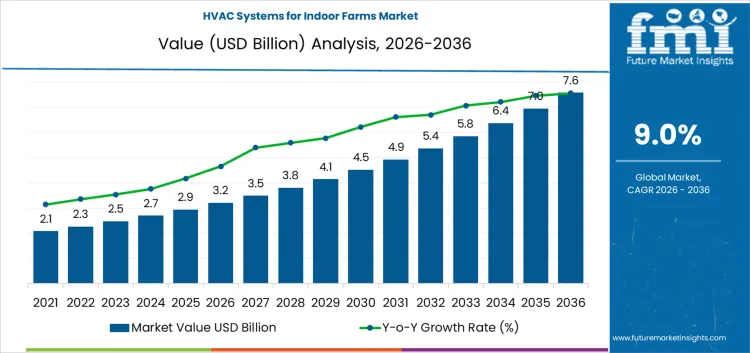
The HVAC systems for indoor farms market is valued at USD 3.2 billion in 2026 and is projected to reach USD 7.6 billion by 2036, reflecting a CAGR of 9%. Early demand is driven by the engineering requirements of enclosed growing environments rather than by general construction activity. Temperature, humidity, and airflow targets are written into crop production plans, which fixes equipment sizing and redundancy levels before facilities are built. System selection is tied to operating cost exposure, failure tolerance, and service access. Buyers favor integrated climate packages that reduce commissioning risk and simplify control system integration across growing zones.
In the later years, market behavior reflects the operational maturity of indoor farming operators. Expansion decisions depend on yield consistency, energy contract terms, and maintenance staffing rather than on short term crop pricing. Retrofit projects grow as first generation facilities are rebalanced for different crops or density targets. Supplier lists remain narrow because climate systems are central to production reliability. Pricing remains under pressure from energy efficiency targets and capital budget discipline. Capacity growth follows regional clustering of indoor farms and utility availability, supporting steady expansion without abrupt shifts in procurement patterns.
Quick Stats of the HVAC Systems for Indoor Farms Market
- HVAC Systems for Indoor Farms Market Value (2026): USD 3.2 billion
- HVAC Systems for Indoor Farms Forecast Value (2036): USD 7.6 billion
- HVAC Systems for Indoor Farms Forecast CAGR 2026 to 2036: 9.0%
- Leading System Type in HVAC Systems for Indoor Farms Market: Dehumidification Systems (36 % share)
- Leading Facility Scale in HVAC Systems for Indoor Farms Market: Small (<2,000 m²) facilities (22 % share)
- Key Growth Regions in HVAC Systems for Indoor Farms Market: India, China, USA, Germany, Japan
- Top Players in HVAC Systems for Indoor Farms Market: Daikin, Carrier, Johnson Controls, Trane Technologies, Munters, Condair, STULZ, Vertiv, Danfoss, Honeywell
What is the Growth Forecast for HVAC Systems for Indoor Farms Market through 2036?
Between 2026 and 2031, the HVAC systems for indoor farms market is projected to expand from USD 3.2 billion along a growth path consistent with a 9% CAGR, driven by the realization that climate control is the primary operating cost and yield risk in closed growing environments. Unlike conventional greenhouses, indoor farms must actively manage humidity, temperature, and air movement at all times, which makes dehumidification and heat management core production assets rather than building services. System selection is therefore tied to crop density, lighting load, and water transpiration rates. Early projects focus on stabilizing operating conditions and energy balance, pushing investment toward integrated, purpose-built systems specified at the facility design stage.
From 2031 to 2036, the market is expected to reach USD 7.6 billion, with growth shaped by facility scaling and operational optimization rather than by experimentation. Larger farms and multi-site operators begin to standardize mechanical layouts, which increases equipment volumes per project even as design diversity narrows. Heat recovery and advanced control systems gain importance because energy costs become the main constraint on profitability. Purchasing shifts toward EPC and design-build models that bundle HVAC into the core production infrastructure. Competitive positioning depends on system engineering depth, commissioning capability, and long-term service support, favoring suppliers such as Daikin, Carrier, Johnson Controls, Trane Technologies, Munters, Condair, STULZ, Vertiv, Danfoss, and Honeywell.
HVAC Systems for Indoor Farms Market Key Takeaways
| Metric | Value |
|---|---|
| Market Value (2026) | USD 3.2 billion |
| Forecast Value (2036) | USD 7.6 billion |
| Forecast CAGR 2026 to 2036 | 9.0% |
How Are HVAC Systems Enhancing Indoor Farm Productivity?
HVAC systems for indoor farms are increasingly adopted to regulate temperature, humidity, and air quality, ensuring optimal growth conditions for controlled-environment agriculture. Historically, indoor farming relied on basic ventilation and heating systems, which often resulted in uneven climate control, crop stress, and reduced yields. Modern HVAC solutions integrate precision sensors, automated climate control, and energy-efficient components to maintain stable conditions, improve air circulation, and reduce operational costs. Indoor farm operators, vertical farming companies, and greenhouse suppliers prioritize system reliability, energy efficiency, and integration with monitoring platforms. Early adoption focused on high-value crops and research facilities, while current demand spans commercial vertical farms, hydroponic operations, and large-scale greenhouses, driven by yield optimization, climate control precision, and operational efficiency. System scalability, control accuracy, and energy efficiency influence supplier selection.
Rising adoption of indoor farming, climate variability, and sustainability objectives are shaping market growth. Compared with conventional ventilation systems, modern HVAC solutions emphasize precise environmental regulation, energy savings, and integration with automated farm management systems. Cost structures depend on system design, component quality, and control software, concentrating margins among suppliers capable of delivering reliable, high-performance solutions. Operators adopt these HVAC systems to optimize growth conditions, reduce energy consumption, and maintain consistent crop quality. By 2036, advanced HVAC systems are expected to become standard in indoor farming operations, supporting efficient, high-yield, and climate-controlled agriculture globally.
What Factors Are Shaping the Demand for HVAC Systems for Indoor Farms by System Function and Facility Scale in 2026?
The HVAC systems for indoor farms market in 2026 is segmented by system type and by facility scale. By system function, demand is divided into dehumidification systems, chilled water HVAC, DX or VRF systems, and other configurations that manage heat, moisture, and air circulation. By facility scale, demand is organized around small, mid sized, large, and other farm footprints that impose different load profiles and redundancy needs. These segments reflect how growers design climate control around crop transpiration rates, lighting heat loads, and failure tolerance while aligning capital budgets, operating cost exposure, and maintenance capabilities with the size and complexity of their production sites.
Why Do Dehumidification Systems Lead System Selection in Indoor Farms?
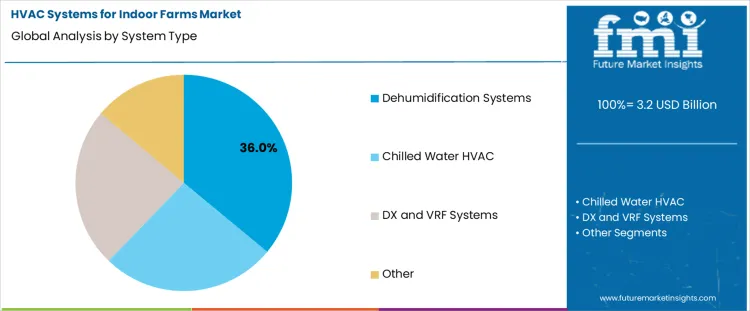
Dehumidification systems account for about 36% of demand in 2026, reflecting the central role of moisture control in enclosed cultivation environments. Plant transpiration releases large volumes of water vapor, and without active removal, humidity quickly reaches levels that promote disease and reduce yield consistency. Unlike temperature, humidity cannot be managed effectively through simple ventilation in sealed facilities designed for energy efficiency. Dedicated dehumidifiers allow growers to decouple moisture control from cooling, which improves stability across day and night cycles. Their modular nature also supports incremental capacity additions as facilities expand. This focus on moisture as the primary risk variable keeps dehumidification systems as the first specification in many indoor farm HVAC designs.
Chilled water and DX or VRF systems address broader thermal management rather than moisture alone. Chilled water plants suit larger facilities where centralized equipment can achieve better efficiency and redundancy, though they require higher upfront investment and technical oversight. DX and VRF systems offer packaged or semi modular solutions that simplify installation in smaller or retrofit sites. Their selection depends on local power costs, heat rejection options, and engineering resources. Many projects combine these systems with dedicated dehumidification rather than relying on them alone for moisture control. This layered approach limits the share of each general cooling system type when counted independently against the more narrowly defined dehumidification category.
Why Do Small Facilities Represent the Largest Share by Site Count?
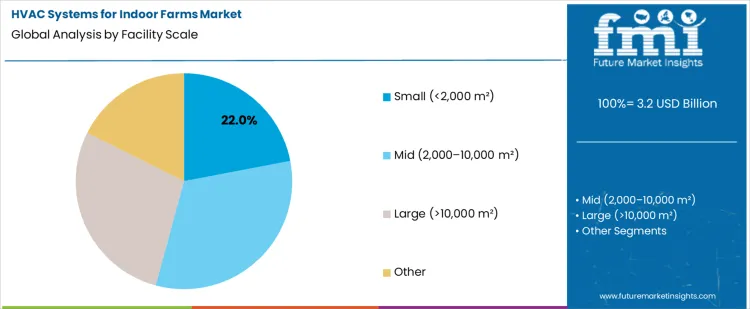
Small facilities under 2,000 square meters represent about 22% of demand in 2026 because they dominate new project counts and pilot scale deployments. Many indoor farming ventures begin with limited footprints to validate crop models, sales channels, and operating procedures before committing to larger investments. These sites favor simpler, modular HVAC solutions that can be installed quickly and adjusted as processes evolve. Financing constraints also push early stage operators toward smaller builds, which multiplies the number of projects even if each consumes less equipment. This pattern makes small facilities disproportionately visible in unit demand statistics, even though their individual system capacities remain well below those of mid sized or large production centers.
Mid sized and large facilities account for greater installed capacity per site but appear less frequently in project counts. These operations require more complex engineering, longer permitting cycles, and higher capital commitments, which slows the pace of new builds. Their HVAC designs emphasize redundancy, energy optimization, and centralized control, which reduces the number of discrete systems installed per square meter. Expansion often occurs through scaling existing sites rather than launching new locations. As a result, while large facilities consume substantial equipment value, the market remains numerically anchored by smaller installations that enter operation in greater numbers each year across different regions and crop categories.
Why Are Crop Consistency Requirements and Year Round Production Models Driving HVAC Investment in Indoor Farms through 2036?
Demand is built around risk control rather than simple capacity expansion. Indoor farms sell predictability, and temperature, humidity, and airflow stability determine crop quality more than lighting alone. Even small deviations can alter growth rates or trigger disease, which directly affects revenue. As farms move toward contract supply with retailers and food processors, tolerance for variability shrinks further. Multi layer growing rooms and dense plant loading also increase latent heat and moisture loads that cannot be managed with standard equipment. HVAC becomes the backbone of the production process, not a building service, which keeps spending tied to output reliability and schedule commitments.
What Energy Cost Exposure and Capital Intensity Are Slowing Large Scale Deployment of These Systems?
The main restraint is operating economics. HVAC is often the largest energy consumer in an indoor farm, and electricity pricing volatility creates margin risk. High capacity dehumidification, air handling, and redundancy requirements drive capital cost well above conventional commercial systems. Many projects struggle to secure financing because payback depends on long term yield assumptions rather than simple square meter utilization. System oversizing to protect crops further raises cost and reduces utilization efficiency. In some regions, grid constraints or demand charges limit expansion plans. These factors narrow the set of viable projects and slow the pace of new facility announcements.
How Are Farm Design Philosophies and Control Integration Changing the Structure of Climate Control Systems?
Change is coming from how farms are engineered. Facilities are moving away from single large climate zones toward multiple controlled cells, which allows crop specific tuning but increases system complexity. Integration between HVAC, irrigation, and lighting control is tightening, so climate equipment is selected as part of a coordinated production platform. Some operators favor modular units to scale capacity gradually, while others design for centralized plants to simplify maintenance. Heat recovery and air recirculation strategies are also becoming more important as energy costs rise. The category is evolving into a tightly coupled production system rather than a standalone building utility.
What is the Demand for HVAC Systems for Indoor Farms by Country?
| Country | CAGR (%) |
|---|---|
| India | 11.0% |
| China | 10.6% |
| USA | 7.0% |
| Germany | 6.2% |
| Japan | 5.6% |
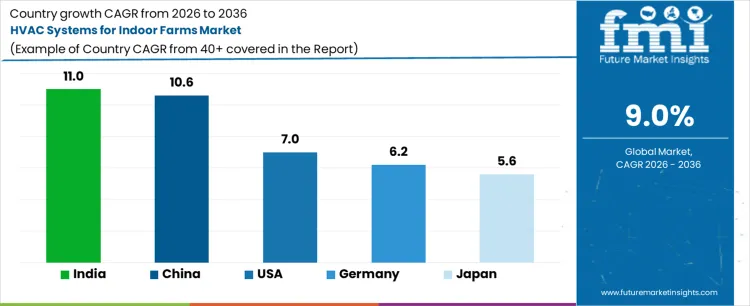
Demand for HVAC systems for indoor farms is rising as controlled-environment agriculture expands to optimize temperature, humidity, and air quality for enhanced crop yield and quality. India leads with an 11.0% CAGR, driven by rapid adoption of vertical farming, greenhouse cultivation, and increasing investment in climate-controlled agriculture. China follows at 10.6%, supported by large-scale indoor farming projects, government incentives, and technological integration. The USA grows at 7.0%, shaped by adoption in urban farming, greenhouse operations, and high-value crop production. Germany records 6.2% growth, reflecting steady modernization of indoor farming facilities. Japan shows 5.6% CAGR, influenced by moderate expansion of climate-controlled agriculture and adoption of advanced HVAC systems.
How is India experiencing growth in the HVAC systems for indoor farms market?
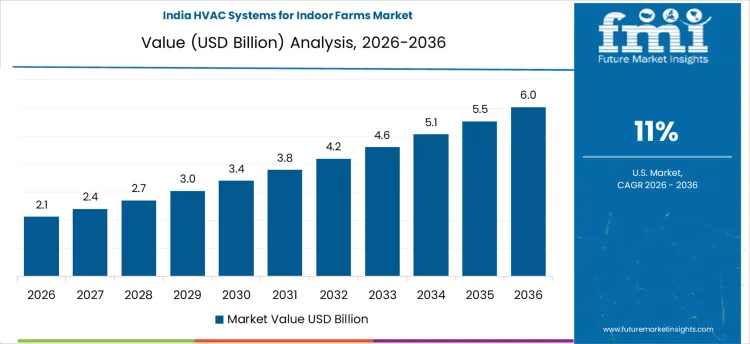
India is experiencing growth at a CAGR of 11%, supported by adoption of HVAC systems for indoor farms market solutions to enhance climate control, plant growth efficiency, and operational reliability in controlled-environment agriculture. Manufacturers and suppliers are producing HVAC systems optimized for temperature stability, energy efficiency, and integration with indoor farming facilities. Demand is concentrated in greenhouse farms, vertical farming units, and agri-tech R&D centers. Investments focus on system performance, material durability, and compliance with agricultural and energy standards rather than large-scale deployment. Growth reflects rising adoption of indoor farming, industrial focus on energy-efficient climate control, and increasing demand for high crop yields.
- Climate control drives adoption.
- HVAC systems optimize temperature stability and energy efficiency.
- Greenhouses and vertical farms concentrate demand.
- System performance and compliance guide investment.
How is China witnessing growth in the HVAC systems for indoor farms market?
China is witnessing growth at a CAGR of 10.6%, fueled by adoption of HVAC systems for indoor farms market solutions to improve climate regulation, plant productivity, and operational efficiency. Manufacturers and suppliers are deploying HVAC systems optimized for temperature uniformity, durability, and compatibility with indoor agricultural setups. Demand is concentrated in greenhouse farms, indoor cultivation facilities, and R&D centers. Investments prioritize energy efficiency, system reliability, and adherence to agricultural and environmental standards rather than fleet-scale deployment. Growth reflects industrial adoption of modern indoor farming practices and focus on high-yield production.
- Climate regulation drives adoption.
- HVAC systems enhance temperature uniformity and energy efficiency.
- Greenhouses and indoor farms concentrate demand.
- Energy efficiency and standards compliance guide investment.
How is the United States experiencing growth in the HVAC systems for indoor farms market?
United States is experiencing growth at a CAGR of 7%, supported by adoption of HVAC systems for indoor farms market solutions to improve environmental control, operational reliability, and plant growth in indoor agricultural facilities. Manufacturers and suppliers are producing systems optimized for temperature consistency, energy efficiency, and integration with greenhouse and vertical farm infrastructure. Demand is concentrated in indoor farming hubs, commercial greenhouse operations, and agri-tech R&D centers. Investments focus on system durability, material quality, and compliance with energy and agricultural standards rather than large-scale deployment. Growth reflects industrial adoption of modern climate control systems and focus on efficient indoor farming.
- Environmental control drives adoption.
- HVAC systems optimize temperature consistency and energy efficiency.
- Indoor farms and greenhouses concentrate demand.
- System durability and compliance guide investment.
How is Germany witnessing growth in the HVAC systems for indoor farms market?
Germany is witnessing growth at a CAGR of 6.2%, fueled by adoption of HVAC systems for indoor farms market solutions to enhance climate control, plant productivity, and energy efficiency in controlled-environment agriculture. Manufacturers and suppliers are deploying HVAC systems optimized for temperature regulation, durability, and integration with indoor farm facilities. Demand is concentrated in greenhouse farms, indoor cultivation centers, and agri-tech R&D hubs. Investments prioritize system performance, energy efficiency, and adherence to agricultural and environmental standards rather than fleet-scale deployment. Growth reflects industrial adoption of indoor farming practices and focus on energy-efficient climate management.
- Climate control drives adoption.
- HVAC systems optimize temperature regulation and energy efficiency.
- Greenhouses and indoor farms concentrate demand.
- System performance and compliance guide investment.
How is Japan experiencing growth in the HVAC systems for indoor farms market?
Japan is experiencing growth at a CAGR of 5.6%, supported by adoption of HVAC systems for indoor farms market solutions to improve plant growth, environmental control, and energy efficiency in indoor agricultural systems. Manufacturers and suppliers are producing HVAC systems optimized for temperature stability, durability, and integration with greenhouse and vertical farm operations. Demand is concentrated in indoor farming hubs, R&D centers, and greenhouse facilities. Investments focus on system reliability, material performance, and compliance with agricultural and energy standards rather than large-scale deployment. Growth reflects moderate expansion of indoor farming, industrial adoption of climate control systems, and focus on operational efficiency.
- Plant growth drives adoption.
- HVAC systems enhance temperature stability and energy efficiency.
- Indoor farms and R&D centers concentrate demand.
- System reliability and compliance guide investment.
Who Competes in the HVAC Systems for Indoor Farms Market and What Defines Their Capabilities?
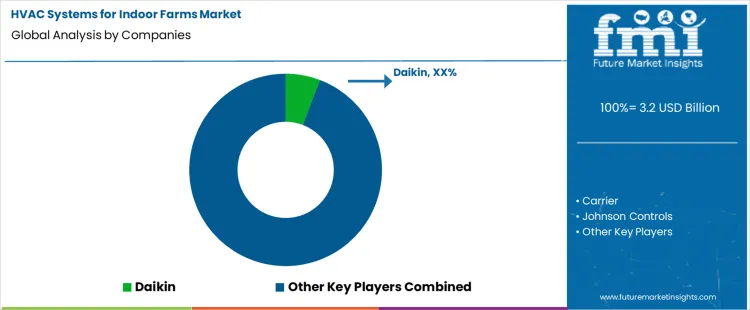
Competition in the HVAC systems for indoor farms market is defined by climate control precision, energy efficiency, and integration with automated cultivation systems. Daikin supplies HVAC solutions engineered for precise temperature, humidity, and airflow control in controlled-environment agriculture. Carrier develops climate systems optimized for multi-zone environmental management and energy efficiency in indoor farming operations. Johnson Controls provides HVAC systems integrating temperature, humidity, and CO₂ regulation with smart monitoring for plant growth optimization. Trane Technologies delivers modular climate solutions designed for precise control and scalability in vertical farms. Munters focuses on dehumidification and energy-efficient airflow management for controlled cultivation environments.
Condair supplies HVAC systems with advanced humidification and environmental control tailored for indoor farming. STULZ delivers compact, energy-efficient HVAC units for multi-tier cultivation systems. Vertiv provides integrated cooling and airflow solutions for indoor farms with high-density lighting setups. Danfoss develops HVAC systems optimized for energy efficiency and process control in horticultural applications. Honeywell offers environmental management systems combining HVAC control with monitoring and automation interfaces. Other regional and specialty suppliers focus on energy efficiency, modularity, and precise climate regulation. Competitive differentiation arises from environmental precision, energy efficiency, system integration, scalability, and reliability under continuous indoor farming operations.
Key Players in the HVAC Systems for Indoor Farms Market
- Daikin
- Carrier
- Johnson Controls
- Trane Technologies
- Munters
- Condair
- STULZ
- Vertiv
- Danfoss
- Honeywell
Scope of the Report
| Items | Values |
|---|---|
| Quantitative Units (2026) | USD billion |
| System Type | Dehumidification Systems, Chilled Water HVAC, DX/VRF Systems, Other |
| Facility Scale | Small (<2,000 m²), Mid (2,000-10,000 m²), Large (>10,000 m²), Other |
| Efficiency Feature | Heat Recovery, Integrated Controls, Desiccant Dehumidification, Other |
| Sales Channel | EPC/Design-Build, HVAC Contractors, OEM Direct, Other |
| Regions Covered | Asia Pacific, Europe, North America, Latin America, Middle East & Africa |
| Countries Covered | China, Japan, South Korea, India, Australia & New Zealand, ASEAN, Germany, United Kingdom, France, Italy, Spain, Nordic, BENELUX, United States, Canada, Mexico, Brazil, Chile, Saudi Arabia, Turkey, South Africa, and other regional markets |
| Key Companies Profiled | Daikin, Carrier, Johnson Controls, Trane Technologies, Munters, Condair, STULZ, Vertiv, Danfoss, Honeywell |
| Additional Attributes | Dollar sales by system type, facility scale, efficiency feature, and sales channel, demand driven by indoor farm engineering requirements rather than general construction cycles, climate systems specified at facility design stage based on crop plans and failure tolerance, dehumidification as the primary load driver due to plant transpiration, HVAC treated as core production infrastructure rather than building utility, procurement concentrated through EPC and design-build models, value growth linked to farm scaling, heat recovery adoption, and tighter integration with lighting and irrigation control systems, and regional deployment aligned with indoor farm clustering and utility availability. |
HVAC Systems for Indoor Farms Market Segmentation
System Type:
- Dehumidification Systems
- Chilled Water HVAC
- DX/VRF Systems
- Other
Facility Scale:
- Small (<2,000 m²)
- Mid (2,000-10,000 m²)
- Large (>10,000 m²)
- Other
Efficiency Feature:
- Heat Recovery
- Integrated Controls
- Desiccant Dehumidification
- Other
Sales Channel:
- EPC/Design-Build
- HVAC Contractors
- OEM Direct
- Other
Region
- Asia Pacific
- China
- Japan
- South Korea
- India
- Australia & New Zealand
- ASEAN
- Rest of Asia Pacific
- Europe
- Germany
- United Kingdom
- France
- Italy
- Spain
- Nordic
- BENELUX
- Rest of Europe
- North America
- United States
- Canada
- Mexico
- Latin America
- Brazil
- Chile
- Rest of Latin America
- Middle East & Africa
- Kingdom of Saudi Arabia
- Other GCC Countries
- Turkey
- South Africa
- Other African Union
- Rest of Middle East & Africa
Bibliography
- American Society of Heating, Refrigerating and Air-Conditioning Engineers. (2024). ASHRAE Standard 62.1 - Ventilation for acceptable indoor air quality. ASHRAE.
- European Commission. (2024). Regulation (EU) 2016/2281 on the energy performance of buildings and HVAC equipment. Official Journal of the European Union.
- United States Department of Energy. (2024). Energy conservation standards for commercial HVAC systems. USA Department of Energy.
- Food and Agriculture Organization of the United Nations. (2024). Controlled environment agriculture and indoor farming systems. FAO.
- USA Environmental Protection Agency. (2024). ENERGY STAR certified HVAC specification and guidance. USA Environmental Protection Agency.
Frequently Asked Questions
How big is the hvac systems for indoor farms market in 2026?
The global hvac systems for indoor farms market is estimated to be valued at USD 3.2 billion in 2026.
What will be the size of hvac systems for indoor farms market in 2036?
The market size for the hvac systems for indoor farms market is projected to reach USD 7.6 billion by 2036.
How much will be the hvac systems for indoor farms market growth between 2026 and 2036?
The hvac systems for indoor farms market is expected to grow at a 9.0% CAGR between 2026 and 2036.
What are the key product types in the hvac systems for indoor farms market?
The key product types in hvac systems for indoor farms market are dehumidification systems, chilled water hvac, dx and vrf systems and other.
Which facility scale segment to contribute significant share in the hvac systems for indoor farms market in 2026?
In terms of facility scale, small (<2,000 m²) segment to command 22.0% share in the hvac systems for indoor farms market in 2026.
Preview the report firsthand - request a free sample
Get SampleGet the brochure for pricing and purchase details.
Get PDFTable of Content
- Executive Summary
- Global Market Outlook
- Demand-side Trends
- Supply-side Trends
- Technology Roadmap Analysis
- Analysis and Recommendations
- Market Overview
- Market Coverage / Taxonomy
- Market Definition / Scope / Limitations
- Market Background
- Market Dynamics
- Drivers
- Restraints
- Opportunity
- Trends
- Scenario Forecast
- Demand in Optimistic Scenario
- Demand in Likely Scenario
- Demand in Conservative Scenario
- Opportunity Map Analysis
- Product Life Cycle Analysis
- Supply Chain Analysis
- Investment Feasibility Matrix
- Value Chain Analysis
- PESTLE and Porter’s Analysis
- Regulatory Landscape
- Regional Parent Market Outlook
- Production and Consumption Statistics
- Import and Export Statistics
- Market Dynamics
- Global Market Analysis 2021 to 2025 and Forecast, 2026 to 2036
- Historical Market Size Value (USD Million) Analysis, 2021 to 2025
- Current and Future Market Size Value (USD Million) Projections, 2026 to 2036
- Y-o-Y Growth Trend Analysis
- Absolute $ Opportunity Analysis
- Global Market Pricing Analysis 2021 to 2025 and Forecast 2026 to 2036
- Global Market Analysis 2021 to 2025 and Forecast 2026 to 2036, By System Type
- Introduction / Key Findings
- Historical Market Size Value (USD Million) Analysis By System Type , 2021 to 2025
- Current and Future Market Size Value (USD Million) Analysis and Forecast By System Type , 2026 to 2036
- Dehumidification Systems
- Chilled Water HVAC
- DX and VRF Systems
- Other
- Dehumidification Systems
- Y-o-Y Growth Trend Analysis By System Type , 2021 to 2025
- Absolute $ Opportunity Analysis By System Type , 2026 to 2036
- Global Market Analysis 2021 to 2025 and Forecast 2026 to 2036, By Facility Scale
- Introduction / Key Findings
- Historical Market Size Value (USD Million) Analysis By Facility Scale, 2021 to 2025
- Current and Future Market Size Value (USD Million) Analysis and Forecast By Facility Scale, 2026 to 2036
- Small (<2,000 m²)
- Mid (2,000–10,000 m²)
- Large (>10,000 m²)
- Other
- Small (<2,000 m²)
- Y-o-Y Growth Trend Analysis By Facility Scale, 2021 to 2025
- Absolute $ Opportunity Analysis By Facility Scale, 2026 to 2036
- Global Market Analysis 2021 to 2025 and Forecast 2026 to 2036, By Efficiency Feature
- Introduction / Key Findings
- Historical Market Size Value (USD Million) Analysis By Efficiency Feature, 2021 to 2025
- Current and Future Market Size Value (USD Million) Analysis and Forecast By Efficiency Feature, 2026 to 2036
- Heat Recovery
- Integrated Controls
- Desiccant Dehumidification
- Other
- Heat Recovery
- Y-o-Y Growth Trend Analysis By Efficiency Feature, 2021 to 2025
- Absolute $ Opportunity Analysis By Efficiency Feature, 2026 to 2036
- Global Market Analysis 2021 to 2025 and Forecast 2026 to 2036, By Sales Channel
- Introduction / Key Findings
- Historical Market Size Value (USD Million) Analysis By Sales Channel, 2021 to 2025
- Current and Future Market Size Value (USD Million) Analysis and Forecast By Sales Channel, 2026 to 2036
- EPC and Design-Build
- HVAC Contractors
- OEM Direct
- Other
- EPC and Design-Build
- Y-o-Y Growth Trend Analysis By Sales Channel, 2021 to 2025
- Absolute $ Opportunity Analysis By Sales Channel, 2026 to 2036
- Global Market Analysis 2021 to 2025 and Forecast 2026 to 2036, By Region
- Introduction
- Historical Market Size Value (USD Million) Analysis By Region, 2021 to 2025
- Current Market Size Value (USD Million) Analysis and Forecast By Region, 2026 to 2036
- North America
- Latin America
- Western Europe
- Eastern Europe
- East Asia
- South Asia and Pacific
- Middle East & Africa
- Market Attractiveness Analysis By Region
- North America Market Analysis 2021 to 2025 and Forecast 2026 to 2036, By Country
- Historical Market Size Value (USD Million) Trend Analysis By Market Taxonomy, 2021 to 2025
- Market Size Value (USD Million) Forecast By Market Taxonomy, 2026 to 2036
- By Country
- USA
- Canada
- Mexico
- By System Type
- By Facility Scale
- By Efficiency Feature
- By Sales Channel
- By Country
- Market Attractiveness Analysis
- By Country
- By System Type
- By Facility Scale
- By Efficiency Feature
- By Sales Channel
- Key Takeaways
- Latin America Market Analysis 2021 to 2025 and Forecast 2026 to 2036, By Country
- Historical Market Size Value (USD Million) Trend Analysis By Market Taxonomy, 2021 to 2025
- Market Size Value (USD Million) Forecast By Market Taxonomy, 2026 to 2036
- By Country
- Brazil
- Chile
- Rest of Latin America
- By System Type
- By Facility Scale
- By Efficiency Feature
- By Sales Channel
- By Country
- Market Attractiveness Analysis
- By Country
- By System Type
- By Facility Scale
- By Efficiency Feature
- By Sales Channel
- Key Takeaways
- Western Europe Market Analysis 2021 to 2025 and Forecast 2026 to 2036, By Country
- Historical Market Size Value (USD Million) Trend Analysis By Market Taxonomy, 2021 to 2025
- Market Size Value (USD Million) Forecast By Market Taxonomy, 2026 to 2036
- By Country
- Germany
- UK
- Italy
- Spain
- France
- Nordic
- BENELUX
- Rest of Western Europe
- By System Type
- By Facility Scale
- By Efficiency Feature
- By Sales Channel
- By Country
- Market Attractiveness Analysis
- By Country
- By System Type
- By Facility Scale
- By Efficiency Feature
- By Sales Channel
- Key Takeaways
- Eastern Europe Market Analysis 2021 to 2025 and Forecast 2026 to 2036, By Country
- Historical Market Size Value (USD Million) Trend Analysis By Market Taxonomy, 2021 to 2025
- Market Size Value (USD Million) Forecast By Market Taxonomy, 2026 to 2036
- By Country
- Russia
- Poland
- Hungary
- Balkan & Baltic
- Rest of Eastern Europe
- By System Type
- By Facility Scale
- By Efficiency Feature
- By Sales Channel
- By Country
- Market Attractiveness Analysis
- By Country
- By System Type
- By Facility Scale
- By Efficiency Feature
- By Sales Channel
- Key Takeaways
- East Asia Market Analysis 2021 to 2025 and Forecast 2026 to 2036, By Country
- Historical Market Size Value (USD Million) Trend Analysis By Market Taxonomy, 2021 to 2025
- Market Size Value (USD Million) Forecast By Market Taxonomy, 2026 to 2036
- By Country
- China
- Japan
- South Korea
- By System Type
- By Facility Scale
- By Efficiency Feature
- By Sales Channel
- By Country
- Market Attractiveness Analysis
- By Country
- By System Type
- By Facility Scale
- By Efficiency Feature
- By Sales Channel
- Key Takeaways
- South Asia and Pacific Market Analysis 2021 to 2025 and Forecast 2026 to 2036, By Country
- Historical Market Size Value (USD Million) Trend Analysis By Market Taxonomy, 2021 to 2025
- Market Size Value (USD Million) Forecast By Market Taxonomy, 2026 to 2036
- By Country
- India
- ASEAN
- Australia & New Zealand
- Rest of South Asia and Pacific
- By System Type
- By Facility Scale
- By Efficiency Feature
- By Sales Channel
- By Country
- Market Attractiveness Analysis
- By Country
- By System Type
- By Facility Scale
- By Efficiency Feature
- By Sales Channel
- Key Takeaways
- Middle East & Africa Market Analysis 2021 to 2025 and Forecast 2026 to 2036, By Country
- Historical Market Size Value (USD Million) Trend Analysis By Market Taxonomy, 2021 to 2025
- Market Size Value (USD Million) Forecast By Market Taxonomy, 2026 to 2036
- By Country
- Kingdom of Saudi Arabia
- Other GCC Countries
- Turkiye
- South Africa
- Other African Union
- Rest of Middle East & Africa
- By System Type
- By Facility Scale
- By Efficiency Feature
- By Sales Channel
- By Country
- Market Attractiveness Analysis
- By Country
- By System Type
- By Facility Scale
- By Efficiency Feature
- By Sales Channel
- Key Takeaways
- Key Countries Market Analysis
- USA
- Pricing Analysis
- Market Share Analysis, 2025
- By System Type
- By Facility Scale
- By Efficiency Feature
- By Sales Channel
- Canada
- Pricing Analysis
- Market Share Analysis, 2025
- By System Type
- By Facility Scale
- By Efficiency Feature
- By Sales Channel
- Mexico
- Pricing Analysis
- Market Share Analysis, 2025
- By System Type
- By Facility Scale
- By Efficiency Feature
- By Sales Channel
- Brazil
- Pricing Analysis
- Market Share Analysis, 2025
- By System Type
- By Facility Scale
- By Efficiency Feature
- By Sales Channel
- Chile
- Pricing Analysis
- Market Share Analysis, 2025
- By System Type
- By Facility Scale
- By Efficiency Feature
- By Sales Channel
- Germany
- Pricing Analysis
- Market Share Analysis, 2025
- By System Type
- By Facility Scale
- By Efficiency Feature
- By Sales Channel
- UK
- Pricing Analysis
- Market Share Analysis, 2025
- By System Type
- By Facility Scale
- By Efficiency Feature
- By Sales Channel
- Italy
- Pricing Analysis
- Market Share Analysis, 2025
- By System Type
- By Facility Scale
- By Efficiency Feature
- By Sales Channel
- Spain
- Pricing Analysis
- Market Share Analysis, 2025
- By System Type
- By Facility Scale
- By Efficiency Feature
- By Sales Channel
- France
- Pricing Analysis
- Market Share Analysis, 2025
- By System Type
- By Facility Scale
- By Efficiency Feature
- By Sales Channel
- India
- Pricing Analysis
- Market Share Analysis, 2025
- By System Type
- By Facility Scale
- By Efficiency Feature
- By Sales Channel
- ASEAN
- Pricing Analysis
- Market Share Analysis, 2025
- By System Type
- By Facility Scale
- By Efficiency Feature
- By Sales Channel
- Australia & New Zealand
- Pricing Analysis
- Market Share Analysis, 2025
- By System Type
- By Facility Scale
- By Efficiency Feature
- By Sales Channel
- China
- Pricing Analysis
- Market Share Analysis, 2025
- By System Type
- By Facility Scale
- By Efficiency Feature
- By Sales Channel
- Japan
- Pricing Analysis
- Market Share Analysis, 2025
- By System Type
- By Facility Scale
- By Efficiency Feature
- By Sales Channel
- South Korea
- Pricing Analysis
- Market Share Analysis, 2025
- By System Type
- By Facility Scale
- By Efficiency Feature
- By Sales Channel
- Russia
- Pricing Analysis
- Market Share Analysis, 2025
- By System Type
- By Facility Scale
- By Efficiency Feature
- By Sales Channel
- Poland
- Pricing Analysis
- Market Share Analysis, 2025
- By System Type
- By Facility Scale
- By Efficiency Feature
- By Sales Channel
- Hungary
- Pricing Analysis
- Market Share Analysis, 2025
- By System Type
- By Facility Scale
- By Efficiency Feature
- By Sales Channel
- Kingdom of Saudi Arabia
- Pricing Analysis
- Market Share Analysis, 2025
- By System Type
- By Facility Scale
- By Efficiency Feature
- By Sales Channel
- Turkiye
- Pricing Analysis
- Market Share Analysis, 2025
- By System Type
- By Facility Scale
- By Efficiency Feature
- By Sales Channel
- South Africa
- Pricing Analysis
- Market Share Analysis, 2025
- By System Type
- By Facility Scale
- By Efficiency Feature
- By Sales Channel
- USA
- Market Structure Analysis
- Competition Dashboard
- Competition Benchmarking
- Market Share Analysis of Top Players
- By Regional
- By System Type
- By Facility Scale
- By Efficiency Feature
- By Sales Channel
- Competition Analysis
- Competition Deep Dive
- Daikin
- Overview
- Product Portfolio
- Profitability by Market Segments (Product/Age /Sales Channel/Region)
- Sales Footprint
- Strategy Overview
- Marketing Strategy
- Product Strategy
- Channel Strategy
- Carrier
- Johnson Controls
- Trane Technologies
- Munters
- Condair
- STULZ
- Vertiv
- Danfoss
- Honeywell
- Daikin
- Competition Deep Dive
- Assumptions & Acronyms Used
- Research Methodology


