

- Market Size (2026)
- USD 210.0 Mn
- Forecast (2036)
- USD 470.0 Mn
- CAGR (2026 to 2036)
- 8.4%
Indoor Leafy Green Precision Nutrition Program Market Forecast and Outlook By FMI
Summary of the Indoor Leafy Green Precision Nutrition Program Market
- Demand and Growth Drivers
- Retail channels are likely to support demand for indoor leafy green precision nutrition programs as growers need tighter control over color, texture, and harvest timing.
- Hydroponic leafy green production is likely to remain a core growth engine as nutrient drift can quickly reduce output quality in short-cycle crops.
- Food resilience funding and public support for controlled environment agriculture are expected to support adoption during the forecast period.
- Product and Segment View
- Closed-loop recipes are likely to remain a leading program type, supported by demand from recirculating systems that need frequent nutrient correction.
- Lettuce is likely to lead, driven by its large share in indoor harvest schedules and its suitability for repeatable crop-stage monitoring.
- Sensor-linked dosing is anticipated to remain an important control layer as pH and EC feedback reduce manual error across dense indoor production cycles.
- Geography and Competitive Outlook
- Saudi Arabia is expected to remain a key market owing to water stress and interest in recirculating indoor crop systems.
- Singapore is likely to sustain demand on account of hydroponic capability upgrades and the high value placed on each square metre of indoor cultivation.
- Companies that can combine recipe control and root-zone feedback are likely to gain ground during the forecast period.
- Analyst Opinion
- Principal Analyst in Healthcare, Sabyasachi Ghosh, at FMI States, “As indoor farms scale, growers are prioritizing repeatability and real‑time root‑zone feedback across rapid crop cycles. Programs that integrate sensor data with crop‑stage nutrition recipes reduce variability and support consistent retail‑grade output. Competitive advantage increasingly depends on integration depth and ongoing program support instead of static advisory guidance alone.”
- Indoor Leafy Green Precision Nutrition Program Market Value Analysis
- The indoor leafy green precision nutrition program market is moving from advisory-led crop support into a more defined software and control category.
- Adoption is being supported by hydroponic leafy green operations that need stable nutrient delivery across rapid crop cycles.
- The market is also benefiting from the broader buildout of protected cultivation in water-stressed and land-constrained regions.
- Demand is further supported by the need for crop programs that balance output quality, water efficiency, and nutrient discipline.
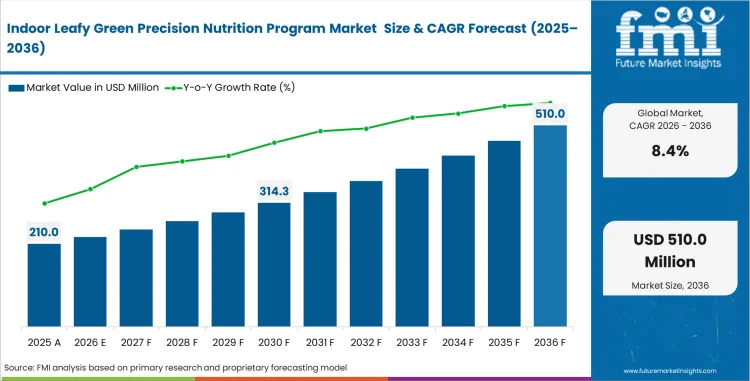
Key Takeaways
- The indoor leafy green precision nutrition program market was valued at USD 190.0 million in 2025.
- By 2036, the indoor leafy green precision nutrition program Market is expected to be worth USD 0.47 billion.
- From 2026 to 2036, the market is projected to expand at a CAGR of 8.4%.
- The market is projected to create an incremental opportunity of USD 260.0 million between 2026 and 2036.
- In 2026, lettuce is expected to account for 41.0% of the crop focus segment, supported by its high turnover in indoor farms.
- Saudi Arabia (9.4% CAGR) and Singapore (9.1% CAGR) are two of the fastest growing markets during the forecast period.
Indoor Leafy Green Precision Nutrition Program Market Definition
The indoor leafy green precision nutrition program market includes paid nutrient programming, crop-stage adjustment routines, root-zone monitoring layers, and linked control tools used for lettuce, spinach, kale, and mixed greens grown under controlled environment agriculture.
Indoor Leafy Green Precision Nutrition Program Market Inclusions
Market scope encompasses all commercially traded precision nutrition programs sold for indoor leafy greens across program type, delivery model, control stack, crop focus, buyer type, and region. The category includes recurring subscriptions, sensor-linked dosing logic, biofortification plans, and crop-specific feed schedules tied to indoor leafy green production from 2026 to 2036.
Indoor Leafy Green Precision Nutrition Program Market Exclusions
The scope does not include greenhouse construction, lighting systems, stand-alone irrigation hardware, generic fertilizers sold without crop programming, or open-field vegetable nutrition services that are not tied to indoor leafy green operations.
Indoor Leafy Green Precision Nutrition Program Market Research Methodology
- Primary Research: FMI analysts reviewed public-agency material on controlled environment agriculture, greenhouse vegetables, hydroponic adoption, and food resilience funding in core countries.
- Desk Research: Supporting evidence included peer-reviewed studies on hydroponic lettuce, kale, and leafy green nutrient management, along with official country agriculture updates.
- Market sizing and forecasting: FMI used a hybrid bottom-up and top-down methodology that linked indoor leafy green area and farm intensity with the spend envelope for nutrient programming and control upgrades.
- Data validation: Cross-checks compared the modeled revenue pool with protected cultivation scale, country policy intensity, and the share of leafy greens within indoor crop production.
Why is the Indoor Leafy Green Precision Nutrition Program Market Growing?
- Indoor farms need repeatable leaf quality for retail and foodservice contracts. Precision nutrition programs support that need because nutrient drift can quickly affect color, texture, and nitrate levels in leafy crops.
- Recirculating hydroponic systems require tighter nutrient correction than soil cultivation. Research on hydroponic lettuce and kale keeps showing that solution balance, oxygen, and system design shape yield and mineral uptake.
- Saudi Arabia leads growth at 9.4% because water scarcity and controlled cultivation policy create a direct use case for recirculating nutrient management.
The market for indoor leafy green precision nutrition programs keeps expanding because soilless farms need better crop consistency and more disciplined use of water and fertilizer. Lettuce remains the largest crop focus segment. Operators use nutrition programs to stabilize harvest timing and reduce quality drift across repeated indoor crop turns. Public support for controlled environment agriculture in the United States, Singapore, and Gulf countries is adding new sites that need standardized nutrition plans from the start.
Market Segmentation Analysis
- Indoor leafy green precision nutrition programs hold a 42.0% leading share in program type through closed-loop recipes that support recirculating operations.
- Lettuce accounts for the largest crop focus share at 41.0% as indoor farms use repeatable feed curves to stabilize high-frequency harvests.
- Annual subscriptions lead delivery, reflecting the recurring adjustment needs that come with cultivar changes and water profile differences.
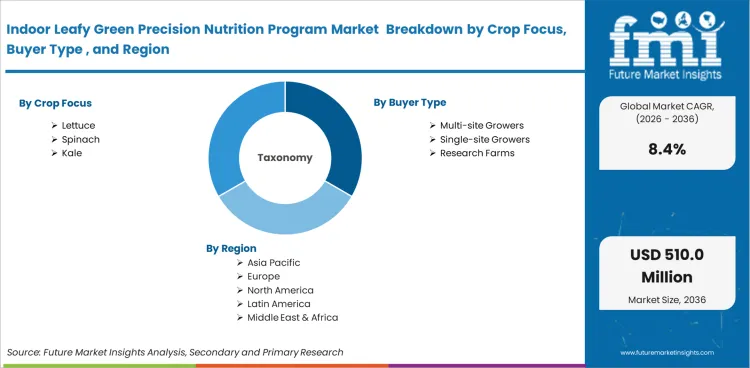
The market for indoor leafy green precision nutrition programs is segmented by program type, delivery model, control stack, crop focus, buyer type, and region. Program structure follows how growers purchase nutrient precision rather than how fertilizer suppliers list raw inputs. Closed-loop recipes, annual subscriptions, and sensor-linked dosing form the commercial core of the category because they connect crop steering with daily operating control.
Indoor Leafy Green Precision Nutrition Program Market Analysis By Crop Focus
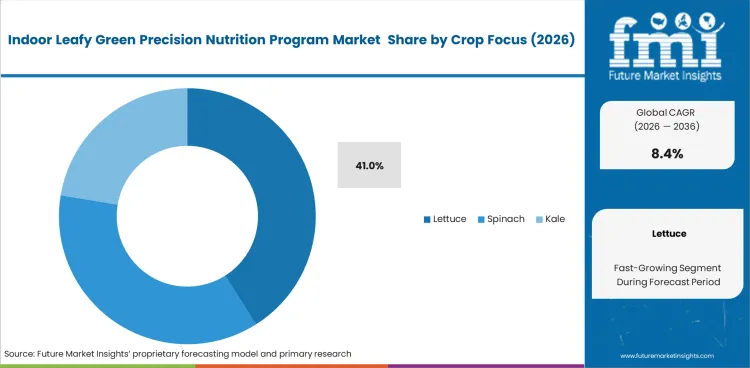
- In 2026, lettuce will make up 41.0% of the market. The largest sub-segment is head lettuce and baby-leaf programs sold into retail salad channels. Precision nutrition improves leaf uniformity and supports tighter nitrate management.
- Spinach and kale programs keep a meaningful role because mineral demand and texture targets differ from lettuce. Mixed green programs remain important for farms serving fresh-cut blends and premium foodservice buyers.
Insights into the Multi-site Grower Buyer Type Segment
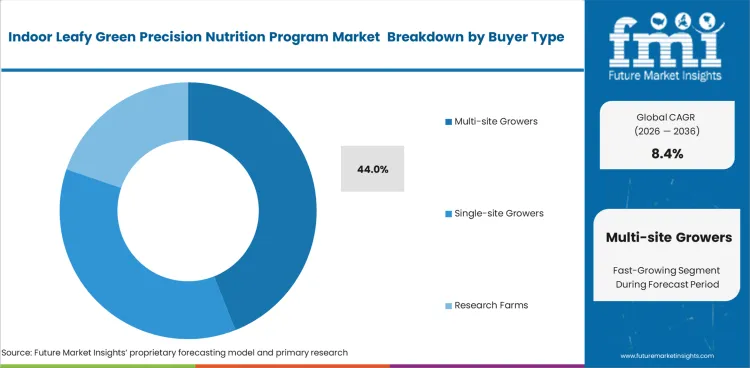
- Multi-site growers are expected to account for 44.0% of buyer type demand in 2026. The leading use case is standardized crop programming across several facilities with different water profiles and staffing conditions.
- Single-site growers still represent an important entry point, while research farms influence pilot work in nitrate control and biofortification routines.
Indoor Leafy Green Precision Nutrition Program Market Drivers, Restraints, and Opportunities
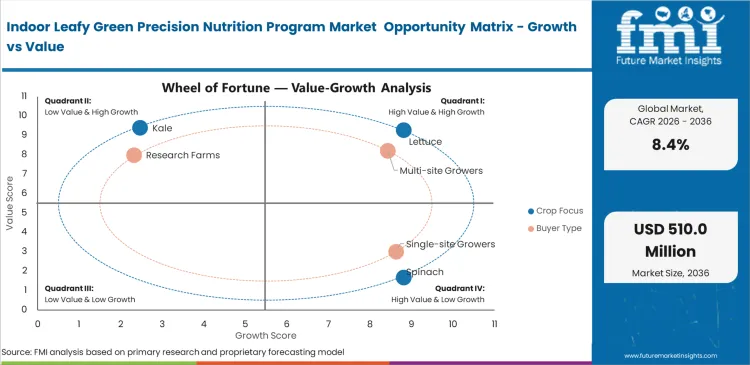
- Retail and foodservice quality standards are creating a structured need for crop recipes that reduce inconsistency across short-cycle indoor harvests.
- High energy costs and limited skilled labor can slow adoption when farms delay premium software or advisory subscriptions during unstable ramp-up periods.
- Water-efficiency goals and biofortified leafy green programs are opening room for higher-value nutrient services that go beyond basic feed schedules.
The market for indoor leafy green precision nutrition programs keeps moving upward because controlled cultivation requires tighter crop steering than field vegetable production. Even with constraints tied to energy cost pressure and uneven farm profitability, the category still offers room for expansion in recirculating hydroponics and public food resilience programs.
Retail-Grade Leaf Consistency
Fresh-cut salad programs and premium grocery shelves reward uniform color, texture, and harvest timing. Precision nutrition supports this requirement by adjusting EC and micronutrient levels at crop stage rather than through one static blend for the full cycle.
Recirculating Hydroponic Nutrient Precision
Recirculating hydroponics gives the category its strongest structural push. Operators must replenish nutrients with more care because crop uptake changes solution chemistry across each crop turn, which makes drain data and root-zone sensing more valuable.
Energy and Labor Cost Pressure
High indoor power costs and limited skilled labor still restrict wider adoption. Farms often delay premium software or advisory contracts when site utilization remains low, so suppliers that show quick payback keep a stronger selling position.
Biofortified Leafy Green Differentiation
Biofortified and functional leafy green programs create an upside for suppliers that can raise micronutrient content without sacrificing yield. Controlled hydroponic systems support that opportunity because nutrient curves can be adjusted more precisely than in open-field production.
Analysis of Indoor Leafy Green Precision Nutrition Program Market By Key Countries
.webp "Top Country Growth Comparison Indoor Leafy Green Precision Nutrition Program Market Cagr (2026 2036)")
| Country | CAGR |
|---|---|
| United States | 8.1% |
| Canada | 8.3% |
| Netherlands | 7.2% |
| Japan | 8.6% |
| Singapore | 9.1% |
| Saudi Arabia | 9.4% |
| United Arab Emirates | 9.0% |
Source: FMI analysis based on public agricultural data, controlled environment agriculture updates, and proprietary forecasting model
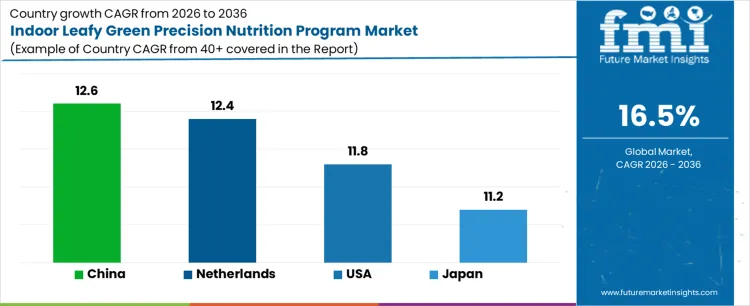
Indoor Leafy Green Precision Nutrition Program Market CAGR Analysis By Country
- Saudi Arabia is rising at a steady 9.4% CAGR as water scarcity and food security policy support recirculating indoor cultivation.
- Singapore at 9.1% CAGR over the forecast period shows strong demand because hydroponic capability funding and land scarcity increase the value of crop precision.
- Japan at 8.6% CAGR and Canada at 8.3% CAGR continue to rise through controlled cultivation know-how and the need for stable year-round crop quality.
- The Netherlands at 7.2% CAGR remains important for revenue and technology reference, though its mature installed base keeps growth below faster-building indoor regions.
The global market for indoor leafy green precision nutrition programs is expected to grow at 8.4% per year from 2026 to 2036. The study covers more than 30 countries, and the main markets are listed below.
Demand Outlook for Indoor Leafy Green Precision Nutrition Program Market in the United States
The U.S. indoor leafy green precision nutrition program market is projected to grow at a CAGR of 8.1% through 2036. This is supported by the scale of hydroponic protected crops and retail channels that value repeatable crop finish.
- Hydroponics support recurring nutrient adjustment.
- Large operators favor annual program contracts.
- Retail quality standards raise the value of recipe control.
Future Outlook for Indoor Leafy Green Precision Nutrition Program Market in Singapore
Singapore indoor leafy green precision nutrition program industry is projected to grow at a CAGR of 9.1% through 2036, supported by the ACT Fund and the high value of each indoor crop cycle in a land-constrained market.
- Public capability funding supports local farm upgrades.
- Hydroponic vegetable systems create direct demand for precision feeding.
- Land scarcity increases the value of crop uniformity.
Opportunity Analysis of Indoor Leafy Green Precision Nutrition Program Market in Saudi Arabia
The Saudi Arabia indoor leafy green precision nutrition program market is anticipated to rise at a CAGR of 9.4% through 2036. This outlook reflects water scarcity, soilless cultivation policy, and the need for nutrient efficiency in protected crop systems.
- Water scarcity supports recirculation and low discharge.
- Public programs highlight plant nutrition and vertical farming.
- Low current penetration leaves room for faster expansion.
In-depth Analysis of Indoor Leafy Green Precision Nutrition Program Market in the Netherlands
Netherlands indoor leafy green precision nutrition program market is estimated to grow at a CAGR of 7.2% during the forecast period. Growth remains slower than in Gulf and Asian markets because advanced nutrient control is already common across high-tech growers, yet Dutch horticulture still shapes global fertigation practice.
- Mature greenhouse systems moderate future growth.
- Dutch science shapes fertigation standards.
- Technology influence remains strong across export markets.
In-depth Analysis of Indoor Leafy Green Precision Nutrition Program Market in Japan
Japan is predicted to expand at a CAGR of 8.6% through 2036. Plant factory know-how, urban land limits, and food safety discipline continue to support indoor crop systems where nutrient precision has a clear role.
- Plant factory know-how supports adoption.
- Urban land limits favor indoor crop density.
- Food safety discipline fits repeatable feeding curves.
Competitive Landscape and Strategic Positioning
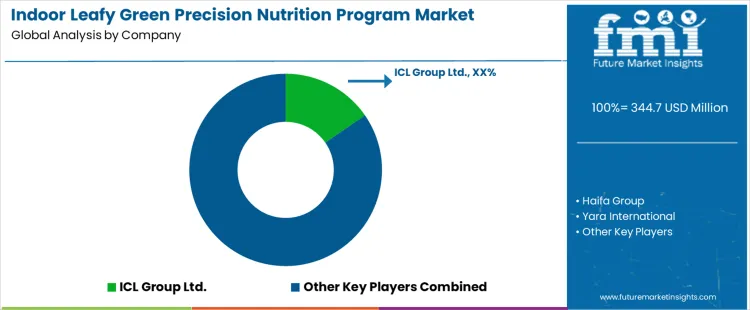
- Priva leads the market comparison because its horticulture stack spans nutrient dosing, irrigation management, greenhouse data integration, and open-platform connections.
- Netafim, Grodan, and Hoogendoorn Growth Management remain important because indoor growers need fertigation discipline and root-zone insight alongside recipe control.
- Analytics specialists such as IUNU add value where plant-response data can improve nutrient decisions and earlier crop intervention.
Competition outlook in the market is driven by recipe accuracy and the ability to embed nutrition programs directly into daily grower workflows. Integrated greenhouse technology providers hold a structural advantage when they can combine dosing and software within one cohesive environment. Partnerships are also critical, as growers increasingly avoid fragmented solutions that split climate and nutrition management across separate systems.
Recent product launches reinforce this trend toward integrated control and analytics. Netafim introduced GrowSphere in 2024 and expanded its positioning with AI‑enabled dosing functions in 2026. Such developments highlight how precision nutrition is evolving from a stand‑alone advisory function into a core layer within broader indoor farming control platforms.
Key Companies in the Indoor Leafy Green Precision Nutrition Program Market
Major Global Players:
- Priva
- Hoogendoorn Growth Management
- Ridder
- Netafim
- Grodan
- Argus Control Systems
- IUNU
Emerging Players/Startups
- Source.ag
- Blue Radix
- 30MHz
- Cultivatd
- Autogrow
Competitive Benchmarking: Indoor Leafy Green Precision Nutrition Program Market
| Company | Leafy recipe control | Fertigation integration | Root-zone feedback | Geographic footprint |
|---|---|---|---|---|
| Priva | High | High | Medium | Global |
| Hoogendoorn Growth Management | High | Medium | Medium | Europe, Global |
| Ridder | Medium | Medium | Medium | Europe |
| Netafim | Medium | High | Low | Global |
| Grodan | Medium | Medium | High | Global |
| Argus Control Systems | Medium | Medium | Medium | North America |
| IUNU | Low | Low | High | North America |
Source: Future Market Insights competitive analysis, 2026.
Key Developments in Indoor Leafy Green Precision Nutrition Program Market
- In June 2024, Ridder and Blue Radix highlighted open integration for autonomous growing during GreenTech Amsterdam.
- In September 2024, Netafim announced GrowSphere as an all-in-one irrigation operating system with precision irrigation and fertigation functions.
- In March 2025, Source.ag launched three product tiers to widen access to AI-driven greenhouse operations.
Key Players in the Indoor Leafy Green Precision Nutrition Program Market:
Integrated control platforms
- Priva
- Hoogendoorn Growth Management
- Ridder
Root-zone and irrigation specialists
- Netafim
- Grodan
Analytics and plant-response tools
- Argus Control Systems
- IUNU
Report Scope and Coverage
| Parameter | Details |
|---|---|
| Quantitative Units | Market size expected to grow from USD 210.0 million in 2026 to USD 0.47 billion by 2036, expanding at a CAGR of 8.4% |
| Market Definition | The indoor leafy green precision nutrition program market includes paid nutrient programming, crop‑stage adjustment routines, and associated control layers used in controlled environment cultivation |
| Regions Covered | North America, Latin America, Europe, East Asia, South Asia & Pacific, Middle East & Africa |
| Countries Covered | United States, Canada, Netherlands, Japan, Singapore, Saudi Arabia, United Arab Emirates, and 30+ additional countries |
| Key Companies Profiled | Priva, Hoogendoorn Growth Management, Ridder, Netafim, Grodan, Argus Control Systems, IUNU, Source.ag, Blue Radix, 30MHz |
| Forecast Period | 2026 to 2036 |
| Methodology / Approach | Hybrid bottom‑up and top‑down approach beginning with verified indoor cultivation and protected agriculture data, followed by projection of precision nutrition program adoption across segments and regions |
Indoor Leafy Green Precision Nutrition Program Market by Segments
Indoor Leafy Green Precision Nutrition Program Market Segmented by Program Type:
- Closed-loop recipes
- Biofortification plans
- Low-EC plans
- Nitrate-control plans
Indoor Leafy Green Precision Nutrition Program Market Segmented by Delivery Model:
- Annual subscriptions
- Seasonal programs
- Trial packages
Indoor Leafy Green Precision Nutrition Program Market Segmented by Control Stack:
- Sensor-linked dosing
- Rule-based dosing
- Manual guidance
Indoor Leafy Green Precision Nutrition Program Market Segmented by Crop Focus:
- Lettuce
- Spinach
- Kale
- Mixed greens
Indoor Leafy Green Precision Nutrition Program Market Segmented by Buyer Type:
- Multi-site growers
- Single-site growers
- Research farms
Indoor Leafy Green Precision Nutrition Program Market by Region:
- North America
- Europe
- East Asia
- South Asia and Pacific
- Middle East & Africa
Research Sources and Bibliography
- USA Department of Agriculture Economic Research Service. (2024). Trends, Insights, and Future Prospects for Production in Controlled Environment Agriculture and Agrivoltaics. USDA ERS.
- USADepartment of Agriculture National Agricultural Statistics Service. (2024). 2024 Census of Horticultural Specialties. USDA NASS.
- Statistics Canada. (2025). The Daily: Greenhouse, sod and nursery industries, 2024. Statistics Canada.
- Statistics Canada. (2025). Table 32-10-0456-01 Production and value of greenhouse fruits and vegetables. Statistics Canada
- Statistics Netherlands. (2026). Vegetables; yield and cultivated area per kind of vegetable. CBS.
- Singapore Food Agency. (2025). Annual Report 2024/2025. SFA.
- Ministry of Agriculture, Forestry and Fisheries Japan. (2025). The Situation Surrounding Organic Agriculture in Japan. MAFF.
- Estidamah. (2024). Vertical Farming. Kingdom of Saudi Arabia.
- Ministry of Climate Change and Environment. (2025). Al Dhaid Agriculture Exhibition 2025 opens in Sharjah. UAE Government.
- Yang, T., et al. (2025). Modified nutrient management protocol for optimum hydroponic kale production. Frontiers in Plant Science.
- Nitu, O. A., et al. (2024). Optimizing lettuce growth in nutrient film technique. Agronomy.
- Chowdhury, M., et al. (2024). Evaluation of hydroponic systems for organic lettuce production. Frontiers in Plant Science.
This Report Answers
- What is the current and future size of the Indoor Leafy Green Precision Nutrition Program Market?
- How fast is the Indoor Leafy Green Precision Nutrition Program Market expected to grow between 2026 and 2036?
- Which program type is likely to lead the market by 2026?
- Which crop focus segment is expected to account for the highest demand by 2026?
- What factors are driving demand for indoor leafy green precision nutrition programs globally?
- How are controlled environment agriculture funding trends influencing adoption?
- Why are recirculating hydroponic systems creating demand for more precise nutrient programs?
- Which countries are projected to show the fastest growth through 2036?
- What is driving market expansion in Saudi Arabia and Singapore?
- Who are the key companies active in the Indoor Leafy Green Precision Nutrition Program Market?
- How does FMI estimate and validate the market forecast?
Frequently Asked Questions
What is the global market demand for Indoor Leafy Green Precision Nutrition Program in 2026?
In 2026, the global market for indoor leafy green precision nutrition programs is expected to be worth USD 0.21 billion.
How big will the market for Indoor Leafy Green Precision Nutrition Program be in 2036?
By 2036, the market for indoor leafy green precision nutrition programs is expected to be worth USD 0.47 billion.
How much will demand for Indoor Leafy Green Precision Nutrition Program grow between 2026 and 2036?
Between 2026 and 2036, demand for indoor leafy green precision nutrition programs is expected to grow at a CAGR of 8.4%.
Which crop focus segment is likely to be the best seller in the world by 2026?
Lettuce is expected to hold 41.0% of the crop focus segment in 2026 because indoor farms harvest it frequently and track performance closely.
What is causing demand to rise in Saudi Arabia?
The Saudi Arabia indoor leafy green precision nutrition program market is projected to grow at a CAGR of 9.4% through 2036 due to water stress and soilless cultivation support.
What is causing demand to rise in Singapore?
The Singapore indoor leafy green precision nutrition program market is projected to grow at a CAGR of 9.1% through 2036 due to hydroponic capability funding and land constraints.
What does this report mean by Indoor Leafy Green Precision Nutrition Program Market definition?
The indoor leafy green precision nutrition program market includes paid nutrient programming, crop-stage adjustments, and linked control tools used in controlled leafy green production.
How does FMI make the Indoor Leafy Green Precision Nutrition Program forecast and check it?
Forecasting models use a hybrid bottom-up and top-down approach, starting with cultivation and protected agriculture data and checking the output against country policy intensity and crop adoption evidence.
Preview the report firsthand - request a free sample
Get SampleGet the brochure for pricing and purchase details.
Get PDFTable of Content
- Executive Summary
- Global Market Outlook
- Demand-side Trends
- Supply-side Trends
- Technology Roadmap Analysis
- Research Methodology
- Chapter Orientation
- Analytical Lens and Working Hypotheses
- Market Structure, Signals, and Trend Drivers
- Benchmarking and Cross-market Comparability
- Market Sizing, Forecasting, and Opportunity Mapping
- Research Design and Evidence Framework
- Desk Research Programme (Secondary Evidence)
- Company Annual and Sustainability Reports
- Peer-reviewed Journals and Academic Literature
- Corporate Websites, Product Literature, and Technical Notes
- Earnings Decks and Investor Briefings
- Statutory Filings and Regulatory Disclosures
- Technical White Papers and Standards Notes
- Trade Journals, Industry Magazines, and Analyst Briefs
- Conference Proceedings, Webinars, and Seminar Materials
- Government Statistics Portals and Public Data Releases
- Press Releases and Reputable Media Coverage
- Specialist Newsletters and Curated Briefings
- Sector Databases and Reference Repositories
- FMI Internal Proprietary Databases and Historical Market Datasets
- Subscription Datasets and Paid Sources
- Social Channels, Communities, and Digital Listening Inputs
- Additional Desk Sources
- Observational and In-context Research
- Social and Community Interactions
- Desk Research Programme (Secondary Evidence)
- Stakeholder Universe Engaged
- C-suite Leaders
- Board Members
- Presidents and Vice Presidents
- R&D and Innovation Heads
- Technical Specialists
- Domain Subject-matter Experts
- Scientists
- Physicians and Other Healthcare Professionals
- Governance, Ethics, and Data Stewardship
- Research Ethics
- Data Integrity and Handling
- Tooling, Models, and Reference Databases
- Data Engineering and Model Build
- Data Acquisition and Ingestion
- Cleaning, Normalisation, and Verification
- Synthesis, Triangulation, and Analysis
- Quality Assurance and Audit Trail
- Market Background
- Market Dynamics
- Drivers
- Restraints
- Opportunity
- Trends
- Scenario Forecast
- Demand in Optimistic Scenario
- Demand in Likely Scenario
- Demand in Conservative Scenario
- Opportunity Map Analysis
- Product Life Cycle Analysis
- Supply Chain Analysis
- Investment Feasibility Matrix
- Value Chain Analysis
- PESTLE and Porter’s Analysis
- Regulatory Landscape
- Regional Parent Market Outlook
- Production and Consumption Statistics
- Import and Export Statistics
- Market Dynamics
- Global Market Analysis 2021 to 2025 and Forecast, 2026 to 2036
- Historical Market Size Value (USD Million) Analysis, 2021 to 2025
- Current and Future Market Size Value (USD Million) Projections, 2026 to 2036
- Y-o-Y Growth Trend Analysis
- Absolute $ Opportunity Analysis
- Global Market Pricing Analysis 2021 to 2025 and Forecast 2026 to 2036
- Global Market Analysis 2021 to 2025 and Forecast 2026 to 2036, By Crop Focus
- Introduction / Key Findings
- Historical Market Size Value (USD Million) Analysis By Crop Focus , 2021 to 2025
- Current and Future Market Size Value (USD Million) Analysis and Forecast By Crop Focus , 2026 to 2036
- Lettuce
- Spinach
- Kale
- Lettuce
- Y-o-Y Growth Trend Analysis By Crop Focus , 2021 to 2025
- Absolute $ Opportunity Analysis By Crop Focus , 2026 to 2036
- Global Market Analysis 2021 to 2025 and Forecast 2026 to 2036, By Buyer Type
- Introduction / Key Findings
- Historical Market Size Value (USD Million) Analysis By Buyer Type, 2021 to 2025
- Current and Future Market Size Value (USD Million) Analysis and Forecast By Buyer Type, 2026 to 2036
- Multi-site Growers
- Single-site Growers
- Research Farms
- Multi-site Growers
- Y-o-Y Growth Trend Analysis By Buyer Type, 2021 to 2025
- Absolute $ Opportunity Analysis By Buyer Type, 2026 to 2036
- Global Market Analysis 2021 to 2025 and Forecast 2026 to 2036, By Region
- Introduction
- Historical Market Size Value (USD Million) Analysis By Region, 2021 to 2025
- Current Market Size Value (USD Million) Analysis and Forecast By Region, 2026 to 2036
- North America
- Latin America
- Western Europe
- Eastern Europe
- East Asia
- South Asia and Pacific
- Middle East & Africa
- Market Attractiveness Analysis By Region
- North America Market Analysis 2021 to 2025 and Forecast 2026 to 2036, By Country
- Historical Market Size Value (USD Million) Trend Analysis By Market Taxonomy, 2021 to 2025
- Market Size Value (USD Million) Forecast By Market Taxonomy, 2026 to 2036
- By Country
- USA
- Canada
- Mexico
- By Crop Focus
- By Buyer Type
- By Country
- Market Attractiveness Analysis
- By Country
- By Crop Focus
- By Buyer Type
- Key Takeaways
- Latin America Market Analysis 2021 to 2025 and Forecast 2026 to 2036, By Country
- Historical Market Size Value (USD Million) Trend Analysis By Market Taxonomy, 2021 to 2025
- Market Size Value (USD Million) Forecast By Market Taxonomy, 2026 to 2036
- By Country
- Brazil
- Chile
- Rest of Latin America
- By Crop Focus
- By Buyer Type
- By Country
- Market Attractiveness Analysis
- By Country
- By Crop Focus
- By Buyer Type
- Key Takeaways
- Western Europe Market Analysis 2021 to 2025 and Forecast 2026 to 2036, By Country
- Historical Market Size Value (USD Million) Trend Analysis By Market Taxonomy, 2021 to 2025
- Market Size Value (USD Million) Forecast By Market Taxonomy, 2026 to 2036
- By Country
- Germany
- UK
- Italy
- Spain
- France
- Nordic
- BENELUX
- Rest of Western Europe
- By Crop Focus
- By Buyer Type
- By Country
- Market Attractiveness Analysis
- By Country
- By Crop Focus
- By Buyer Type
- Key Takeaways
- Eastern Europe Market Analysis 2021 to 2025 and Forecast 2026 to 2036, By Country
- Historical Market Size Value (USD Million) Trend Analysis By Market Taxonomy, 2021 to 2025
- Market Size Value (USD Million) Forecast By Market Taxonomy, 2026 to 2036
- By Country
- Russia
- Poland
- Hungary
- Balkan & Baltic
- Rest of Eastern Europe
- By Crop Focus
- By Buyer Type
- By Country
- Market Attractiveness Analysis
- By Country
- By Crop Focus
- By Buyer Type
- Key Takeaways
- East Asia Market Analysis 2021 to 2025 and Forecast 2026 to 2036, By Country
- Historical Market Size Value (USD Million) Trend Analysis By Market Taxonomy, 2021 to 2025
- Market Size Value (USD Million) Forecast By Market Taxonomy, 2026 to 2036
- By Country
- China
- Japan
- South Korea
- By Crop Focus
- By Buyer Type
- By Country
- Market Attractiveness Analysis
- By Country
- By Crop Focus
- By Buyer Type
- Key Takeaways
- South Asia and Pacific Market Analysis 2021 to 2025 and Forecast 2026 to 2036, By Country
- Historical Market Size Value (USD Million) Trend Analysis By Market Taxonomy, 2021 to 2025
- Market Size Value (USD Million) Forecast By Market Taxonomy, 2026 to 2036
- By Country
- India
- ASEAN
- Australia & New Zealand
- Rest of South Asia and Pacific
- By Crop Focus
- By Buyer Type
- By Country
- Market Attractiveness Analysis
- By Country
- By Crop Focus
- By Buyer Type
- Key Takeaways
- Middle East & Africa Market Analysis 2021 to 2025 and Forecast 2026 to 2036, By Country
- Historical Market Size Value (USD Million) Trend Analysis By Market Taxonomy, 2021 to 2025
- Market Size Value (USD Million) Forecast By Market Taxonomy, 2026 to 2036
- By Country
- Kingdom of Saudi Arabia
- Other GCC Countries
- Turkiye
- South Africa
- Other African Union
- Rest of Middle East & Africa
- By Crop Focus
- By Buyer Type
- By Country
- Market Attractiveness Analysis
- By Country
- By Crop Focus
- By Buyer Type
- Key Takeaways
- Key Countries Market Analysis
- USA
- Pricing Analysis
- Market Share Analysis, 2025
- By Crop Focus
- By Buyer Type
- Canada
- Pricing Analysis
- Market Share Analysis, 2025
- By Crop Focus
- By Buyer Type
- Mexico
- Pricing Analysis
- Market Share Analysis, 2025
- By Crop Focus
- By Buyer Type
- Brazil
- Pricing Analysis
- Market Share Analysis, 2025
- By Crop Focus
- By Buyer Type
- Chile
- Pricing Analysis
- Market Share Analysis, 2025
- By Crop Focus
- By Buyer Type
- Germany
- Pricing Analysis
- Market Share Analysis, 2025
- By Crop Focus
- By Buyer Type
- UK
- Pricing Analysis
- Market Share Analysis, 2025
- By Crop Focus
- By Buyer Type
- Italy
- Pricing Analysis
- Market Share Analysis, 2025
- By Crop Focus
- By Buyer Type
- Spain
- Pricing Analysis
- Market Share Analysis, 2025
- By Crop Focus
- By Buyer Type
- France
- Pricing Analysis
- Market Share Analysis, 2025
- By Crop Focus
- By Buyer Type
- India
- Pricing Analysis
- Market Share Analysis, 2025
- By Crop Focus
- By Buyer Type
- ASEAN
- Pricing Analysis
- Market Share Analysis, 2025
- By Crop Focus
- By Buyer Type
- Australia & New Zealand
- Pricing Analysis
- Market Share Analysis, 2025
- By Crop Focus
- By Buyer Type
- China
- Pricing Analysis
- Market Share Analysis, 2025
- By Crop Focus
- By Buyer Type
- Japan
- Pricing Analysis
- Market Share Analysis, 2025
- By Crop Focus
- By Buyer Type
- South Korea
- Pricing Analysis
- Market Share Analysis, 2025
- By Crop Focus
- By Buyer Type
- Russia
- Pricing Analysis
- Market Share Analysis, 2025
- By Crop Focus
- By Buyer Type
- Poland
- Pricing Analysis
- Market Share Analysis, 2025
- By Crop Focus
- By Buyer Type
- Hungary
- Pricing Analysis
- Market Share Analysis, 2025
- By Crop Focus
- By Buyer Type
- Kingdom of Saudi Arabia
- Pricing Analysis
- Market Share Analysis, 2025
- By Crop Focus
- By Buyer Type
- Turkiye
- Pricing Analysis
- Market Share Analysis, 2025
- By Crop Focus
- By Buyer Type
- South Africa
- Pricing Analysis
- Market Share Analysis, 2025
- By Crop Focus
- By Buyer Type
- USA
- Market Structure Analysis
- Competition Dashboard
- Competition Benchmarking
- Market Share Analysis of Top Players
- By Regional
- By Crop Focus
- By Buyer Type
- Competition Analysis
- Competition Deep Dive
- Priva
- Overview
- Product Portfolio
- Profitability by Market Segments (Product/Age /Sales Channel/Region)
- Sales Footprint
- Strategy Overview
- Marketing Strategy
- Product Strategy
- Channel Strategy
- Hoogendoorn Growth Management
- Ridder
- Netafim
- Grodan
- Argus Control Systems
- IUNU
- Priva
- Competition Deep Dive
- Assumptions & Acronyms Used


