

- Industry Size (2026)
- USD 494.6 Mn
- Forecast (2036)
- USD 1591.9 Mn
- CAGR (2026 to 2036)
- 12.4%
Precision Orchard Spraying Insecticides Market Forecast and Outlook 2026 to 2036
The global precision orchard spraying insecticides market is set to grow significantly, with an estimated value of USD 494.6 Million in 2026, projected to reach USD 1,591.9 Million by 2036, reflecting a robust CAGR of 12.4% over the forecast period. This growth is driven by the increasing demand for sustainable and efficient pest control solutions in orchard farming, where precision spraying technology allows for targeted application of insecticides.
By minimizing chemical usage and reducing waste, precision orchard spraying helps improve crop yield, quality, and environmental sustainability. Technological advancements, such as sensor-based spraying, drone-based precision applications, and AI-driven systems, are enhancing the accuracy and efficiency of pest management. As farmers seek to comply with stricter regulations and reduce environmental impact, the adoption of precision spraying technologies is accelerating, positioning the market for substantial expansion in the coming years.
Quick Stats for Precision Orchard Spraying Insecticides Market
- Precision Orchard Spraying Insecticides Market Value (2026): USD 494.6 Million
- Precision Orchard Spraying Insecticides Market Forecast Value (2036): USD 1,591.9 Million
- Precision Orchard Spraying Insecticides Market Forecast CAGR 2026 to 2036: 12.4%
- Leading Crop Type in Precision Orchard Spraying Insecticides Market: Pome Fruits (Apple, Pear)
- Leading Spraying Technology in Precision Orchard Spraying Insecticides Market: Sensor-Based Variable Rate Spraying
- Key Growth Regions in Precision Orchard Spraying Insecticides Market: North America, Asia Pacific, Latin America
- Top Key Players in Precision Orchard Spraying Insecticides Market: Bayer CropScience, Syngenta Group, BASF SE, Corteva Agriscience, UPL Limited

Precision Orchard Spraying Insecticides Market Key Takeaways
| Metric | Value |
|---|---|
| Industry Value (2026) | USD 494.6 Million |
| Forecast Value (2036) | USD 1,591.9 Million |
| Forecast CAGR 2026 to 2036 | 12.4% |
How Is the Global Precision Orchard Spraying Insecticides Market Advancing?
The global precision orchard spraying insecticides market is experiencing significant growth, driven by the increasing demand for more efficient, environmentally friendly, and targeted pest management solutions in agriculture. Precision orchard spraying technology allows for the precise application of insecticides, ensuring that they are only applied where needed, reducing pesticide waste, and minimizing environmental impact. This method is particularly effective in orchard farming, where the challenge is to protect crops from pests while minimizing the use of chemicals that could harm the surrounding ecosystem.
A major driver for this market is the growing demand for sustainable agricultural practices, particularly in orchard farming, where pest control is crucial for maintaining crop health and yield. Precision spraying technologies offer significant advantages, such as reducing chemical runoff, minimizing pesticide resistance, and lowering the overall cost of pest control. As global regulations on pesticide use become more stringent, farmers are seeking innovative solutions like precision spraying to comply with environmental standards while maintaining crop protection.
Technological advancements in spraying equipment, such as drones, automated sprayers, and AI-driven systems, are contributing to the market’s growth. These innovations enable more accurate pesticide application, improving both the efficiency and effectiveness of insecticide use. The integration of data analytics and remote sensing technologies is also playing a crucial role in optimizing spraying patterns, allowing farmers to identify pest hotspots and apply treatments only where necessary. As the demand for smarter and more sustainable farming practices continues to rise, the precision orchard spraying insecticides market is poised for substantial expansion, providing farmers with advanced tools to improve productivity and reduce environmental impact.
What Is the Segment-Wise Analysis for the Precision Orchard Spraying Insecticides Market?
The precision orchard spraying insecticides market is segmented by crop type and spraying technology. Pome fruits (apple, pear) lead the crop type segment with a 31% share, followed by stone fruits (peach, cherry, plum), citrus fruits, nuts (almond, walnut, pistachio), and other crops. Pome fruits are a major focus of orchard spraying due to their wide cultivation and susceptibility to pest infestations. In terms of spraying technology, sensor-based variable rate spraying holds the largest share at 34%, followed by electrostatic spraying, drone-based precision spraying, air-blast smart sprayers, and other technologies. The increasing demand for precision agriculture techniques is driving the adoption of advanced spraying technologies for orchard pest control.
Why Do Pome Fruits Lead the Precision Orchard Spraying Insecticides Market?

Pome fruits (apple, pear) lead the precision orchard spraying insecticides market with a 31% share due to their large cultivation area and high susceptibility to a wide range of pests and diseases. Pome fruits are particularly important for pest management; as proper spraying is essential to ensure high-quality yields. As the demand for precision farming grows, the adoption of advanced spraying technologies in pome fruit orchards is increasing. Precision orchard spraying helps reduce pesticide use, improve application efficiency, and minimize environmental impact. The need for targeted and efficient pest control in pome fruit orchards continues to drive their dominance in the market.
How Does Sensor-Based Variable Rate Spraying Contribute to the Precision Orchard Spraying Insecticides Market?
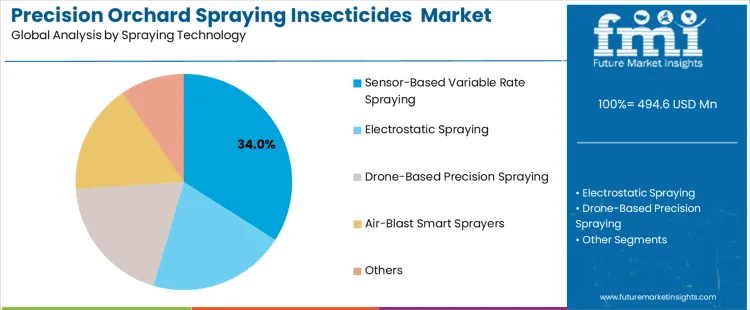
Sensor-based variable rate spraying accounts for 34% of the spraying technology segment in the precision orchard spraying insecticides market. This technology uses sensors to detect pest infestations or crop health and adjusts the pesticide application rate accordingly, ensuring that only the necessary amount of pesticide is applied to the affected areas. This reduces pesticide waste, minimizes environmental impact, and improves the efficiency of pest management in orchards. As farmers seek more sustainable and cost-effective pest control solutions, sensor-based variable rate spraying is gaining popularity for its precision, helping optimize both crop protection and resource use in orchards.
What Are the Key Dynamics for the Precision Orchard Spraying Insecticides Market?
The precision orchard spraying insecticides market is driven by the increasing need for efficient, targeted pest control in orchard farming. Precision spraying technologies, which use advanced sensors, GPS, and AI to precisely target areas with pest infestations, are improving the effectiveness of insecticide applications while minimizing waste and environmental impact. With growing concerns about sustainability, the market for precision orchard spraying insecticides is expanding as farmers seek to reduce pesticide usage, lower costs, and enhance the quality and yield of their crops, all while adhering to regulatory guidelines on pesticide application.
Why Is the Precision Orchard Spraying Insecticides Market Growing?
The market for precision orchard spraying insecticides is growing due to the increasing demand for more efficient and sustainable pest control solutions in the agriculture sector. Precision spraying reduces the use of chemicals by targeting specific areas affected by pests, making it more environmentally friendly and cost-effective compared to traditional spraying methods. The rise in orchard production, especially for high-value crops like fruits, is also driving the adoption of precision spraying systems. Advancements in drone technology and automated sprayers are enabling more precise and efficient insecticide applications, further accelerating market growth.
How Are the Key Drivers Shaping the Precision Orchard Spraying Insecticides Market?
Key drivers for the precision orchard spraying insecticides market include the growing emphasis on sustainable agriculture and the need to reduce pesticide usage to minimize environmental impact. Precision spraying technologies offer a solution by allowing for targeted application, reducing chemical runoff, and improving pest control efficiency. The growing adoption of smart farming technologies, such as drones and AI-powered sprayers, is enhancing the precision of pesticide applications. As farmers aim to meet regulatory requirements for pesticide use and reduce input costs, precision spraying offers a cost-effective and efficient way to control pests while improving crop yield and quality.
What is the Growth Outlook for the Precision Orchard Spraying Insecticides Market by Country?
| Country | CAGR (%) |
|---|---|
| India | 13.5% |
| China | 12.1% |
| Brazil | 11.3% |
| USA | 10.4% |
| Italy | 9.6% |
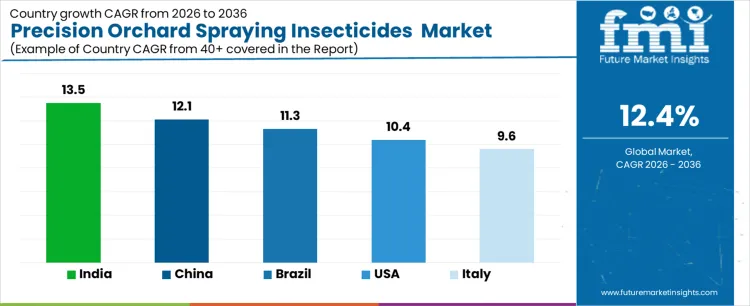
The precision orchard spraying insecticides market is experiencing strong growth globally, with India leading at 13.5%, driven by the country’s expanding agricultural sector and the increasing adoption of precision farming technologies. China follows at 12.1%, supported by the country’s large-scale fruit production and the demand for efficient pest control solutions. Brazil grows at 11.3%, fueled by its strong position in the global fruit export market and the adoption of precision spraying to optimize pesticide use. The USA grows at 10.4%, driven by advanced agricultural practices and a focus on sustainability. Italy grows at 9.6%, supported by its agricultural innovation and focus on eco-friendly pest management.
What is Driving the Growth of the Precision Orchard Spraying Insecticides Market in India?
India’s precision orchard spraying insecticides market is growing at 13.5%, driven by the country’s significant agricultural sector and the increasing adoption of precision farming techniques. The rise in orchard crops, such as fruits, nuts, and berries, has led to a growing demand for more efficient pest control solutions. Precision spraying technologies, which reduce pesticide use and target specific areas of the orchard, are becoming more popular for their ability to minimize waste, reduce costs, and increase yield. As India continues to modernize its agricultural practices and adopts technology-driven solutions, the demand for precision orchard spraying insecticides is expected to grow steadily.
How is the Precision Orchard Spraying Insecticides Market Expanding in China?
China’s precision orchard spraying insecticides market is growing at 12.1%, fueled by the country’s large-scale fruit production and rising demand for advanced agricultural technologies. With the growing focus on improving crop yield and minimizing environmental impact, Chinese farmers are increasingly adopting precision spraying technologies to enhance the efficiency of pest management in orchards. These technologies not only reduce pesticide consumption but also ensure better coverage and more effective pest control, which is crucial for maintaining high-quality fruit production. China’s government support for agricultural innovation and the adoption of eco-friendly farming practices is contributing to the market’s expansion.
How is the Precision Orchard Spraying Insecticides Market Expanding in Brazil?
Brazil’s precision orchard spraying insecticides market is growing at 11.3%, driven by the country’s large fruit export sector, particularly in citrus and tropical fruits. As Brazil continues to strengthen its position as a global leader in agricultural exports, the need for efficient and sustainable pest management solutions is rising. Precision orchard spraying technologies are increasingly being adopted to optimize pesticide use, reduce environmental impact, and improve the overall quality and yield of orchard crops. The adoption of these technologies is supported by government policies promoting sustainable farming and the country’s growing interest in precision agriculture as a means to enhance food security and improve farm productivity.
What is Driving the Growth of the Precision Orchard Spraying Insecticides Market in the USA?
The precision orchard spraying insecticides market in the USA is growing at 10.4%, driven by the country’s advanced agricultural industry and a focus on sustainable farming practices. With the rise of precision agriculture, American orchard farmers are increasingly adopting technologies that improve pest control while reducing pesticide use and environmental impact. Precision spraying systems allow for targeted application of insecticides, minimizing waste and ensuring better pest management. The USA’s emphasis on reducing agricultural inputs and maximizing efficiency, along with increasing demand for organic and high-quality produce, is driving the adoption of these technologies in the orchard spraying market.
How is the Precision Orchard Spraying Insecticides Market Expanding in Italy?
Italy’s precision orchard spraying insecticides market is growing at 9.6%, supported by the country’s strong agricultural sector, particularly in the production of fruits such as apples, grapes, and citrus. With an increasing focus on sustainability and reducing pesticide use, Italian farmers are adopting precision spraying technologies to improve the efficiency of pest control while minimizing environmental impact. The adoption of these technologies aligns with the European Union’s regulatory push for more sustainable agricultural practices and integrated pest management (IPM). As Italy’s agricultural industry continues to innovate and modernize, the demand for precision orchard spraying insecticides is expected to grow.
How Are Companies Competing in the Precision Orchard Spraying Insecticides Market?
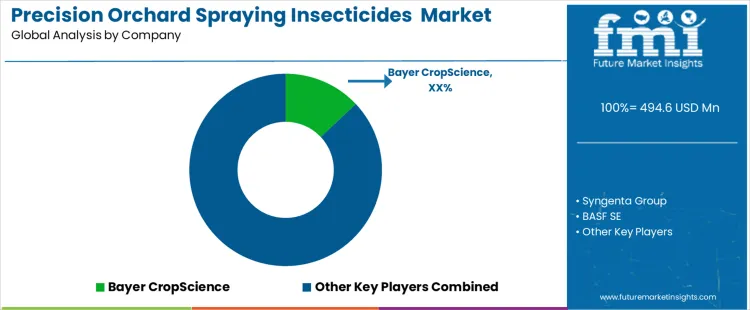
Competition in the precision orchard spraying insecticides market is driven by targeted efficacy, formulation stability, drift control technology, crop safety, and integration with precision application systems such as automated sprayers and sensor guided delivery. Bayer CropScience positions its precision orchard insecticides with strong emphasis on high pest specificity and reduced off target impact, and its product materials highlight optimized droplet size and drift reduction that help growers protect fruit crops while minimizing environmental exposure. Syngenta Group competes with advanced chemistries and adjuvant technologies designed to enhance coverage uniformity and residual control, with collateral stressing fit with variable rate and orchard mapping systems that elevate application precision.
BASF SE differentiates through next generation formulation platforms that balance broad pest control with orchard plant safety, marketed with data on consistent uptake and minimal fruit phytotoxicity. Its brochures emphasize enhanced adherence to foliage and improved rainfastness key qualities for predictable performance in perennial systems. Corteva Agriscience brings precision ready insecticide solutions that integrate with digital spraying technologies and orchard management tools; its documentation highlights predictive pest models and application timing guides to help growers optimize control windows and input efficiency.
UPL Limited and Others contribute with regionally adapted insecticides and drift mitigating additives tailored to diverse orchard crops and climatic zones, with materials that underscore versatility and compatibility with precision spraying hardware. Across vendors, product literature emphasizes targeted pest efficacy, formulation performance, orchard crop safety, and synergy with precision spraying technologies as key differentiators that help producers
Key Players in Precision Orchard Spraying Insecticides Market
- Bayer CropScience
- Syngenta Group
- BASF SE
- Corteva Agriscience
- UPL Limited
- Others
Scope of Report
| Attributes | Description |
|---|---|
| Quantitative Unit (2026) | USD Million |
| Crop Type | Pome Fruits (Apple, Pear), Stone Fruits (Peach, Cherry, Plum), Citrus Fruits, Nuts (Almond, Walnut, Pistachio), Others |
| Spraying Technology | Sensor-Based Variable Rate Spraying, Electrostatic Spraying, Drone-Based Precision Spraying, Air-Blast Smart Sprayers, Others |
| Regions Covered | Asia Pacific, Europe, North America, Latin America, Middle East & Africa |
| Countries Covered | China, Japan, South Korea, India, Australia & New Zealand, ASEAN, Germany, United Kingdom, France, Italy, Spain, Nordic, BENELUX, United States, Canada, Mexico, Brazil, Chile, Turkey, South Africa, Other GCC Countries |
| Key Companies Profiled | Bayer CropScience, Syngenta Group, BASF SE, Corteva Agriscience, UPL Limited, Others |
| Additional Attributes | Dollar sales by crop type, spraying technology, and region; regional CAGR and growth outlook for the precision orchard spraying insecticides market. |
Precision Orchard Spraying Insecticides Market by Key Segments
Crop Type
- Pome Fruits (Apple, Pear)
- Stone Fruits (Peach, Cherry, Plum)
- Citrus Fruits
- Nuts (Almond, Walnut, Pistachio)
- Others
Spraying Technology
- Sensor-Based Variable Rate Spraying
- Electrostatic Spraying
- Drone-Based Precision Spraying
- Air-Blast Smart Sprayers
- Others
Region
- Asia Pacific
- China
- Japan
- South Korea
- India
- Australia & New Zealand
- ASEAN
- Rest of Asia Pacific
- Europe
- Germany
- United Kingdom
- France
- Italy
- Spain
- Nordic
- BENELUX
- Rest of Europe
- North America
- United States
- Canada
- Mexico
- Latin America
- Brazil
- Chile
- Rest of Latin America
- Middle East & Africa
- Kingdom of Saudi Arabia
- Other GCC Countries
- Turkey
- South Africa
- Other African Union
- Rest of Middle East & Africa
Bibliography
- Food and Agriculture Organization of the United Nations (FAO). (2024). Precision agriculture technologies for sustainable pest management in fruit orchards. FAO Plant Production and Protection Division.
- European Commission, Joint Research Centre (JRC). (2024). Precision pesticide application technologies and environmental risk reduction in perennial crops. Publications Office of the European Union.
- Organisation for Economic Co‑operation and Development (OECD). (2024).
Integrated pest management, precision spraying, and sustainable pesticide use in agriculture. OECD Environment, Health and Safety Programme. - United States Department of Agriculture (USDA). (2024). Precision orchard management systems and targeted pesticide application technologies. USDA Agricultural Research Service.
- European Food Safety Authority (EFSA). (2024). Risk assessment of insecticide application techniques and spray drift mitigation in orchards. EFSA Journal.
Frequently Asked Questions
How big is the precision orchard spraying insecticides market in 2026?
The global precision orchard spraying insecticides market is estimated to be valued at USD 494.6 mn in 2026.
What will be the size of precision orchard spraying insecticides market in 2036?
The market size for the precision orchard spraying insecticides market is projected to reach USD 1,591.9 mn by 2036.
How much will be the precision orchard spraying insecticides market growth between 2026 and 2036?
The precision orchard spraying insecticides market is expected to grow at a 12.4% CAGR between 2026 and 2036.
What are the key product types in the precision orchard spraying insecticides market?
The key product types in precision orchard spraying insecticides market are pome fruits (apple, pear), stone fruits (peach, cherry, plum), citrus fruits, nuts (almond, walnut, pistachio) and others.
Which spraying technology segment to contribute significant share in the precision orchard spraying insecticides market in 2026?
In terms of spraying technology, sensor-based variable rate spraying segment to command 34.0% share in the precision orchard spraying insecticides market in 2026.
Preview the report firsthand - request a free sample
Get SampleGet the brochure for pricing and purchase details.
Get PDFTable of Content
- Executive Summary
- Global Market Outlook
- Demand-side Trends
- Supply-side Trends
- Technology Roadmap Analysis
- Analysis and Recommendations
- Market Overview
- Market Coverage / Taxonomy
- Market Definition / Scope / Limitations
- Market Background
- Market Dynamics
- Drivers
- Restraints
- Opportunity
- Trends
- Scenario Forecast
- Demand in Optimistic Scenario
- Demand in Likely Scenario
- Demand in Conservative Scenario
- Opportunity Map Analysis
- Product Life Cycle Analysis
- Supply Chain Analysis
- Investment Feasibility Matrix
- Value Chain Analysis
- PESTLE and Porter’s Analysis
- Regulatory Landscape
- Regional Parent Market Outlook
- Production and Consumption Statistics
- Import and Export Statistics
- Market Dynamics
- Global Market Analysis 2021 to 2025 and Forecast, 2026 to 2036
- Historical Market Size Value (USD Million) Analysis, 2021 to 2025
- Current and Future Market Size Value (USD Million) Projections, 2026 to 2036
- Y-o-Y Growth Trend Analysis
- Absolute $ Opportunity Analysis
- Global Market Pricing Analysis 2021 to 2025 and Forecast 2026 to 2036
- Global Market Analysis 2021 to 2025 and Forecast 2026 to 2036, By Crop Type
- Introduction / Key Findings
- Historical Market Size Value (USD Million) Analysis By Crop Type , 2021 to 2025
- Current and Future Market Size Value (USD Million) Analysis and Forecast By Crop Type , 2026 to 2036
- Pome Fruits (Apple, Pear)
- Stone Fruits (Peach, Cherry, Plum)
- Citrus Fruits
- Nuts (Almond, Walnut, Pistachio)
- Others
- Pome Fruits (Apple, Pear)
- Y-o-Y Growth Trend Analysis By Crop Type , 2021 to 2025
- Absolute $ Opportunity Analysis By Crop Type , 2026 to 2036
- Global Market Analysis 2021 to 2025 and Forecast 2026 to 2036, By Spraying Technology
- Introduction / Key Findings
- Historical Market Size Value (USD Million) Analysis By Spraying Technology, 2021 to 2025
- Current and Future Market Size Value (USD Million) Analysis and Forecast By Spraying Technology, 2026 to 2036
- Sensor-Based Variable Rate Spraying
- Electrostatic Spraying
- Drone-Based Precision Spraying
- Air-Blast Smart Sprayers
- Others
- Sensor-Based Variable Rate Spraying
- Y-o-Y Growth Trend Analysis By Spraying Technology, 2021 to 2025
- Absolute $ Opportunity Analysis By Spraying Technology, 2026 to 2036
- Global Market Analysis 2021 to 2025 and Forecast 2026 to 2036, By Region
- Introduction
- Historical Market Size Value (USD Million) Analysis By Region, 2021 to 2025
- Current Market Size Value (USD Million) Analysis and Forecast By Region, 2026 to 2036
- North America
- Latin America
- Western Europe
- Eastern Europe
- East Asia
- South Asia and Pacific
- Middle East & Africa
- Market Attractiveness Analysis By Region
- North America Market Analysis 2021 to 2025 and Forecast 2026 to 2036, By Country
- Historical Market Size Value (USD Million) Trend Analysis By Market Taxonomy, 2021 to 2025
- Market Size Value (USD Million) Forecast By Market Taxonomy, 2026 to 2036
- By Country
- USA
- Canada
- Mexico
- By Crop Type
- By Spraying Technology
- By Country
- Market Attractiveness Analysis
- By Country
- By Crop Type
- By Spraying Technology
- Key Takeaways
- Latin America Market Analysis 2021 to 2025 and Forecast 2026 to 2036, By Country
- Historical Market Size Value (USD Million) Trend Analysis By Market Taxonomy, 2021 to 2025
- Market Size Value (USD Million) Forecast By Market Taxonomy, 2026 to 2036
- By Country
- Brazil
- Chile
- Rest of Latin America
- By Crop Type
- By Spraying Technology
- By Country
- Market Attractiveness Analysis
- By Country
- By Crop Type
- By Spraying Technology
- Key Takeaways
- Western Europe Market Analysis 2021 to 2025 and Forecast 2026 to 2036, By Country
- Historical Market Size Value (USD Million) Trend Analysis By Market Taxonomy, 2021 to 2025
- Market Size Value (USD Million) Forecast By Market Taxonomy, 2026 to 2036
- By Country
- Germany
- UK
- Italy
- Spain
- France
- Nordic
- BENELUX
- Rest of Western Europe
- By Crop Type
- By Spraying Technology
- By Country
- Market Attractiveness Analysis
- By Country
- By Crop Type
- By Spraying Technology
- Key Takeaways
- Eastern Europe Market Analysis 2021 to 2025 and Forecast 2026 to 2036, By Country
- Historical Market Size Value (USD Million) Trend Analysis By Market Taxonomy, 2021 to 2025
- Market Size Value (USD Million) Forecast By Market Taxonomy, 2026 to 2036
- By Country
- Russia
- Poland
- Hungary
- Balkan & Baltic
- Rest of Eastern Europe
- By Crop Type
- By Spraying Technology
- By Country
- Market Attractiveness Analysis
- By Country
- By Crop Type
- By Spraying Technology
- Key Takeaways
- East Asia Market Analysis 2021 to 2025 and Forecast 2026 to 2036, By Country
- Historical Market Size Value (USD Million) Trend Analysis By Market Taxonomy, 2021 to 2025
- Market Size Value (USD Million) Forecast By Market Taxonomy, 2026 to 2036
- By Country
- China
- Japan
- South Korea
- By Crop Type
- By Spraying Technology
- By Country
- Market Attractiveness Analysis
- By Country
- By Crop Type
- By Spraying Technology
- Key Takeaways
- South Asia and Pacific Market Analysis 2021 to 2025 and Forecast 2026 to 2036, By Country
- Historical Market Size Value (USD Million) Trend Analysis By Market Taxonomy, 2021 to 2025
- Market Size Value (USD Million) Forecast By Market Taxonomy, 2026 to 2036
- By Country
- India
- ASEAN
- Australia & New Zealand
- Rest of South Asia and Pacific
- By Crop Type
- By Spraying Technology
- By Country
- Market Attractiveness Analysis
- By Country
- By Crop Type
- By Spraying Technology
- Key Takeaways
- Middle East & Africa Market Analysis 2021 to 2025 and Forecast 2026 to 2036, By Country
- Historical Market Size Value (USD Million) Trend Analysis By Market Taxonomy, 2021 to 2025
- Market Size Value (USD Million) Forecast By Market Taxonomy, 2026 to 2036
- By Country
- Kingdom of Saudi Arabia
- Other GCC Countries
- Turkiye
- South Africa
- Other African Union
- Rest of Middle East & Africa
- By Crop Type
- By Spraying Technology
- By Country
- Market Attractiveness Analysis
- By Country
- By Crop Type
- By Spraying Technology
- Key Takeaways
- Key Countries Market Analysis
- USA
- Pricing Analysis
- Market Share Analysis, 2025
- By Crop Type
- By Spraying Technology
- Canada
- Pricing Analysis
- Market Share Analysis, 2025
- By Crop Type
- By Spraying Technology
- Mexico
- Pricing Analysis
- Market Share Analysis, 2025
- By Crop Type
- By Spraying Technology
- Brazil
- Pricing Analysis
- Market Share Analysis, 2025
- By Crop Type
- By Spraying Technology
- Chile
- Pricing Analysis
- Market Share Analysis, 2025
- By Crop Type
- By Spraying Technology
- Germany
- Pricing Analysis
- Market Share Analysis, 2025
- By Crop Type
- By Spraying Technology
- UK
- Pricing Analysis
- Market Share Analysis, 2025
- By Crop Type
- By Spraying Technology
- Italy
- Pricing Analysis
- Market Share Analysis, 2025
- By Crop Type
- By Spraying Technology
- Spain
- Pricing Analysis
- Market Share Analysis, 2025
- By Crop Type
- By Spraying Technology
- France
- Pricing Analysis
- Market Share Analysis, 2025
- By Crop Type
- By Spraying Technology
- India
- Pricing Analysis
- Market Share Analysis, 2025
- By Crop Type
- By Spraying Technology
- ASEAN
- Pricing Analysis
- Market Share Analysis, 2025
- By Crop Type
- By Spraying Technology
- Australia & New Zealand
- Pricing Analysis
- Market Share Analysis, 2025
- By Crop Type
- By Spraying Technology
- China
- Pricing Analysis
- Market Share Analysis, 2025
- By Crop Type
- By Spraying Technology
- Japan
- Pricing Analysis
- Market Share Analysis, 2025
- By Crop Type
- By Spraying Technology
- South Korea
- Pricing Analysis
- Market Share Analysis, 2025
- By Crop Type
- By Spraying Technology
- Russia
- Pricing Analysis
- Market Share Analysis, 2025
- By Crop Type
- By Spraying Technology
- Poland
- Pricing Analysis
- Market Share Analysis, 2025
- By Crop Type
- By Spraying Technology
- Hungary
- Pricing Analysis
- Market Share Analysis, 2025
- By Crop Type
- By Spraying Technology
- Kingdom of Saudi Arabia
- Pricing Analysis
- Market Share Analysis, 2025
- By Crop Type
- By Spraying Technology
- Turkiye
- Pricing Analysis
- Market Share Analysis, 2025
- By Crop Type
- By Spraying Technology
- South Africa
- Pricing Analysis
- Market Share Analysis, 2025
- By Crop Type
- By Spraying Technology
- USA
- Market Structure Analysis
- Competition Dashboard
- Competition Benchmarking
- Market Share Analysis of Top Players
- By Regional
- By Crop Type
- By Spraying Technology
- Competition Analysis
- Competition Deep Dive
- Bayer CropScience
- Overview
- Product Portfolio
- Profitability by Market Segments (Product/Age /Sales Channel/Region)
- Sales Footprint
- Strategy Overview
- Marketing Strategy
- Product Strategy
- Channel Strategy
- Syngenta Group
- BASF SE
- Corteva Agriscience
- UPL Limited
- Others
- Bayer CropScience
- Competition Deep Dive
- Assumptions & Acronyms Used
- Research Methodology


