

- Industry Size (2026)
- USD 0.5 Bn
- Forecast (2036)
- USD 2.4 Bn
- CAGR (2026 to 2036)
- 17%
High-Precision Row-Zone Herbicide Banding Chemistry Market Forecast and Outlook 2026 to 2036
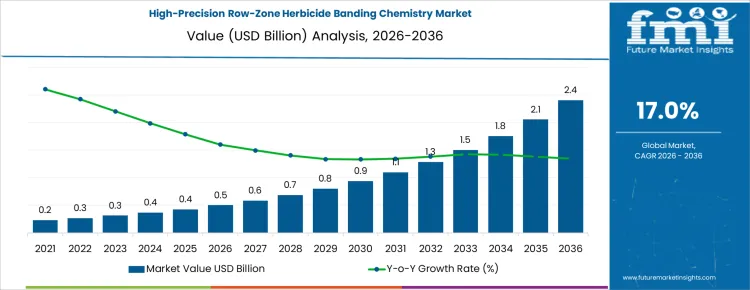
The high-precision row-zone herbicide banding chemistry market is projected to grow from USD 0.5 billion in 2026 to USD 2.4 billion by 2036, at a 17% CAGR. This growth is driven by the increasing adoption of precision agriculture technologies and the demand for efficient herbicide application that reduces chemical use and environmental impact. Key segments driving this market include high-adhesion low-spread banding formulations, holding a 36% share, which enable precise herbicide application with minimal drift. Other significant segments include soil-active residual band chemistries, volatility-reduced target-zone herbicides, and micro-encapsulated precision band actives. Camera-guided row-zone sprayers, which hold a 39% share, lead the application systems, followed by planter-mounted band applicators and robotic & autonomous weeders.
Quick Stats for High-Precision Row-Zone Herbicide Banding Chemistry Market
- High-Precision Row-Zone Herbicide Banding Chemistry Market Value (2026): USD 0.5 billion
- High-Precision Row-Zone Herbicide Banding Chemistry Market Forecast Value (2036): USD 2.4 billion
- High-Precision Row-Zone Herbicide Banding Chemistry Market Forecast CAGR: 17%
- Leading Chemistry Design Type in High-Precision Row-Zone Herbicide Banding Chemistry Market: High-Adhesion Low-Spread Banding Formulations
- Key Growth Regions in High-Precision Row-Zone Herbicide Banding Chemistry Market: North America
- Key Players in High-Precision Row-Zone Herbicide Banding Chemistry Market: Blue River Technology, Ecorobotix SA, Carbon Bee, Greeneye Technology, Bilberry SAS
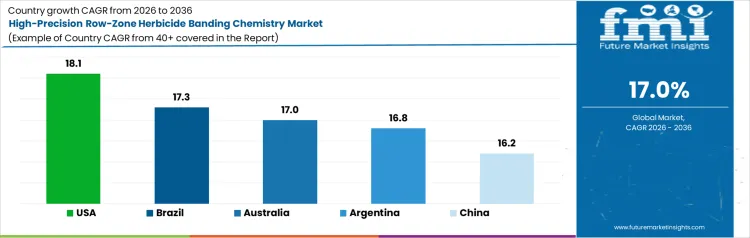
The market's growth is led by the USA, with an 18.1% CAGR, driven by the country’s large-scale adoption of precision farming technologies in row crops like corn and soybeans. Brazil follows with a 17.3% CAGR, supported by its vast agricultural sector and need for more efficient herbicide application. Argentina and Australia are expanding at 16.8% and 17.0% CAGRs, respectively, driven by the need to optimize herbicide use and improve crop yields. China’s market grows at 16.2%, with the country’s push towards modernizing its agricultural practices and increasing crop productivity. As the demand for eco-friendly farming rises globally, high-precision herbicide banding technologies are becoming key to improving farming practices and reducing agrochemical usage.
High‑Precision Row‑Zone Herbicide Banding Chemistry Market Key Takeaways
| Metric | Value |
|---|---|
| Industry Value (2026) | USD 0.5 billion |
| Forecast Value (2036) | USD 2.4 billion |
| Forecast CAGR (2026 to 2036) | 17% |
How Is the Global High-Precision Row-Zone Herbicide Banding Chemistry Sector Advancing?
The global high-precision row-zone herbicide banding chemistry market is growing rapidly as growers adopt precision weed management techniques that improve efficiency and reduce chemical usage. Row-zone herbicide banding involves applying herbicides in narrow bands directly over crop rows, targeting weeds where they compete most with planted crops. High-precision banding chemistries are optimized to work with advanced application technologies, ensuring herbicide actives are effectively delivered in precise zones, minimizing off-target exposure, and reducing environmental impact compared with broadcast sprays.
Demand for these specialized chemistries is rising as precision agriculture tools such as GPS-guided applicators, variable-rate technologies, and advanced field mapping become more widespread. These systems enable growers to integrate row-zone strategies into broader crop protection programs that prioritize sustainability and cost efficiency. Advances in formulation science have improved compatibility with equipment and enhanced uptake in target weed species, boosting performance even when using reduced rates of active ingredients. This makes high-precision banding especially useful in high-value row crops and agronomic systems where efficient weed control directly influences yield and profitability.
Challenges such as the need for field-specific calibration, education on precision application best practices, and ensuring consistent field performance across diverse soil and crop conditions may influence adoption rates. Despite these factors, the strong emphasis on precision weed control and reduced chemical use will continue to drive demand for high-precision row-zone herbicide banding chemistries worldwide.
What is the Segment-Wise Analysis for the Global High-Precision Row-Zone Herbicide Banding Chemistry Market?
The global high-precision row-zone herbicide banding chemistry market is segmented by chemistry design type and application system compatibility. High-adhesion low-spread banding formulations lead the market with a 36% share, offering efficient herbicide application with minimal spread, targeting only the row zones. Other key chemistries include soil-active residual band chemistries, volatility-reduced target-zone herbicides, and micro-encapsulated precision band actives. In terms of application system compatibility, camera-guided row-zone sprayers hold the largest share at 39%, followed by planter-mounted band applicators, robotic & autonomous weeders, and strip-till integrated banding.
How Do High-Adhesion Low-Spread Banding Formulations Lead the Global Herbicide Banding Chemistry Market?
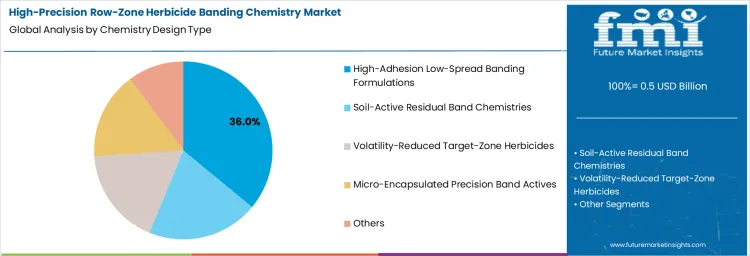
High-adhesion low-spread banding formulations hold a 36% share in the global high-precision row-zone herbicide banding chemistry market due to their ability to apply herbicides precisely to the targeted row zones with minimal drift or spread. These formulations are designed to adhere well to the plant surfaces while reducing herbicide loss, ensuring more effective and controlled applications. Their precision makes them ideal for row-crop farming, where targeting only the row zone is essential for optimizing herbicide use and minimizing environmental impact, driving their dominant position in the market.
Why Do Camera-Guided Row-Zone Sprayers Hold the Largest Market Share in the Global Herbicide Banding Chemistry Market?
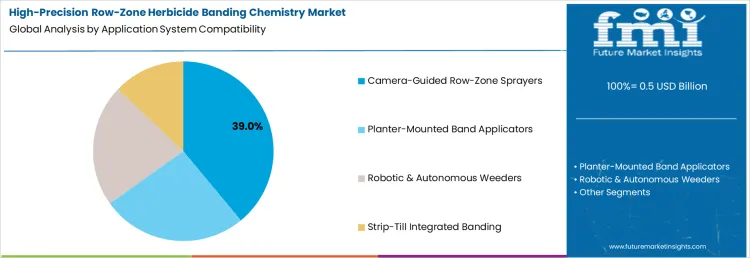
Camera-guided row-zone sprayers hold the largest share of 39% in the global high-precision row-zone herbicide banding chemistry market due to their ability to accurately target herbicide application in row zones. These sprayers use real-time image recognition technology to detect crop rows and ensure that herbicide is applied only where needed, improving accuracy and reducing waste. As precision agriculture technologies continue to evolve, camera-guided sprayers provide a highly efficient solution for controlling weeds while minimizing chemical use, making them the preferred choice for row-crop farmers.
How is Precision Banding Transforming Weed Management?
The high-precision row-zone herbicide banding chemistry market is evolving as grower’s demand more efficient and eco-friendly weed control methods. Instead of blanket spraying entire fields, row-zone banding delivers herbicides only where crops grow and weeds compete most along planting rows. This targeted approach reduces overall chemical use, minimizes off-target exposure, and supports soil health. Advances in herbicide formulations optimized for banding such as enhanced uptake at low doses and compatibility with reduced application volumes are enabling greater adoption, especially in high-value row crops like corn, soybeans, and cotton.
What is Driving Adoption of Row-Zone Herbicide Banding Solutions?
Growers and agronomists are adopting high-precision row-zone herbicide banding chemistries to cut input costs, improve weed control efficiency, and meet sustainability goals. Rising labor and input expenses make precision placement financially attractive, as banding lowers herbicide volume without compromising efficacy. Pressure from regulatory agencies and buyers to reduce pesticide loads in runoff and drift is also encouraging banding strategies. Integration with GPS-guided applicators and auto-steering systems helps farmers match chemistry deployment precisely to crop rows, improving performance while reducing environmental impact.
What Barriers Are Shaping Market Uptake?
Despite clear benefits, adoption is moderated by practical and technical challenges. Precise banding requires compatible application equipment, accurate field mapping, and calibration know-how, which can be barriers for smaller or resource-constrained farms. Some growers are hesitant to switch from broad coverage methods without extensive localized data showing consistent weed suppression. Formulation challenges also arise when ensuring herbicides remain active at lower doses concentrated in bands. Regional variability in weed species and resistance patterns means banding solutions must be tailored, adding complexity to product selection and agronomic planning.
What is the Growth Outlook for the High-Precision Row-Zone Herbicide Banding Chemistry Market by Country?
| Country | CAGR (%) |
|---|---|
| USA | 18.1% |
| Brazil | 17.3% |
| Argentina | 16.8% |
| Australia | 17.0% |
| China | 16.2% |
The high-precision row-zone herbicide banding chemistry market is growing significantly, with the USA leading at an 18.1% CAGR, driven by the increasing adoption of precision farming technologies and the need for more efficient herbicide application. Brazil follows closely with 17.3%, supported by its large agricultural sector and the growing demand for eco-friendly crop management practices. Argentina’s market grows at 16.8%, fueled by the need to optimize herbicide use and improve crop yield. Australia’s market grows at 17.0%, driven by the adoption of precision application technologies in crop production. China’s market grows at 16.2%, supported by the country’s push to modernize agriculture and reduce herbicide use.
Why is the USA Leading in the High-Precision Row-Zone Herbicide Banding Chemistry Market?
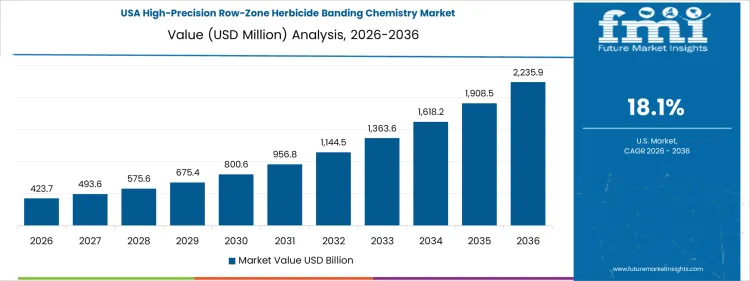
The USA’s high-precision row-zone herbicide banding chemistry market is growing at 18.1%, driven by the widespread adoption of precision agriculture technologies aimed at improving crop yield and reducing input costs. The USA, with its vast agricultural base, particularly in row crops like corn and soybeans, has a significant demand for more efficient herbicide application methods. High-precision row-zone herbicide banding allows for targeted herbicide application directly onto the rows where crops are growing, reducing herbicide waste and minimizing environmental impact. With increasing pressure to improve farm productivity while reducing chemical use, American farmers are turning to advanced solutions like high-precision herbicide banding. Regulatory support for eco-friendly farming practices and growing interest in eco-friendly crop management are accelerating the adoption of this technology. As the USA focuses on eco-friendlier agricultural practices, the demand for precision herbicide application solutions continues to grow.
What is Driving the Growth of the High-Precision Row-Zone Herbicide Banding Chemistry Market in Brazil?
Brazil’s high-precision row-zone herbicide banding chemistry market is growing at 17.3%, fueled by the country’s large-scale agricultural operations and the increasing demand for more efficient herbicide application techniques. Brazil is one of the world’s largest producers of crops like soybeans, sugarcane, and coffee, where efficient herbicide use is crucial for maximizing productivity and minimizing costs. High-precision row-zone herbicide banding offers Brazilian farmers a targeted method for herbicide application, reducing waste and improving herbicide efficacy while minimizing environmental impact. Brazil’s focus on eco-friendly agriculture and improving farm productivity is driving the adoption of these technologies. As the country continues to modernize its agricultural practices and adopt more efficient and environmentally friendly crop protection solutions, the demand for high-precision herbicide banding chemistry is expected to grow steadily.
How is the High-Precision Row-Zone Herbicide Banding Chemistry Market Expanding in Argentina?
Argentina’s high-precision row-zone herbicide banding chemistry market is growing at 16.8%, driven by the need to optimize herbicide use and improve crop yields in the country’s large agricultural sector. Argentina is a major producer of grains such as soybeans, wheat, and corn, and efficient herbicide application is key to maintaining high crop productivity. High-precision row-zone herbicide banding offers farmers a more effective way to apply herbicides directly where they are needed, minimizing waste and reducing environmental impact. The growing demand for eco-friendlier farming practices and the need to reduce herbicide overuse are accelerating the adoption of this technology in Argentina. As the country continues to modernize its agricultural industry, the market for high-precision herbicide banding is expected to expand, driven by the increasing focus on efficiency and environmental responsibility.
What is Contributing to the Growth of the High-Precision Row-Zone Herbicide Banding Chemistry Market in Australia?
Australia’s high-precision row-zone herbicide banding chemistry market is growing at 17.0%, driven by the country’s strong focus on eco-friendly farming and the need for more efficient crop protection solutions. In Australia’s agricultural sector, particularly in crops like wheat, barley, and cotton, high-precision herbicide banding is becoming an essential tool for reducing herbicide use while maximizing effectiveness. The targeted application of herbicides directly to crop rows helps reduce waste and ensures more precise control over weed management. Australia’s agricultural industry is increasingly adopting technologies that improve farm productivity and reduce environmental impact, and high-precision herbicide banding is well-aligned with these goals. With a growing emphasis on eco-friendly practices and optimizing resource use, the demand for high-precision row-zone herbicide banding chemistry in Australia is expected to continue expanding.
What is Driving the Growth of the High-Precision Row-Zone Herbicide Banding Chemistry Market in China?
China’s high-precision row-zone herbicide banding chemistry market is growing at 16.2%, supported by the country’s large agricultural base and the increasing need to improve efficiency in crop protection. As China continues to modernize its agricultural practices, the adoption of technologies that allow for more targeted and effective herbicide use is growing. High-precision row-zone herbicide banding helps optimize herbicide application by ensuring that chemicals are applied directly to the crop rows, reducing waste and environmental impact. With China’s focus on improving food security and sustainability in agriculture, there is growing demand for solutions that increase crop yield while minimizing chemical use. The increasing focus on precision farming and eco-friendly practices in China is driving the adoption of high-precision herbicide banding, and the market is expected to continue expanding as farmers look for more efficient ways to manage crops.
How Are Companies Competing in the High-Precision Row-Zone Herbicide Banding Chemistry Market?
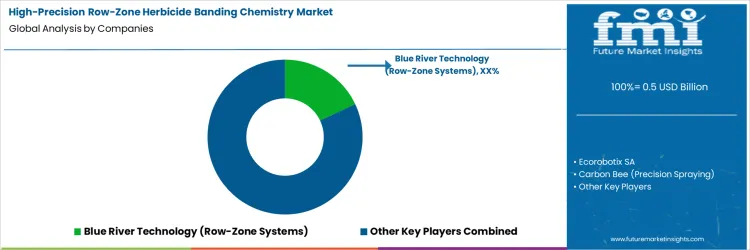
In the high-precision row-zone herbicide banding chemistry market Blue River Technology (Row-Zone Systems), Ecorobotix SA, Carbon Bee (Precision Spraying), Greeneye Technology, Bilberry SAS, and others are positioned with product brochures that highlight targeted application performance and advanced delivery strategies. At Blue River Technology products are described with intelligent banding systems paired with optimized herbicide chemistries that reduce overall use and enhance weed control in row zones. Technical summaries show efficacy improvements with precision guidance and clear setup notes. Ecorobotix SA materials present autonomous banding platforms combined with micro-dose herbicide chemistries. Performance charts and deployment guidance are provided to help growers visualize reduced chemical volumes and better selectivity.
Carbon Bee (Precision Spraying) brochures focus on ultra-precise actuated spray systems engineered for narrow band application. Additive chemistries are featured with compatibility guidance and examples of improved target placement. Short use cases illustrate weed suppression benefits. Greeneye Technology collateral showcases vision-guided sprayers integrated with herbicide banding chemistries. Trial results are shown alongside simple instructions to support decision making by advisors and operators. Bilberry SAS literature emphasizes adaptable banding modules with tailored chemistries optimized for diverse row crops. Visual aids and dosing recommendations are included.
Key Players in High-Precision Row-Zone Herbicide Banding Chemistry Market
- Blue River Technology (Row-Zone Systems)
- Ecorobotix SA
- Carbon Bee (Precision Spraying)
- Greeneye Technology
- Bilberry SAS
- Others
Scope of Report
| Items | Values |
|---|---|
| Quantitative Units (2026) | USD billion |
| Chemistry Design Type | High-Adhesion Low-Spread Banding Formulations, Soil-Active Residual Band Chemistries, Volatility-Reduced Target-Zone Herbicides, Micro-Encapsulated Precision Band Actives |
| Application System Compatibility | Camera-Guided Row-Zone Sprayers, Planter-Mounted Band Applicators, Robotic & Autonomous Weeders, Strip-Till Integrated Banding |
| Regions Covered | Asia Pacific, Europe, North America, Latin America, Middle East & Africa |
| Countries Covered | USA, China, Japan, South Korea, India, Australia & New Zealand, ASEAN, Germany, UK, France, Italy, Spain, Nordic, BENELUX, Brazil, Chile, Mexico, Saudi Arabia, Other GCC Countries, Turkey, South Africa, Other African Union |
| Key Companies Profiled | Blue River Technology (Row-Zone Systems), Ecorobotix SA, Carbon Bee (Precision Spraying), Greeneye Technology, Bilberry SAS |
| Additional Attributes | Dollar sales by chemistry design type, application system compatibility, and region; regional CAGR and growth outlook; distribution channels including sprayer manufacturers, agrochemical service providers, and precision application equipment suppliers; innovation trends in precision herbicide banding chemistries; competitive positioning of global vs regional suppliers. |
High-Precision Row-Zone Herbicide Banding Chemistry Market by Segments
Chemistry Design Type
- High-Adhesion Low-Spread Banding Formulations
- Soil-Active Residual Band Chemistries
- Volatility-Reduced Target-Zone Herbicides
- Micro-Encapsulated Precision Band Actives
- Others
Application System Compatibility
- Camera-Guided Row-Zone Sprayers
- Planter-Mounted Band Applicators
- Robotic & Autonomous Weeders
- Strip-Till Integrated Banding
Region
- Asia Pacific
- China
- Japan
- South Korea
- India
- Australia & New Zealand
- ASEAN
- Rest of Asia Pacific
- Europe
- Germany
- United Kingdom
- France
- Italy
- Spain
- Nordic
- BENELUX
- Rest of Europe
- North America
- United States
- Canada
- Mexico
- Latin America
- Brazil
- Chile
- Rest of Latin America
- Middle East & Africa
- Kingdom of Saudi Arabia
- Other GCC Countries
- Turkey
- South Africa
- Other African Union
- Rest of Middle East & Africa
Frequently Asked Questions
How big is the high-precision row-zone herbicide banding chemistry market in 2026?
The global high-precision row-zone herbicide banding chemistry market is estimated to be valued at USD 0.5 billion in 2026.
What will be the size of high-precision row-zone herbicide banding chemistry market in 2036?
The market size for the high-precision row-zone herbicide banding chemistry market is projected to reach USD 2.4 billion by 2036.
How much will be the high-precision row-zone herbicide banding chemistry market growth between 2026 and 2036?
The high-precision row-zone herbicide banding chemistry market is expected to grow at a 17.0% CAGR between 2026 and 2036.
What are the key product types in the high-precision row-zone herbicide banding chemistry market?
The key product types in high-precision row-zone herbicide banding chemistry market are high-adhesion low-spread banding formulations, soil-active residual band chemistries, volatility-reduced target-zone herbicides, micro-encapsulated precision band actives and others.
Which application system compatibility segment to contribute significant share in the high-precision row-zone herbicide banding chemistry market in 2026?
In terms of application system compatibility, camera-guided row-zone sprayers segment to command 39.0% share in the high-precision row-zone herbicide banding chemistry market in 2026.
Preview the report firsthand - request a free sample
Get SampleGet the brochure for pricing and purchase details.
Get PDFTable of Content
- Executive Summary
- Global Market Outlook
- Demand-side Trends
- Supply-side Trends
- Technology Roadmap Analysis
- Analysis and Recommendations
- Market Overview
- Market Coverage / Taxonomy
- Market Definition / Scope / Limitations
- Market Background
- Market Dynamics
- Drivers
- Restraints
- Opportunity
- Trends
- Scenario Forecast
- Demand in Optimistic Scenario
- Demand in Likely Scenario
- Demand in Conservative Scenario
- Opportunity Map Analysis
- Product Life Cycle Analysis
- Supply Chain Analysis
- Investment Feasibility Matrix
- Value Chain Analysis
- PESTLE and Porter’s Analysis
- Regulatory Landscape
- Regional Parent Market Outlook
- Production and Consumption Statistics
- Import and Export Statistics
- Market Dynamics
- Global Market Analysis 2021 to 2025 and Forecast, 2026 to 2036
- Historical Market Size Value (USD Million) Analysis, 2021 to 2025
- Current and Future Market Size Value (USD Million) Projections, 2026 to 2036
- Y-o-Y Growth Trend Analysis
- Absolute $ Opportunity Analysis
- Global Market Pricing Analysis 2021 to 2025 and Forecast 2026 to 2036
- Global Market Analysis 2021 to 2025 and Forecast 2026 to 2036, By Chemistry Design Type
- Introduction / Key Findings
- Historical Market Size Value (USD Million) Analysis By Chemistry Design Type , 2021 to 2025
- Current and Future Market Size Value (USD Million) Analysis and Forecast By Chemistry Design Type , 2026 to 2036
- High-Adhesion Low-Spread Banding Formulations
- Soil-Active Residual Band Chemistries
- Volatility-Reduced Target-Zone Herbicides
- Micro-Encapsulated Precision Band Actives
- Others
- Y-o-Y Growth Trend Analysis By Chemistry Design Type , 2021 to 2025
- Absolute $ Opportunity Analysis By Chemistry Design Type , 2026 to 2036
- Global Market Analysis 2021 to 2025 and Forecast 2026 to 2036, By Application System Compatibility
- Introduction / Key Findings
- Historical Market Size Value (USD Million) Analysis By Application System Compatibility, 2021 to 2025
- Current and Future Market Size Value (USD Million) Analysis and Forecast By Application System Compatibility, 2026 to 2036
- Camera-Guided Row-Zone Sprayers
- Planter-Mounted Band Applicators
- Robotic & Autonomous Weeders
- Strip-Till Integrated Banding
- Y-o-Y Growth Trend Analysis By Application System Compatibility, 2021 to 2025
- Absolute $ Opportunity Analysis By Application System Compatibility, 2026 to 2036
- Global Market Analysis 2021 to 2025 and Forecast 2026 to 2036, By Region
- Introduction
- Historical Market Size Value (USD Million) Analysis By Region, 2021 to 2025
- Current Market Size Value (USD Million) Analysis and Forecast By Region, 2026 to 2036
- North America
- Latin America
- Western Europe
- Eastern Europe
- East Asia
- South Asia and Pacific
- Middle East & Africa
- Market Attractiveness Analysis By Region
- North America Market Analysis 2021 to 2025 and Forecast 2026 to 2036, By Country
- Historical Market Size Value (USD Million) Trend Analysis By Market Taxonomy, 2021 to 2025
- Market Size Value (USD Million) Forecast By Market Taxonomy, 2026 to 2036
- By Country
- USA
- Canada
- Mexico
- By Chemistry Design Type
- By Application System Compatibility
- By Country
- Market Attractiveness Analysis
- By Country
- By Chemistry Design Type
- By Application System Compatibility
- Key Takeaways
- Latin America Market Analysis 2021 to 2025 and Forecast 2026 to 2036, By Country
- Historical Market Size Value (USD Million) Trend Analysis By Market Taxonomy, 2021 to 2025
- Market Size Value (USD Million) Forecast By Market Taxonomy, 2026 to 2036
- By Country
- Brazil
- Chile
- Rest of Latin America
- By Chemistry Design Type
- By Application System Compatibility
- By Country
- Market Attractiveness Analysis
- By Country
- By Chemistry Design Type
- By Application System Compatibility
- Key Takeaways
- Western Europe Market Analysis 2021 to 2025 and Forecast 2026 to 2036, By Country
- Historical Market Size Value (USD Million) Trend Analysis By Market Taxonomy, 2021 to 2025
- Market Size Value (USD Million) Forecast By Market Taxonomy, 2026 to 2036
- By Country
- Germany
- UK
- Italy
- Spain
- France
- Nordic
- BENELUX
- Rest of Western Europe
- By Chemistry Design Type
- By Application System Compatibility
- By Country
- Market Attractiveness Analysis
- By Country
- By Chemistry Design Type
- By Application System Compatibility
- Key Takeaways
- Eastern Europe Market Analysis 2021 to 2025 and Forecast 2026 to 2036, By Country
- Historical Market Size Value (USD Million) Trend Analysis By Market Taxonomy, 2021 to 2025
- Market Size Value (USD Million) Forecast By Market Taxonomy, 2026 to 2036
- By Country
- Russia
- Poland
- Hungary
- Balkan & Baltic
- Rest of Eastern Europe
- By Chemistry Design Type
- By Application System Compatibility
- By Country
- Market Attractiveness Analysis
- By Country
- By Chemistry Design Type
- By Application System Compatibility
- Key Takeaways
- East Asia Market Analysis 2021 to 2025 and Forecast 2026 to 2036, By Country
- Historical Market Size Value (USD Million) Trend Analysis By Market Taxonomy, 2021 to 2025
- Market Size Value (USD Million) Forecast By Market Taxonomy, 2026 to 2036
- By Country
- China
- Japan
- South Korea
- By Chemistry Design Type
- By Application System Compatibility
- By Country
- Market Attractiveness Analysis
- By Country
- By Chemistry Design Type
- By Application System Compatibility
- Key Takeaways
- South Asia and Pacific Market Analysis 2021 to 2025 and Forecast 2026 to 2036, By Country
- Historical Market Size Value (USD Million) Trend Analysis By Market Taxonomy, 2021 to 2025
- Market Size Value (USD Million) Forecast By Market Taxonomy, 2026 to 2036
- By Country
- India
- ASEAN
- Australia & New Zealand
- Rest of South Asia and Pacific
- By Chemistry Design Type
- By Application System Compatibility
- By Country
- Market Attractiveness Analysis
- By Country
- By Chemistry Design Type
- By Application System Compatibility
- Key Takeaways
- Middle East & Africa Market Analysis 2021 to 2025 and Forecast 2026 to 2036, By Country
- Historical Market Size Value (USD Million) Trend Analysis By Market Taxonomy, 2021 to 2025
- Market Size Value (USD Million) Forecast By Market Taxonomy, 2026 to 2036
- By Country
- Kingdom of Saudi Arabia
- Other GCC Countries
- Turkiye
- South Africa
- Other African Union
- Rest of Middle East & Africa
- By Chemistry Design Type
- By Application System Compatibility
- By Country
- Market Attractiveness Analysis
- By Country
- By Chemistry Design Type
- By Application System Compatibility
- Key Takeaways
- Key Countries Market Analysis
- USA
- Pricing Analysis
- Market Share Analysis, 2025
- By Chemistry Design Type
- By Application System Compatibility
- Canada
- Pricing Analysis
- Market Share Analysis, 2025
- By Chemistry Design Type
- By Application System Compatibility
- Mexico
- Pricing Analysis
- Market Share Analysis, 2025
- By Chemistry Design Type
- By Application System Compatibility
- Brazil
- Pricing Analysis
- Market Share Analysis, 2025
- By Chemistry Design Type
- By Application System Compatibility
- Chile
- Pricing Analysis
- Market Share Analysis, 2025
- By Chemistry Design Type
- By Application System Compatibility
- Germany
- Pricing Analysis
- Market Share Analysis, 2025
- By Chemistry Design Type
- By Application System Compatibility
- UK
- Pricing Analysis
- Market Share Analysis, 2025
- By Chemistry Design Type
- By Application System Compatibility
- Italy
- Pricing Analysis
- Market Share Analysis, 2025
- By Chemistry Design Type
- By Application System Compatibility
- Spain
- Pricing Analysis
- Market Share Analysis, 2025
- By Chemistry Design Type
- By Application System Compatibility
- France
- Pricing Analysis
- Market Share Analysis, 2025
- By Chemistry Design Type
- By Application System Compatibility
- India
- Pricing Analysis
- Market Share Analysis, 2025
- By Chemistry Design Type
- By Application System Compatibility
- ASEAN
- Pricing Analysis
- Market Share Analysis, 2025
- By Chemistry Design Type
- By Application System Compatibility
- Australia & New Zealand
- Pricing Analysis
- Market Share Analysis, 2025
- By Chemistry Design Type
- By Application System Compatibility
- China
- Pricing Analysis
- Market Share Analysis, 2025
- By Chemistry Design Type
- By Application System Compatibility
- Japan
- Pricing Analysis
- Market Share Analysis, 2025
- By Chemistry Design Type
- By Application System Compatibility
- South Korea
- Pricing Analysis
- Market Share Analysis, 2025
- By Chemistry Design Type
- By Application System Compatibility
- Russia
- Pricing Analysis
- Market Share Analysis, 2025
- By Chemistry Design Type
- By Application System Compatibility
- Poland
- Pricing Analysis
- Market Share Analysis, 2025
- By Chemistry Design Type
- By Application System Compatibility
- Hungary
- Pricing Analysis
- Market Share Analysis, 2025
- By Chemistry Design Type
- By Application System Compatibility
- Kingdom of Saudi Arabia
- Pricing Analysis
- Market Share Analysis, 2025
- By Chemistry Design Type
- By Application System Compatibility
- Turkiye
- Pricing Analysis
- Market Share Analysis, 2025
- By Chemistry Design Type
- By Application System Compatibility
- South Africa
- Pricing Analysis
- Market Share Analysis, 2025
- By Chemistry Design Type
- By Application System Compatibility
- USA
- Market Structure Analysis
- Competition Dashboard
- Competition Benchmarking
- Market Share Analysis of Top Players
- By Regional
- By Chemistry Design Type
- By Application System Compatibility
- Competition Analysis
- Competition Deep Dive
- Blue River Technology (Row-Zone Systems)
- Overview
- Product Portfolio
- Profitability by Market Segments (Product/Age /Sales Channel/Region)
- Sales Footprint
- Strategy Overview
- Marketing Strategy
- Product Strategy
- Channel Strategy
- Ecorobotix SA
- Carbon Bee (Precision Spraying)
- Greeneye Technology
- Bilberry SAS
- Others
- Blue River Technology (Row-Zone Systems)
- Competition Deep Dive
- Assumptions & Acronyms Used
- Research Methodology


