

- Industry Size (2026)
- USD 284 Mn
- Forecast (2036)
- USD 1179.3 Mn
- CAGR (2026 to 2036)
- 15.3%
Moisture-Triggered Herbicide Microgranule Market Forecast and Outlook 2026 to 2036
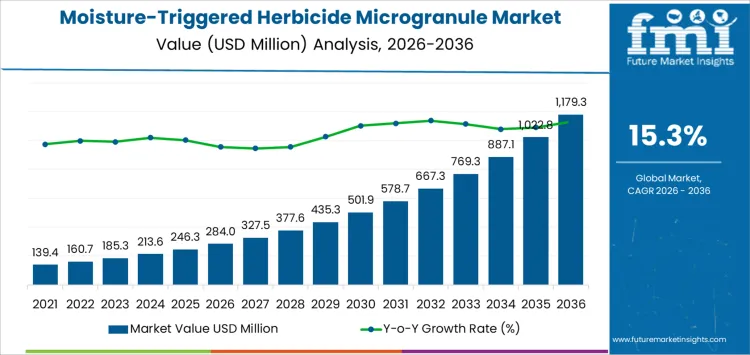
The moisture-triggered herbicide microgranule market is expected to grow from USD 284 million in 2026 to USD 1,179.3 million by 2036, reflecting a compound annual growth rate (CAGR) of 15.3%. These innovative microgranules, which release herbicides when triggered by moisture, offer more efficient and targeted weed control. They reduce herbicide waste, minimize environmental impact, and enhance crop protection, making them increasingly popular in modern agriculture. The growing demand for sustainable, effective, and precision-based solutions in weed management is driving the adoption of moisture-triggered herbicide microgranules, particularly in regions with large agricultural sectors.
The market’s growth is further supported by the increasing global demand for food, advancements in agricultural technologies, and the need for eco-friendlier crop protection solutions. As the industry shifts towards precision farming and integrated pest management, the demand for products like moisture-triggered microgranules, which improve the efficiency of herbicide application, is expected to rise. Innovations in formulation technologies and increased adoption of these herbicide systems across different types of crops are expected to significantly drive the market forward in the next decade.
Quick Stats of the Moisture-Triggered Herbicide Microgranule Market
- Moisture-Triggered Herbicide Microgranule Market Value (2026): USD 284 million
- Moisture-Triggered Herbicide Microgranule Market Forecast Value (2036): USD 1,179.3 million
- Moisture-Triggered Herbicide Microgranule Market Global Forecast CAGR (2026 to 2036): 15.3%
- Moisture-Triggered Herbicide Microgranule Market Leading Segment: Crop Type (Row Crops - Corn, Soybean, Cotton) 49%
- Key Growth Regions in Moisture-Triggered Herbicide Microgranule Market: United States
- Top Players in Moisture-Triggered Herbicide Microgranule Market: FMC Corporation, Nufarm Limited, Albaugh LLC, Gowan Company, Sipcam Oxon, Others
What is the Growth Forecast for the Moisture-Triggered Herbicide Microgranule Market through 2036?
The contribution of volume vs price growth analysis for the moisture-triggered herbicide microgranule market reveals steady expansion in both volume and price over the forecast period. Starting at USD 284 million in 2026, the market grows to USD 327.9 million in 2027 and USD 379.9 million in 2028, indicating gradual volume growth as adoption increases. These early years reflect the initial uptake of moisture-triggered microgranules, with volume expansion driven by their growing acceptance in precision farming applications and an increasing need for efficient weed control solutions.
From 2028 to 2030, the market continues to expand steadily, reaching USD 440.9 million in 2029 and USD 512 million in 2030, driven by both increasing volume and incremental price growth as more agricultural regions adopt these products. Between 2030 and 2035, the market sees further acceleration, reaching USD 594.8 million in 2031, USD 690.2 million in 2032, and USD 799.1 million in 2033. The final phase, from 2033 to 2036, shows substantial growth in both volume and price, reaching USD 923.5 million by 2035 and USD 1,179.3 million by 2036. The analysis suggests that while volume will be a significant driver, the price growth driven by product advancements and efficiency gains will also contribute notably to the market's overall growth.
Moisture-Triggered Herbicide Microgranule Market Key Takeaways
| Metric | Value |
|---|---|
| Industry Sales Value (2026) | USD 284 million |
| Industry Forecast Value (2036) | USD 1,179.3 million |
| Industry Forecast CAGR (2026 to 2036) | 15.3% |
What Is Driving the Demand for the Moisture-Triggered Herbicide Microgranule Market Globally?
The global demand for moisture-triggered herbicide microgranules is being driven by growing emphasis on precision agriculture, weed management efficiency, and environmental stewardship. Traditional herbicide spray applications can suffer from drift, uneven coverage, and reliance on operator timing, leading to suboptimal weed control and higher chemical use. Moisture triggered microgranules respond to soil moisture conditions, activating only when water is present and helping ensure targeted release and uptake by weeds. This behaviour improves application timing flexibility, reduces off target movement, and enhances both efficacy and crop safety. Farmers and agribusinesses in major crop regions across North America, Europe, Latin America, Africa, and Asia Pacific are under pressure to increase productivity while controlling input costs, and these granules support efficient use of active ingredients. Adoption of no till and conservation tillage practices has also grown the need for granular formulations that integrate easily with existing seeding and soil management equipment. Regulatory scrutiny of pesticide use and consumer demand for reduced chemical residues in food and the environment are additional factors encouraging interest in formulations that can deliver effective control with potentially lower total active use.
Future demand for moisture triggered herbicide microgranules is expected to grow as agricultural systems continue shifting toward data driven and sustainable practices. Integration of these formulations with precision application technologies, such as GPS guided spreaders and variable rate application systems, will enable more site specific weed control and resource optimisation. Advances in formulation science that improve granule stability, moisture responsiveness, and compatibility with a broader range of active ingredients will expand use across diverse cropping systems, including cereals, pulses, fruits, and specialty crops. Growth in global food demand and a parallel need to reduce yield losses to weeds will maintain pressure on growers to adopt more efficient herbicide tools. Regulatory frameworks that prioritise environmental impact reduction and integrated pest management strategies may further encourage uptake of moisture responsive products that align with these goals. Supply chain enhancements, farmer education on best use practices, and demonstrable cost effectiveness compared with conventional formulations will shape how widely moisture triggered microgranules are adopted worldwide. As agronomic challenges evolve and sustainability metrics become more embedded in procurement and farming benchmarks, the market for moisture triggered herbicide microgranules is positioned for ongoing expansion.
What is the Segment Analysis for the Moisture-Triggered Herbicide Microgranule Market?
The moisture-triggered herbicide microgranule market is driven by key segments, including crop types and herbicide modes of action. Row crops (corn, soybean, cotton) dominate the market, accounting for 49% of the share, followed by cereals & grains, plantation & industrial crops, and horticulture & specialty crops. In terms of herbicide modes of action, residual/pre-emergent herbicides lead with 42% of the market share, followed by other herbicide types. The market is growing due to the efficiency of moisture-triggered microgranules in providing targeted, sustainable weed control. This technology enhances herbicide effectiveness by releasing active ingredients in response to moisture, reducing environmental impact and offering controlled, precise application. As sustainability and efficient crop protection become increasingly important, the demand for moisture-triggered herbicides is expected to rise.
What is Driving Growth in the Row Crops (Corn, Soybean, Cotton) Segment of the Herbicide Microgranule Market?
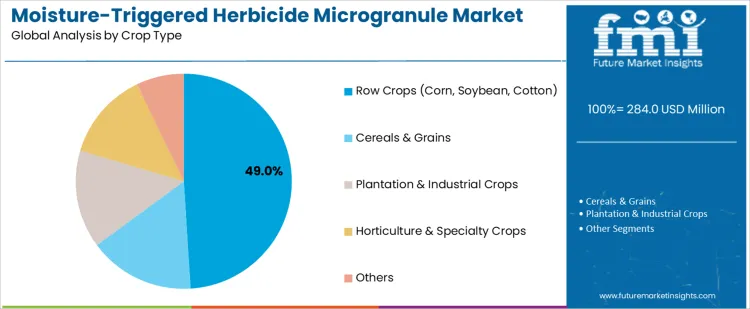
The row crops (corn, soybean, cotton) segment is the largest crop type category in the moisture-triggered herbicide microgranule market, comprising 49% of the market share. This segment's growth is driven by the widespread use of herbicides in these crops to manage weeds effectively and optimize yields. Row crops are critical to global food production, and the adoption of moisture-triggered microgranules helps farmers achieve more efficient weed control. The ability to target weeds with a controlled release activated by moisture improves herbicide effectiveness and reduces the risk of herbicide runoff, aligning with sustainability goals. As demand for these crops continues to rise, particularly in major agricultural regions, the use of moisture-triggered herbicide microgranules is expected to increase, further supporting growth in this segment.
What is Contributing to the Growth of Residual/Pre-Emergent Herbicides in the Herbicide Mode of Action Segment?
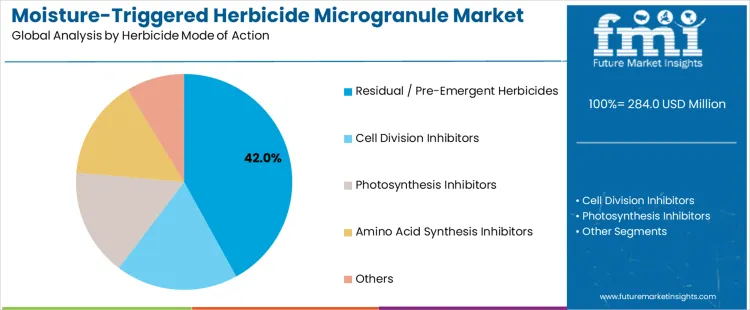
Residual/pre-emergent herbicides are the leading mode of action in the moisture-triggered herbicide microgranule market, accounting for 42% of the market share. These herbicides are favored for their ability to prevent weed germination before it occurs, which is critical in ensuring crop protection throughout the growing season. The growth of this segment is driven by the need for proactive weed management, particularly in crops like row crops, cereals, and grains, where early-stage weed control is essential for maximizing yields. Moisture-triggered microgranules enhance the effectiveness of residual herbicides by allowing for a controlled release when moisture is present, ensuring that herbicides are applied exactly when needed. As farmers increasingly focus on sustainable practices and effective crop protection solutions, the demand for residual and pre-emergent herbicides in moisture-triggered formats is expected to rise, contributing to the segment's growth.
What are the Key Dynamics of the Global Moisture-Triggered Herbicide Microgranule Market?
The global moisture-triggered herbicide microgranule market is expanding as agricultural producers seek targeted weed control that activates with soil moisture. These microgranules release herbicidal active ingredients precisely when conditions favor uptake, improving efficiency and reducing off target exposure. Growth is supported by demand for sustainable crop protection solutions, rising global food production needs, and adoption of precision farming practices. Use spans row crops, specialty crops and turf management where optimized release profiles help manage resistant weed species and enhance field performance across diverse geographies.
What are the Key Drivers for the Global Moisture Triggered Herbicide Microgranule Market?
Rising adoption of advanced crop protection technologies drives interest in moisture-triggered microgranules that align release with environmental conditions. Farmers focus on improving application efficiency and reducing frequency of treatments, which supports labor savings and cost management. Increasing prevalence of herbicide resistant weeds encourages use of formulations that deliver consistent active ingredient exposure under optimal soil moisture. Expansion of precision agriculture and digital soil moisture mapping enhances alignment of input timing with crop and field conditions. Regulatory emphasis on minimizing environmental impact and runoff motivates use of controlled release formats that lower non target movement compared with conventional sprays.
What are the Restraints for the Global Moisture Triggered Herbicide Microgranule Market?
A restraint is the higher development and formulation cost of moisture-triggered microgranules relative to standard herbicide products. Specialized granule design, material science, and soil interaction research increase production expense, which can affect pricing in cost sensitive agricultural segments. Some growers remain cautious about transitioning from familiar liquid or conventional dry formulations without localized performance data. Compatibility with wide ranges of soil types, moisture patterns and crop systems requires extensive field validation, which adds time and resource needs for suppliers. Variability in regulatory requirements and approval timelines across regions creates planning complexity for product launches and market entry.
What is the Key Trends in the Global Moisture Triggered Herbicide Microgranule Market?
A key trend is integration of advanced carriers and polymer matrices that improve moisture responsiveness and control active ingredient release kinetics. Formulators are combining microgranule platforms with multiple modes of action to address resistant weed populations while supporting crop safety. Use of data driven application guidance based on soil moisture sensors and weather forecasting enhances timing accuracy and product performance. Partnerships between agritech firms, distributors and crop advisors are increasing to support education and field trial programs that demonstrate value. Growth of sustainability focused procurement standards and stewardship programs encourages adoption of precision activated herbicide solutions that align agronomic goals with environmental considerations.
What is the Country-Wise Analysis of the Moisture-Triggered Herbicide Microgranule Market?
The moisture-triggered herbicide microgranule market is projected to grow rapidly, driven by increasing demand for efficient and sustainable agricultural solutions. These microgranules release herbicide when exposed to moisture, providing more controlled and targeted application, which reduces the overall environmental impact. As the agricultural industry seeks to improve productivity while minimizing chemical use, moisture-triggered microgranules are gaining traction in key markets. High-growth regions like the United States, Brazil, and Argentina are experiencing strong demand due to their expansive agricultural sectors. Meanwhile, markets in China and Australia are also showing significant adoption as they seek to optimize herbicide use. The growth in these markets is largely driven by advancements in agricultural technology and an increasing focus on sustainable farming practices.
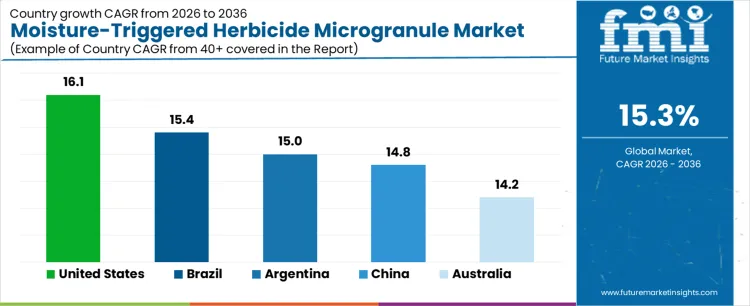
| Country | CAGR (2026 to 2036) |
|---|---|
| United States | 16.1% |
| Brazil | 15.4% |
| China | 14.8% |
| Argentina | 15% |
| Australia | 14.2% |
What is the Growth Outlook for the Moisture-Triggered Herbicide Microgranule Market in the United States?
The moisture-triggered herbicide microgranule market in the United States is expected to grow rapidly, with a projected CAGR of 16.1%. The U.S. agricultural industry, which is one of the largest in the world, is increasingly adopting advanced technologies to improve efficiency and sustainability. As the demand for more targeted, eco-friendly herbicide application grows, moisture-triggered microgranules are becoming more popular. These products help reduce herbicide waste and improve crop protection by releasing active ingredients only when moisture is present. With a growing emphasis on sustainable farming practices and regulatory pressures on chemical use, the U.S. market for moisture-triggered herbicide microgranules is set to expand significantly.
What is the Market Outlook for the Moisture-Triggered Herbicide Microgranule Market in Brazil?
The moisture-triggered herbicide microgranule market in Brazil is projected to grow at a strong rate, with a projected CAGR of 15.4%. Brazil, being one of the largest agricultural producers in the world, is increasingly focusing on adopting innovative solutions to optimize herbicide use and reduce environmental impact. As Brazilian farmers seek more efficient ways to control weeds while minimizing chemical inputs, moisture-triggered herbicide microgranules are gaining traction. Additionally, Brazil’s focus on sustainable agriculture and reducing the impact of traditional herbicide methods is driving the market growth. With a vast agricultural sector and a push for sustainability, Brazil is poised to experience significant growth in the adoption of these advanced herbicide delivery systems.
What is the Growth Forecast for the Moisture-Triggered Herbicide Microgranule Market in China?
The moisture-triggered herbicide microgranule market in China is expected to grow steadily, with a projected CAGR of 14.8%. China’s large agricultural industry and growing need for sustainable farming solutions are driving the demand for moisture-triggered microgranules. The country is increasingly focusing on reducing the use of traditional herbicides and improving the efficiency of herbicide application to minimize environmental damage. As China looks to modernize its agricultural practices and adopt more eco-friendly solutions, moisture-triggered herbicide microgranules are becoming a preferred choice. With a focus on improving crop yields and reducing chemical usage, China’s market for moisture-triggered microgranules is expected to experience steady growth.
What is the Market Outlook for the Moisture-Triggered Herbicide Microgranule Market in Argentina?
The moisture-triggered herbicide microgranule market in Argentina is projected to grow at a strong pace, with a projected CAGR of 15%. Argentina’s large agricultural sector, particularly in the production of soybeans, corn, and wheat, is seeing increased adoption of sustainable farming practices. As farmers seek more efficient ways to apply herbicides while reducing environmental impact, moisture-triggered microgranules are becoming increasingly popular. With the demand for more targeted and eco-friendly herbicide applications rising, Argentina’s market is expected to see significant growth in the coming years. The country’s focus on increasing agricultural productivity while minimizing chemical use is expected to drive the adoption of these innovative packaging systems.
What are the Growth Prospects for the Moisture-Triggered Herbicide Microgranule Market in Australia?
The moisture-triggered herbicide microgranule market in Australia is expected to experience steady growth, with a projected CAGR of 14.2%. Australia’s agricultural sector, particularly in the production of grains and cotton, is focusing on improving efficiency and sustainability. As water scarcity and environmental concerns become increasingly important, moisture-triggered microgranules are seen as a solution that can reduce herbicide waste and improve crop protection. The Australian market is growing as farmers look for more sustainable ways to manage weeds and enhance crop yields while minimizing the environmental footprint of chemical inputs. With growing emphasis on sustainable farming and technological innovation, the demand for moisture-triggered herbicide microgranules in Australia is set to increase steadily.
What is the Competitive Landscape for the Moisture-Triggered Herbicide Microgranule Market?
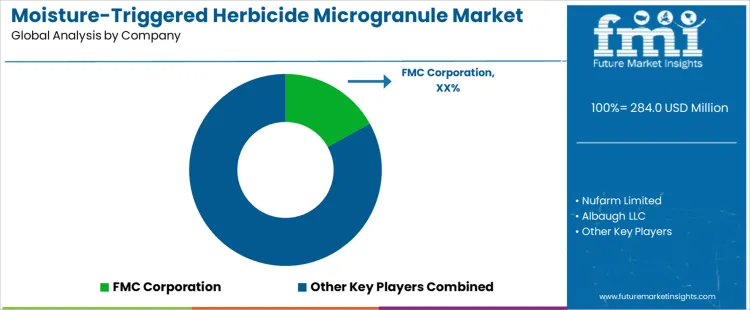
The moisture-triggered herbicide microgranule market is growing as agricultural companies seek advanced solutions for precise and efficient herbicide application. FMC Corporation leads the market with its innovative moisture-triggered herbicide microgranules, designed to enhance the targeted delivery of herbicides and improve their effectiveness. Their focus on precision agriculture and sustainability has positioned them as a key player in the market. Nufarm Limited, Albaugh LLC, and Gowan Company are major competitors, each offering advanced herbicide formulations that utilize microgranule technologies for controlled release and improved environmental safety. Nufarm Limited and Albaugh LLC focus on cost-effective, high-performance microgranules, while Gowan Company specializes in providing specialized solutions for different crop protection needs.
Sipcam Oxon and Others further contribute to the competitive dynamics by offering alternative formulations in the moisture-triggered herbicide microgranule space. Sipcam Oxon focuses on developing innovative, sustainable agricultural solutions that improve herbicide efficiency, while other companies continue to innovate in this niche market by providing effective, environmentally friendly solutions for herbicide application. These companies compete through product efficacy, sustainability, and the ability to offer controlled, moisture-triggered release mechanisms that improve crop protection and minimize environmental impact.
Key Players of the Moisture-Triggered Herbicide Microgranule Market
- FMC Corporation
- Nufarm Limited
- Albaugh LLC
- Gowan Company
- Sipcam Oxon
- Others
Scope of the Report
| Items | Values |
|---|---|
| Quantitative Units (2026) | USD Million |
| Microgranule Technology Type | Moisture-Activated Polymer-Coated Granules, Clay-Matrix Swell-Release Granules, Biodegradable Starch-Based Microgranules, Wax-Encapsulated Delayed-Release Granules, Others |
| Herbicide Mode of Action | Residual / Pre-Emergent Herbicides, Cell Division Inhibitors, Photosynthesis Inhibitors, Amino Acid Synthesis Inhibitors, Others |
| Crop Type | Row Crops (Corn, Soybean, Cotton), Cereals & Grains, Plantation & Industrial Crops, Horticulture & Specialty Crops, Others |
| Companies | FMC Corporation, Nufarm Limited, Albaugh LLC, Gowan Company, Sipcam Oxon, Others |
| Regions Covered | North America, Latin America, Western Europe, Eastern Europe, South Asia and Pacific, East Asia, Middle East & Africa |
| Countries Covered | United States, Canada, Mexico, Brazil, Argentina, Germany, France, United Kingdom, Italy, Spain, Netherlands, China, India, Japan, South Korea, ANZ, GCC Countries, South Africa |
| Additional Attributes | Dollar by sales by microgranule technology type, herbicide mode of action, crop type, and region. Includes market trends in moisture-triggered herbicide microgranules, focusing on polymer-coated, clay-matrix, biodegradable, and wax-encapsulated granules. Highlights the role of residual, pre-emergent, photosynthesis, and amino acid synthesis inhibitors in various crop types like row crops, cereals, and horticulture. Focus on cost-effectiveness, sustainability, regulatory compliance, market share, and competitive positioning of key companies. |
Moisture-Triggered Herbicide Microgranule Market Segmentation
Microgranule Technology Type
- Moisture-Activated Polymer-Coated Granules
- Clay-Matrix Swell-Release Granules
- Biodegradable Starch-Based Microgranules
- Wax-Encapsulated Delayed-Release Granules
- Others
Herbicide Mode of Action
- Residual / Pre-Emergent Herbicides
- Cell Division Inhibitors
- Photosynthesis Inhibitors
- Amino Acid Synthesis Inhibitors
- Others
Crop Type
- Row Crops (Corn, Soybean, Cotton)
- Cereals & Grains
- Plantation & Industrial Crops
- Horticulture & Specialty Crops
- Others
Region
- Asia Pacific
- China
- Japan
- South Korea
- India
- Australia & New Zealand
- ASEAN
- Rest of Asia Pacific
- Europe
- Germany
- United Kingdom
- France
- Italy
- Spain
- Nordic
- BENELUX
- Rest of Europe
- North America
- United States
- Canada
- Mexico
- Latin America
- Brazil
- Chile
- Rest of Latin America
- Middle East & Africa
- Kingdom of Saudi Arabia
- Other GCC Countries
- Turkey
- South Africa
- Other African Union
- Rest of Middle East & Africa
Frequently Asked Questions
How big is the moisture-triggered herbicide microgranule market in 2026?
The global moisture-triggered herbicide microgranule market is estimated to be valued at USD 284.0 million in 2026.
What will be the size of moisture-triggered herbicide microgranule market in 2036?
The market size for the moisture-triggered herbicide microgranule market is projected to reach USD 1,179.3 million by 2036.
How much will be the moisture-triggered herbicide microgranule market growth between 2026 and 2036?
The moisture-triggered herbicide microgranule market is expected to grow at a 15.3% CAGR between 2026 and 2036.
What are the key product types in the moisture-triggered herbicide microgranule market?
The key product types in moisture-triggered herbicide microgranule market are moisture-activated polymer-coated granules, clay-matrix swell-release granules, biodegradable starch-based microgranules, wax-encapsulated delayed-release granules and others.
Which herbicide mode of action segment to contribute significant share in the moisture-triggered herbicide microgranule market in 2026?
In terms of herbicide mode of action, residual / pre-emergent herbicides segment to command 42.0% share in the moisture-triggered herbicide microgranule market in 2026.
Preview the report firsthand - request a free sample
Get SampleGet the brochure for pricing and purchase details.
Get PDFTable of Content
- Executive Summary
- Global Market Outlook
- Demand-side Trends
- Supply-side Trends
- Technology Roadmap Analysis
- Analysis and Recommendations
- Market Overview
- Market Coverage / Taxonomy
- Market Definition / Scope / Limitations
- Market Background
- Market Dynamics
- Drivers
- Restraints
- Opportunity
- Trends
- Scenario Forecast
- Demand in Optimistic Scenario
- Demand in Likely Scenario
- Demand in Conservative Scenario
- Opportunity Map Analysis
- Product Life Cycle Analysis
- Supply Chain Analysis
- Investment Feasibility Matrix
- Value Chain Analysis
- PESTLE and Porter’s Analysis
- Regulatory Landscape
- Regional Parent Market Outlook
- Production and Consumption Statistics
- Import and Export Statistics
- Market Dynamics
- Global Market Analysis 2021 to 2025 and Forecast, 2026 to 2036
- Historical Market Size Value (USD Million) Analysis, 2021 to 2025
- Current and Future Market Size Value (USD Million) Projections, 2026 to 2036
- Y-o-Y Growth Trend Analysis
- Absolute $ Opportunity Analysis
- Global Market Pricing Analysis 2021 to 2025 and Forecast 2026 to 2036
- Global Market Analysis 2021 to 2025 and Forecast 2026 to 2036, By Microgranule Technology Type
- Introduction / Key Findings
- Historical Market Size Value (USD Million) Analysis By Microgranule Technology Type , 2021 to 2025
- Current and Future Market Size Value (USD Million) Analysis and Forecast By Microgranule Technology Type , 2026 to 2036
- Moisture-Activated Polymer-Coated Granules
- Clay-Matrix Swell-Release Granules
- Biodegradable Starch-Based Microgranules
- Wax-Encapsulated Delayed-Release Granules
- Others
- Y-o-Y Growth Trend Analysis By Microgranule Technology Type , 2021 to 2025
- Absolute $ Opportunity Analysis By Microgranule Technology Type , 2026 to 2036
- Global Market Analysis 2021 to 2025 and Forecast 2026 to 2036, By Herbicide Mode of Action
- Introduction / Key Findings
- Historical Market Size Value (USD Million) Analysis By Herbicide Mode of Action, 2021 to 2025
- Current and Future Market Size Value (USD Million) Analysis and Forecast By Herbicide Mode of Action, 2026 to 2036
- Residual / Pre-Emergent Herbicides
- Cell Division Inhibitors
- Photosynthesis Inhibitors
- Amino Acid Synthesis Inhibitors
- Others
- Y-o-Y Growth Trend Analysis By Herbicide Mode of Action, 2021 to 2025
- Absolute $ Opportunity Analysis By Herbicide Mode of Action, 2026 to 2036
- Global Market Analysis 2021 to 2025 and Forecast 2026 to 2036, By Crop Type
- Introduction / Key Findings
- Historical Market Size Value (USD Million) Analysis By Crop Type, 2021 to 2025
- Current and Future Market Size Value (USD Million) Analysis and Forecast By Crop Type, 2026 to 2036
- Row Crops (Corn, Soybean, Cotton)
- Cereals & Grains
- Plantation & Industrial Crops
- Horticulture & Specialty Crops
- Others
- Y-o-Y Growth Trend Analysis By Crop Type, 2021 to 2025
- Absolute $ Opportunity Analysis By Crop Type, 2026 to 2036
- Global Market Analysis 2021 to 2025 and Forecast 2026 to 2036, By Region
- Introduction
- Historical Market Size Value (USD Million) Analysis By Region, 2021 to 2025
- Current Market Size Value (USD Million) Analysis and Forecast By Region, 2026 to 2036
- North America
- Latin America
- Western Europe
- Eastern Europe
- East Asia
- South Asia and Pacific
- Middle East & Africa
- Market Attractiveness Analysis By Region
- North America Market Analysis 2021 to 2025 and Forecast 2026 to 2036, By Country
- Historical Market Size Value (USD Million) Trend Analysis By Market Taxonomy, 2021 to 2025
- Market Size Value (USD Million) Forecast By Market Taxonomy, 2026 to 2036
- By Country
- USA
- Canada
- Mexico
- By Microgranule Technology Type
- By Herbicide Mode of Action
- By Crop Type
- By Country
- Market Attractiveness Analysis
- By Country
- By Microgranule Technology Type
- By Herbicide Mode of Action
- By Crop Type
- Key Takeaways
- Latin America Market Analysis 2021 to 2025 and Forecast 2026 to 2036, By Country
- Historical Market Size Value (USD Million) Trend Analysis By Market Taxonomy, 2021 to 2025
- Market Size Value (USD Million) Forecast By Market Taxonomy, 2026 to 2036
- By Country
- Brazil
- Chile
- Rest of Latin America
- By Microgranule Technology Type
- By Herbicide Mode of Action
- By Crop Type
- By Country
- Market Attractiveness Analysis
- By Country
- By Microgranule Technology Type
- By Herbicide Mode of Action
- By Crop Type
- Key Takeaways
- Western Europe Market Analysis 2021 to 2025 and Forecast 2026 to 2036, By Country
- Historical Market Size Value (USD Million) Trend Analysis By Market Taxonomy, 2021 to 2025
- Market Size Value (USD Million) Forecast By Market Taxonomy, 2026 to 2036
- By Country
- Germany
- UK
- Italy
- Spain
- France
- Nordic
- BENELUX
- Rest of Western Europe
- By Microgranule Technology Type
- By Herbicide Mode of Action
- By Crop Type
- By Country
- Market Attractiveness Analysis
- By Country
- By Microgranule Technology Type
- By Herbicide Mode of Action
- By Crop Type
- Key Takeaways
- Eastern Europe Market Analysis 2021 to 2025 and Forecast 2026 to 2036, By Country
- Historical Market Size Value (USD Million) Trend Analysis By Market Taxonomy, 2021 to 2025
- Market Size Value (USD Million) Forecast By Market Taxonomy, 2026 to 2036
- By Country
- Russia
- Poland
- Hungary
- Balkan & Baltic
- Rest of Eastern Europe
- By Microgranule Technology Type
- By Herbicide Mode of Action
- By Crop Type
- By Country
- Market Attractiveness Analysis
- By Country
- By Microgranule Technology Type
- By Herbicide Mode of Action
- By Crop Type
- Key Takeaways
- East Asia Market Analysis 2021 to 2025 and Forecast 2026 to 2036, By Country
- Historical Market Size Value (USD Million) Trend Analysis By Market Taxonomy, 2021 to 2025
- Market Size Value (USD Million) Forecast By Market Taxonomy, 2026 to 2036
- By Country
- China
- Japan
- South Korea
- By Microgranule Technology Type
- By Herbicide Mode of Action
- By Crop Type
- By Country
- Market Attractiveness Analysis
- By Country
- By Microgranule Technology Type
- By Herbicide Mode of Action
- By Crop Type
- Key Takeaways
- South Asia and Pacific Market Analysis 2021 to 2025 and Forecast 2026 to 2036, By Country
- Historical Market Size Value (USD Million) Trend Analysis By Market Taxonomy, 2021 to 2025
- Market Size Value (USD Million) Forecast By Market Taxonomy, 2026 to 2036
- By Country
- India
- ASEAN
- Australia & New Zealand
- Rest of South Asia and Pacific
- By Microgranule Technology Type
- By Herbicide Mode of Action
- By Crop Type
- By Country
- Market Attractiveness Analysis
- By Country
- By Microgranule Technology Type
- By Herbicide Mode of Action
- By Crop Type
- Key Takeaways
- Middle East & Africa Market Analysis 2021 to 2025 and Forecast 2026 to 2036, By Country
- Historical Market Size Value (USD Million) Trend Analysis By Market Taxonomy, 2021 to 2025
- Market Size Value (USD Million) Forecast By Market Taxonomy, 2026 to 2036
- By Country
- Kingdom of Saudi Arabia
- Other GCC Countries
- Turkiye
- South Africa
- Other African Union
- Rest of Middle East & Africa
- By Microgranule Technology Type
- By Herbicide Mode of Action
- By Crop Type
- By Country
- Market Attractiveness Analysis
- By Country
- By Microgranule Technology Type
- By Herbicide Mode of Action
- By Crop Type
- Key Takeaways
- Key Countries Market Analysis
- USA
- Pricing Analysis
- Market Share Analysis, 2025
- By Microgranule Technology Type
- By Herbicide Mode of Action
- By Crop Type
- Canada
- Pricing Analysis
- Market Share Analysis, 2025
- By Microgranule Technology Type
- By Herbicide Mode of Action
- By Crop Type
- Mexico
- Pricing Analysis
- Market Share Analysis, 2025
- By Microgranule Technology Type
- By Herbicide Mode of Action
- By Crop Type
- Brazil
- Pricing Analysis
- Market Share Analysis, 2025
- By Microgranule Technology Type
- By Herbicide Mode of Action
- By Crop Type
- Chile
- Pricing Analysis
- Market Share Analysis, 2025
- By Microgranule Technology Type
- By Herbicide Mode of Action
- By Crop Type
- Germany
- Pricing Analysis
- Market Share Analysis, 2025
- By Microgranule Technology Type
- By Herbicide Mode of Action
- By Crop Type
- UK
- Pricing Analysis
- Market Share Analysis, 2025
- By Microgranule Technology Type
- By Herbicide Mode of Action
- By Crop Type
- Italy
- Pricing Analysis
- Market Share Analysis, 2025
- By Microgranule Technology Type
- By Herbicide Mode of Action
- By Crop Type
- Spain
- Pricing Analysis
- Market Share Analysis, 2025
- By Microgranule Technology Type
- By Herbicide Mode of Action
- By Crop Type
- France
- Pricing Analysis
- Market Share Analysis, 2025
- By Microgranule Technology Type
- By Herbicide Mode of Action
- By Crop Type
- India
- Pricing Analysis
- Market Share Analysis, 2025
- By Microgranule Technology Type
- By Herbicide Mode of Action
- By Crop Type
- ASEAN
- Pricing Analysis
- Market Share Analysis, 2025
- By Microgranule Technology Type
- By Herbicide Mode of Action
- By Crop Type
- Australia & New Zealand
- Pricing Analysis
- Market Share Analysis, 2025
- By Microgranule Technology Type
- By Herbicide Mode of Action
- By Crop Type
- China
- Pricing Analysis
- Market Share Analysis, 2025
- By Microgranule Technology Type
- By Herbicide Mode of Action
- By Crop Type
- Japan
- Pricing Analysis
- Market Share Analysis, 2025
- By Microgranule Technology Type
- By Herbicide Mode of Action
- By Crop Type
- South Korea
- Pricing Analysis
- Market Share Analysis, 2025
- By Microgranule Technology Type
- By Herbicide Mode of Action
- By Crop Type
- Russia
- Pricing Analysis
- Market Share Analysis, 2025
- By Microgranule Technology Type
- By Herbicide Mode of Action
- By Crop Type
- Poland
- Pricing Analysis
- Market Share Analysis, 2025
- By Microgranule Technology Type
- By Herbicide Mode of Action
- By Crop Type
- Hungary
- Pricing Analysis
- Market Share Analysis, 2025
- By Microgranule Technology Type
- By Herbicide Mode of Action
- By Crop Type
- Kingdom of Saudi Arabia
- Pricing Analysis
- Market Share Analysis, 2025
- By Microgranule Technology Type
- By Herbicide Mode of Action
- By Crop Type
- Turkiye
- Pricing Analysis
- Market Share Analysis, 2025
- By Microgranule Technology Type
- By Herbicide Mode of Action
- By Crop Type
- South Africa
- Pricing Analysis
- Market Share Analysis, 2025
- By Microgranule Technology Type
- By Herbicide Mode of Action
- By Crop Type
- USA
- Market Structure Analysis
- Competition Dashboard
- Competition Benchmarking
- Market Share Analysis of Top Players
- By Regional
- By Microgranule Technology Type
- By Herbicide Mode of Action
- By Crop Type
- Competition Analysis
- Competition Deep Dive
- FMC Corporation
- Overview
- Product Portfolio
- Profitability by Market Segments (Product/Age /Sales Channel/Region)
- Sales Footprint
- Strategy Overview
- Marketing Strategy
- Product Strategy
- Channel Strategy
- Nufarm Limited
- Albaugh LLC
- Gowan Company
- Sipcam Oxon
- Others
- FMC Corporation
- Competition Deep Dive
- Assumptions & Acronyms Used
- Research Methodology


