

- Industry Size (2026)
- USD 78.8 Mn
- Forecast (2036)
- USD 297.3 Mn
- CAGR (2026 to 2036)
- 14.2%
Slurry-To-Precision Fertilizer Conversion Chemistry Market Forecast and Outlook 2026 to 2036
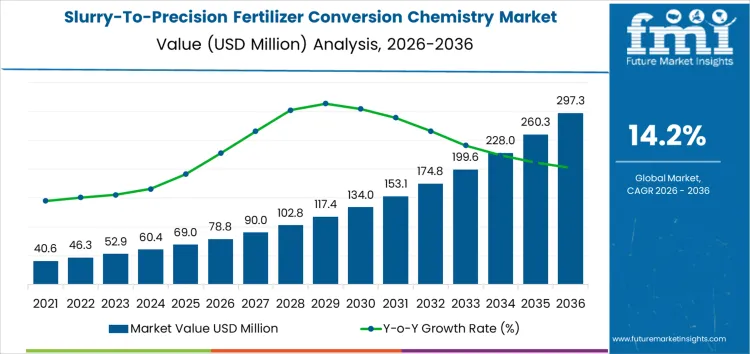
The slurry-to-precision fertilizer conversion chemistry market is valued at USD 78.8 million in 2026 and is projected to reach USD 297.3 million by 2036, with a compound annual growth rate (CAGR) of 14.2%. The industry’s growth quality will be shaped by application concentration, with a strong focus on agricultural sectors requiring high-efficiency fertilizer conversion processes. End-use dependency will drive adoption in large-scale agricultural operations, where precision fertilization is crucial for optimizing yields while minimizing waste. Volume stability will play a critical role, as the need for consistent, reliable performance over extended periods becomes essential in large-scale farming systems. Suppliers that can provide both scalability and precision will be in a strong position to capture market share. However, the growth of this market will also be influenced by the ability to navigate regulatory hurdles and maintain cost-effectiveness. Companies able to integrate technological advancements with operational reliability will lead the way in this expanding segment.
Quick Stats of the Slurry-To-Precision Fertilizer Conversion Chemistry Market
- Slurry-To-Precision Fertilizer Conversion Chemistry Market Value (2026): USD 78.8 million
- Slurry-To-Precision Fertilizer Conversion Chemistry Market Forecast Value (2036): USD 297.3 million
- Slurry-To-Precision Fertilizer Conversion Chemistry Market Global Forecast CAGR (2026 to 2036): 14.2%
- Slurry-To-Precision Fertilizer Conversion Chemistry Market Leading Segment: Sales Channel (Ag-Retailers) 60%
- Key Growth Regions in Slurry-To-Precision Fertilizer Conversion Chemistry Market: Netherlands
- Top Players in Slurry-To-Precision Fertilizer Conversion Chemistry Market: BASF, Nutrien, Yara International, Veolia, Suez, Kemira
What is the Growth Forecast for the Slurry-To-Precision Fertilizer Conversion Chemistry Market through 2036?
The 10-year growth comparison for the slurry-to-precision fertilizer conversion chemistry market highlights the rapid acceleration in the early years followed by steady growth as the market matures. From USD 78.8 million in 2026, the market is projected to grow to USD 153.1 million by 2031, representing an increase of USD 74.3 million. This growth in the first half of the forecast period is driven by the early adoption of precision fertilizer technologies and increasing demand for more efficient farming solutions.
From 2031 to 2036, the market will continue to expand, rising from USD 153.1 million in 2031 to USD 297.3 million in 2036, representing an increase of USD 144.2 million over the second half of the forecast period. This stage of the market will reflect the maturing adoption of slurry-to-precision fertilizer conversion technologies as they become more established in global agricultural markets. The growth comparison reveals that the market will see significant momentum in the first five years, driven by innovation and adoption, followed by more steady, sustained expansion as these technologies become standard practice in the fertilizer industry.
Slurry-To-Precision Fertilizer Conversion Chemistry Market Key Takeaways
| Metric | Value |
|---|---|
| Industry Sales Value (2026) | USD 78.8 million |
| Industry Forecast Value (2036) | USD 297.3 million |
| Industry Forecast CAGR (2026-2036) | 14.2% |
What Is Driving the Demand for Slurry-To-Precision Fertilizer Conversion Chemistry?
Historical demand for slurry-to-precision fertilizer conversion chemistry stems from the fundamental use of organic slurries such as livestock manure and biogas slurry as nutrient sources in agriculture. Organic slurries contain nitrogen, phosphorus, potassium, and organic matter that contribute to soil fertility and crop growth when directly applied, but nutrient availability can be slow or uneven and losses such as ammonia volatilization may reduce effective fertilizer value. Techniques such as slurry acidification and physical processing have been used to improve nutrient retention and reduce environmental losses, enabling slurry to function more effectively as a soil amendment or partial fertilizer substitute. Converting slurry into more precise fertilizer formulations aims to make nutrient content more predictable and plant-available by refining the chemistry of slurry components, reducing variability, and increasing reliability in field performance. Research and practice have explored methods of separating fine solids, concentrating nutrients, and blending with mineral fertilizers to produce tailored nutrient products that align with crop needs and application timing. These approaches reflect agronomic efforts to enhance the utility of slurry in nutrient management systems and reduce reliance on conventional synthetic fertilizers.
Future demand for slurry-to-precision fertilizer conversion chemistry is expected to grow as agriculture adopts nutrient-efficient and circular economy practices that maximize the value of organic resources while limiting environmental impacts. Additives and chemical conversion processes that stabilize slurry nutrients, reduce losses, and create products with controlled nutrient release characteristics support precision agriculture objectives. Growth factors include regulatory emphasis on nutrient use efficiency, interest in reducing synthetic fertilizer dependence, and the expansion of anaerobic digestion and organic waste valorization systems that generate large volumes of slurry and digestate. The broader fertilizer additives market, which includes coating, stabilizing, and efficiency-enhancing chemistries, is projected to expand as farmers adopt precision nutrient management tools that align with environmental and productivity goals. Challenges include variability in slurry composition, technical complexity of conversion processes, and the need for cost-effective solutions that produce uniform, agronomically effective products at scale. Continued innovation in slurry processing chemistry and integration with precision agriculture practices could support broader uptake of slurry-to-precision fertilizer conversion solutions in sustainable nutrient management.
What are the Leading Segments in the Global Slurry-To-Precision Fertilizer Conversion Chemistry Market?
The global slurry-to-precision fertilizer conversion chemistry market is segmented by crop and form. Among crop types, cereals lead the market, capturing 50% of the share, followed by oilseeds, fruits, and vegetables. Cereal crops dominate due to their widespread cultivation and the need for precision fertilizers to optimize yields and nutrient uptake. On the form side, granular fertilizers are the most prevalent, holding 45% of the share, followed by liquid, powder, and suspension forms. Granular fertilizers are preferred for their ease of application, slow-release properties, and efficiency in large-scale farming operations.
What Drives the Growth of Cereal Crops in the Slurry-To-Precision Fertilizer Conversion Chemistry Market?
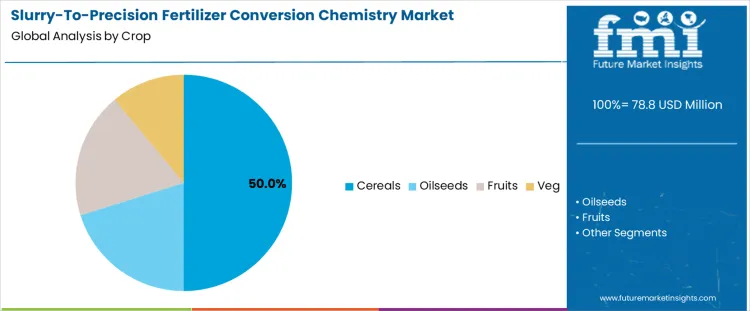
Cereal crops are the leading crop type in the slurry-to-precision fertilizer conversion chemistry market, holding 50% of the share. The demand for precision fertilizers in cereal production is driven by the need to enhance crop yields and ensure optimal nutrient uptake. Cereal crops such as wheat, corn, and rice are vital staples in the global food supply, and their growth relies heavily on fertilizers that can deliver nutrients efficiently. Slurry-to-precision fertilizer conversion technologies are particularly beneficial in providing targeted nutrient application, ensuring minimal waste and optimal use of fertilizers. As the demand for higher yields and sustainable agricultural practices increases, the use of precision fertilizers for cereal crops is expected to continue growing.
What is Driving the Demand for Granular Fertilizers in the Slurry-To-Precision Fertilizer Conversion Chemistry Market?
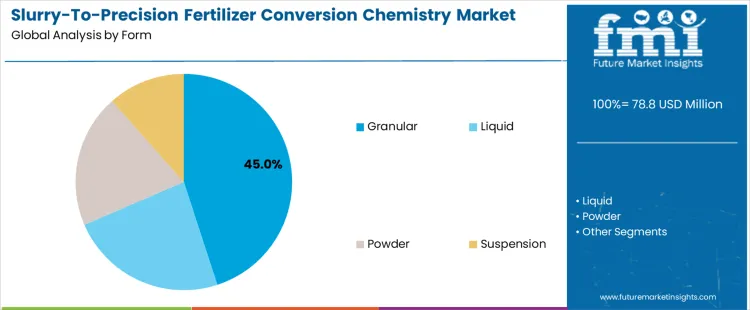
Granular fertilizers are the leading form in the slurry-to-precision fertilizer conversion chemistry market, capturing 45% of the share. This demand is driven by the widespread use of granular fertilizers in large-scale agricultural operations, where ease of application, controlled release, and efficiency are key factors. Granular fertilizers are ideal for precision agriculture as they allow for more uniform nutrient distribution and can be applied with precision equipment, reducing the likelihood of over-fertilization and nutrient loss. Additionally, the compatibility of granular fertilizers with most farming equipment makes them convenient for use across various crops, including cereals. As precision agriculture continues to gain traction, the demand for granular fertilizers in slurry-to-precision fertilizer systems is expected to remain strong.
What are the Key Dynamics in the Slurry-to-Precision Fertilizer Conversion Chemistry Market?
The slurry-to-precision fertilizer conversion chemistry market is influenced by efforts to improve nutrient recovery from livestock and organic waste streams. Conversion chemistries are used to transform slurry into products with defined nutrient profiles that can be applied with targeted placement and timing. Farmers and agribusinesses assess solutions based on nutrient availability, consistency, and ease of integration with existing equipment. Environmental guidelines on nutrient runoff and greenhouse gas emissions affect adoption patterns. Raw material access, logistics of slurry collection, and compatibility with precision application technologies shape how conversion chemistries are developed and used in different agricultural systems.
What are the Main Factors Driving Growth in the Market?
Interest in efficient nutrient management drives growth in the slurry-to-precision fertilizer conversion chemistry market. Producers aim to recover nitrogen, phosphorus, and potassium from animal manures and organic slurries in forms that match crop needs and reduce waste. Soil testing and precision application practices are encouraging use of fertilizers with predictable nutrient release. Policy measures that limit over-application of traditional fertilizers increase attention to alternative nutrient sources. Research into conversion processes that reduce odors and stabilize nutrients expands supplier offerings. Growth in intensive cropping systems with high nutrient demand also underpins interest in converted slurry products.
What Challenges Are Restricting Market Expansion?
Cost barriers can restrict uptake of slurry conversion chemistries, particularly where capital investment in processing infrastructure is required. Variability in slurry composition complicates formulation of standardized products and may lead to inconsistent field performance. Technical issues in controlling nutrient release rates and ensuring product stability can deter some users. Regulatory frameworks for organic waste handling and fertilizer registration differ across regions, adding compliance complexity for suppliers. Logistics of collecting, transporting, and processing slurry at scale can limit adoption in areas with dispersed livestock operations or limited processing facilities.
What Emerging Trends Are Shaping Future Development in the Market?
Advances in chemical and biological conversion methods are improving nutrient stabilization and reducing emissions from processed slurry. Integration of sensor systems and data analytics in nutrient management is supporting more precise application of converted products. Partnerships between livestock producers, technology providers, and fertilizer distributors are increasing to address supply chain challenges. Focus on nutrient budgeting and soil health monitoring is encouraging adoption of products that align nutrient supply with crop requirements. Research into co-products, such as carbon-rich materials from slurry treatment, is expanding potential uses beyond fertilizer alone.
What is the Country-Wise Analysis of the Slurry-To-Precision Fertilizer Conversion Chemistry Market?
The slurry-to-precision fertilizer conversion chemistry market is seeing substantial growth, driven by increasing demand for efficient and sustainable fertilizer solutions. This technology converts slurry waste into high-quality fertilizers, enabling more precise nutrient delivery to crops, thus improving agricultural productivity while minimizing environmental impact. As the agricultural sector seeks to reduce fertilizer waste and optimize resource use, this innovative conversion process is gaining significant attention. Developed markets such as the Netherlands, Germany, and the USA are witnessing strong demand for slurry-to-precision fertilizer conversion technology, driven by their focus on sustainable farming practices and advanced agricultural technologies. Emerging markets like China are also experiencing significant growth, as the country strives to improve its agricultural efficiency and reduce the environmental impact of traditional farming practices. As the need for precision agriculture grows globally, the market for slurry-to-precision fertilizer conversion chemistry is expected to expand in both developed and developing markets.
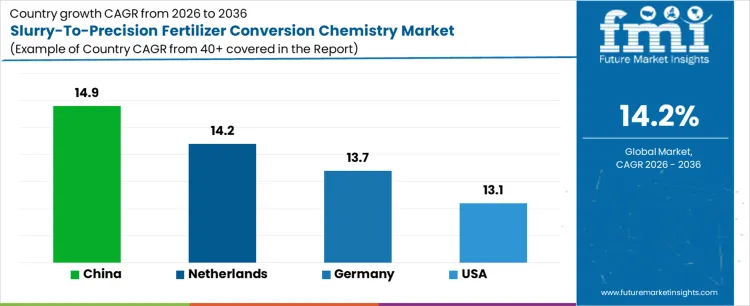
| Country | CAGR (2026 to 2036) |
|---|---|
| Netherlands | 14.2% |
| Germany | 13.7% |
| USA | 13.1% |
| China | 14.9% |
What is the Growth Outlook for the Slurry-To-Precision Fertilizer Conversion Chemistry Market in the Netherlands?
The slurry-to-precision fertilizer conversion chemistry market in the Netherlands is expected to experience robust growth, with a projected CAGR of 14.2% from 2026 to 2036. The Netherlands is a global leader in agricultural innovation and sustainability, with a strong focus on reducing environmental impact through advanced farming techniques. The demand for precision fertilizers, which optimize nutrient delivery to crops while reducing waste, is growing as Dutch farmers seek more sustainable and efficient solutions. The Dutch government’s commitment to promoting sustainable farming practices, along with the country's emphasis on circular economy principles, is further driving the adoption of slurry-to-precision fertilizer conversion technology. As the market for precision agriculture continues to expand, the Netherlands is expected to remain a key player in the growth of this innovative fertilizer conversion market.
What is the Market Outlook for the Slurry-To-Precision Fertilizer Conversion Chemistry Market in Germany?
Germany is projected to experience steady growth in the slurry-to-precision fertilizer conversion chemistry market, with a projected CAGR of 13.7% from 2026 to 2036. Germany is known for its commitment to sustainability and environmental stewardship, making it a key market for technologies that reduce waste and optimize the use of resources in agriculture. Slurry-to-precision fertilizer conversion technology aligns with Germany’s focus on sustainable farming practices and precision agriculture. As German farmers increasingly seek ways to enhance nutrient delivery to crops while reducing environmental pollution, the demand for efficient fertilizer solutions like slurry-to-precision conversion is expected to grow. With strong governmental support for sustainable agriculture and ongoing innovation in the farming sector, the market for slurry-to-precision fertilizer conversion chemistry in Germany is set to expand steadily.
What is the Growth Forecast for the Slurry-To-Precision Fertilizer Conversion Chemistry Market in the USA?
The slurry-to-precision fertilizer conversion chemistry market in the USA is projected to grow steadily, with a projected CAGR of 13.1% from 2026 to 2036. The USA is a major player in the global agricultural market, and the demand for sustainable farming solutions is rapidly increasing. As American farmers face growing pressure to improve efficiency and minimize the environmental impact of traditional farming methods, the adoption of slurry-to-precision fertilizer conversion technology is gaining traction. This technology helps optimize nutrient delivery to crops while reducing waste and runoff, aligning with the broader trend of precision agriculture in the USA The USA government’s emphasis on sustainable farming practices and the growing focus on reducing the carbon footprint of agriculture are expected to drive significant growth in the market for slurry-to-precision fertilizer conversion chemistry.
What is the Market Outlook for the Slurry-To-Precision Fertilizer Conversion Chemistry Market in China?
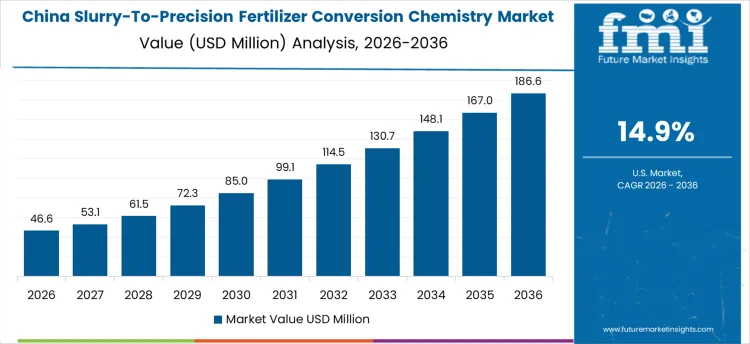
China is expected to experience the highest growth in the slurry-to-precision fertilizer conversion chemistry market, with a projected CAGR of 14.9% from 2026 to 2036. As one of the largest agricultural markets globally, China is under increasing pressure to improve agricultural efficiency and reduce the environmental impact of its farming practices. Slurry-to-precision fertilizer conversion technology offers a promising solution by enabling more efficient use of nutrients and reducing fertilizer waste. With the Chinese government’s focus on promoting sustainable agriculture, reducing pollution, and increasing the adoption of precision farming technologies, the market for slurry-to-precision fertilizer conversion systems is expected to grow rapidly. The country’s large-scale agricultural operations, combined with a growing need to improve soil health and crop yields, position China as a key driver of the global market for this technology.
What are the Growth Prospects for the Slurry-To-Precision Fertilizer Conversion Chemistry Market in India?
India is projected to see steady growth in the slurry-to-precision fertilizer conversion chemistry market, with a projected CAGR of 13.5% from 2026 to 2036. India’s agricultural sector, which is essential to the country’s economy, faces significant challenges related to inefficient fertilizer use and environmental sustainability. Slurry-to-precision fertilizer conversion technology is seen as a key solution to optimize nutrient delivery and reduce fertilizer waste, aligning with India’s broader goals of improving agricultural productivity while minimizing environmental impact. As the Indian government pushes for more sustainable farming practices and increased adoption of precision agriculture technologies, the demand for slurry-to-precision fertilizer systems is expected to grow. With India’s vast agricultural base and increasing need for efficient, eco-friendly farming solutions, the market for this technology is poised for strong expansion in the coming years.
What is the Competitive Landscape for the Slurry-To-Precision Fertilizer Conversion Chemistry Market?
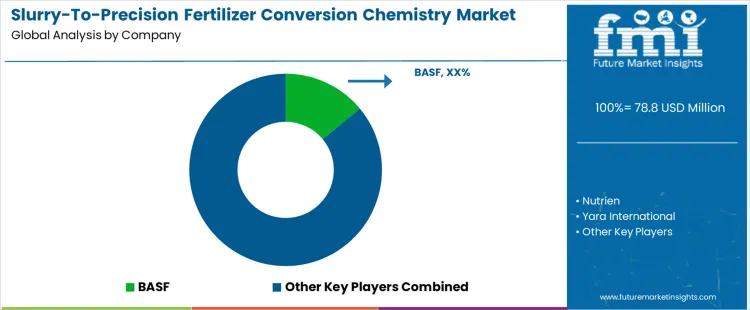
The slurry-to-precision fertilizer conversion chemistry market is growing rapidly as the agricultural industry seeks more efficient and sustainable ways to transform slurry waste into high-performance fertilizers. BASF leads the market with its advanced slurry-to-precision fertilizer conversion technologies, offering high-efficiency solutions that convert agricultural and industrial slurry into precision fertilizers, reducing waste and optimizing nutrient delivery for crops. Their focus on product innovation, sustainability, and regulatory compliance has positioned them as a dominant player in this market. Nutrien, Yara International, and Veolia are key competitors, each providing specialized solutions designed to improve nutrient recovery and fertilizer quality from slurry. Nutrien offers a broad portfolio of precision fertilizers, while Yara International focuses on sustainable solutions that optimize nutrient efficiency, and Veolia provides technologies that support waste management and fertilizer conversion in agricultural applications.
Suez and Kemira further contribute to the competitive landscape by offering their own solutions for converting slurry waste into value-added fertilizers. Suez specializes in water and waste treatment technologies, including slurry-to-fertilizer conversion, while Kemira focuses on sustainable chemical solutions that enhance nutrient recycling and fertilizer production. These companies compete by focusing on technological innovation, sustainability, and the ability to meet the growing demand for efficient, eco-friendly fertilizer production solutions. As the agricultural industry continues to prioritize sustainability and waste reduction, the market for slurry-to-precision fertilizer conversion chemistry is expected to continue growing, driving further competition and innovation.
Key Players of the Slurry-To-Precision Fertilizer Conversion Chemistry Market
- BASF
- Nutrien
- Yara International
- Veolia
- Suez
- Kemira
Scope of the Report
| Items | Values |
|---|---|
| Quantitative Units (2026) | USD Million |
| Crop | Cereals, Oilseeds, Fruits, Vegetables |
| Form | Granular, Liquid, Powder, Suspension |
| Sales Channel | Ag-Retailers, Direct-to-Farmer, Online Marketplaces, Cooperatives |
| Companies | BASF, Nutrien, Yara International, Veolia, Suez, Kemira |
| Regions Covered | North America, Latin America, Western Europe, Eastern Europe, South Asia & Pacific, East Asia, Middle East & Africa |
| Countries Covered | United States, Canada, Mexico, Brazil, Argentina, Germany, France, United Kingdom, Italy, Spain, Netherlands, China, India, Japan, South Korea, ANZ, GCC Countries, South Africa |
| Additional Attributes | Dollar by sales by crop, form, sales channel, and region. Includes analysis of market trends in slurry-to-precision fertilizer conversion chemistry adoption, performance of conversion products in precision fertilizer applications, formulation and processing cost factors, regulatory and environmental considerations affecting conversion chemistry use, adoption patterns among agricultural producers, market share and competitive positioning of key companies, innovations in slurry conversion technologies, and evaluation of impact on nutrient use efficiency, crop yield outcomes, and operational precision in fertilizer applications. |
Slurry-To-Precision Fertilizer Conversion Chemistry Market Segmentation
Crop
- Cereals
- Oilseeds
- Fruits
- Vegetables
Form
- Granular
- Liquid
- Powder
- Suspension
Sales Channel
- Ag-Retailers
- Direct-to-Farmer
- Online Marketplaces
- Cooperatives
Region
- Asia Pacific
- China
- Japan
- South Korea
- India
- Australia & New Zealand
- ASEAN
- Rest of Asia Pacific
- Europe
- Germany
- United Kingdom
- France
- Italy
- Spain
- Nordic
- BENELUX
- Rest of Europe
- North America
- United States
- Canada
- Mexico
- Latin America
- Brazil
- Chile
- Rest of Latin America
- Middle East & Africa
- Kingdom of Saudi Arabia
- Other GCC Countries
- Turkey
- South Africa
- Other African Union
- Rest of Middle East & Africa
Frequently Asked Questions
How big is the slurry-to-precision fertilizer conversion chemistry market in 2026?
The global slurry-to-precision fertilizer conversion chemistry market is estimated to be valued at USD 78.8 million in 2026.
What will be the size of slurry-to-precision fertilizer conversion chemistry market in 2036?
The market size for the slurry-to-precision fertilizer conversion chemistry market is projected to reach USD 297.3 million by 2036.
How much will be the slurry-to-precision fertilizer conversion chemistry market growth between 2026 and 2036?
The slurry-to-precision fertilizer conversion chemistry market is expected to grow at a 14.2% CAGR between 2026 and 2036.
What are the key product types in the slurry-to-precision fertilizer conversion chemistry market?
The key product types in slurry-to-precision fertilizer conversion chemistry market are cereals, oilseeds, fruits and veg.
Which form segment to contribute significant share in the slurry-to-precision fertilizer conversion chemistry market in 2026?
In terms of form, granular segment to command 45.0% share in the slurry-to-precision fertilizer conversion chemistry market in 2026.
Preview the report firsthand - request a free sample
Get SampleGet the brochure for pricing and purchase details.
Get PDFTable of Content
- Executive Summary
- Global Market Outlook
- Demand-side Trends
- Supply-side Trends
- Technology Roadmap Analysis
- Analysis and Recommendations
- Market Overview
- Market Coverage / Taxonomy
- Market Definition / Scope / Limitations
- Market Background
- Market Dynamics
- Drivers
- Restraints
- Opportunity
- Trends
- Scenario Forecast
- Demand in Optimistic Scenario
- Demand in Likely Scenario
- Demand in Conservative Scenario
- Opportunity Map Analysis
- Product Life Cycle Analysis
- Supply Chain Analysis
- Investment Feasibility Matrix
- Value Chain Analysis
- PESTLE and Porter’s Analysis
- Regulatory Landscape
- Regional Parent Market Outlook
- Production and Consumption Statistics
- Import and Export Statistics
- Market Dynamics
- Global Market Analysis 2021 to 2025 and Forecast, 2026 to 2036
- Historical Market Size Value (USD Million) Analysis, 2021 to 2025
- Current and Future Market Size Value (USD Million) Projections, 2026 to 2036
- Y-o-Y Growth Trend Analysis
- Absolute $ Opportunity Analysis
- Global Market Pricing Analysis 2021 to 2025 and Forecast 2026 to 2036
- Global Market Analysis 2021 to 2025 and Forecast 2026 to 2036, By Crop
- Introduction / Key Findings
- Historical Market Size Value (USD Million) Analysis By Crop , 2021 to 2025
- Current and Future Market Size Value (USD Million) Analysis and Forecast By Crop , 2026 to 2036
- Cereals
- Oilseeds
- Fruits
- Veg
- Cereals
- Y-o-Y Growth Trend Analysis By Crop , 2021 to 2025
- Absolute $ Opportunity Analysis By Crop , 2026 to 2036
- Global Market Analysis 2021 to 2025 and Forecast 2026 to 2036, By Form
- Introduction / Key Findings
- Historical Market Size Value (USD Million) Analysis By Form, 2021 to 2025
- Current and Future Market Size Value (USD Million) Analysis and Forecast By Form, 2026 to 2036
- Granular
- Liquid
- Powder
- Suspension
- Granular
- Y-o-Y Growth Trend Analysis By Form, 2021 to 2025
- Absolute $ Opportunity Analysis By Form, 2026 to 2036
- Global Market Analysis 2021 to 2025 and Forecast 2026 to 2036, By Sales Channel
- Introduction / Key Findings
- Historical Market Size Value (USD Million) Analysis By Sales Channel, 2021 to 2025
- Current and Future Market Size Value (USD Million) Analysis and Forecast By Sales Channel, 2026 to 2036
- Ag-Retailers
- Direct-to-Farmer
- Online Marketplaces
- Cooperatives
- Ag-Retailers
- Y-o-Y Growth Trend Analysis By Sales Channel, 2021 to 2025
- Absolute $ Opportunity Analysis By Sales Channel, 2026 to 2036
- Global Market Analysis 2021 to 2025 and Forecast 2026 to 2036, By Region
- Introduction
- Historical Market Size Value (USD Million) Analysis By Region, 2021 to 2025
- Current Market Size Value (USD Million) Analysis and Forecast By Region, 2026 to 2036
- North America
- Latin America
- Western Europe
- Eastern Europe
- East Asia
- South Asia and Pacific
- Middle East & Africa
- Market Attractiveness Analysis By Region
- North America Market Analysis 2021 to 2025 and Forecast 2026 to 2036, By Country
- Historical Market Size Value (USD Million) Trend Analysis By Market Taxonomy, 2021 to 2025
- Market Size Value (USD Million) Forecast By Market Taxonomy, 2026 to 2036
- By Country
- USA
- Canada
- Mexico
- By Crop
- By Form
- By Sales Channel
- By Country
- Market Attractiveness Analysis
- By Country
- By Crop
- By Form
- By Sales Channel
- Key Takeaways
- Latin America Market Analysis 2021 to 2025 and Forecast 2026 to 2036, By Country
- Historical Market Size Value (USD Million) Trend Analysis By Market Taxonomy, 2021 to 2025
- Market Size Value (USD Million) Forecast By Market Taxonomy, 2026 to 2036
- By Country
- Brazil
- Chile
- Rest of Latin America
- By Crop
- By Form
- By Sales Channel
- By Country
- Market Attractiveness Analysis
- By Country
- By Crop
- By Form
- By Sales Channel
- Key Takeaways
- Western Europe Market Analysis 2021 to 2025 and Forecast 2026 to 2036, By Country
- Historical Market Size Value (USD Million) Trend Analysis By Market Taxonomy, 2021 to 2025
- Market Size Value (USD Million) Forecast By Market Taxonomy, 2026 to 2036
- By Country
- Germany
- UK
- Italy
- Spain
- France
- Nordic
- BENELUX
- Rest of Western Europe
- By Crop
- By Form
- By Sales Channel
- By Country
- Market Attractiveness Analysis
- By Country
- By Crop
- By Form
- By Sales Channel
- Key Takeaways
- Eastern Europe Market Analysis 2021 to 2025 and Forecast 2026 to 2036, By Country
- Historical Market Size Value (USD Million) Trend Analysis By Market Taxonomy, 2021 to 2025
- Market Size Value (USD Million) Forecast By Market Taxonomy, 2026 to 2036
- By Country
- Russia
- Poland
- Hungary
- Balkan & Baltic
- Rest of Eastern Europe
- By Crop
- By Form
- By Sales Channel
- By Country
- Market Attractiveness Analysis
- By Country
- By Crop
- By Form
- By Sales Channel
- Key Takeaways
- East Asia Market Analysis 2021 to 2025 and Forecast 2026 to 2036, By Country
- Historical Market Size Value (USD Million) Trend Analysis By Market Taxonomy, 2021 to 2025
- Market Size Value (USD Million) Forecast By Market Taxonomy, 2026 to 2036
- By Country
- China
- Japan
- South Korea
- By Crop
- By Form
- By Sales Channel
- By Country
- Market Attractiveness Analysis
- By Country
- By Crop
- By Form
- By Sales Channel
- Key Takeaways
- South Asia and Pacific Market Analysis 2021 to 2025 and Forecast 2026 to 2036, By Country
- Historical Market Size Value (USD Million) Trend Analysis By Market Taxonomy, 2021 to 2025
- Market Size Value (USD Million) Forecast By Market Taxonomy, 2026 to 2036
- By Country
- India
- ASEAN
- Australia & New Zealand
- Rest of South Asia and Pacific
- By Crop
- By Form
- By Sales Channel
- By Country
- Market Attractiveness Analysis
- By Country
- By Crop
- By Form
- By Sales Channel
- Key Takeaways
- Middle East & Africa Market Analysis 2021 to 2025 and Forecast 2026 to 2036, By Country
- Historical Market Size Value (USD Million) Trend Analysis By Market Taxonomy, 2021 to 2025
- Market Size Value (USD Million) Forecast By Market Taxonomy, 2026 to 2036
- By Country
- Kingdom of Saudi Arabia
- Other GCC Countries
- Turkiye
- South Africa
- Other African Union
- Rest of Middle East & Africa
- By Crop
- By Form
- By Sales Channel
- By Country
- Market Attractiveness Analysis
- By Country
- By Crop
- By Form
- By Sales Channel
- Key Takeaways
- Key Countries Market Analysis
- USA
- Pricing Analysis
- Market Share Analysis, 2025
- By Crop
- By Form
- By Sales Channel
- Canada
- Pricing Analysis
- Market Share Analysis, 2025
- By Crop
- By Form
- By Sales Channel
- Mexico
- Pricing Analysis
- Market Share Analysis, 2025
- By Crop
- By Form
- By Sales Channel
- Brazil
- Pricing Analysis
- Market Share Analysis, 2025
- By Crop
- By Form
- By Sales Channel
- Chile
- Pricing Analysis
- Market Share Analysis, 2025
- By Crop
- By Form
- By Sales Channel
- Germany
- Pricing Analysis
- Market Share Analysis, 2025
- By Crop
- By Form
- By Sales Channel
- UK
- Pricing Analysis
- Market Share Analysis, 2025
- By Crop
- By Form
- By Sales Channel
- Italy
- Pricing Analysis
- Market Share Analysis, 2025
- By Crop
- By Form
- By Sales Channel
- Spain
- Pricing Analysis
- Market Share Analysis, 2025
- By Crop
- By Form
- By Sales Channel
- France
- Pricing Analysis
- Market Share Analysis, 2025
- By Crop
- By Form
- By Sales Channel
- India
- Pricing Analysis
- Market Share Analysis, 2025
- By Crop
- By Form
- By Sales Channel
- ASEAN
- Pricing Analysis
- Market Share Analysis, 2025
- By Crop
- By Form
- By Sales Channel
- Australia & New Zealand
- Pricing Analysis
- Market Share Analysis, 2025
- By Crop
- By Form
- By Sales Channel
- China
- Pricing Analysis
- Market Share Analysis, 2025
- By Crop
- By Form
- By Sales Channel
- Japan
- Pricing Analysis
- Market Share Analysis, 2025
- By Crop
- By Form
- By Sales Channel
- South Korea
- Pricing Analysis
- Market Share Analysis, 2025
- By Crop
- By Form
- By Sales Channel
- Russia
- Pricing Analysis
- Market Share Analysis, 2025
- By Crop
- By Form
- By Sales Channel
- Poland
- Pricing Analysis
- Market Share Analysis, 2025
- By Crop
- By Form
- By Sales Channel
- Hungary
- Pricing Analysis
- Market Share Analysis, 2025
- By Crop
- By Form
- By Sales Channel
- Kingdom of Saudi Arabia
- Pricing Analysis
- Market Share Analysis, 2025
- By Crop
- By Form
- By Sales Channel
- Turkiye
- Pricing Analysis
- Market Share Analysis, 2025
- By Crop
- By Form
- By Sales Channel
- South Africa
- Pricing Analysis
- Market Share Analysis, 2025
- By Crop
- By Form
- By Sales Channel
- USA
- Market Structure Analysis
- Competition Dashboard
- Competition Benchmarking
- Market Share Analysis of Top Players
- By Regional
- By Crop
- By Form
- By Sales Channel
- Competition Analysis
- Competition Deep Dive
- BASF
- Overview
- Product Portfolio
- Profitability by Market Segments (Product/Age /Sales Channel/Region)
- Sales Footprint
- Strategy Overview
- Marketing Strategy
- Product Strategy
- Channel Strategy
- Nutrien
- Yara International
- Veolia
- Suez
- Kemira
- BASF
- Competition Deep Dive
- Assumptions & Acronyms Used
- Research Methodology


