

- Market Size (2026)
- USD 168.4 Mn
- Forecast (2036)
- USD 629.8 Mn
- CAGR (2026 to 2036)
- 14.1%
Indoor Vertical Farm-Safe Crop Protection Chemistry Market Size, Market Forecast and Outlook By FMI
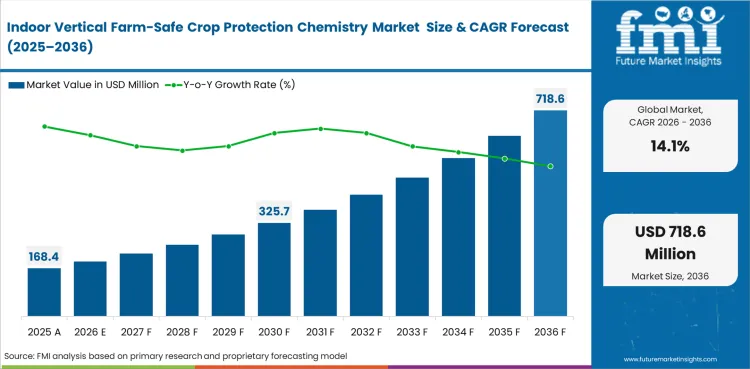
The indoor vertical farm-safe crop protection chemistry market was valued at USD 147.6 million in 2025. The market is projected to reach USD 168.4 million by the end of 2026. It is forecast to expand at a CAGR of 14.1% from 2026 to 2036 and reach USD 629.8 million by 2036. Biofungicides in product type are expected to account for 31.0%, while leafy greens in crop type are expected to account for 38.0%.
Summary of the Indoor Vertical Farm-Safe Crop Protection Chemistry
- Demand and Growth Drivers
- Enclosed crop rooms raise disease pressure. They raise sanitation needs and crop-loss exposure across short harvest cycles.
- Demand is expected to rise because microbial and low-residue chemistries fit fresh-produce programs better than broad conventional spray programs.
- Supplier preference shifts toward products with high crop safety. It also shifts toward sanitation utility and root-zone compatibility.
- Product and Segment View
- Biofungicides lead product demand because fungal spread can damage yield and visual quality within a short period.
- Microbial actives maintain higher use because indoor farms prefer softer residue profiles and easier use in integrated pest programs.
- Liquid concentrates hold a larger share because dosing and line use are easier in recirculating systems.
- Geography and Competitive Outlook
- Singapore and the UAE post faster expansion outlook during the forecast period because indoor farming investment is rising. India and China show the same pattern.
- The United States and the Netherlands have larger supplier pools because greenhouse biological-input experience is deeper.
- Competition remains fragmented. Distributor support and technical guidance shape supplier position.
- Analyst Opinion
- Principal Analyst Nikhil Kaitwade states: “Indoor vertical farms reward crop protection suppliers that offer crop-safe chemistry. They also reward low-residue fit and practical protocols for enclosed hydroponic production.”
- Indoor Vertical Farm-Safe Crop Protection Chemistry Market Value Analysis
- Market growth reflects crop-safe chemistries suited for enclosed rooms. Hydroponic lines and residue-sensitive fresh produce programs support this demand.
- Value concentration is highest in disease control and sanitation support. Crop-safe programs for leafy greens and herbs add to this concentration.
- Supplier expansion depends on label fit and operator confidence. Repeat crop safety across short-cycle production matters as well.
Key Takeaways
- Market value reached USD 147.6 million in 2025.
- Market value is projected to reach USD 629.8 million by 2036.
- The market is projected to expand at a CAGR of 14.1% from 2026 to 2036.
- Incremental opportunity from 2026 to 2036 is estimated at USD 461.4 million.
- Biofungicides segment by product type is expected to account for 31.0% in 2026.
- Singapore is projected to record the highest CAGR at 16.8% during the forecast period.
- The UAE is expected to record a CAGR of 16.2% from 2026 to 2036.
Indoor Vertical Farm-Safe Crop Protection Chemistry Market Definition
Indoor vertical farm-safe crop protection chemistry covers inputs used inside enclosed vertical farms and indoor plant factories. It includes products used against disease and insects. It also includes products used against nematodes. It includes products used for algae control and hydroponic systems. Fresh-produce crop cycles are part of the same scope.
Indoor Vertical Farm-Safe Crop Protection Chemistry Market Inclusions
Market scope includes biofungicides and bioinsecticides. It also includes bactericides. It includes sanitizers and bionematicides. Mineral-based disease-control products are part of the same scope. These products are used across leafy greens and herbs. Berries and seedlings are included as well. Application methods include foliar spray and root drench. Fogging and surface sanitation are included as well. Broader market context connects with indoor farming and vertical farming. Controlled environment agriculture is part of the same context.
Indoor Vertical Farm-Safe Crop Protection Chemistry Market Exclusions
Scope excludes beneficial insects sold without chemistry. It excludes crop nutrition salts and lighting systems. HVAC systems and irrigation hardware are excluded as well. Broad-acre crop protection products for open-field use fall outside the market boundary. Standalone farm infrastructure categories such as commercial greenhouse systems and agricultural lighting also fall outside this market boundary.
Indoor Vertical Farm-Safe Crop Protection Chemistry Market Research Methodology
- Primary Research: Interviews with biological-input suppliers and indoor farm operators. Greenhouse distributors and controlled-environment crop specialists were included as well.
- Desk Research: Review of public regulatory material and product labels. Crop protection portfolios and controlled-environment agriculture studies were included as well.
- Market sizing and forecasting: Bottom-up assessment using indoor crop mix and chemistry use intensity. Product fit and country adoption patterns were included in the same assessment.
- Data validation: Cross-check against adjacent input categories such as the water filtration systems for hydroponics market. It also uses the vertical-farming optimized liquid nutrient market and the hydroponics market for comparison.
Why is the Indoor Vertical Farm-Safe Crop Protection Chemistry Market Growing?
- Biofungicides in product type are expected to account for 31.0% in 2026 because fungal spread can damage enclosed crop rooms very fast.
- Microbial actives in active origin are projected to contribute 37.0% in 2026 because residue pressure is lower and rotation use is easier.
- Leafy greens in crop type are expected to make up 38.0% in 2026 because stacked indoor production still centers on lettuce and similar short-cycle crops.
Indoor farms use crop protection very differently from open-field farms. Product selection depends on enclosed-room fit and crop safety. Residue profile and root-zone compatibility matter as well. A broad field label does not solve indoor production needs on its own. This market is connected with the biocontrol solutions market. It is connected with the biocontrol agents market and the bioinsecticides market as well.
Short crop cycles increase the cost of disease outbreaks in indoor farms. One infection across a dense rack can disrupt harvest timing. It can reduce crop quality and increase room sanitation needs within the same week. Products with preventive use gain stronger acceptance in many farms. Low crop stress and repeat application flexibility support the same preference. Broad chemistries designed for seasonal field use fit less well.
Product selection depends on whether a product can be used safely and effectively in recirculating systems. Liquid formats, line compatibility and sanitation use matter because enclosed farms run on fixed workflows and narrow timing windows. Similar input-selection patterns are observed in the agricultural microbials market. The biofertilizers market shows similar patterns. The agricultural activator adjuvant market shows them as well.
Market Segmentation Analysis
- Biofungicides in product type are expected to account for 31.0% in 2026 because humid crop rooms raise mildew and botrytis pressure. Root-disease exposure adds further demand.
- Microbial actives in active origin are projected to account for 37.0% in 2026 because indoor farms prefer softer residue profiles and rotation flexibility.
- Leafy greens in crop type are expected to account for 38.0% in 2026 because lettuce and related crops dominate stacked indoor acreage.
The market is divided into product type, active origin, application method, crop type, target problem, facility type, formulation, and region. Product type explains disease, insect, sanitation, and root-health demand. Application method and formulation explain day-to-day farm use. Facility type and crop type explain spending concentration across warehouse farms, container farms, and short-cycle fresh produce. Farm-system context also overlaps with the HVAC systems for indoor farms market, vertical grow rack systems market, and greenhouse multi-layer benching systems market.
Insights into the Biofungicides Segment
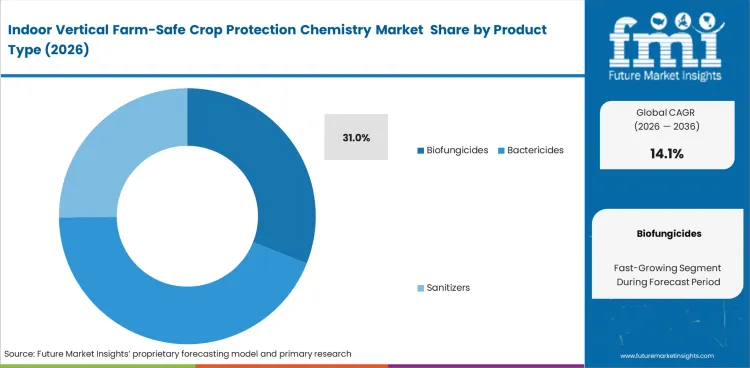
- Biofungicides in product type are expected to account for 31.0% in 2026 because mildew and botrytis can reduce yield within a short period.
- Disease-control use is higher than insect-control use across leafy greens and herbs because enclosed humidity and dense canopy growth raise infection pressure.
Insights into the Microbial Segment
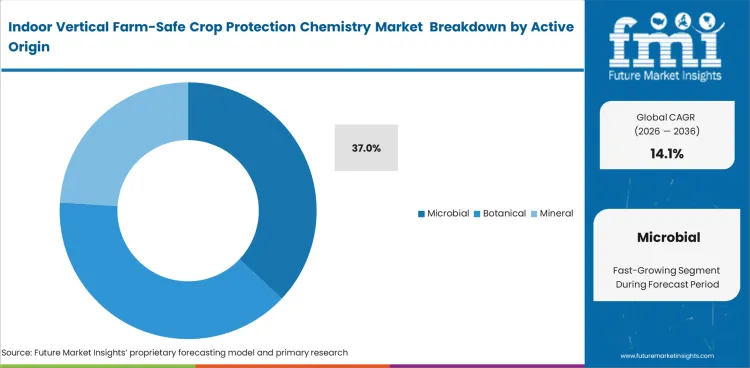
- Microbial actives in active origin are projected to represent 37.0% of total market share in 2026 because Bacillus systems fit indoor food-crop programs well. Beauveria and related systems support the same fit. Heavier residue-oriented chemistry is less suitable in many programs.
- Rotation programs support microbial products in many farms. Low crop stress strengthens that position. Easier use within integrated pest routines keeps microbial products ahead of botanical and mineral options in many farms.
Insights into the Leafy Greens Segment
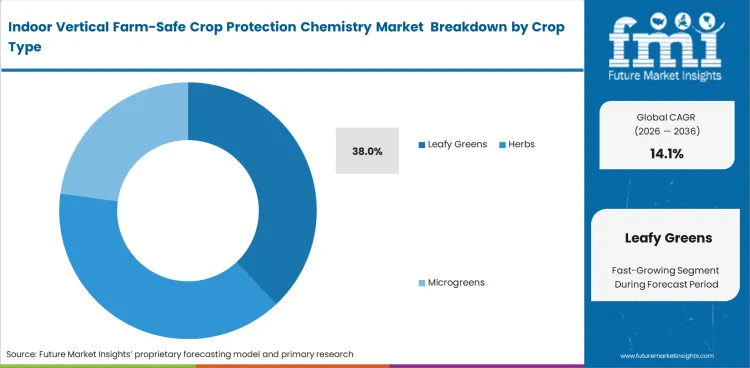
- Leafy greens in crop type are expected to account for 38.0% in 2026 because vertical farms continue to focus on lettuce and similar crops with fast harvest cycles.
- Weekly harvest frequency raises regular use of preventive disease-control and sanitation products across leafy greens.
Insights into the Liquid Concentrates Segment
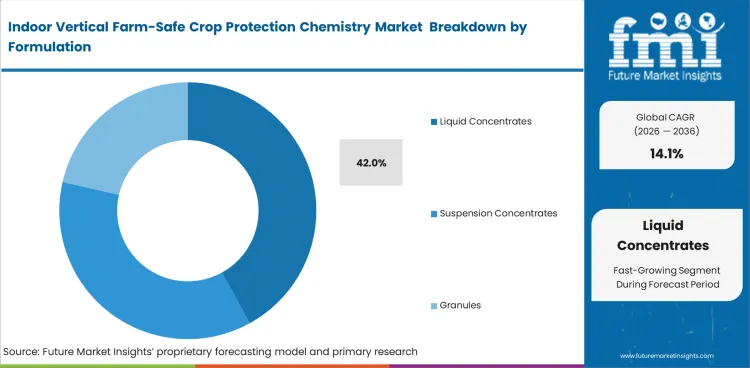
- Liquid concentrates in formulation are projected to account for 42.0% in 2026 because dilution and dosing are easier than powder-heavy handling routines.
- Surface sanitation and quick-response programs favor liquids across enclosed rooms with fixed operating schedules.
Indoor Vertical Farm-Safe Crop Protection Chemistry Market Drivers, Restraints, and Opportunities
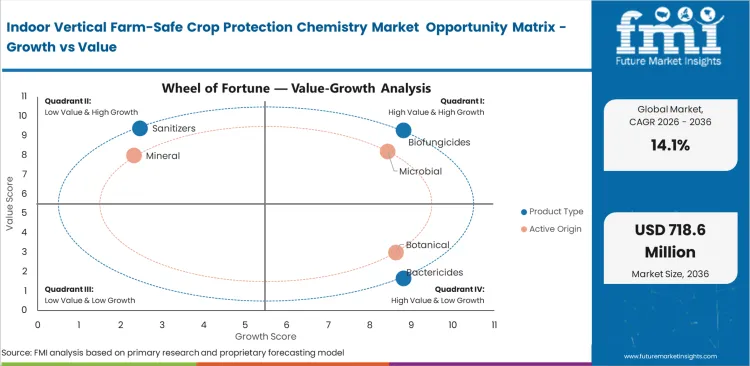
- Enclosed production increases the value of preventive disease control and sanitation chemistry.
- Approved label coverage is limited across indoor crops and enclosed operating conditions.
- Suppliers can expand market presence by offering crop-specific protocols for leafy greens and herbs. Strawberries and hydroponic disease management create added room for expansion.
Indoor farms do not reward broad product portfolios on their own. Adoption increases when products are supported by strong crop‑safety data and clear use protocols. Narrow labels and limited indoor‑use language can slow conversion, and weak technical guidance can delay adoption even when products show clear performance potential. Adjacent demand trends link this market with indoor leafy‑green precision nutrition programs and agri natural‑enemy pest control solutions.
Disease Pressure in Enclosed Crop Rooms
High humidity and dense crop architecture can speed fungal activity in enclosed production. A horticulture paper notes that relative humidity of at least 93% and prolonged leaf wetness support spore germination. A vertical farming review notes that pest and disease movement between growth levels adds a separate control issue. [1]
Residue Sensitivity and Food-Safety Programs
Fresh-produce programs in indoor farms put extra pressure on residue-safe chemistry. Pro Farm Group states that Arino and Bronte are exempt from residue tolerances. The company states that both products carry a four-hour re-entry window and a zero-day preharvest interval. These features provide a commercial example of fit for residue-sensitive programs. [2]
Analysis of Indoor Vertical Farm-Safe Crop Protection Chemistry Market By Key Countries
.webp "Top Country Growth Comparison Indoor Vertical Farm Safe Crop Protection Chemistry Market Cagr (2026 2036)")
| Country | CAGR |
|---|---|
| Singapore | 16.8% |
| United Arab Emirates | 16.2% |
| India | 15.7% |
| China | 15.1% |
| United States | 13.2% |
| Netherlands | 12.4% |
| Japan | 11.8% |
Source: FMI analysis based on primary research and proprietary forecasting model
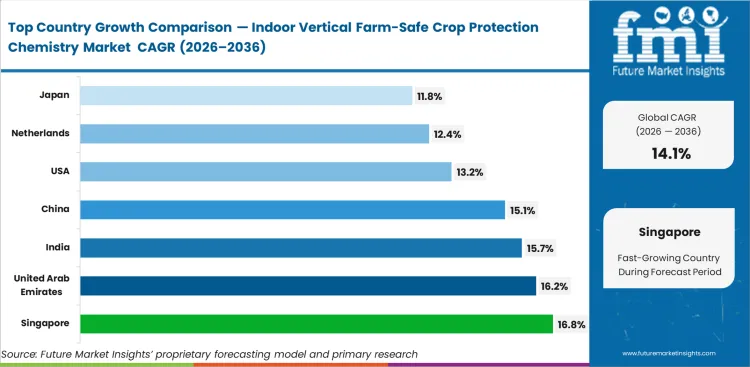
Indoor Vertical Farm-Safe Crop Protection Chemistry Market CAGR Analysis By Country
- Singapore is projected to expand at a CAGR of 16.8% because food-security policy and urban production economics support enclosed-farm investment from a compact base.
- The UAE is expected to record a CAGR of 16.2% because climate limits and import dependence support indoor crop production.
- India is projected to post a CAGR of 15.7% because protected horticulture investment and biological-input interest are rising together.
- China is expected to advance at a CAGR of 15.1% because indoor farming buildout and urban supply planning support enclosed vegetable production.
- The United States is forecast to register a CAGR of 13.2% because vertical farming activity and biological-input familiarity are broader than in many emerging markets.
- The Netherlands is likely to grow at a CAGR of 12.4% because greenhouse biological know-how is already well established.
- Japan is projected to record a CAGR of 11.8% because plant-factory adoption supports demand. Scale-up speed remains measured.
The global indoor vertical farm‑safe crop protection chemistry market is anticipated to expand at a CAGR of 14.1% from 2026 to 2036, supported by rising disease pressure in enclosed crop rooms and growing preference for residue‑safe or crop‑compatible chemistries. The study covers multiple regions and countries, with the key high‑growth markets outlined above.[NA1]
Demand Outlook for Indoor Vertical Farm-Safe Crop Protection Chemistry in Singapore
Singapore supports enclosed crop production because food-security policy and limited land increase interest in indoor farming. Demand for indoor vertical farm-safe crop protection chemistry in Singapore is expected to rise at a CAGR of 16.8% through 2036. Vertical-farm investment and tight operating control across short-cycle leafy greens support this demand. Crop-safe disease control and sanitation programs can gain faster acceptance in this market.
- Limited arable land supports indoor-farm growth.
- Short crop cycles increase the need for preventive chemistry.
- Technical guidance can affect supplier adoption.
Future Outlook for Indoor Vertical Farm-Safe Crop Protection Chemistry in the United Arab Emirates
The UAE supports indoor vegetable production because climate pressure and import dependence increase the need for enclosed farming. Sales of indoor vertical farm-safe crop protection chemistry in the UAE are likely to increase at a CAGR of 16.2% through 2036. Enclosed-farm projects and year-round fresh-produce targets support this demand. Residue-safe disease control and sanitation chemistries can gain faster acceptance across premium produce programs.
- Outdoor climate limits support enclosed production.
- Fresh-produce stability supports indoor-farm investment.
- Residue profile affects crop-protection selection.
Opportunity Analysis of Indoor Vertical Farm-Safe Crop Protection Chemistry in India
India is expanding indoor crop production because protected horticulture growth is widening room for enclosed farming. The indoor vertical farm-safe crop protection chemistry market in India is set to expand at a CAGR of 15.7% through 2036. Hydroponic interest supports this outlook. Urban farming projects and wider biological-input use support it as well. Pricing discipline can influence supplier growth. Crop safety and field support can influence it as well.
- Hydroponics and protected farming are gaining scale.
- Biological-input use is widening across fresh crops.
- Price sensitivity can slow premium program adoption.
In-depth Analysis of Indoor Vertical Farm-Safe Crop Protection Chemistry in China
China combines scale potential with rising investment in controlled-environment farming. Demand for indoor vertical farm-safe crop protection chemistry in China is expected to rise at a CAGR of 15.1% through 2036. Urban food-supply planning and expanding enclosed vegetable production support this outlook. Local approval requirements and distribution access can affect how quickly suppliers expand product offerings in this market.
- Urban produce supply supports enclosed systems.
- Dense crop rooms increase disease-control need.
- Local registrations affect speed of market entry.
Sales Analysis of Indoor Vertical Farm-Safe Crop Protection Chemistry in the United States
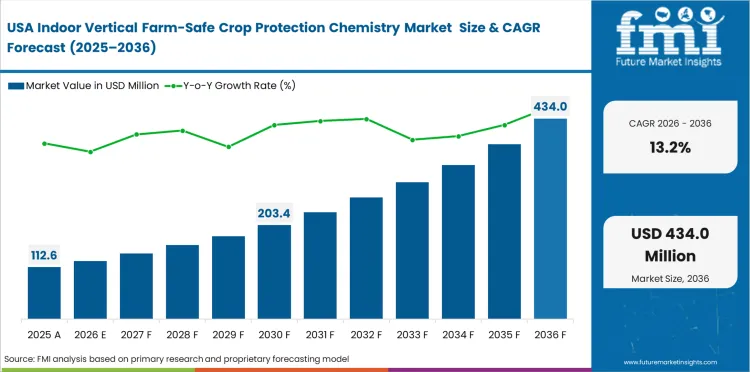
The United States has one of the strongest commercial bases for indoor and greenhouse biological inputs. Sales of indoor vertical farm-safe crop protection chemistry in the United States are likely to increase at a CAGR of 13.2% through 2036. Vertical-farm activity and wider familiarity with biological crop protection support this outlook and technical trials with crop safety data can carry more weight than launch visibility alone.
- Distributor networks are already broader.
- Trial data affects product acceptance.
- Supplier competition is more crowded.
Future Outlook for Indoor Vertical Farm-Safe Crop Protection Chemistry in the Netherlands
The Netherlands has strong technical capability because protected-cropping expertise is well developed. The market for indoor vertical farm-safe crop protection chemistry in the Netherlands is set to expand at a CAGR of 12.4% through 2036. Greenhouse biological-input knowledge and residue-sensitive crop programs support this outlook. Protocol quality and suitability for specific crops can influence supplier preference more than novelty.
- Greenhouse know-how is already high.
- Biological programs have a deeper technical base.
- Growth pace is steadier because the base is mature.
Competitive Landscape and Strategic Positioning
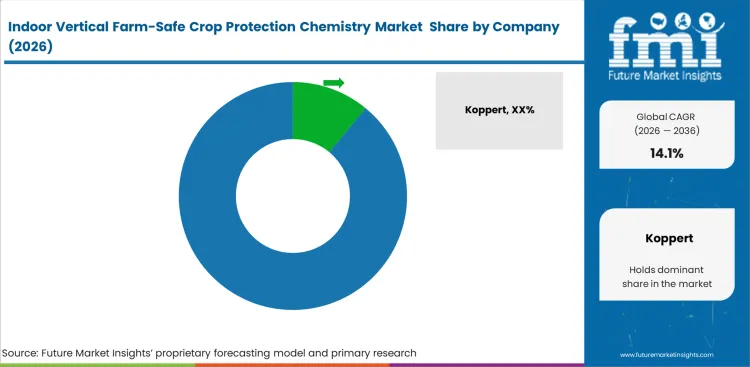
This market has moderate to low concentration among the key players. Leading suppliers are dealing in greenhouse biologicals and specialty crop protection. Protected-horticulture input networks are part of the same group. Entry barriers include product registrations and crop safety proof. Distributor support and clear use protocols add further barriers in enclosed farming systems.[2]
Koppert and BioFirst Group hold visible supplier positions in this market. Certis Biologicals and BioWorks are visible as well. Andermatt Group remains active in the same field. Pro Farm Group and Valent BioSciences remain active as well. Product portfolio breadth also holds importance in the competitive outlook. Indoor farm acceptance depends more on disease-control reliability and residue suitability.
New entrants can find opportunities in sanitation chemistry and root-zone disease programs. Targeted insect control offers another opening. Growth becomes harder when farms ask for validated crop protocols instead of a single standalone product. Similar competitive patterns across related farm-input categories are observed in the indoor farming market.
Key Companies in the Indoor Vertical Farm-Safe Crop Protection Chemistry Market
- Global companies active in the indoor vertical farm-safe crop protection chemistry market include:
- Koppert and BioFirst Group, with broad biological crop protection depth and protected-cropping exposure.
- Andermatt Group and Certis Biologicals, with specialty biological portfolios and active protected-cropping presence.
- Pro Farm Group and Valent BioSciences, with specialty-crop biological portfolios and active registration work.
- BioWorks and similar focused suppliers, with greenhouse and indoor vegetable disease-control exposure.
Competitive Benchmarking: Indoor Vertical Farm-Safe Crop Protection Chemistry
| Company | Portfolio Depth | Greenhouse / Indoor Fit | Biological Crop Protection Breadth | Geographic Footprint |
|---|---|---|---|---|
| Koppert | High | High | Strong | Global |
| BioFirst Group | High | High | Strong | Global |
| Certis Biologicals | High | Medium | Strong | North America / Europe |
| BioWorks | Medium | High | Medium | North America |
| Andermatt Group | High | Medium | Strong | Global |
Source: Future Market Insights competitive analysis, 2026. Ratings reflect relative positioning based on portfolio depth. Greenhouse or indoor fit is another basis. Biological crop protection breadth is the third basis.
Key Developments in Indoor Vertical Farm-Safe Crop Protection Chemistry
- In March 2024, Certis Biologicals acquired multiple assets from AgBiome. The deal included fungicides Howler® and Theia®. [3]
- In July 2025, Koppert signed a renewed and expanded partnership agreement. The agreement extended biological crop protection solutions to 300 hectares of greenhouse sweet pepper cultivation in Egypt. [4]
- In February 2026, Pro Farm Group stated that California fruit and vegetable growers received labels for Arino™ insecticide/nematicide and Bronte™ insecticide/nematicide. [5]
Key Players in the Indoor Vertical Farm-Safe Crop Protection Chemistry:
Major Global Players:
- Koppert
- BioFirst Group
- Andermatt Group
- Certis Biologicals
Emerging Players/Startups
- BioWorks
- Pro Farm Group
- GreenLight Biosciences
Report Scope and Coverage
| Parameter | Details |
|---|---|
| Quantitative Units | USD Million, value, CAGR, and share analysis |
| Market Definition | Crop protection chemistries used in indoor vertical farms, including biological, mineral, and sanitation-oriented products for enclosed crop systems |
| Regions Covered | North America, Latin America, Europe, Asia Pacific, Middle East & Africa |
| Countries Covered | Singapore, United Arab Emirates, India, China, United States, Netherlands, Japan |
| Key Companies Profiled | Koppert, BioFirst Group, Certis Biologicals, BioWorks, Pro Farm Group, Andermatt Group, Valent BioSciences |
| Forecast Period | 2026 to 2036 |
| Approach | Primary research, desk research, bottom-up sizing, segment mapping, and country forecasting |
Indoor Vertical Farm-Safe Crop Protection Chemistry Market by Segments
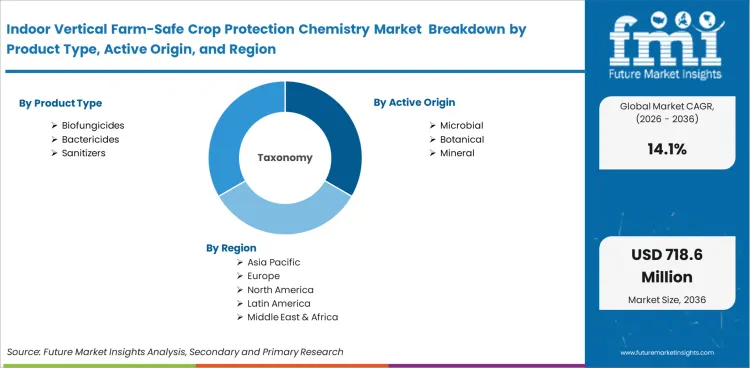
Indoor Vertical Farm-Safe Crop Protection Chemistry Market Segmented by Product Type:
- Biofungicides
- Bioinsecticides
- Bactericides
- Sanitizers
- Bionematicides
- Adjuvants
- Mineral fungicides
Indoor Vertical Farm-Safe Crop Protection Chemistry Market Segmented by Active Origin:
- Microbial
- Botanical
- Mineral
- Oxidizing
- Chitosan
- Fermentation-derived
Indoor Vertical Farm-Safe Crop Protection Chemistry Market Segmented by Application Method:
- Foliar spray
- Root drench
- Fogging
- Line dosing
- Surface sanitation
- Tank mix
Indoor Vertical Farm-Safe Crop Protection Chemistry Market Segmented by Crop Type:
- Leafy greens
- Herbs
- Microgreens
- Strawberries
- Tomatoes
- Cucumbers
- Seedlings
Indoor Vertical Farm-Safe Crop Protection Chemistry Market Segmented by Target Problem:
- Fungal pathogens
- Sucking insects
- Root pathogens
- Biofilm algae
- Mites
- Nematodes
- Bacterial diseases
Indoor Vertical Farm-Safe Crop Protection Chemistry Market Segmented by Facility Type:
- Warehouse farms
- Container farms
- Hybrid greenhouses
- Propagation rooms
- Research farms
- Retail farms
Indoor Vertical Farm-Safe Crop Protection Chemistry Market Segmented by Formulation:
- Liquid concentrates
- Wettable powders
- Suspension concentrates
- Soluble liquids
- Ready-to-use
- Granules
Indoor Vertical Farm-Safe Crop Protection Chemistry Market Segmented by Region:
- North America
- USA
- Canada
- Mexico
- Latin America
- Brazil
- Chile
- Rest of Latin America
- Western Europe
- Germany
- UK
- Italy
- Spain
- France
- Nordic
- BENELUX
- Rest of Western Europe
- Eastern Europe
- Russia
- Poland
- Hungary
- Balkan & Baltic
- Rest of Eastern Europe
- East Asia
- China
- Japan
- South Korea
- South Asia and Pacific
- India
- ASEAN
- Australia & New Zealand
- Rest of South Asia and Pacific
- Middle East & Africa
- Kingdom of Saudi Arabia
- Other GCC Countries
- Turkiye
- South Africa
- Other African Union
- Rest of Middle East & Africa
Research Sources and Bibliography
- Zabiák, A., Csótó, A., Pál, K., Fekete, E., Karaffa, L., & Sándor, E. (2025). Identification of Botrytis cinerea as a walnut fruit rot pathogen, and its biocontrol by Trichoderma. Horticulturae, 11(7), 725.
- Pro Farm Group. (2026, February 20). Pro Farm Group brings new pest management tools to California farmers.
- Certis Biologicals. (2024, March 19). Certis Biologicals acquires Howler® and Theia® fungicides from AgBiome.
- Koppert. (2025, July 11). Koppert and Fresh Energy expand partnership after Egypt’s first large-scale biological crop protection success.
- Pro Farm Group. (2026, February 20). Pro Farm Group brings new pest management tools to California farmers.
- Elliot Dohlman, Kenneth Maguire, Wallace V. Davis, Matthew Husby, John Bovay, Catharine Weber, and Yoonjung Lee. (2024, January). Trends, Insights, and Future Prospects for Production in Controlled Environment Agriculture and Agrivoltaics Systems.
- USA Department of Agriculture, Agricultural Research Service. (2025, January). Vertical Farming – No Longer A Futuristic Concept.
- Mitchell Doss, Kaylee A. South, J. Scott Lowman, and Michael R. Evans. (2026, February). What is Controlled Environment Agriculture?
- USA Environmental Protection Agency. (2025, October). EPA Announces Proposed Registration of New Biopesticide and Biopesticides Webpage.
- Panqin Cai and George Dimopoulos. (2024, December). Microbial biopesticides: A one health perspective on benefits and risks.
- Vanesa Calvo-Baltanás. (2025, March). The future potential of controlled environment agriculture.
This Report Answers
- What is the current size of the indoor vertical farm-safe crop protection chemistry market?
- What value is expected by 2036?
- What CAGR is projected between 2026 and 2036?
- Which product type leads demand in 2026?
- Which active origin keeps the highest share?
- Why do leafy greens account for the largest crop-based demand?
- Which countries are projected to expand faster than the global rate?
- What limits wider use of crop protection chemistry in enclosed vertical farms?
- Which companies carry the highest current category visibility?
- How does supplier position differ between mature and emerging country markets?
- What is the main incremental opportunity across the forecast period?
- How do residue-safe protocols shape supplier selection?
Frequently Asked Questions
What is indoor vertical farm-safe crop protection chemistry?
It covers crop protection products used inside enclosed vertical farms without causing major residue, crop stress, or recirculation-system problems.
Why is this market smaller than the broader biologicals market?
Indoor vertical farms form a narrow production base, and product use depends on crop safety, label fit, and enclosed-system compatibility.
Which product category leads this market?
Biofungicides lead because fungal and root-zone disease can disrupt harvest schedules very quickly inside enclosed farms.
Why do microbial products get high attention?
Microbial actives fit residue-sensitive food crops and support rotation programs more easily than many conventional chemistries.
Which crop group drives the most demand?
Leafy greens lead because commercial vertical farms still focus heavily on lettuce and similar short-cycle crops.
How do liquid concentrates keep a lead over powders?
Liquid concentrates fit dosing, dilution, and hydroponic-line use more easily inside enclosed production systems.
Which country is forecast to grow fastest?
Singapore carries the highest projected CAGR in this assessment.
What slows adoption in this market?
Limited label depth, uneven indoor-use evidence, and the need for crop-safe protocols can delay farm-level conversion.
What do farms screen first during product selection?
Crop safety, enclosed-system fit, disease-control reliability, and technical support usually carry the most weight.
Can greenhouse products automatically fit indoor vertical farms?
No. Some greenhouse products can fit well. Many indoor farms still ask for clearer proof on crop safety, interval fit, and recirculating-system compatibility.
Is this mainly an insect-control market?
No. Disease control and sanitation carry more weight because enclosed humidity and short harvest timing make disease losses costly.
How can suppliers expand faster in this category?
Faster expansion usually comes from preventive disease programs, root-zone health protocols, sanitation support, and clear crop-use guidance for leafy greens and herbs.
Preview the report firsthand - request a free sample
Get SampleGet the brochure for pricing and purchase details.
Get PDFTable of Content
- Executive Summary
- Global Market Outlook
- Demand-side Trends
- Supply-side Trends
- Technology Roadmap Analysis
- Analysis and Recommendations
- Market Overview
- Market Coverage / Taxonomy
- Market Definition / Scope / Limitations
- Research Methodology
- Chapter Orientation
- Analytical Lens and Working Hypotheses
- Market Structure, Signals, and Trend Drivers
- Benchmarking and Cross-market Comparability
- Market Sizing, Forecasting, and Opportunity Mapping
- Research Design and Evidence Framework
- Desk Research Programme (Secondary Evidence)
- Company Annual and Sustainability Reports
- Peer-reviewed Journals and Academic Literature
- Corporate Websites, Product Literature, and Technical Notes
- Earnings Decks and Investor Briefings
- Statutory Filings and Regulatory Disclosures
- Technical White Papers and Standards Notes
- Trade Journals, Industry Magazines, and Analyst Briefs
- Conference Proceedings, Webinars, and Seminar Materials
- Government Statistics Portals and Public Data Releases
- Press Releases and Reputable Media Coverage
- Specialist Newsletters and Curated Briefings
- Sector Databases and Reference Repositories
- FMI Internal Proprietary Databases and Historical Market Datasets
- Subscription Datasets and Paid Sources
- Social Channels, Communities, and Digital Listening Inputs
- Additional Desk Sources
- Expert Input and Fieldwork (Primary Evidence)
- Primary Modes
- Qualitative Interviews and Expert Elicitation
- Quantitative Surveys and Structured Data Capture
- Blended Approach
- Why Primary Evidence is Used
- Field Techniques
- Interviews
- Surveys
- Focus Groups
- Observational and In-context Research
- Social and Community Interactions
- Stakeholder Universe Engaged
- C-suite Leaders
- Board Members
- Presidents and Vice Presidents
- R&D and Innovation Heads
- Technical Specialists
- Domain Subject-matter Experts
- Scientists
- Physicians and Other Healthcare Professionals
- Governance, Ethics, and Data Stewardship
- Research Ethics
- Data Integrity and Handling
- Primary Modes
- Tooling, Models, and Reference Databases
- Desk Research Programme (Secondary Evidence)
- Data Engineering and Model Build
- Data Acquisition and Ingestion
- Cleaning, Normalisation, and Verification
- Synthesis, Triangulation, and Analysis
- Quality Assurance and Audit Trail
- Market Background
- Market Dynamics
- Drivers
- Restraints
- Opportunity
- Trends
- Scenario Forecast
- Demand in Optimistic Scenario
- Demand in Likely Scenario
- Demand in Conservative Scenario
- Opportunity Map Analysis
- Product Life Cycle Analysis
- Supply Chain Analysis
- Investment Feasibility Matrix
- Value Chain Analysis
- PESTLE and Porter’s Analysis
- Regulatory Landscape
- Regional Parent Market Outlook
- Production and Consumption Statistics
- Import and Export Statistics
- Market Dynamics
- Global Market Analysis 2021 to 2025 and Forecast, 2026 to 2036
- Historical Market Size Value (USD Million) Analysis, 2021 to 2025
- Current and Future Market Size Value (USD Million) Projections, 2026 to 2036
- Y-o-Y Growth Trend Analysis
- Absolute $ Opportunity Analysis
- Global Market Pricing Analysis 2021 to 2025 and Forecast 2026 to 2036
- Global Market Analysis 2021 to 2025 and Forecast 2026 to 2036, By Product Type
- Introduction / Key Findings
- Historical Market Size Value (USD Million) Analysis By Product Type , 2021 to 2025
- Current and Future Market Size Value (USD Million) Analysis and Forecast By Product Type , 2026 to 2036
- Biofungicides
- Bioinsecticides
- Botanical fungicides
- Biofungicides
- Y-o-Y Growth Trend Analysis By Product Type , 2021 to 2025
- Absolute $ Opportunity Analysis By Product Type , 2026 to 2036
- Global Market Analysis 2021 to 2025 and Forecast 2026 to 2036, By Active Base
- Introduction / Key Findings
- Historical Market Size Value (USD Million) Analysis By Active Base, 2021 to 2025
- Current and Future Market Size Value (USD Million) Analysis and Forecast By Active Base, 2026 to 2036
- Microbials
- Botanicals
- Blends
- Microbials
- Y-o-Y Growth Trend Analysis By Active Base, 2021 to 2025
- Absolute $ Opportunity Analysis By Active Base, 2026 to 2036
- Global Market Analysis 2021 to 2025 and Forecast 2026 to 2036, By Crop Type
- Introduction / Key Findings
- Historical Market Size Value (USD Million) Analysis By Crop Type, 2021 to 2025
- Current and Future Market Size Value (USD Million) Analysis and Forecast By Crop Type, 2026 to 2036
- Vegetables
- Ornamentals
- Herbs
- Vegetables
- Y-o-Y Growth Trend Analysis By Crop Type, 2021 to 2025
- Absolute $ Opportunity Analysis By Crop Type, 2026 to 2036
- Global Market Analysis 2021 to 2025 and Forecast 2026 to 2036, By Application
- Introduction / Key Findings
- Historical Market Size Value (USD Million) Analysis By Application, 2021 to 2025
- Current and Future Market Size Value (USD Million) Analysis and Forecast By Application, 2026 to 2036
- Hydraulic Spray
- Backpack Spray
- Fogging
- Hydraulic Spray
- Y-o-Y Growth Trend Analysis By Application, 2021 to 2025
- Absolute $ Opportunity Analysis By Application, 2026 to 2036
- Global Market Analysis 2021 to 2025 and Forecast 2026 to 2036, By Region
- Introduction
- Historical Market Size Value (USD Million) Analysis By Region, 2021 to 2025
- Current Market Size Value (USD Million) Analysis and Forecast By Region, 2026 to 2036
- North America
- Latin America
- Western Europe
- Eastern Europe
- East Asia
- South Asia and Pacific
- Middle East & Africa
- Market Attractiveness Analysis By Region
- North America Market Analysis 2021 to 2025 and Forecast 2026 to 2036, By Country
- Historical Market Size Value (USD Million) Trend Analysis By Market Taxonomy, 2021 to 2025
- Market Size Value (USD Million) Forecast By Market Taxonomy, 2026 to 2036
- By Country
- USA
- Canada
- Mexico
- By Product Type
- By Active Base
- By Crop Type
- By Application
- By Country
- Market Attractiveness Analysis
- By Country
- By Product Type
- By Active Base
- By Crop Type
- By Application
- Key Takeaways
- Latin America Market Analysis 2021 to 2025 and Forecast 2026 to 2036, By Country
- Historical Market Size Value (USD Million) Trend Analysis By Market Taxonomy, 2021 to 2025
- Market Size Value (USD Million) Forecast By Market Taxonomy, 2026 to 2036
- By Country
- Brazil
- Chile
- Rest of Latin America
- By Product Type
- By Active Base
- By Crop Type
- By Application
- By Country
- Market Attractiveness Analysis
- By Country
- By Product Type
- By Active Base
- By Crop Type
- By Application
- Key Takeaways
- Western Europe Market Analysis 2021 to 2025 and Forecast 2026 to 2036, By Country
- Historical Market Size Value (USD Million) Trend Analysis By Market Taxonomy, 2021 to 2025
- Market Size Value (USD Million) Forecast By Market Taxonomy, 2026 to 2036
- By Country
- Germany
- UK
- Italy
- Spain
- France
- Nordic
- BENELUX
- Rest of Western Europe
- By Product Type
- By Active Base
- By Crop Type
- By Application
- By Country
- Market Attractiveness Analysis
- By Country
- By Product Type
- By Active Base
- By Crop Type
- By Application
- Key Takeaways
- Eastern Europe Market Analysis 2021 to 2025 and Forecast 2026 to 2036, By Country
- Historical Market Size Value (USD Million) Trend Analysis By Market Taxonomy, 2021 to 2025
- Market Size Value (USD Million) Forecast By Market Taxonomy, 2026 to 2036
- By Country
- Russia
- Poland
- Hungary
- Balkan & Baltic
- Rest of Eastern Europe
- By Product Type
- By Active Base
- By Crop Type
- By Application
- By Country
- Market Attractiveness Analysis
- By Country
- By Product Type
- By Active Base
- By Crop Type
- By Application
- Key Takeaways
- East Asia Market Analysis 2021 to 2025 and Forecast 2026 to 2036, By Country
- Historical Market Size Value (USD Million) Trend Analysis By Market Taxonomy, 2021 to 2025
- Market Size Value (USD Million) Forecast By Market Taxonomy, 2026 to 2036
- By Country
- China
- Japan
- South Korea
- By Product Type
- By Active Base
- By Crop Type
- By Application
- By Country
- Market Attractiveness Analysis
- By Country
- By Product Type
- By Active Base
- By Crop Type
- By Application
- Key Takeaways
- South Asia and Pacific Market Analysis 2021 to 2025 and Forecast 2026 to 2036, By Country
- Historical Market Size Value (USD Million) Trend Analysis By Market Taxonomy, 2021 to 2025
- Market Size Value (USD Million) Forecast By Market Taxonomy, 2026 to 2036
- By Country
- India
- ASEAN
- Australia & New Zealand
- Rest of South Asia and Pacific
- By Product Type
- By Active Base
- By Crop Type
- By Application
- By Country
- Market Attractiveness Analysis
- By Country
- By Product Type
- By Active Base
- By Crop Type
- By Application
- Key Takeaways
- Middle East & Africa Market Analysis 2021 to 2025 and Forecast 2026 to 2036, By Country
- Historical Market Size Value (USD Million) Trend Analysis By Market Taxonomy, 2021 to 2025
- Market Size Value (USD Million) Forecast By Market Taxonomy, 2026 to 2036
- By Country
- Kingdom of Saudi Arabia
- Other GCC Countries
- Turkiye
- South Africa
- Other African Union
- Rest of Middle East & Africa
- By Product Type
- By Active Base
- By Crop Type
- By Application
- By Country
- Market Attractiveness Analysis
- By Country
- By Product Type
- By Active Base
- By Crop Type
- By Application
- Key Takeaways
- Key Countries Market Analysis
- USA
- Pricing Analysis
- Market Share Analysis, 2025
- By Product Type
- By Active Base
- By Crop Type
- By Application
- Canada
- Pricing Analysis
- Market Share Analysis, 2025
- By Product Type
- By Active Base
- By Crop Type
- By Application
- Mexico
- Pricing Analysis
- Market Share Analysis, 2025
- By Product Type
- By Active Base
- By Crop Type
- By Application
- Brazil
- Pricing Analysis
- Market Share Analysis, 2025
- By Product Type
- By Active Base
- By Crop Type
- By Application
- Chile
- Pricing Analysis
- Market Share Analysis, 2025
- By Product Type
- By Active Base
- By Crop Type
- By Application
- Germany
- Pricing Analysis
- Market Share Analysis, 2025
- By Product Type
- By Active Base
- By Crop Type
- By Application
- UK
- Pricing Analysis
- Market Share Analysis, 2025
- By Product Type
- By Active Base
- By Crop Type
- By Application
- Italy
- Pricing Analysis
- Market Share Analysis, 2025
- By Product Type
- By Active Base
- By Crop Type
- By Application
- Spain
- Pricing Analysis
- Market Share Analysis, 2025
- By Product Type
- By Active Base
- By Crop Type
- By Application
- France
- Pricing Analysis
- Market Share Analysis, 2025
- By Product Type
- By Active Base
- By Crop Type
- By Application
- India
- Pricing Analysis
- Market Share Analysis, 2025
- By Product Type
- By Active Base
- By Crop Type
- By Application
- ASEAN
- Pricing Analysis
- Market Share Analysis, 2025
- By Product Type
- By Active Base
- By Crop Type
- By Application
- Australia & New Zealand
- Pricing Analysis
- Market Share Analysis, 2025
- By Product Type
- By Active Base
- By Crop Type
- By Application
- China
- Pricing Analysis
- Market Share Analysis, 2025
- By Product Type
- By Active Base
- By Crop Type
- By Application
- Japan
- Pricing Analysis
- Market Share Analysis, 2025
- By Product Type
- By Active Base
- By Crop Type
- By Application
- South Korea
- Pricing Analysis
- Market Share Analysis, 2025
- By Product Type
- By Active Base
- By Crop Type
- By Application
- Russia
- Pricing Analysis
- Market Share Analysis, 2025
- By Product Type
- By Active Base
- By Crop Type
- By Application
- Poland
- Pricing Analysis
- Market Share Analysis, 2025
- By Product Type
- By Active Base
- By Crop Type
- By Application
- Hungary
- Pricing Analysis
- Market Share Analysis, 2025
- By Product Type
- By Active Base
- By Crop Type
- By Application
- Kingdom of Saudi Arabia
- Pricing Analysis
- Market Share Analysis, 2025
- By Product Type
- By Active Base
- By Crop Type
- By Application
- Turkiye
- Pricing Analysis
- Market Share Analysis, 2025
- By Product Type
- By Active Base
- By Crop Type
- By Application
- South Africa
- Pricing Analysis
- Market Share Analysis, 2025
- By Product Type
- By Active Base
- By Crop Type
- By Application
- USA
- Market Structure Analysis
- Competition Dashboard
- Competition Benchmarking
- Market Share Analysis of Top Players
- By Regional
- By Product Type
- By Active Base
- By Crop Type
- By Application
- Competition Analysis
- Competition Deep Dive
- BASF
- Overview
- Product Portfolio
- Profitability by Market Segments (Product/Age /Sales Channel/Region)
- Sales Footprint
- Strategy Overview
- Marketing Strategy
- Product Strategy
- Channel Strategy
- Syngenta
- Certis Biologicals
- BioWorks
- BASF
- Competition Deep Dive
- Assumptions & Acronyms Used


