

- Industry Size (2026)
- USD 423.8 Mn
- Forecast (2036)
- USD 2712.9 Mn
- CAGR (2026 to 2036)
- 20.4%
Vertical-Farming Optimized Liquid Nutrient Market Forecast and Outlook 2026 to 2036
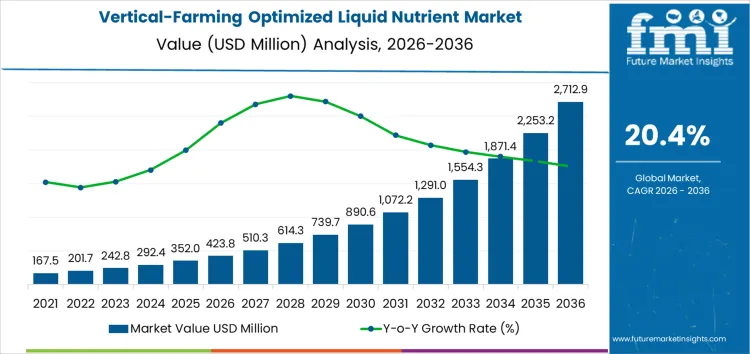
The vertical-farming optimized liquid nutrient market is valued at USD 423.8 million in 2026 and is forecasted to reach USD 2,712.9 million by 2036, registering a CAGR of 20.4%. Expansion over this period reflects capital flowing into production systems where nutrient precision directly determines yield density, cycle speed, and asset utilization. Liquid nutrient platforms capture value by reducing biological variability inside stacked growing environments, allowing operators to standardize outputs across locations. Cost structures favor suppliers able to deliver stable formulations compatible with automation, since nutrient errors translate into immediate crop loss rather than gradual degradation. Pricing strength concentrates around products that integrate seamlessly with sensors, dosing software, and recirculation infrastructure already embedded in modern vertical farms.
Investment behavior shapes performance more strongly than aggregate agricultural demand. Operators allocate capital toward inputs that shorten harvest intervals and improve predictability of cash flows under fixed lighting and real estate costs. Liquid nutrients aligned with automated control systems reduce labor exposure and operational risk, supporting higher capital efficiency per square meter. Switching between nutrient platforms introduces recalibration costs, crop testing cycles, and downtime, creating structural stickiness once a formulation proves reliable at scale. Regional expansion of vertical farming facilities further reinforces dependence on suppliers capable of supporting replication across sites with consistent chemistry. Growth quality therefore rests on integration depth, operational reliability, and alignment with long-horizon infrastructure investment rather than short-term volume expansion.
Quick Stats for Vertical-Farming Optimized Liquid Nutrient Market
- Vertical-Farming Optimized Liquid Nutrient Market Value (2026): USD 423.8 million
- Vertical-Farming Optimized Liquid Nutrient Market Forecast Value (2036): USD 2,712.9 million
- Forecast CAGR (2026 to 2036): 20.4%
- Leading Crop Segment in Global Demand: Greenhouse Vegetables
- Fastest-Growing Countries: China, Netherlands, USA, Japan
- Key Players in Global Demand: ICL Group Ltd., Haifa Group, Yara International, Nutrien, EuroChem, Compass Minerals
Vertical-Farming Optimized Liquid Nutrient Market Key Takeaways
| Metric | Value |
|---|---|
| Market Value (2026) | USD 423.8 million |
| Market Forecast Value (2036) | USD 2,712.9 million |
| Forecast CAGR (2026-2036) | 20.4% |
Why is the Demand for Vertical-Farming Optimized Liquid Nutrient Market Growing?
Demand for vertical-farming optimized liquid nutrient is growing globally due to rapid expansion of controlled environment agriculture and the adoption of vertical farming systems in urban and peri-urban areas. Vertical farming relies on hydroponic and aeroponic systems that require precisely balanced nutrient solutions tailored to specific crop types, growth stages, and environmental conditions. Optimized liquid nutrients deliver consistent concentrations of essential macro and micronutrients, which supports rapid plant growth, uniform development, and predictable yields in stacked production systems. Growth in leafy greens, herbs, and specialty vegetables driven by consumer demand for local, fresh produce enhances procurement of formulation systems that maximize nutrient uptake efficiency while minimizing waste and runoff.
Regulatory frameworks in multiple regions emphasize food safety, residue control, and sustainable resource use, reinforcing the need for nutrient solutions that maintain high quality and purity standards. Advances in formulation chemistry improve solubility, stability, and compatibility with water recycling practices common in vertical farms. Investments in smart farming technologies and integrated monitoring systems strengthen adoption of nutrient platforms that support automated dosing and real-time adjustment. Expansion of commercial vertical farms, research facilities, and pilot projects reinforces global demand for tailored liquid nutrient solutions that improve resource efficiency, water use, and crop performance.
How Is the Vertical-Farming Optimized Liquid Nutrient Market Structured?
Demand for vertical-farming optimized liquid nutrient is shaped by controlled-environment agriculture expansion, precision nutrition requirements, and yield optimization objectives. Growers prioritize nutrient formulations that deliver consistent availability, rapid uptake, and compatibility with recirculating hydroponic systems. Global demand reflects adoption across greenhouse operations, high-density indoor farms, and specialty crop production, where liquid stability, dosing accuracy, and channel accessibility directly influence nutrient system selection and operational efficiency.
Which Crop Segment Accounts for the Largest Share of Global Demand?
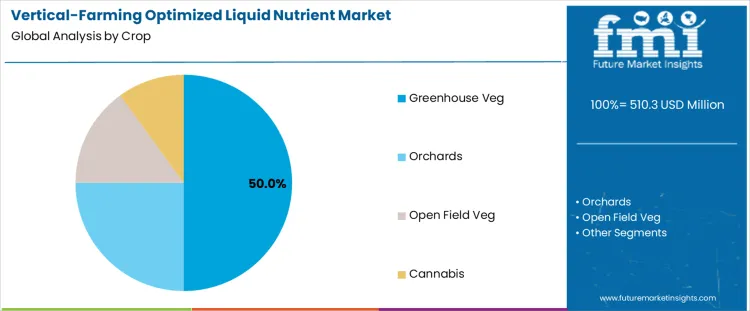
Greenhouse vegetables account for 50.0%, representing the largest share of global demand. These crops require frequent nutrient replenishment, precise macro-micro balance, and compatibility with automated fertigation systems common in controlled environments. Orchards follow at 25.0%, where liquid nutrients support targeted supplementation during specific growth stages and stress conditions. Open field vegetables account for 15.0%, reflecting selective use of liquid formulations for rapid correction and foliar feeding. Cannabis represents 10.0%, driven by high-value cultivation requiring strict nutrient consistency and controlled uptake.
Key Points
- Greenhouse vegetables dominate due to intensive nutrient cycles
- Orchards use liquids for stage-specific supplementation
- Cannabis adoption reflects precision and value sensitivity
Which Viscosity Type Holds the Largest Share of Global Demand?
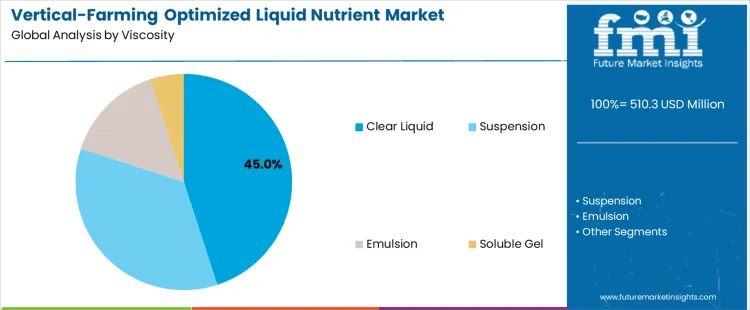
Clear liquid formulations account for 45.0%, making them the leading viscosity type globally. Clear liquids ensure uniform nutrient distribution, rapid solubility, and low clogging risk in drip and hydroponic delivery systems. Suspensions follow at 35.0%, supporting inclusion of less soluble nutrients while requiring agitation management. Emulsions represent 15.0%, used where oil-based or micronutrient components enhance nutrient availability. Soluble gels hold 5.0%, applied in niche systems requiring slow release or controlled nutrient diffusion.
Key Points
- Clear liquids lead due to system compatibility and stability
- Suspensions balance formulation flexibility with handling needs
- Gels remain limited to specialized applications
Which Sales Channel Represents the Largest Share of Global Demand?
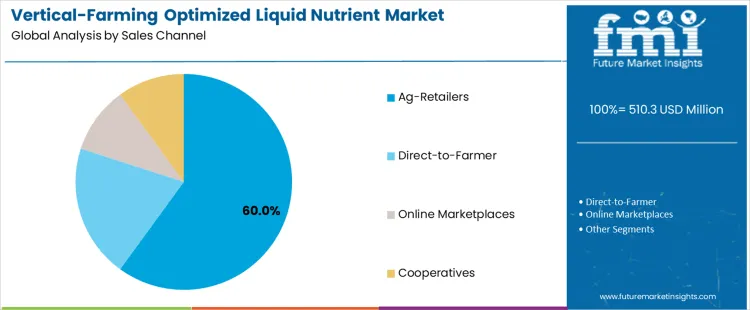
Ag-retailers account for 60.0%, representing the largest share of global demand. These channels provide technical guidance, localized product availability, and integration with existing farm input procurement practices. Direct-to-farmer sales follow at 20.0%, supporting customized nutrient programs and large-scale grower relationships. Online marketplaces represent 10.0%, reflecting gradual digital adoption for standardized formulations. Cooperatives account for 10.0%, enabling collective purchasing and distribution for small and mid-scale growers.
Key Points
- Ag-retailers dominate due to advisory and distribution reach
- Direct sales support tailored nutrient solutions
- Cooperatives enable collective access and cost efficiency
What are the Key Dynamics in the Vertical-Farming Optimized Liquid Nutrient Market?
Global demand rises as controlled environment agriculture facilities and vertical farming operators adopt liquid nutrient solutions specifically optimized for hydroponic, aeroponic, and aquaponic systems. Optimized liquid nutrients support precise delivery of macro- and micronutrients tailored to crop type, growth stage, and controlled light and climate conditions. Adoption aligns with rapid expansion of vertical farming in North America, Europe, Asia-Pacific, and the Middle East as producers seek efficient, high-yield crop production with reduced water and land use. Usage spans leafy greens, herbs, strawberries, and specialty vegetables cultivated in compact, urban agriculture facilities.
How do controlled environment requirements and crop performance expectations shape adoption?
Vertical farms require nutrient solutions formulated for stable pH, electrical conductivity, and consistent uptake under recirculating irrigation and non-soil conditions. Operators prioritize tailored nutrient profiles that deliver rapid growth, uniform quality, and predictable harvest cycles. Liquid nutrients designed for minimal precipitation and clog-free delivery in recirculating systems reduce maintenance and support longer solution longevity. Crop consultants and agronomy specialists collaborate with growers to refine formulations that match light spectra, temperature, and crop-specific nutrient demands. Retailers and institutional buyers seeking year-round local produce emphasize consistency of quality and traceability, reinforcing preference for optimized nutrient systems that support crop performance benchmarks in controlled environments.
How do cost pressures, supply stability, and regulatory frameworks influence market scalability?
Optimized liquid nutrient solutions often carry higher cost relative to standard fertilizer inputs due to tailored formulations, precision dosing requirements, and micronutrient balance. Cost considerations influence adoption among smaller farms where capital efficiency and operating margin are critical. Supply chain variability for key nutrient components, chelators, and soluble minerals affects pricing stability and inventory planning across regions. Integration with automated dosing and monitoring equipment requires investment in compatible hardware and training. Regulatory frameworks governing fertilizer labeling, nutrient discharge, and chemical safety differ across countries, affecting formulation disclosure and compliance processes for global distribution. Long-term growth depends on continued innovation in cost-effective, stable nutrient chemistries, harmonized safety and labeling standards, and agronomic support that maximizes productivity in diverse vertical farming deployments worldwide.
How Is Demand for Vertical-Farming Optimized Liquid Nutrient Evolving?
Demand for vertical-farming optimized liquid nutrient is increasing globally due to expansion of controlled environment agriculture, urban food security initiatives, and need for precise nutrient delivery systems. China leads with a 14.4% CAGR, supported by large-scale vertical farming deployment and government-backed food resilience programs. Netherlands follows at 13.9%, driven by advanced greenhouse integration and nutrient formulation expertise. USA records a 13.1% CAGR, shaped by commercial vertical farm expansion and technology-driven yield optimization. Japan posts 12.6%, reflecting space-constrained agriculture and emphasis on stable domestic produce supply. Growth reflects shift toward liquid nutrient solutions engineered for hydroponic, aeroponic, and recirculating vertical farming systems.
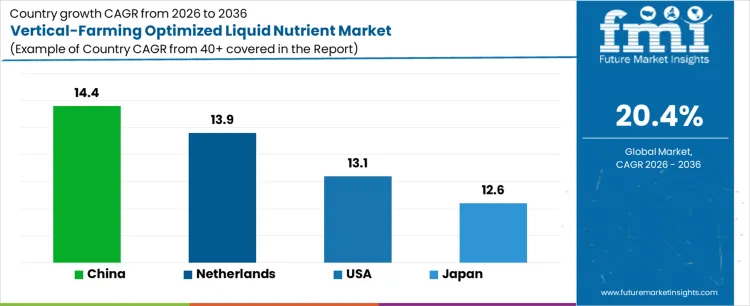
| Country | CAGR (%) |
|---|---|
| China | 14.4% |
| Netherlands | 13.9% |
| USA | 13.1% |
| Japan | 12.6% |
What is driving rapid growth of vertical-farming liquid nutrients in China?
China demand is driven by urban population density, food supply security priorities, and accelerated deployment of vertical farming infrastructure. CAGR of 14.4% reflects widespread adoption of liquid nutrient formulations tailored for hydroponic and multi-layer farming systems. Large metropolitan regions invest in vertically integrated food production to reduce logistics dependence. Liquid nutrients enable precise control of macro and micronutrient ratios under artificial lighting conditions. Government-supported agricultural modernization programs encourage adoption of high-efficiency nutrient systems. Domestic suppliers scale production of customized formulations to serve commercial farms. Growth remains scale-driven and policy-supported, aligned with yield optimization, water efficiency, and urban agriculture expansion objectives.
- Expansion of large-scale urban vertical farming projects
- Government support for food security and modernization
- Need for precise nutrient control in multi-layer systems
- Scaling of domestic liquid nutrient manufacturing
How is the Netherlands sustaining strong demand for vertical-farming liquid nutrients?
Netherlands demand reflects leadership in controlled environment agriculture and nutrient formulation science. CAGR of 13.9% is supported by integration of liquid nutrient systems within advanced vertical and greenhouse hybrid farms. Growers require formulations optimized for specific crop varieties, growth stages, and closed-loop systems. Strong research collaboration between universities, suppliers, and growers accelerates nutrient innovation. Export-oriented vertical farming technologies reinforce demand for high-performance nutrient solutions. Precision agriculture culture emphasizes efficiency, consistency, and minimal waste. Growth remains innovation-led and technology-focused, aligned with Netherlands’ role as a global reference point for intensive agriculture systems.
- Leadership in controlled environment agriculture
- Advanced crop-specific nutrient formulation expertise
- Strong research and industry collaboration
- Export-driven vertical farming technology adoption
What factors are shaping demand growth in the USA for vertical-farming liquid nutrients?
USA demand is shaped by rapid commercialization of vertical farms, retail demand for year-round produce, and focus on yield predictability. CAGR of 13.1% reflects increasing use of liquid nutrients designed for hydroponic and aeroponic systems. Operators prioritize formulations that support fast growth cycles, uniform crop quality, and efficient nutrient uptake. Investment in agtech startups accelerates adoption of data-driven nutrient management. Sustainability goals encourage reduced fertilizer runoff and closed-loop nutrient use. Growth remains technology-led and operations-focused, aligned with commercial scalability and supply chain resilience.
- Commercial expansion of vertical farming facilities
- Demand for consistent year-round produce supply
- Adoption of data-driven nutrient management systems
- Focus on sustainability and closed-loop efficiency
Why is Japan showing steady growth in vertical-farming liquid nutrient adoption?
Japan demand reflects land scarcity, aging farming population, and emphasis on stable domestic food production. CAGR of 12.6% is supported by deployment of compact vertical farms in urban and peri-urban locations. Liquid nutrients enable precise control in highly automated farming environments. Operators prioritize formulations that deliver consistent quality with minimal labor input. Government initiatives promote smart agriculture and reduced reliance on imports. High consumer expectations for food safety and uniformity reinforce demand for controlled nutrient solutions. Growth remains efficiency-driven and technology-aligned, supported by structural constraints and innovation in indoor farming systems.
- Limited arable land driving vertical farming adoption
- Need for automation-compatible nutrient solutions
- Government support for smart agriculture initiatives
- High standards for food quality and consistency
What is the competitive landscape of demand for vertical-farming optimized liquid nutrient?
Demand for vertical-farming optimized liquid nutrient is driven by controlled-environment agriculture expansion, yield predictability requirements, and precision nutrient delivery needs. Vertical farms require fully soluble, low-residue liquid nutrients that support hydroponic and aeroponic systems without clogging or microbial imbalance. Buyers evaluate nutrient purity, chelation stability, formulation flexibility, crop-specific customization, and compatibility with recirculating irrigation systems. Procurement teams prioritize suppliers with agronomic support, consistent micronutrient availability, and capability to tailor formulations for leafy greens, herbs, and fruiting crops. Trend in the global market reflects scaling of commercial vertical farms, tighter nutrient control to optimize unit economics, and increased focus on water-use efficiency and crop uniformity.
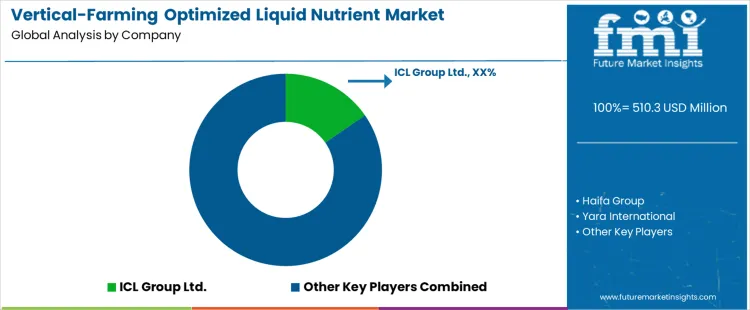
ICL Group Ltd. maintains leading positioning through specialty liquid fertilizers and precision nutrition platforms tailored for controlled-environment agriculture. Haifa Group supplies high-purity liquid and water-soluble nutrients widely adopted in hydroponic and vertical farming operations. Yara International supports demand with premium liquid nutrient solutions and digital agronomy tools adapted for indoor farming systems. Nutrien contributes liquid fertilizer technologies and formulation expertise serving commercial greenhouse and indoor growers. EuroChem participates through specialty nutrient products and upstream control of raw materials supporting consistency and scalability. Competitive differentiation depends on nutrient solubility, formulation precision, crop-specific optimization, and ability to support large-scale vertical farming operations reliably.
Key Players in the Vertical-Farming Optimized Liquid Nutrient Market
- ICL Group Ltd.
- Haifa Group
- Yara International
- Nutrien
- EuroChem
- Compass Minerals
Scope of the Report
| Items | Values |
|---|---|
| Quantitative Units | USD million |
| Crop | Greenhouse Veg; Orchards; Open Field Veg; Cannabis |
| Viscosity | Clear Liquid; Suspension; Emulsion; Soluble Gel |
| Sales Channel | Ag-Retailers; Direct-to-Farmer; Online Marketplaces; Cooperatives |
| Regions Covered | Asia Pacific, Europe, North America, Latin America, Middle East & Africa |
| Countries Covered | China, Netherlands, USA, Japan, and 40+ countries |
| Key Companies Profiled | ICL Group Ltd.; Haifa Group; Yara International; Nutrien; EuroChem; Compass Minerals |
| Additional Attributes | Dollar sales by crop and viscosity; adoption trends for liquid and gel-based nutrient solutions in vertical and controlled-environment farming; nutrient stability, solubility, and clogging-resistance performance metrics; compatibility with fertigation, hydroponic, and aeroponic delivery systems; formulation consistency, shelf-life, and mixing behavior considerations; regulatory compliance and nutrient labeling standards influencing vertical-farming liquid nutrient selection. |
Vertical-Farming Optimized Liquid Nutrient Market by Segment
Crop:
- Greenhouse Veg
- Orchards
- Open Field Veg
- Cannabis
Viscosity:
- Clear Liquid
- Suspension
- Emulsion
- Soluble Gel
Sales Channel:
- Ag-Retailers
- Direct-to-Farmer
- Online Marketplaces
- Cooperatives
Region:
- Asia Pacific
- China
- Japan
- South Korea
- India
- Australia & New Zealand
- ASEAN
- Rest of Asia Pacific
- Europe
- Germany
- United Kingdom
- France
- Italy
- Spain
- Nordic
- BENELUX
- Rest of Europe
- North America
- United States
- Canada
- Mexico
- Latin America
- Brazil
- Chile
- Rest of Latin America
- Middle East & Africa
- Kingdom of Saudi Arabia
- Other GCC Countries
- Turkey
- South Africa
- Other African Union
- Rest of Middle East & Africa
Frequently Asked Questions
How big is the vertical-farming optimized liquid nutrient market in 2026?
The global vertical-farming optimized liquid nutrient market is estimated to be valued at USD 423.8 million in 2026.
What will be the size of vertical-farming optimized liquid nutrient market in 2036?
The market size for the vertical-farming optimized liquid nutrient market is projected to reach USD 2,712.9 million by 2036.
How much will be the vertical-farming optimized liquid nutrient market growth between 2026 and 2036?
The vertical-farming optimized liquid nutrient market is expected to grow at a 20.4% CAGR between 2026 and 2036.
What are the key crop types in the vertical-farming optimized liquid nutrient market?
The key crop types in vertical-farming optimized liquid nutrient market are greenhouse veg, orchards, open field veg and cannabis.
Which viscosity segment will contribute significant share in the vertical-farming optimized liquid nutrient market in 2026?
In terms of viscosity, clear liquid segment to command 45.0% share in the vertical-farming optimized liquid nutrient market in 2026.
Preview the report firsthand - request a free sample
Get SampleGet the brochure for pricing and purchase details.
Get PDFTable of Content
- Executive Summary
- Global Market Outlook
- Demand-side Trends
- Supply-side Trends
- Technology Roadmap Analysis
- Analysis and Recommendations
- Market Overview
- Market Coverage / Taxonomy
- Market Definition / Scope / Limitations
- Market Background
- Market Dynamics
- Drivers
- Restraints
- Opportunity
- Trends
- Scenario Forecast
- Demand in Optimistic Scenario
- Demand in Likely Scenario
- Demand in Conservative Scenario
- Opportunity Map Analysis
- Product Life Cycle Analysis
- Supply Chain Analysis
- Investment Feasibility Matrix
- Value Chain Analysis
- PESTLE and Porter’s Analysis
- Regulatory Landscape
- Regional Parent Market Outlook
- Production and Consumption Statistics
- Import and Export Statistics
- Market Dynamics
- Global Market Analysis 2021 to 2025 and Forecast, 2026 to 2036
- Historical Market Size Value (USD Million) Analysis, 2021 to 2025
- Current and Future Market Size Value (USD Million) Projections, 2026 to 2036
- Y-o-Y Growth Trend Analysis
- Absolute $ Opportunity Analysis
- Global Market Pricing Analysis 2021 to 2025 and Forecast 2026 to 2036
- Global Market Analysis 2021 to 2025 and Forecast 2026 to 2036, By Crop
- Introduction / Key Findings
- Historical Market Size Value (USD Million) Analysis By Crop , 2021 to 2025
- Current and Future Market Size Value (USD Million) Analysis and Forecast By Crop , 2026 to 2036
- Greenhouse Veg
- Orchards
- Open Field Veg
- Cannabis
- Greenhouse Veg
- Y-o-Y Growth Trend Analysis By Crop , 2021 to 2025
- Absolute $ Opportunity Analysis By Crop , 2026 to 2036
- Global Market Analysis 2021 to 2025 and Forecast 2026 to 2036, By Viscosity
- Introduction / Key Findings
- Historical Market Size Value (USD Million) Analysis By Viscosity, 2021 to 2025
- Current and Future Market Size Value (USD Million) Analysis and Forecast By Viscosity, 2026 to 2036
- Clear Liquid
- Suspension
- Emulsion
- Soluble Gel
- Clear Liquid
- Y-o-Y Growth Trend Analysis By Viscosity, 2021 to 2025
- Absolute $ Opportunity Analysis By Viscosity, 2026 to 2036
- Global Market Analysis 2021 to 2025 and Forecast 2026 to 2036, By Sales Channel
- Introduction / Key Findings
- Historical Market Size Value (USD Million) Analysis By Sales Channel, 2021 to 2025
- Current and Future Market Size Value (USD Million) Analysis and Forecast By Sales Channel, 2026 to 2036
- Ag-Retailers
- Direct-to-Farmer
- Online Marketplaces
- Cooperatives
- Ag-Retailers
- Y-o-Y Growth Trend Analysis By Sales Channel, 2021 to 2025
- Absolute $ Opportunity Analysis By Sales Channel, 2026 to 2036
- Global Market Analysis 2021 to 2025 and Forecast 2026 to 2036, By Region
- Introduction
- Historical Market Size Value (USD Million) Analysis By Region, 2021 to 2025
- Current Market Size Value (USD Million) Analysis and Forecast By Region, 2026 to 2036
- North America
- Latin America
- Western Europe
- Eastern Europe
- East Asia
- South Asia and Pacific
- Middle East & Africa
- Market Attractiveness Analysis By Region
- North America Market Analysis 2021 to 2025 and Forecast 2026 to 2036, By Country
- Historical Market Size Value (USD Million) Trend Analysis By Market Taxonomy, 2021 to 2025
- Market Size Value (USD Million) Forecast By Market Taxonomy, 2026 to 2036
- By Country
- USA
- Canada
- Mexico
- By Crop
- By Viscosity
- By Sales Channel
- By Country
- Market Attractiveness Analysis
- By Country
- By Crop
- By Viscosity
- By Sales Channel
- Key Takeaways
- Latin America Market Analysis 2021 to 2025 and Forecast 2026 to 2036, By Country
- Historical Market Size Value (USD Million) Trend Analysis By Market Taxonomy, 2021 to 2025
- Market Size Value (USD Million) Forecast By Market Taxonomy, 2026 to 2036
- By Country
- Brazil
- Chile
- Rest of Latin America
- By Crop
- By Viscosity
- By Sales Channel
- By Country
- Market Attractiveness Analysis
- By Country
- By Crop
- By Viscosity
- By Sales Channel
- Key Takeaways
- Western Europe Market Analysis 2021 to 2025 and Forecast 2026 to 2036, By Country
- Historical Market Size Value (USD Million) Trend Analysis By Market Taxonomy, 2021 to 2025
- Market Size Value (USD Million) Forecast By Market Taxonomy, 2026 to 2036
- By Country
- Germany
- UK
- Italy
- Spain
- France
- Nordic
- BENELUX
- Rest of Western Europe
- By Crop
- By Viscosity
- By Sales Channel
- By Country
- Market Attractiveness Analysis
- By Country
- By Crop
- By Viscosity
- By Sales Channel
- Key Takeaways
- Eastern Europe Market Analysis 2021 to 2025 and Forecast 2026 to 2036, By Country
- Historical Market Size Value (USD Million) Trend Analysis By Market Taxonomy, 2021 to 2025
- Market Size Value (USD Million) Forecast By Market Taxonomy, 2026 to 2036
- By Country
- Russia
- Poland
- Hungary
- Balkan & Baltic
- Rest of Eastern Europe
- By Crop
- By Viscosity
- By Sales Channel
- By Country
- Market Attractiveness Analysis
- By Country
- By Crop
- By Viscosity
- By Sales Channel
- Key Takeaways
- East Asia Market Analysis 2021 to 2025 and Forecast 2026 to 2036, By Country
- Historical Market Size Value (USD Million) Trend Analysis By Market Taxonomy, 2021 to 2025
- Market Size Value (USD Million) Forecast By Market Taxonomy, 2026 to 2036
- By Country
- China
- Japan
- South Korea
- By Crop
- By Viscosity
- By Sales Channel
- By Country
- Market Attractiveness Analysis
- By Country
- By Crop
- By Viscosity
- By Sales Channel
- Key Takeaways
- South Asia and Pacific Market Analysis 2021 to 2025 and Forecast 2026 to 2036, By Country
- Historical Market Size Value (USD Million) Trend Analysis By Market Taxonomy, 2021 to 2025
- Market Size Value (USD Million) Forecast By Market Taxonomy, 2026 to 2036
- By Country
- India
- ASEAN
- Australia & New Zealand
- Rest of South Asia and Pacific
- By Crop
- By Viscosity
- By Sales Channel
- By Country
- Market Attractiveness Analysis
- By Country
- By Crop
- By Viscosity
- By Sales Channel
- Key Takeaways
- Middle East & Africa Market Analysis 2021 to 2025 and Forecast 2026 to 2036, By Country
- Historical Market Size Value (USD Million) Trend Analysis By Market Taxonomy, 2021 to 2025
- Market Size Value (USD Million) Forecast By Market Taxonomy, 2026 to 2036
- By Country
- Kingdom of Saudi Arabia
- Other GCC Countries
- Turkiye
- South Africa
- Other African Union
- Rest of Middle East & Africa
- By Crop
- By Viscosity
- By Sales Channel
- By Country
- Market Attractiveness Analysis
- By Country
- By Crop
- By Viscosity
- By Sales Channel
- Key Takeaways
- Key Countries Market Analysis
- USA
- Pricing Analysis
- Market Share Analysis, 2025
- By Crop
- By Viscosity
- By Sales Channel
- Canada
- Pricing Analysis
- Market Share Analysis, 2025
- By Crop
- By Viscosity
- By Sales Channel
- Mexico
- Pricing Analysis
- Market Share Analysis, 2025
- By Crop
- By Viscosity
- By Sales Channel
- Brazil
- Pricing Analysis
- Market Share Analysis, 2025
- By Crop
- By Viscosity
- By Sales Channel
- Chile
- Pricing Analysis
- Market Share Analysis, 2025
- By Crop
- By Viscosity
- By Sales Channel
- Germany
- Pricing Analysis
- Market Share Analysis, 2025
- By Crop
- By Viscosity
- By Sales Channel
- UK
- Pricing Analysis
- Market Share Analysis, 2025
- By Crop
- By Viscosity
- By Sales Channel
- Italy
- Pricing Analysis
- Market Share Analysis, 2025
- By Crop
- By Viscosity
- By Sales Channel
- Spain
- Pricing Analysis
- Market Share Analysis, 2025
- By Crop
- By Viscosity
- By Sales Channel
- France
- Pricing Analysis
- Market Share Analysis, 2025
- By Crop
- By Viscosity
- By Sales Channel
- India
- Pricing Analysis
- Market Share Analysis, 2025
- By Crop
- By Viscosity
- By Sales Channel
- ASEAN
- Pricing Analysis
- Market Share Analysis, 2025
- By Crop
- By Viscosity
- By Sales Channel
- Australia & New Zealand
- Pricing Analysis
- Market Share Analysis, 2025
- By Crop
- By Viscosity
- By Sales Channel
- China
- Pricing Analysis
- Market Share Analysis, 2025
- By Crop
- By Viscosity
- By Sales Channel
- Japan
- Pricing Analysis
- Market Share Analysis, 2025
- By Crop
- By Viscosity
- By Sales Channel
- South Korea
- Pricing Analysis
- Market Share Analysis, 2025
- By Crop
- By Viscosity
- By Sales Channel
- Russia
- Pricing Analysis
- Market Share Analysis, 2025
- By Crop
- By Viscosity
- By Sales Channel
- Poland
- Pricing Analysis
- Market Share Analysis, 2025
- By Crop
- By Viscosity
- By Sales Channel
- Hungary
- Pricing Analysis
- Market Share Analysis, 2025
- By Crop
- By Viscosity
- By Sales Channel
- Kingdom of Saudi Arabia
- Pricing Analysis
- Market Share Analysis, 2025
- By Crop
- By Viscosity
- By Sales Channel
- Turkiye
- Pricing Analysis
- Market Share Analysis, 2025
- By Crop
- By Viscosity
- By Sales Channel
- South Africa
- Pricing Analysis
- Market Share Analysis, 2025
- By Crop
- By Viscosity
- By Sales Channel
- USA
- Market Structure Analysis
- Competition Dashboard
- Competition Benchmarking
- Market Share Analysis of Top Players
- By Regional
- By Crop
- By Viscosity
- By Sales Channel
- Competition Analysis
- Competition Deep Dive
- ICL Group Ltd.
- Overview
- Product Portfolio
- Profitability by Market Segments (Product/Age /Sales Channel/Region)
- Sales Footprint
- Strategy Overview
- Marketing Strategy
- Product Strategy
- Channel Strategy
- Haifa Group
- Yara International
- Nutrien
- EuroChem
- Compass Minerals
- ICL Group Ltd.
- Competition Deep Dive
- Assumptions & Acronyms Used
- Research Methodology


