

- Industry Size (2026)
- USD 168 Mn
- Forecast (2036)
- USD 376.4 Mn
- CAGR (2026 to 2036)
- 8.4%
Sodic-Soil Reclamation Nutrient Package Market Forecast and Outlook 2026 to 2036
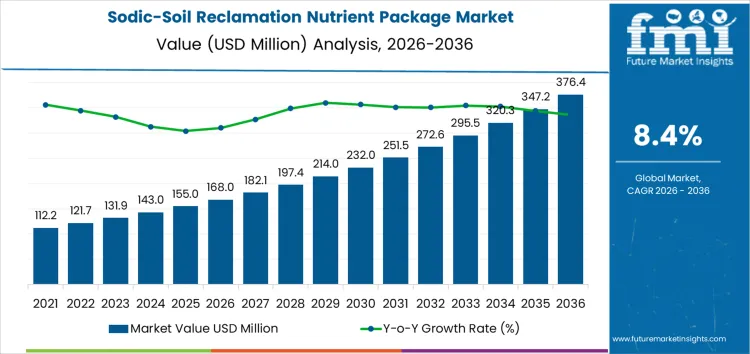
The sodic-soil reclamation nutrient package market is valued at USD 168 million in 2026 and is projected to reach USD 376.4 million by 2036, reflecting a CAGR of 8.4%. Growth over this period is shaped by soil structure degradation, infiltration constraints, and yield losses associated with high sodium saturation. Cost structures are influenced by amendment chemistry, application sequencing, and integration with irrigation or leaching practices. Packages combining calcium sources and supporting nutrients require careful formulation to ensure displacement efficiency. Suppliers demonstrating consistent soil response across regions retain stronger acceptance. Purchasing decisions focus on remediation reliability rather than short-term nutrient cost.
Between 2026 and 2036, outcomes are driven by grower risk management and land recovery timelines. Adoption advances where nutrient packages show measurable improvements in soil permeability and root development. Once incorporated into reclamation plans, switching remains limited due to multi-season recovery cycles and recalibration effort. Sales channels offering technical assessment and field guidance reinforce repeat use. Entry barriers persist through site-specific performance validation and regional soil variability. Strategic trade offs arise between remediation speed and input cost control. Competitive positioning favors suppliers aligned with long-term soil restoration programs rather than single-season corrective applications.
Quick Stats for Sodic-Soil Reclamation Nutrient Package Market
- Sodic-Soil Reclamation Nutrient Package Market Value (2026): USD 168 million
- Sodic-Soil Reclamation Nutrient Package Market Forecast Value (2036): USD 376.4 million
- Sodic-Soil Reclamation Nutrient Package Market Forecast CAGR: 8.4%
- Leading Stress in Sodic-Soil Reclamation Nutrient Package Market: Salinity-related sodic stress
- Key Growth Regions in Sodic-Soil Reclamation Nutrient Package Market: Asia Pacific, Australia, North America
- Top Players in Sodic-Soil Reclamation Nutrient Package Market: Nutrien, Yara International, ICL Group, EuroChem, BASF, UPL
What Is the Growth Forecast for Sodic Soil Reclamation Nutrient Package Market through 2036?
The primary breakpoint in the sodic soil reclamation nutrient package market occurs around 2031, separating an early corrective adoption phase from a broader programmatic expansion phase. Between 2026 and 2031, the market grows from USD 168 million to USD 230 million, adding USD 62 million. Year over year progression from USD 118 million in 2020 to USD 168 million in 2026 reflects targeted use in highly sodic plots where soil dispersion, infiltration loss, and yield decline are already visible. Growth before the breakpoint is driven by reactive remediation efforts, limited acreage treatment, and dependence on agronomic advisory interventions. Adoption remains selective, with programs applied mainly in reclamation focused projects rather than routine fertility planning.
Post 2031, the market crosses a structural breakpoint as usage shifts from corrective to preventive soil management. From 2031 to 2036, the market expands from USD 230 million to USD 376.4 million, adding USD 154 million. Annual values rise from USD 248 million in 2031 to USD 376.4 million in 2036, indicating faster year over year expansion. This phase reflects integration of sodicity management into standard nutrient programs across irrigated and semi-arid regions. Larger treated acreage, repeat application cycles, and growing confidence in long term soil structure improvement drive accelerated growth beyond the breakpoint, making the later period the dominant contributor to overall market expansion.
Sodic Soil Reclamation Nutrient Package Market Key Takeaways
| Metric | Value |
|---|---|
| Market Value (2026) | USD 168 million |
| Forecast Value (2036) | USD 376.4 million |
| Forecast CAGR (2026 to 2036) | 8.4% |
What Is Driving Demand in the Sodic-Soil Reclamation Nutrient Package Market?
Demand for sodic-soil reclamation nutrient packages arises from fundamental soil chemistry constraints that impede crop growth rather than from general fertilizer use increases. Sodic soils contain high levels of exchangeable sodium, which displaces calcium and magnesium on soil exchange sites, leading to poor structure, reduced permeability, and root zone oxygen restriction. Growers observed that conventional nutrient applications failed to improve yields because sodium-induced dispersion limited water infiltration, nutrient diffusion, and root development. Sodic-soil reclamation packages combine nutrient amendments with targeted calcium-based amendments, gypsum and tailored micronutrients to displace sodium and restore exchange balance. These packages also support soil aggregation and improved pore continuity, enabling better nutrient uptake.
Future growth in this market will be shaped by integration with soil health monitoring, precision intervention planning and long-term land productivity objectives rather than by incremental product substitution alone. Advances in soil sensor technology, exchangeable cation testing and geospatial soil mapping allow producers to identify sodic patches with precision and target remediation economically. Nutrient packages designed for sodic soils now integrate calcium sources, sulfur amendments, tailored nitrogen application timing and organic matter to improve soil structure and cation exchange balance more predictably across varying textures. Environmental stewardship frameworks and regulatory incentives aimed at reducing soil degradation are prompting broader adoption where documented improvements in infiltration, root penetration, and yield consistency are quantifiable.
What Factors Are Affecting the Demand for Sodic Soil Reclamation Nutrient Package Market in Terms of Stress and Chemistry?
The sodic soil reclamation nutrient package market is driven by rising soil sodicity in irrigated regions, declining soil structure, and reduced nutrient availability caused by sodium accumulation. Demand centers on targeted nutrient packages that restore cation balance and improve soil physical properties rather than short term yield stimulation. Adoption depends on stress persistence, reclamation timelines, and compatibility with irrigation based application systems. Market leadership reflects effectiveness in correcting sodicity related constraints rather than broad soil conditioning claims.
What Is Driving Leadership by Stress in the Sodic Soil Reclamation Nutrient Package Market?
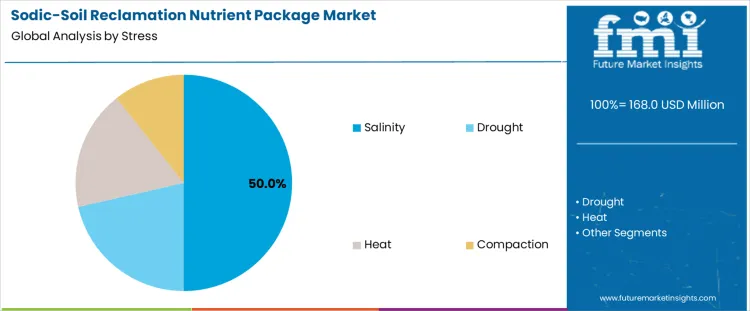
Salinity related sodic stress accounts for about 50% of demand because sodium accumulation is the primary driver of soil dispersion and structural collapse in affected fields. Sodic soils restrict water infiltration, reduce aeration, and impair root development, directly limiting crop productivity. Unlike transient stresses, sodicity worsens over time if not actively corrected, making reclamation programs essential rather than optional. Nutrient packages designed for sodic soils focus on restoring soil aggregation and enabling leaching of excess sodium from the root zone. Growers prioritize these programs in irrigated systems where repeated exposure to sodium rich water accelerates soil degradation. Yield losses associated with sodic conditions are cumulative and predictable, strengthening willingness to invest in multi season remediation strategies.
Drought, heat, and compaction contribute secondary stress demand but are often episodic or managed through irrigation, crop selection, or mechanical intervention. These stresses do not fundamentally alter soil exchange chemistry. Sodic stress leadership therefore reflects its chronic nature, structural impact on soils, and direct link to long term fertility decline rather than short term crop stress severity alone.
What Is Driving Leadership by Chemistry in the Sodic Soil Reclamation Nutrient Package Market?
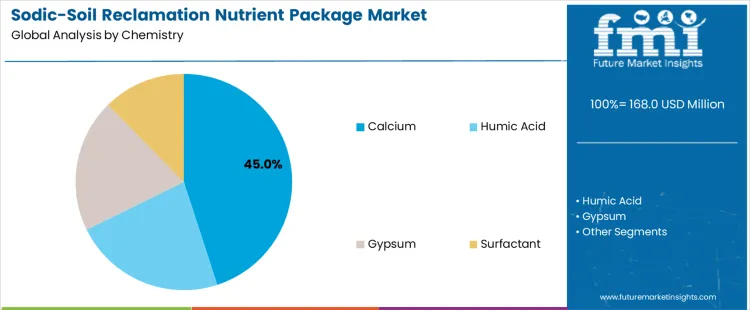
Calcium based chemistries account for about 45% of demand because calcium is the most effective ion for displacing sodium from soil exchange sites. In sodic soils, exces sodium weakens clay particle bonds, leading to dispersion and surface sealing. Calcium restores flocculation, improves soil structure, and enables downward movement of sodium through leaching. Calcium sources used in reclamation packages often provide both chemical correction and plant nutrition, supporting recovery during remediation phases. Their compatibility with fertigation and surface application systems common in irrigated farming further supports adoption.
Humic acid, gypsum, and surfactant based chemistries play supporting roles. Humic acids improve buffering capacity and biological activity but act gradually. Gypsum supplies calcium but requires sufficient water movement for full effectiveness. Surfactants enhance infiltration but do not correct exchange imbalance. Calcium based solutions therefore dominate because they address the root chemical cause of sodicity while integrating smoothly into practical field reclamation programs.
How Is the Sodic-Soil Reclamation Nutrient Package Being Applied Across Agriculture?
Use appears in row crops, orchards, and high-value horticulture where sodic soils limit nutrient availability, water infiltration, and crop growth. Farmers adopt nutrient packages combining NPK, gypsum, and micronutrients to reclaim sodic soils by improving soil structure, reducing sodium concentration, and enhancing fertility. Application through soil incorporation, fertigation, or banding ensures targeted nutrient delivery and soil remediation. These applications reflect operational and agronomic priorities rather than purely cost objectives, with adoption driven by soil health restoration, nutrient efficiency, and crop yield optimization.
What Operational and Material Conditions Support Adoption of Sodic-Soil Reclamation Nutrient Packages?
Selection aligns with soil types exhibiting high sodium content, poor infiltration, or low cation-exchange capacity. Formulations are optimized for solubility, chemical stability, and compatibility with existing soil amendments to enhance reclamation effectiveness. Farmers monitor soil pH, electrical conductivity, and sodium levels to determine application rates and scheduling. Quality control evaluates nutrient composition, soil remediation impact, and crop response to comply with agronomic and environmental standards. These conditions emerge from operational efficiency, soil restoration performance, and sustainable nutrient management priorities in structured reclamation workflows.
Which Practical Considerations Limit Wider Use of Sodic-Soil Reclamation Nutrient Packages?
Higher material and application costs may limit adoption in low-margin or small-scale farms. Soil texture, irrigation water quality, and crop type affect reclamation efficiency. Compatibility with existing fertilizers and amendments must be validated. Long-term monitoring is required to ensure sustainable soil improvement. Regulatory approvals and environmental standards differ by region. These factors lead to selective deployment where soil remediation, nutrient availability, and crop productivity justify incremental cost, careful planning, and precise operational management in sodic-soil reclamation programs.
What is the Demand for Sodic Soil Reclamation Nutrient Packages by Country?
| Country | CAGR (%) |
|---|---|
| India | 13.8% |
| Australia | 12.6% |
| Brazil | 11.9% |
| USA | 11.2% |
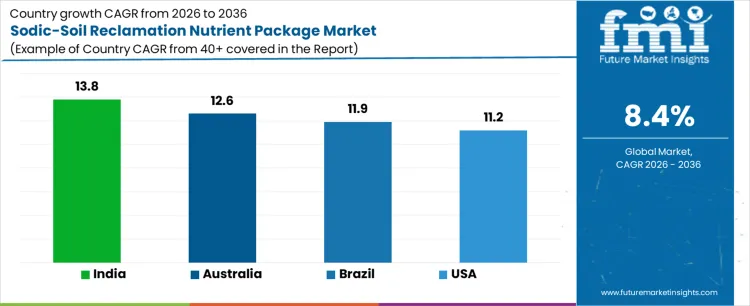
The demand for sodic soil reclamation nutrient packages is rising across regions facing sodium induced soil degradation, driven by irrigation intensity, declining soil structure, and yield recovery requirements. India leads with a 13.8% CAGR, supported by large areas affected by sodicity, extensive canal and groundwater irrigation, and increasing adoption of integrated nutrient and soil amendment programs. Australia follows at 12.6%, reflecting long standing sodic soil challenges in irrigated cropping zones and strong uptake of calcium based and conditioning nutrient solutions. Brazil records 11.9%, shaped by expansion of irrigated agriculture and efforts to maintain soil permeability in high productivity systems. The USA grows at 11.2%, driven by adoption in arid and semi-arid regions where sodicity management is essential for sustaining crop performance and irrigation efficiency.
How are sodic-soil reclamation nutrient packages expanding adoption in India?
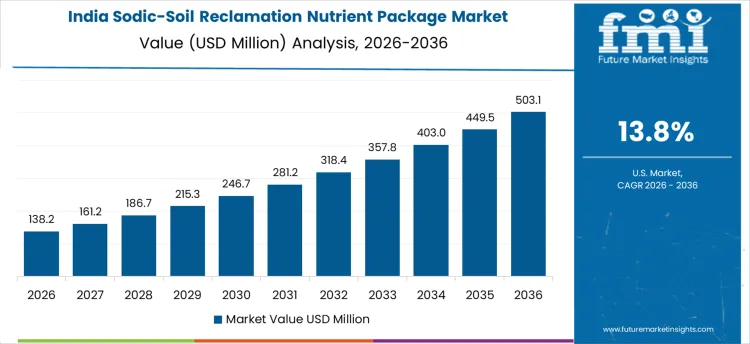
In India, the sodic-soil reclamation nutrient package market is growing at a CAGR of 13.8% through 2036, driven by widespread soil sodicity challenges, adoption of high-value horticulture, and government initiatives promoting soil restoration. Farmers are using these packages to improve soil structure, enhance nutrient availability, and increase crop productivity in affected irrigated regions. Demand is concentrated in high-intensity agricultural zones, irrigated horticultural areas, and industrial crop hubs. Compared to Australia, adoption emphasizes rapid deployment across diverse crops and large-scale farm integration. Domestic suppliers provide high-performance, chemically compatible nutrient packages suitable for recurring seasonal reclamation applications.
- High-intensity agricultural zones, irrigated horticultural areas, and industrial crop hubs drive adoption
- Packages improve soil structure, nutrient availability, and crop productivity
- Domestic suppliers provide high-performance, chemically compatible solutions
- Recurring seasonal reclamation applications sustain adoption
How are precision farming and soil health management driving adoption in Australia?
In Australia, revenue is growing at a CAGR of 12.6% through 2036, supported by the need to reclaim sodic soils, adoption of precision irrigation, and large-scale industrial cropping. Farmers are integrating nutrient packages to enhance soil cation exchange capacity, reduce sodium toxicity, and improve early crop growth. Demand is concentrated in irrigated horticultural zones, mechanized crop regions, and high-value grain-producing areas. Compared to India, adoption emphasizes adaptation to arid climates and soil-specific nutrient management. Domestic suppliers provide high-performance, stable nutrient packages suitable for recurring seasonal reclamation cycles.
- Irrigated horticultural zones, mechanized crop regions, and high-value grain areas drive adoption
- Packages enhance soil cation exchange capacity and reduce sodium toxicity
- Domestic suppliers provide high-performance, stable solutions
- Recurring seasonal reclamation cycles sustain adoption
How are industrial agriculture and salinity management driving growth in Brazil?
In Brazil, the market is expanding at a CAGR of 11.9% through 2036, fueled by industrial crop production, expansion of irrigated agriculture, and the need to reclaim sodic soils for high-value crops. Farmers are applying nutrient packages to restore soil structure, improve nutrient retention, and increase yields in saline-affected areas. Demand is concentrated in mechanized grain regions, industrial crop hubs, and irrigated horticultural zones. Compared to the USA, adoption emphasizes medium-scale deployment with focus on regional crop production. Domestic suppliers provide cost-effective, high-performance nutrient solutions suitable for recurring seasonal reclamation operations.
- Mechanized grain regions, industrial crop hubs, and irrigated horticultural zones drive adoption
- Packages restore soil structure and improve nutrient retention
- Domestic suppliers provide cost-effective, high-performance solutions
- Recurring seasonal reclamation operations sustain adoption
How are precision nutrient management and sustainable agriculture driving adoption in the United States?
In the United States, revenue is growing at a CAGR of 11.2% through 2036, supported by adoption of precision nutrient management, large-scale row crop production, and environmental compliance initiatives. Farmers are using sodic-soil reclamation packages to mitigate soil salinity, enhance nutrient availability, and improve early crop development. Demand is concentrated in irrigated row crop regions, high-intensity grain zones, and industrial agricultural hubs. Compared to India, adoption emphasizes regulatory compliance and precision application over high-volume deployment. Domestic suppliers provide chemically stable, high-performance nutrient packages suitable for recurring seasonal reclamation cycles.
- Irrigated row crop regions, high-intensity grain zones, and industrial hubs drive adoption
- Packages mitigate soil salinity and improve nutrient availability
- Domestic suppliers provide chemically stable, high-performance solutions
- Recurring seasonal reclamation cycles sustain adoption
How Do Regional Exposure and Program Architecture Shape Competition in the Sodic Soil Reclamation Nutrient Package Market?
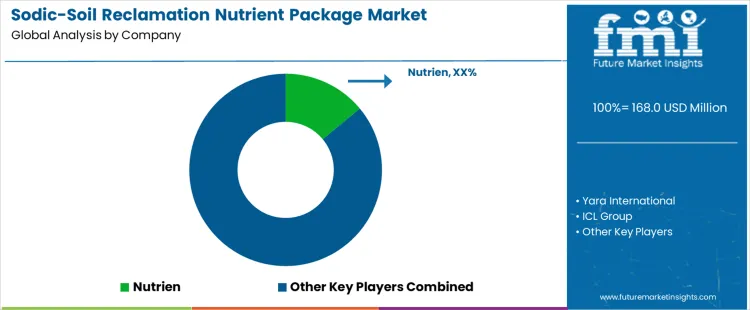
Competition in sodic soil reclamation nutrient packages is defined by regional soil chemistry challenges and the intensity of irrigated agriculture rather than by generic soil amendment claims. Nutrien and Yara International have meaningful exposure in North America and Australia, where sodicity emerges from long term irrigation and bicarbonate rich water. Their offerings are positioned as integrated nutrient packages combined with advisory support, making revenue exposure incremental within broader soil health programs rather than standalone products. ICL Group shows stronger concentration in Mediterranean regions and intensive horticulture zones, where sodic soils directly affect fertigation efficiency and yield stability. Here, reclamation packages represent a more material share of specialty nutrition revenues due to repeat application cycles.
Program structure and commercialization models further distinguish competitors. EuroChem addresses sodicity primarily through standardized calcium based blends aligned with large scale field crops in Eastern Europe and Central Asia, reflecting a volume driven approach with limited customization. BASF participates through enabling soil chemistry and amendment technologies that are bundled into partner programs rather than sold independently, keeping direct revenue exposure modest but strategic. UPL integrates sodic soil remediation into stress management and crop resilience programs, linking nutrient packages with biologicals and crop protection cycles. Competitive advantage is shaped by regional sodicity prevalence, irrigation intensity, and whether reclamation is positioned as a core revenue stream or an embedded agronomic capability.
Key Players in the Sodic-Soil Reclamation Nutrient Package Market
- Nutrien
- Yara International
- ICL Group
- EuroChem
- BASF
- UPL
Scope of the Report
| Items | Values |
|---|---|
| Quantitative Units | USD Million |
| Stress | Salinity, sodicity-related soil degradation, drought, compaction |
| Chemistry | Calcium-based amendments, gypsum-supported formulations, humic acid additives, surfactant-assisted packages |
| Application | Sodic soil reclamation, soil structure restoration, infiltration improvement, long-term land recovery programs |
| End Users | Irrigated farm operators, commercial row crop growers, horticulture and orchard producers, intensive soil reclamation projects |
| Regions Covered | Asia Pacific, Europe, North America, Latin America, Middle East & Africa |
| Countries Covered | India, Australia, Brazil, United States, and other sodicity-affected agricultural regions |
| Key Companies Profiled | Nutrien, Yara International, ICL Group, EuroChem, BASF, UPL |
| Additional Attributes | Dollar by sales across stress type and chemistry, adoption trends linked to sodium saturation and soil permeability loss, competitive landscape shaped by calcium-driven sodium displacement efficiency, integration with irrigation and leaching practices, site-specific soil testing and multi-season validation requirements, repeat application cycles driven by land recovery timelines |
Sodic-Soil Reclamation Nutrient Package Market Segmentation
Stress:
- Salinity
- Drought
- Heat
- Compaction
Chemistry:
- Calcium
- Humic Acid
- Gypsum
- Surfactant
Sales Channel:
- Ag-Retailers
- Direct-to-Farmer
- Online Marketplaces
- Cooperatives
Region
- Asia Pacific
- China
- Japan
- South Korea
- India
- Australia & New Zealand
- ASEAN
- Rest of Asia Pacific
- Europe
- Germany
- United Kingdom
- France
- Italy
- Spain
- Nordic
- BENELUX
- Rest of Europe
- North America
- United States
- Canada
- Mexico
- Latin America
- Brazil
- Chile
- Rest of Latin America
- Middle East & Africa
- Kingdom of Saudi Arabia
- Other GCC Countries
- Turkey
- South Africa
- Other African Union
- Rest of Middle East & Africa
Frequently Asked Questions
How big is the sodic-soil reclamation nutrient package market in 2026?
The global sodic-soil reclamation nutrient package market is estimated to be valued at USD 168.0 million in 2026.
What will be the size of sodic-soil reclamation nutrient package market in 2036?
The market size for the sodic-soil reclamation nutrient package market is projected to reach USD 376.4 million by 2036.
How much will be the sodic-soil reclamation nutrient package market growth between 2026 and 2036?
The sodic-soil reclamation nutrient package market is expected to grow at a 8.4% CAGR between 2026 and 2036.
What are the key product types in the sodic-soil reclamation nutrient package market?
The key product types in sodic-soil reclamation nutrient package market are salinity, drought, heat and compaction.
Which chemistry segment to contribute significant share in the sodic-soil reclamation nutrient package market in 2026?
In terms of chemistry, calcium segment to command 45.0% share in the sodic-soil reclamation nutrient package market in 2026.
Preview the report firsthand - request a free sample
Get SampleGet the brochure for pricing and purchase details.
Get PDFTable of Content
- Executive Summary
- Global Market Outlook
- Demand-side Trends
- Supply-side Trends
- Technology Roadmap Analysis
- Analysis and Recommendations
- Market Overview
- Market Coverage / Taxonomy
- Market Definition / Scope / Limitations
- Market Background
- Market Dynamics
- Drivers
- Restraints
- Opportunity
- Trends
- Scenario Forecast
- Demand in Optimistic Scenario
- Demand in Likely Scenario
- Demand in Conservative Scenario
- Opportunity Map Analysis
- Product Life Cycle Analysis
- Supply Chain Analysis
- Investment Feasibility Matrix
- Value Chain Analysis
- PESTLE and Porter’s Analysis
- Regulatory Landscape
- Regional Parent Market Outlook
- Production and Consumption Statistics
- Import and Export Statistics
- Market Dynamics
- Global Market Analysis 2021 to 2025 and Forecast, 2026 to 2036
- Historical Market Size Value (USD Million) Analysis, 2021 to 2025
- Current and Future Market Size Value (USD Million) Projections, 2026 to 2036
- Y-o-Y Growth Trend Analysis
- Absolute $ Opportunity Analysis
- Global Market Pricing Analysis 2021 to 2025 and Forecast 2026 to 2036
- Global Market Analysis 2021 to 2025 and Forecast 2026 to 2036, By Stress
- Introduction / Key Findings
- Historical Market Size Value (USD Million) Analysis By Stress , 2021 to 2025
- Current and Future Market Size Value (USD Million) Analysis and Forecast By Stress , 2026 to 2036
- Salinity
- Drought
- Heat
- Compaction
- Salinity
- Y-o-Y Growth Trend Analysis By Stress , 2021 to 2025
- Absolute $ Opportunity Analysis By Stress , 2026 to 2036
- Global Market Analysis 2021 to 2025 and Forecast 2026 to 2036, By Chemistry
- Introduction / Key Findings
- Historical Market Size Value (USD Million) Analysis By Chemistry, 2021 to 2025
- Current and Future Market Size Value (USD Million) Analysis and Forecast By Chemistry, 2026 to 2036
- Calcium
- Humic Acid
- Gypsum
- Surfactant
- Calcium
- Y-o-Y Growth Trend Analysis By Chemistry, 2021 to 2025
- Absolute $ Opportunity Analysis By Chemistry, 2026 to 2036
- Global Market Analysis 2021 to 2025 and Forecast 2026 to 2036, By Sales Channel
- Introduction / Key Findings
- Historical Market Size Value (USD Million) Analysis By Sales Channel, 2021 to 2025
- Current and Future Market Size Value (USD Million) Analysis and Forecast By Sales Channel, 2026 to 2036
- Ag-Retailers
- Direct-to-Farmer
- Online Marketplaces
- Cooperatives
- Ag-Retailers
- Y-o-Y Growth Trend Analysis By Sales Channel, 2021 to 2025
- Absolute $ Opportunity Analysis By Sales Channel, 2026 to 2036
- Global Market Analysis 2021 to 2025 and Forecast 2026 to 2036, By Region
- Introduction
- Historical Market Size Value (USD Million) Analysis By Region, 2021 to 2025
- Current Market Size Value (USD Million) Analysis and Forecast By Region, 2026 to 2036
- North America
- Latin America
- Western Europe
- Eastern Europe
- East Asia
- South Asia and Pacific
- Middle East & Africa
- Market Attractiveness Analysis By Region
- North America Market Analysis 2021 to 2025 and Forecast 2026 to 2036, By Country
- Historical Market Size Value (USD Million) Trend Analysis By Market Taxonomy, 2021 to 2025
- Market Size Value (USD Million) Forecast By Market Taxonomy, 2026 to 2036
- By Country
- USA
- Canada
- Mexico
- By Stress
- By Chemistry
- By Sales Channel
- By Country
- Market Attractiveness Analysis
- By Country
- By Stress
- By Chemistry
- By Sales Channel
- Key Takeaways
- Latin America Market Analysis 2021 to 2025 and Forecast 2026 to 2036, By Country
- Historical Market Size Value (USD Million) Trend Analysis By Market Taxonomy, 2021 to 2025
- Market Size Value (USD Million) Forecast By Market Taxonomy, 2026 to 2036
- By Country
- Brazil
- Chile
- Rest of Latin America
- By Stress
- By Chemistry
- By Sales Channel
- By Country
- Market Attractiveness Analysis
- By Country
- By Stress
- By Chemistry
- By Sales Channel
- Key Takeaways
- Western Europe Market Analysis 2021 to 2025 and Forecast 2026 to 2036, By Country
- Historical Market Size Value (USD Million) Trend Analysis By Market Taxonomy, 2021 to 2025
- Market Size Value (USD Million) Forecast By Market Taxonomy, 2026 to 2036
- By Country
- Germany
- UK
- Italy
- Spain
- France
- Nordic
- BENELUX
- Rest of Western Europe
- By Stress
- By Chemistry
- By Sales Channel
- By Country
- Market Attractiveness Analysis
- By Country
- By Stress
- By Chemistry
- By Sales Channel
- Key Takeaways
- Eastern Europe Market Analysis 2021 to 2025 and Forecast 2026 to 2036, By Country
- Historical Market Size Value (USD Million) Trend Analysis By Market Taxonomy, 2021 to 2025
- Market Size Value (USD Million) Forecast By Market Taxonomy, 2026 to 2036
- By Country
- Russia
- Poland
- Hungary
- Balkan & Baltic
- Rest of Eastern Europe
- By Stress
- By Chemistry
- By Sales Channel
- By Country
- Market Attractiveness Analysis
- By Country
- By Stress
- By Chemistry
- By Sales Channel
- Key Takeaways
- East Asia Market Analysis 2021 to 2025 and Forecast 2026 to 2036, By Country
- Historical Market Size Value (USD Million) Trend Analysis By Market Taxonomy, 2021 to 2025
- Market Size Value (USD Million) Forecast By Market Taxonomy, 2026 to 2036
- By Country
- China
- Japan
- South Korea
- By Stress
- By Chemistry
- By Sales Channel
- By Country
- Market Attractiveness Analysis
- By Country
- By Stress
- By Chemistry
- By Sales Channel
- Key Takeaways
- South Asia and Pacific Market Analysis 2021 to 2025 and Forecast 2026 to 2036, By Country
- Historical Market Size Value (USD Million) Trend Analysis By Market Taxonomy, 2021 to 2025
- Market Size Value (USD Million) Forecast By Market Taxonomy, 2026 to 2036
- By Country
- India
- ASEAN
- Australia & New Zealand
- Rest of South Asia and Pacific
- By Stress
- By Chemistry
- By Sales Channel
- By Country
- Market Attractiveness Analysis
- By Country
- By Stress
- By Chemistry
- By Sales Channel
- Key Takeaways
- Middle East & Africa Market Analysis 2021 to 2025 and Forecast 2026 to 2036, By Country
- Historical Market Size Value (USD Million) Trend Analysis By Market Taxonomy, 2021 to 2025
- Market Size Value (USD Million) Forecast By Market Taxonomy, 2026 to 2036
- By Country
- Kingdom of Saudi Arabia
- Other GCC Countries
- Turkiye
- South Africa
- Other African Union
- Rest of Middle East & Africa
- By Stress
- By Chemistry
- By Sales Channel
- By Country
- Market Attractiveness Analysis
- By Country
- By Stress
- By Chemistry
- By Sales Channel
- Key Takeaways
- Key Countries Market Analysis
- USA
- Pricing Analysis
- Market Share Analysis, 2025
- By Stress
- By Chemistry
- By Sales Channel
- Canada
- Pricing Analysis
- Market Share Analysis, 2025
- By Stress
- By Chemistry
- By Sales Channel
- Mexico
- Pricing Analysis
- Market Share Analysis, 2025
- By Stress
- By Chemistry
- By Sales Channel
- Brazil
- Pricing Analysis
- Market Share Analysis, 2025
- By Stress
- By Chemistry
- By Sales Channel
- Chile
- Pricing Analysis
- Market Share Analysis, 2025
- By Stress
- By Chemistry
- By Sales Channel
- Germany
- Pricing Analysis
- Market Share Analysis, 2025
- By Stress
- By Chemistry
- By Sales Channel
- UK
- Pricing Analysis
- Market Share Analysis, 2025
- By Stress
- By Chemistry
- By Sales Channel
- Italy
- Pricing Analysis
- Market Share Analysis, 2025
- By Stress
- By Chemistry
- By Sales Channel
- Spain
- Pricing Analysis
- Market Share Analysis, 2025
- By Stress
- By Chemistry
- By Sales Channel
- France
- Pricing Analysis
- Market Share Analysis, 2025
- By Stress
- By Chemistry
- By Sales Channel
- India
- Pricing Analysis
- Market Share Analysis, 2025
- By Stress
- By Chemistry
- By Sales Channel
- ASEAN
- Pricing Analysis
- Market Share Analysis, 2025
- By Stress
- By Chemistry
- By Sales Channel
- Australia & New Zealand
- Pricing Analysis
- Market Share Analysis, 2025
- By Stress
- By Chemistry
- By Sales Channel
- China
- Pricing Analysis
- Market Share Analysis, 2025
- By Stress
- By Chemistry
- By Sales Channel
- Japan
- Pricing Analysis
- Market Share Analysis, 2025
- By Stress
- By Chemistry
- By Sales Channel
- South Korea
- Pricing Analysis
- Market Share Analysis, 2025
- By Stress
- By Chemistry
- By Sales Channel
- Russia
- Pricing Analysis
- Market Share Analysis, 2025
- By Stress
- By Chemistry
- By Sales Channel
- Poland
- Pricing Analysis
- Market Share Analysis, 2025
- By Stress
- By Chemistry
- By Sales Channel
- Hungary
- Pricing Analysis
- Market Share Analysis, 2025
- By Stress
- By Chemistry
- By Sales Channel
- Kingdom of Saudi Arabia
- Pricing Analysis
- Market Share Analysis, 2025
- By Stress
- By Chemistry
- By Sales Channel
- Turkiye
- Pricing Analysis
- Market Share Analysis, 2025
- By Stress
- By Chemistry
- By Sales Channel
- South Africa
- Pricing Analysis
- Market Share Analysis, 2025
- By Stress
- By Chemistry
- By Sales Channel
- USA
- Market Structure Analysis
- Competition Dashboard
- Competition Benchmarking
- Market Share Analysis of Top Players
- By Regional
- By Stress
- By Chemistry
- By Sales Channel
- Competition Analysis
- Competition Deep Dive
- Nutrien
- Overview
- Product Portfolio
- Profitability by Market Segments (Product/Age /Sales Channel/Region)
- Sales Footprint
- Strategy Overview
- Marketing Strategy
- Product Strategy
- Channel Strategy
- Yara International
- ICL Group
- EuroChem
- BASF
- UPL
- Nutrien
- Competition Deep Dive
- Assumptions & Acronyms Used
- Research Methodology


