

- Industry Size (2026)
- USD 97.4 Mn
- Forecast (2036)
- USD 299.8 Mn
- CAGR (2026 to 2036)
- 11.9%
Low-Methane Paddy Rice Nutrient Program Market Forecast and Outlook 2026 to 2036
The low-methane paddy rice nutrient program market is projected to grow from USD 97.4 million in 2026 to USD 299.8 million by 2036, with a compound annual growth rate (CAGR) of 11.9%. Commercial performance in this market will be shaped by the need for pricing discipline as the high cost of developing and scaling low-methane nutrient solutions is balanced against market demand. Buyer leverage will increase as agricultural operations, particularly in regions with large-scale rice production, will seek cost-effective, proven solutions that meet both environmental and regulatory requirements. Volume predictability is another key factor, as demand for low-methane fertilizers may fluctuate with market conditions, such as rice prices and shifting government incentives. Strategic decisions will be influenced by the trade-off between maintaining competitive pricing and ensuring long-term profitability. Companies that can offer consistent product performance, while managing costs and aligning with environmental regulations, will be best positioned to navigate these market realities.
Quick Stats of the Low-Methane Paddy Rice Nutrient Program Market
- Low-Methane Paddy Rice Nutrient Program Market Value (2026): USD 97.4 million
- Low-Methane Paddy Rice Nutrient Program Market Forecast Value (2036): USD 299.8 million
- Low-Methane Paddy Rice Nutrient Program Market Global Forecast CAGR (2026-2036): 11.9%
- Low-Methane Paddy Rice Nutrient Program Market Leading Segment: Sales Channel (Ag-Retailers) 60%
- Key Growth Regions in Low-Methane Paddy Rice Nutrient Program Market: India
- Top Players in Low-Methane Paddy Rice Nutrient Program Market: Yara International, Nutrien, ICL Group, EuroChem, BASF, Syngenta
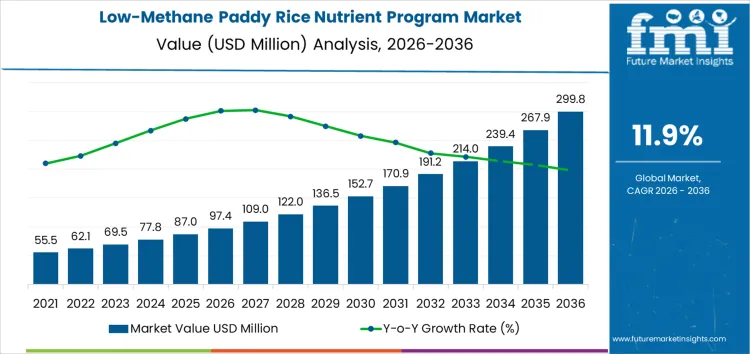
What is the Growth Forecast for the Low-Methane Paddy Rice Nutrient Program Market through 2036?
The peak-to-trough analysis for the low-methane paddy rice nutrient program market demonstrates the phases of rapid growth followed by stabilization as the technology becomes more widely adopted. In the initial phase, from 2026 to 2031, the market will experience significant acceleration, increasing from USD 97.4 million to USD 170.8 million. This growth reflects early adoption, driven by both regulatory pressures to reduce methane emissions and the increasing demand for sustainable agricultural practices. As more rice farmers and agricultural producers seek ways to mitigate the environmental impact of their operations, the market will see strong upward momentum.
Following the initial surge, the market will experience a more stable, gradual growth phase from 2031 to 2036. From USD 170.8 million in 2031, the market will rise to USD 299.8 million by 2036. The deceleration phase will be characterized by the technology becoming more standard in rice farming practices, with less dramatic growth expected as the low-methane nutrient program is integrated into mainstream agricultural techniques. While the market will still grow steadily, the rate of expansion will slow as the product becomes an established solution for sustainable rice farming, with the primary drivers shifting to continued innovation and incremental improvements in application methods.
Low-Methane Paddy Rice Nutrient Program Market Key Takeaways
| Metric | Value |
|---|---|
| Industry Sales Value (2026) | USD 97.4 million |
| Industry Forecast Value (2036) | USD 299.8 million |
| Industry Forecast CAGR (2026-2036) | 11.9% |
What Is Driving the Demand for Low-Methane Paddy Rice Nutrient Programs?
Historical demand for rice nutrient programs has been shaped by long standing reliance on conventional fertilizer and water practices that support high yields in paddy rice cultivation while creating anaerobic soil conditions that favour methane (CH₄) production. Methane is generated when organic matter decomposes under oxygen limited conditions common in continuously flooded rice fields, making rice paddies a significant source of agricultural methane emissions. Traditional nutrient management often used nitrogen fertilizers such as urea in flooded soils, which can increase methane emissions by fostering conditions for methanogenic microbes. Research has shown that fertilizer choice and application influence methane flux from paddies, and that integrated soil nutrient and water management practices can reduce emissions while maintaining productivity. Methane mitigation strategies began gaining traction as climate science highlighted the role of agriculture in greenhouse gas inventories, and agronomic research explored how nutrient placement and fertilizer types affect both yield and emissions. These early practices contributed to farmer and researcher interest in nutrient focused approaches that reduce methanogenesis in paddy systems.
Future demand for low methane paddy rice nutrient programs is expected to grow as agricultural systems seek methods to balance crop productivity with environmental targets for greenhouse gas reduction. Drivers include adoption of integrated nutrient management approaches that tailor fertilizer type, placement, and timing to limit anaerobic soil conditions and influence microbial dynamics that produce methane. Practices such as deep nitrogen placement and use of controlled release fertilizers have been associated with methane reduction in field studies, helping shift nutrient programs toward low methane outcomes. Regulatory and policy frameworks at national and international levels are encouraging mitigation of methane emissions from agriculture as part of broader climate action goals, and this creates impetus for nutrient programs that contribute to emission targets. Demand is further supported by interest in combining nutrient strategies with water management techniques such as alternate wetting and drying, which disrupt anaerobic conditions and lower methane generation. Challenges include developing nutrient protocols that are agronomically effective, cost feasible for farmers, and adaptable across diverse soil and climate contexts. Continued research and extension support for integrated nutrient and water management is likely to influence how low methane nutrient programs are adopted in rice production systems.
What are the Leading Segments in the Global Low-Methane Paddy Rice Nutrient Program Market?
The global low-methane paddy rice nutrient program market is segmented by crop and sales channel. Among crops, cereals lead the market, capturing 50% of the share, followed by oilseeds, fruits, and vegetables. Cereal crops dominate the market due to their significant role in global food production, particularly in regions where rice cultivation is prevalent. On the sales channel side, ag-retailers dominate, holding 60% of the share, followed by direct-to-farmer, online marketplaces, and cooperatives. Ag-retailers lead due to their established distribution networks and ability to provide tailored products for large-scale agricultural operations.
What Drives the Growth of Cereal Crops in the Low-Methane Paddy Rice Nutrient Program Market?
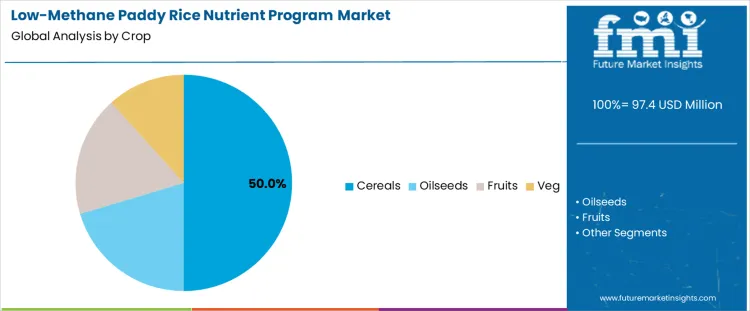
Cereal crops are the leading crop type in the low-methane paddy rice nutrient program market, holding 50% of the share. This demand is primarily driven by the widespread production of rice, which is a staple food in many regions, especially Asia. As the agricultural industry increasingly adopts sustainable farming practices, the use of low-methane paddy rice nutrient programs is becoming essential. These programs help reduce methane emissions, a significant contributor to global warming, by optimizing the application of nutrients and improving soil health. Additionally, the growing focus on climate-smart agriculture and the push for environmentally friendly farming practices in cereal crop production are driving the adoption of these nutrient programs. As sustainability becomes a priority in global food production, the demand for low-methane nutrient programs in cereal crop cultivation, especially rice, will continue to rise, ensuring the sector’s dominance in the market.
What is Driving the Demand for Ag-Retailers in the Low-Methane Paddy Rice Nutrient Program Market?
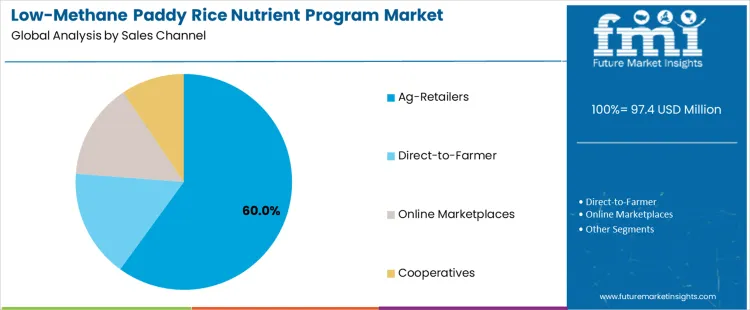
Ag-retailers are the leading sales channel in the low-methane paddy rice nutrient program market, capturing 60% of the share. This growth is driven by the established relationships ag-retailers have with farmers, their broad distribution networks, and their ability to provide specialized, sustainable products. Ag-retailers are critical in supplying farmers with low-methane nutrient programs that are tailored to meet the needs of specific crops, such as rice. They also offer valuable expertise, helping farmers implement best practices for reducing methane emissions while improving soil health and productivity. As sustainable farming practices become more widespread, ag-retailers are central to the distribution of low-methane fertilizers and nutrient programs, playing a crucial role in educating farmers and making these environmentally friendly solutions accessible. With the increasing focus on climate-conscious agriculture, ag-retailers will remain a dominant force in the market for low-methane paddy rice nutrient programs.
What are the Key Dynamics in the Low-Methane Paddy Rice Nutrient Program Market?
The low methane paddy rice nutrient program market is shaped by the need to reduce methane emissions from flooded rice systems and improve nutrient efficiency. These programs combine nutrient management practices with fertilizer products that influence soil biology and carbon cycling. Growers assess programs based on yield impact, methane mitigation potential, and compatibility with irrigation practices. Policy frameworks on greenhouse gas reduction in agriculture influence adoption. Research evidence on emission response to nutrient strategies and field performance data guide decision making.
Market activity reflects interaction among agronomy, environmental goals, and farm economics. What are the Main Drivers Supporting Growth in the Market?
Growth in this market is supported by regulatory focus on climate change and agricultural emissions. National and regional policies seek to cut methane output from rice cultivation as part of climate action plans. Scientific studies linking nutrient inputs, water management, and soil microbiology are increasing interest in tailored nutrient programs. Grower demand for practices that maintain or improve yield while reducing greenhouse gas intensity is rising. Funding for research and extension services helps disseminate best management practices. Collaboration between agribusinesses, research institutions, and government bodies is expanding options for low methane nutrient solutions.
What Restraints Are Limiting Market Expansion?
Cost considerations restrict uptake of specialized nutrient programs for some rice producers. Investment in training, soil testing, and program adaptation can be a barrier in resource constrained regions. Variability in soil type and water management practices can lead to inconsistent results from nutrient strategies, creating uncertainty for growers. Lack of standardized measurement protocols for methane and nutrient performance complicates comparison of program outcomes. Differences in regulatory approaches across countries add complexity for product developers and service providers seeking broader market access.
What Emerging Trends Are Shaping the Future of the Market?
Emerging trends include integration of precision agriculture tools, such as sensor data and modelling, to match nutrient applications with soil conditions and emissions targets. Advances in organic and inorganic fertilizer chemistry aim to influence soil microbial pathways linked to methane production. Field trials and demonstration plots are generating localized evidence on program performance under diverse conditions. Partnerships between technology providers and rice producer associations are increasing access to decision support resources. Emphasis on sustainable intensification is reinforcing adoption of nutrient programs that balance productivity with environmental outcomes.
What is the Country-Wise Analysis of the Low-Methane Paddy Rice Nutrient Program Market?
The low-methane paddy rice nutrient program market is experiencing strong growth as the agricultural industry seeks to address the environmental impact of rice cultivation, particularly the methane emissions associated with traditional paddy rice farming. Rice paddies are a major source of methane, a potent greenhouse gas, and reducing these emissions has become a key goal for sustainable agriculture. Low-methane nutrient programs aim to optimize rice cultivation practices to reduce methane production while maintaining high yields. Countries like India, China, Vietnam, and Thailand, which are major rice producers, are seeing significant demand for these innovative farming solutions. As these nations work towards improving sustainability in rice farming, the market for low-methane nutrient programs is projected to expand rapidly, supported by government initiatives, environmental policies, and the need to reduce agricultural emissions.
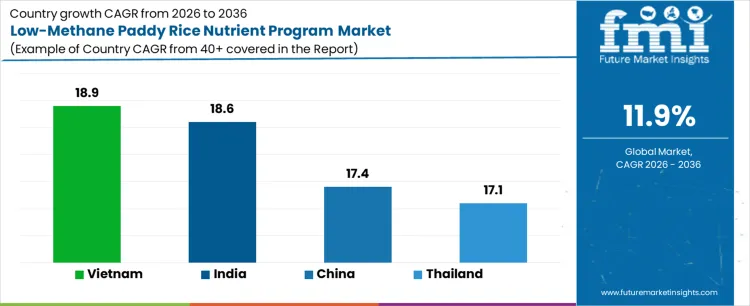
| Country | CAGR (2026-2036) |
|---|---|
| India | 18.6% |
| China | 17.4% |
| Vietnam | 18.9% |
| Thailand | 17.1% |
What is the Growth Outlook for the Low-Methane Paddy Rice Nutrient Program Market in India?
India is projected to experience the highest growth in the low-methane paddy rice nutrient program market, with a projected CAGR of 18.6% from 2026 to 2036. As one of the largest rice producers globally, India is under increasing pressure to adopt sustainable agricultural practices that reduce environmental harm. Rice cultivation in India is a significant contributor to methane emissions, and the country is increasingly seeking ways to mitigate these emissions while maintaining rice production levels. The adoption of low-methane nutrient programs is gaining traction, as Indian farmers and government bodies look for innovative solutions to both enhance crop yields and reduce the environmental impact of rice farming. With strong government support for sustainable farming practices and the rising awareness of climate change issues, the demand for low-methane paddy rice nutrient programs in India is expected to grow rapidly in the coming years.
What is the Market Outlook for the Low-Methane Paddy Rice Nutrient Program Market in China?
China is expected to see steady growth in the low-methane paddy rice nutrient program market, with a projected CAGR of 17.4% from 2026 to 2036. As the world’s largest producer and consumer of rice, China is actively working to reduce the environmental impact of its agricultural practices. Rice cultivation, particularly in paddy fields, is a significant source of methane emissions, and China has increasingly focused on reducing these emissions through innovative farming techniques. The adoption of low-methane nutrient programs is part of China’s broader efforts to implement sustainable agricultural solutions that address climate change while ensuring food security. With government support for green farming practices and a growing commitment to environmental sustainability, China’s market for low-methane paddy rice nutrient programs is expected to grow steadily, driven by both policy and farmer adoption of more sustainable practices.
What is the Growth Forecast for the Low-Methane Paddy Rice Nutrient Program Market in Vietnam?
Vietnam is projected to experience robust growth in the low-methane paddy rice nutrient program market, with a projected CAGR of 18.9% from 2026 to 2036. As a major rice-producing nation, Vietnam is increasingly adopting environmentally friendly agricultural practices to mitigate the impact of rice farming on the environment. Rice cultivation in Vietnam is responsible for a significant amount of methane emissions, and the country is focusing on reducing these emissions as part of its environmental and sustainability goals. The low-methane paddy rice nutrient programs offer a promising solution, providing farmers with the tools to optimize rice yields while minimizing methane production. With strong government support for sustainable agriculture and a growing emphasis on climate change mitigation, the demand for low-methane nutrient programs in Vietnam is expected to rise rapidly.
What is the Market Outlook for the Low-Methane Paddy Rice Nutrient Program Market in Thailand?
Thailand is expected to see steady growth in the low-methane paddy rice nutrient program market, with a projected CAGR of 17.1% from 2026 to 2036. Thailand, a major producer and exporter of rice, is increasingly focusing on sustainable agricultural practices to improve productivity while addressing the environmental impact of rice farming. Rice cultivation in Thailand contributes significantly to methane emissions, and reducing these emissions is a priority for the government and farmers alike. Low-methane nutrient programs, which aim to reduce methane emissions from paddy fields while optimizing fertilizer use, are gaining traction in Thailand’s agricultural sector. With the Thai government’s strong emphasis on sustainable farming solutions and the rising demand for eco-friendly practices, the market for low-methane paddy rice nutrient programs is expected to grow steadily in the coming years.
What are the Growth Prospects for the Low-Methane Paddy Rice Nutrient Program Market Globally?
Globally, the low-methane paddy rice nutrient program market is poised for significant growth as the agricultural industry increasingly embraces sustainability and climate-smart practices. Rice paddies are a major source of methane emissions, and mitigating these emissions is a key focus of global agricultural policy. Low-methane nutrient programs, which optimize rice cultivation practices to reduce methane production while maintaining high yields, are gaining adoption in major rice-producing countries. As governments around the world implement stricter environmental regulations and incentivize sustainable farming, the demand for low-methane paddy rice nutrient programs is expected to rise. The market will continue to expand, supported by global efforts to combat climate change, improve food security, and promote sustainable agricultural practices. As more countries adopt these technologies, the global market for low-methane paddy rice nutrient programs is set to grow rapidly in the coming decades.
What is the Competitive Landscape for the Low-Methane Paddy Rice Nutrient Program Market?
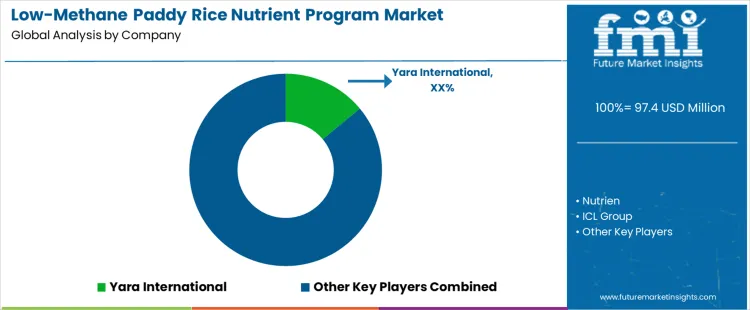
The low-methane paddy rice nutrient program market is growing as the agricultural industry seeks to reduce the environmental impact of rice cultivation, particularly methane emissions, which are a significant contributor to greenhouse gases. Yara International leads the market with its innovative low-methane paddy rice nutrient programs, offering high-performance fertilizers and nutrient management solutions designed to reduce methane emissions while enhancing rice crop productivity. Their focus on sustainability, product efficacy, and environmental responsibility has positioned them as a dominant player in this sector. Nutrien, ICL Group, and EuroChem are significant competitors, each offering specialized fertilizers and nutrient programs aimed at reducing methane emissions in rice fields. Nutrien provides nutrient management solutions that optimize rice production and minimize emissions, while ICL Group and EuroChem emphasize sustainable nutrient use to reduce environmental impacts.
BASF and Syngenta further contribute to the competitive landscape by offering their own solutions for low-methane rice cultivation. BASF focuses on delivering sustainable crop nutrition solutions that reduce methane emissions, while Syngenta provides innovative agricultural technologies and nutrient programs aimed at sustainable rice farming. These companies compete by focusing on product innovation, sustainability, and the growing demand for solutions that reduce the environmental footprint of rice cultivation. As climate change concerns continue to drive agricultural practices, the market for low-methane paddy rice nutrient programs is expected to expand, fostering further innovation and competition in the sector.
Key Players of the Low-Methane Paddy Rice Nutrient Program Market
- Yara International
- Nutrien
- ICL Group
- EuroChem
- BASF
- Syngenta
Scope of the Report
| Items | Values |
|---|---|
| Quantitative Units (2026) | USD Million |
| Crop | Cereals, Oilseeds, Fruits, Vegetables |
| Form | Granular, Liquid, Powder, Suspension |
| Sales Channel | Ag Retailers, Direct to Farmer, Online Marketplaces, Cooperatives |
| Companies | Yara International, Nutrien, ICL Group, EuroChem, BASF, Syngenta |
| Regions Covered | North America, Latin America, Western Europe, Eastern Europe, South Asia & Pacific, East Asia, Middle East & Africa |
| Countries Covered | United States, Canada, Mexico, Brazil, Argentina, Germany, France, United Kingdom, Italy, Spain, Netherlands, China, India, Japan, South Korea, ANZ, GCC Countries, South Africa |
| Additional Attributes | Dollar by sales by crop, form, sales channel, and region. Includes analysis of market dynamics in low methane paddy rice nutrient program adoption, performance of nutrient formulations in paddy systems and other crops, formulation cost and delivery factors, regulatory and environmental considerations related to methane reduction strategies, agronomic and greenhouse gas mitigation impacts, adoption patterns among producers, market share and competitive positioning of key companies, innovations in nutrient program technologies, and assessment of influence on nutrient use efficiency, crop yield, soil health, and methane emission outcomes. |
Low-Methane Paddy Rice Nutrient Program Market Segmentation
Crop
- Cereals
- Oilseeds
- Fruits
- Vegetables
Form
- Granular
- Liquid
- Powder
- Suspension
Sales Channel
- Ag-Retailers
- Direct-to-Farmer
- Online Marketplaces
- Cooperatives
Region
- Asia Pacific
- China
- Japan
- South Korea
- India
- Australia & New Zealand
- ASEAN
- Rest of Asia Pacific
- Europe
- Germany
- United Kingdom
- France
- Italy
- Spain
- Nordic
- BENELUX
- Rest of Europe
- North America
- United States
- Canada
- Mexico
- Latin America
- Brazil
- Chile
- Rest of Latin America
- Middle East & Africa
- Kingdom of Saudi Arabia
- Other GCC Countries
- Turkey
- South Africa
- Other African Union
- Rest of Middle East & Africa
Frequently Asked Questions
How big is the low-methane paddy rice nutrient program market in 2026?
The global low-methane paddy rice nutrient program market is estimated to be valued at USD 97.4 million in 2026.
What will be the size of low-methane paddy rice nutrient program market in 2036?
The market size for the low-methane paddy rice nutrient program market is projected to reach USD 299.8 million by 2036.
How much will be the low-methane paddy rice nutrient program market growth between 2026 and 2036?
The low-methane paddy rice nutrient program market is expected to grow at an 11.9% CAGR between 2026 and 2036.
What are the key crop types in the low-methane paddy rice nutrient program market?
The key crop types in the low-methane paddy rice nutrient program market are cereals, oilseeds, fruits, and vegetables.
Which form segment will contribute significant share in the low-methane paddy rice nutrient program market in 2026?
In terms of form, granular segment to command 45.0% share in the low-methane paddy rice nutrient program market in 2026.
Preview the report firsthand - request a free sample
Get SampleGet the brochure for pricing and purchase details.
Get PDFTable of Content
- Executive Summary
- Global Market Outlook
- Demand-side Trends
- Supply-side Trends
- Technology Roadmap Analysis
- Analysis and Recommendations
- Market Overview
- Market Coverage / Taxonomy
- Market Definition / Scope / Limitations
- Market Background
- Market Dynamics
- Drivers
- Restraints
- Opportunity
- Trends
- Scenario Forecast
- Demand in Optimistic Scenario
- Demand in Likely Scenario
- Demand in Conservative Scenario
- Opportunity Map Analysis
- Product Life Cycle Analysis
- Supply Chain Analysis
- Investment Feasibility Matrix
- Value Chain Analysis
- PESTLE and Porter’s Analysis
- Regulatory Landscape
- Regional Parent Market Outlook
- Production and Consumption Statistics
- Import and Export Statistics
- Market Dynamics
- Global Market Analysis 2021 to 2025 and Forecast, 2026 to 2036
- Historical Market Size Value (USD Million) Analysis, 2021 to 2025
- Current and Future Market Size Value (USD Million) Projections, 2026 to 2036
- Y-o-Y Growth Trend Analysis
- Absolute $ Opportunity Analysis
- Global Market Pricing Analysis 2021 to 2025 and Forecast 2026 to 2036
- Global Market Analysis 2021 to 2025 and Forecast 2026 to 2036, By Crop
- Introduction / Key Findings
- Historical Market Size Value (USD Million) Analysis By Crop , 2021 to 2025
- Current and Future Market Size Value (USD Million) Analysis and Forecast By Crop , 2026 to 2036
- Cereals
- Oilseeds
- Fruits
- Veg
- Cereals
- Y-o-Y Growth Trend Analysis By Crop , 2021 to 2025
- Absolute $ Opportunity Analysis By Crop , 2026 to 2036
- Global Market Analysis 2021 to 2025 and Forecast 2026 to 2036, By Form
- Introduction / Key Findings
- Historical Market Size Value (USD Million) Analysis By Form, 2021 to 2025
- Current and Future Market Size Value (USD Million) Analysis and Forecast By Form, 2026 to 2036
- Granular
- Liquid
- Powder
- Suspension
- Granular
- Y-o-Y Growth Trend Analysis By Form, 2021 to 2025
- Absolute $ Opportunity Analysis By Form, 2026 to 2036
- Global Market Analysis 2021 to 2025 and Forecast 2026 to 2036, By Sales Channel
- Introduction / Key Findings
- Historical Market Size Value (USD Million) Analysis By Sales Channel, 2021 to 2025
- Current and Future Market Size Value (USD Million) Analysis and Forecast By Sales Channel, 2026 to 2036
- Ag-Retailers
- Direct-to-Farmer
- Online Marketplaces
- Cooperatives
- Ag-Retailers
- Y-o-Y Growth Trend Analysis By Sales Channel, 2021 to 2025
- Absolute $ Opportunity Analysis By Sales Channel, 2026 to 2036
- Global Market Analysis 2021 to 2025 and Forecast 2026 to 2036, By Region
- Introduction
- Historical Market Size Value (USD Million) Analysis By Region, 2021 to 2025
- Current Market Size Value (USD Million) Analysis and Forecast By Region, 2026 to 2036
- North America
- Latin America
- Western Europe
- Eastern Europe
- East Asia
- South Asia and Pacific
- Middle East & Africa
- Market Attractiveness Analysis By Region
- North America Market Analysis 2021 to 2025 and Forecast 2026 to 2036, By Country
- Historical Market Size Value (USD Million) Trend Analysis By Market Taxonomy, 2021 to 2025
- Market Size Value (USD Million) Forecast By Market Taxonomy, 2026 to 2036
- By Country
- USA
- Canada
- Mexico
- By Crop
- By Form
- By Sales Channel
- By Country
- Market Attractiveness Analysis
- By Country
- By Crop
- By Form
- By Sales Channel
- Key Takeaways
- Latin America Market Analysis 2021 to 2025 and Forecast 2026 to 2036, By Country
- Historical Market Size Value (USD Million) Trend Analysis By Market Taxonomy, 2021 to 2025
- Market Size Value (USD Million) Forecast By Market Taxonomy, 2026 to 2036
- By Country
- Brazil
- Chile
- Rest of Latin America
- By Crop
- By Form
- By Sales Channel
- By Country
- Market Attractiveness Analysis
- By Country
- By Crop
- By Form
- By Sales Channel
- Key Takeaways
- Western Europe Market Analysis 2021 to 2025 and Forecast 2026 to 2036, By Country
- Historical Market Size Value (USD Million) Trend Analysis By Market Taxonomy, 2021 to 2025
- Market Size Value (USD Million) Forecast By Market Taxonomy, 2026 to 2036
- By Country
- Germany
- UK
- Italy
- Spain
- France
- Nordic
- BENELUX
- Rest of Western Europe
- By Crop
- By Form
- By Sales Channel
- By Country
- Market Attractiveness Analysis
- By Country
- By Crop
- By Form
- By Sales Channel
- Key Takeaways
- Eastern Europe Market Analysis 2021 to 2025 and Forecast 2026 to 2036, By Country
- Historical Market Size Value (USD Million) Trend Analysis By Market Taxonomy, 2021 to 2025
- Market Size Value (USD Million) Forecast By Market Taxonomy, 2026 to 2036
- By Country
- Russia
- Poland
- Hungary
- Balkan & Baltic
- Rest of Eastern Europe
- By Crop
- By Form
- By Sales Channel
- By Country
- Market Attractiveness Analysis
- By Country
- By Crop
- By Form
- By Sales Channel
- Key Takeaways
- East Asia Market Analysis 2021 to 2025 and Forecast 2026 to 2036, By Country
- Historical Market Size Value (USD Million) Trend Analysis By Market Taxonomy, 2021 to 2025
- Market Size Value (USD Million) Forecast By Market Taxonomy, 2026 to 2036
- By Country
- China
- Japan
- South Korea
- By Crop
- By Form
- By Sales Channel
- By Country
- Market Attractiveness Analysis
- By Country
- By Crop
- By Form
- By Sales Channel
- Key Takeaways
- South Asia and Pacific Market Analysis 2021 to 2025 and Forecast 2026 to 2036, By Country
- Historical Market Size Value (USD Million) Trend Analysis By Market Taxonomy, 2021 to 2025
- Market Size Value (USD Million) Forecast By Market Taxonomy, 2026 to 2036
- By Country
- India
- ASEAN
- Australia & New Zealand
- Rest of South Asia and Pacific
- By Crop
- By Form
- By Sales Channel
- By Country
- Market Attractiveness Analysis
- By Country
- By Crop
- By Form
- By Sales Channel
- Key Takeaways
- Middle East & Africa Market Analysis 2021 to 2025 and Forecast 2026 to 2036, By Country
- Historical Market Size Value (USD Million) Trend Analysis By Market Taxonomy, 2021 to 2025
- Market Size Value (USD Million) Forecast By Market Taxonomy, 2026 to 2036
- By Country
- Kingdom of Saudi Arabia
- Other GCC Countries
- Turkiye
- South Africa
- Other African Union
- Rest of Middle East & Africa
- By Crop
- By Form
- By Sales Channel
- By Country
- Market Attractiveness Analysis
- By Country
- By Crop
- By Form
- By Sales Channel
- Key Takeaways
- Key Countries Market Analysis
- USA
- Pricing Analysis
- Market Share Analysis, 2025
- By Crop
- By Form
- By Sales Channel
- Canada
- Pricing Analysis
- Market Share Analysis, 2025
- By Crop
- By Form
- By Sales Channel
- Mexico
- Pricing Analysis
- Market Share Analysis, 2025
- By Crop
- By Form
- By Sales Channel
- Brazil
- Pricing Analysis
- Market Share Analysis, 2025
- By Crop
- By Form
- By Sales Channel
- Chile
- Pricing Analysis
- Market Share Analysis, 2025
- By Crop
- By Form
- By Sales Channel
- Germany
- Pricing Analysis
- Market Share Analysis, 2025
- By Crop
- By Form
- By Sales Channel
- UK
- Pricing Analysis
- Market Share Analysis, 2025
- By Crop
- By Form
- By Sales Channel
- Italy
- Pricing Analysis
- Market Share Analysis, 2025
- By Crop
- By Form
- By Sales Channel
- Spain
- Pricing Analysis
- Market Share Analysis, 2025
- By Crop
- By Form
- By Sales Channel
- France
- Pricing Analysis
- Market Share Analysis, 2025
- By Crop
- By Form
- By Sales Channel
- India
- Pricing Analysis
- Market Share Analysis, 2025
- By Crop
- By Form
- By Sales Channel
- ASEAN
- Pricing Analysis
- Market Share Analysis, 2025
- By Crop
- By Form
- By Sales Channel
- Australia & New Zealand
- Pricing Analysis
- Market Share Analysis, 2025
- By Crop
- By Form
- By Sales Channel
- China
- Pricing Analysis
- Market Share Analysis, 2025
- By Crop
- By Form
- By Sales Channel
- Japan
- Pricing Analysis
- Market Share Analysis, 2025
- By Crop
- By Form
- By Sales Channel
- South Korea
- Pricing Analysis
- Market Share Analysis, 2025
- By Crop
- By Form
- By Sales Channel
- Russia
- Pricing Analysis
- Market Share Analysis, 2025
- By Crop
- By Form
- By Sales Channel
- Poland
- Pricing Analysis
- Market Share Analysis, 2025
- By Crop
- By Form
- By Sales Channel
- Hungary
- Pricing Analysis
- Market Share Analysis, 2025
- By Crop
- By Form
- By Sales Channel
- Kingdom of Saudi Arabia
- Pricing Analysis
- Market Share Analysis, 2025
- By Crop
- By Form
- By Sales Channel
- Turkiye
- Pricing Analysis
- Market Share Analysis, 2025
- By Crop
- By Form
- By Sales Channel
- South Africa
- Pricing Analysis
- Market Share Analysis, 2025
- By Crop
- By Form
- By Sales Channel
- USA
- Market Structure Analysis
- Competition Dashboard
- Competition Benchmarking
- Market Share Analysis of Top Players
- By Regional
- By Crop
- By Form
- By Sales Channel
- Competition Analysis
- Competition Deep Dive
- Yara International
- Overview
- Product Portfolio
- Profitability by Market Segments (Product/Age /Sales Channel/Region)
- Sales Footprint
- Strategy Overview
- Marketing Strategy
- Product Strategy
- Channel Strategy
- Nutrien
- ICL Group
- EuroChem
- BASF
- Syngenta
- Yara International
- Competition Deep Dive
- Assumptions & Acronyms Used
- Research Methodology


