

- Industry Size (2026)
- USD 427.4 Mn
- Forecast (2036)
- USD 1068.9 Mn
- CAGR (2026 to 2036)
- 9.6%
Nutrient Recovery Chemicals for Sludge Processing Market Forecast and Outlook 2026 to 2036
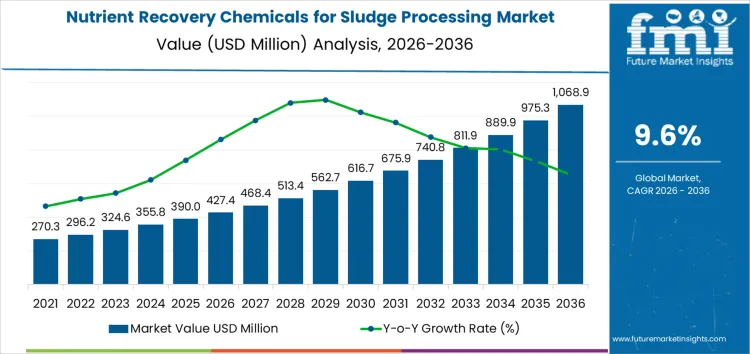
The nutrient recovery chemicals for sludge processing market is valued at USD 427.4 million in 2026 and is projected to reach USD 1,068.9 million by 2036, registering a CAGR of 9.6%. Growth is supported by tightening phosphorus discharge limits, circular resource policies, and rising operating costs linked to sludge handling. Utilities and industrial operators prioritize recovery pathways that convert residual nutrients into saleable products while reducing scaling, disposal volumes, and compliance risk across anaerobic digestion and dewatering stages.
Struvite precipitation chemicals represent leading chemical type globally, driven by proven selectivity for phosphorus capture and operational stability. Phosphorus recovery holds primary focus due to regulatory pressure on eutrophication control and strong downstream demand for recovered phosphate fertilizers. Adoption concentrates on controlled crystallization systems that mitigate pipe scaling and improve solids handling efficiency. Segment structure reflects preference for solutions delivering predictable crystal growth, lower chemical consumption, and integration with existing sludge processing assets.
India and China lead growth due to expanding wastewater capacity and nutrient discharge constraints. USA, Germany, and Netherlands reflect demand from advanced recovery mandates and circular economy targets. Competitive landscape includes Ostara Nutrient Recovery Technologies, Veolia Water Technologies, SUEZ Water Technologies, Kemira, and Ecolab, emphasizing integrated recovery systems, reagent optimization, and stable fertilizer-grade outputs.
Quick Stats for Nutrient Recovery Chemicals for Sludge Processing Market
- Nutrient Recovery Chemicals for Sludge Processing Market Value (2026): USD 427.4 million
- Nutrient Recovery Chemicals for Sludge Processing Market Forecast Value (2036): USD 1,068.9 million
- Nutrient Recovery Chemicals for Sludge Processing Market Forecast CAGR (2026–2036): 9.6%
- Leading Chemical Type in Global Demand: Struvite Precipitation Chemicals
- Fastest-Growing Countries: India, China, USA, Germany, Netherlands
- Top Players in Global Demand: Ostara Nutrient Recovery Technologies, Veolia Water Technologies, SUEZ Water Technologies, Kemira, Ecolab
Nutrient Recovery Chemicals for Sludge Processing Market Key Takeaways
| Metric | Value |
|---|---|
| Market Value (2026) | USD 427.4 million |
| Market Forecast Value (2036) | USD 1,068.9 million |
| Forecast CAGR (2026-2036) | 9.6% |
Why is the Demand for Nutrient Recovery Chemicals for Sludge Processing Market Growing?
Demand for nutrient recovery chemicals for sludge processing is growing globally due to rising emphasis on sustainable resource management, regulatory pressure to reduce nutrient discharge, and expansion of circular economy practices. Wastewater treatment plants generate sludge that contains nitrogen and phosphorus, which can contribute to eutrophication if released into natural waters. Operators adopt nutrient recovery chemicals to precipitate, capture, and convert these elements into reusable products such as fertilizers and soil amendments. Regulatory frameworks in multiple regions set stringent limits on nutrient loads in effluent and biosolids, which strengthens adoption of recovery strategies that support compliance while generating value from waste streams.
Population growth, urbanization, and increased wastewater volumes intensify nutrient burdens within treatment systems, reinforcing need for effective recovery solutions. Industrial sectors, including food processing and agriculture, implement chemical aided recovery to meet sustainability goals and reduce dependency on virgin nutrient sources. Research and development improve reagent efficiency, selectivity, and integration with phosphorus crystallization and ammonia stripping technologies, broadening applicability across varied sludge compositions. Utilities and municipalities pursue integrated treatment trains that leverage nutrient capture to reduce disposal costs and enhance environmental performance.
How Are the Segments Classified in the Nutrient Recovery Chemicals for Sludge Processing Market?
Demand for nutrient recovery chemicals for sludge processing globally is shaped by circular economy policies, phosphorus scarcity concerns, and rising sludge disposal constraints. Operators evaluate recovery yield, chemical efficiency, process integration with anaerobic digestion, and downstream reuse viability. Adoption patterns reflect transition from disposal-oriented sludge handling toward resource recovery across municipal wastewater systems and allied industrial treatment operations.
Which Chemical Type Represents the Largest Share of Global Demand?

Struvite precipitation chemicals hold 34.0%, representing the largest share of global demand. Magnesium-based reagents enable controlled crystallization of phosphorus and ammonium into recoverable struvite products. Ammonia stripping and capture chemicals account for 24.0%, supporting nitrogen recovery from high-strength sludge liquors. Phosphate recovery and precipitation agents hold 20.0%, addressing targeted phosphorus extraction pathways. Bio-based and enzyme-assisted recovery chemicals account for 12.0%, reflecting emerging low-energy recovery approaches. Other specialty nutrient recovery chemicals hold 10.0%. Chemical-type distribution reflects preference for mature, scalable phosphorus recovery chemistries.
Key Points
- Struvite chemicals lead due to proven phosphorus recovery efficiency.
- Ammonia capture supports nitrogen valorization pathways.
- Bio-based recovery reflects emerging circular treatment models.
Which Nutrient Recovered Accounts for the Highest Share of Global Focus?

Phosphorus recovery holds 38.0%, accounting for the highest share of global focus. Phosphorus remains a critical and finite nutrient with strong regulatory recovery incentives. Nitrogen recovery accounts for 30.0%, supporting ammonia management and fertilizer reuse. Potassium recovery holds 14.0%, addressing secondary nutrient valorization. Mixed NPK recovery accounts for 12.0%, enabling integrated fertilizer product streams. Other micronutrient recovery holds 6.0%. Nutrient distribution reflects prioritization of phosphorus due to supply risk and discharge regulation.
Key Points
- Phosphorus dominates due to strategic resource importance.
- Nitrogen recovery supports ammonia load reduction.
- Integrated NPK recovery enables multi-nutrient reuse.
Which End-Use Sector Drives the Largest Share of Global Demand?
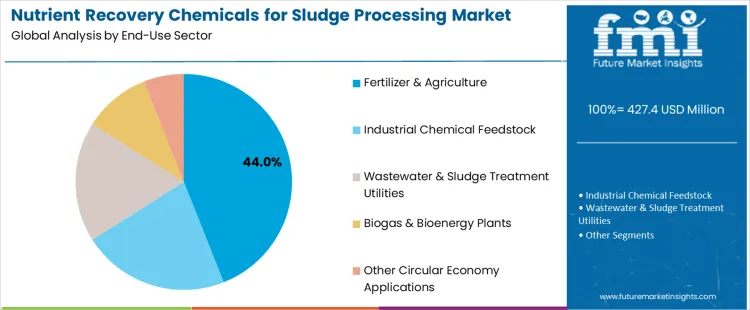
Fertilizer and agriculture hold 44.0%, driving the largest share of global demand. Recovered nutrients are increasingly reused as soil amendments and fertilizer inputs. Industrial chemical feedstock applications account for 22.0%, integrating recovered nutrients into downstream processing. Wastewater and sludge treatment utilities hold 18.0%, adopting recovery to reduce disposal volumes. Biogas and bioenergy plants account for 10.0%, linking nutrient recovery with digestion processes. Other circular economy applications hold 6.0%. End-use distribution reflects strongest pull from agricultural reuse pathways.
Key Points
- Agriculture leads due to direct nutrient reuse demand.
- Industrial feedstock use supports material circularity.
- Utilities adopt recovery to reduce sludge disposal burden.
What are the Key Dynamics in the Nutrient Recovery Chemicals for Sludge Processing Market?
Global demand rises as wastewater utilities, sludge management firms, and industrial processors adopt nutrient recovery chemicals to extract nitrogen, phosphorus, and other valuable elements from biosolids. Recovery chemicals such as magnesium salts, precipitants, and pH adjusters support formation of recoverable compounds (e.g., struvite) that reduce disposal costs and create value-added products. Adoption aligns with tightening nutrient discharge regulations, circular economy initiatives, and rising interest in sustainable resource recovery across regions. Usage spans municipal wastewater treatment plants, agricultural biosolids processors, and industrial water reuse facilities seeking to optimize sludge management and nutrient reuse.
How do regulatory frameworks and circular economy priorities shape global demand?
Environmental regulations in North America, Europe, Asia-Pacific, and other regions enforce strict effluent limits for nitrogen and phosphorus to protect aquatic ecosystems from eutrophication and harmful algal blooms. Treatment facilities integrate nutrient recovery chemicals to capture soluble nutrients during sludge dewatering, enhancing compliance and reducing burden on downstream treatment. Circular economy strategies promote reuse of recovered nutrients as fertilizer or soil amendments, supporting sustainable agriculture and reducing reliance on virgin mineral fertilizers. Government incentives and sustainability targets reinforce adoption where recovered products contribute to resource efficiency and reduced environmental footprint.
How do cost considerations, process variability, and operational complexity influence market scalability?
Nutrient recovery performance depends on feedstock composition, pH, temperature, and competing ions, requiring tailored chemical dosing and process optimization. Chemical costs and operational overhead influence treatment budgets, particularly where recovered nutrient value is variable or market access is limited. Integration with existing dewatering equipment, centrifuges, or membrane systems increases process complexity and monitoring requirements. Handling and storage of reagents necessitate safety protocols and trained personnel. Regional differences in regulatory enforcement and market demand for recovered nutrient products affect investment timing. Global growth depends on development of cost-effective, robust recovery chemistries and harmonized quality standards for recovered nutrient products that support sustainable sludge management across diverse wastewater contexts worldwide.
How Is Demand for Nutrient Recovery Chemicals for Sludge Processing Evolving?
Demand for nutrient recovery chemicals for sludge processing is increasing globally due to phosphorus scarcity concerns, circular economy policies, and tighter sludge disposal regulations. India leads with a 10.4% CAGR, supported by wastewater infrastructure expansion and fertilizer import reduction objectives. China follows at 10.1%, driven by large municipal treatment capacity and resource recovery mandates. USA records an 8.2% CAGR, reflecting regulatory incentives for biosolids reuse and cost control. Germany posts 7.6%, shaped by nutrient recycling obligations and advanced sludge treatment practices. Netherlands records 7.4%, supported by long-standing phosphorus recovery programs. Growth reflects sustained shift toward transforming sludge from waste into recoverable nutrient resources worldwide.

| Country | CAGR (%) |
|---|---|
| India | 10.4% |
| China | 10.1% |
| USA | 8.2% |
| Germany | 7.6% |
| Netherlands | 7.4% |
What factors are driving strong adoption of nutrient recovery chemicals in India?
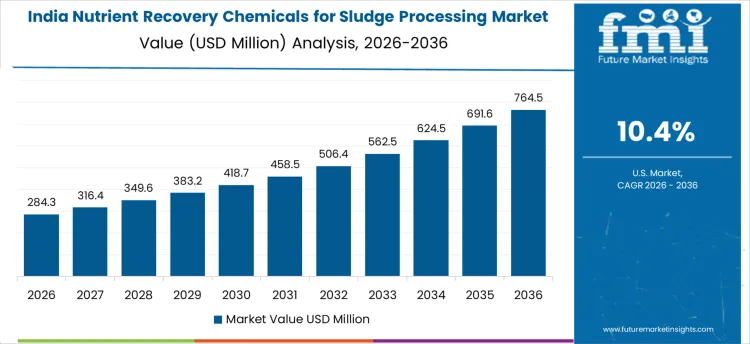
India demand is driven by rapid expansion of sewage treatment capacity and pressure to reduce landfill disposal of sludge. CAGR of 10.4% reflects increased use of magnesium salts, iron-based agents, and pH modifiers to enable phosphorus precipitation and struvite recovery. Fertilizer demand and import dependence encourage recovery of nutrients from biosolids. Urban utilities integrate recovery steps within new treatment plants. Regulatory guidance supports reuse of treated sludge in agriculture. Growth remains infrastructure-led and policy-supported, aligned with circular resource utilization and sanitation improvement goals.
- Expansion of municipal sewage treatment capacity
- Reduction of sludge disposal and landfill reliance
- Fertilizer demand supporting nutrient recovery
- Integration of recovery steps in new plants
How is China sustaining high growth in nutrient recovery chemical usage?
China demand reflects scale of municipal wastewater treatment and emphasis on resource efficiency. CAGR of 10.1% is supported by adoption of chemicals enabling phosphorus recovery and controlled sludge conditioning. National policies encourage extraction of valuable nutrients from waste streams. Large plants deploy standardized recovery processes to manage struvite scaling and recover phosphorus. Industrial wastewater inputs increase nutrient load in sludge, strengthening recovery economics. Growth remains scale-driven and policy-aligned, supported by centralized planning and environmental targets.
- Large-scale municipal wastewater operations
- Policy-driven resource recovery mandates
- Management of struvite formation risks
- Centralized deployment of recovery processes
What regulatory and operational drivers shape demand growth in the USA?
USA demand is shaped by biosolids management regulations, rising disposal costs, and interest in resource recovery. CAGR of 8.2% reflects adoption of nutrient recovery chemicals to stabilize sludge and recover phosphorus. Utilities deploy recovery systems to reduce pipe scaling and maintenance issues. Agricultural reuse standards influence chemical selection and dosing. Federal and state programs encourage circular waste practices. Growth remains regulation-driven and operations-focused, aligned with cost optimization and sustainable sludge management.
- Biosolids reuse and disposal regulations
- Reduction of maintenance from struvite scaling
- Agricultural reuse quality requirements
- Incentives for circular waste practices
Why does Germany show steady but controlled demand growth?
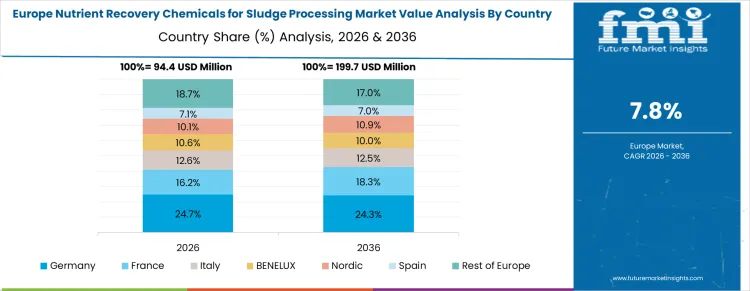
Germany demand reflects strict sludge disposal bans and mandatory nutrient recovery requirements. CAGR of 7.6% is supported by use of recovery chemicals within advanced thermal and wet sludge treatment systems. Utilities prioritize precise dosing and recovery efficiency. Compliance with phosphorus recycling targets guides chemical procurement. Strong documentation and validation frameworks ensure controlled application. Growth remains efficiency-led and compliance-focused, aligned with national nutrient recycling obligations.
- Mandatory phosphorus recovery regulations
- Advanced sludge treatment integration
- Emphasis on dosing precision and efficiency
- Strong compliance and validation frameworks
What supports continued demand growth in the Netherlands?
Netherlands demand reflects early adoption of circular economy practices and advanced wastewater treatment infrastructure. CAGR of 7.4% is supported by long-standing phosphorus recovery programs and innovation in sludge processing. Utilities deploy recovery chemicals to support struvite production and downstream reuse. Agricultural nutrient management policies reinforce demand. Collaboration between utilities and technology providers accelerates optimization. Growth remains innovation-driven and policy-aligned, supported by leadership in sustainable sludge management.
- Long-established nutrient recovery programs
- Focus on struvite production and reuse
- Agricultural nutrient management alignment
- Strong utility and technology collaboration
What is the competitive landscape of demand for nutrient recovery chemicals for sludge processing?
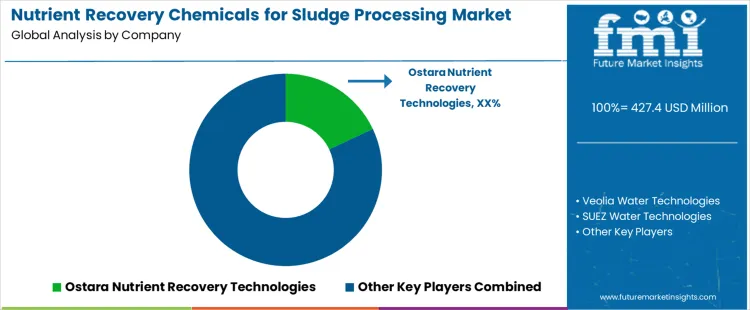
Demand for nutrient recovery chemicals for sludge processing is driven by tightening discharge regulations, circular economy objectives, and rising costs of sludge disposal. Treatment programs focus on recovering phosphorus and nitrogen from digested sludge, centrate, and sidestreams through precipitation, crystallization, and controlled chemical reactions. Buyers evaluate recovery efficiency, operational stability, chemical selectivity, and compatibility with existing anaerobic digestion and dewatering processes. Procurement teams prioritize solutions that reduce scaling, lower nutrient recycle loads, and support production of marketable fertilizer products. Trend in the global market reflects increased adoption of phosphorus recovery mandates, growing interest in struvite production, and integration of nutrient recovery within sustainable wastewater treatment strategies.
Ostara Nutrient Recovery Technologies maintains strong positioning through proprietary recovery systems and associated chemical programs designed for controlled struvite formation. Veolia Water Technologies supports global demand with nutrient recovery chemicals integrated into comprehensive sludge and wastewater treatment solutions. SUEZ Water Technologies contributes recovery chemistries embedded within process engineering frameworks focused on regulatory compliance and resource efficiency. Kemira supplies precipitation and process-support chemicals applied to optimize nutrient capture and sludge handling performance. Ecolab participates through service-led chemical programs supporting sidestream treatment and recovery optimization. Competitive differentiation depends on recovery yield, process reliability, integration capability, and ability to convert recovered nutrients into usable products supporting circular resource management.
Key Players in the Nutrient Recovery Chemicals for Sludge Processing Market
- Ostara Nutrient Recovery Technologies
- Veolia Water Technologies
- SUEZ Water Technologies
- Kemira
- Ecolab
Scope of the Report
| Items | Values |
|---|---|
| Quantitative Units | USD million |
| Chemical Type | Struvite Precipitation Chemicals (MgCl₂, MgO, etc.); Ammonia Stripping & Capture Chemicals; Phosphate Recovery and Precipitation Agents; Bio-Based & Enzyme-Assisted Recovery Chemicals; Other Specialty Nutrient Recovery Chemicals |
| Nutrient Recovered | Phosphorus (P); Nitrogen (N); Potassium (K); Mixed NPK Recovery; Other Micro-Nutrient Recovery |
| End-Use Sector | Fertilizer & Agriculture; Industrial Chemical Feedstock; Wastewater & Sludge Treatment Utilities; Biogas & Bioenergy Plants; Other Circular Economy Applications |
| Regions Covered | Asia Pacific, Europe, North America, Latin America, Middle East & Africa |
| Countries Covered | India, China, USA, Germany, Netherlands, and 40+ countries |
| Key Companies Profiled | Ostara Nutrient Recovery Technologies; Veolia Water Technologies; SUEZ Water Technologies; Kemira; Ecolab |
| Additional Attributes | Dollar sales by chemical type and nutrient recovered; adoption trends for struvite-based and ammonia recovery pathways; recovery efficiency metrics for phosphorus, nitrogen, and mixed nutrient streams; integration with sludge digestion, dewatering, and sidestream treatment processes; product purity, handling, and reuse considerations for agricultural and industrial applications; regulatory drivers and circular economy policies influencing nutrient recovery chemical deployment. |
Nutrient Recovery Chemicals for Sludge Processing Market by Segment
Chemical Type:
- Struvite Precipitation Chemicals (MgCl₂, MgO, etc.)
- Ammonia Stripping & Capture Chemicals
- Phosphate Recovery and Precipitation Agents
- Bio-Based & Enzyme-Assisted Recovery Chemicals
- Other Specialty Nutrient Recovery Chemicals
Nutrient Recovered:
- Phosphorus (P)
- Nitrogen (N)
- Potassium (K)
- Mixed NPK Recovery
- Other Micro-Nutrient Recovery
End-Use Sector:
- Fertilizer & Agriculture
- Industrial Chemical Feedstock
- Wastewater & Sludge Treatment Utilities
- Biogas & Bioenergy Plants
- Other Circular Economy Applications
Region:
- Asia Pacific
- China
- Japan
- South Korea
- India
- Australia & New Zealand
- ASEAN
- Rest of Asia Pacific
- Europe
- Germany
- United Kingdom
- France
- Italy
- Spain
- Nordic
- BENELUX
- Rest of Europe
- North America
- United States
- Canada
- Mexico
- Latin America
- Brazil
- Chile
- Rest of Latin America
- Middle East & Africa
- Kingdom of Saudi Arabia
- Other GCC Countries
- Turkey
- South Africa
- Other African Union
- Rest of Middle East & Africa
Frequently Asked Questions
How big is the nutrient recovery chemicals for sludge processing market in 2026?
The global nutrient recovery chemicals for sludge processing market is estimated to be valued at USD 427.4 million in 2026.
What will be the size of nutrient recovery chemicals for sludge processing market in 2036?
The market size for the nutrient recovery chemicals for sludge processing market is projected to reach USD 1,068.9 million by 2036.
How much will be the nutrient recovery chemicals for sludge processing market growth between 2026 and 2036?
The nutrient recovery chemicals for sludge processing market is expected to grow at a 9.6% CAGR between 2026 and 2036.
What are the key product types in the nutrient recovery chemicals for sludge processing market?
The key product types in nutrient recovery chemicals for sludge processing market are struvite precipitation chemicals (mgcl₂, mgo, etc.), ammonia stripping & capture chemicals, phosphate recovery and precipitation agents, bio-based & enzyme-assisted recovery chemicals and other specialty nutrient recovery chemicals.
Which nutrient recovered segment to contribute significant share in the nutrient recovery chemicals for sludge processing market in 2026?
In terms of nutrient recovered, phosphorus (p) segment to command 38.0% share in the nutrient recovery chemicals for sludge processing market in 2026.
Preview the report firsthand - request a free sample
Get SampleGet the brochure for pricing and purchase details.
Get PDFTable of Content
- Executive Summary
- Global Market Outlook
- Demand-side Trends
- Supply-side Trends
- Technology Roadmap Analysis
- Analysis and Recommendations
- Market Overview
- Market Coverage / Taxonomy
- Market Definition / Scope / Limitations
- Market Background
- Market Dynamics
- Drivers
- Restraints
- Opportunity
- Trends
- Scenario Forecast
- Demand in Optimistic Scenario
- Demand in Likely Scenario
- Demand in Conservative Scenario
- Opportunity Map Analysis
- Product Life Cycle Analysis
- Supply Chain Analysis
- Investment Feasibility Matrix
- Value Chain Analysis
- PESTLE and Porter’s Analysis
- Regulatory Landscape
- Regional Parent Market Outlook
- Production and Consumption Statistics
- Import and Export Statistics
- Market Dynamics
- Global Market Analysis 2021 to 2025 and Forecast, 2026 to 2036
- Historical Market Size Value (USD Million) Analysis, 2021 to 2025
- Current and Future Market Size Value (USD Million) Projections, 2026 to 2036
- Y-o-Y Growth Trend Analysis
- Absolute $ Opportunity Analysis
- Global Market Pricing Analysis 2021 to 2025 and Forecast 2026 to 2036
- Global Market Analysis 2021 to 2025 and Forecast 2026 to 2036, By Chemical Type
- Introduction / Key Findings
- Historical Market Size Value (USD Million) Analysis By Chemical Type , 2021 to 2025
- Current and Future Market Size Value (USD Million) Analysis and Forecast By Chemical Type , 2026 to 2036
- Struvite Precipitation Chemicals (MgCl₂, MgO, etc.)
- Ammonia Stripping & Capture Chemicals
- Phosphate Recovery and Precipitation Agents
- Bio-Based & Enzyme-Assisted Recovery Chemicals
- Other Specialty Nutrient Recovery Chemicals
- Struvite Precipitation Chemicals (MgCl₂, MgO, etc.)
- Y-o-Y Growth Trend Analysis By Chemical Type , 2021 to 2025
- Absolute $ Opportunity Analysis By Chemical Type , 2026 to 2036
- Global Market Analysis 2021 to 2025 and Forecast 2026 to 2036, By Nutrient Recovered
- Introduction / Key Findings
- Historical Market Size Value (USD Million) Analysis By Nutrient Recovered, 2021 to 2025
- Current and Future Market Size Value (USD Million) Analysis and Forecast By Nutrient Recovered, 2026 to 2036
- Phosphorus (P)
- Nitrogen (N)
- Potassium (K)
- Mixed NPK Recovery
- Other Micro-Nutrient Recovery
- Phosphorus (P)
- Y-o-Y Growth Trend Analysis By Nutrient Recovered, 2021 to 2025
- Absolute $ Opportunity Analysis By Nutrient Recovered, 2026 to 2036
- Global Market Analysis 2021 to 2025 and Forecast 2026 to 2036, By End-Use Sector
- Introduction / Key Findings
- Historical Market Size Value (USD Million) Analysis By End-Use Sector, 2021 to 2025
- Current and Future Market Size Value (USD Million) Analysis and Forecast By End-Use Sector, 2026 to 2036
- Fertilizer & Agriculture
- Industrial Chemical Feedstock
- Wastewater & Sludge Treatment Utilities
- Biogas & Bioenergy Plants
- Other Circular Economy Applications
- Fertilizer & Agriculture
- Y-o-Y Growth Trend Analysis By End-Use Sector, 2021 to 2025
- Absolute $ Opportunity Analysis By End-Use Sector, 2026 to 2036
- Global Market Analysis 2021 to 2025 and Forecast 2026 to 2036, By Region
- Introduction
- Historical Market Size Value (USD Million) Analysis By Region, 2021 to 2025
- Current Market Size Value (USD Million) Analysis and Forecast By Region, 2026 to 2036
- North America
- Latin America
- Western Europe
- Eastern Europe
- East Asia
- South Asia and Pacific
- Middle East & Africa
- Market Attractiveness Analysis By Region
- North America Market Analysis 2021 to 2025 and Forecast 2026 to 2036, By Country
- Historical Market Size Value (USD Million) Trend Analysis By Market Taxonomy, 2021 to 2025
- Market Size Value (USD Million) Forecast By Market Taxonomy, 2026 to 2036
- By Country
- USA
- Canada
- Mexico
- By Chemical Type
- By Nutrient Recovered
- By End-Use Sector
- By Country
- Market Attractiveness Analysis
- By Country
- By Chemical Type
- By Nutrient Recovered
- By End-Use Sector
- Key Takeaways
- Latin America Market Analysis 2021 to 2025 and Forecast 2026 to 2036, By Country
- Historical Market Size Value (USD Million) Trend Analysis By Market Taxonomy, 2021 to 2025
- Market Size Value (USD Million) Forecast By Market Taxonomy, 2026 to 2036
- By Country
- Brazil
- Chile
- Rest of Latin America
- By Chemical Type
- By Nutrient Recovered
- By End-Use Sector
- By Country
- Market Attractiveness Analysis
- By Country
- By Chemical Type
- By Nutrient Recovered
- By End-Use Sector
- Key Takeaways
- Western Europe Market Analysis 2021 to 2025 and Forecast 2026 to 2036, By Country
- Historical Market Size Value (USD Million) Trend Analysis By Market Taxonomy, 2021 to 2025
- Market Size Value (USD Million) Forecast By Market Taxonomy, 2026 to 2036
- By Country
- Germany
- UK
- Italy
- Spain
- France
- Nordic
- BENELUX
- Rest of Western Europe
- By Chemical Type
- By Nutrient Recovered
- By End-Use Sector
- By Country
- Market Attractiveness Analysis
- By Country
- By Chemical Type
- By Nutrient Recovered
- By End-Use Sector
- Key Takeaways
- Eastern Europe Market Analysis 2021 to 2025 and Forecast 2026 to 2036, By Country
- Historical Market Size Value (USD Million) Trend Analysis By Market Taxonomy, 2021 to 2025
- Market Size Value (USD Million) Forecast By Market Taxonomy, 2026 to 2036
- By Country
- Russia
- Poland
- Hungary
- Balkan & Baltic
- Rest of Eastern Europe
- By Chemical Type
- By Nutrient Recovered
- By End-Use Sector
- By Country
- Market Attractiveness Analysis
- By Country
- By Chemical Type
- By Nutrient Recovered
- By End-Use Sector
- Key Takeaways
- East Asia Market Analysis 2021 to 2025 and Forecast 2026 to 2036, By Country
- Historical Market Size Value (USD Million) Trend Analysis By Market Taxonomy, 2021 to 2025
- Market Size Value (USD Million) Forecast By Market Taxonomy, 2026 to 2036
- By Country
- China
- Japan
- South Korea
- By Chemical Type
- By Nutrient Recovered
- By End-Use Sector
- By Country
- Market Attractiveness Analysis
- By Country
- By Chemical Type
- By Nutrient Recovered
- By End-Use Sector
- Key Takeaways
- South Asia and Pacific Market Analysis 2021 to 2025 and Forecast 2026 to 2036, By Country
- Historical Market Size Value (USD Million) Trend Analysis By Market Taxonomy, 2021 to 2025
- Market Size Value (USD Million) Forecast By Market Taxonomy, 2026 to 2036
- By Country
- India
- ASEAN
- Australia & New Zealand
- Rest of South Asia and Pacific
- By Chemical Type
- By Nutrient Recovered
- By End-Use Sector
- By Country
- Market Attractiveness Analysis
- By Country
- By Chemical Type
- By Nutrient Recovered
- By End-Use Sector
- Key Takeaways
- Middle East & Africa Market Analysis 2021 to 2025 and Forecast 2026 to 2036, By Country
- Historical Market Size Value (USD Million) Trend Analysis By Market Taxonomy, 2021 to 2025
- Market Size Value (USD Million) Forecast By Market Taxonomy, 2026 to 2036
- By Country
- Kingdom of Saudi Arabia
- Other GCC Countries
- Turkiye
- South Africa
- Other African Union
- Rest of Middle East & Africa
- By Chemical Type
- By Nutrient Recovered
- By End-Use Sector
- By Country
- Market Attractiveness Analysis
- By Country
- By Chemical Type
- By Nutrient Recovered
- By End-Use Sector
- Key Takeaways
- Key Countries Market Analysis
- USA
- Pricing Analysis
- Market Share Analysis, 2025
- By Chemical Type
- By Nutrient Recovered
- By End-Use Sector
- Canada
- Pricing Analysis
- Market Share Analysis, 2025
- By Chemical Type
- By Nutrient Recovered
- By End-Use Sector
- Mexico
- Pricing Analysis
- Market Share Analysis, 2025
- By Chemical Type
- By Nutrient Recovered
- By End-Use Sector
- Brazil
- Pricing Analysis
- Market Share Analysis, 2025
- By Chemical Type
- By Nutrient Recovered
- By End-Use Sector
- Chile
- Pricing Analysis
- Market Share Analysis, 2025
- By Chemical Type
- By Nutrient Recovered
- By End-Use Sector
- Germany
- Pricing Analysis
- Market Share Analysis, 2025
- By Chemical Type
- By Nutrient Recovered
- By End-Use Sector
- UK
- Pricing Analysis
- Market Share Analysis, 2025
- By Chemical Type
- By Nutrient Recovered
- By End-Use Sector
- Italy
- Pricing Analysis
- Market Share Analysis, 2025
- By Chemical Type
- By Nutrient Recovered
- By End-Use Sector
- Spain
- Pricing Analysis
- Market Share Analysis, 2025
- By Chemical Type
- By Nutrient Recovered
- By End-Use Sector
- France
- Pricing Analysis
- Market Share Analysis, 2025
- By Chemical Type
- By Nutrient Recovered
- By End-Use Sector
- India
- Pricing Analysis
- Market Share Analysis, 2025
- By Chemical Type
- By Nutrient Recovered
- By End-Use Sector
- ASEAN
- Pricing Analysis
- Market Share Analysis, 2025
- By Chemical Type
- By Nutrient Recovered
- By End-Use Sector
- Australia & New Zealand
- Pricing Analysis
- Market Share Analysis, 2025
- By Chemical Type
- By Nutrient Recovered
- By End-Use Sector
- China
- Pricing Analysis
- Market Share Analysis, 2025
- By Chemical Type
- By Nutrient Recovered
- By End-Use Sector
- Japan
- Pricing Analysis
- Market Share Analysis, 2025
- By Chemical Type
- By Nutrient Recovered
- By End-Use Sector
- South Korea
- Pricing Analysis
- Market Share Analysis, 2025
- By Chemical Type
- By Nutrient Recovered
- By End-Use Sector
- Russia
- Pricing Analysis
- Market Share Analysis, 2025
- By Chemical Type
- By Nutrient Recovered
- By End-Use Sector
- Poland
- Pricing Analysis
- Market Share Analysis, 2025
- By Chemical Type
- By Nutrient Recovered
- By End-Use Sector
- Hungary
- Pricing Analysis
- Market Share Analysis, 2025
- By Chemical Type
- By Nutrient Recovered
- By End-Use Sector
- Kingdom of Saudi Arabia
- Pricing Analysis
- Market Share Analysis, 2025
- By Chemical Type
- By Nutrient Recovered
- By End-Use Sector
- Turkiye
- Pricing Analysis
- Market Share Analysis, 2025
- By Chemical Type
- By Nutrient Recovered
- By End-Use Sector
- South Africa
- Pricing Analysis
- Market Share Analysis, 2025
- By Chemical Type
- By Nutrient Recovered
- By End-Use Sector
- USA
- Market Structure Analysis
- Competition Dashboard
- Competition Benchmarking
- Market Share Analysis of Top Players
- By Regional
- By Chemical Type
- By Nutrient Recovered
- By End-Use Sector
- Competition Analysis
- Competition Deep Dive
- Ostara Nutrient Recovery Technologies
- Overview
- Product Portfolio
- Profitability by Market Segments (Product/Age /Sales Channel/Region)
- Sales Footprint
- Strategy Overview
- Marketing Strategy
- Product Strategy
- Channel Strategy
- Veolia Water Technologies
- SUEZ Water Technologies
- Kemira
- Ecolab
- Ostara Nutrient Recovery Technologies
- Competition Deep Dive
- Assumptions & Acronyms Used
- Research Methodology


