

- Industry Size (2026)
- USD 860 Mn
- Forecast (2036)
- USD 1857 Mn
- CAGR (2026 to 2036)
- 8%
Nutrient Dosing Pumps Market Forecast and Outlook 2026 to 2036
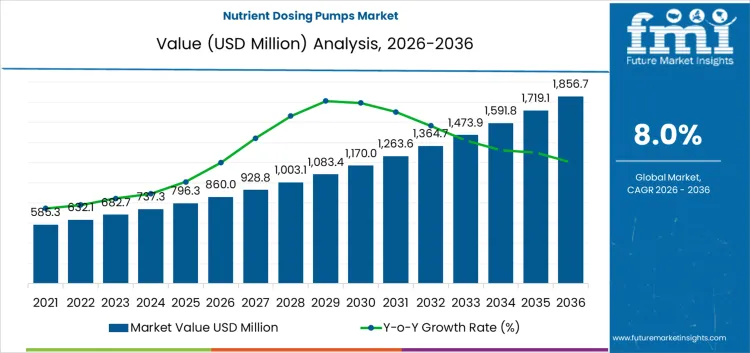
The nutrient dosing pumps market is projected to reach USD 1,857 million by 2036, growing at a CAGR of 8% from its estimated 2026 valuation of USD 860 million. The market’s performance will be shaped by cost structures, where investments in efficient manufacturing processes and high-quality materials will directly impact profitability. Companies that can optimize production costs without compromising performance will maintain a competitive advantage.
Pricing control will be crucial, as suppliers navigate the balance between cost leadership and product differentiation, especially as demand for advanced dosing technologies grows. Margin concentration will be influenced by the ability to offer solutions that meet specific customer needs, with higher margins likely going to those who provide customizable, high-precision pumps for specialized applications. Vendors with established relationships and strong technical support capabilities will capture the most value, as they can command premium prices for reliability and performance, positioning themselves as leaders in this growing market.
Quick Stats for the Nutrient Dosing Pumps Market
- Nutrient Dosing Pumps Market Value (2026): USD 860 million
- Nutrient Dosing Pumps Market Forecast Value (2036): USD 1,857 million
- Nutrient Dosing Pumps Market Global Forecast CAGR 2026 to 2036: 8%
- Nutrient Dosing Pumps Market Leading Segment: Diaphragm Metering Pumps (44%)
- Key Growth Regions in Nutrient Dosing Pumps Market: India
- Top Players in Nutrient Dosing Pumps Market: Grundfos, SEKO, ProMinent, Verder, Dover (PSG), IDEX, Watson-Marlow (Spirax), LMI (Milton Roy), Blue-White Industries, Stenner Pump
What is the Compound Annual Growth Rate (CAGR) for the Nutrient Dosing Pumps Market through 2036?
The compound annual growth rate (CAGR) of 8% reflects steady growth in the nutrient dosing pumps market over the forecast period. Starting from USD 860 million in 2026, the market will grow steadily to USD 1,003.1 million in 2028. This growth will be fueled by the growing adoption of precision farming and aquaculture systems that rely on precise nutrient management. From 2029 to 2032, the market will experience further expansion, reaching USD 1,364.7 million in 2032 as demand for optimized nutrient dosing continues to rise.
Between 2032 and 2036, the market is expected to grow from USD 1,473.9 million to USD 1,857 million, driven by continued advancements in dosing pump technology, greater efficiency, and expanding use across various sectors. This consistent and reliable growth reflects the ongoing need for accurate nutrient application in agriculture, horticulture, and aquaculture, marking nutrient dosing pumps as a key component of sustainable food production systems. The CAGR of 8% highlights the continued importance of innovation and efficiency in driving market demand.
Nutrient Dosing Pumps Market Key Takeaways
| Metric | Value |
|---|---|
| Industry Sales Value (2026) | USD 860 million |
| Industry Forecast Value (2036) | USD 1,857 million |
| Industry Forecast CAGR 2026 to 2036 | 8% |
What Is Driving the Nutrient Dosing Pumps Market?
Historically, the nutrient dosing pumps market developed alongside the modernization of irrigation and fertilization practices in agriculture, horticulture, and controlled environment farming. Conventional nutrient application methods relied heavily on manual blending and broadcast fertilizer spreading, which often led to uneven distribution and inconsistent plant nutrition. Early injection systems provided basic metering but lacked the precision needed for optimal nutrient uptake, particularly in high value crops and intensive production systems.
As growers adopted drip and micro irrigation systems, the need for accurate, repeatable dosing of liquid fertilizers and water soluble nutrients became clearer. This drove demand for positive displacement and diaphragm dosing pumps that could deliver controlled volumes of concentrated nutrient solutions into irrigation streams with minimal variation. Early adopters in greenhouses, nurseries, and high density vegetable production reported improved uniformity in plant growth and reduced fertilizer use, establishing expectations for precision and reliability that traditional methods could not meet. This formative period helped define key performance criteria, including flow stability, chemical compatibility, and ease of calibration, laying the groundwork for broader commercial interest in dosing pump technology.
Future demand for nutrient dosing pumps is expected to be shaped by increasing adoption of precision agriculture, growth in controlled environment agriculture, and heightened focus on resource efficient crop production. Growth will be driven by systems that integrate dosing pumps with automated controllers, soil and tissue sensors, and fertigation platforms that adjust nutrient delivery in real time based on plant needs and environmental conditions.
Expansion of greenhouse, vertical farming, and hydroponic operations will elevate the importance of pumps capable of fine tuned, repeatable nutrient injection to support uniform crop development and maximize yields. Advances in pump materials and design will improve chemical compatibility and reduce maintenance, enabling longer service life in demanding environments. Sustainability pressures-such as optimizing fertilizer use to reduce runoff and environmental impact-will further incentivize precise dosing solutions. Barriers to market growth include the initial investment cost, the need for operator training on calibration and system integration, and compatibility issues with diverse fertigation systems. Long term expansion will depend on how effectively dosing pump manufacturers deliver scalable, reliable solutions that meet growers’ demands for precision, efficiency, and integration with smart agricultural technologies.
What are the Key Segments in the Nutrient Dosing Pumps Market?
The nutrient dosing pumps market is segmented by pump type and end use. Pump types include diaphragm metering pumps, peristaltic pumps, piston metering pumps, and others, with diaphragm metering pumps leading the market at 44%. End-use segments include greenhouses, vertical farms, aquaculture, and others, with greenhouses accounting for 42% of the market share. The market is driven by the growing need for precise and efficient nutrient dosing systems in agriculture, aquaculture, and other industries, where accurate delivery of nutrients is critical to plant and aquatic animal health. The demand for nutrient dosing pumps is growing due to the increasing focus on automation, resource efficiency, and optimal crop yields in controlled environments. Key regions driving the growth include North America, Europe, and Asia Pacific, where agricultural practices are evolving, and the need for precision farming is increasing.
What is Driving Growth in the Diaphragm Metering Pumps Segment?
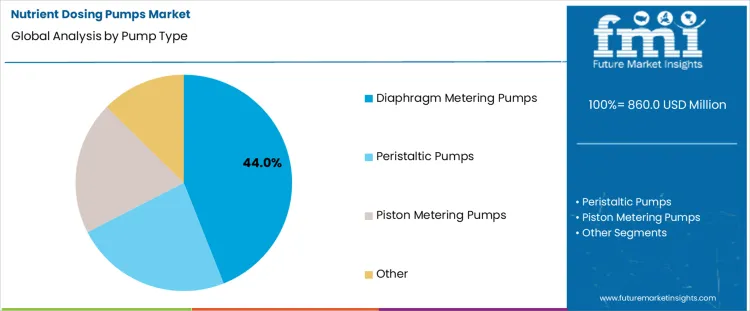
Diaphragm metering pumps are the leading pump type in the Nutrient Dosing Pumps market, accounting for 44% of the market share. This growth is driven by the high precision, reliability, and durability that diaphragm metering pumps offer, particularly in the delivery of nutrients in controlled environments such as greenhouses and vertical farms.
Diaphragm pumps are designed for accurate dosing and can handle a wide range of fluid viscosities, making them suitable for nutrient-rich solutions in agricultural applications. Their ability to deliver consistent flow rates and operate with minimal maintenance makes them a preferred choice for nutrient dosing, especially in automated systems where reliability and precision are crucial.
The growing emphasis on optimized nutrient delivery in agriculture, particularly for high-value crops grown in controlled environments, is further driving the demand for diaphragm metering pumps. As the global agricultural industry continues to prioritize sustainability and productivity, the demand for diaphragm metering pumps is expected to increase, particularly in regions like North America and Europe, where modern farming technologies are widely adopted.
What is Driving the Demand for Greenhouses in the End-Use Segment?
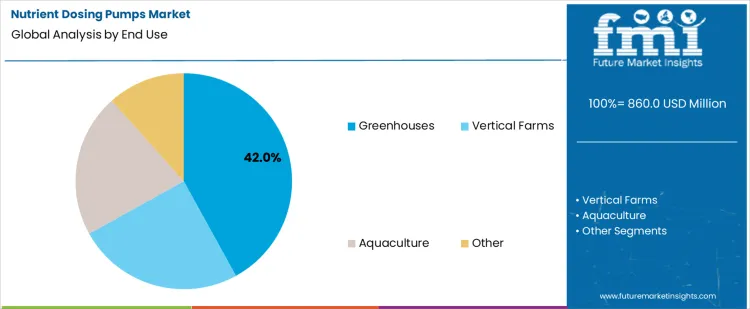
Greenhouses represent the largest end-use segment in the Nutrient Dosing Pumps market, holding 42% of the market share. This growth is driven by the increasing adoption of greenhouse farming, where precise nutrient delivery is essential to support crop growth in controlled environments. Greenhouses offer an ideal setting for using nutrient dosing pumps, as they allow for year-round cultivation with controlled climate and soil conditions. In these settings, accurate and efficient delivery of water and nutrients is critical for optimizing crop yields and maintaining plant health.
Nutrient dosing pumps, particularly diaphragm metering pumps, are widely used in greenhouse operations to ensure that plants receive the correct amounts of essential nutrients at the right times, contributing to more efficient resource use and reducing wastage. The growing demand for organic produce, high-value crops, and sustainable farming practices in greenhouses is further driving the adoption of nutrient dosing pumps. As greenhouse farming continues to expand globally, particularly in North America, Europe, and Asia Pacific, the demand for nutrient dosing pumps in these environments is expected to remain strong, fueling growth in this segment.
What are the Key Dynamics in the Nutrient Dosing Pumps Market?
The nutrient dosing pumps market is experiencing growth as the demand for precise and efficient nutrient delivery in agricultural, horticultural, and industrial applications increases. These pumps are used to deliver a specific amount of nutrients or chemicals to plants, ensuring optimal growth and maximizing resource use. The market is driven by the increasing adoption of precision farming techniques, which require accurate and automated nutrient delivery systems to optimize crop yields and reduce waste. The rise in controlled environment agriculture, such as greenhouse farming, and the growing need for sustainable agricultural practices that minimize water and fertilizer use further fuel the demand for nutrient dosing pumps.
What are the Key Drivers of Growth in the Nutrient Dosing Pumps Market?
Several factors are driving growth in the nutrient dosing pumps market. The growing need for precision in agricultural practices is a major driver, as farmers seek to optimize the use of water, fertilizers, and nutrients for maximum crop yield and minimum waste. Nutrient dosing pumps provide precise, automated nutrient application, improving the efficiency of farming operations and supporting sustainable agricultural practices.
Additionally, the rise in controlled environment agriculture (CEA), such as hydroponics and greenhouse farming, where nutrient delivery plays a key role in plant growth, is further driving demand. The increasing focus on reducing environmental impact and minimizing the use of chemical fertilizers is pushing the demand for systems that offer accurate dosing and reduce nutrient runoff. Technological advancements in dosing pump design, such as the integration of smart sensors, IoT capabilities, and programmable controls, are also contributing to market growth by enhancing the efficiency and convenience of nutrient management.
What are the Key Restraints in the Nutrient Dosing Pumps Market?
Despite the positive growth prospects, the nutrient dosing pumps market faces several challenges. One major restraint is the high initial cost of advanced dosing pump systems, which can be a barrier for small-scale farmers or those in developing regions with limited access to capital. The complexity of installation and the need for specialized knowledge to operate and maintain these systems also add to the cost. Additionally, the need for regular maintenance and calibration to ensure accuracy and prevent malfunctions can increase the operational costs over time.
Another challenge is the limited compatibility of dosing pumps with different types of fertilizers or nutrients, which can create difficulties in systems that require a variety of chemicals. Finally, while nutrient dosing pumps are highly efficient, the energy consumption required to run large-scale systems could be a concern, particularly in regions with expensive energy costs, making the system less cost-effective for some users.
What are the Key Trends in the Nutrient Dosing Pumps Market?
Several key trends are shaping the nutrient dosing pumps market. One major trend is the increasing integration of smart technology and IoT capabilities in nutrient dosing pumps. These pumps are now being equipped with sensors, remote monitoring, and control systems that allow for real-time data collection and management, making nutrient application more efficient and customizable. Another trend is the rising demand for energy-efficient dosing systems, as farmers and industrial operators seek to minimize energy consumption and reduce operational costs.
Additionally, the trend toward sustainable and organic farming is driving the demand for nutrient dosing pumps that work effectively with organic fertilizers and eco-friendly inputs. The market is also seeing a move toward modular and flexible dosing systems that can be easily adapted to different scales of operation, from small greenhouses to large industrial farms. As the agricultural industry increasingly embraces automation and precision technologies, nutrient dosing pumps are expected to play a central role in optimizing resource use and improving sustainability.
What is the Country-Wise Analysis of the Nutrient Dosing Pumps Market?
The nutrient dosing pumps market is growing as industries such as agriculture, water treatment, and chemical manufacturing increasingly rely on precise nutrient dosing systems to enhance productivity and ensure quality control. Nutrient dosing pumps are essential in applications like fertigation systems, where the precise delivery of nutrients is critical for optimal crop growth. The market is driven by the increasing demand for efficient and accurate systems to manage the application of fertilizers and other chemicals. Countries like India, China, Indonesia, Mexico, and the USA are experiencing growth in this market, driven by factors such as the expansion of agriculture, industrial processes, and the growing focus on sustainability and resource efficiency.
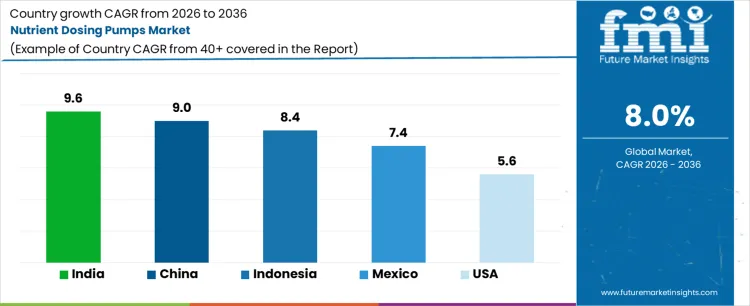
| Country | CAGR (%) |
|---|---|
| India | 9.6 |
| China | 9 |
| Indonesia | 8.4 |
| Mexico | 7.4 |
| USA | 5.6 |
What is Driving the Growth of the Nutrient Dosing Pumps Market in India?
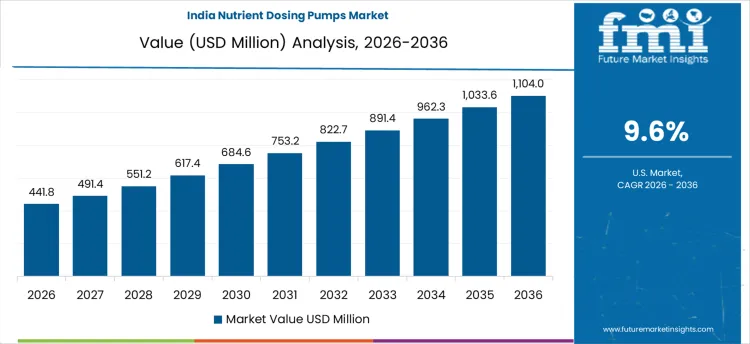
India’s nutrient dosing pumps market is growing at a CAGR of 9.6%, the highest among the countries analyzed. The growth is largely driven by India’s rapidly expanding agricultural sector, particularly in the adoption of precision farming technologies like fertigation, where precise nutrient delivery is critical. The government’s support for sustainable farming practices, coupled with a focus on increasing crop yield and efficiency, is contributing to the demand for nutrient dosing pumps. Additionally, the increasing adoption of automated irrigation systems and the growing awareness of efficient water and fertilizer use are driving the market forward. As India’s agricultural sector continues to modernize, the demand for nutrient dosing pumps is expected to remain strong.
How is the Nutrient Dosing Pumps Market Performing in China?
China’s nutrient dosing pumps market is growing at a CAGR of 9%. The demand for nutrient dosing pumps in China is driven by the country’s expanding agricultural industry, particularly in sectors like horticulture, greenhouse farming, and large-scale crop production. China’s emphasis on improving agricultural productivity, reducing environmental impact, and enhancing water and fertilizer use efficiency is fueling the adoption of nutrient dosing pumps. The government’s push for smart agriculture and sustainable farming practices is contributing to the growth of this market. As China continues to modernize its farming practices and embrace technology-driven solutions, the demand for nutrient dosing pumps is expected to rise steadily.
What Factors are Shaping the Nutrient Dosing Pumps Market in Indonesia?
Indonesia’s nutrient dosing pumps market is growing at a CAGR of 8.4%. The market growth is primarily driven by the country’s expanding agricultural sector, where nutrient dosing pumps are increasingly used to improve crop yield and optimize fertilizer usage. As the demand for high-value crops increases, particularly in horticulture, and as farming practices evolve towards more sustainable methods, the adoption of nutrient dosing systems is growing. The Indonesian government’s initiatives to modernize agriculture and promote efficient water and nutrient management in irrigation systems are further supporting the market’s growth. As Indonesia continues to improve its agricultural infrastructure and embrace modern farming techniques, the demand for nutrient dosing pumps is expected to increase.
How is the Nutrient Dosing Pumps Market Evolving in Mexico?
Mexico’s nutrient dosing pumps market is growing at a CAGR of 7.4%. The country’s agricultural sector, which is a key part of its economy, is increasingly adopting advanced farming technologies to enhance crop productivity and sustainability. Nutrient dosing pumps are being used in sectors like fruit and vegetable production, where precise nutrient delivery is critical for maximizing yield and quality. Mexico’s government is also supporting modern farming practices and efficient irrigation systems, which are driving the adoption of nutrient dosing pumps. With the growing focus on water conservation and resource efficiency in agriculture, the demand for nutrient dosing pumps in Mexico is expected to continue growing.
What is Contributing to the Growth of the Nutrient Dosing Pumps Market in the USA?
The nutrient dosing pumps market in the USA is growing at a CAGR of 5.6%. While the growth rate is slower compared to other countries, the USA remains a significant market for nutrient dosing pumps due to the large-scale agricultural operations, particularly in the production of high-value crops. The demand for precise nutrient management, especially in controlled-environment farming, greenhouse operations, and fertigation systems, is driving the market. Additionally, the increasing adoption of smart farming solutions, which include automated nutrient dosing systems, is contributing to the growth of the market. As the focus on sustainable farming practices and resource efficiency grows, the USA’s nutrient dosing pumps market is expected to continue expanding, though at a slower pace compared to emerging markets.
What is the Competitive Landscape for the Nutrient Dosing Pumps Market?
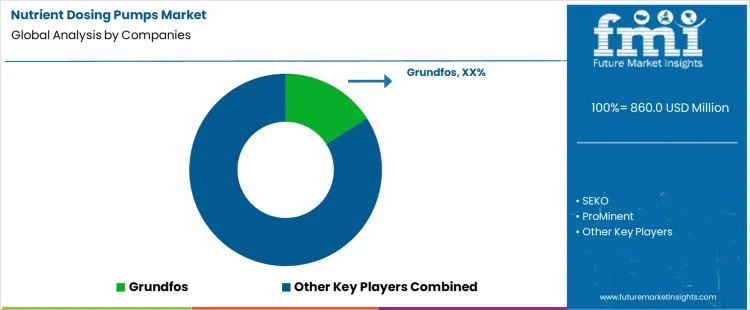
The nutrient dosing pumps market is expanding as industries like agriculture, water treatment, and chemical processing demand precise dosing solutions to optimize nutrient application. Grundfos leads the market, offering high-performance dosing pumps known for their reliability, efficiency, and ability to accurately control nutrient delivery in various applications. SEKO is a key competitor, providing a wide range of dosing pumps that focus on precision and ease of integration into industrial systems.
ProMinent also competes with its advanced dosing pumps, offering solutions that cater to the water treatment and chemical industries, with a focus on high accuracy and durability. Verder specializes in reliable, cost-effective dosing solutions that ensure precise nutrient delivery and efficiency. Dover (PSG) offers innovative dosing systems designed to meet the needs of industries requiring high-performance pumps for both small and large-scale operations.
IDEX provides specialized nutrient dosing pumps that are highly customizable, offering solutions for diverse industrial applications. Watson-Marlow (Spirax) is another strong player, offering accurate and robust dosing pumps that focus on long-term performance and operational efficiency. LMI (Milton Roy) provides dosing pumps known for their precision and flexibility, catering to various industries, including agriculture and water treatment. Blue-White Industries offers durable, versatile dosing pumps designed to meet the precise nutrient needs of users, while Stenner Pump provides reliable, easy-to-use systems for small and large applications.
To remain competitive, companies focus on product innovation, precision, and integration capabilities. Grundfos continues to lead by enhancing its dosing pumps with smart monitoring and control features, ensuring high efficiency and accuracy in nutrient application. SEKO and ProMinent improve their systems by offering more customizable and scalable solutions to meet the specific demands of various industries. Verder focuses on developing cost-effective solutions without compromising on quality, while Dover (PSG) and IDEX are investing in advanced technologies to improve pump performance and energy efficiency.
Watson-Marlow (Spirax) and LMI (Milton Roy) focus on expanding their portfolios with highly accurate dosing systems that cater to both small- and large-scale applications. Blue-White Industries and Stenner Pump continue to refine their products to provide durable, reliable, and easy-to-install systems, ensuring their place in the growing nutrient dosing pumps market. These strategies position these companies to lead the expanding market for nutrient dosing pumps, meeting the increasing demand for precision and efficiency in nutrient delivery across industries.
Key Players of the Nutrient Dosing Pumps Market
- Grundfos
- SEKO
- ProMinent
- Verder
- Dover (PSG)
- IDEX
- Watson-Marlow (Spirax)
- LMI (Milton Roy)
- Blue-White Industries
- Stenner Pump
Scope of the Report
| Items | Values |
|---|---|
| Quantitative Units (2026) | USD Million |
| Pump Type | Diaphragm Metering Pumps, Peristaltic Pumps, Piston Metering Pumps, Other |
| End Use | Greenhouses, Vertical Farms, Aquaculture, Other |
| Control Type | Analog Controlled, Manual, Digital or Smart, Other |
| Sales Channel | Distributors, OEM Bundled, Direct Sales, Other |
| Companies | Grundfos, SEKO, ProMinent, Verder, Dover (PSG), IDEX, Watson-Marlow (Spirax), LMI (Milton Roy), Blue-White Industries, Stenner Pump |
| Regions Covered | North America, Latin America, Western Europe, Eastern Europe, South Asia and Pacific, East Asia, Middle East & Africa |
| Countries Covered | United States, Canada, Mexico, Brazil, Argentina, Germany, France, United Kingdom, Italy, Spain, Netherlands, China, India, Japan, South Korea, ANZ, GCC Countries, South Africa |
| Additional Attributes | Dollar by sales by pump type, end use, control type, and sales channel. Includes market trends towards automation, efficiency, regulatory compliance, and the role of nutrient dosing pumps in improving precision and sustainability in agricultural and aquaculture applications. |
Nutrient Dosing Pumps Market Segmentation
Pump Type:
- Diaphragm Metering Pumps
- Peristaltic Pumps
- Piston Metering Pumps
- Other
End Use:
- Greenhouses
- Vertical Farms
- Aquaculture
- Other
Control Type:
- Analog Controlled
- Manual
- Digital or Smart
- Other
Sales Channel:
- Distributors
- OEM Bundled
- Direct Sales
- Other
Region
- Asia Pacific
- China
- Japan
- India
- Australia & New Zealand
- ASEAN
- Rest of Asia Pacific
- Europe
- Germany
- United Kingdom
- France
- Italy
- Spain
- Nordic
- BENELUX
- Rest of Europe
- North America
- United States
- Canada
- Mexico
- Latin America
- Brazil
- Argentina
- Rest of Latin America
- Middle East & Africa
- Kingdom of Saudi Arabia
- Other GCC Countries
- South Africa
- Rest of Middle East & Africa
Bibliography
- Grundfos. (2023). High-Performance Dosing Pumps for Agricultural and Industrial Applications. Grundfos.
- SEKO. (2023). Precision Dosing Solutions for Sustainable Farming Practices. SEKO.
- ProMinent. (2023). Advanced Metering Pumps for Water and Nutrient Application. ProMinent.
- Verder. (2023). Reliable and Cost-Effective Dosing Pumps for Efficient Nutrient Delivery. Verder.
- Dover (PSG). (2023). Innovative Nutrient Dosing Systems for Industrial and Agricultural Use. Dover (PSG).
Frequently Asked Questions
How big is the nutrient dosing pumps market in 2026?
The global nutrient dosing pumps market is estimated to be valued at USD 860.0 million in 2026.
What will be the size of nutrient dosing pumps market in 2036?
The market size for the nutrient dosing pumps market is projected to reach USD 1,856.7 million by 2036.
How much will be the nutrient dosing pumps market growth between 2026 and 2036?
The nutrient dosing pumps market is expected to grow at a 8.0% CAGR between 2026 and 2036.
What are the key product types in the nutrient dosing pumps market?
The key product types in nutrient dosing pumps market are diaphragm metering pumps, peristaltic pumps, piston metering pumps and other.
Which end use segment to contribute significant share in the nutrient dosing pumps market in 2026?
In terms of end use, greenhouses segment to command 42.0% share in the nutrient dosing pumps market in 2026.
Preview the report firsthand - request a free sample
Get SampleGet the brochure for pricing and purchase details.
Get PDFTable of Content
- Executive Summary
- Global Market Outlook
- Demand-side Trends
- Supply-side Trends
- Technology Roadmap Analysis
- Analysis and Recommendations
- Market Overview
- Market Coverage / Taxonomy
- Market Definition / Scope / Limitations
- Market Background
- Market Dynamics
- Drivers
- Restraints
- Opportunity
- Trends
- Scenario Forecast
- Demand in Optimistic Scenario
- Demand in Likely Scenario
- Demand in Conservative Scenario
- Opportunity Map Analysis
- Product Life Cycle Analysis
- Supply Chain Analysis
- Investment Feasibility Matrix
- Value Chain Analysis
- PESTLE and Porter’s Analysis
- Regulatory Landscape
- Regional Parent Market Outlook
- Production and Consumption Statistics
- Import and Export Statistics
- Market Dynamics
- Global Market Analysis 2021 to 2025 and Forecast, 2026 to 2036
- Historical Market Size Value (USD Million) Analysis, 2021 to 2025
- Current and Future Market Size Value (USD Million) Projections, 2026 to 2036
- Y-o-Y Growth Trend Analysis
- Absolute $ Opportunity Analysis
- Global Market Pricing Analysis 2021 to 2025 and Forecast 2026 to 2036
- Global Market Analysis 2021 to 2025 and Forecast 2026 to 2036, By Pump Type
- Introduction / Key Findings
- Historical Market Size Value (USD Million) Analysis By Pump Type, 2021 to 2025
- Current and Future Market Size Value (USD Million) Analysis and Forecast By Pump Type, 2026 to 2036
- Diaphragm Metering Pumps
- Peristaltic Pumps
- Piston Metering Pumps
- Other
- Diaphragm Metering Pumps
- Y-o-Y Growth Trend Analysis By Pump Type, 2021 to 2025
- Absolute $ Opportunity Analysis By Pump Type, 2026 to 2036
- Global Market Analysis 2021 to 2025 and Forecast 2026 to 2036, By End Use
- Introduction / Key Findings
- Historical Market Size Value (USD Million) Analysis By End Use, 2021 to 2025
- Current and Future Market Size Value (USD Million) Analysis and Forecast By End Use, 2026 to 2036
- Greenhouses
- Vertical Farms
- Aquaculture
- Other
- Greenhouses
- Y-o-Y Growth Trend Analysis By End Use, 2021 to 2025
- Absolute $ Opportunity Analysis By End Use, 2026 to 2036
- Global Market Analysis 2021 to 2025 and Forecast 2026 to 2036, By Control Type
- Introduction / Key Findings
- Historical Market Size Value (USD Million) Analysis By Control Type, 2021 to 2025
- Current and Future Market Size Value (USD Million) Analysis and Forecast By Control Type, 2026 to 2036
- Analog Controlled
- Manual
- Digital or Smart
- Other
- Analog Controlled
- Y-o-Y Growth Trend Analysis By Control Type, 2021 to 2025
- Absolute $ Opportunity Analysis By Control Type, 2026 to 2036
- Global Market Analysis 2021 to 2025 and Forecast 2026 to 2036, By Sales Channel
- Introduction / Key Findings
- Historical Market Size Value (USD Million) Analysis By Sales Channel, 2021 to 2025
- Current and Future Market Size Value (USD Million) Analysis and Forecast By Sales Channel, 2026 to 2036
- Distributors
- OEM Bundled
- Direct Sales
- Other
- Distributors
- Y-o-Y Growth Trend Analysis By Sales Channel, 2021 to 2025
- Absolute $ Opportunity Analysis By Sales Channel, 2026 to 2036
- Global Market Analysis 2021 to 2025 and Forecast 2026 to 2036, By Region
- Introduction
- Historical Market Size Value (USD Million) Analysis By Region, 2021 to 2025
- Current Market Size Value (USD Million) Analysis and Forecast By Region, 2026 to 2036
- North America
- Latin America
- Western Europe
- Eastern Europe
- East Asia
- South Asia and Pacific
- Middle East & Africa
- Market Attractiveness Analysis By Region
- North America Market Analysis 2021 to 2025 and Forecast 2026 to 2036, By Country
- Historical Market Size Value (USD Million) Trend Analysis By Market Taxonomy, 2021 to 2025
- Market Size Value (USD Million) Forecast By Market Taxonomy, 2026 to 2036
- By Country
- USA
- Canada
- Mexico
- By Pump Type
- By End Use
- By Control Type
- By Sales Channel
- By Country
- Market Attractiveness Analysis
- By Country
- By Pump Type
- By End Use
- By Control Type
- By Sales Channel
- Key Takeaways
- Latin America Market Analysis 2021 to 2025 and Forecast 2026 to 2036, By Country
- Historical Market Size Value (USD Million) Trend Analysis By Market Taxonomy, 2021 to 2025
- Market Size Value (USD Million) Forecast By Market Taxonomy, 2026 to 2036
- By Country
- Brazil
- Chile
- Rest of Latin America
- By Pump Type
- By End Use
- By Control Type
- By Sales Channel
- By Country
- Market Attractiveness Analysis
- By Country
- By Pump Type
- By End Use
- By Control Type
- By Sales Channel
- Key Takeaways
- Western Europe Market Analysis 2021 to 2025 and Forecast 2026 to 2036, By Country
- Historical Market Size Value (USD Million) Trend Analysis By Market Taxonomy, 2021 to 2025
- Market Size Value (USD Million) Forecast By Market Taxonomy, 2026 to 2036
- By Country
- Germany
- UK
- Italy
- Spain
- France
- Nordic
- BENELUX
- Rest of Western Europe
- By Pump Type
- By End Use
- By Control Type
- By Sales Channel
- By Country
- Market Attractiveness Analysis
- By Country
- By Pump Type
- By End Use
- By Control Type
- By Sales Channel
- Key Takeaways
- Eastern Europe Market Analysis 2021 to 2025 and Forecast 2026 to 2036, By Country
- Historical Market Size Value (USD Million) Trend Analysis By Market Taxonomy, 2021 to 2025
- Market Size Value (USD Million) Forecast By Market Taxonomy, 2026 to 2036
- By Country
- Russia
- Poland
- Hungary
- Balkan & Baltic
- Rest of Eastern Europe
- By Pump Type
- By End Use
- By Control Type
- By Sales Channel
- By Country
- Market Attractiveness Analysis
- By Country
- By Pump Type
- By End Use
- By Control Type
- By Sales Channel
- Key Takeaways
- East Asia Market Analysis 2021 to 2025 and Forecast 2026 to 2036, By Country
- Historical Market Size Value (USD Million) Trend Analysis By Market Taxonomy, 2021 to 2025
- Market Size Value (USD Million) Forecast By Market Taxonomy, 2026 to 2036
- By Country
- China
- Japan
- South Korea
- By Pump Type
- By End Use
- By Control Type
- By Sales Channel
- By Country
- Market Attractiveness Analysis
- By Country
- By Pump Type
- By End Use
- By Control Type
- By Sales Channel
- Key Takeaways
- South Asia and Pacific Market Analysis 2021 to 2025 and Forecast 2026 to 2036, By Country
- Historical Market Size Value (USD Million) Trend Analysis By Market Taxonomy, 2021 to 2025
- Market Size Value (USD Million) Forecast By Market Taxonomy, 2026 to 2036
- By Country
- India
- ASEAN
- Australia & New Zealand
- Rest of South Asia and Pacific
- By Pump Type
- By End Use
- By Control Type
- By Sales Channel
- By Country
- Market Attractiveness Analysis
- By Country
- By Pump Type
- By End Use
- By Control Type
- By Sales Channel
- Key Takeaways
- Middle East & Africa Market Analysis 2021 to 2025 and Forecast 2026 to 2036, By Country
- Historical Market Size Value (USD Million) Trend Analysis By Market Taxonomy, 2021 to 2025
- Market Size Value (USD Million) Forecast By Market Taxonomy, 2026 to 2036
- By Country
- Kingdom of Saudi Arabia
- Other GCC Countries
- Turkiye
- South Africa
- Other African Union
- Rest of Middle East & Africa
- By Pump Type
- By End Use
- By Control Type
- By Sales Channel
- By Country
- Market Attractiveness Analysis
- By Country
- By Pump Type
- By End Use
- By Control Type
- By Sales Channel
- Key Takeaways
- Key Countries Market Analysis
- USA
- Pricing Analysis
- Market Share Analysis, 2025
- By Pump Type
- By End Use
- By Control Type
- By Sales Channel
- Canada
- Pricing Analysis
- Market Share Analysis, 2025
- By Pump Type
- By End Use
- By Control Type
- By Sales Channel
- Mexico
- Pricing Analysis
- Market Share Analysis, 2025
- By Pump Type
- By End Use
- By Control Type
- By Sales Channel
- Brazil
- Pricing Analysis
- Market Share Analysis, 2025
- By Pump Type
- By End Use
- By Control Type
- By Sales Channel
- Chile
- Pricing Analysis
- Market Share Analysis, 2025
- By Pump Type
- By End Use
- By Control Type
- By Sales Channel
- Germany
- Pricing Analysis
- Market Share Analysis, 2025
- By Pump Type
- By End Use
- By Control Type
- By Sales Channel
- UK
- Pricing Analysis
- Market Share Analysis, 2025
- By Pump Type
- By End Use
- By Control Type
- By Sales Channel
- Italy
- Pricing Analysis
- Market Share Analysis, 2025
- By Pump Type
- By End Use
- By Control Type
- By Sales Channel
- Spain
- Pricing Analysis
- Market Share Analysis, 2025
- By Pump Type
- By End Use
- By Control Type
- By Sales Channel
- France
- Pricing Analysis
- Market Share Analysis, 2025
- By Pump Type
- By End Use
- By Control Type
- By Sales Channel
- India
- Pricing Analysis
- Market Share Analysis, 2025
- By Pump Type
- By End Use
- By Control Type
- By Sales Channel
- ASEAN
- Pricing Analysis
- Market Share Analysis, 2025
- By Pump Type
- By End Use
- By Control Type
- By Sales Channel
- Australia & New Zealand
- Pricing Analysis
- Market Share Analysis, 2025
- By Pump Type
- By End Use
- By Control Type
- By Sales Channel
- China
- Pricing Analysis
- Market Share Analysis, 2025
- By Pump Type
- By End Use
- By Control Type
- By Sales Channel
- Japan
- Pricing Analysis
- Market Share Analysis, 2025
- By Pump Type
- By End Use
- By Control Type
- By Sales Channel
- South Korea
- Pricing Analysis
- Market Share Analysis, 2025
- By Pump Type
- By End Use
- By Control Type
- By Sales Channel
- Russia
- Pricing Analysis
- Market Share Analysis, 2025
- By Pump Type
- By End Use
- By Control Type
- By Sales Channel
- Poland
- Pricing Analysis
- Market Share Analysis, 2025
- By Pump Type
- By End Use
- By Control Type
- By Sales Channel
- Hungary
- Pricing Analysis
- Market Share Analysis, 2025
- By Pump Type
- By End Use
- By Control Type
- By Sales Channel
- Kingdom of Saudi Arabia
- Pricing Analysis
- Market Share Analysis, 2025
- By Pump Type
- By End Use
- By Control Type
- By Sales Channel
- Turkiye
- Pricing Analysis
- Market Share Analysis, 2025
- By Pump Type
- By End Use
- By Control Type
- By Sales Channel
- South Africa
- Pricing Analysis
- Market Share Analysis, 2025
- By Pump Type
- By End Use
- By Control Type
- By Sales Channel
- USA
- Market Structure Analysis
- Competition Dashboard
- Competition Benchmarking
- Market Share Analysis of Top Players
- By Regional
- By Pump Type
- By End Use
- By Control Type
- By Sales Channel
- Competition Analysis
- Competition Deep Dive
- Grundfos
- Overview
- Product Portfolio
- Profitability by Market Segments (Product/Age /Sales Channel/Region)
- Sales Footprint
- Strategy Overview
- Marketing Strategy
- Product Strategy
- Channel Strategy
- SEKO
- ProMinent
- Verder
- Dover (PSG)
- IDEX
- Watson-Marlow (Spirax)
- LMI (Milton Roy)
- Blue-White Industries
- Stenner Pump
- Grundfos
- Competition Deep Dive
- Assumptions & Acronyms Used
- Research Methodology


