

- Market Size (2026)
- USD 2.5 Bn
- Forecast (2036)
- USD 4.5 Bn
- CAGR (2026 to 2036)
- 6.0%
How big is Rotary Airlock Valves Market in 2026?
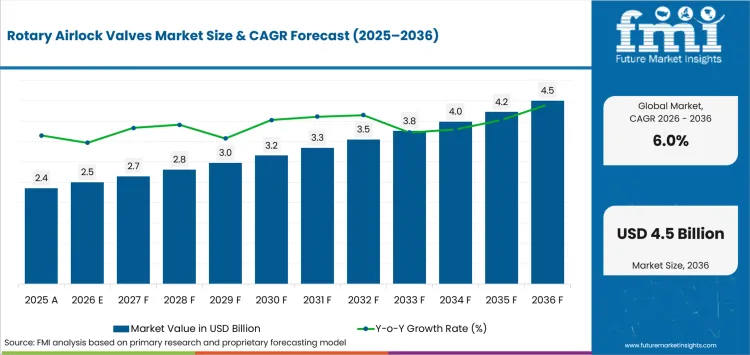
USD 2.5 billion in 2026 and USD 4.5 billion by 2036 at a 6.0% CAGR.
Rotary airlock valve demand is projected to rise from USD 2.5 billion in 2026 to USD 4.5 billion by 2036 at a 6.0% CAGR. Plants use these valves at transfer points that meter dry solids while preserving pressure between connected process stages. Prater Industries stated in April 2025 that rotary airlocks regulate pressure and feed bulk material into pneumatic systems. That operating role keeps industrial valve selection tied to uptime and makes bulk material handling systems a recurring replacement market instead of a greenfield-only purchase.
Country demand converts at different speeds as installed process bases and project economics are not identical. The UK Department for Business and Trade reported in June 2026 that Great Britain produced 7.3 million tonnes of cement in 2024 after a 5.3% annual decline. That output still creates wear-prone transfer points even as plant expansion slows. Mature sites therefore emphasize industrial dust collection interfaces and retrofit fit, while faster industrial se place more weight on new pneumatic conveying diverters and complete solids-handling lines.
Key Takeaways of Rotary Airlock Valves Market
- Dry-bulk processors replace rotary airlock valves when leakage, wear or cleaning downtime threatens pressure control and dependable material transfer.
- Drop-through valves are projected to account for 31.0% of valve type demand in 2026, owing to the continued use of gravity discharge points across storage and collection equipment.
- Open-end rotors are estimated to capture 33.0% share in 2026, driven by general powder applications that favor usable pocket volume and predictable discharge.
- Cast iron is anticipated to represent 35.0% of material demand in 2026 as general industrial applications balance housing rigidity with acquisition cost.
- Abrasive solids and hygiene-sensitive powders can increase lifecycle cost, as the selected rotor, coating and cleaning arrangement must fit the exact duty.
- Coperion, DMN-WESTINGHOUSE, Gericke, ACS Valves, Meyer Industrial, Prater Industries, Rieco Industries and Young Industries represent some key players in the market.
Analyst Perspective
"Plant engineers should evaluate rotary airlocks around pressure duty, handled material and maintenance access before comparing purchase price. Commercial value improves when the selected configuration protects clearances and reduces the service interruption attached to an existing transfer point."
- Nikhil Kaitwade, Principal Consultant, Future Market Insights
How is the Rotary Airlock Valves Market segmented?
The rotary airlock valves market is segmented by valve type, rotor design, material, application, sales channel and region.
Market taxonomy covers valve type, rotor design, material, application, sales channel and region. Valve types include drop-through, blow-through, side-entry, quick-clean and heavy-duty abrasion-resistant valves. Rotor designs comprise open-end, closed-end, adjustable-tip and reduced-capacity rotors. Materials include carbon steel, cast iron, stainless steel and wear-lined or coated construction. Applications cover cement and minerals, food powders, chemicals, plastics and biomass or power. Sales channels comprise process equipment OEMs, direct end users and distributors or representatives.
What makes drop-through valves central to the valve type category?
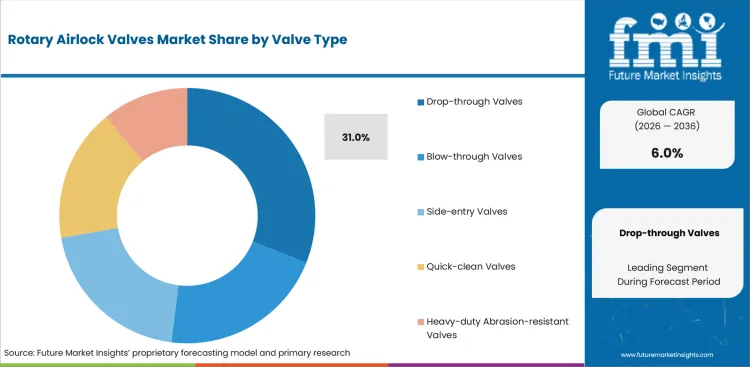
Drop-through valves suit gravity discharge positions beneath hoppers or collectors where material must enter downstream equipment without losing the required pressure boundary. RIECO Industries wrote in June 2025 that rotary airlocks minimize air loss while transferring bulk solids into pneumatic systems.
- By valve type, drop-through valves are projected to account for 31.0% in 2026, attributable to their straight gravity path fitting common storage and conveying equipment interfaces without specialized injection geometry.
- Plant engineers can standardize this configuration across dust collection or feeding points while changing rotor clearances and wear protection for each handled powder without redesigning the complete transfer point.
Why does the open-end rotor lead the rotor design category?
Open-end rotors favor full pocket filling and straightforward discharge when free-flowing powders or granules do not require specialized reduced-volume geometry. DMN-WESTINGHOUSE documented eight rotor options in August 2025 and tied blade design to material flow, hygiene, pressure and wear conditions.
- In 2026, open-end rotors are expected to lead rotor design with 33.0% share, since general process duties usually reward usable pocket volume and predictable discharge.
- OEM engineers can retain a familiar rotor platform across plastic processing machinery or chemical lines while changing blade material and clearances, reducing engineering variation across repeated process layouts at plants.
How does cast iron retain the leading material position?
Cast iron remains practical for general industrial housings that need a rigid machined body without sanitary stainless construction during scheduled rebuild work. ACS Valves noted in September 2025 that abrasive duties can require hard chrome, tungsten or AR400 wear protection around active surfaces.
- By material, cast iron is estimated to hold 35.0% in 2026, as many plants prioritize dimensional stability and acquisition cost before paying for fully stainless housings.
- Maintenance teams can protect high-wear surfaces selectively while keeping the housing material familiar across cement and mineral applications during repeated rebuilds over long operating cycles.
What supports cement and minerals as the leading application?
Cement and mineral lines expose rotary airlocks to fine abrasive material at silo, collector and pneumatic-transfer interfaces during continuous plant operation. ACS Valves stated in September 2025 that shaft-seal air purge suits abrasive materials such as cement and very fine products prone to leakage.
- Cement and minerals are forecast to represent 28.0% of application demand in 2026, owing to continuous abrasive handling that creates many wear-sensitive airlock and metering positions.
- Recurring rebuild and replacement activity depends on stable clearances for pressure control while limiting downtime around industrial air filtration equipment where worn tips can increase leakage and force unscheduled maintenance.
What are the drivers, restraints and opportunities in the Rotary Airlock Valves Market?
Controlled solids transfer and pressure isolation support demand. Wear and qualification raise lifecycle cost while quick-clean or wear-protected retrofits create replacement opportunities.
- Driver: Process plants need dependable solids discharge while rotary airlocks preserve pressure separation across connected dry-bulk equipment.
- Restraint: Abrasion and hygiene requirements can extend specification work, as clearances, materials and cleaning access change with the handled product.
- Opportunity: Retrofit designs that reduce inspection time or preserve wear surfaces can convert installed-base maintenance into higher-value replacement orders.
Pressure Separation Keeps Airlocks Inside Critical Process Interfaces
Plant engineers specify rotary airlocks where dry solids must pass between process stages without losing pressure control or allowing a hazard to propagate. ACS Valves stated in February 2026 that close-clearance rotary airlocks can function as passive explosion-isolation devices under NFPA 69 concepts with rotor-to-housing tolerance below 0.0079 inches. That specification makes pressure retention and documented clearances part of the valve purchase rather than separate maintenance concerns.
Wear and Qualification Increase Lifecycle Scrutiny
Material wear and cleaning demands can turn a simple replacement into an application-qualification exercise with higher lifecycle scrutiny. Meyer Industrial described its KLEAN-IN-PLACE II sanitary rotary airlock in December 2025 for food, dairy and pharmaceutical duties that require frequent cleaning without removing the valve from service. Plants using hygienic processing equipment therefore compare access time and contamination control alongside pressure performance before approving a configuration.
Quick-Clean Retrofits Reduce Maintenance Interruption
Retrofit demand improves when a new valve reduces the maintenance hours attached to an existing transfer point. Gericke updated its Fast Clean range in July 2026 with standard extractable versions up to 400 mm and RotaLign rotor alignment across the range. Those features let maintenance teams shorten inspection or cleaning work while preserving alignment, which gives food processing equipment operators a measurable reason to replace an installed unit before the surrounding line changes.
Which country CAGRs are profiled in the Rotary Airlock Valves Market?
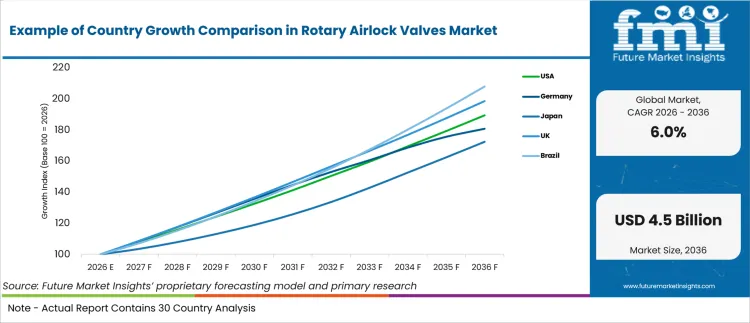
| Country | CAGR |
|---|---|
| Brazil | 5.6% |
| UK | 5.5% |
| USA | 5.1% |
| Germany | 4.7% |
| Japan | 4.5% |
How do country-level CAGRs compare in the Rotary Airlock Valves Market?
The profiled countries span 1.2 percentage points between Brazil at 5.6% and Japan at 4.5% from 2026 to 2036. Brazil and the UK form the upper pair, while the USA occupies a middle position. Germany and Japan remain below 5.0% as mature installed bases shift spending toward qualified replacement projects.
- Brazil combines stronger cement volumes with long service distances across industrial regions.
- UK plants emphasize retrofit economics across mature cement assets under tight capital review.
- USA replacement demand follows a broad installed base with demanding combustible-dust documentation.
- Germany combines modernization projects with detailed compliance review across existing cement facilities.
- Japan favors proven retrofit fit and long-term parts support across established industrial lines.
Similar CAGRs can conceal different service and qualification conditions for market entry. The full report provides country-level CAGR analysis across North America, Latin America, Europe, East Asia, South Asia, Oceania and the Middle East and Africa.
Country-wise Analysis
- Brazilian cement and mineral sites operate across long service corridors where abrasive duty raises the value of local parts inventory and maintenance support across clinker grinding and raw-material transfer points outside major service centers. The National Cement Industry Union reported in June 2026 that first-half cement sales increased 2.3% year over year to 32.9 million tonnes, giving heavy-duty transfer equipment a larger active operating base to support. Rotary airlock valve demand in Brazil is forecast to rise at 5.6% CAGR over the forecast period, although service distance and wear exposure favor companies that combine rugged configurations with regional engineering coverage.
- UK rotary airlock purchases concentrate in established cement and process plants where retrofit fit and lifecycle economics receive close capital scrutiny, especially when drop-in flange compatibility limits shutdown time during replacement work. The UK is estimated to post 5.5% CAGR over the forecast period, aided by replacement needs even as the Department for Business and Trade recorded a 5.0% annual decline in cement prices during May 2026. Lower product pricing can tighten investment tests for plant upgrades, so valve companies need quantified leakage control, maintenance benefits and dependable local parts support before a replacement order clears internal approval.
- US plant engineers often replace rotary airlocks inside established cement and mineral systems that already define flange geometry, pressure duty and shutdown windows across regional dust-collection and pneumatic-conveying installations operating on different maintenance schedules. The U.S. Geological Survey reported in February 2026 that cement production during 2025 came from 97 plants across 34 states and Puerto Rico, reinforcing a broad installed base for maintenance and retrofit activity. USA demand is projected to advance at 5.1% CAGR through 2036, but suppliers need documented fit-up, safety performance and predictable spare-parts support that reaches widely distributed industrial sites during scheduled outages.
- German process plants place strong emphasis on documented pressure duty and compliance where rotary airlocks connect dust-prone or modernized material-handling equipment, and ATEX documentation can extend approval work before a retrofit reaches purchase. VDZ stated in March 2026 that a reliable carbon-price signal remains central to investment decisions for industrial carbon-capture facilities, which can alter material-flow interfaces as cement sites modernize auxiliary equipment. Germany is anticipated to record 4.7% CAGR during the assessment period, reflecting a shift toward modernization-led replacement projects where detailed compliance documentation and maintainable wear components determine supplier selection across cement facilities.
- Japanese industrial plants usually prefer rotary airlocks that fit established lines with minimal commissioning disruption and dependable long-term service, owing to tightly planned shutdown windows and limited tolerance for repeat work. Japan is forecast to post 4.5% CAGR between 2026 and 2036, reflecting replacement-led demand as the Japan Cement Association updated its monthly supply and demand series on July 23, 2026. Vendors entering retrofit projects must pair compact fit and stable clearances with local parts availability, since cautious supplier switching raises the value of nearby maintenance support outside Japan's major industrial centers during planned outages.
Who are the notable companies in the Rotary Airlock Valves Market?
Coperion, DMN-WESTINGHOUSE, Gericke, ACS Valves, Meyer Industrial, Prater Industries, Rieco Industries and Young Industries are the notable companies serving this market.
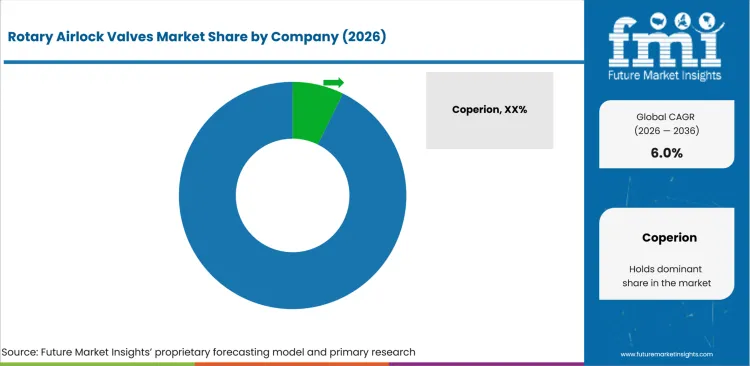
Competition separates integrated powder-handling groups from companies focused primarily on rotary-valve engineering. Entry barriers rise when a plant requires documented pressure duty, hygienic access or wear protection across an existing interface. Service depth also matters because a failed airlock can interrupt the connected conveying line. Companies with application engineering can therefore compete beyond component price by reducing specification risk and maintenance disruption.
- Coperion, Gericke and Rieco Industries combine rotary airlocks with broader powder-handling or process-engineering capabilities across several industrial applications.
- DMN-WESTINGHOUSE, ACS Valves and Meyer Industrial compete with broad rotary-valve configurations that address pressure duty, hygiene and material-specific handling needs.
- Prater Industries and Young Industries position rotary airlocks alongside dry-bulk process equipment with emphasis on application engineering and maintainable plant interfaces.
Competitive Benchmarking: Rotary Airlock Valves Market
| Company | Valve Configuration Breadth | Severe-Duty Qualification | System / Service Integration | Geographic Reach |
|---|---|---|---|---|
| Coperion | High | High | High | Global |
| DMN-WESTINGHOUSE | High | High | Medium | Europe, North America and Asia |
| Gericke | High | High | High | Europe, Americas and Asia-Pacific |
| ACS Valves | High | High | Medium | North America and international sales |
| Meyer Industrial | High | High | Medium | North America and international sales |
| Prater Industries | High | High | High | North America and international projects |
| Rieco Industries | High | Medium | High | India, Asia and Middle East |
| Young Industries | Medium | Medium | Medium | North America and international sales |
Key Developments in the Rotary Airlock Valves Market
- In July 2026, Gericke updated its Fast Clean rotary valve range with standard extractable versions up to 400 mm and RotaLign alignment across the line.
- In September 2025, DMN-WESTINGHOUSE exhibited at POWTECH TECHNOPHARM in Nuremberg, Germany, showcasing its rotary and diverter valve portfolio across different process-duty levels.
- In July 2025, Coperion introduced a ZRD rotary valve configuration for plastics recycling with a revised gap design and drive for reliable flake discharge.
Key Players in the Rotary Airlock Valves Market
Integrated Powder-Handling Platforms
- Coperion
- Gericke
- Rieco Industries
Rotary Valve Engineering Specialists
- DMN-WESTINGHOUSE
- ACS Valves
- Meyer Industrial
Dry-Bulk Process Equipment Specialists
- Prater Industries
- Young Industries
Rotary Airlock Valves Market - Report Scope
| Coverage field | Report scope |
|---|---|
| Market breakdown | By valve type, rotor design, material, application, sales channel and region. |
| Quantitative Units | Revenue in USD million and CAGR in %. |
| Market Definition | Commercial rotary airlock valves used to meter or discharge dry bulk solids while maintaining a pressure boundary across connected process equipment. |
| Regions Covered | North America, Latin America, Western Europe, Eastern Europe, East Asia, South Asia and Pacific and Middle East and Africa. |
| Countries Covered | Brazil, UK, USA, Germany, Japan, and 20+ countries included in the full report. |
| Key Companies Profiled | Coperion, DMN-WESTINGHOUSE, Gericke, ACS Valves, Meyer Industrial, Prater Industries, Rieco Industries and Young Industries. |
| Forecast Period | 2026 to 2036. |
| Approach | Primary and secondary research with market triangulation. |
Rotary Airlock Valves Market - Research Methodology
| Method | Approach |
|---|---|
| Primary Research | FMI analysts gathered input from manufacturers, service providers, technology developers, distributors, end users, procurement teams, and subject-matter experts. Interviews examined purchasing decisions, product or service evaluation, adoption barriers, approval requirements, pricing considerations, and expectations for technical or commercial support. Respondents were also asked what evidence is required before a trial, pilot, or initial order develops into regular purchasing. |
| Desk Research | Desk research covered government statistics, regulatory publications, trade data, industry associations, technical literature, standards, company filings, product information, and official corporate announcements. Sources were reviewed for relevance, publication date, geographic coverage, and consistency with the defined market scope. Claims relating to performance, applications, approvals, capacity, investment, and commercial activity were retained only when supported by credible public evidence. |
| Market Sizing and Forecasting | The market model combined the baseline value with historical performance, segment structure, pricing and volume indicators, adoption levels, company participation, and country-level demand conditions. Forecast assumptions considered economic activity, investment trends, regulatory developments, technology adoption, purchasing cycles, supply availability, and barriers to wider market use. Segment and regional estimates were reconciled before the final market total was calculated. |
| Data Validation | Estimates were checked against multiple independent indicators, including public data, company activity, trade patterns, industry developments, and findings from primary interviews. Validation also tested whether products, services, applications, and company revenues fell within the defined market boundaries. Adjacent categories, unsupported claims, overlapping revenues, and activities without direct market relevance were excluded to reduce double counting and maintain consistency across segments and countries. |
Rotary Airlock Valves Market by Segments
Rotary Airlock Valves Market segmented by Valve Type:
- Drop-through Valves
- Blow-through Valves
- Side-entry Valves
- Quick-clean Valves
- Heavy-duty Abrasion-resistant Valves
Rotary Airlock Valves Market segmented by Rotor Design:
- Open-end Rotor
- Closed-end Rotor
- Adjustable Tip Rotor
- Reduced Capacity Rotor
Rotary Airlock Valves Market segmented by Material:
- Carbon Steel
- Cast Iron
- Stainless Steel
- Wear-lined / Coated
Rotary Airlock Valves Market segmented by Application:
- Cement / Minerals
- Food Powders
- Chemicals
- Plastics
- Biomass / Power
Rotary Airlock Valves Market segmented by Sales Channel:
- Process Equipment OEMs
- Direct End User
- Distributors / Reps
Rotary Airlock Valves Market by Region:
- North America
- United States
- Canada
- Latin America
- Brazil
- Mexico
- Chile
- Rest of Latin America
- Western Europe
- Germany
- United Kingdom
- Italy
- Spain
- France
- Nordics
- Benelux
- Rest of Western Europe
- Eastern Europe
- Russia
- Poland
- Hungary
- Balkan and Baltic States
- Rest of Eastern Europe
- East Asia
- China
- Japan
- South Korea
- South Asia and Pacific
- India
- ASEAN
- Australia and New Zealand
- Rest of South Asia and Pacific
- Middle East and Africa
- Kingdom of Saudi Arabia
- Other GCC Countries
- Türkiye
- South Africa
- Other African Union Countries
- Rest of Middle East and Africa
Research Sources and Bibliography
- Prater Industries. (2025, April 8). The Role of Rotary Airlock Valves in Bulk Material Handling.
- Department for Business and Trade. (2026, June). Construction building materials: commentary June 2026.
- RIECO Industries. (2025, June 9). Understanding Rotary Airlock Valves: Features and Precautions to Maintain.
- DMN-WESTINGHOUSE. (2025, August 13). The correct rotor choice: the key to efficient process performances.
- ACS Valves. (2025, September 22). How well do rotary valves hold up against wear and tear from coarse construction materials like crushed rock, gravel, or demolition debris?.
- ACS Valves. (2025, September 22). What kind of air purge kit do I need for my rotary valve?.
- ACS Valves. (2026, February 10). What are explosion isolation devices?.
- Meyer Industrial. (2025, December 2). KLEAN-IN-PLACE II®: The Ultimate Sanitary Rotary Airlock Valve for Food, Dairy & Pharmaceutical Processing.
- Gericke. (2026, July 17). Making Fast Clean Rotary Valves even better (and bigger).
- Sindicato Nacional da Indústria do Cimento. (2026, June). Resultados Preliminares Junho 2026.
- U.S. Geological Survey. (2026, February 6). Mineral commodity summaries 2026.
- VDZ. (2026, March 17). Reform of the EU Emissions Trading Scheme: The cement industry’s positions.
- Japan Cement Association. (2026, July 23).
- DMN-WESTINGHOUSE. (2025, September 10). Experience Our Products at POWTECH TECHNOPHARM Germany.
- Coperion. (2025, July 15). Coperion at K 2025: Innovative Interplay of Plastics Recycling Technologies.
- The Young Industries, Inc. (2026). Wood, Pulp, & Paper. Retrieved August 13, 2026.
This Report Answers
- How large is the rotary airlock valves market in 2026 and what value is forecast for 2036?
- Which operating duties keep rotary airlock valves tied to dry-bulk pressure control and recurring replacement demand?
- Why do drop-through valves hold the largest approved share within the valve type category?
- How does rotor design change discharge performance across common powder and granular material duties?
- Why does cast iron remain the largest approved material category for general industrial rotary airlock housings?
- What makes cement and minerals the largest approved application across abrasion-prone bulk handling lines?
- How do service coverage and installed-base conditions change the profiled country growth paths?
- Which companies compete through integrated systems or specialist rotary-valve engineering across the defined market?
- Which maintenance and qualification requirements most strongly affect replacement timing across existing process lines?
Frequently Asked Questions
How big is the Rotary Airlock Valves Market in 2026?
The rotary airlock valves market is valued at USD 2.5 billion in 2026. Growth is driven by increasing demand for reliable bulk-material handling systems that require accurate metering and pressure isolation.
What is the CAGR of the Rotary Airlock Valves Market from 2026 to 2036?
The rotary airlock valves market is projected to grow at a CAGR of 6.0% between 2026 and 2036. Expansion is supported by ongoing replacement demand and new installations across processing, manufacturing, and bulk-material handling facilities.
Which valve type leads the Rotary Airlock Valves Market?
Drop-through valves are projected to account for 31.0% of the market in 2026. Their leading share is supported by a simple gravity-fed design that is widely used in hopper, collector, and discharge applications.
How much value will the Rotary Airlock Valves Market add between 2026 and 2036?
The rotary airlock valves market is expected to add USD 2 billion in value between 2026 and 2036. Growth reflects increasing retrofit activity, equipment replacement, and expansion of dry-bulk processing infrastructure.
Which companies are active in the Rotary Airlock Valves Market?
Key companies operating in the market include Coperion, DMN-WESTINGHOUSE, Gericke, ACS Valves, Meyer Industrial, Prater Industries, Rieco Industries, and Young Industries. These companies compete through valve engineering expertise, system integration capabilities, and application-specific product offerings.
Preview the report firsthand - request a free sample
Get SampleGet the brochure for pricing and purchase details.
Get PDFTable of Content
- Key Takeaways
- Market Size and CAGR
- Top Growth Driver
- Fastest Growing Segment
- Leading Region
- Key Companies
- Emerging Opportunities
- Executive Summary
- Global Market Outlook
- Demand-side Trends
- Supply-side Trends
- Technology Roadmap Analysis
- Analysis and Recommendations
- Analyst Perspective (What is happening? Why now? What should investors know?)
- Key Questions Answered
- How large is the market?
- What is the CAGR?
- What are key trends?
- Which region dominates?
- Who are the leaders?
- Market Overview
- Market Coverage / Taxonomy
- Market Definition / Scope / Limitations
- Research Methodology
- Chapter Orientation
- Analytical Lens and Working Hypotheses
- Market Structure, Signals, and Trend Drivers
- Benchmarking and Cross-market Comparability
- Market Sizing, Forecasting, and Opportunity Mapping
- Research Design and Evidence Framework
- Desk Research Programme (Secondary Evidence)
- Expert Input and Fieldwork (Primary Evidence)
- Tooling, Models, and Reference Databases
- Data Engineering and Model Build
- Quality Assurance and Audit Trail
- Market Background
- Market Dynamics (Drivers, Restraints, Opportunity, Trends)
- Scenario Forecast (Optimistic, Likely, Conservative)
- Impact Analysis
- AI Impact
- Sustainability Impact
- Regulatory Impact
- Technology Impact
- Consumer / Buyer Analysis
- Purchase Drivers
- Adoption Barriers
- Buyer Journey
- Opportunity Map Analysis
- Product Life Cycle Analysis
- Supply Chain Analysis
- Investment Feasibility Matrix
- Value Chain Analysis
- PESTLE and Porter's Analysis
- Regulatory Landscape
- Regional Parent Market Outlook
- Production and Consumption Statistics
- Import and Export Statistics
- Global Market Analysis and Forecast, 2021 to 2036
- Historical Market Size Value (USD Billion) Analysis, 2021 to 2025
- Current and Future Market Size Value (USD Billion) Projections, 2026 to 2036
- Y-o-Y Growth Trend Analysis
- Absolute $ Opportunity Analysis
- Global Market Pricing Analysis, 2021 to 2036
- Global Market Analysis and Forecast, By Valve Type, 2021 to 2036
- Introduction / Key Findings
- Historical Market Size Value (USD Billion) Analysis By Valve Type, 2021 to 2025
- Current and Future Market Size Value (USD Billion) Analysis and Forecast By Valve Type, 2026 to 2036
- Drop-through Valves
- Blow-through Valves
- Side-entry Valves
- Quick-clean Valves
- Heavy-duty Abrasion-resistant Valves
- Drop-through Valves
- Y-o-Y Growth Trend Analysis By Valve Type, 2021 to 2025
- Absolute $ Opportunity Analysis By Valve Type, 2026 to 2036
- Global Market Analysis and Forecast, By Rotor Design, 2021 to 2036
- Introduction / Key Findings
- Historical Market Size Value (USD Billion) Analysis By Rotor Design, 2021 to 2025
- Current and Future Market Size Value (USD Billion) Analysis and Forecast By Rotor Design, 2026 to 2036
- Open-end Rotor
- Closed-end Rotor
- Adjustable Tip Rotor
- Reduced Capacity Rotor
- Open-end Rotor
- Y-o-Y Growth Trend Analysis By Rotor Design, 2021 to 2025
- Absolute $ Opportunity Analysis By Rotor Design, 2026 to 2036
- Global Market Analysis and Forecast, By Material, 2021 to 2036
- Introduction / Key Findings
- Historical Market Size Value (USD Billion) Analysis By Material, 2021 to 2025
- Current and Future Market Size Value (USD Billion) Analysis and Forecast By Material, 2026 to 2036
- Carbon Steel
- Cast Iron
- Stainless Steel
- Wear-lined / Coated
- Carbon Steel
- Y-o-Y Growth Trend Analysis By Material, 2021 to 2025
- Absolute $ Opportunity Analysis By Material, 2026 to 2036
- Global Market Analysis and Forecast, By Application, 2021 to 2036
- Introduction / Key Findings
- Historical Market Size Value (USD Billion) Analysis By Application, 2021 to 2025
- Current and Future Market Size Value (USD Billion) Analysis and Forecast By Application, 2026 to 2036
- Cement / Minerals
- Food Powders
- Chemicals
- Plastics
- Biomass / Power
- Cement / Minerals
- Y-o-Y Growth Trend Analysis By Application, 2021 to 2025
- Absolute $ Opportunity Analysis By Application, 2026 to 2036
- Global Market Analysis and Forecast, By Sales Channel, 2021 to 2036
- Introduction / Key Findings
- Historical Market Size Value (USD Billion) Analysis By Sales Channel, 2021 to 2025
- Current and Future Market Size Value (USD Billion) Analysis and Forecast By Sales Channel, 2026 to 2036
- Process Equipment OEMs
- Direct End User
- Distributors / Reps
- Process Equipment OEMs
- Y-o-Y Growth Trend Analysis By Sales Channel, 2021 to 2025
- Absolute $ Opportunity Analysis By Sales Channel, 2026 to 2036
- Global Market Analysis and Forecast, By Region, 2021 to 2036
- Introduction
- Historical Market Size Value (USD Billion) Analysis By Region, 2021 to 2025
- Current Market Size Value (USD Billion) Analysis and Forecast By Region, 2026 to 2036
- North America
- Latin America
- Western Europe
- Eastern Europe
- East Asia
- South Asia and Pacific
- Middle East & Africa
- Market Attractiveness Analysis By Region
- North America Market Analysis and Forecast, By Country, 2021 to 2036
- Historical Market Size Value (USD Billion) Trend Analysis By Market Taxonomy, 2021 to 2025
- Market Size Value (USD Billion) Forecast By Market Taxonomy, 2026 to 2036
- By Country
- USA
- Canada
- By Valve Type
- By Rotor Design
- By Material
- By Application
- By Sales Channel
- By Country
- Market Attractiveness Analysis
- By Country
- By Valve Type
- By Rotor Design
- By Material
- By Application
- By Sales Channel
- Key Takeaways
- Latin America Market Analysis and Forecast, By Country
- Historical Market Size Value (USD Billion) Trend Analysis By Market Taxonomy, 2021 to 2025
- Market Size Value (USD Billion) Forecast By Market Taxonomy, 2026 to 2036
- By Country
- Brazil
- Mexico
- Chile
- Rest of Latin America
- By Valve Type
- By Rotor Design
- By Material
- By Application
- By Sales Channel
- By Country
- Market Attractiveness Analysis
- By Country
- By Valve Type
- By Rotor Design
- By Material
- By Application
- By Sales Channel
- Key Takeaways
- Western Europe Market Analysis and Forecast, By Country
- Historical Market Size Value (USD Billion) Trend Analysis By Market Taxonomy, 2021 to 2025
- Market Size Value (USD Billion) Forecast By Market Taxonomy, 2026 to 2036
- By Country
- Germany
- UK
- Italy
- Spain
- France
- Nordic
- BENELUX
- Rest of Western Europe
- By Valve Type
- By Rotor Design
- By Material
- By Application
- By Sales Channel
- By Country
- Market Attractiveness Analysis
- By Country
- By Valve Type
- By Rotor Design
- By Material
- By Application
- By Sales Channel
- Key Takeaways
- Eastern Europe Market Analysis and Forecast, By Country
- Historical Market Size Value (USD Billion) Trend Analysis By Market Taxonomy, 2021 to 2025
- Market Size Value (USD Billion) Forecast By Market Taxonomy, 2026 to 2036
- By Country
- Russia
- Poland
- Hungary
- Balkan & Baltic
- Rest of Eastern Europe
- By Valve Type
- By Rotor Design
- By Material
- By Application
- By Sales Channel
- By Country
- Market Attractiveness Analysis
- By Country
- By Valve Type
- By Rotor Design
- By Material
- By Application
- By Sales Channel
- Key Takeaways
- East Asia Market Analysis and Forecast, By Country
- Historical Market Size Value (USD Billion) Trend Analysis By Market Taxonomy, 2021 to 2025
- Market Size Value (USD Billion) Forecast By Market Taxonomy, 2026 to 2036
- By Country
- China
- Japan
- South Korea
- By Valve Type
- By Rotor Design
- By Material
- By Application
- By Sales Channel
- By Country
- Market Attractiveness Analysis
- By Country
- By Valve Type
- By Rotor Design
- By Material
- By Application
- By Sales Channel
- Key Takeaways
- South Asia and Pacific Market Analysis and Forecast, By Country
- Historical Market Size Value (USD Billion) Trend Analysis By Market Taxonomy, 2021 to 2025
- Market Size Value (USD Billion) Forecast By Market Taxonomy, 2026 to 2036
- By Country
- India
- ASEAN
- Australia & New Zealand
- Rest of South Asia and Pacific
- By Valve Type
- By Rotor Design
- By Material
- By Application
- By Sales Channel
- By Country
- Market Attractiveness Analysis
- By Country
- By Valve Type
- By Rotor Design
- By Material
- By Application
- By Sales Channel
- Key Takeaways
- Middle East & Africa Market Analysis and Forecast, By Country
- Historical Market Size Value (USD Billion) Trend Analysis By Market Taxonomy, 2021 to 2025
- Market Size Value (USD Billion) Forecast By Market Taxonomy, 2026 to 2036
- By Country
- Kingdom of Saudi Arabia
- Other GCC Countries
- Türkiye
- South Africa
- Other African Union
- Rest of Middle East & Africa
- By Valve Type
- By Rotor Design
- By Material
- By Application
- By Sales Channel
- By Country
- Market Attractiveness Analysis
- By Country
- By Valve Type
- By Rotor Design
- By Material
- By Application
- By Sales Channel
- Key Takeaways
- Key Countries Market Analysis
- USA
- Pricing Analysis
- Market Share Analysis, 2025
- By Valve Type
- By Rotor Design
- By Material
- By Application
- By Sales Channel
- Canada
- Pricing Analysis
- Market Share Analysis, 2025
- By Valve Type
- By Rotor Design
- By Material
- By Application
- By Sales Channel
- Mexico
- Pricing Analysis
- Market Share Analysis, 2025
- By Valve Type
- By Rotor Design
- By Material
- By Application
- By Sales Channel
- Brazil
- Pricing Analysis
- Market Share Analysis, 2025
- By Valve Type
- By Rotor Design
- By Material
- By Application
- By Sales Channel
- Chile
- Pricing Analysis
- Market Share Analysis, 2025
- By Valve Type
- By Rotor Design
- By Material
- By Application
- By Sales Channel
- Germany
- Pricing Analysis
- Market Share Analysis, 2025
- By Valve Type
- By Rotor Design
- By Material
- By Application
- By Sales Channel
- UK
- Pricing Analysis
- Market Share Analysis, 2025
- By Valve Type
- By Rotor Design
- By Material
- By Application
- By Sales Channel
- Italy
- Pricing Analysis
- Market Share Analysis, 2025
- By Valve Type
- By Rotor Design
- By Material
- By Application
- By Sales Channel
- Spain
- Pricing Analysis
- Market Share Analysis, 2025
- By Valve Type
- By Rotor Design
- By Material
- By Application
- By Sales Channel
- France
- Pricing Analysis
- Market Share Analysis, 2025
- By Valve Type
- By Rotor Design
- By Material
- By Application
- By Sales Channel
- India
- Pricing Analysis
- Market Share Analysis, 2025
- By Valve Type
- By Rotor Design
- By Material
- By Application
- By Sales Channel
- ASEAN
- Pricing Analysis
- Market Share Analysis, 2025
- By Valve Type
- By Rotor Design
- By Material
- By Application
- By Sales Channel
- Australia & New Zealand
- Pricing Analysis
- Market Share Analysis, 2025
- By Valve Type
- By Rotor Design
- By Material
- By Application
- By Sales Channel
- China
- Pricing Analysis
- Market Share Analysis, 2025
- By Valve Type
- By Rotor Design
- By Material
- By Application
- By Sales Channel
- Japan
- Pricing Analysis
- Market Share Analysis, 2025
- By Valve Type
- By Rotor Design
- By Material
- By Application
- By Sales Channel
- South Korea
- Pricing Analysis
- Market Share Analysis, 2025
- By Valve Type
- By Rotor Design
- By Material
- By Application
- By Sales Channel
- Russia
- Pricing Analysis
- Market Share Analysis, 2025
- By Valve Type
- By Rotor Design
- By Material
- By Application
- By Sales Channel
- Poland
- Pricing Analysis
- Market Share Analysis, 2025
- By Valve Type
- By Rotor Design
- By Material
- By Application
- By Sales Channel
- Hungary
- Pricing Analysis
- Market Share Analysis, 2025
- By Valve Type
- By Rotor Design
- By Material
- By Application
- By Sales Channel
- Kingdom of Saudi Arabia
- Pricing Analysis
- Market Share Analysis, 2025
- By Valve Type
- By Rotor Design
- By Material
- By Application
- By Sales Channel
- Türkiye
- Pricing Analysis
- Market Share Analysis, 2025
- By Valve Type
- By Rotor Design
- By Material
- By Application
- By Sales Channel
- South Africa
- Pricing Analysis
- Market Share Analysis, 2025
- By Valve Type
- By Rotor Design
- By Material
- By Application
- By Sales Channel
- USA
- Market Structure Analysis
- Competition Dashboard
- Competition Benchmarking
- Market Share Analysis of Top Players
- By Regional
- By Valve Type
- By Rotor Design
- By Material
- By Application
- By Sales Channel
- Emerging Startups
- Innovation Benchmarking
- Competition Analysis
- Competition Deep Dive
- Coperion
- Overview
- Product Portfolio
- Profitability by Market Segments
- Sales Footprint
- Strategy Overview
- Marketing Strategy
- Product Strategy
- Channel Strategy
- Schenck Process
- DMN-WESTINGHOUSE
- ACS Valves
- WAMGROUP
- Gericke
- Meyer Industrial
- Prater Industries
- Rieco Industries
- Young Industries
- Coperion
- Case Studies
- Success Stories
- Recent Developments
- Competition Deep Dive
- Assumptions & Acronyms Used


