

- Industry Size (2026)
- USD 0.7 Bn
- Forecast (2036)
- USD 1.4 Bn
- CAGR (2026 to 2036)
- 6.9%
Pneumatic Conveying Diverters Market Size, Market Forecast and Outlook By FMI
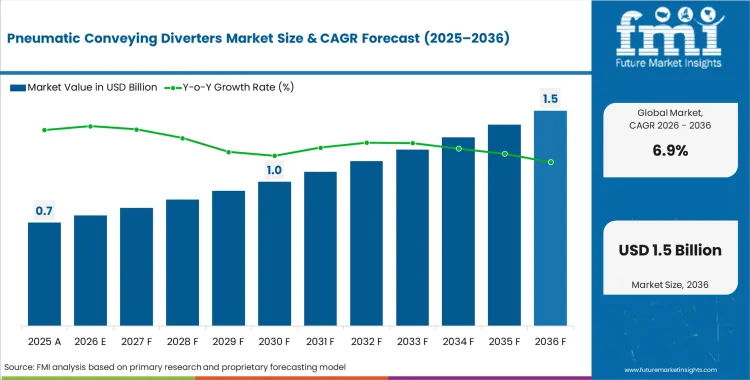
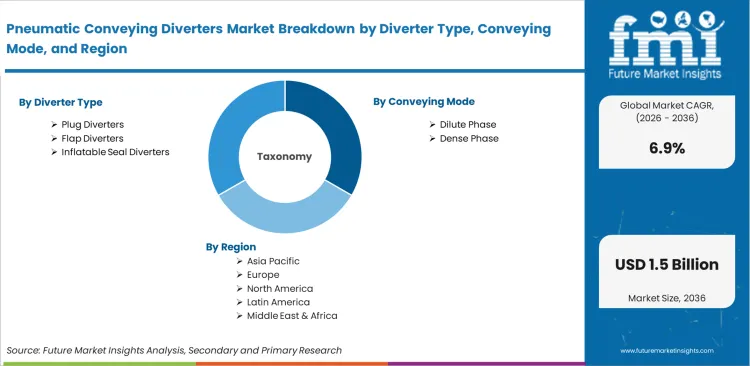
The pneumatic conveying diverters market stood at USD 0.6 billion in 2025 and is projected to reach USD 0.7 billion in 2026. Sector is projected to expand at a CAGR of 6.9% during 2026 to 2036, with total valuation projected at USD 1.4 billion by 2036. The positive growth prospects are linked to automation in bulk material handling systems, where plants are shifting from manual routing to multi-destination conveying setups.
Summary of Pneumatic Conveying Diverters Market
- The market is estimated at USD 0.6 billion in 2025.
- The market is projected to reach USD 1.4 billion by 2036.
- The market is expected to grow at a CAGR of 6.9% from 2026 to 2036.
- The forecast period represents an incremental opportunity of USD 0.7 billion.
- Plug-type diverters lead the type segment with a 34% share.
- Dilute-phase systems dominate the conveying mode segment with a 58% share.
- Food and beverage applications lead the end-use segment with a 24% share.
- Low-pressure setups lead the pressure segment with a 41% share.
- Diverging configurations lead the valve function segment with a 54% share.
- India (7.6%), China (6.7%), and the United States (5.8%) are among the fastest-growing markets.
Product integrity during material transfer remains a critical requirement across chemical, food, and advanced materials processing. Even minor leakage between conveying lines can result in contamination and full batch rejection. Diverter systems with tight sealing mechanisms reduce this risk while enabling uninterrupted material flow. Facilities handling sensitive or high-cost powders prioritize designs that maintain isolation without stopping operations.
Operational efficiency improves when switching occurs under active conveying conditions. Systems capable of mid-stream diversion reduce idle time and improve utilization of blowers and pipelines. This shift supports higher throughput and more consistent production cycles. Automated routing also reduces operator intervention, improving process control across large-scale plants.
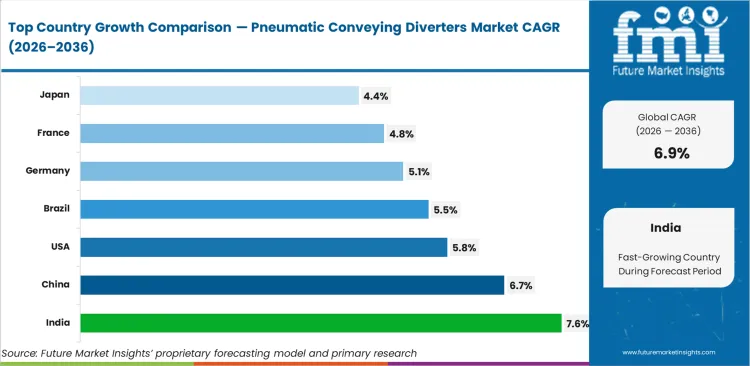
India is estimated to record a CAGR of 7.6% in the pneumatic conveying diverters market during 2026 to 2036, supported by expansion in cement and bulk material infrastructure. China is projected at 6.7%, driven by upgrades in petrochemical processing facilities. The United States is expected to register 5.8%, reflecting replacement of legacy equipment in food and industrial applications. Brazil records 5.5%, Germany 5.1%, France 4.8%, and Japan 4.4% over the same period, showing a shift toward hygienic design in mature regions and high-volume handling in emerging markets.
Segmental Analysis
Pneumatic Conveying Diverters Market Analysis by Diverter Type
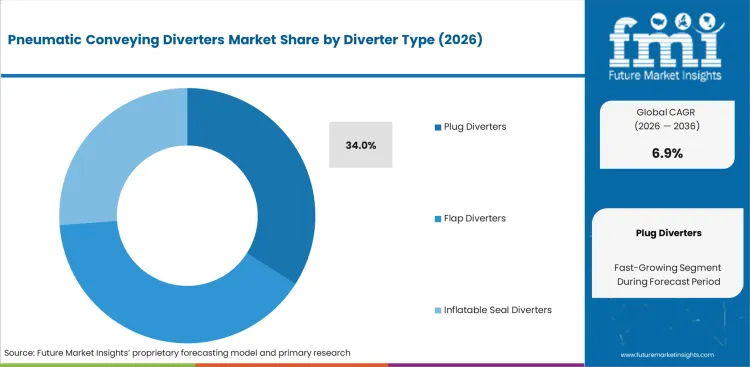
Minimizing product shearing drives chemical engineers toward specific routing architectures. Plug Diverters are anticipated to capture 34.0% share in 2026 as smooth internal bores prevent plastic pellets from fracturing during branch transitions. FMI's analysis indicates bulk manufacturers producing aerospace composite materials using pcr rely on this smooth geometry to maintain particle integrity. Plant managers specify these units to eliminate hang-up points common in cheaper designs. Buyers purchase plug diverters for gentle handling, but a hidden operational penalty exists: turning solid metal plugs under full pneumatic pressure requires huge pneumatic actuators consuming extreme compressed air volumes. Sudden compressor capacity shortfalls when processing low temperature cure exterior coatings for composite airframes across sprawling production floors.
- Actuator stall prevention: Turning thick metal plugs under load demands oversized pneumatic cylinders. Maintenance directors must upgrade dedicated air supply lines or risk mid-cycle valve jamming.
- Housing deflection risks: Heavy casting weights cause pipeline sagging if improperly supported. Mechanical contractors must install isolated structural bracing preventing flange stress fractures.
- Seal wear monitoring: Abrasive dust infiltrating tight clearances destroys internal O-rings. Process technicians must implement continuous pressure-decay testing catching leakage before batch contamination occurs.
Pneumatic Conveying Diverters Market Analysis by Conveying Mode
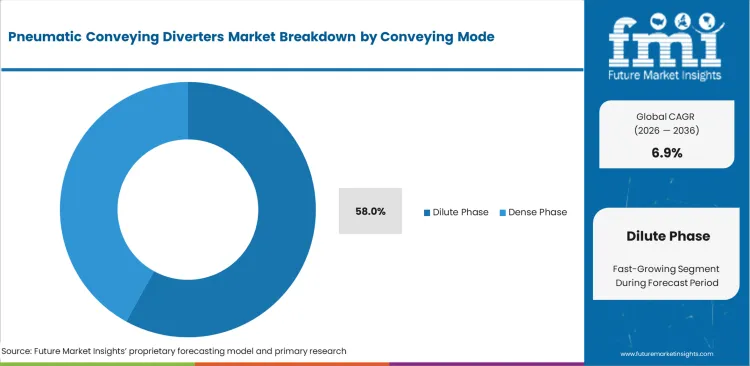
High-volume material transfer across extended plant layouts requires consistent flow velocity to maintain throughput. Dilute phase conveying dominates due to its ability to move materials rapidly using suspended air streams. Abrasion becomes a key concern under high-speed conditions, as continuous particle impact affects internal surfaces. Dilute phase systems are likely to hold 58.0% share among other conveying modes in 2026, reflecting preference for throughput-driven operations. Material handling efficiency depends on balancing velocity with durability, as excessive speed increases wear while insufficient velocity disrupts flow continuity.
- Erosion replacement budgets: High-speed particle impacts destroy standard valve plates rapidly. Procurement directors must budget for frequent tungsten-carbide replacement inserts preventing housing breaches.
- Blower energy overhead: Suspending materials requires massive continuous airflow. Energy managers face high electricity costs unless optimizing variable frequency drives on central blower units.
- Product degradation penalties: Smashing fragile particles through sharp bends generates useless dust. Quality controllers must install downstream classification screens removing shattered material before packaging.
Pneumatic Conveying Diverters Market Analysis by End Use
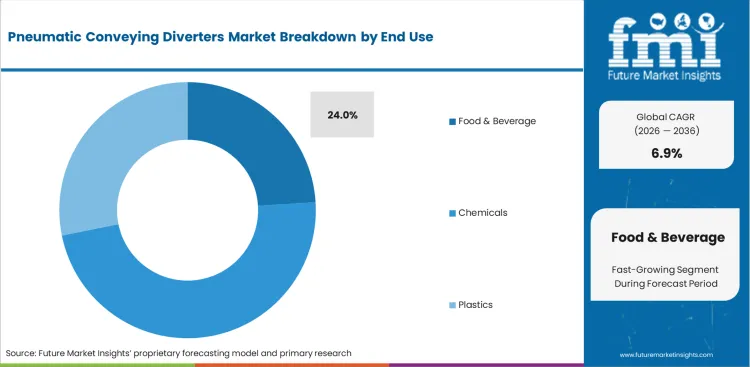
Food & Beverage is predicted to reach 24.0% share over the forecast period. Plant operators processing specialized advanced composites or allergen-sensitive flours demand valves holding strict FDA certifications. According to FMI's assessment, isolating pneumatic lines perfectly prevents product recalls. Hygienic valve selection contains dangerous paradoxes: models designed for easy manual disassembly often possess microscopic internal crevices trapping moisture during cleaning cycles. Quality assurance directors formulating bio based and low voc aircraft exterior coating systems frequently battle mysterious microbial blooms because CIP fluids cannot penetrate compressed seating gaskets.
- Allergen isolation mandates: Processing multiple recipes through shared silos requires absolute port sealing. Plant managers adopt inflatable seal technology guaranteeing zero leakage between adjacent transfer lines.
- Sanitary qualification hurdles: Securing hygienic certification delays equipment commissioning. Quality directors must validate complete drainability before approving new routing nodes for production use.
- CIP integration challenges: Automating washdown cycles requires specialized valve geometries. Automation engineers must sequence valve actuation precisely during cleaning exposing hidden seating surfaces.
Pneumatic Conveying Diverters Market Analysis by Material Handling Pressure
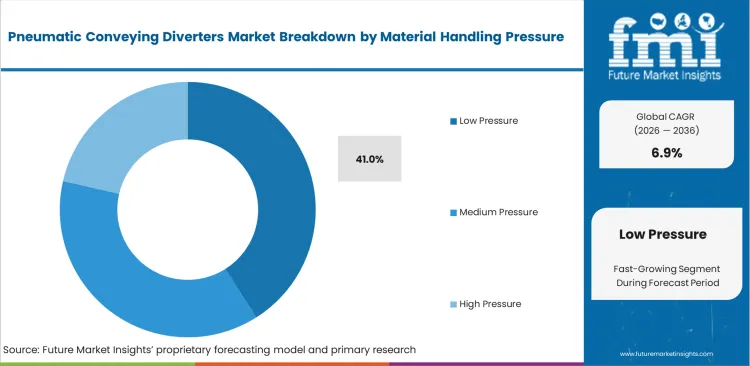
Material sensitivity and structural integrity define pressure requirements across conveying systems. Low-pressure configurations support gentle handling of fragile materials by reducing particle impact velocity. System design must maintain consistent airflow to prevent settling within pipelines. Low-pressure systems are anticipated to account for 41.0% share of material handling pressure segments in 2026. Performance depends on minimizing pressure losses across multiple routing points, as cumulative resistance affects overall system efficiency and flow stability.
- Gentle velocity limits: Moving delicate materials demands precise airflow control. Process engineers must balance blower speeds perfectly preventing settling while avoiding particle impact damage.
- Pressure drop accumulation: Every branch transition steals kinetic energy from conveying air. Piping designers must specify ultra-smooth diverter bores maintaining minimum suspension velocities.
- Filter blinding consequences: Dropping below suspension speed creates sudden line blockages. Maintenance directors must clear hundreds of feet of packed powder manually if pressure profiles fail.
Pneumatic Conveying Diverters Market Drivers, Restraints, and Opportunities
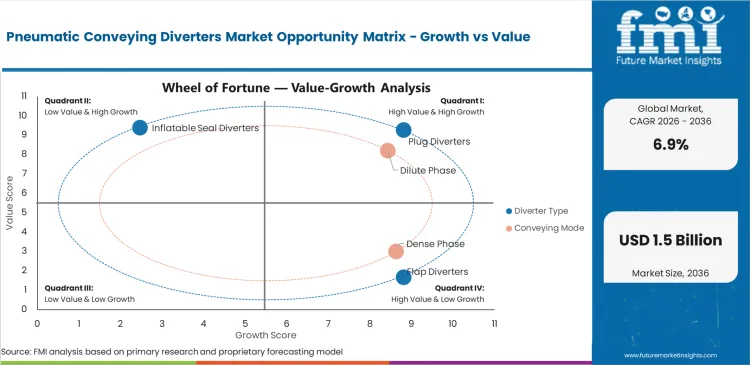
Automation of transfer points is reducing reliance on manual hose switching in pneumatic conveying systems. Handling of hazardous or sensitive powders increases safety risk when pressurized lines are manually disconnected. Automated routing systems improve operator safety by limiting exposure to airborne particles and reducing handling steps. Consistent flow control also supports batch integrity in applications requiring precise material composition. Facilities handling high-value or reactive materials increasingly prioritize automated diverter systems to maintain process stability.
Mechanical design constraints affect performance under varying operating conditions. Thermal expansion of metal components can impact plug rotation and lead to operational failure if tolerances are too tight. Increasing clearances reduces the risk of seizure but can affect internal flow characteristics and material movement. Design optimization requires balancing thermal stability with flow efficiency across different temperature environments. Variations between outdoor storage and indoor processing conditions add complexity to equipment standardization across installations.
Opportunities in the Pneumatic Conveying Diverters Market
- Smart position monitoring: Integrating wireless sensors into actuator limit switches. Automation engineers gain instant dashboard visibility confirming exact internal plate alignment before starting blowers.
- Inflatable seal adoption: Retrofitting standard flap housings with expanding pneumatic gaskets. Maintenance chiefs achieve absolute airtight isolation without purchasing new diverter bodies.
- Abrasive-resistant alloys: Casting internal diverter channels from specialized hardened metals. Procurement directors secure multi-year operational lifespans even when handling aggressive minerals for evtol charging facilities.
Regional Analysis
Based on regional analysis, Pneumatic Conveying Diverters is segmented into North America, Latin America, Western Europe, Eastern Europe, East Asia, South Asia and Pacific, and Middle East and Africa across 40 plus countries.
.webp "Top Country Growth Comparison Pneumatic Conveying Diverters Market Cagr (2026 2036)")
| Country | CAGR (2026 to 2036) |
|---|---|
| India | 7.6% |
| China | 6.7% |
| United States | 5.8% |
| Brazil | 5.5% |
| Germany | 5.1% |
| France | 4.8% |
| Japan | 4.4% |
Source: Future Market Insights (FMI) analysis, based on proprietary forecasting model and primary research
Asia Pacific Pneumatic Conveying Diverters Market Analysis
Large-scale infrastructure and industrial expansion across Asia Pacific increases the need for efficient bulk material handling systems. Cement, chemicals, and energy projects require automated routing systems capable of handling high throughput volumes. Local manufacturing capabilities for heavy-duty diverters improve supply timelines and reduce dependence on imports. Equipment availability at competitive pricing supports faster commissioning of large industrial facilities.
- India: Demand for pneumatic conveying diverters in India is anticipated to rise at a CAGR of 7.6% from 2026 to 2036. Expansion of cement production corridors and bulk material terminals drives the need for high-capacity routing systems. Operators focus on reducing material loss and improving flow control across long-distance conveying lines. Automated diverter systems support continuous plant operation without manual intervention. Domestic manufacturers benefit from long-term supply agreements linked to infrastructure development projects. Consistent demand from construction and industrial sectors supports steady equipment deployment. Operational efficiency remains a key factor influencing procurement decisions across large-scale facilities.
- China: Petrochemical and chemical processing facilities in China are undergoing upgrades to improve operational reliability and safety standards. Manual routing systems are increasingly replaced with automated diverters to reduce handling errors and improve process control. Revenue for pneumatic conveying diverters in China is expected to reach at a 6.7% CAGR over the forecast period. Plant operators prioritize equipment that supports continuous flow without leakage or contamination. Domestic production of industrial components ensures faster delivery and customization. These upgrades support higher throughput requirements across expanding industrial clusters.
- Japan: Strict material purity standards influence equipment design and selection across Japan’s industrial sectors. Battery material processing and specialty chemicals require diverters with zero-leakage performance and smooth internal surfaces. Japan industry is projected to grow at 4.4% through 2036. Manufacturers focus on precision-engineered systems that maintain consistent flow without contamination. Equipment reliability is critical in high-value production environments. These requirements support the development of specialized diverters suited for sensitive material handling applications.
Americas Pneumatic Conveying Diverters Market Analysis
Aging industrial infrastructure forces North and South American producers into huge equipment modernization cycles. Plant managers systematically rip out leaking diverters causing persistent housekeeping hazards. FMI observes strong pivots toward inflatable seal technologies offering drop-in replacements for obsolete flap designs. Retrofitting modern valves onto existing pneumatic lines allows facilities handling aircraft electric motor components or producing uv resistant aircraft exterior paints to improve cleanliness without redesigning entire piping layouts.
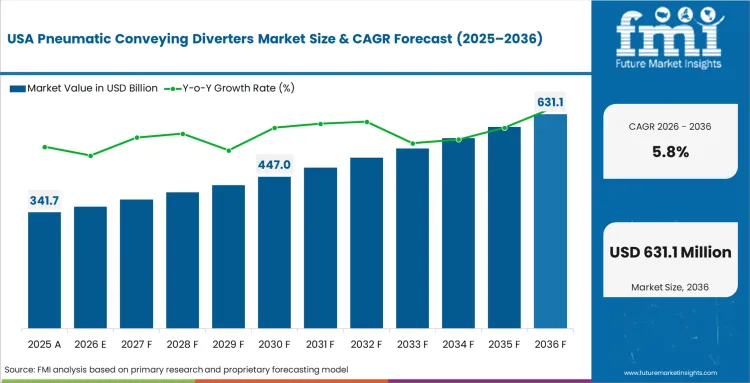
- United States: Food processing, pharmaceuticals, and advanced manufacturing sectors drive demand for upgraded pneumatic conveying systems in the United States. Strict regulatory standards require equipment that supports hygiene and contamination control. The pneumatic conveying diverters market in the United States is expected to expand at a 5.8% CAGR over the study period. Manufacturers prioritize fast-clean designs and reliable sealing mechanisms. Retrofitting existing systems reduces capital expenditure while improving compliance. These upgrades support long-term operational efficiency across regulated industries.
- Brazil: Agricultural export terminals in Brazil require durable conveying systems capable of handling abrasive materials such as grains and raw commodities. Equipment selection focuses on wear resistance and consistent performance under high-volume conditions. Growth in Brazil is likely to witness a CAGR of 5.5% during the 2026 to 2036 period. Terminal operators prioritize heavy-duty diverters with reinforced internal surfaces to extend service life. Efficient routing systems support faster loading and unloading cycles. These requirements strengthen demand across large-scale agricultural logistics operations.
Western Europe Pneumatic Conveying Diverters Market Analysis
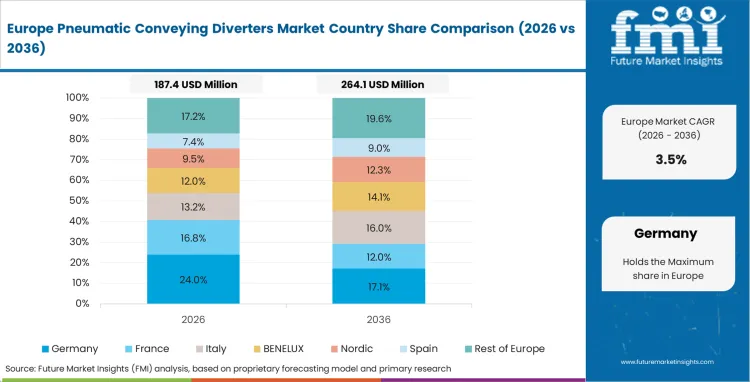
Stringent explosion protection directives dictate bulk handling hardware selection across European facilities. Safety engineers require diverters holding strict ATEX certifications preventing dust-ignition scenarios. In FMI's view, isolating ignition sources mechanically makes positive-seal routing valves mandatory equipment. Regional manufacturers focus heavily on designing specialized actuators lacking sparking components to satisfy rigorous safety mandates.
- Germany: Germany’s chemical and industrial manufacturing sectors are upgrading pneumatic systems to improve process control and safety compliance. Facilities replace older equipment with diverters that support automated monitoring and control. The country is anticipated to record a CAGR of 5.1% in pneumatic conveying diverters from 2026 to 2036. Integration with digital monitoring systems allows real-time tracking of valve positions and flow conditions. These upgrades support efficient plant operations and reduce downtime. Demand remains closely tied to modernization of legacy infrastructure.
- France: Specialty manufacturing sectors in France require high-precision material handling systems to maintain product quality. Resin production and advanced materials processing depend on contamination-free conveying solutions. Sales of pneumatic conveying diverters in France are expected to grow at 4.8% over the assessment period. Equipment with polished internal surfaces supports clean material transfer across production stages. Manufacturers prioritize systems that maintain consistent flow and reduce residue buildup. These requirements support demand in high-value industrial applications.
FMI's report includes extensive analysis covering unlisted geographies. Maturing industrial bases across Southeast Asia and Northern Europe drive specific regional demands for temperature-controlled pneumatic hardware capable of sustaining air taxi infrastructure development.
Competitive Aligners for Market Players
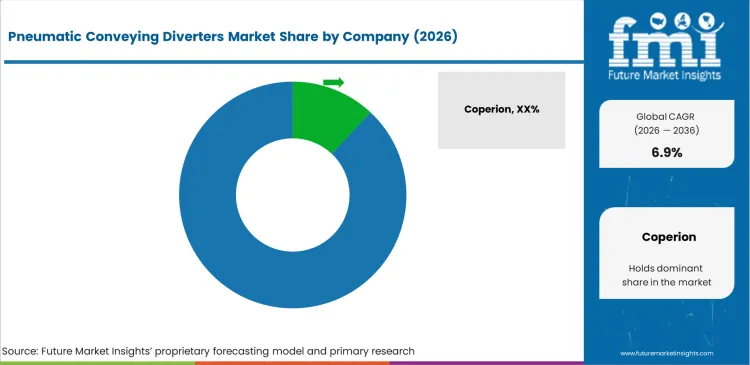
Equipment design in this segment requires alignment between large-scale fabrication capability and tight machining tolerances. Established suppliers such as Coperion and Zeppelin Systems operate with integrated system offerings, where diverters are supplied alongside conveying infrastructure. End users often prefer single-source systems to maintain warranty coverage and ensure compatibility across critical conveying lines. Smaller engineering firms compete in niche applications by developing specialized hygienic designs tailored to specific material handling challenges.
Established manufacturers maintain an advantage through proprietary interface standards and installed system compatibility. Custom flange geometries and connection formats increase switching complexity for existing plants. Replacement decisions depend on alignment with current pipeline layouts and conveying configurations. New suppliers face barriers where non-standard dimensions require modification of installed systems. Retrofitting constraints limit rapid changes in supplier selection.
Sourcing strategies are shifting toward standardization to reduce dependency on single suppliers. New installations increasingly specify uniform connection dimensions and compatibility with third-party actuation systems. This approach supports multi-vendor sourcing and simplifies maintenance. As basic mechanical components become standardized, differentiation shifts toward seal materials, wear monitoring, and lifecycle performance. Advanced sealing solutions and predictive maintenance features are becoming key factors in supplier selection.
Key Players in Pneumatic Conveying Diverters Market
- Coperion
- Zeppelin Systems
- Qlar (formerly Schenck Process)
- Gericke
- DMN-WESTINGHOUSE
- Palamatic Process
- FLSmidth
Scope of the Report
| Metric | Value |
|---|---|
| Quantitative Units | USD 0.7 billion to USD 1.4 billion, at a CAGR of 6.9% |
| Market Definition | Specialized routing valves installed within bulk powder transfer pipelines directing suspended solids toward specific destination silos. |
| Segmentation | Diverter Type, Conveying Mode, End Use, Material Handling Pressure |
| Regions Covered | North America, Latin America, Western Europe, Eastern Europe, East Asia, South Asia and Pacific, Middle East and Africa |
| Countries Covered | USA, Germany, France, China, India, Japan, Brazil |
| Key Companies Profiled | Coperion, Zeppelin Systems, Qlar (formerly Schenck Process), Gericke, DMN-WESTINGHOUSE, Palamatic Process, FLSmidth |
| Forecast Period | 2026 to 2036 |
| Approach | Validating capital expenditure budgets across pilot line facilities. |
Source: Future Market Insights (FMI) analysis, based on proprietary forecasting model and primary research
Pneumatic Conveying Diverters Market Analysis by Segments
Diverter Type
- Plug Diverters
- Flap Diverters
- Inflatable Seal Diverters
- Other
Conveying Mode
- Dilute Phase
- Dense Phase
End Use
- Food & Beverage
- Chemicals
- Plastics
- Cement & Minerals
- Other
Material Handling Pressure
- Low Pressure
- Medium Pressure
- High Pressure
Region:
- North America
- United States
- Canada
- Europe
- Germany
- United Kingdom
- France
- Italy
- Spain
- Asia Pacific
- China
- Japan
- South Korea
- Taiwan
- Singapore
- Latin America
- Brazil
- Mexico
- Argentina
- Middle East & Africa
- GCC Countries
- South Africa
- Israel
Bibliography
- Archer Aviation Inc. (2026, March 2). Archer announces fourth quarter and full year 2025 results, USA and UAE air taxi pilot programs on-track for 2026.
- Civil Aviation Authority. (2026). CAP3169: Advanced air mobility: eVTOL delivery model.
- EHang Holdings Limited. (2026, March 12). EHang reports fourth quarter and fiscal year 2025 unaudited financial results.
- Federal Aviation Administration. (2025). Roadmap for advanced air mobility aircraft type certification.
- Joby Aviation, Inc. (2026, February 25). Joby reports fourth quarter 2025 financial results.
This bibliography is provided for reader reference. The full FMI report contains the complete reference list with primary source documentation.
This Report Addresses
- Actuator stall prevention requirements during continuous mid-stream plug rotation.
- Sanitary qualification hurdles delaying equipment commissioning across food processing lines.
- Erosion replacement budgets necessary for surviving high-velocity dilute phase particle impacts.
- Pressure drop accumulation risks stalling central blowers across sprawling pneumatic networks.
- Thermal expansion traps causing tightly machined diverter plugs to seize permanently.
- Flange standardization mandates destroying proprietary dimensional moats for legacy manufacturers.
- Inflatable seal adoption providing drop-in replacements for obsolete flap designs.
- Explosion protection directives dictating mechanical isolation hardware selection across Europe.
Frequently Asked Questions
What represents overall valuation by 2036?
Demand scales toward USD 1.4 billion by 2036. Sustained capital investment drives this expansion as bulk processing facilities transition from manual hose switching to fully automated routing networks.
What compound growth rate defines this hardware sector?
Sales advance at 6.9% annually. Plant managers face extreme commercial pressure to eliminate cross-contamination during rapid product changeovers, accelerating hardware modernization cycles globally.
Which specific valve architecture leads procurement?
Plug Diverters capture 34.0% share in 2026. Smooth internal bores prevent plastic pellets from fracturing during branch transitions, maintaining particle integrity across sensitive chemical lines.
Why do engineers avoid flap valves in abrasive applications?
Suspending aggressive materials in high-velocity air streams erodes standard aluminum flap plates rapidly. Maintenance routinely discover cheap diverters completely destroyed within six months of dilute-phase operation.
How does thermal expansion constrain equipment selection?
Metal parts expanding under varying temperatures cause tightly machined diverter plugs to seize permanently inside housings. This prevents operators from using identical valve designs across both freezing outdoor silos and heated indoor processing lines.
What hides crossover effects during hygienic CIP cycles?
Models designed for easy manual disassembly often possess microscopic internal crevices. These hidden voids trap moisture during cleaning cycles, fostering microbial blooms because CIP fluids cannot penetrate compressed seating gaskets.
Why do terminal operators prefer dilute phase systems?
Moving immense bulk volumes across sprawling factory footprints economically requires high-velocity transfer profiles. Facilities prioritize raw unloading throughput over gentle material handling when emptying railcars or massive storage silos.
How does actuator sizing impact facility utility budgets?
Turning solid metal plugs under full pneumatic pressure requires massive pneumatic cylinders consuming extreme compressed air volumes. Upgrading diverters forces maintenance directors to upgrade dedicated air supply compressors simultaneously.
What drives rapid adoption across Indian cement corridors?
India advances at 7.6% driven by massive greenfield infrastructure projects. Engineering directors mandate automated routing stations managing extreme throughput, granting domestic valve manufacturers lucrative multi-year supply contracts.
How do European safety mandates influence hardware design?
Safety engineers require diverters holding strict ATEX certifications preventing dust-ignition scenarios. Isolating ignition sources mechanically makes positive-seal routing valves mandatory equipment across Western European facilities.
What specific risk do automation engineers face with legacy valves?
Older designs lack integrated position feedback sensors. Starting massive blowers before internal diverter plates fully align causes pipeline blockages requiring days of manual clearing.
Why is smart position monitoring critical for commercialization?
Integrating wireless sensors into actuator limit switches provides instant dashboard visibility. Control rooms confirm exact internal plate alignment before initiating transfer sequences, preventing mixed batches.
What creates true vendor lock-in for legacy valve manufacturers?
Incumbents protect market share through massive libraries of proprietary flange dimensions. Plant managers refuse altering existing pipeline configurations to accommodate non-standard valve dimensions from newer challengers.
How do chemical conglomerates disrupt proprietary flange monopolies?
Procurement teams explicitly reject proprietary actuator mountings and unique flange geometries. Forcing suppliers to accommodate third-party pneumatic cylinders commoditizes basic valve bodies across new plant constructions.
What limits widespread low-pressure system deployment?
Operating at minimal differential presents severe hidden risks. Slight pressure drops across poorly engineered diverter branches accumulate rapidly, causing central blowers to stall completely across long conveying distances.
Why do North American food processors favor inflatable seals?
Strict FDA allergen regulations compel operators to upgrade routing nodes. Retrofitting modern expanding gaskets onto existing pneumatic lines achieves absolute airtight isolation without redesigning entire piping layouts.
How do fragile materials complicate pneumatic routing?
Moving delicate agglomerates demands precise airflow control. Dropping below suspension speed creates sudden line blockages, while exceeding velocity limits shatters sensitive crystal structures against diverter walls.
What differentiates plug designs from standard flap architectures?
Plug models rotate a complete internal pipe section to align with destination branches. This ensures materials never impact flat surfaces, whereas flap designs mechanically bash particles into angled deflector plates.
How do Japanese purity standards influence equipment fabrication?
Stringent requirements in battery material processing dictate zero-leakage designs. Quality controllers specify highly polished internal surfaces, positioning Japanese suppliers uniquely in global high-tech powder markets.
What causes false security in cheap routing hardware?
Designing pneumatic systems with standard flap valves seems economical upfront. Reality strikes during maintenance cycles when abrasive powders wear down internal seals rapidly, causing cross-contamination incidents.
Why must CIP procedures sequence valve actuation perfectly?
Automating washdown cycles requires specialized valve geometries. Automation systems must rotate diverters mid-clean to expose hidden seating surfaces, ensuring sanitizing fluids reach every microscopic crevice.
What represents ultimate commercial end-states for routing nodes?
Integrating digital feedback directly into heavy valves establishes critical foundations for fully autonomous plant operations. Future diverters will predict seal failures autonomously before leakage occurs.
Preview the report firsthand - request a free sample
Get SampleGet the brochure for pricing and purchase details.
Get PDFTable of Content
- Executive Summary
- Global Market Outlook
- Demand-side Trends
- Supply-side Trends
- Technology Roadmap Analysis
- Analysis and Recommendations
- Market Overview
- Market Coverage / Taxonomy
- Market Definition / Scope / Limitations
- Research Methodology
- Chapter Orientation
- Analytical Lens and Working Hypotheses
- Market Structure, Signals, and Trend Drivers
- Benchmarking and Cross-market Comparability
- Market Sizing, Forecasting, and Opportunity Mapping
- Research Design and Evidence Framework
- Desk Research Programme (Secondary Evidence)
- Company Annual and Sustainability Reports
- Peer-reviewed Journals and Academic Literature
- Corporate Websites, Product Literature, and Technical Notes
- Earnings Decks and Investor Briefings
- Statutory Filings and Regulatory Disclosures
- Technical White Papers and Standards Notes
- Trade Journals, Industry Magazines, and Analyst Briefs
- Conference Proceedings, Webinars, and Seminar Materials
- Government Statistics Portals and Public Data Releases
- Press Releases and Reputable Media Coverage
- Specialist Newsletters and Curated Briefings
- Sector Databases and Reference Repositories
- FMI Internal Proprietary Databases and Historical Market Datasets
- Subscription Datasets and Paid Sources
- Social Channels, Communities, and Digital Listening Inputs
- Additional Desk Sources
- Expert Input and Fieldwork (Primary Evidence)
- Primary Modes
- Qualitative Interviews and Expert Elicitation
- Quantitative Surveys and Structured Data Capture
- Blended Approach
- Why Primary Evidence is Used
- Field Techniques
- Interviews
- Surveys
- Focus Groups
- Observational and In-context Research
- Social and Community Interactions
- Stakeholder Universe Engaged
- C-suite Leaders
- Board Members
- Presidents and Vice Presidents
- R&D and Innovation Heads
- Technical Specialists
- Domain Subject-matter Experts
- Scientists
- Physicians and Other Healthcare Professionals
- Governance, Ethics, and Data Stewardship
- Research Ethics
- Data Integrity and Handling
- Primary Modes
- Tooling, Models, and Reference Databases
- Desk Research Programme (Secondary Evidence)
- Data Engineering and Model Build
- Data Acquisition and Ingestion
- Cleaning, Normalisation, and Verification
- Synthesis, Triangulation, and Analysis
- Quality Assurance and Audit Trail
- Market Background
- Market Dynamics
- Drivers
- Restraints
- Opportunity
- Trends
- Scenario Forecast
- Demand in Optimistic Scenario
- Demand in Likely Scenario
- Demand in Conservative Scenario
- Opportunity Map Analysis
- Product Life Cycle Analysis
- Supply Chain Analysis
- Investment Feasibility Matrix
- Value Chain Analysis
- PESTLE and Porter’s Analysis
- Regulatory Landscape
- Regional Parent Market Outlook
- Production and Consumption Statistics
- Import and Export Statistics
- Market Dynamics
- Global Market Analysis 2021 to 2025 and Forecast, 2026 to 2036
- Historical Market Size Value (USD Million) Analysis, 2021 to 2025
- Current and Future Market Size Value (USD Million) Projections, 2026 to 2036
- Y-o-Y Growth Trend Analysis
- Absolute $ Opportunity Analysis
- Global Market Pricing Analysis 2021 to 2025 and Forecast 2026 to 2036
- Global Market Analysis 2021 to 2025 and Forecast 2026 to 2036, By Diverter Type
- Introduction / Key Findings
- Historical Market Size Value (USD Million) Analysis By Diverter Type , 2021 to 2025
- Current and Future Market Size Value (USD Million) Analysis and Forecast By Diverter Type , 2026 to 2036
- Plug Diverters
- Flap Diverters
- Inflatable Seal Diverters
- Plug Diverters
- Y-o-Y Growth Trend Analysis By Diverter Type , 2021 to 2025
- Absolute $ Opportunity Analysis By Diverter Type , 2026 to 2036
- Global Market Analysis 2021 to 2025 and Forecast 2026 to 2036, By Conveying Mode
- Introduction / Key Findings
- Historical Market Size Value (USD Million) Analysis By Conveying Mode, 2021 to 2025
- Current and Future Market Size Value (USD Million) Analysis and Forecast By Conveying Mode, 2026 to 2036
- Dilute Phase
- Dense Phase
- Dilute Phase
- Y-o-Y Growth Trend Analysis By Conveying Mode, 2021 to 2025
- Absolute $ Opportunity Analysis By Conveying Mode, 2026 to 2036
- Global Market Analysis 2021 to 2025 and Forecast 2026 to 2036, By End Use
- Introduction / Key Findings
- Historical Market Size Value (USD Million) Analysis By End Use, 2021 to 2025
- Current and Future Market Size Value (USD Million) Analysis and Forecast By End Use, 2026 to 2036
- Food & Beverage
- Chemicals
- Plastics
- Food & Beverage
- Y-o-Y Growth Trend Analysis By End Use, 2021 to 2025
- Absolute $ Opportunity Analysis By End Use, 2026 to 2036
- Global Market Analysis 2021 to 2025 and Forecast 2026 to 2036, By Material Handling Pressure
- Introduction / Key Findings
- Historical Market Size Value (USD Million) Analysis By Material Handling Pressure, 2021 to 2025
- Current and Future Market Size Value (USD Million) Analysis and Forecast By Material Handling Pressure, 2026 to 2036
- Low Pressure
- Medium Pressure
- High Pressure
- Low Pressure
- Y-o-Y Growth Trend Analysis By Material Handling Pressure, 2021 to 2025
- Absolute $ Opportunity Analysis By Material Handling Pressure, 2026 to 2036
- Global Market Analysis 2021 to 2025 and Forecast 2026 to 2036, By Region
- Introduction
- Historical Market Size Value (USD Million) Analysis By Region, 2021 to 2025
- Current Market Size Value (USD Million) Analysis and Forecast By Region, 2026 to 2036
- North America
- Latin America
- Western Europe
- Eastern Europe
- East Asia
- South Asia and Pacific
- Middle East & Africa
- Market Attractiveness Analysis By Region
- North America Market Analysis 2021 to 2025 and Forecast 2026 to 2036, By Country
- Historical Market Size Value (USD Million) Trend Analysis By Market Taxonomy, 2021 to 2025
- Market Size Value (USD Million) Forecast By Market Taxonomy, 2026 to 2036
- By Country
- USA
- Canada
- Mexico
- By Diverter Type
- By Conveying Mode
- By End Use
- By Material Handling Pressure
- By Country
- Market Attractiveness Analysis
- By Country
- By Diverter Type
- By Conveying Mode
- By End Use
- By Material Handling Pressure
- Key Takeaways
- Latin America Market Analysis 2021 to 2025 and Forecast 2026 to 2036, By Country
- Historical Market Size Value (USD Million) Trend Analysis By Market Taxonomy, 2021 to 2025
- Market Size Value (USD Million) Forecast By Market Taxonomy, 2026 to 2036
- By Country
- Brazil
- Chile
- Rest of Latin America
- By Diverter Type
- By Conveying Mode
- By End Use
- By Material Handling Pressure
- By Country
- Market Attractiveness Analysis
- By Country
- By Diverter Type
- By Conveying Mode
- By End Use
- By Material Handling Pressure
- Key Takeaways
- Western Europe Market Analysis 2021 to 2025 and Forecast 2026 to 2036, By Country
- Historical Market Size Value (USD Million) Trend Analysis By Market Taxonomy, 2021 to 2025
- Market Size Value (USD Million) Forecast By Market Taxonomy, 2026 to 2036
- By Country
- Germany
- UK
- Italy
- Spain
- France
- Nordic
- BENELUX
- Rest of Western Europe
- By Diverter Type
- By Conveying Mode
- By End Use
- By Material Handling Pressure
- By Country
- Market Attractiveness Analysis
- By Country
- By Diverter Type
- By Conveying Mode
- By End Use
- By Material Handling Pressure
- Key Takeaways
- Eastern Europe Market Analysis 2021 to 2025 and Forecast 2026 to 2036, By Country
- Historical Market Size Value (USD Million) Trend Analysis By Market Taxonomy, 2021 to 2025
- Market Size Value (USD Million) Forecast By Market Taxonomy, 2026 to 2036
- By Country
- Russia
- Poland
- Hungary
- Balkan & Baltic
- Rest of Eastern Europe
- By Diverter Type
- By Conveying Mode
- By End Use
- By Material Handling Pressure
- By Country
- Market Attractiveness Analysis
- By Country
- By Diverter Type
- By Conveying Mode
- By End Use
- By Material Handling Pressure
- Key Takeaways
- East Asia Market Analysis 2021 to 2025 and Forecast 2026 to 2036, By Country
- Historical Market Size Value (USD Million) Trend Analysis By Market Taxonomy, 2021 to 2025
- Market Size Value (USD Million) Forecast By Market Taxonomy, 2026 to 2036
- By Country
- China
- Japan
- South Korea
- By Diverter Type
- By Conveying Mode
- By End Use
- By Material Handling Pressure
- By Country
- Market Attractiveness Analysis
- By Country
- By Diverter Type
- By Conveying Mode
- By End Use
- By Material Handling Pressure
- Key Takeaways
- South Asia and Pacific Market Analysis 2021 to 2025 and Forecast 2026 to 2036, By Country
- Historical Market Size Value (USD Million) Trend Analysis By Market Taxonomy, 2021 to 2025
- Market Size Value (USD Million) Forecast By Market Taxonomy, 2026 to 2036
- By Country
- India
- ASEAN
- Australia & New Zealand
- Rest of South Asia and Pacific
- By Diverter Type
- By Conveying Mode
- By End Use
- By Material Handling Pressure
- By Country
- Market Attractiveness Analysis
- By Country
- By Diverter Type
- By Conveying Mode
- By End Use
- By Material Handling Pressure
- Key Takeaways
- Middle East & Africa Market Analysis 2021 to 2025 and Forecast 2026 to 2036, By Country
- Historical Market Size Value (USD Million) Trend Analysis By Market Taxonomy, 2021 to 2025
- Market Size Value (USD Million) Forecast By Market Taxonomy, 2026 to 2036
- By Country
- Kingdom of Saudi Arabia
- Other GCC Countries
- Turkiye
- South Africa
- Other African Union
- Rest of Middle East & Africa
- By Diverter Type
- By Conveying Mode
- By End Use
- By Material Handling Pressure
- By Country
- Market Attractiveness Analysis
- By Country
- By Diverter Type
- By Conveying Mode
- By End Use
- By Material Handling Pressure
- Key Takeaways
- Key Countries Market Analysis
- USA
- Pricing Analysis
- Market Share Analysis, 2025
- By Diverter Type
- By Conveying Mode
- By End Use
- By Material Handling Pressure
- Canada
- Pricing Analysis
- Market Share Analysis, 2025
- By Diverter Type
- By Conveying Mode
- By End Use
- By Material Handling Pressure
- Mexico
- Pricing Analysis
- Market Share Analysis, 2025
- By Diverter Type
- By Conveying Mode
- By End Use
- By Material Handling Pressure
- Brazil
- Pricing Analysis
- Market Share Analysis, 2025
- By Diverter Type
- By Conveying Mode
- By End Use
- By Material Handling Pressure
- Chile
- Pricing Analysis
- Market Share Analysis, 2025
- By Diverter Type
- By Conveying Mode
- By End Use
- By Material Handling Pressure
- Germany
- Pricing Analysis
- Market Share Analysis, 2025
- By Diverter Type
- By Conveying Mode
- By End Use
- By Material Handling Pressure
- UK
- Pricing Analysis
- Market Share Analysis, 2025
- By Diverter Type
- By Conveying Mode
- By End Use
- By Material Handling Pressure
- Italy
- Pricing Analysis
- Market Share Analysis, 2025
- By Diverter Type
- By Conveying Mode
- By End Use
- By Material Handling Pressure
- Spain
- Pricing Analysis
- Market Share Analysis, 2025
- By Diverter Type
- By Conveying Mode
- By End Use
- By Material Handling Pressure
- France
- Pricing Analysis
- Market Share Analysis, 2025
- By Diverter Type
- By Conveying Mode
- By End Use
- By Material Handling Pressure
- India
- Pricing Analysis
- Market Share Analysis, 2025
- By Diverter Type
- By Conveying Mode
- By End Use
- By Material Handling Pressure
- ASEAN
- Pricing Analysis
- Market Share Analysis, 2025
- By Diverter Type
- By Conveying Mode
- By End Use
- By Material Handling Pressure
- Australia & New Zealand
- Pricing Analysis
- Market Share Analysis, 2025
- By Diverter Type
- By Conveying Mode
- By End Use
- By Material Handling Pressure
- China
- Pricing Analysis
- Market Share Analysis, 2025
- By Diverter Type
- By Conveying Mode
- By End Use
- By Material Handling Pressure
- Japan
- Pricing Analysis
- Market Share Analysis, 2025
- By Diverter Type
- By Conveying Mode
- By End Use
- By Material Handling Pressure
- South Korea
- Pricing Analysis
- Market Share Analysis, 2025
- By Diverter Type
- By Conveying Mode
- By End Use
- By Material Handling Pressure
- Russia
- Pricing Analysis
- Market Share Analysis, 2025
- By Diverter Type
- By Conveying Mode
- By End Use
- By Material Handling Pressure
- Poland
- Pricing Analysis
- Market Share Analysis, 2025
- By Diverter Type
- By Conveying Mode
- By End Use
- By Material Handling Pressure
- Hungary
- Pricing Analysis
- Market Share Analysis, 2025
- By Diverter Type
- By Conveying Mode
- By End Use
- By Material Handling Pressure
- Kingdom of Saudi Arabia
- Pricing Analysis
- Market Share Analysis, 2025
- By Diverter Type
- By Conveying Mode
- By End Use
- By Material Handling Pressure
- Turkiye
- Pricing Analysis
- Market Share Analysis, 2025
- By Diverter Type
- By Conveying Mode
- By End Use
- By Material Handling Pressure
- South Africa
- Pricing Analysis
- Market Share Analysis, 2025
- By Diverter Type
- By Conveying Mode
- By End Use
- By Material Handling Pressure
- USA
- Market Structure Analysis
- Competition Dashboard
- Competition Benchmarking
- Market Share Analysis of Top Players
- By Regional
- By Diverter Type
- By Conveying Mode
- By End Use
- By Material Handling Pressure
- Competition Analysis
- Competition Deep Dive
- Coperion
- Overview
- Product Portfolio
- Profitability by Market Segments (Product/Age /Sales Channel/Region)
- Sales Footprint
- Strategy Overview
- Marketing Strategy
- Product Strategy
- Channel Strategy
- Zeppelin Systems
- Qlar (formerly Schenck Process)
- Gericke
- DMN-WESTINGHOUSE
- Palamatic Process
- Coperion
- Competition Deep Dive
- Assumptions & Acronyms Used


