

- Industry Size (2026)
- USD 1040 Mn
- Forecast (2036)
- USD 3620 Mn
- CAGR (2026 to 2036)
- 13.3%
Aerospace Composite Materials Using PCR Market Forecast and Outlook 2026 to 2036
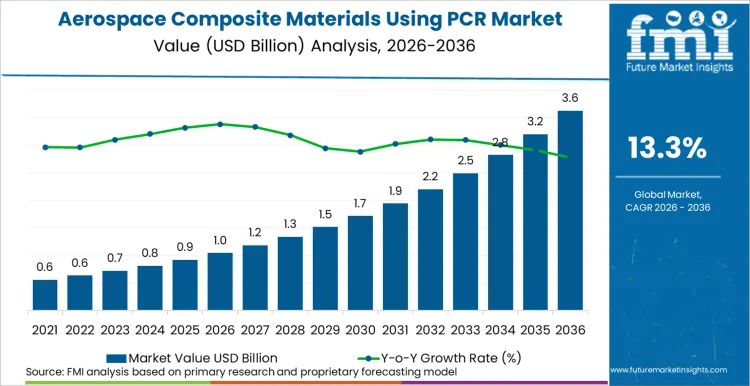
The global aerospace composite materials using PCR market is estimated to be valued at USD 1,040 million in 2026 and is projected to reach USD 3,620 million by 2036, expanding at a 13.3% CAGR. FMI analysis indicates that growth is structurally linked to the aerospace industry’s shift toward lifecycle-driven material evaluation, where sustainability metrics are increasingly embedded into procurement decisions alongside performance, weight, and durability requirements.
Aircraft OEMs and major tier suppliers are under pressure from regulators, airlines, and financiers to demonstrate measurable reductions in environmental impact across aircraft programs. Composite materials, which already dominate weight-critical structures, are now being examined for recycled content integration as part of broader decarbonization and circularity strategies. PCR-based composites are gaining traction where recycled polymers can be incorporated without disrupting fibre architecture, mechanical performance, or long-term fatigue behavior.
FMI observes that adoption is progressing unevenly across applications. Interiors and secondary structures are emerging as primary entry points, while primary load-bearing structures remain tightly constrained by certification risk. This selective adoption pattern underpins steady but disciplined market growth, as PCR composites move through multi-year validation and approval cycles rather than rapid substitution.
Summary of Aerospace Composite Materials Using PCR Market
- The aerospace composite materials using PCR market comprises fibre-reinforced composite systems incorporating post-consumer recycled polymers, qualified for use in aircraft interiors, secondary structures, and other non-primary aerospace applications across commercial, business, and selected defense aircraft programs.
- The defined scope is structured under FMI taxonomy with segmentation across end use, composite type, PCR source, and processing technology, focusing on certification-grade thermoplastic and hybrid composite systems and excluding primary load-bearing structures, experimental materials, and non-aerospace applications.
- The aerospace composite materials using PCR market is projected to grow at a CAGR of 13.3% from 2026 to 2036, expanding from USD 1,040 million in 2026 to USD 3,620 million by 2036, based on FMI proprietary forecasting integrating aircraft production outlooks, interior replacement cycles, material qualification timelines, and recycled polymer processing capabilities.
- The sector is transitioning from sustainability-led exploratory initiatives toward tightly governed, qualification-driven material systems, where PCR integration is evaluated through certification integrity, structural risk management, and long-term fleet reliability rather than recycled content targets alone.
- Competition is concentrated among established aerospace composite and polymer suppliers such as Solvay, Toray Advanced Composites, Arkema, Teijin, and Mitsubishi Chemical, with competitive advantage defined by certification capital, advanced compounding and fibre reinforcement capabilities, and the ability to neutralize PCR variability within aerospace-qualified processing frameworks.
- India is projected to record the fastest growth at a 15.6% CAGR through 2036, while the United States retains the largest value share, supported by deep certification infrastructure, mature composite qualification ecosystems, and strong procurement pull linked to lifecycle sustainability reporting across aircraft programs.
Aerospace Composite Materials Using PCR Market Key Takeaways
| Metric | Value |
|---|---|
| Expected Value 2026E | USD 1,040 million |
| Forecast Value 2036F | USD 3,620 million |
| CAGR 2026 to 2036 | 13.3% |
Source: Future Market Insights analysis based on proprietary forecasting model and primary research
Why is the Aerospace Composite Materials Using PCR Market Growing?
The primary growth driver is the aerospace industry’s shift from component-level sustainability initiatives to program-level lifecycle accountability. Aircraft OEMs are increasingly required to report environmental performance across the full lifecycle of aircraft, including materials used in interiors and structures. This has elevated interest in recycled polymer integration within composite systems, provided that safety and certification integrity can be maintained.
A second driver is the growing maturity of thermoplastic composite processing. Unlike thermoset systems, thermoplastic composites allow for remelting and reprocessing, making them more compatible with recycled polymer inputs. PCR-based thermoplastics such as PCR PEEK and PCR PET can be integrated into fibre-reinforced systems with controlled processing, opening pathways for recycled content adoption in aerospace-qualified materials.
Growth is reinforced by supply-chain resilience considerations. Aerospace manufacturers are seeking to diversify material sourcing and reduce dependency on virgin polymer supply chains that are exposed to geopolitical and energy price volatility. PCR integration, when supported by controlled processing and traceability, offers a supplementary pathway that aligns sustainability with procurement risk management.
What is the Segment Profile of the Aerospace Composite Materials Using PCR Market?
The segment structure reflects where PCR-based composites can be deployed with acceptable certification and operational risk. FMI retains only the dominant segment in each category and expands the analysis to reflect aerospace execution realities.
Why do Aircraft Interiors and Secondary Structures dominate End-Use Demand?
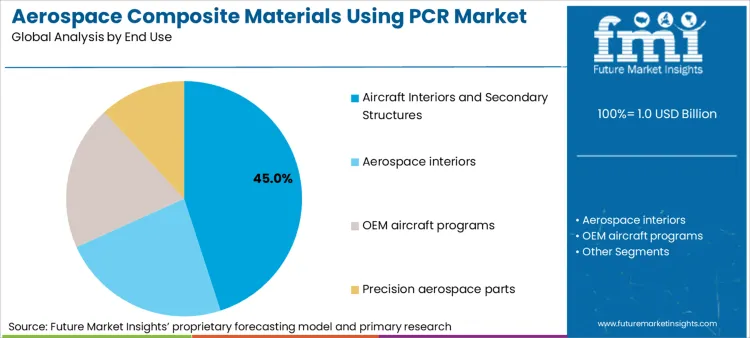
Aircraft interiors and secondary structures account for 45% of end-use demand because these components sit outside the most critical load-bearing safety envelope. Interior panels, monuments, ducts, and secondary structural elements allow for material innovation under defined regulatory frameworks, making them the most practical entry point for PCR composite adoption.
A second reinforcing factor is replacement and retrofit cycles. Interiors are refreshed more frequently than primary structures, which creates recurring opportunities to introduce new materials without affecting aircraft type certification. FMI observes that PCR composites gain traction fastest where they can be qualified as part of interior refurbishment programs, allowing OEMs and airlines to demonstrate sustainability progress without disrupting core airworthiness approvals.
Why do Thermoplastic Composites lead Composite Type Adoption?
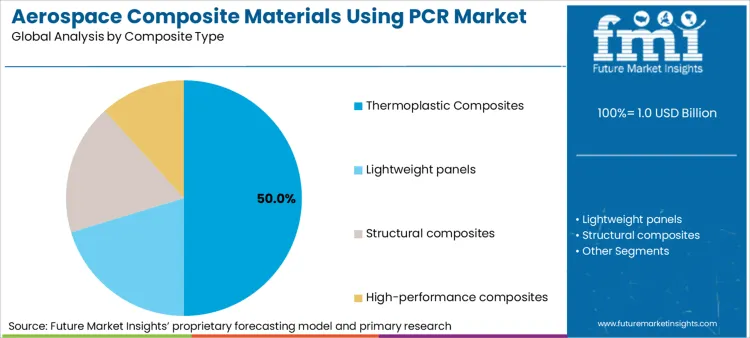
Thermoplastic composites represent 50% of composite type demand because they align most closely with both aerospace performance requirements and recycled polymer integration. Thermoplastics offer high damage tolerance, chemical resistance, and weldability, while also enabling melt reprocessing that supports PCR incorporation.
From a certification perspective, thermoplastic composites also offer more predictable processing windows compared to thermosets. FMI analysis shows that aerospace material teams prefer thermoplastic systems when introducing PCR because variability can be better controlled through compounding and processing discipline. This reduces uncertainty during qualification testing and long-term durability assessment.
How does PCR PEEK and PCR PET dominate PCR source selection?
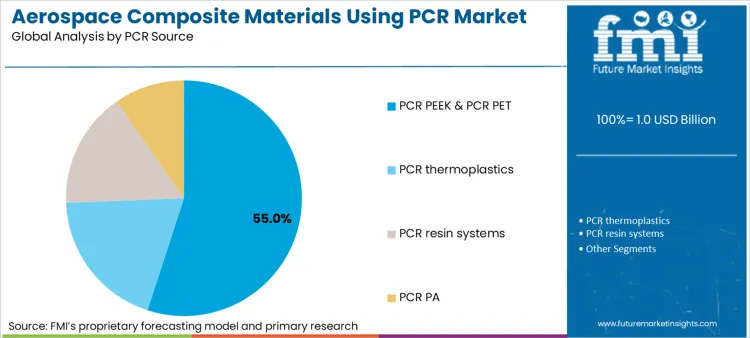
PCR PEEK and PCR PET together account for 55% of PCR source demand due to their established performance credentials in aerospace environments. PEEK offers exceptional thermal stability and mechanical strength, while PET provides weight efficiency and cost advantages in interior applications. Their dominance is driven by qualification pragmatism rather than material novelty.
Another critical factor is supply-chain traceability. PCR PEEK and PET streams can be more tightly controlled through industrial recycling and compounding systems, enabling documentation and batch consistency required for aerospace use. FMI finds that OEMs and tier suppliers prioritize PCR sources where material provenance and processing history can be clearly demonstrated during audits and certification reviews.
Why Does Advanced Compounding and Fibre Reinforcement Lead Technology Adoption?
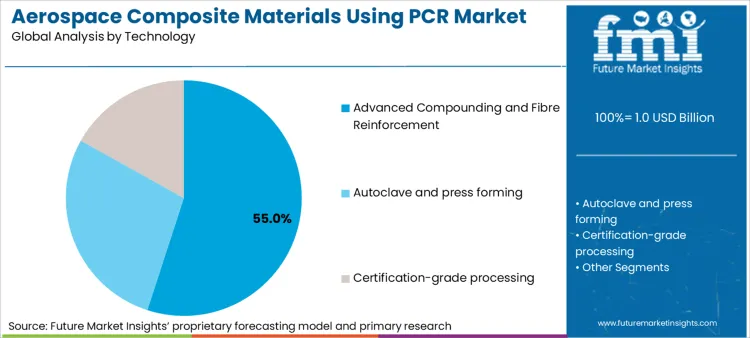
Advanced compounding and fibre reinforcement technologies account for 55% of technology demand because PCR integration in aerospace composites requires exceptional control over fibre wet-out, dispersion, and interfacial bonding. Simple substitution of recycled polymer is insufficient in aerospace contexts, making advanced processing capabilities essential.
FMI analysis indicates that suppliers investing in high-precision compounding, filtration, and fibre alignment technologies are best positioned to scale PCR composites. These technologies enable mitigation of variability associated with recycled polymers, allowing material systems to meet stringent aerospace mechanical and durability requirements.
What Drivers, Restraints, Opportunities, and Trends Prevail in the Aerospace Composite Materials Using PCR Market?
The aerospace PCR composite market is primarily driven by lifecycle sustainability mandates embedded within aircraft procurement and financing decisions. OEMs face increasing scrutiny from regulators, airlines, and lessors to demonstrate reductions in environmental impact across materials used in aircraft programs. PCR composites offer a pathway to address these expectations, particularly in non-primary structures, without fundamentally altering aircraft design architectures.
A significant restraint is certification complexity. Aerospace materials are subject to extensive qualification, testing, and approval cycles that can span multiple years. Introducing PCR content adds another layer of scrutiny, as regulators require assurance that recycled polymers do not introduce variability that could compromise long-term performance. This slows adoption and concentrates demand among suppliers with strong certification track records.
Opportunities are emerging in modular interiors and next-generation aircraft platforms. New aircraft programs and interior modularization initiatives provide clean-sheet opportunities to integrate PCR composites from the design phase rather than through retrofit. FMI observes growing interest in designing PCR compatibility into future platforms, which could accelerate adoption over the long term.
A defining trend is the convergence of sustainability and certification engineering. Aerospace suppliers are increasingly building material qualification strategies that explicitly incorporate recycled content considerations alongside mechanical testing and durability assessment. Over the forecast period, competitive advantage will accrue to companies that can demonstrate both environmental benefit and certification robustness in a single, coherent material system.
How is the Aerospace Composite Materials Using PCR Market Analyzed in Key Countries?
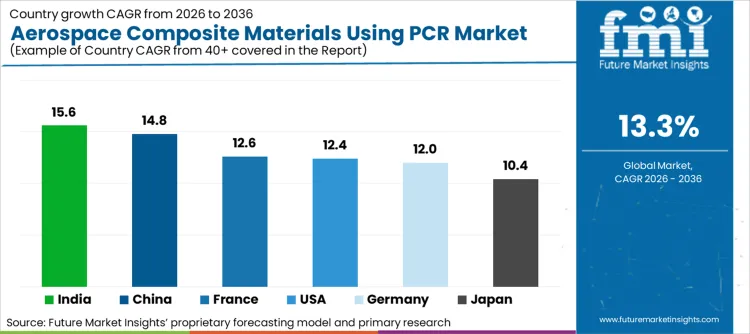
| Country | CAGR 2026 to 2036 |
|---|---|
| USA | 12.4% |
| Germany | 12.0% |
| France | 12.6% |
| Japan | 10.4% |
| China | 14.8% |
| India | 15.6% |
Source: Future Market Insights analysis based on proprietary forecasting model and primary research
How is USA Scaling Adoption through Certification Infrastructure and Procurement Pull?
USA is projected to grow at a 12.4% CAGR, supported by the depth of its aerospace qualification ecosystem and the concentration of tier suppliers with mature composite certification experience. USA adoption is driven by the ability to industrialize validation programs, including establishing statistically defensible property windows, controlling batch-to-batch variability, and documenting process traceability across multi-site manufacturing. FMI observes that PCR composite integration is progressing first in interiors and secondary structures because these applications allow qualification pathways that are more modular, enabling faster approvals without disrupting the most sensitive structural certification baselines.
A second USA driver is procurement pull that is increasingly linked to sustainability reporting and program eligibility rather than optional brand positioning. Large OEM programs and defense supply chains are pushing suppliers to demonstrate credible lifecycle reductions while preserving program risk controls. This changes the commercial calculus for PCR composites. Adoption accelerates when suppliers can offer validated PCR variants that fit within existing material allowables frameworks and can be deployed across multiple platforms with minimal requalification, converting sustainability from a pilot activity into a repeatable procurement standard.
Why is Germany advancing through Validation Discipline and Industrial Process Governance?
Germany is forecasted to expand at a 12.0% CAGR, shaped by rigorous engineering validation culture and a structural preference for conservative, documentation-heavy material transitions. German aerospace stakeholders tend to treat recycled polymer integration as a process governance problem rather than a materials substitution decision. FMI analysis indicates that adoption is being built through controlled demonstration corridors that emphasize long-term stability, including property drift monitoring, environmental aging evidence, and repeatable processing controls in composite fabrication.
A second growth engine in Germany is the ability to embed PCR composites into tightly managed manufacturing quality systems that reduce variability risk. Adoption is most credible where suppliers can demonstrate disciplined compounding, filtration, and fibre reinforcement workflows that generate consistent output under defined tolerances. This enables stepwise scaling into interior panels and lightweight secondary structures, where qualification can be achieved through repeatable test evidence without expanding certification exposure into primary structural domains.
How is France Integrating PCR Composites into OEM Aircraft Program Execution?
France is expected to grow at a 12.6% CAGR, reflecting the structural advantage of being closely linked to major aircraft program decision-making and integrated supplier development practices. French adoption is driven by the need to translate sustainability objectives into program-ready materials that can be validated against aircraft build schedules and conformity requirements. FMI observes that PCR composite adoption advances fastest when it is packaged as a certified, program-compatible material pathway rather than a standalone sustainability initiative, which reduces the risk of timeline slippage during platform development and production ramp-up.
A second driver is the collaborative validation model commonly used in French aerospace ecosystems, where material suppliers, tier manufacturers, and OEM engineering teams co-develop qualification logic early. This helps compress iteration cycles and prevents late-stage rejection due to insufficient documentation or process variability. As a result, France is positioned to scale PCR composites where certification-grade processing and traceability can be demonstrated in alignment with aircraft program milestones, particularly in interior modules and selected secondary structural elements where substitution risk is manageable.
Why does Japan Follow a Precision-Led Adoption Pathway with High Evidence Thresholds?
Japan is projected to grow at a 10.4% CAGR, shaped by conservative quality expectations and strong emphasis on repeatability, precision processing, and long-term reliability. Japanese aerospace adopters prioritize controlled deployment and extended validation windows, which slows scaling but increases durability of adoption once approval is achieved. FMI analysis indicates that PCR composite integration progresses through narrowly scoped pilots tied to specific parts or interior assemblies, where quality performance can be tracked across time and where supplier process controls can be demonstrated in depth.
A second driver is Japan’s preference for high-spec material qualification discipline that emphasizes consistency over novelty. PCR composites gain acceptance when suppliers can show exceptional control of compounding and fibre reinforcement that reduces heterogeneity risk and ensures stable performance under environmental cycling. This supports a measured adoption trajectory, where Japan becomes a market defined by high trust and high documentation quality, even if commercial scaling is slower than in scale-driven markets.
How is China leveraging Domestic Aerospace Expansion and Scale Economics to Accelerate PCR Composite Uptake?
China is expected to grow at a 14.8% CAGR, driven by rapid expansion of domestic aerospace production and a strategic push toward material capability development. Scale creates a strong incentive to develop compliant PCR composite pathways because even incremental material changes can generate large aggregated sustainability impact across growing production volumes. FMI observes that China’s adoption is concentrated in interiors and secondary structures where qualification barriers are lower and where domestic programs can prioritize rapid iteration of materials engineering and process validation.
A second growth driver is the policy and industrial emphasis on building domestic control over advanced materials supply chains, including recycled polymer processing and composite fabrication capability. This strengthens investment in compounding, filtration, and controlled processing infrastructure that is necessary for PCR composites to meet aerospace expectations. As certification regimes and internal allowables frameworks mature, China is positioned for accelerated scaling, particularly where advanced compounding and fibre reinforcement can demonstrate consistent output and traceable feedstock governance.
Why is India Emerging as a High-Growth Market through MRO Intensity and Global Supply Chain Alignment?
India leads growth at a 15.6% CAGR, supported by expanding aerospace manufacturing participation and rising MRO intensity that creates recurring replacement demand in interiors and secondary structures. FMI analysis indicates that India’s most executable adoption pathway is tied to retrofit and interior refresh cycles, where PCR composites can be introduced with lower certification friction than primary structural applications. This creates a practical commercialization corridor where suppliers can validate performance within defined interior specifications while building the documentation maturity required for broader acceptance.
A second driver is India’s increasing integration into global aerospace supply chains, which is raising expectations for sustainability disclosure and material governance without compromising airworthiness discipline. Export-linked suppliers face customer pressure to demonstrate progress on recycled content and lifecycle impact, but only within credible quality systems. PCR composite adoption therefore accelerates where Indian suppliers can establish controlled PCR feedstock pathways, maintain traceability, and produce repeatable composite outputs that align with international customer audit expectations. Over time, this builds a platform for scaling from interior-focused adoption toward broader secondary structure use as qualification capabilities strengthen.
How Competitive is the Aerospace Composite Materials Using PCR Market?
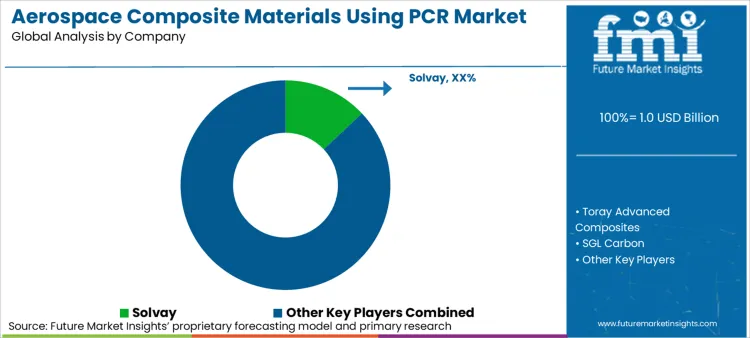
Extremely high entry barriers and a narrow set of qualified suppliers define the competitive landscape of the aerospace composite materials using PCR market. Unlike conventional composite markets, competition is not driven by price or volume capacity, but by certification credibility, materials science depth, and the ability to integrate recycled polymers into aerospace-qualified systems without compromising long-term reliability.
Leading players compete on their capacity to manage variability. PCR polymers introduce inherent heterogeneity, which must be neutralized through advanced compounding, filtration, and fibre reinforcement. Companies that control these processes internally are structurally advantaged. FMI observes that vertical integration across recycling, compounding, and composite fabrication is becoming a critical competitive differentiator.
Another axis of competition is certification capital. Aerospace material qualification requires sustained investment in testing, documentation, and regulatory engagement. Suppliers with established certification portfolios can extend existing approvals to PCR variants more efficiently than new entrants. This creates a reinforcing advantage for incumbents, particularly those already supplying thermoplastic composites to major OEM programs.
Collaboration is also shaping competition. PCR composite development increasingly occurs through joint programs involving polymer suppliers, fibre manufacturers, and aerospace OEMs. These partnerships allow risk-sharing and alignment with aircraft program timelines. FMI finds that suppliers embedded in OEM development ecosystems are more likely to secure long-term positions as PCR adoption scales.
Finally, competition is influenced by strategic signaling. Aerospace OEMs are selective in publicizing PCR adoption due to safety sensitivities. Suppliers that can deliver sustainability gains without reputational risk gain trust and repeat business. Over the forecast period, FMI expects competitive intensity to remain high but concentrated among a limited group of certification-capable players.
Key Players Profiled
- Solvay
- Toray Advanced Composites
- SGL Carbon
- BASF
- Safran
- Arkema
- Teijin
- Mitsubishi Chemical
Market Definition
The aerospace composite materials using PCR market comprises revenues generated from fibre-reinforced composite materials that incorporate post-consumer recycled (PCR) polymers and are qualified for use in aerospace interiors, secondary structures, and other non-primary aircraft applications. These materials are engineered to meet aerospace performance, safety, and traceability requirements while supporting OEM and Tier-1 sustainability objectives related to recycled content, weight reduction, and lifecycle emissions management.
The scope includes thermoplastic and hybrid composite systems in which PCR polymers-such as recycled PET, PEEK, PEKK, or other qualified engineering resins-are compounded, fibre-reinforced, and processed under aerospace-certified manufacturing conditions. Applications within scope cover aircraft interior panels, brackets, ducts, clips, seat structures, secondary fairings, and other non-load-critical components used in commercial, business, and selected military aircraft programs. Materials supplied through validated aerospace qualification pathways and approved supplier lists are included.
The scope excludes primary load-bearing aircraft structures such as wings, fuselage frames, and critical flight-control components, regardless of polymer origin. It also excludes non-certified experimental materials, laboratory-scale formulations, and recycled composites not processed under aerospace qualification standards. Virgin polymer composites without PCR content, metallic aerospace materials, and non-aerospace composite applications fall outside the defined market boundary.
Scope of Report
| Items | Values |
|---|---|
| Quantitative Units | USD 1,040 million |
| End Use | Aircraft interiors and secondary structures, Aerospace interiors, OEM aircraft programs, Precision aerospace parts |
| Composite Type | Thermoplastic composites, Lightweight panels, Structural composites, High-performance composites |
| PCR Source | PCR PEEK, PCR PET, PCR thermoplastics, PCR resin systems, PCR PA |
| Technology | Advanced compounding and fibre reinforcement, Autoclave and press forming, Certification-grade processing |
| Countries Covered | USA, Germany, France, Japan, China, India |
| Regions | North America, Latin America, Asia Pacific, Europe, Middle East & Africa |
Aerospace Composite Materials Using PCR Market Key Segments
End Use
- Aircraft interiors and secondary structures
- Aerospace interiors
- OEM aircraft programs
- Precision aerospace parts
Composite Type
- Thermoplastic composites
- Lightweight panels
- Structural composites
- High-performance composites
PCR Source
- PCR PEEK
- PCR PET
- PCR thermoplastics
- PCR resin systems
- PCR PA
Technology
- Advanced compounding and fibre reinforcement
- Autoclave and press forming
- Certification-grade processing
Region
- North America
- Latin America
- Asia Pacific
- Europe
- Middle East & Africa
Bibliography
- International Civil Aviation Organization. 2024. Environmental sustainability in aviation materials.
- European Union Aviation Safety Agency. 2025. Certification considerations for composite materials.
- Federal Aviation Administration. 2024. Advisory material on composite aircraft structures.
- OECD. 2025. Circular materials and high-performance polymers.
- Japan Ministry of Economy Trade and Industry. 2024. Advanced materials roadmap for aerospace.
Frequently Asked Questions
How big is the aerospace composite materials using pcr market in 2026?
The global aerospace composite materials using pcr market is estimated to be valued at USD 1.0 billion in 2026.
What will be the size of aerospace composite materials using pcr market in 2036?
The market size for the aerospace composite materials using pcr market is projected to reach USD 3.6 billion by 2036.
How much will be the aerospace composite materials using pcr market growth between 2026 and 2036?
The aerospace composite materials using pcr market is expected to grow at a 13.3% CAGR between 2026 and 2036.
What are the key product types in the aerospace composite materials using pcr market?
The key product types in aerospace composite materials using pcr market are aircraft interiors and secondary structures , aerospace interiors, oem aircraft programs and precision aerospace parts.
Which composite type segment to contribute significant share in the aerospace composite materials using pcr market in 2026?
In terms of composite type, thermoplastic composites segment to command 50.0% share in the aerospace composite materials using pcr market in 2026.
Preview the report firsthand - request a free sample
Get SampleGet the brochure for pricing and purchase details.
Get PDFTable of Content
- Executive Summary
- Global Market Outlook
- Demand-side Trends
- Supply-side Trends
- Technology Roadmap Analysis
- Analysis and Recommendations
- Market Overview
- Market Coverage / Taxonomy
- Market Definition / Scope / Limitations
- Research Methodology
- Chapter Orientation
- Analytical Lens and Working Hypotheses
- Market Structure, Signals, and Trend Drivers
- Benchmarking and Cross-market Comparability
- Market Sizing, Forecasting, and Opportunity Mapping
- Research Design and Evidence Framework
- Desk Research Programme (Secondary Evidence)
- Company Annual and Sustainability Reports
- Peer-reviewed Journals and Academic Literature
- Corporate Websites, Product Literature, and Technical Notes
- Earnings Decks and Investor Briefings
- Statutory Filings and Regulatory Disclosures
- Technical White Papers and Standards Notes
- Trade Journals, Industry Magazines, and Analyst Briefs
- Conference Proceedings, Webinars, and Seminar Materials
- Government Statistics Portals and Public Data Releases
- Press Releases and Reputable Media Coverage
- Specialist Newsletters and Curated Briefings
- Sector Databases and Reference Repositories
- FMI Internal Proprietary Databases and Historical Market Datasets
- Subscription Datasets and Paid Sources
- Social Channels, Communities, and Digital Listening Inputs
- Additional Desk Sources
- Expert Input and Fieldwork (Primary Evidence)
- Primary Modes
- Qualitative Interviews and Expert Elicitation
- Quantitative Surveys and Structured Data Capture
- Blended Approach
- Why Primary Evidence is Used
- Field Techniques
- Interviews
- Surveys
- Focus Groups
- Observational and In-context Research
- Social and Community Interactions
- Stakeholder Universe Engaged
- C-suite Leaders
- Board Members
- Presidents and Vice Presidents
- R&D and Innovation Heads
- Technical Specialists
- Domain Subject-matter Experts
- Scientists
- Physicians and Other Healthcare Professionals
- Governance, Ethics, and Data Stewardship
- Research Ethics
- Data Integrity and Handling
- Primary Modes
- Tooling, Models, and Reference Databases
- Desk Research Programme (Secondary Evidence)
- Data Engineering and Model Build
- Data Acquisition and Ingestion
- Cleaning, Normalisation, and Verification
- Synthesis, Triangulation, and Analysis
- Quality Assurance and Audit Trail
- Market Background
- Market Dynamics
- Drivers
- Restraints
- Opportunity
- Trends
- Scenario Forecast
- Demand in Optimistic Scenario
- Demand in Likely Scenario
- Demand in Conservative Scenario
- Opportunity Map Analysis
- Product Life Cycle Analysis
- Supply Chain Analysis
- Investment Feasibility Matrix
- Value Chain Analysis
- PESTLE and Porter’s Analysis
- Regulatory Landscape
- Regional Parent Market Outlook
- Production and Consumption Statistics
- Import and Export Statistics
- Market Dynamics
- Global Market Analysis 2021 to 2025 and Forecast, 2026 to 2036
- Historical Market Size Value (USD Million) Analysis, 2021 to 2025
- Current and Future Market Size Value (USD Million) Projections, 2026 to 2036
- Y-o-Y Growth Trend Analysis
- Absolute $ Opportunity Analysis
- Global Market Pricing Analysis 2021 to 2025 and Forecast 2026 to 2036
- Global Market Analysis 2021 to 2025 and Forecast 2026 to 2036, By End Use
- Introduction / Key Findings
- Historical Market Size Value (USD Million) Analysis By End Use , 2021 to 2025
- Current and Future Market Size Value (USD Million) Analysis and Forecast By End Use , 2026 to 2036
- Aircraft Interiors and Secondary Structures
- Aerospace interiors
- OEM aircraft programs
- Precision aerospace parts
- Aircraft Interiors and Secondary Structures
- Y-o-Y Growth Trend Analysis By End Use , 2021 to 2025
- Absolute $ Opportunity Analysis By End Use , 2026 to 2036
- Global Market Analysis 2021 to 2025 and Forecast 2026 to 2036, By Composite Type
- Introduction / Key Findings
- Historical Market Size Value (USD Million) Analysis By Composite Type, 2021 to 2025
- Current and Future Market Size Value (USD Million) Analysis and Forecast By Composite Type, 2026 to 2036
- Thermoplastic Composites
- Lightweight panels
- Structural composites
- High-performance composites
- Thermoplastic Composites
- Y-o-Y Growth Trend Analysis By Composite Type, 2021 to 2025
- Absolute $ Opportunity Analysis By Composite Type, 2026 to 2036
- Global Market Analysis 2021 to 2025 and Forecast 2026 to 2036, By PCR Source
- Introduction / Key Findings
- Historical Market Size Value (USD Million) Analysis By PCR Source, 2021 to 2025
- Current and Future Market Size Value (USD Million) Analysis and Forecast By PCR Source, 2026 to 2036
- PCR PEEK & PCR PET
- PCR thermoplastics
- PCR resin systems
- PCR PA
- PCR PEEK & PCR PET
- Y-o-Y Growth Trend Analysis By PCR Source, 2021 to 2025
- Absolute $ Opportunity Analysis By PCR Source, 2026 to 2036
- Global Market Analysis 2021 to 2025 and Forecast 2026 to 2036, By Technology
- Introduction / Key Findings
- Historical Market Size Value (USD Million) Analysis By Technology, 2021 to 2025
- Current and Future Market Size Value (USD Million) Analysis and Forecast By Technology, 2026 to 2036
- Advanced Compounding and Fibre Reinforcement
- Autoclave and press forming
- Certification-grade processing
- Advanced Compounding and Fibre Reinforcement
- Y-o-Y Growth Trend Analysis By Technology, 2021 to 2025
- Absolute $ Opportunity Analysis By Technology, 2026 to 2036
- Global Market Analysis 2021 to 2025 and Forecast 2026 to 2036, By Region
- Introduction
- Historical Market Size Value (USD Million) Analysis By Region, 2021 to 2025
- Current Market Size Value (USD Million) Analysis and Forecast By Region, 2026 to 2036
- North America
- Latin America
- Western Europe
- Eastern Europe
- East Asia
- South Asia and Pacific
- Middle East & Africa
- Market Attractiveness Analysis By Region
- North America Market Analysis 2021 to 2025 and Forecast 2026 to 2036, By Country
- Historical Market Size Value (USD Million) Trend Analysis By Market Taxonomy, 2021 to 2025
- Market Size Value (USD Million) Forecast By Market Taxonomy, 2026 to 2036
- By Country
- USA
- Canada
- Mexico
- By End Use
- By Composite Type
- By PCR Source
- By Technology
- By Country
- Market Attractiveness Analysis
- By Country
- By End Use
- By Composite Type
- By PCR Source
- By Technology
- Key Takeaways
- Latin America Market Analysis 2021 to 2025 and Forecast 2026 to 2036, By Country
- Historical Market Size Value (USD Million) Trend Analysis By Market Taxonomy, 2021 to 2025
- Market Size Value (USD Million) Forecast By Market Taxonomy, 2026 to 2036
- By Country
- Brazil
- Chile
- Rest of Latin America
- By End Use
- By Composite Type
- By PCR Source
- By Technology
- By Country
- Market Attractiveness Analysis
- By Country
- By End Use
- By Composite Type
- By PCR Source
- By Technology
- Key Takeaways
- Western Europe Market Analysis 2021 to 2025 and Forecast 2026 to 2036, By Country
- Historical Market Size Value (USD Million) Trend Analysis By Market Taxonomy, 2021 to 2025
- Market Size Value (USD Million) Forecast By Market Taxonomy, 2026 to 2036
- By Country
- Germany
- UK
- Italy
- Spain
- France
- Nordic
- BENELUX
- Rest of Western Europe
- By End Use
- By Composite Type
- By PCR Source
- By Technology
- By Country
- Market Attractiveness Analysis
- By Country
- By End Use
- By Composite Type
- By PCR Source
- By Technology
- Key Takeaways
- Eastern Europe Market Analysis 2021 to 2025 and Forecast 2026 to 2036, By Country
- Historical Market Size Value (USD Million) Trend Analysis By Market Taxonomy, 2021 to 2025
- Market Size Value (USD Million) Forecast By Market Taxonomy, 2026 to 2036
- By Country
- Russia
- Poland
- Hungary
- Balkan & Baltic
- Rest of Eastern Europe
- By End Use
- By Composite Type
- By PCR Source
- By Technology
- By Country
- Market Attractiveness Analysis
- By Country
- By End Use
- By Composite Type
- By PCR Source
- By Technology
- Key Takeaways
- East Asia Market Analysis 2021 to 2025 and Forecast 2026 to 2036, By Country
- Historical Market Size Value (USD Million) Trend Analysis By Market Taxonomy, 2021 to 2025
- Market Size Value (USD Million) Forecast By Market Taxonomy, 2026 to 2036
- By Country
- China
- Japan
- South Korea
- By End Use
- By Composite Type
- By PCR Source
- By Technology
- By Country
- Market Attractiveness Analysis
- By Country
- By End Use
- By Composite Type
- By PCR Source
- By Technology
- Key Takeaways
- South Asia and Pacific Market Analysis 2021 to 2025 and Forecast 2026 to 2036, By Country
- Historical Market Size Value (USD Million) Trend Analysis By Market Taxonomy, 2021 to 2025
- Market Size Value (USD Million) Forecast By Market Taxonomy, 2026 to 2036
- By Country
- India
- ASEAN
- Australia & New Zealand
- Rest of South Asia and Pacific
- By End Use
- By Composite Type
- By PCR Source
- By Technology
- By Country
- Market Attractiveness Analysis
- By Country
- By End Use
- By Composite Type
- By PCR Source
- By Technology
- Key Takeaways
- Middle East & Africa Market Analysis 2021 to 2025 and Forecast 2026 to 2036, By Country
- Historical Market Size Value (USD Million) Trend Analysis By Market Taxonomy, 2021 to 2025
- Market Size Value (USD Million) Forecast By Market Taxonomy, 2026 to 2036
- By Country
- Kingdom of Saudi Arabia
- Other GCC Countries
- Turkiye
- South Africa
- Other African Union
- Rest of Middle East & Africa
- By End Use
- By Composite Type
- By PCR Source
- By Technology
- By Country
- Market Attractiveness Analysis
- By Country
- By End Use
- By Composite Type
- By PCR Source
- By Technology
- Key Takeaways
- Key Countries Market Analysis
- USA
- Pricing Analysis
- Market Share Analysis, 2025
- By End Use
- By Composite Type
- By PCR Source
- By Technology
- Canada
- Pricing Analysis
- Market Share Analysis, 2025
- By End Use
- By Composite Type
- By PCR Source
- By Technology
- Mexico
- Pricing Analysis
- Market Share Analysis, 2025
- By End Use
- By Composite Type
- By PCR Source
- By Technology
- Brazil
- Pricing Analysis
- Market Share Analysis, 2025
- By End Use
- By Composite Type
- By PCR Source
- By Technology
- Chile
- Pricing Analysis
- Market Share Analysis, 2025
- By End Use
- By Composite Type
- By PCR Source
- By Technology
- Germany
- Pricing Analysis
- Market Share Analysis, 2025
- By End Use
- By Composite Type
- By PCR Source
- By Technology
- UK
- Pricing Analysis
- Market Share Analysis, 2025
- By End Use
- By Composite Type
- By PCR Source
- By Technology
- Italy
- Pricing Analysis
- Market Share Analysis, 2025
- By End Use
- By Composite Type
- By PCR Source
- By Technology
- Spain
- Pricing Analysis
- Market Share Analysis, 2025
- By End Use
- By Composite Type
- By PCR Source
- By Technology
- France
- Pricing Analysis
- Market Share Analysis, 2025
- By End Use
- By Composite Type
- By PCR Source
- By Technology
- India
- Pricing Analysis
- Market Share Analysis, 2025
- By End Use
- By Composite Type
- By PCR Source
- By Technology
- ASEAN
- Pricing Analysis
- Market Share Analysis, 2025
- By End Use
- By Composite Type
- By PCR Source
- By Technology
- Australia & New Zealand
- Pricing Analysis
- Market Share Analysis, 2025
- By End Use
- By Composite Type
- By PCR Source
- By Technology
- China
- Pricing Analysis
- Market Share Analysis, 2025
- By End Use
- By Composite Type
- By PCR Source
- By Technology
- Japan
- Pricing Analysis
- Market Share Analysis, 2025
- By End Use
- By Composite Type
- By PCR Source
- By Technology
- South Korea
- Pricing Analysis
- Market Share Analysis, 2025
- By End Use
- By Composite Type
- By PCR Source
- By Technology
- Russia
- Pricing Analysis
- Market Share Analysis, 2025
- By End Use
- By Composite Type
- By PCR Source
- By Technology
- Poland
- Pricing Analysis
- Market Share Analysis, 2025
- By End Use
- By Composite Type
- By PCR Source
- By Technology
- Hungary
- Pricing Analysis
- Market Share Analysis, 2025
- By End Use
- By Composite Type
- By PCR Source
- By Technology
- Kingdom of Saudi Arabia
- Pricing Analysis
- Market Share Analysis, 2025
- By End Use
- By Composite Type
- By PCR Source
- By Technology
- Turkiye
- Pricing Analysis
- Market Share Analysis, 2025
- By End Use
- By Composite Type
- By PCR Source
- By Technology
- South Africa
- Pricing Analysis
- Market Share Analysis, 2025
- By End Use
- By Composite Type
- By PCR Source
- By Technology
- USA
- Market Structure Analysis
- Competition Dashboard
- Competition Benchmarking
- Market Share Analysis of Top Players
- By Regional
- By End Use
- By Composite Type
- By PCR Source
- By Technology
- Competition Analysis
- Competition Deep Dive
- Solvay
- Overview
- Product Portfolio
- Profitability by Market Segments (Product/Age /Sales Channel/Region)
- Sales Footprint
- Strategy Overview
- Marketing Strategy
- Product Strategy
- Channel Strategy
- Toray Advanced Composites
- SGL Carbon
- BASF
- Safran
- Arkema
- Solvay
- Competition Deep Dive
- Assumptions & Acronyms Used


