

- Industry Size (2026)
- USD 1180 Mn
- Forecast (2036)
- USD 4260 Mn
- CAGR (2026 to 2036)
- 13.7%
PCR-Based Circular Supply Chain Platform Market Forecast and Outlook 2026 to 2036
The PCR-based circular supply chain platform market revenue is likely to total USD 1,180 million in 2026, rising further to USD 4,260 million by 2036, at a CAGR of 13.7%. Future Market Insights analysis indicates this market is transitioning from pilot-scale traceability projects to enterprise-level operational systems that are essential for regulatory compliance and sustainable sourcing. This expansion through 2026 is propelled by the enforcement of digital product passport regulations in the EU, the mainstreaming of Scope 3 emissions reporting, and the need for brands to de-risk their PCR procurement through verified chains of custody.
A primary catalyst is the legislative push toward digital material tracking and standardized product data. The EU’s ESPR entered into force on 18 July 2024 and introduced the DPP as a core mechanism to support product sustainability, circularity, and compliance. As ESPR is a framework, the exact data fields required in passports are expected to be specified through product-group rules and delegated acts, but the direction of travel is clear: companies will need stronger systems to organize and share product information across value chains. Platform providers such as Circularise have positioned their tools directly around DPP creation and ESPR-oriented traceability, enabling aggregation of supplier data into product-level digital passports.
The value proposition is reinforced by brand commitments to verifiable progress on plastics and packaging. Unilever, for example, publicly reports progress toward using 25% recycled plastic in packaging by 2025 and has set longer-term targets for plastic packaging design outcomes. These commitments increase pressure for credible, scalable data capture across packaging portfolios and supplier networks, even when brands use different assurance routes.
Interoperability with enterprise systems remains a key adoption lever. SAP Responsible Design and Production has been available since 2021 as a cloud solution intended to help companies calculate and manage obligations such as EPR and plastics-related requirements, anchoring circularity and compliance data closer to core business processes. This “embedded” approach reduces barriers to adoption by connecting compliance logic to packaging/material master data and enterprise reporting workflows rather than treating sustainability data as a standalone layer.
Investment interest is also extending to platforms that can support high-volume, multi-party traceability. For example, AntChain has been publicly discussed in the context of using blockchain-based data transfer to improve downstream recycling efficiency in battery value chains, illustrating how scalable digital infrastructure can reduce information gaps between upstream producers and recyclers. While sector specifics vary, the common theme is that circular sourcing at scale increasingly depends on reliable data exchange across fragmented networks.
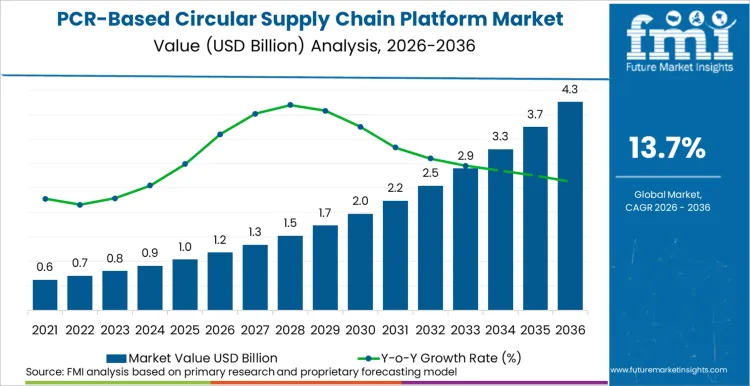
Summary of PCR-Based Circular Supply Chain Platform Market
What is the Long-Term Growth Outlook for the PCR-Based Circular Supply Chain Platform Market?
FMI projects the global PCR-based circular supply chain platform market to expand from USD 1,180 million in 2026 to USD 4,260 million by 2036, registering a 13.7% CAGR. This accelerated growth reflects the transition of circularity from a marketing aspiration to a core operational and compliance requirement. Digital platforms are the indispensable tools for managing the complexity, proving claims, and optimizing the flow of recycled materials at industrial scale, making them a foundational investment for any business with serious circular economy goals.
FMI Research Approach: This projection is derived from FMI's proprietary model analyzing the rollout timelines of digital product passport regulations, corporate adoption rates of Scope 3 reporting software, investments in supply chain digitization by material producers, and the growth of PCR volume requiring verification.
How do FMI Analysts Expect the PCR-Based Circular Supply Chain Platform Market to Evolve Structurally?
FMI analysts anticipate a market evolution from standalone traceability platforms to integrated circularity operations systems. Future platforms will not only track materials but also actively optimize logistics, automate compliance reporting, facilitate financial transactions (e.g., trading recycled content credits), and integrate real-time IoT sensor data from recycling and production facilities. The convergence of traceability with supply chain execution and finance will create more holistic and valuable enterprise solutions.
FMI Research Approach: Insights are informed by tracking venture capital investments in circular economy tech, analyzing the feature roadmap expansions of leading platform vendors, and monitoring the integration of environmental, social, and governance data standards into supply chain software.
Which Geographies Command Strategic Importance in the PCR-Based Circular Supply Chain Platform Market?
Strategic growth is concentrated in regions with aggressive digital and circular economy policies. The European Union, led by Germany, is the regulatory frontrunner with DPP mandates. The United States is a major market driven by corporate sustainability leadership and complex multi-state compliance. China and India represent high-growth markets where government-led digitalization initiatives are intersecting with new circular economy policies. Japan focuses on high-precision tracking for quality-sensitive industries.
FMI Research Approach: Regional market sizing is based on the stringency of transparency regulations, the maturity of corporate ESG adoption, the scale of manufacturing and PCR consumption, and government-led digital infrastructure programs.
What Will Be the Market Size of PCR-Based Circular Supply Chain Platform by 2036?
By 2036, the PCR-based circular supply chain platform market is expected to reach USD 4,260 million. This expansion will be sustained as digital product passports become ubiquitous for products sold in major economies, and as circularity data becomes a standard component of financial reporting, audits, and stakeholder communications, making these platforms a non-negotiable part of the corporate IT stack.
FMI Research Approach: The long-term outlook incorporates forecasts for the global volume of PCR requiring certification, the proliferation of product-specific recycled content laws, and the increasing integration of circularity metrics into investment and lending decisions.
What are some Globally Distinct Trends Shaping the PCR-Based Circular Supply Chain Platform Market?
Globally, the market is shaped by the rise of blockchain for immutable proof, the adoption of mass balance chain-of-custody models, and the platform's role as a data bridge for carbon accounting. Blockchain provides trust in decentralized networks. Mass balance enables the scaling of chemically recycled content claims. Furthermore, platforms are increasingly calculating and allocating the carbon footprint savings of using PCR, directly feeding into corporate carbon accounting and product-level environmental declarations.
FMI Research Approach: Trend identification involves monitoring the adoption of blockchain consortia in materials (e.g., RCS, ISCC PLUS for mass balance), analyzing the integration of lifecycle assessment databases into platforms, and reviewing new standards for the digital exchange of product footprint data.
PCR-Based Circular Supply Chain Platform Market Key Takeaways
| Metrics | Values |
|---|---|
| Expected Value (2026E) | USD 1,180 million |
| Projected Value (2036F) | USD 4,260 million |
| CAGR (2026 to 2036) | 13.7% |
Source: Future Market Insights (FMI) analysis, based on proprietary forecasting model and primary research
Why is the PCR-Based Circular Supply Chain Platform Market Growing?
The primary growth catalyst is the regulatory shift from setting recycled content targets to demanding verified proof of compliance. Authorities are moving beyond self-declaration to requiring auditable, digital records. The EU's DPP is the most prominent example, but similar concepts are emerging in California's SB 54 implementation and in product stewardship schemes globally. This creates a non-discretionary need for software that can systematically collect, verify, and report the necessary data across multi-tier supply chains, transforming platform adoption from a "nice-to-have" to a "must-have" for market access.
Corporate risk management and brand protection are powerful drivers. The reputational and financial risk of "greenwashing" accusations related to recycled content claims is substantial. Digital platforms provide an auditable chain of custody that defends against such claims. Furthermore, they de-risk PCR procurement by providing visibility into supplier reliability and material quality history, enabling brands to make strategic, long-term sourcing decisions based on data rather than anecdote.
Technological advancements are making comprehensive tracking feasible and affordable. The convergence of cheap IoT sensors, cloud computing, blockchain, and standardized data formats (e.g., GS1 standards for circularity) allows platforms to automatically capture data at various points in the supply chain—from bale composition at a recycler to pellet production at a compounder-with minimal manual input. This automation reduces the administrative burden of participation, encouraging wider ecosystem adoption and improving data accuracy.
How is PCR-Based Circular Supply Chain Platform Market Segmented?
The market segment landscape is defined by the need to manage the complete journey of PCR, ensure stakeholder collaboration, and handle specific data types for verification. End-to-end PCR sourcing is the comprehensive service need, fulfilled by dedicated circular supply chain platforms that manage the flow of material flow and certificate data, primarily built on cloud and API architectures for integration and scalability.
How is End-to-End PCR Sourcing Defining the Core Platform Function?
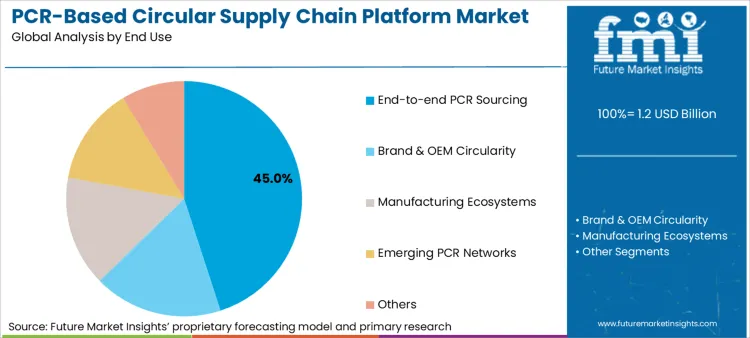
End-to-end PCR sourcing represents the largest end-use segment with a 45.0% share. This encompasses the full workflow: identifying and qualifying PCR suppliers, issuing purchase orders, tracking shipments, verifying recycled content upon receipt (via certificate matching or IoT data), and allocating that content to specific production runs or products for compliance reporting. Platforms that support this entire process replace a patchwork of emails, PDF certificates, and spreadsheets, providing operational efficiency alongside compliance assurance.
This segment’s dominance underscores that brands and manufacturers seek a holistic solution. They need a system that manages the entire sourcing operation, not just a point solution for certificate storage. A platform that can also help discover new suppliers, benchmark pricing, and manage contracts adds significant value beyond basic traceability.
Which Platform Architecture is Designed for Ecosystem Connectivity?
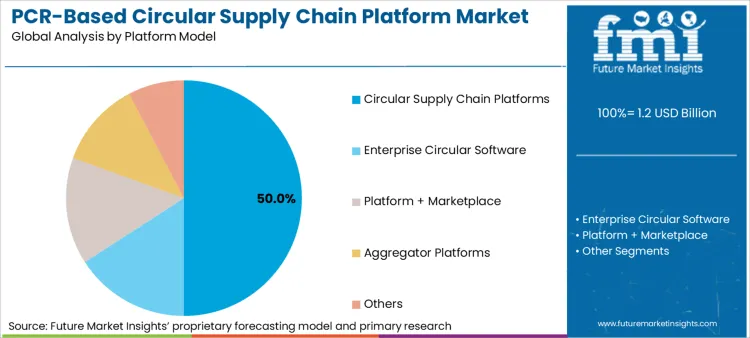
Circular supply chain platforms constitute the leading platform model segment with a 50.0% share. These are cloud-native platforms specifically architected to connect multiple, independent organizations in a supply network (e.g., brand, Tier-N suppliers, recyclers, logistics). Their design prioritizes data sovereignty, permissioning, and standards-based interoperability, allowing each participant to share only the necessary data with relevant partners. This model is essential for building the trusted, multi-party networks that characterize circular material flows.
The preference for this model over enterprise-only software reflects the reality of circularity: it is a team sport. Success depends on connecting external partners, making platforms designed for ecosystem collaboration inherently more valuable than internal data management tools.
What is the Fundamental Data Required for Verification?
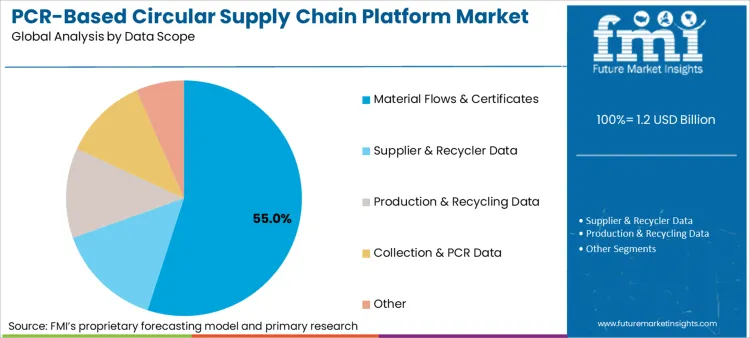
Material flows and certificates constitute the leading data scope segment with a 55.0% share. This dual data set is the core of verification. "Material flow" data refers to the physical movement and transformation of PCR (weights, batch IDs, shipping events). "Certificate" data refers to the digital or digitized attestations (Mass Balance certificates, Certificate of Analysis, Proof of Recycling) that formally attribute recycled content to a specific batch of material. The platform's critical function is to automatically link these two data sets-ensuring that a certificate for 1,000 kg of PCR is matched to the physical receipt of 1,000 kg of material from the certified supplier.
Mastering the ingestion, validation, and reconciliation of this core data is the primary technical challenge and value proposition for platform providers.
Which Technology Stack Enables Scalability and Integration?
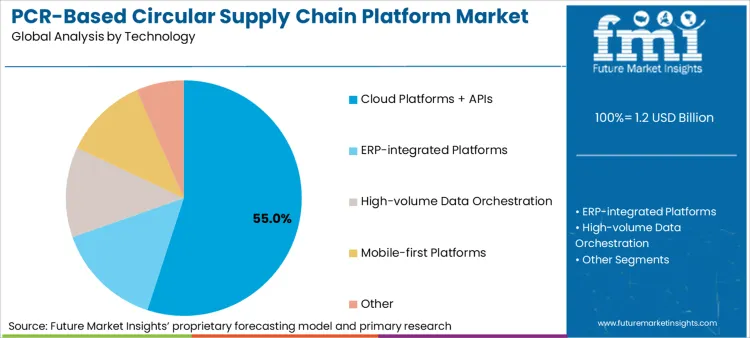
Cloud platforms + APIs represent the dominant technology segment with a 55.0% share. The cloud provides the necessary scalability, accessibility, and security to host data from a globally dispersed network of users. APIs (Application Programming Interfaces) are the connectors that allow the platform to integrate seamlessly with other business systems: pulling procurement data from an ERP, pushing compliance data to a sustainability reporting tool, or receiving automated weight data from a warehouse management system. This open, integrated architecture is non-negotiable for enterprise adoption.
What Drivers, Restraints, Opportunities, and Trends Prevail in the PCR-Based Circular Supply Chain Platform Market?
Market expansion is critically driven by the financial sector's integration of ESG data into lending and investment decisions. Banks and investors are increasingly demanding granular, auditable data on supply chain sustainability, including recycled content. Companies need platforms to generate the reliable reports required for sustainable finance instruments like green loans or sustainability-linked bonds, directly linking platform data to capital access and cost.
A significant restraint is the lack of universal data standards and the resulting interoperability challenges. While standards like ISCC PLUS, RCS, and GS1's digital link are gaining traction, the ecosystem remains fragmented. A platform must be able to interpret multiple certificate formats and data protocols to serve a global client, increasing complexity and cost. This fragmentation can slow adoption as companies wait for standards to mature.
A major opportunity lies in embedding financial and logistics marketplaces within traceability platforms. Once a platform has mapped a network of verified PCR suppliers and consumers, it can facilitate transactions—spot purchases, offtake agreements, or trading of recycled content credits-adding a substantial revenue stream. This transforms the platform from a cost center (compliance tool) into a profit center (transaction enabler), as seen in early models from companies like Scandere.
A defining technical trend is the use of AI and machine learning for data validation and anomaly detection. Platforms are employing AI to automatically cross-check uploaded certificates against known issuer templates, flag discrepancies in material flow data (e.g., shipment weight exceeds certificate weight), and predict supply chain disruptions. This moves the platform from a passive data repository to an active intelligence system that improves data quality and operational resilience.
The trend toward "Embedded Circularity" in procurement and PLM software is accelerating. Major procurement software providers and Product Lifecycle Management (PLM) systems are beginning to bake in circular material tracking modules. This could pose a challenge to standalone platforms but also validates the market. It suggests that in the long term, circular supply chain functionality may become a standard feature of enterprise software suites, requiring specialists to compete on depth of functionality and ecosystem connectivity.
Analysis of PCR-Based Circular Supply Chain Platform Market by Key Countries
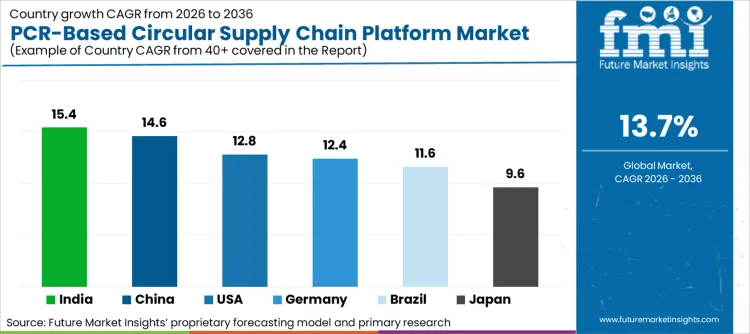
| Country | CAGR (2026-2036) |
|---|---|
| India | 15.4% |
| China | 14.6% |
| USA | 12.8% |
| Germany | 12.4% |
| Brazil | 11.6% |
| Japan | 9.6% |
Source: Future Market Insights (FMI) analysis, based on proprietary forecasting model and primary research
How are Digital Public Infrastructure and EPR Formalization Driving the Indian Market?
India is projected to expand at a 15.4% CAGR through 2036, the highest among key nations. This is driven by the intersection of its Digital Public Infrastructure (DPI) stack and new, digitally-enabled Extended Producer Responsibility rules. The government's API-based EPR portal mandates digital reporting of plastic waste flows. Platforms like Recykal are building on this by offering mobile-first solutions that connect informal waste collectors to brands, digitizing the entire chain from collection to certified PCR. The massive, informal recycling sector's formalization creates an immense greenfield opportunity for platforms that can simplify data capture and create transparency in a fragmented market.
How do National Tech Ecosystems and Industrial Policy Shape the Chinese Market?
China’s market is growing at a 14.6% CAGR, fueled by its "Dual Carbon" goals and the integration of circular economy objectives into its national industrial digitalization strategy. Tech giants like Alibaba (via AntChain) and Tencent are leveraging their cloud and blockchain expertise to build platforms for industrial ecosystems. These platforms are often bundled with other B2B services (logistics, finance) and are promoted through state-backed "Industrial Internet" initiatives, aiming to create transparent, efficient supply chains for recycled materials that serve both the domestic "Internal Circulation" strategy and export compliance needs.
Which Mix of Corporate Leadership and Regulatory Complexity Defines the USA Market?
The United States market, with a 12.8% CAGR, is characterized by ambitious corporate sustainability goals and a complex, multi-state regulatory landscape. Major brands and retailers are driving adoption to meet their public commitments and to navigate differing state laws (e.g., CA, WA, OR). Platform adoption focuses on ERP-integrated solutions (like SAP or Salesforce) that can scale across large, existing enterprise systems. The need is for platforms that provide a unified view of recycled content procurement and compliance across all 50 states, making complexity management a key selling point.
How do EU's Digital Product Passport Mandates Steer the German Market?
Germany’s market, expanding at a 12.4% CAGR, is directly shaped by its role in implementing the EU's ESPR and DPP. German manufacturing and automotive companies, with complex global supply chains, are early and demanding adopters. They require platforms that can handle sophisticated mass balance accounting, integrate with high-precision engineering and production data, and produce DPPs that meet anticipated EU technical standards. The focus is on platforms with strong regulatory expertise, robust audit trails, and the ability to handle confidential supply chain data with high security, favoring specialized players like Circularise.
What Role do Agri-Industrial Chains and Credit Systems Play in Brazil?
Brazil’s market, with an 11.6% CAGR, is influenced by its strong agri-industrial sector and nascent circular economy policies. Early platform applications focus on tracking recycled materials in packaging for agricultural products (e.g., fertilizer bags, food packaging). There is also growing interest in platforms that can manage reverse logistics credits and certificates as part of Brazil's EPR system for packaging. The opportunity lies in adapting global platform models to the specific material flows and regulatory incentives of Brazil's resource-based economy.
How does a Focus on Quality and Export Compliance Influence Japan?
Japan’s market, growing at a 9.6% CAGR, is defined by its export-oriented manufacturing and extreme focus on quality and precision. Japanese companies need platforms that provide impeccable, detailed records of PCR content for high-value exports to regulated markets like the EU. The demand is for platforms with very high data integrity, secure permissioning, and seamless integration with Japan's own advanced manufacturing execution systems (MES) to ensure that material traceability is maintained with zero tolerance for error in high-tech production environments.
What is the Competition Outlook for PCR-Based Circular Supply Chain Platforms?
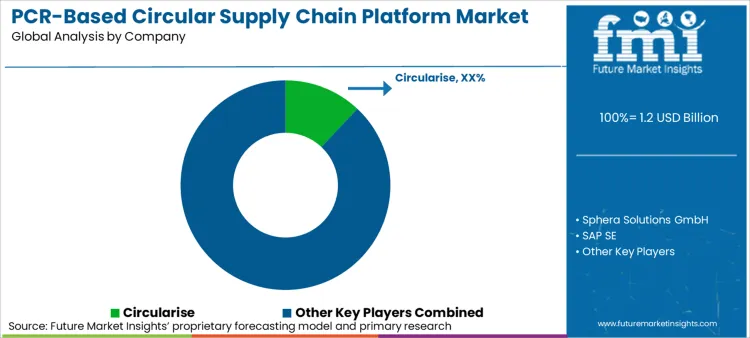
Competitive intensity centers on building the most extensive and active network of participants, and on achieving deep, valuable integrations with key enterprise software (ERP, PLM, SCM). The landscape features competition between specialized circular economy tech startups, large enterprise software vendors expanding into sustainability modules, and consortia or industry-backed platforms. Success is increasingly a "network effects" game: the value of the platform grows exponentially with the number of recyclers, suppliers, and brands using it, creating a winner-takes-most dynamic in specific regions or industries.
Strategic moves are characterized by partnerships and open API strategies. Standalone platforms are partnering with logistics companies, testing labs, and certification bodies to offer bundled services. They are also publishing open APIs to encourage third-party developers to build complementary applications, enriching their ecosystem. The competitive battle is shifting from who has the best standalone software to who can build the most vibrant and useful ecosystem around their core data platform.
Key Developments
BASF and Circularise expanded their collaboration in 2023 to 2024 to scale digital mass-balance and traceability solutions for circular plastics across BASF’s ChemCycling® portfolio. The collaboration focuses on enabling downstream customers to access verified information on recycled feedstock allocation, sustainability attributes, and certification status through secure data-sharing mechanisms.
CIRPASS advanced pilot work in 2024 on Digital Product Passport data models covering plastics, electronics, and batteries. CIRPASS brings together platform providers, manufacturers, recyclers, and standards bodies to define interoperable data architectures for product-level circularity information, including material composition and recycled content.
IBM and Plastic Bank continued the expansion of their blockchain-enabled material traceability platform through 2024, tracking recycled plastic collection across multiple emerging markets. The system records collection, aggregation, and handoff events to provide auditable proof of origin and volume for recycled plastics entering global supply chains.
Key Players Profiled
- Circularise
- Sphera Solutions GmbH
- SAP SE
- Salesforce Inc. (Net Zero Cloud)
- AntChain (Alibaba Group)
- Alibaba Cloud
- Recykal
Market Definition
The PCR-based circular supply chain platform market comprises revenue generated from the provision of software-as-a-service (SaaS) platforms that enable the digital tracking, verification, and management of post-consumer recycled materials across multi-tier supply chains. These platforms provide functionalities for chain-of-custody documentation, mass balance accounting, digital certificate management, supplier engagement, compliance reporting, and the generation of sustainability disclosures or digital product passports.
The market scope includes subscription fees, implementation services, and transaction fees related to these platforms. It covers both horizontal platforms serving multiple industries and vertical-specific solutions. The market excludes generic supply chain management software without dedicated circularity/PCR modules, one-off consulting services for circular strategy, and manual certificate management services.
Scope of Report
| Items | Values |
|---|---|
| Quantitative Units | USD 1,180 Million |
| End-use | End-to-end PCR Sourcing, Brand & OEM Circularity, Manufacturing Ecosystems, Emerging PCR Networks, Other |
| Platform Model | Circular Supply Chain Platforms, Enterprise Circular Software, Platform + Marketplace, Aggregator Platforms, Other |
| Data Scope | Material Flows & Certificates, Supplier & Recycler Data, Production & Recycling Data, Collection & PCR Data, Other |
| Technology | Cloud Platforms + APIs, ERP-integrated Platforms, High-volume Data Orchestration, Mobile-first Platforms, Other |
| Regions Covered | North America, Europe, Asia-Pacific, Latin America, Middle East & Africa |
| Countries | USA, Germany, China, India, Brazil, Japan and 40+ countries |
| Key Companies | Circularise, Sphera, SAP, Salesforce, AntChain, Alibaba Cloud, Recykal |
Source: Future Market Insights (FMI) analysis, based on proprietary forecasting model and primary research
PCR-Based Circular Supply Chain Platform Market Key Segments
End-use:
- End-to-end PCR Sourcing
- Brand & OEM Circularity
- Manufacturing Ecosystems
- Emerging PCR Networks
- Others
Platform Model:
- Circular Supply Chain Platforms
- Enterprise Circular Software
- Platform + Marketplace
- Aggregator Platforms
- Others
Data Scope:
- Material Flows & Certificates
- Supplier & Recycler Data
- Production & Recycling Data
- Collection & PCR Data
- Other
Technology:
- Cloud Platforms + APIs
- ERP-integrated Platforms
- High-volume Data Orchestration
- Mobile-first Platforms
- Other
Region:
- North America
- Europe
- Asia-Pacific
- Latin America
- Middle East & Africa
Bibliography
- World Business Council for Sustainable Development. (2024). Guidance on circular transition indicators and digital data exchange for value chains. WBCSD.
- Ellen MacArthur Foundation. (2024). Scaling circular economy through digital infrastructure: Enablers, barriers, and system design. Ellen MacArthur Foundation.
- GS1. (2024). Digital link and data interoperability for circular packaging and recycled content tracking. GS1 Global Office.
- International Solid Waste Association. (2024). Traceability systems and digital platforms in advanced recycling value chains. ISWA.
- GreenBiz Group. (2025). State of the circular economy 2025: Data, verification, and enterprise integration. GreenBiz Group.
- SAP & World Business Council for Sustainable Development. (2024). Catena-X open data models for circular economy and material traceability. SAP SE & WBCSD.
Frequently Asked Questions
How big is the pcr-based circular supply chain platform market in 2026?
The global pcr-based circular supply chain platform market is estimated to be valued at USD 1.2 billion in 2026.
What will be the size of pcr-based circular supply chain platform market in 2036?
The market size for the pcr-based circular supply chain platform market is projected to reach USD 4.3 billion by 2036.
How much will be the pcr-based circular supply chain platform market growth between 2026 and 2036?
The pcr-based circular supply chain platform market is expected to grow at a 13.7% CAGR between 2026 and 2036.
What are the key product types in the pcr-based circular supply chain platform market?
The key product types in pcr-based circular supply chain platform market are end-to-end pcr sourcing, brand & oem circularity, manufacturing ecosystems, emerging pcr networks and others.
Which platform model segment to contribute significant share in the pcr-based circular supply chain platform market in 2026?
In terms of platform model, circular supply chain platforms segment to command 50.0% share in the pcr-based circular supply chain platform market in 2026.
Preview the report firsthand - request a free sample
Get SampleGet the brochure for pricing and purchase details.
Get PDFTable of Content
- Executive Summary
- Global Market Outlook
- Demand-side Trends
- Supply-side Trends
- Technology Roadmap Analysis
- Analysis and Recommendations
- Market Overview
- Market Coverage / Taxonomy
- Market Definition / Scope / Limitations
- Research Methodology
- Chapter Orientation
- Analytical Lens and Working Hypotheses
- Market Structure, Signals, and Trend Drivers
- Benchmarking and Cross-market Comparability
- Market Sizing, Forecasting, and Opportunity Mapping
- Research Design and Evidence Framework
- Desk Research Programme (Secondary Evidence)
- Company Annual and Sustainability Reports
- Peer-reviewed Journals and Academic Literature
- Corporate Websites, Product Literature, and Technical Notes
- Earnings Decks and Investor Briefings
- Statutory Filings and Regulatory Disclosures
- Technical White Papers and Standards Notes
- Trade Journals, Industry Magazines, and Analyst Briefs
- Conference Proceedings, Webinars, and Seminar Materials
- Government Statistics Portals and Public Data Releases
- Press Releases and Reputable Media Coverage
- Specialist Newsletters and Curated Briefings
- Sector Databases and Reference Repositories
- FMI Internal Proprietary Databases and Historical Market Datasets
- Subscription Datasets and Paid Sources
- Social Channels, Communities, and Digital Listening Inputs
- Additional Desk Sources
- Expert Input and Fieldwork (Primary Evidence)
- Primary Modes
- Qualitative Interviews and Expert Elicitation
- Quantitative Surveys and Structured Data Capture
- Blended Approach
- Why Primary Evidence is Used
- Field Techniques
- Interviews
- Surveys
- Focus Groups
- Observational and In-context Research
- Social and Community Interactions
- Stakeholder Universe Engaged
- C-suite Leaders
- Board Members
- Presidents and Vice Presidents
- R&D and Innovation Heads
- Technical Specialists
- Domain Subject-matter Experts
- Scientists
- Physicians and Other Healthcare Professionals
- Governance, Ethics, and Data Stewardship
- Research Ethics
- Data Integrity and Handling
- Primary Modes
- Tooling, Models, and Reference Databases
- Desk Research Programme (Secondary Evidence)
- Data Engineering and Model Build
- Data Acquisition and Ingestion
- Cleaning, Normalisation, and Verification
- Synthesis, Triangulation, and Analysis
- Quality Assurance and Audit Trail
- Market Background
- Market Dynamics
- Drivers
- Restraints
- Opportunity
- Trends
- Scenario Forecast
- Demand in Optimistic Scenario
- Demand in Likely Scenario
- Demand in Conservative Scenario
- Opportunity Map Analysis
- Product Life Cycle Analysis
- Supply Chain Analysis
- Investment Feasibility Matrix
- Value Chain Analysis
- PESTLE and Porter’s Analysis
- Regulatory Landscape
- Regional Parent Market Outlook
- Production and Consumption Statistics
- Import and Export Statistics
- Market Dynamics
- Global Market Analysis 2021 to 2025 and Forecast, 2026 to 2036
- Historical Market Size Value (USD Million) Analysis, 2021 to 2025
- Current and Future Market Size Value (USD Million) Projections, 2026 to 2036
- Y-o-Y Growth Trend Analysis
- Absolute $ Opportunity Analysis
- Global Market Pricing Analysis 2021 to 2025 and Forecast 2026 to 2036
- Global Market Analysis 2021 to 2025 and Forecast 2026 to 2036, By End Use
- Introduction / Key Findings
- Historical Market Size Value (USD Million) Analysis By End Use , 2021 to 2025
- Current and Future Market Size Value (USD Million) Analysis and Forecast By End Use , 2026 to 2036
- End-to-end PCR Sourcing
- Brand & OEM Circularity
- Manufacturing Ecosystems
- Emerging PCR Networks
- Others
- End-to-end PCR Sourcing
- Y-o-Y Growth Trend Analysis By End Use , 2021 to 2025
- Absolute $ Opportunity Analysis By End Use , 2026 to 2036
- Global Market Analysis 2021 to 2025 and Forecast 2026 to 2036, By Platform Model
- Introduction / Key Findings
- Historical Market Size Value (USD Million) Analysis By Platform Model, 2021 to 2025
- Current and Future Market Size Value (USD Million) Analysis and Forecast By Platform Model, 2026 to 2036
- Circular Supply Chain Platforms
- Enterprise Circular Software
- Platform + Marketplace
- Aggregator Platforms
- Others
- Circular Supply Chain Platforms
- Y-o-Y Growth Trend Analysis By Platform Model, 2021 to 2025
- Absolute $ Opportunity Analysis By Platform Model, 2026 to 2036
- Global Market Analysis 2021 to 2025 and Forecast 2026 to 2036, By Data Scope
- Introduction / Key Findings
- Historical Market Size Value (USD Million) Analysis By Data Scope, 2021 to 2025
- Current and Future Market Size Value (USD Million) Analysis and Forecast By Data Scope, 2026 to 2036
- Material Flows & Certificates
- Supplier & Recycler Data
- Production & Recycling Data
- Collection & PCR Data
- Other
- Material Flows & Certificates
- Y-o-Y Growth Trend Analysis By Data Scope, 2021 to 2025
- Absolute $ Opportunity Analysis By Data Scope, 2026 to 2036
- Global Market Analysis 2021 to 2025 and Forecast 2026 to 2036, By Technology
- Introduction / Key Findings
- Historical Market Size Value (USD Million) Analysis By Technology, 2021 to 2025
- Current and Future Market Size Value (USD Million) Analysis and Forecast By Technology, 2026 to 2036
- Cloud Platforms + APIs
- ERP-integrated Platforms
- High-volume Data Orchestration
- Mobile-first Platforms
- Other
- Cloud Platforms + APIs
- Y-o-Y Growth Trend Analysis By Technology, 2021 to 2025
- Absolute $ Opportunity Analysis By Technology, 2026 to 2036
- Global Market Analysis 2021 to 2025 and Forecast 2026 to 2036, By Region
- Introduction
- Historical Market Size Value (USD Million) Analysis By Region, 2021 to 2025
- Current Market Size Value (USD Million) Analysis and Forecast By Region, 2026 to 2036
- North America
- Latin America
- Western Europe
- Eastern Europe
- East Asia
- South Asia and Pacific
- Middle East & Africa
- Market Attractiveness Analysis By Region
- North America Market Analysis 2021 to 2025 and Forecast 2026 to 2036, By Country
- Historical Market Size Value (USD Million) Trend Analysis By Market Taxonomy, 2021 to 2025
- Market Size Value (USD Million) Forecast By Market Taxonomy, 2026 to 2036
- By Country
- USA
- Canada
- Mexico
- By End Use
- By Platform Model
- By Data Scope
- By Technology
- By Country
- Market Attractiveness Analysis
- By Country
- By End Use
- By Platform Model
- By Data Scope
- By Technology
- Key Takeaways
- Latin America Market Analysis 2021 to 2025 and Forecast 2026 to 2036, By Country
- Historical Market Size Value (USD Million) Trend Analysis By Market Taxonomy, 2021 to 2025
- Market Size Value (USD Million) Forecast By Market Taxonomy, 2026 to 2036
- By Country
- Brazil
- Chile
- Rest of Latin America
- By End Use
- By Platform Model
- By Data Scope
- By Technology
- By Country
- Market Attractiveness Analysis
- By Country
- By End Use
- By Platform Model
- By Data Scope
- By Technology
- Key Takeaways
- Western Europe Market Analysis 2021 to 2025 and Forecast 2026 to 2036, By Country
- Historical Market Size Value (USD Million) Trend Analysis By Market Taxonomy, 2021 to 2025
- Market Size Value (USD Million) Forecast By Market Taxonomy, 2026 to 2036
- By Country
- Germany
- UK
- Italy
- Spain
- France
- Nordic
- BENELUX
- Rest of Western Europe
- By End Use
- By Platform Model
- By Data Scope
- By Technology
- By Country
- Market Attractiveness Analysis
- By Country
- By End Use
- By Platform Model
- By Data Scope
- By Technology
- Key Takeaways
- Eastern Europe Market Analysis 2021 to 2025 and Forecast 2026 to 2036, By Country
- Historical Market Size Value (USD Million) Trend Analysis By Market Taxonomy, 2021 to 2025
- Market Size Value (USD Million) Forecast By Market Taxonomy, 2026 to 2036
- By Country
- Russia
- Poland
- Hungary
- Balkan & Baltic
- Rest of Eastern Europe
- By End Use
- By Platform Model
- By Data Scope
- By Technology
- By Country
- Market Attractiveness Analysis
- By Country
- By End Use
- By Platform Model
- By Data Scope
- By Technology
- Key Takeaways
- East Asia Market Analysis 2021 to 2025 and Forecast 2026 to 2036, By Country
- Historical Market Size Value (USD Million) Trend Analysis By Market Taxonomy, 2021 to 2025
- Market Size Value (USD Million) Forecast By Market Taxonomy, 2026 to 2036
- By Country
- China
- Japan
- South Korea
- By End Use
- By Platform Model
- By Data Scope
- By Technology
- By Country
- Market Attractiveness Analysis
- By Country
- By End Use
- By Platform Model
- By Data Scope
- By Technology
- Key Takeaways
- South Asia and Pacific Market Analysis 2021 to 2025 and Forecast 2026 to 2036, By Country
- Historical Market Size Value (USD Million) Trend Analysis By Market Taxonomy, 2021 to 2025
- Market Size Value (USD Million) Forecast By Market Taxonomy, 2026 to 2036
- By Country
- India
- ASEAN
- Australia & New Zealand
- Rest of South Asia and Pacific
- By End Use
- By Platform Model
- By Data Scope
- By Technology
- By Country
- Market Attractiveness Analysis
- By Country
- By End Use
- By Platform Model
- By Data Scope
- By Technology
- Key Takeaways
- Middle East & Africa Market Analysis 2021 to 2025 and Forecast 2026 to 2036, By Country
- Historical Market Size Value (USD Million) Trend Analysis By Market Taxonomy, 2021 to 2025
- Market Size Value (USD Million) Forecast By Market Taxonomy, 2026 to 2036
- By Country
- Kingdom of Saudi Arabia
- Other GCC Countries
- Turkiye
- South Africa
- Other African Union
- Rest of Middle East & Africa
- By End Use
- By Platform Model
- By Data Scope
- By Technology
- By Country
- Market Attractiveness Analysis
- By Country
- By End Use
- By Platform Model
- By Data Scope
- By Technology
- Key Takeaways
- Key Countries Market Analysis
- USA
- Pricing Analysis
- Market Share Analysis, 2025
- By End Use
- By Platform Model
- By Data Scope
- By Technology
- Canada
- Pricing Analysis
- Market Share Analysis, 2025
- By End Use
- By Platform Model
- By Data Scope
- By Technology
- Mexico
- Pricing Analysis
- Market Share Analysis, 2025
- By End Use
- By Platform Model
- By Data Scope
- By Technology
- Brazil
- Pricing Analysis
- Market Share Analysis, 2025
- By End Use
- By Platform Model
- By Data Scope
- By Technology
- Chile
- Pricing Analysis
- Market Share Analysis, 2025
- By End Use
- By Platform Model
- By Data Scope
- By Technology
- Germany
- Pricing Analysis
- Market Share Analysis, 2025
- By End Use
- By Platform Model
- By Data Scope
- By Technology
- UK
- Pricing Analysis
- Market Share Analysis, 2025
- By End Use
- By Platform Model
- By Data Scope
- By Technology
- Italy
- Pricing Analysis
- Market Share Analysis, 2025
- By End Use
- By Platform Model
- By Data Scope
- By Technology
- Spain
- Pricing Analysis
- Market Share Analysis, 2025
- By End Use
- By Platform Model
- By Data Scope
- By Technology
- France
- Pricing Analysis
- Market Share Analysis, 2025
- By End Use
- By Platform Model
- By Data Scope
- By Technology
- India
- Pricing Analysis
- Market Share Analysis, 2025
- By End Use
- By Platform Model
- By Data Scope
- By Technology
- ASEAN
- Pricing Analysis
- Market Share Analysis, 2025
- By End Use
- By Platform Model
- By Data Scope
- By Technology
- Australia & New Zealand
- Pricing Analysis
- Market Share Analysis, 2025
- By End Use
- By Platform Model
- By Data Scope
- By Technology
- China
- Pricing Analysis
- Market Share Analysis, 2025
- By End Use
- By Platform Model
- By Data Scope
- By Technology
- Japan
- Pricing Analysis
- Market Share Analysis, 2025
- By End Use
- By Platform Model
- By Data Scope
- By Technology
- South Korea
- Pricing Analysis
- Market Share Analysis, 2025
- By End Use
- By Platform Model
- By Data Scope
- By Technology
- Russia
- Pricing Analysis
- Market Share Analysis, 2025
- By End Use
- By Platform Model
- By Data Scope
- By Technology
- Poland
- Pricing Analysis
- Market Share Analysis, 2025
- By End Use
- By Platform Model
- By Data Scope
- By Technology
- Hungary
- Pricing Analysis
- Market Share Analysis, 2025
- By End Use
- By Platform Model
- By Data Scope
- By Technology
- Kingdom of Saudi Arabia
- Pricing Analysis
- Market Share Analysis, 2025
- By End Use
- By Platform Model
- By Data Scope
- By Technology
- Turkiye
- Pricing Analysis
- Market Share Analysis, 2025
- By End Use
- By Platform Model
- By Data Scope
- By Technology
- South Africa
- Pricing Analysis
- Market Share Analysis, 2025
- By End Use
- By Platform Model
- By Data Scope
- By Technology
- USA
- Market Structure Analysis
- Competition Dashboard
- Competition Benchmarking
- Market Share Analysis of Top Players
- By Regional
- By End Use
- By Platform Model
- By Data Scope
- By Technology
- Competition Analysis
- Competition Deep Dive
- Circularise
- Overview
- Product Portfolio
- Profitability by Market Segments (Product/Age /Sales Channel/Region)
- Sales Footprint
- Strategy Overview
- Marketing Strategy
- Product Strategy
- Channel Strategy
- Sphera Solutions GmbH
- SAP SE
- Salesforce Inc. (Net Zero Cloud)
- AntChain (Alibaba Group)
- Alibaba Cloud
- Circularise
- Competition Deep Dive
- Assumptions & Acronyms Used


