

- Industry Size (2026)
- USD 640 Mn
- Forecast (2036)
- USD 1721.4 Mn
- CAGR (2026 to 2036)
- 10.4%
Circular E-Commerce Packaging for Fashion & Apparel Market Forecast and Outlook 2026 to 2036
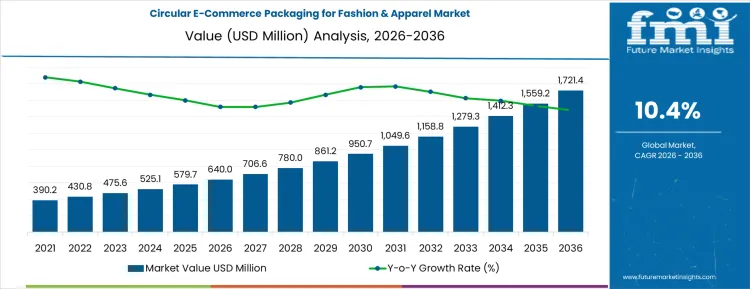
The circular e-commerce packaging for fashion and apparel market is expected to grow from USD 640 million in 2026 to USD 1,721.4 million by 2036, reflecting a compound annual growth rate (CAGR) of 10.4%. Circular packaging solutions are becoming increasingly popular in the fashion and apparel sector, driven by the rising demand for sustainable practices in e-commerce. These packaging solutions, which are reusable, recyclable, or biodegradable, aim to reduce the environmental impact of packaging waste. The market is driven by growing consumer awareness of sustainability and the increasing pressure on fashion brands to align with environmental goals. E-commerce, which is a key distribution channel for fashion products, is leading the transition towards eco-friendlier packaging options that promote circularity and reduce waste.
The growth of this market is further supported by the expansion of online shopping, particularly in the fashion and apparel sector, where packaging plays a key role in ensuring product integrity and brand experience. As more fashion brands implement circular packaging practices to meet regulatory requirements and consumer demand for sustainability, the market for circular e-commerce packaging solutions is expected to see strong growth in the coming years.
Quick Stats of the Circular E-Commerce Packaging for Fashion & Apparel Market
- Circular E-Commerce Packaging for Fashion & Apparel Market Value (2026): USD 640 million
- Circular E-Commerce Packaging for Fashion & Apparel Market Forecast Value (2036): USD 1,721.4 million
- Circular E-Commerce Packaging for Fashion & Apparel Market Global Forecast CAGR (2026-2036): 10.4%
- Circular E-Commerce Packaging for Fashion & Apparel Market Leading Segment: Packaging Format (Reusable mailers and return bags) 50%
- Key Growth Regions in Circular E-Commerce Packaging for Fashion & Apparel Market: China
- Top Players in Circular E-Commerce Packaging for Fashion & Apparel Market: RePack, DS Smith, Alibaba Packaging Ecosystem, UFlex, Berry Global, Schoeller Allibert
What is the Growth Forecast for the Circular E-Commerce Packaging for Fashion & Apparel Market through 2036?
The early vs late growth curve comparison for the circular e-commerce packaging market highlights gradual early-stage growth followed by more significant acceleration as sustainability becomes more deeply integrated into e-commerce operations. Starting at USD 640 million in 2026, the market grows to USD 707.4 million in 2027 and USD 782.5 million in 2028, reflecting steady initial growth as e-commerce businesses begin adopting circular packaging solutions to reduce their environmental footprint.
From 2028 to 2030, the market experiences further steady expansion, reaching USD 866.7 million in 2029 and USD 960.4 million in 2030. The early years reflect an increase in adoption as companies seek to comply with environmental regulations and meet growing consumer demand for sustainable packaging. Between 2030 and 2035, the market begins to accelerate, reaching USD 1,064.3 million in 2031, USD 1,180.7 million in 2032, and USD 1,310.1 million in 2033.
By 2035, the market is projected to reach USD 1,454.3 million, with the final value of USD 1,721.4 million expected in 2036. The late growth phase shows a significant acceleration driven by widespread adoption across the fashion and apparel e-commerce sector, which is expected to increasingly prioritize circular packaging solutions as sustainability becomes a central focus. The comparison indicates that while the market experiences steady growth in the early years, the pace of expansion accelerates as more fashion brands embrace circular packaging to meet both consumer expectations and regulatory pressures.
Circular E-Commerce Packaging for Fashion & Apparel Market Key Takeaways
| Metric | Value |
|---|---|
| Industry Sales Value (2026) | USD 640 million |
| Industry Forecast Value (2036) | USD 1,721.4 million |
| Industry Forecast CAGR (2026-2036) | 10.4% |
What Is Driving the Demand for the Circular E-Commerce Packaging for Fashion & Apparel Market Globally?
The global demand for circular e-commerce packaging in the fashion and apparel sector is driven by increasing environmental regulations, rising consumer awareness of sustainability, and pressure on brands to reduce packaging waste. Traditional packaging associated with online fashion retail often relies on single-use plastics, cardboard, and mixed materials that are difficult to recycle or reuse, contributing to landfill burden and resource inefficiency. Fashion brands and e-commerce platforms are responding by adopting circular packaging systems that prioritise reusable, recyclable, or returnable solutions designed to withstand multiple shipping cycles.
These solutions include durable mailers, modular boxes, and collapsible carriers equipped with features that support easy return and reintegration into supply chains, reducing reliance on disposable materials. Regulatory frameworks in many countries now include extended producer responsibility (EPR) requirements and plastic reduction mandates, prompting apparel companies to redesign packaging strategies to meet compliance and reduce their environmental footprint. Consumer demand for transparent sustainability practices in fashion further elevates the importance of reusable packaging, as eco-conscious shoppers increasingly favour brands that demonstrate commitment to circularity and reduced waste.
Future demand for circular e-commerce packaging for fashion and apparel is expected to grow as stakeholders across the value chain prioritise sustainability and operational efficiency. Continued innovation in materials science - for example, development of robust bio-based polymers, high-strength textiles, and recyclable composites - will expand viable options for circular packaging that maintain protection and aesthetics while supporting multiple uses. Investment in logistics infrastructure that enables efficient collection, cleaning, and redistribution of reusable packaging will be critical to scaling circular systems at low cost.
Growth in direct-to-consumer and omni-channel retail models will further increase the volume of packages in circulation, reinforcing the value of systems that reduce waste and total lifecycle impact. Reporting frameworks and sustainability benchmarks that include packaging circularity metrics will encourage broader adoption, as brands seek to meet environmental, social, and governance (ESG) targets and differentiate their offerings. As fashion companies align product strategy with consumer expectations and regulatory imperatives, circular e-commerce packaging solutions are expected to expand steadily, supporting both environmental outcomes and long-term cost efficiencies in global apparel logistics.
What is the Segment Analysis for the Circular E-Commerce Packaging for Fashion & Apparel Market?
The circular e-commerce packaging for fashion and apparel market is driven by end-use applications and packaging formats. Online apparel retail leads the market, holding 45% of the share, followed by premium fashion, fast fashion platforms, and D2C apparel brands. Reusable mailers and return bags dominate packaging formats, comprising 50% of the market. This growth is driven by the increasing demand for sustainable packaging solutions that reduce waste, support reuse, and align with eco-friendly business practices. The fashion industry’s shift toward circular packaging is set to expand as consumer demand for environmentally responsible options continues to rise.
What is Driving Growth in the Online Apparel Retail Segment of the Circular E-Commerce Packaging Market?
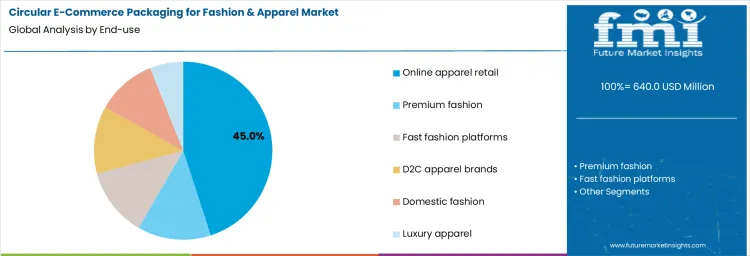
The online apparel retail segment is the largest end-use application in the circular e-commerce packaging for fashion and apparel market, accounting for 45% of the market share. This growth is primarily driven by the continued rise of online shopping, especially in the fashion industry, where convenient, eco-friendly packaging is becoming a key factor in attracting environmentally conscious consumers. Online apparel retailers are increasingly adopting circular packaging solutions such as reusable mailers and return bags, which align with growing sustainability efforts. These packaging formats allow consumers to reuse the mailers for returns, reducing the need for single-use packaging and minimizing waste.
Additionally, the shift towards circular packaging helps online retailers meet sustainability goals and improve their brand image, appealing to consumers who prioritize environmentally responsible practices. As the demand for sustainable fashion continues to rise and e-commerce platforms scale, the online apparel retail segment is expected to maintain its dominant position in the market, driving further adoption of circular packaging solutions.
What is Contributing to the Growth of Reusable Mailers & Return Bags in the Packaging Format Segment?

Reusable mailers and return bags dominate the packaging format segment in the circular e-commerce packaging for fashion and apparel market, accounting for 50% of the market share. The growth of this format is driven by the increasing focus on sustainability in the fashion and apparel industry, as both brands and consumers seek to reduce packaging waste. Reusable mailers and return bags are designed to be used multiple times, allowing for easy returns and exchanges without generating additional waste.
This circular packaging approach not only helps reduce the environmental impact but also lowers costs for e-commerce businesses by reducing the need for new packaging materials. The ability to reuse these mailers and bags aligns with the growing trend of reducing single-use plastics and promotes a more sustainable packaging model. As the fashion industry continues to embrace sustainable practices and respond to consumer demands for eco-friendly solutions, the adoption of reusable mailers and return bags is expected to grow, further driving the market's expansion.
What are the Key Dynamics of the Global Circular E-Commerce Packaging for Fashion & Apparel Market?
The global circular e-commerce packaging for fashion and apparel market is expanding as brands and logistics partners adopt reusable, returnable, and recyclable packaging solutions that reduce waste and support sustainability commitments. Circular packaging systems include durable mailers, returnable bins, modular inserts and trackable packaging that replace single-use materials while maintaining protection and presentation standards. Growth is supported by rising e-commerce sales, consumer demand for eco-responsible solutions, and investment in reusable supply chain infrastructure. Retailers and fashion companies are building closed-loop systems that help lower cost over time and improve environmental performance across markets worldwide.
What are the Key Drivers for the Global Circular E-Commerce Packaging for Fashion & Apparel Market?
One key driver is increasing consumer awareness of environmental impact and strong preference for brands that demonstrate sustainability leadership through packaging. Fashion and apparel companies face pressure to reduce plastic waste and align with circular economy principles, encouraging adoption of packaging that can be reused across multiple delivery and return cycles. Growth in online fashion purchases increases volume of outbound and return shipments, creating opportunity to optimise packaging lifecycles and reduce single-use consumption. Advancements in materials technology and digital return systems also help brands implement scalable reuse programs that improve return logistics and asset tracking.
What are the Restraints for the Global Circular E-Commerce Packaging for Fashion & Apparel Market?
One restraint is the operational complexity of managing returnable packaging at scale, which requires robust reverse logistics systems, cleaning and inspection processes and tracking technologies. Initial capital cost for durable reusable packaging and related infrastructure can be higher than conventional single-use alternatives, which may limit early adoption in smaller or cost-sensitive businesses. Inconsistent recycling and reuse infrastructure across regions can make it difficult to achieve reliable closed-loop flows. Consumer participation in returning packaging and compliance with return instructions also influences effectiveness of circular models and requires investment in incentives and communication.
What is the Key Trends in the Global Circular E-Commerce Packaging for Fashion & Apparel Market?
A key trend is integration of technology such as QR codes, RFID and mobile apps that support real-time tracking, return initiation and consumer engagement throughout the packaging lifecycle. Brands are piloting reusable mailers and modular packaging systems that can adapt to varied product sizes and reduce void fill. Collaboration among fashion retailers, logistics providers and packaging innovators is increasing to establish shared reuse networks and pooled assets that improve utilisation. Use of recyclable and compostable materials in hybrid circular systems is gaining interest, as stakeholders seek balance between performance, sustainability and cost. Transparency in reporting environmental impact and recycled content is influencing purchase decisions and shaping packaging strategies across channels.
What is the Country-Wise Analysis of the Circular E-Commerce Packaging for Fashion & Apparel Market?
The circular e-commerce packaging for fashion and apparel market is projected to experience strong growth, driven by increasing demand for sustainable and eco-friendly packaging solutions in the fashion industry. As e-commerce continues to expand, especially in the fashion and apparel sector, there is a growing push toward circular packaging, which focuses on recyclability and reuse to minimize environmental impact.
Countries like India and China are expected to experience high growth due to rapid industrialization, expanding middle-class populations, and increased consumer focus on sustainability. In developed markets like the USA and Germany, growth is fueled by regulatory frameworks and consumer demand for sustainable practices in fashion and apparel packaging. As the need for eco-friendly solutions grows, the market for circular e-commerce packaging in the fashion and apparel industry is expected to rise globally.
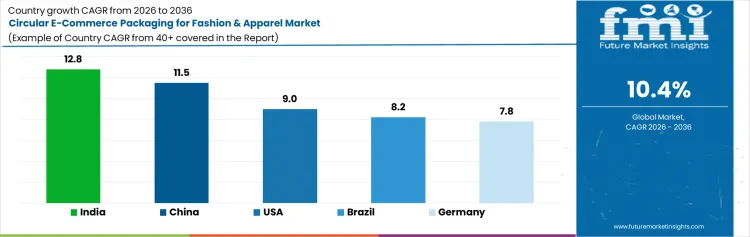
| Country | CAGR (2026-2036) |
|---|---|
| USA | 9% |
| Germany | 7.8% |
| China | 11.5% |
| India | 12.8% |
| Brazil | 8.2% |
What is the Growth Outlook for the Circular E-Commerce Packaging for Fashion & Apparel Market in the USA?
The market for circular e-commerce packaging for fashion and apparel in the United States is expected to grow at a moderate pace, with a projected CAGR of 9%. The USA is a leader in e-commerce, particularly in the fashion and apparel sector, where demand for sustainable packaging solutions is rising. Consumer awareness about the environmental impact of packaging waste is driving brands to adopt circular packaging systems. Additionally, regulatory pressures and corporate sustainability goals are pushing companies to meet more stringent environmental standards. As e-commerce continues to grow and consumers increasingly prioritize eco-friendly packaging, the demand for circular packaging solutions in the USA is expected to rise steadily.
What is the Market Outlook for the Circular E-Commerce Packaging for Fashion & Apparel Market in Germany?
The circular e-commerce packaging for fashion and apparel market in Germany is projected to grow at a moderate rate, with a projected CAGR of 7.8%. Germany’s strong commitment to sustainability and environmental protection is driving the adoption of circular packaging solutions in the fashion and apparel sector. The country’s regulatory environment encourages businesses to reduce their environmental footprint, which is pushing fashion brands to adopt recyclable, reusable, and sustainable packaging options. German consumers are increasingly aware of the impact of packaging waste, and brands are responding by shifting to circular packaging solutions that align with consumer values. As a result, Germany is expected to see steady growth in the adoption of circular e-commerce packaging in the fashion and apparel market.
What is the Growth Forecast for the Circular E-Commerce Packaging for Fashion & Apparel Market in China?
The circular e-commerce packaging for fashion and apparel market in China is expected to experience rapid growth, with a projected CAGR of 11.5%. China’s expanding e-commerce market, particularly in the fashion sector, is contributing to the growing demand for sustainable packaging solutions. The country’s government is also pushing for greener manufacturing practices, and brands are increasingly adopting circular packaging systems to align with both consumer preferences and regulatory requirements. As China’s middle class continues to grow, there is an increasing demand for eco-friendly products, including fashion packaging. The combination of expanding e-commerce, consumer awareness of sustainability, and government support for circular economy practices is expected to drive robust market growth in China.
What is the Market Outlook for the Circular E-Commerce Packaging for Fashion & Apparel Market in India?
The circular e-commerce packaging for fashion and apparel market in India is projected to grow at the highest rate globally, with a CAGR of 12.8%. India’s rapidly expanding e-commerce sector, coupled with rising consumer awareness of environmental issues, is fueling the demand for circular packaging solutions. As more consumers in India prioritize sustainability, fashion brands are under pressure to adopt eco-friendlier packaging. Additionally, the Indian government’s initiatives to reduce plastic waste and promote recycling are contributing to the growth of circular packaging solutions in the country. As India’s retail and fashion sectors continue to grow, the market for circular e-commerce packaging in the fashion and apparel industry is expected to see substantial growth in the coming years.
What are the Growth Prospects for the Circular E-Commerce Packaging for Fashion & Apparel Market in Brazil?
The circular e-commerce packaging for fashion and apparel market in Brazil is expected to grow at a moderate pace, with a projected CAGR of 8.2%. Brazil’s growing e-commerce market, particularly in the fashion sector, is contributing to the rising demand for sustainable packaging solutions. As consumers become more environmentally conscious, Brazilian fashion brands are increasingly adopting circular packaging solutions to reduce their environmental impact. While the adoption of circular packaging in Brazil has been slower than in other regions, the growing focus on sustainability, combined with regulatory pressures to reduce plastic waste, is expected to drive steady market growth. As Brazilian consumers demand more sustainable products, the market for circular e-commerce packaging in fashion and apparel is expected to continue expanding.
What is the Competitive Landscape for the Circular E-Commerce Packaging for Fashion & Apparel Market?
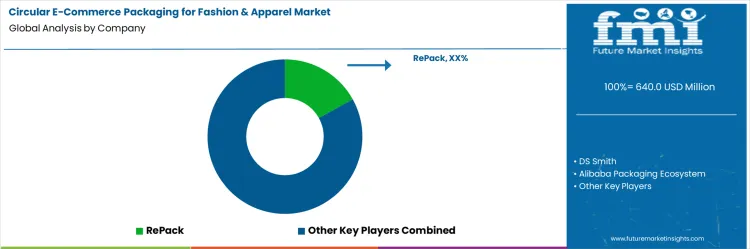
The circular e-commerce packaging for fashion and apparel market is growing rapidly, driven by the need for sustainable packaging solutions that reduce environmental impact. RePack leads the market with its innovative reusable packaging solutions designed specifically for fashion and apparel e-commerce. Their focus on circularity, reducing waste, and promoting recycling has positioned them as a market leader. DS Smith, Alibaba Packaging Ecosystem, and UFlex are key competitors, offering sustainable packaging solutions that align with the growing demand for eco-friendly practices in the fashion and apparel industry.
DS Smith focuses on designing sustainable, recyclable, and reusable packaging, while Alibaba Packaging Ecosystem integrates circular packaging solutions to support sustainable e-commerce in the fashion sector. UFlex provides flexible packaging solutions that are tailored to fashion and apparel, combining recyclability with durability.
Berry Global and Schoeller Allibert further contribute to the competitive landscape, offering advanced packaging solutions that emphasize sustainability and recyclability. Berry Global focuses on creating high-performance, eco-friendly packaging for fashion e-commerce, while Schoeller Allibert provides reusable packaging systems designed to improve the circularity of e-commerce operations. These companies compete by focusing on product innovation, sustainability, and the ability to offer packaging solutions that help fashion and apparel brands reduce their environmental footprint while maintaining functionality and appeal for consumers.
Key Players of the Circular E-Commerce Packaging for Fashion & Apparel Market
- RePack
- DS Smith
- Alibaba Packaging Ecosystem
- UFlex
- Berry Global
- Schoeller Allibert
Scope of the Report
| Items | Values |
|---|---|
| Quantitative Units (2026) | USD Million |
| End-use / Application | Online Apparel Retail, Premium Fashion, Fast Fashion Platforms, D2C Apparel Brands, Domestic Fashion, Luxury Apparel |
| Packaging Format / Type | Reusable Mailers & Return Bags, Foldable Return Mailers, Multi-Use Poly Mailers, Returnable Bags, Others |
| Material | Recycled PE / PP Fabrics, Woven PP, Recycled PE Blends, PE Fabrics, Others |
| Technology | Reverse-Logistics-Enabled Reuse, RFID/QR Reuse Tracking, High-Cycle Durability Films, Cost-Optimised Reuse |
| Companies | RePack (Leading), DS Smith, Alibaba Packaging Ecosystem, UFlex, Berry Global, Schoeller Allibert |
| Regions Covered | North America, Latin America, Western Europe, Eastern Europe, South Asia and Pacific, East Asia, Middle East & Africa |
| Countries Covered | United States, Canada, Mexico, Brazil, Argentina, Germany, France, United Kingdom, Italy, Spain, Netherlands, China, India, Japan, South Korea, ANZ, GCC Countries, South Africa |
| Additional Attributes | Dollar by sales by end-use/application, packaging format/type, material, technology, and region. Includes market trends in circular e-commerce packaging for fashion & apparel, focusing on reusable mailers, foldable return mailers, and multi-use poly mailers. Highlights the role of RFID/QR tracking, high-cycle durability films, and reverse-logistics-enabled reuse in reducing environmental impact. Focus on cost-effectiveness, sustainability, regulatory compliance, and market share of key companies in the fashion & apparel packaging space. |
Circular E-Commerce Packaging for Fashion & Apparel Market Segmentation
End-use / Application
- Online apparel retail
- Premium fashion
- Fast fashion platforms
- D2C apparel brands
- Domestic fashion
- Luxury apparel
Packaging Format / Type
- Reusable mailers & return bags
- Foldable return mailers
- Multi-use poly mailers
- Returnable bags
- Others
Material
- Recycled PE / PP fabrics
- Woven PP
- Recycled PE blends
- PE fabrics
- Others
Technology
- Reverse-logistics-enabled reuse
- RFID/QR reuse tracking
- High-cycle durability films
- Cost-optimised reuse
- Others
Region
- Asia Pacific
- China
- Japan
- South Korea
- India
- Australia & New Zealand
- ASEAN
- Rest of Asia Pacific
- Europe
- Germany
- United Kingdom
- France
- Italy
- Spain
- Nordic
- BENELUX
- Rest of Europe
- North America
- United States
- Canada
- Mexico
- Latin America
- Brazil
- Chile
- Rest of Latin America
- Middle East & Africa
- Kingdom of Saudi Arabia
- Other GCC Countries
- Turkey
- South Africa
- Other African Union
- Rest of Middle East & Africa
Frequently Asked Questions
How big is the circular e-commerce packaging for fashion & apparel market in 2026?
The global circular e-commerce packaging for fashion & apparel market is estimated to be valued at USD 640.0 million in 2026.
What will be the size of circular e-commerce packaging for fashion & apparel market in 2036?
The market size for the circular e-commerce packaging for fashion & apparel market is projected to reach USD 1,721.4 million by 2036.
How much will be the circular e-commerce packaging for fashion & apparel market growth between 2026 and 2036?
The circular e-commerce packaging for fashion & apparel market is expected to grow at a 10.4% CAGR between 2026 and 2036.
What are the key product types in the circular e-commerce packaging for fashion & apparel market?
The key product types in circular e-commerce packaging for fashion & apparel market are online apparel retail, premium fashion, fast fashion platforms, d2c apparel brands, domestic fashion and luxury apparel.
Which packaging format segment to contribute significant share in the circular e-commerce packaging for fashion & apparel market in 2026?
In terms of packaging format, reusable mailers & return bags segment to command 50.0% share in the circular e-commerce packaging for fashion & apparel market in 2026.
Preview the report firsthand - request a free sample
Get SampleGet the brochure for pricing and purchase details.
Get PDFTable of Content
- Executive Summary
- Global Market Outlook
- Demand-side Trends
- Supply-side Trends
- Technology Roadmap Analysis
- Analysis and Recommendations
- Market Overview
- Market Coverage / Taxonomy
- Market Definition / Scope / Limitations
- Market Background
- Market Dynamics
- Drivers
- Restraints
- Opportunity
- Trends
- Scenario Forecast
- Demand in Optimistic Scenario
- Demand in Likely Scenario
- Demand in Conservative Scenario
- Opportunity Map Analysis
- Product Life Cycle Analysis
- Supply Chain Analysis
- Investment Feasibility Matrix
- Value Chain Analysis
- PESTLE and Porter’s Analysis
- Regulatory Landscape
- Regional Parent Market Outlook
- Production and Consumption Statistics
- Import and Export Statistics
- Market Dynamics
- Global Market Analysis 2021 to 2025 and Forecast, 2026 to 2036
- Historical Market Size Value (USD Million) Analysis, 2021 to 2025
- Current and Future Market Size Value (USD Million) Projections, 2026 to 2036
- Y-o-Y Growth Trend Analysis
- Absolute $ Opportunity Analysis
- Global Market Pricing Analysis 2021 to 2025 and Forecast 2026 to 2036
- Global Market Analysis 2021 to 2025 and Forecast 2026 to 2036, By End-use
- Introduction / Key Findings
- Historical Market Size Value (USD Million) Analysis By End-use , 2021 to 2025
- Current and Future Market Size Value (USD Million) Analysis and Forecast By End-use , 2026 to 2036
- Online apparel retail
- Premium fashion
- Fast fashion platforms
- D2C apparel brands
- Domestic fashion
- Luxury apparel
- Y-o-Y Growth Trend Analysis By End-use , 2021 to 2025
- Absolute $ Opportunity Analysis By End-use , 2026 to 2036
- Global Market Analysis 2021 to 2025 and Forecast 2026 to 2036, By Packaging Format
- Introduction / Key Findings
- Historical Market Size Value (USD Million) Analysis By Packaging Format, 2021 to 2025
- Current and Future Market Size Value (USD Million) Analysis and Forecast By Packaging Format, 2026 to 2036
- Reusable mailers & return bags
- Foldable return mailers
- Multi-use poly mailers
- Returnable bags
- Y-o-Y Growth Trend Analysis By Packaging Format, 2021 to 2025
- Absolute $ Opportunity Analysis By Packaging Format, 2026 to 2036
- Global Market Analysis 2021 to 2025 and Forecast 2026 to 2036, By Material
- Introduction / Key Findings
- Historical Market Size Value (USD Million) Analysis By Material, 2021 to 2025
- Current and Future Market Size Value (USD Million) Analysis and Forecast By Material, 2026 to 2036
- Recycled PE / PP fabrics
- Woven PP
- Recycled PE blends
- PE fabrics
- Y-o-Y Growth Trend Analysis By Material, 2021 to 2025
- Absolute $ Opportunity Analysis By Material, 2026 to 2036
- Global Market Analysis 2021 to 2025 and Forecast 2026 to 2036, By Technology
- Introduction / Key Findings
- Historical Market Size Value (USD Million) Analysis By Technology, 2021 to 2025
- Current and Future Market Size Value (USD Million) Analysis and Forecast By Technology, 2026 to 2036
- Reverse-logistics-enabled reuse
- RFID/QR reuse tracking
- High-cycle durability films
- Cost-optimised reuse
- Y-o-Y Growth Trend Analysis By Technology, 2021 to 2025
- Absolute $ Opportunity Analysis By Technology, 2026 to 2036
- Global Market Analysis 2021 to 2025 and Forecast 2026 to 2036, By Region
- Introduction
- Historical Market Size Value (USD Million) Analysis By Region, 2021 to 2025
- Current Market Size Value (USD Million) Analysis and Forecast By Region, 2026 to 2036
- North America
- Latin America
- Western Europe
- Eastern Europe
- East Asia
- South Asia and Pacific
- Middle East & Africa
- Market Attractiveness Analysis By Region
- North America Market Analysis 2021 to 2025 and Forecast 2026 to 2036, By Country
- Historical Market Size Value (USD Million) Trend Analysis By Market Taxonomy, 2021 to 2025
- Market Size Value (USD Million) Forecast By Market Taxonomy, 2026 to 2036
- By Country
- USA
- Canada
- Mexico
- By End-use
- By Packaging Format
- By Material
- By Technology
- By Country
- Market Attractiveness Analysis
- By Country
- By End-use
- By Packaging Format
- By Material
- By Technology
- Key Takeaways
- Latin America Market Analysis 2021 to 2025 and Forecast 2026 to 2036, By Country
- Historical Market Size Value (USD Million) Trend Analysis By Market Taxonomy, 2021 to 2025
- Market Size Value (USD Million) Forecast By Market Taxonomy, 2026 to 2036
- By Country
- Brazil
- Chile
- Rest of Latin America
- By End-use
- By Packaging Format
- By Material
- By Technology
- By Country
- Market Attractiveness Analysis
- By Country
- By End-use
- By Packaging Format
- By Material
- By Technology
- Key Takeaways
- Western Europe Market Analysis 2021 to 2025 and Forecast 2026 to 2036, By Country
- Historical Market Size Value (USD Million) Trend Analysis By Market Taxonomy, 2021 to 2025
- Market Size Value (USD Million) Forecast By Market Taxonomy, 2026 to 2036
- By Country
- Germany
- UK
- Italy
- Spain
- France
- Nordic
- BENELUX
- Rest of Western Europe
- By End-use
- By Packaging Format
- By Material
- By Technology
- By Country
- Market Attractiveness Analysis
- By Country
- By End-use
- By Packaging Format
- By Material
- By Technology
- Key Takeaways
- Eastern Europe Market Analysis 2021 to 2025 and Forecast 2026 to 2036, By Country
- Historical Market Size Value (USD Million) Trend Analysis By Market Taxonomy, 2021 to 2025
- Market Size Value (USD Million) Forecast By Market Taxonomy, 2026 to 2036
- By Country
- Russia
- Poland
- Hungary
- Balkan & Baltic
- Rest of Eastern Europe
- By End-use
- By Packaging Format
- By Material
- By Technology
- By Country
- Market Attractiveness Analysis
- By Country
- By End-use
- By Packaging Format
- By Material
- By Technology
- Key Takeaways
- East Asia Market Analysis 2021 to 2025 and Forecast 2026 to 2036, By Country
- Historical Market Size Value (USD Million) Trend Analysis By Market Taxonomy, 2021 to 2025
- Market Size Value (USD Million) Forecast By Market Taxonomy, 2026 to 2036
- By Country
- China
- Japan
- South Korea
- By End-use
- By Packaging Format
- By Material
- By Technology
- By Country
- Market Attractiveness Analysis
- By Country
- By End-use
- By Packaging Format
- By Material
- By Technology
- Key Takeaways
- South Asia and Pacific Market Analysis 2021 to 2025 and Forecast 2026 to 2036, By Country
- Historical Market Size Value (USD Million) Trend Analysis By Market Taxonomy, 2021 to 2025
- Market Size Value (USD Million) Forecast By Market Taxonomy, 2026 to 2036
- By Country
- India
- ASEAN
- Australia & New Zealand
- Rest of South Asia and Pacific
- By End-use
- By Packaging Format
- By Material
- By Technology
- By Country
- Market Attractiveness Analysis
- By Country
- By End-use
- By Packaging Format
- By Material
- By Technology
- Key Takeaways
- Middle East & Africa Market Analysis 2021 to 2025 and Forecast 2026 to 2036, By Country
- Historical Market Size Value (USD Million) Trend Analysis By Market Taxonomy, 2021 to 2025
- Market Size Value (USD Million) Forecast By Market Taxonomy, 2026 to 2036
- By Country
- Kingdom of Saudi Arabia
- Other GCC Countries
- Turkiye
- South Africa
- Other African Union
- Rest of Middle East & Africa
- By End-use
- By Packaging Format
- By Material
- By Technology
- By Country
- Market Attractiveness Analysis
- By Country
- By End-use
- By Packaging Format
- By Material
- By Technology
- Key Takeaways
- Key Countries Market Analysis
- USA
- Pricing Analysis
- Market Share Analysis, 2025
- By End-use
- By Packaging Format
- By Material
- By Technology
- Canada
- Pricing Analysis
- Market Share Analysis, 2025
- By End-use
- By Packaging Format
- By Material
- By Technology
- Mexico
- Pricing Analysis
- Market Share Analysis, 2025
- By End-use
- By Packaging Format
- By Material
- By Technology
- Brazil
- Pricing Analysis
- Market Share Analysis, 2025
- By End-use
- By Packaging Format
- By Material
- By Technology
- Chile
- Pricing Analysis
- Market Share Analysis, 2025
- By End-use
- By Packaging Format
- By Material
- By Technology
- Germany
- Pricing Analysis
- Market Share Analysis, 2025
- By End-use
- By Packaging Format
- By Material
- By Technology
- UK
- Pricing Analysis
- Market Share Analysis, 2025
- By End-use
- By Packaging Format
- By Material
- By Technology
- Italy
- Pricing Analysis
- Market Share Analysis, 2025
- By End-use
- By Packaging Format
- By Material
- By Technology
- Spain
- Pricing Analysis
- Market Share Analysis, 2025
- By End-use
- By Packaging Format
- By Material
- By Technology
- France
- Pricing Analysis
- Market Share Analysis, 2025
- By End-use
- By Packaging Format
- By Material
- By Technology
- India
- Pricing Analysis
- Market Share Analysis, 2025
- By End-use
- By Packaging Format
- By Material
- By Technology
- ASEAN
- Pricing Analysis
- Market Share Analysis, 2025
- By End-use
- By Packaging Format
- By Material
- By Technology
- Australia & New Zealand
- Pricing Analysis
- Market Share Analysis, 2025
- By End-use
- By Packaging Format
- By Material
- By Technology
- China
- Pricing Analysis
- Market Share Analysis, 2025
- By End-use
- By Packaging Format
- By Material
- By Technology
- Japan
- Pricing Analysis
- Market Share Analysis, 2025
- By End-use
- By Packaging Format
- By Material
- By Technology
- South Korea
- Pricing Analysis
- Market Share Analysis, 2025
- By End-use
- By Packaging Format
- By Material
- By Technology
- Russia
- Pricing Analysis
- Market Share Analysis, 2025
- By End-use
- By Packaging Format
- By Material
- By Technology
- Poland
- Pricing Analysis
- Market Share Analysis, 2025
- By End-use
- By Packaging Format
- By Material
- By Technology
- Hungary
- Pricing Analysis
- Market Share Analysis, 2025
- By End-use
- By Packaging Format
- By Material
- By Technology
- Kingdom of Saudi Arabia
- Pricing Analysis
- Market Share Analysis, 2025
- By End-use
- By Packaging Format
- By Material
- By Technology
- Turkiye
- Pricing Analysis
- Market Share Analysis, 2025
- By End-use
- By Packaging Format
- By Material
- By Technology
- South Africa
- Pricing Analysis
- Market Share Analysis, 2025
- By End-use
- By Packaging Format
- By Material
- By Technology
- USA
- Market Structure Analysis
- Competition Dashboard
- Competition Benchmarking
- Market Share Analysis of Top Players
- By Regional
- By End-use
- By Packaging Format
- By Material
- By Technology
- Competition Analysis
- Competition Deep Dive
- RePack
- Overview
- Product Portfolio
- Profitability by Market Segments (Product/Age /Sales Channel/Region)
- Sales Footprint
- Strategy Overview
- Marketing Strategy
- Product Strategy
- Channel Strategy
- DS Smith
- Alibaba Packaging Ecosystem
- UFlex
- Berry Global
- Schoeller Allibert
- RePack
- Competition Deep Dive
- Assumptions & Acronyms Used
- Research Methodology


