

- Industry Size (2026)
- USD 3.0 Bn
- Forecast (2036)
- USD 7.0 Bn
- CAGR (2026 to 2036)
- 8.8%
Circular Specialty Plastics for Textiles & Packaging Market Forecast Outlook 2026 to 2036
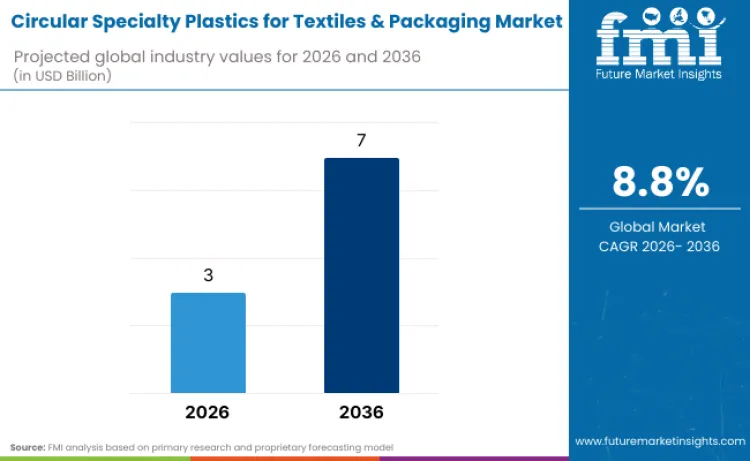
The circular specialty plastics market serving textiles and packaging market will likely total USD 3.0 billion in 2026, and increase to USD 7.0 billion by 2036, registering a CAGR of 8.8%. FMI is of the opinion that circular specialty plastics market serving textiles and packaging is moving through a clear turning point. Regulation has been a major accelerant, particularly across Europe, where packaging reform and recycled-content expectations from global consumer brands have pushed the industry beyond the limits of mechanical recycling.
This has driven increased adoption of chemical recycling pathways and bio-based feedstocks that can deliver circular outcomes without weakening material performance. These approaches are gaining momentum because they work within real-world constraints, preserving durability, barrier properties, and compliance while supporting environmental goals.
Investment is concentrated on scalable, low-carbon manufacturing platforms that can absorb circular feedstocks without disrupting operations. In the textile sector, recycled polymers are being redirected away from lower-grade uses toward applications that demand consistency, strength, and reliability. The industry’s focus has shifted from experimentation to execution, with attention squarely on repeatability, quality control, and long-term economics.
Mass balance accounting has become a practical enabler of this transition. By allowing circular inputs to be integrated into established polymer streams, it reduces adoption risk while maintaining equivalence to conventional materials. For brand owners, this offers a credible and operationally simple route to advance climate commitments without redesigning products or retooling supply chains.
As this market matures, the most pressing challenges are no longer technological. Instead, progress depends on system-level alignment. Collection infrastructure, sorting performance, and harmonized design-for-circularity standards will determine how quickly circular specialty plastics can scale. Increasingly, circularity is being addressed upstream, with resin development incorporating feedstock flexibility and end-of-life considerations from the earliest design stages.
This perspective is clearly reflected in the following analyst-relevant commentary from Dow’s leadership:
"To make a real difference, any agreement must create and nurture an environment that promotes innovation and investments at scale, including circularity drivers like sustainable design standards, recycled content mandates, national recycling targets, and extended producer responsibility (EPR) in national action plans."
Summary of the Circular Specialty Plastics for Textiles & Packaging Market
What is Growth Outlook for Circular Specialty Plastics for Textiles & Packaging Market as per Future Market Insights Projection?
Future Market Insights projects the circular specialty plastics for textiles & packaging market to expand at a CAGR of 8.8% from 2026 to 2036, increasing from USD 3.0 billion in 2026 to USD 7.0 billion by 2036.
FMI Research Approach: FMI proprietary forecasting model integrating packaging regulation enforcement timelines, recycled-content mandates, chemical recycling scale-up, and adoption of mass-balance–attributed circular polymers across textiles and packaging value chains.
How do FMI Analysts Perceive Circular Specialty Plastics for Textiles & Packaging Market to Evolve?
FMI analysts perceive the market evolving from voluntary circularity initiatives into a compliance-driven materials system. Demand is increasingly anchored in enforceable recyclability, recycled-content, and chemical safety requirements rather than brand-led sustainability commitments.
FMI Research Approach: Assessment of regulatory mandates, brand procurement strategies, and commercial readiness of chemical recycling and bio-attributed polymer platforms.
Which Country Holds Largest Share in Global Circular Specialty Plastics for Textiles & Packaging Market?
China holds the largest share of the global circular specialty plastics for textiles & packaging market, supported by national standards governing recycled plastic quality, strategic positioning of chemical recycling as an industrial pathway, and rising demand for compliant circular polymers across packaging and textile manufacturing.
FMI Research Approach: Country-level modeling based on recycling standardization, specialty polymer production capacity, and integration of circular feedstocks into domestic textile and packaging supply chains.
How Large will the Circular Specialty Plastics for Textiles & Packaging Market Be by 2036?
The global circular specialty plastics for textiles & packaging market is projected to reach USD 7.0 billion by 2036.
FMI Research Approach: Long-term revenue forecasting derived from binding packaging regulations, extended producer responsibility frameworks, and increasing substitution of virgin specialty polymers with certified circular alternatives.
What is the Definition of Circular Specialty Plastics for Textiles & Packaging Market?
The circular specialty plastics for textiles & packaging market comprises high-performance polymer materials engineered to incorporate mechanically recycled, chemically recycled, bio-based, or mass-balance–attributed circular feedstocks while maintaining functional performance required in regulated textile and packaging applications.
FMI Research Approach: FMI market taxonomy and inclusion–exclusion framework covering specialty polymers designed for recyclability, traceability, and regulatory compliance across textile and packaging end uses.
What are some Globally Unique Trends Shaping Circular Specialty Plastics for Textiles & Packaging Market?
Globally unique trends include the dominance of specialty polyesters and copolyesters, rising adoption of chemical recycling to meet food-contact and performance requirements, increasing reliance on mass-balance accounting, and growing integration of digital traceability systems to support regulatory audits and premium pricing.
FMI Research Approach: Synthesis of regulatory developments, advanced recycling deployment data, and procurement behavior of multinational brand owners across regulated markets.
Circular Specialty Plastics for Textiles & Packaging Market Key Takeaways
| Metric | Value |
|---|---|
| Expected Value (2026E) | USD 3.0 billion |
| Projected Valued (2036F) | USD 7.0 billion |
| CAGR (2026-2036) | 8.8% |
Source: Future Market Insights (FMI) analysis, based on proprietary forecasting model and primary research
Why is the Circular Specialty Plastics for Textiles & Packaging Market Growing?
The circular specialty plastics market for textiles and packaging is shifting into a new growth phase as sustainability moves from choice to obligation. By 2026, regulation, infrastructure maturity, and demand certainty are aligning in a way that pushes the sector out of pilot projects and into industrial scale. Growth is now tied to compliance economics, not brand storytelling, supporting a compound annual growth rate of about twelve percent through 2036.
Regulation is the primary force reshaping demand. The EU Packaging and Packaging Waste Regulation, enforced from August 2026, sets binding rules on recyclability, recycled content, and chemical safety across all packaging formats. Restrictions on PFAS in food contact materials and stricter extended producer responsibility requirements raise the cost of non-compliance through penalties and reduced market access. Circular specialty plastics are no longer an upgrade option. They are becoming the minimum standard for operating in regulated packaging markets.
Advanced recycling is scaling to meet performance and safety thresholds that mechanical recycling cannot reliably deliver, especially for food and medical uses. In early 2026, SABIC and Pashupati Group launched a large chemical recycling project in India to convert mixed plastic waste into pyrolysis oil. With annual capacity of roughly three hundred thousand metric tons, the facility supports certified circular polymers that match virgin material performance while meeting regulatory specifications.
Demand is becoming more stable as multinational brand owners commit to long-term recycled content procurement. By 2026, PepsiCo is likely to expand recycled PET use across more than sixty markets and reported a clear reduction in virgin plastic consumption. The rollout of fully recycled PET bottles in selected emerging markets is helping lock in predictable offtake for specialty circular resins.
Material design is also accelerating adoption. Companies are replacing complex multi-layer packaging with high performance mono-material solutions that maintain durability and barrier properties while remaining recyclable.
Commercial programs led by Borealis with Henkel and Korozo Group show that flexible packaging with post-consumer recycled content can meet functional and regulatory requirements at scale. Together, these shifts place circular specialty plastics firmly in a compliance-driven growth cycle entering sustained expansion after 2026.
How is the Circular Specialty Plastics for Textiles & Packaging Market Segmented?
Demand concentration in circular specialty plastics is being shaped by performance retention under circular inputs and end-use qualification speed. Technical textiles and performance apparel lead application uptake as brands prioritise functional circular materials over aesthetic substitution. On the materials side, specialty polyesters and copolyesters dominate due to their recyclability, tunable performance, and regulatory familiarity across both textile and packaging value chains.
Why do Technical Textiles and Performance Apparel Lead Circular Specialty Plastic Adoption?
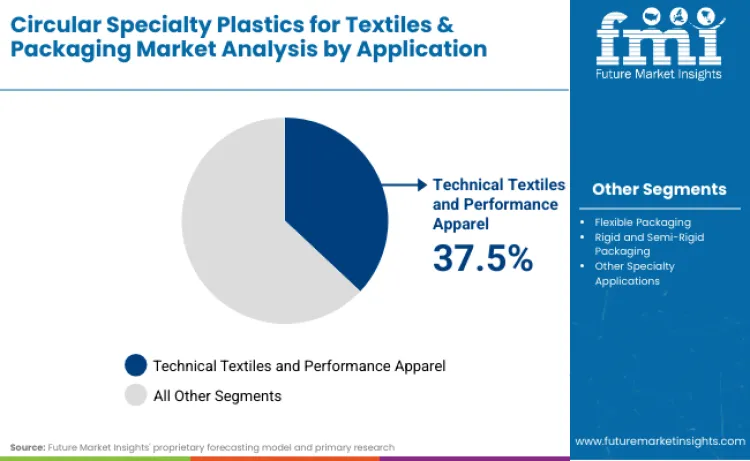
Technical textiles and performance apparel account for 37.5% all applications, making them the largest outlet for circular specialty plastics. This dominance reflects the sector’s high tolerance for engineered material substitution when performance benchmarks are preserved. Applications such as outdoor apparel, workwear, protective textiles, and sports performance garments increasingly specify circular polymers that deliver moisture management, abrasion resistance, elasticity retention, and thermal stability comparable to virgin materials.
Another driver is the speed of qualification and brand pull-through within performance apparel supply chains. Compared with packaging, textile brands exert greater influence over material selection and are more willing to collaborate on polymer reformulation to meet circularity targets. As recycled and bio-attributed specialty plastics demonstrate durability across repeated wash cycles and mechanical stress, technical textiles have become the primary proving ground for circular polymer innovation, absorbing a disproportionate share of early adoption volumes.
What Explains the Dominance of Specialty Polyesters and Copolyesters in the Polymer Mix?
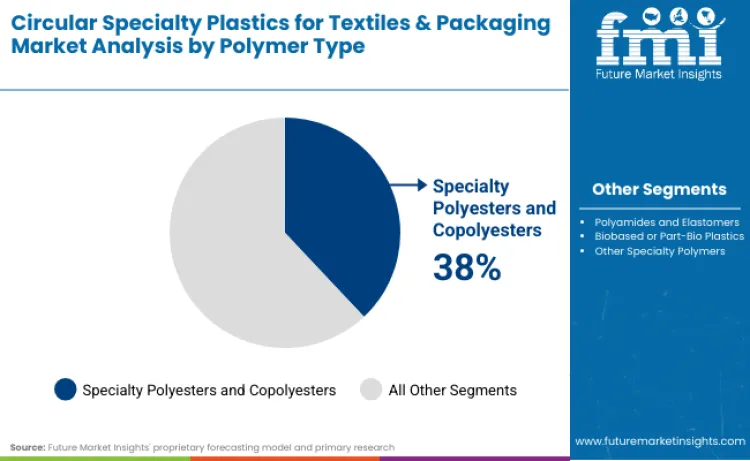
Specialty polyesters and copolyesters represent around 38% of polymer demand in the circular specialty plastics market, positioning them as the leading material class. Their dominance is rooted in chemical versatility and recyclability, allowing performance attributes such as elasticity, dyeability, and barrier properties to be tuned without sacrificing circular compatibility. Modified PET, PBT, and copolyester systems are particularly well suited to mechanical and molecular recycling routes, enabling repeated material loops with limited property degradation.
Equally important is their cross-sector acceptance across both textiles and packaging. Specialty polyesters are already embedded in existing regulatory frameworks, processing equipment, and recycling infrastructures, reducing adoption friction. This familiarity allows converters and brands to scale circular content rapidly while maintaining compliance and process efficiency. As circularity requirements tighten across apparel and packaging, specialty polyesters and copolyesters continue to function as the material backbone, supporting both volume scalability and performance-driven differentiation.
What Factors will Influence Demand for Circular Specialty Plastics for Textiles & Packaging?
The global circular specialty plastics market in 2026 is moving into a more decisive and disciplined phase as regulation becomes a direct driver of commercial outcomes. Mandatory recyclability rules are reshaping how packaging producers and specialty resin suppliers approach market access, particularly across Europe.
Manufacturers are being pushed to rethink material design, accelerate circular innovation, and lock in reliable sources of compliant recycled inputs. National plastics registries are reinforcing this shift by increasing visibility across the full material lifecycle, rewarding traceability and consistency over volume-based recycling claims.
The regulatory push is advancing faster than the industry’s ability to fully absorb it. In the United States, uncertainty around how advanced recycling technologies are treated under air emissions regulations continues to raise compliance costs and delay large-scale investment. Chemical recycling projects face longer permitting cycles and higher capital thresholds than originally anticipated.
Mechanical recycling also remains constrained when applied to specialty polymers, where contamination, sorting losses, and lower yield retention limit economic viability. These gaps are exposing structural weaknesses in existing recycling systems for high-performance and multilayer materials.
Clear opportunity is forming where chemical recycling meets material traceability. Circular naphtha produced from mixed plastic waste is gaining acceptance as a feedstock capable of delivering virgin-equivalent performance for food and pharmaceutical packaging.
Digital product passports are expected to reshape how circular materials are valued and traded. Verified data on origin, composition, and recycling pathways is likely to support premium pricing and smoother regulatory compliance, encouraging investment in certification platforms and data infrastructure.
Analysis of the Circular Specialty Plastics for Textiles & Packaging by Key Countries
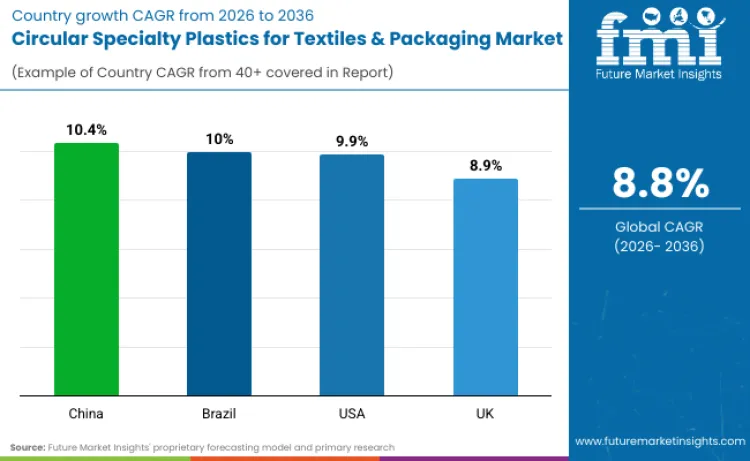
| Country | CAGR (2026-2036) |
|---|---|
| USA | 9.9% |
| Brazil | 10.0% |
| UK | 8.9% |
| China | 10.4% |
Source: Future Market Insights analysis, supported by a proprietary forecasting model and primary research
How is USA Converging Industrial Scale-Up with Federal Regulatory Scrutiny in the Upcoming Compliance Cycle?
The United States is moving into its next compliance cycle with an unresolved tension between rapid chemical recycling scale-up and intensifying federal oversight. On the industrial side, Eastman Chemical shows how molecular recycling has shifted from pilot validation to core business strategy. Expansion at its Kingsport facility reflects durable demand for recycled-content specialty polymers, especially from brand owners seeking drop-in materials that preserve performance. This investment also aligns with Eastman’s broader portfolio shift, where specialty plastics and circular feedstocks are stabilizing earnings as traditional intermediates face volatility. Chemical recycling is being treated as a structural margin defense, not a reputational exercise.
Regulatory attention is now moving away from semantic debates and toward operational accountability. The U.S. Environmental Protection Agency is signaling closer review of chemical recycling under existing environmental statutes, focusing on emissions, residual by-products, and pellet loss. For companies supplying specialty packaging in USA, compliance exposure now extends beyond recycled-content claims to verifiable process controls and traceability, particularly where chemically recycled inputs are used.
Why is Brazil Structuring Circularity around Enforcement Compared to Incentives?
Brazil is anchoring its circular economy strategy in mandatory compliance systems, not subsidies or voluntary targets. The nationwide rollout of the Waste Transport Manifest creates a centralized digital record of waste generation, movement, and processing. This sharply limits informal recycling and undocumented material flows, redefining what qualifies as compliant recycled content. For specialty packaging producers, access to secondary materials increasingly depends on participation in registered reverse-logistics systems rather than informal sourcing networks.
This enforcement framework is reinforced by Brazil’s ban on solid waste imports, which removes external feedstock inflows and redirects demand toward domestic collection and processing. The result is a protected internal recycling market paired with higher documentation standards for manufacturers using recycled content. Within this structure, Petrobras’s investment in biorefining and circular initiatives reflects alignment between industrial capital and regulatory direction.
How is UK Re-Engineering Economic Pressure to Accelerate Circular Packaging?
UK is using direct cost exposure to drive circular packaging adoption. The Plastic Packaging Tax now functions as a recurring margin variable rather than a transitional penalty, especially for specialty formats where recycled polymers have historically been difficult to deploy. Manufacturers are responding by locking in long-term compliant supply rather than relying on short-term adjustments or exemptions.
The evolution from the Plastics Pact to the broader UK Packaging Pact expands circularity expectations across material categories without softening enforcement pressure. Recyclability, reuse, and material efficiency are being treated as baseline requirements across packaging types. While mass-balance recognition for chemically recycled plastics remains under discussion, it is not yet operational. Exporters must continue to comply with physical attribution rules, while preparing systems and supplier documentation for eventual regulatory acceptance.
Why is China Using Standardization to Direct Recycling Outcomes Rather Than Market Signals?
China is steering recycling outcomes through technical standards, not price incentives. New national specifications for recycled plastics set explicit requirements for material grading, design compatibility, and traceability, especially for high-volume packaging polymers. Compliance is assessed on material quality and safety rather than recycled-content declarations alone, raising entry thresholds for specialty packaging suppliers.
These standards sit within a broader policy push to eliminate low-quality plastic applications while upgrading the value of recovered materials. The National Development and Reform Commission has positioned chemical recycling as a strategic pathway for converting complex waste into industrial-grade feedstocks. For foreign exporters, access depends on alignment with national standards, participation in approved recycling systems, and contribution to domestic resource-efficiency goals, not standalone commercial competitiveness.
What is the Competition Outlook for Circular Specialty Plastics for Textiles & Packaging?
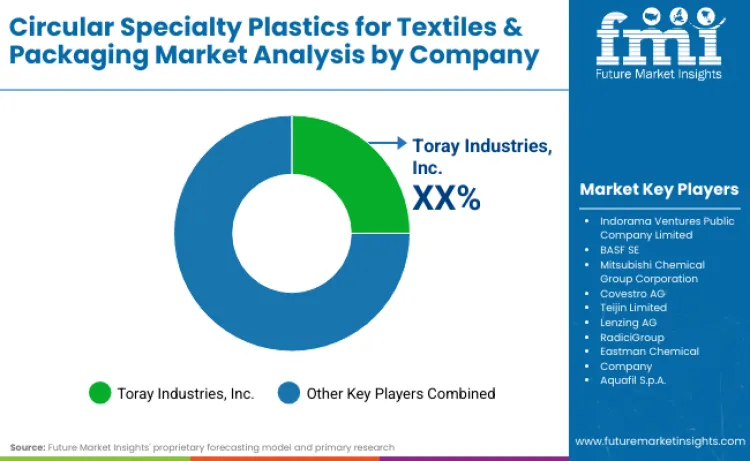
The global circular specialty plastics market has shifted from a voluntary sustainability exercise into a regulated industrial system. Earlier growth was shaped mainly by corporate pledges and ESG signal. Brand owners adopted recycled content targets to strengthen reputation rather than to meet enforceable requirements.
This created predictable demand for post-consumer recycled materials without placing strong pressure on consistency or scalability. Mechanical recycling dominated supply, especially for PET and HDPE used in rigid packaging. Investment focused on expanding washing and reprocessing capacity, reinforcing a market structure driven by throughput efficiency and cost discipline.
Advanced recycling followed a different path during this period. Technologies such as depolymerization, methanolysis, and pyrolysis attracted strategic interest but remained commercially marginal. Most projects operated at pilot or demonstration scale, aimed at proving technical feasibility rather than building supply volume.
High capital intensity, limited policy clarity, and weak offtake certainty slowed industrial deployment. Chemical recycling was positioned as a future solution for complex plastic streams, not as a near-term competitive lever. As a result, mechanical recycling continued to define material availability and pricing behaviour.
This balance is now changing. Regulatory mandates are redefining demand across packaging, textiles, and specialty applications. Recycled content and recyclability requirements are becoming binding conditions for market participation rather than aspirational targets. Circular materials are no longer selected for brand differentiation.
They are required inputs to maintain regulatory compliance. This shift is altering procurement behavior, investment priorities, and supply chain design across the plastics ecosystem. Capital allocation is increasingly aligned with regulatory timelines rather than voluntary sustainability roadmaps.
Quality requirements under these mandates are accelerating the role of advanced recycling. Mechanical processes struggle to deliver consistent performance for food contact, high-barrier packaging, and technical textiles. Chemical recycling enables recovery at the molecular level, producing materials that closely match virgin polymer specifications. As compliance pressure increases, demand is moving toward solutions that combine circularity with reliability. Commercial facilities planned for the coming years reflect growing confidence in monomer recovery systems. Competitive advantage is shifting away from waste aggregation toward process efficiency, catalyst optimization, and feedstock flexibility. Producers capable of supplying high-specification circular polymers are securing long-term offtake and pricing stability.
Digital capability is emerging as a structural differentiator. Conventional recycling systems lose value through contamination, poor sorting, and limited material identification. AI-driven sorting and sensor technologies are improving separation accuracy and usable yield. These tools reduce downcycling and improve consistency, directly affecting economics.
Traceability is becoming equally important. End users increasingly require verified data on recycled content, material origin, and emissions intensity. Transparency is no longer a reporting add-on. It is influencing supplier selection and contract structure, particularly in regulated markets where compliance verification is routine.
Key Players Profiled
- Toray Industries, Inc.
- Indorama Ventures Public Company Limited
- BASF SE
- Mitsubishi Chemical Group Corporation
- Covestro AG
- Teijin Limited
- Lenzing AG
- RadiciGroup
- Eastman Chemical Company
- Aquafil S.p.A.
Market Definition
The circular specialty plastics for textiles & packaging market comprises high-performance polymer materials engineered to incorporate circular feedstocks while maintaining functional properties required in regulated textile and packaging applications. These materials are designed to enable recyclability, recycled-content integration, or bio-attribution without compromising durability, barrier performance, safety, or processability. The market reflects the transition of circular plastics from voluntary sustainability initiatives into compliance-driven material systems shaped by packaging regulation, extended producer responsibility, and brand-level recycled-content mandates.
The report includes specialty polymers produced using mechanically recycled inputs, chemically recycled feedstocks, bio-based or part-bio carbon sources, and mass-balance–attributed circular materials. It covers applications across technical textiles and performance apparel, flexible packaging, rigid and semi-rigid packaging, and other specialty uses where material consistency and regulatory qualification are critical. Polymer classes within scope include specialty polyesters and copolyesters, polyamides and elastomers, and other engineered plastics designed for repeated material loops and traceability across global textile and packaging value chains.
The scope excludes commodity plastics used in low-performance or non-specialty applications, uncertified recycled polymers lacking traceability or compliance attribution, and virgin fossil-based plastics without circular positioning. It also excludes waste collection and sorting operations, recycling equipment, finished textile or packaging products, and experimental recycling technologies not operating at commercial or pre-commercial industrial scale. Downstream conversion activities and consumer goods manufacturing fall outside the defined market boundary.
Scope of Report
| Items | Values |
|---|---|
| Quantitative Units (2026) | USD 3.0 billion |
| Application |
Technical Textiles and Performance Apparel, Flexible Packaging, Rigid and Semi-Rigid Packaging, Other Specialty Applications |
| Polymer Type |
Specialty Polyesters and Copolyesters, Polyamides and Elastomers, Biobased or Part-Bio Plastics, Other Specialty Polymers |
| Regions Covered | North America, Western Europe, Eastern Europe, East Asia, South Asia & Pacific, Latin America, Middle East & Africa |
| Countries Covered | USA, UK, China, Brazil and 40+ Countries |
| Key Companies Profiled | Toray Industries, Inc., Indorama Ventures Public Company Limited, BASF SE, Mitsubishi Chemical Group Corporation, Covestro AG, Teijin Limited, Lenzing AG, RadiciGroup, Eastman Chemical Company, Aquafil S.p.A. |
Source: FMI’s proprietary forecasting model and primary research
Key Segments Profiled
Application
- Technical Textiles and Performance Apparel
- Flexible Packaging
- Rigid and Semi-Rigid Packaging
- Other Specialty Applications
Polymer Type
- Specialty Polyesters and Copolyesters
- Polyamides and Elastomers
- Biobased or Part-Bio Plastics
- Other Specialty Polymers
Region
- North America
- Western Europe
- Eastern Europe
- East Asia
- South Asia & Pacific
- Latin America
- Middle East & Africa
Bibliography
- Rorrer, N. A., Nicholson, S., Carpenter, A., Biddy, M. J., Grundl, N. J., & Beckham, G. T. (2023). Combining reclaimed PET with chemical recycling to enable circular polyester. Nature Communications, 14, 1231.
- European Committee for Standardization. (2024). EN 15353: Plastics — Recycled plastics — Characterization of poly(ethylene terephthalate) (PET) recyclates. CEN.
- Eastman Chemical Company. (2025). Molecular recycling of polyesters: Feedstock flexibility, resin performance, and mass-balance attribution. Technical Sustainability Report.
- Borealis AG. (2025). Advanced recycling and circular polyolefin and polyester solutions for packaging and technical textiles. Circular Economy Technology Brief.
Frequently Asked Questions
How large is the circular specialty plastics market from a technology adoption standpoint?
The market is valued at around USD 3.0 billion in 2026, reflecting the transition of circular polymer technologies from pilot-scale validation into commercially deployed industrial systems.
Which technologies are enabling circular specialty plastics at industrial scale?
Chemical recycling platforms such as depolymerisation, pyrolysis, and mass-balance-enabled polymerisation are the core technologies, supported by bio-based feedstock processing and advanced compounding systems.
Why is mass-balance accounting considered a critical technology enabler?
Mass-balance systems allow circular feedstocks to be integrated into existing polymer assets without retooling, reducing technical risk while maintaining material equivalence and compliance with certification frameworks.
How are digital technologies influencing circular plastics deployment?
Digital traceability tools, material passports, and data-driven certification platforms are becoming essential for verifying recycled content, managing regulatory audits, and enabling premium pricing for compliant circular materials.
What technology-related constraints limit faster scaling of circular specialty plastics?
Key constraints include feedstock variability, capital intensity of chemical recycling assets, permitting complexity, and the need to align recycling technologies with evolving design-for-circularity standards.
Preview the report firsthand - request a free sample
Get SampleGet the brochure for pricing and purchase details.
Get PDFTable of Content
- Executive Summary
- Circular Specialty Plastics for Textiles & Packaging Market Forecast & Outlook (2026–2036)
- Why is the Circular Specialty Plastics for Textiles & Packaging Market Growing?
- Shift from Voluntary Circularity to Regulatory Compliance
- Limitations of Mechanical Recycling in Performance Applications
- Commercial Scale-up of Chemical Recycling Platforms
- Mass-balance Accounting as a Risk-mitigation Tool
- How is the Circular Specialty Plastics for Textiles & Packaging Market Segmented?
- By Application
- By Polymer Type
- By Region
- What Factors Influence Demand for Circular Specialty Plastics for Textiles & Packaging?
- Packaging Regulation and Extended Producer Responsibility
- Feedstock Availability and Recycling Infrastructure Gaps
- Traceability, Certification, and Audit Defensibility
- Digital Product Passports and Data Transparency
- Analysis of the Circular Specialty Plastics for Textiles & Packaging Market by Key Countries
- United States
- Brazil
- United Kingdom
- China
- What is the Competition Outlook for Circular Specialty Plastics for Textiles & Packaging?
- Market Structure Evolution
- Role of Advanced Recycling versus Mechanical Recycling
- Strategic Investments and Capacity Expansion
- Key Players Profiled
- Toray Industries, Inc.
- Indorama Ventures Public Company Limited
- BASF SE
- Mitsubishi Chemical Group Corporation
- Covestro AG
- Teijin Limited
- Lenzing AG
- RadiciGroup
- Eastman Chemical Company
- Aquafil S.p.A.
- Market Definition
- Scope of Report
- Key Segments Profiled
- Bibliography
- Frequently Asked Questions (FAQs)


