

- Industry Size (2026)
- USD 0.5 Bn
- Forecast (2036)
- USD 1.3 Bn
- CAGR (2026 to 2036)
- 10.6%
Isosorbide-based High-Performance Apparel Fiber Market Forecast and Outlook 2026 to 2036
The isosorbide-based high-performance apparel fiber market is projected to be valued at USD 0.5 billion in 2026 and is expected to reach USD 1.3 billion by 2036, expanding at a 10.6% CAGR. Growth is anchored in apparel programs where brands want meaningful performance uplift while limiting the complexity of material changeover. Qualification decisions in this market are structured around fiber-to-fabric conversion stability rather than experimental novelty. Mill partners and brand sourcing teams tend to approve a narrow set of formulations, then scale them across multiple collections over successive seasons to protect repeatability and compliance continuity.
as per FMI's projection, adoption strengthens fastest in categories that experience frequent thermal stress, repeated laundering, and high exposure to perspiration, light, and surface chemistry from detergents and finishes. These conditions reward materials that can hold performance metrics without pushing mills into unpredictable dyeing or finishing outcomes. Isosorbide-linked performance pathways are increasingly treated as a controlled upgrade route within polyester-aligned systems, keeping manufacturing learning curves manageable for large-volume supply chains.
Commercial traction also rises because the market is positioned between premium fashion narratives and measurable technical value. This enables sourcing teams to justify higher input costs when the fiber creates a clear reduction in warranty risk and returns, particularly for high-frequency activewear replenishment lines. Over the decade, scale will consolidate around suppliers that combine polymer know-how with dependable industrial supply, stable specifications, and fast technical troubleshooting during ramp-ups.
Quick Stats for Isosorbide-based High-Performance Apparel Fiber Market
- Isosorbide-based High-Performance Apparel Fiber Market Value (2026): USD 0.5 billion
- Isosorbide-based High-Performance Apparel Fiber Market Forecast Value (2036): USD 1.3 billion
- Isosorbide-based High-Performance Apparel Fiber Market Forecast CAGR: 10.6%
- Leading Polymer Type: Isosorbide-modified polyesters
- Leading Application Type: Sportswear and performance apparel
- Leading Performance Criteria: Improved heat resistance
- Leading End User: Global Sports Brands
- Key Growth Countries: USA, UK, China, Brazil, Japan
Key Players: Covestro, Teijin, Far Eastern New Century, Others
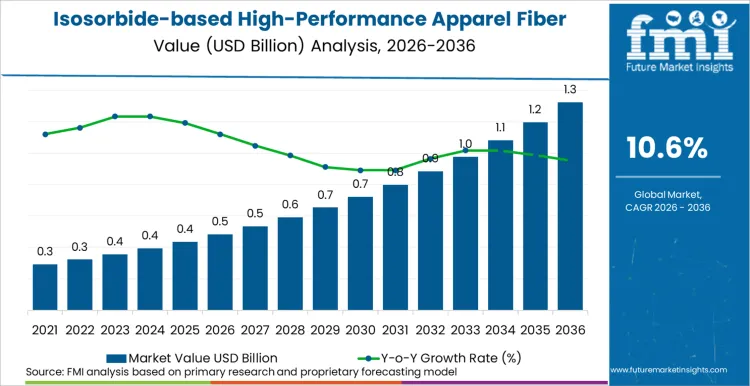
Key Macro Trends Expected to Influence the Isosorbide-based High-Performance Apparel Market
How are performance-led procurement scorecards changing apparel material selection?
As per FMI's estimates, apparel sourcing is shifting toward measurable durability outcomes rather than marketing-led substitutions. Fibers that stabilize heat behavior and resist chemical stress reduce downstream risk in dyeing, finishing, and consumer use. This preference supports steady adoption of higher-performance polymer variants that can be qualified once and reused across multiple seasons with fewer specification revisions.
Why are Heat Management and Finish Stability becoming Commercial Differentiators?
FMI is of the opinion that brands are increasingly judged on garment consistency across repeat buys, not only on initial feel. Materials that hold shape, color appearance, and surface integrity after repeated washing reduce customer dissatisfaction and brand returns. This is especially relevant as functional finishes proliferate and the margin for process drift becomes tighter.
What is driving a shift from single-parameter upgrades to multi-property performance packages?
As per FMI's projection, buyers want fibers that improve multiple stress points in one move, such as thermal stability plus chemical and UV resistance, without increasing conversion variability. This approach reduces the need for layered add-on solutions that can complicate compliance documentation and introduce variability at scale.
How will Tighter Material Governance increase Preference for Specification-Stable Polymers?
FMI anticipated apparel supply chains are moving toward stricter change control to protect performance claims across regions and contract manufacturing partners. Fibers that run consistently across different mill settings and geographies gain preference because they reduce revalidation cycles and shorten the time required to scale across product families.
Isosorbide-based High-Performance Apparel Fiber Market Key Takeaways
| Metric | Value |
|---|---|
| Market Value (2026) | USD 0.5 billion |
| Market Forecast Value (2036) | USD 1.3 billion |
| Forecast CAGR 2026 to 2036 | 10.6% |
Source: FMI analysis based on primary research and proprietary forecasting model
Why is the Isosorbide-based High-Performance Apparel Fiber Market Growing?
This market grows because it targets the most expensive pain point in performance apparel: inconsistency after real-world use. Fiber upgrades that preserve process predictability while improving stress resistance are easier to commercialize than disruptive substitutions. as per FMI's projection, procurement teams increasingly treat these fibers as a platform reinforcement strategy rather than a one-off innovation, making them suitable for long production cycles and multi-source scaling.
A second reason is the need for performance certainty across fast replenishment models. As brands shorten refresh cycles, they still require stable dyeing behavior and finishing repeatability to avoid shade drift and handfeel inconsistency. When the base fiber behaves predictably under thermal and chemical stress, mills can maintain throughput while reducing rework and scrap, improving total delivered cost for the brand.
Third, performance apparel purchasing increasingly values risk reduction. Many sourcing programs now quantify the cost of early garment fatigue, loss of recovery, or surface degradation. as per FMI's estimates, a fiber that extends wear life supports fewer warranty issues and reduces the hidden cost associated with returns and discounting. This market logic aligns well with how performance textiles are evaluated across the broader ecosystem, including the high-performance fibers market.
Finally, supplier selection is influenced by how quickly technical documentation can be refreshed when buyer compliance requirements change. This favors participants with responsive technical teams and disciplined control over polymer manufacturing parameters, enabling stable performance within defined acceptance windows.
Segmental Analysis
Which Polymer Choices secure Faster Approvals in Performance Apparel Programs?
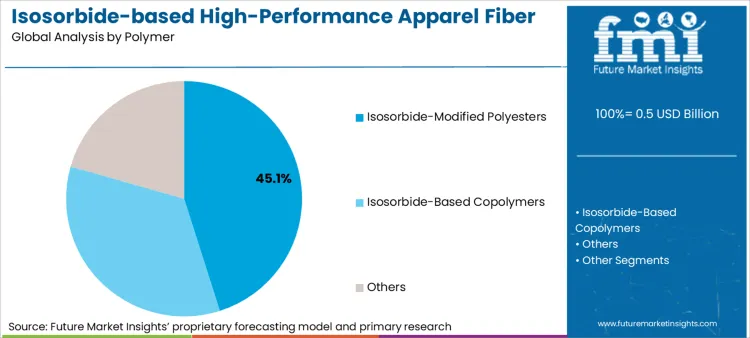
Isosorbide-modified polyesters lead polymer adoption and account for a 45.1% share because they fit into established polyester handling and processing pathways while improving performance retention. This makes them attractive for mills that want a controlled improvement rather than a complete redesign of spinning or finishing sequences.
FMI project that polymer choices that behave predictably through dyeing and finishing are most likely to be scaled across multiple product lines. This adoption logic is consistent with fiber portfolios that prioritize engineered textile outcomes, similar to clothing fibers.
Isosorbide-based copolymers grow where buyers prioritize a tailored performance curve for specific end-use conditions, especially in technical apparel. However, these can require more careful quality management when mills run multi-material production schedules. Others remain relevant for niche development programs, but tend to be constrained by limited qualification coverage across global supply chains.
Why is Sportswear and Performance Apparel setting the Pace for Demand?
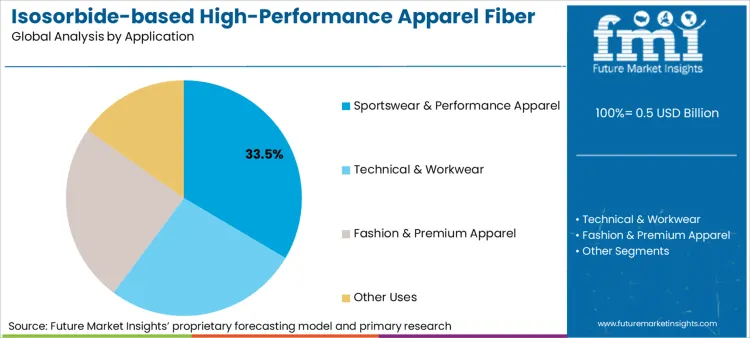
Sportswear and performance apparel represent a 33.5% share because they combine high wear frequency with strict expectations for retention of fit and surface quality. Product owners are under pressure to maintain consistent consumer experience across repeated use and across multiple replenishment cycles.
As per FMI's estimates, this segment scales when brands can validate the fiber across multiple fabric constructions, enabling portfolio expansion without repeated base-material trials. Market pull from performance categories also benefits from adjacent product ecosystems, including performance fabric innovations visible in reflective sportswear fabrics.
Technical and workwear demand rises where chemical exposure, abrasion, and heat stress are common, supporting stable replacement cycles and procurement discipline. Fashion and premium apparel adopt the fiber when durability supports brand positioning and reduces variability, but scaling depends on managing aesthetics and handfeel targets without compromising mill efficiency.
Which Performance Criteria are Most Valued by buyers signing multi-season programs?
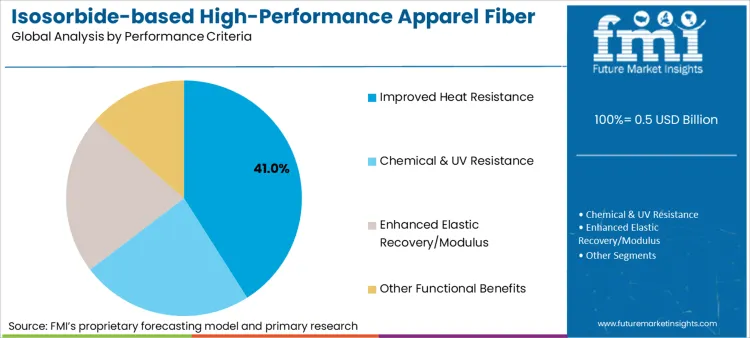
Improved heat resistance is the leading performance criterion and accounts for a 41.0% share because it directly reduces deformation risk, stabilizes garment structure, and improves consistency across usage cycles. Heat exposure occurs not only in end use but also in finishing and post-processing steps, so stability at elevated temperatures helps protect repeatability through the value chain.
Chemical and UV resistance is especially valuable where apparel is exposed to aggressive washing regimes, outdoor use, or functional finishes. Enhanced elastic recovery and modulus becomes a decision driver where buyers want shape retention without increasing garment weight or stiffness beyond acceptable comfort thresholds. FMI is of the opinion that performance criteria win faster approvals when they directly reduce measurable failure modes rather than adding soft benefits that are difficult to validate at scale.
Which End-user Groups are Most Responsible for Scaling this Fiber Category?
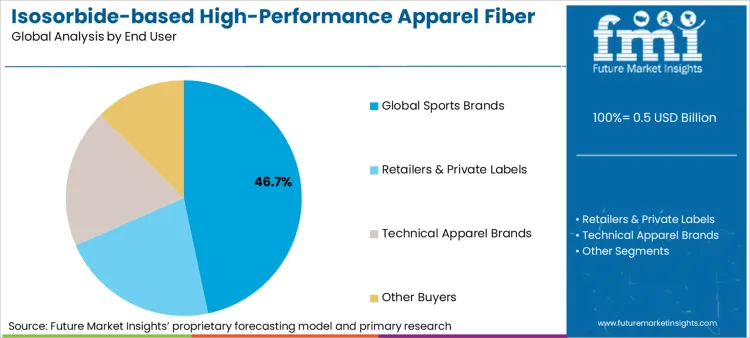
Global sports brands represent a 46.7% share because they run structured material qualification pipelines and can scale fiber decisions across multiple regions and factories. These buyers typically lock materials during line planning, then reuse them across collections to simplify compliance and supplier management.
Retailers and private labels participate as they seek durable performance upgrades without large design changes, but price ceilings and shorter planning cycles often limit scaling. Technical apparel brands adopt faster when performance differentiation is central to product positioning and when fiber upgrades reduce reliance on layered finish solutions.
Why are buyers paying more attention to heat stability and resistance to harsh use cycles?
Garments are increasingly expected to perform consistently over time, particularly in high-frequency categories. Heat stability supports better retention of garment structure, reduces fatigue failure, and increases reliability across repeated laundering. as per FMI's projection, fibers that help avoid shape drift and premature breakdown unlock higher reorder confidence, which improves long-term contract stability for suppliers.
What slows adoption even when the performance value is clear?
Qualification complexity and supply assurance remain key barriers. Large brands want consistent performance across multiple mills and regions, and they will not scale materials that show variability across lots or processing setups. as per FMI's estimates, any increase in production troubleshooting can erase the value of performance uplift, especially in programs where line throughput is tightly managed.
Where will the strongest growth opportunities emerge through 2036?
Growth opportunities will concentrate where performance criteria align with measurable buyer KPIs such as durability, recovery retention, and reduced returns. This will also expand in portfolios where bio-based input strategies are already being adopted at upstream stages, supported by developments in adjacent material ecosystems like bio-based polyester precursors for high-performance bioplastics.
How will Material Governance reshape competitive advantage?
FMI is of the opinion that suppliers will compete as much on specification discipline as on polymer performance. Faster documentation refresh cycles, stable quality windows, and consistent delivery schedules will separate long-term winners from suppliers that only compete on trial performance.
Analysis of the Isosorbide-based High-Performance Apparel Fiber Market by Key Countries
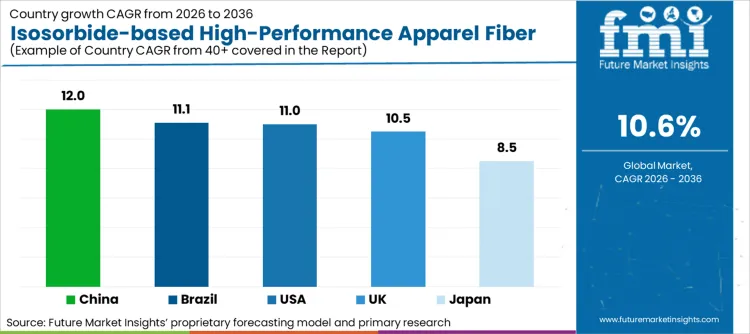
| Country | CAGR (2026-2036) |
|---|---|
| USA | 11.0% |
| UK | 10.5% |
| China | 12.0% |
| Brazil | 11.1% |
| Japan | 8.5% |
Source: FMI analysis based on primary research and proprietary forecasting model
Why does the USA remain a High-Value Market for performance-driven apparel fiber programs?
The USA grows at an 11.0% CAGR because of large, organized demand for technical apparel and a mature ecosystem of sportswear brands that continuously refresh product platforms. as per FMI's projection, program scaling is strongest where brands operate structured qualification pipelines and where suppliers can support multi-factory adoption with stable technical documentation.
How is the UK converting performance apparel demand into repeat procurement cycles?
The UK expands at a 10.5% CAGR through stable demand for sportswear and premium performance categories where consumer expectations on durability are high. as per FMI's estimates, fibers that reduce variability and protect garment retention help brands improve repeat purchase confidence while limiting complaints tied to early garment fatigue.
Why is China expected to show the highest growth rate in this market?
China leads at 12.0% CAGR due to its role as a manufacturing hub and as a large consumer market with rising adoption of performance apparel. Supplier success depends on aligning fiber performance with scalable mill operations that prioritize throughput. FMI is of the opinion that adoption expands fastest when fiber upgrades preserve runability and reduce the need for complex finishing steps.
What makes Brazil an attractive growth market despite cost sensitivity?
Brazil grows at an 11.1% CAGR as performance apparel demand rises and brand portfolios expand into durable, climate-relevant products. Scaling depends on proving that fiber upgrades reduce product failures and extend wear life enough to justify delivered-cost premiums. Programs that improve repeatability in high-use conditions gain momentum in organized retail and branded sports channels.
Why is Japan growing more steadily than the other focus countries?
Japan expands at an 8.5% CAGR because reliability-focused qualification rather than rapid switching drive adoption. Buyers prioritize stability, low defect rates, and predictable quality outcomes across long cycles. As per FMI's projection, suppliers that can maintain consistent lot behavior and support detailed compliance needs will capture long-term contracts even if near-term growth is steadier.
Competitive Landscape
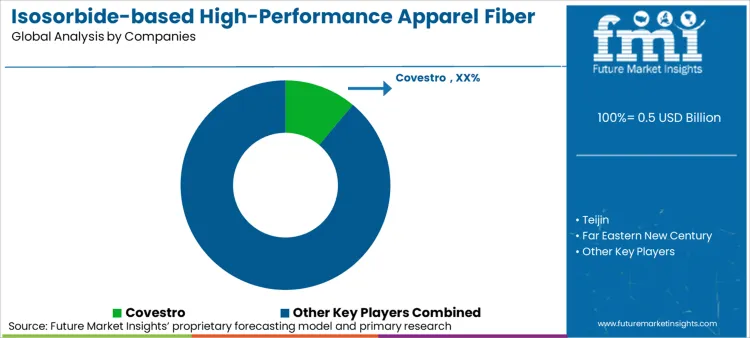
Competition is defined by polymer capability, supply assurance, and application engineering support for mills and brands. Market participants differentiate on how consistently they can deliver performance criteria without increasing conversion variability. Stable quality windows and responsive technical support influence whether brands expand a trial into multi-season adoption.
Supplier strength also depends on how quickly participants can scale across multiple regions while maintaining uniform performance. Companies with deep polymer expertise and established textile relationships have an advantage in closing large-volume supply agreements. Participants that can demonstrate consistent performance retention across varied fabric constructions, dyeing conditions, and finishing routes are most likely to secure repeated allocations.
Competitive pressure will intensify as more suppliers pursue performance apparel pathways with engineered polymer variants. Those that combine dependable industrial scale with disciplined change control will remain best positioned to capture long-term sourcing agreements.
Key Players
- Covestro
- Teijin
- Far Eastern New Century
- RadiciGroup
- Mitsubishi Chemical Group
- Eastman Chemical Company
- BASF
- Toray Industries
- Indorama Ventures
- Roquette
Scope of Report
| Items | Values |
|---|---|
| Quantitative Units | USD Billion |
| Polymer Segments | Isosorbide-Modified Polyesters; Isosorbide-Based Copolymers; Others |
| Application Segments | Sportswear & Performance Apparel; Technical & Workwear; Fashion & Premium Apparel; Other Uses |
| Performance Criteria Segments | Improved Heat Resistance; Chemical & UV Resistance; Enhanced Elastic Recovery/Modulus; Other Functional Benefits |
| End User Segments | Global Sports Brands; Retailers & Private Labels; Technical Apparel Brands; Other Buyers |
| Region Segmentation | North America; Latin America; Western Europe; Eastern Europe; East Asia; South Asia & Pacific; Middle East & Africa |
| Key Countries | USA, UK, China, Brazil, Japan |
Isosorbide-based High-Performance Apparel Fiber Market by Segment
By Polymer
- Isosorbide-Modified Polyesters
- Isosorbide-Based Copolymers
- Others
By Application
- Sportswear & Performance Apparel
- Technical & Workwear
- Fashion & Premium Apparel
- Other Uses
By Performance Criteria
- Improved Heat Resistance
- Chemical & UV Resistance
- Enhanced Elastic Recovery/Modulus
- Other Functional Benefits
By End User
- Global Sports Brands
- Retailers & Private Labels
- Technical Apparel Brands
- Other Buyers
By Region
- North America
- Latin America
- Western Europe
- Eastern Europe
- East Asia
- South Asia & Pacific
- Middle East & Africa
Bibliography
- International Organization for Standardization. (2023). ISO 105-B02: Textiles - Tests for colour fastness - Part B02: Colour fastness to artificial light. ISO.
- International Organization for Standardization. (2024). ISO 6330: Textiles - Domestic washing and drying procedures for textile testing. ISO.
- International Organization for Standardization. (2023). ISO 139: Textiles - Standard atmospheres for conditioning and testing. ISO.
- Organisation for Economic Co-operation and Development. (2023). OECD guidelines for the testing of chemicals: Overview and considerations for polymer performance evaluation. OECD Publishing.
- European Commission. (2024). A sustainable and circular textiles strategy: Policy framework and implementation priorities. Publications Office of the European Union.
- USA Environmental Protection Agency. (2024). Sustainable materials management: Textiles and durable goods considerations. USA EPA.
- United States Department of Agriculture. (2024). BioPreferred Program annual report. USDA.
- Siracusa, V., & Blanco, I. (2023). Bio-based polymers for durable applications: Processing stability and performance retention. Polymer Testing, 121, 107991.
Frequently Asked Questions
How big is the Isosorbide-based High-Performance Apparel Fiber Market expected to be in 2026?
The isosorbide-based high-performance apparel fiber market is valued at USD 0.5 billion in 2026.
What will be the size of the Isosorbide-based High-Performance Apparel Fiber Market in 2036?
The market for isosorbide-based high-performance apparel fiber is projected to reach USD 1.3 billion by 2036.
How fast will the Isosorbide-based High-Performance Apparel Fiber Market Grow?
Demand for isosorbide-based high-performance apparel fiber is projected to grow at a 10.6% CAGR between 2026 and 2036.
Which Polymer Segment holds the Largest Market Share?
Isosorbide-modified polyesters lead polymer adoption, accounting for a 45.1% share in 2026.
Which End-User Group drives the Highest Demand?
Global sports brands are expected to represent a 46.7% share of demand in 2026.
Preview the report firsthand - request a free sample
Get SampleGet the brochure for pricing and purchase details.
Get PDFTable of Content
- Executive Summary
- Global Market Outlook
- Demand-side Trends
- Supply-side Trends
- Technology Roadmap Analysis
- Analysis and Recommendations
- Market Overview
- Market Coverage / Taxonomy
- Market Definition / Scope / Limitations
- Research Methodology
- Chapter Orientation
- Analytical Lens and Working Hypotheses
- Market Structure, Signals, and Trend Drivers
- Benchmarking and Cross-market Comparability
- Market Sizing, Forecasting, and Opportunity Mapping
- Research Design and Evidence Framework
- Desk Research Programme (Secondary Evidence)
- Company Annual and Sustainability Reports
- Peer-reviewed Journals and Academic Literature
- Corporate Websites, Product Literature, and Technical Notes
- Earnings Decks and Investor Briefings
- Statutory Filings and Regulatory Disclosures
- Technical White Papers and Standards Notes
- Trade Journals, Industry Magazines, and Analyst Briefs
- Conference Proceedings, Webinars, and Seminar Materials
- Government Statistics Portals and Public Data Releases
- Press Releases and Reputable Media Coverage
- Specialist Newsletters and Curated Briefings
- Sector Databases and Reference Repositories
- Roots Internal Knowledge Base and Historical Datasets
- Subscription Datasets and Paid Sources
- Social Channels, Communities, and Digital Listening Inputs
- Additional Desk Sources
- Expert Input and Fieldwork (Primary Evidence)
- Primary Modes
- Qualitative Interviews and Expert Elicitation
- Quantitative Surveys and Structured Data Capture
- Blended A9oach
- Why Primary Evidence is Used
- Field Techniques
- Interviews
- Surveys
- Focus Groups
- Observational and In-context Research
- Social and Community Interactions
- Stakeholder Universe Engaged
- C-suite Leaders
- Board Members
- Presidents and Vice Presidents
- R&D and Innovation Heads
- Technical Specialists
- Domain Subject-matter Experts
- Scientists
- Physicians and Other Healthcare Professionals
- Governance, Ethics, and Data Stewardship
- Research Ethics
- Data Integrity and Handling
- Primary Modes
- Tooling, Models, and Reference Databases
- Desk Research Programme (Secondary Evidence)
- Data Engineering and Model Build
- Data Acquisition and Ingestion
- Cleaning, Normalisation, and Verification
- Synthesis, Triangulation, and Analysis
- Quality Assurance and Audit Trail
- Market Background
- Market Dynamics
- Drivers
- Restraints
- Opportunity
- Trends
- Scenario Forecast
- Demand in Optimistic Scenario
- Demand in Likely Scenario
- Demand in Conservative Scenario
- Opportunity Map Analysis
- Product Life Cycle Analysis
- Supply Chain Analysis
- Investment Feasibility Matrix
- Value Chain Analysis
- PESTLE and Porter’s Analysis
- Regulatory Landscape
- Regional Parent Market Outlook
- Production and Consumption Statistics
- Import and Export Statistics
- Market Dynamics
- Global Market Analysis 2021 to 2025 and Forecast, 2026 to 2036
- Historical Market Size Value (USD Million) Analysis, 2021 to 2025
- Current and Future Market Size Value (USD Million) Projections, 2026 to 2036
- Y-o-Y Growth Trend Analysis
- Absolute $ Opportunity Analysis
- Global Market Pricing Analysis 2021 to 2025 and Forecast 2026 to 2036
- Global Market Analysis 2021 to 2025 and Forecast 2026 to 2036, By Polymer
- Introduction / Key Findings
- Historical Market Size Value (USD Million) Analysis By Polymer , 2021 to 2025
- Current and Future Market Size Value (USD Million) Analysis and Forecast By Polymer , 2026 to 2036
- Isosorbide-Modified Polyesters
- Isosorbide-Based Copolymers
- Others
- Isosorbide-Modified Polyesters
- Y-o-Y Growth Trend Analysis By Polymer , 2021 to 2025
- Absolute $ Opportunity Analysis By Polymer , 2026 to 2036
- Global Market Analysis 2021 to 2025 and Forecast 2026 to 2036, By Application
- Introduction / Key Findings
- Historical Market Size Value (USD Million) Analysis By Application, 2021 to 2025
- Current and Future Market Size Value (USD Million) Analysis and Forecast By Application, 2026 to 2036
- Sportswear & Performance Apparel
- Technical & Workwear
- Fashion & Premium Apparel
- Other Uses
- Sportswear & Performance Apparel
- Y-o-Y Growth Trend Analysis By Application, 2021 to 2025
- Absolute $ Opportunity Analysis By Application, 2026 to 2036
- Global Market Analysis 2021 to 2025 and Forecast 2026 to 2036, By Performance Criteria
- Introduction / Key Findings
- Historical Market Size Value (USD Million) Analysis By Performance Criteria, 2021 to 2025
- Current and Future Market Size Value (USD Million) Analysis and Forecast By Performance Criteria, 2026 to 2036
- Improved Heat Resistance
- Chemical & UV Resistance
- Enhanced Elastic Recovery/Modulus
- Other Functional Benefits
- Improved Heat Resistance
- Y-o-Y Growth Trend Analysis By Performance Criteria, 2021 to 2025
- Absolute $ Opportunity Analysis By Performance Criteria, 2026 to 2036
- Global Market Analysis 2021 to 2025 and Forecast 2026 to 2036, By End User
- Introduction / Key Findings
- Historical Market Size Value (USD Million) Analysis By End User, 2021 to 2025
- Current and Future Market Size Value (USD Million) Analysis and Forecast By End User, 2026 to 2036
- Global Sports Brands
- Retailers & Private Labels
- Technical Apparel Brands
- Other Buyers
- Global Sports Brands
- Y-o-Y Growth Trend Analysis By End User, 2021 to 2025
- Absolute $ Opportunity Analysis By End User, 2026 to 2036
- Global Market Analysis 2021 to 2025 and Forecast 2026 to 2036, By Region
- Introduction
- Historical Market Size Value (USD Million) Analysis By Region, 2021 to 2025
- Current Market Size Value (USD Million) Analysis and Forecast By Region, 2026 to 2036
- North America
- Latin America
- Western Europe
- Eastern Europe
- East Asia
- South Asia and Pacific
- Middle East & Africa
- Market Attractiveness Analysis By Region
- North America Market Analysis 2021 to 2025 and Forecast 2026 to 2036, By Country
- Historical Market Size Value (USD Million) Trend Analysis By Market Taxonomy, 2021 to 2025
- Market Size Value (USD Million) Forecast By Market Taxonomy, 2026 to 2036
- By Country
- USA
- Canada
- Mexico
- By Polymer
- By Application
- By Performance Criteria
- By End User
- By Country
- Market Attractiveness Analysis
- By Country
- By Polymer
- By Application
- By Performance Criteria
- By End User
- Key Takeaways
- Latin America Market Analysis 2021 to 2025 and Forecast 2026 to 2036, By Country
- Historical Market Size Value (USD Million) Trend Analysis By Market Taxonomy, 2021 to 2025
- Market Size Value (USD Million) Forecast By Market Taxonomy, 2026 to 2036
- By Country
- Brazil
- Chile
- Rest of Latin America
- By Polymer
- By Application
- By Performance Criteria
- By End User
- By Country
- Market Attractiveness Analysis
- By Country
- By Polymer
- By Application
- By Performance Criteria
- By End User
- Key Takeaways
- Western Europe Market Analysis 2021 to 2025 and Forecast 2026 to 2036, By Country
- Historical Market Size Value (USD Million) Trend Analysis By Market Taxonomy, 2021 to 2025
- Market Size Value (USD Million) Forecast By Market Taxonomy, 2026 to 2036
- By Country
- Germany
- UK
- Italy
- Spain
- France
- Nordic
- BENELUX
- Rest of Western Europe
- By Polymer
- By Application
- By Performance Criteria
- By End User
- By Country
- Market Attractiveness Analysis
- By Country
- By Polymer
- By Application
- By Performance Criteria
- By End User
- Key Takeaways
- Eastern Europe Market Analysis 2021 to 2025 and Forecast 2026 to 2036, By Country
- Historical Market Size Value (USD Million) Trend Analysis By Market Taxonomy, 2021 to 2025
- Market Size Value (USD Million) Forecast By Market Taxonomy, 2026 to 2036
- By Country
- Russia
- Poland
- Hungary
- Balkan & Baltic
- Rest of Eastern Europe
- By Polymer
- By Application
- By Performance Criteria
- By End User
- By Country
- Market Attractiveness Analysis
- By Country
- By Polymer
- By Application
- By Performance Criteria
- By End User
- Key Takeaways
- East Asia Market Analysis 2021 to 2025 and Forecast 2026 to 2036, By Country
- Historical Market Size Value (USD Million) Trend Analysis By Market Taxonomy, 2021 to 2025
- Market Size Value (USD Million) Forecast By Market Taxonomy, 2026 to 2036
- By Country
- China
- Japan
- South Korea
- By Polymer
- By Application
- By Performance Criteria
- By End User
- By Country
- Market Attractiveness Analysis
- By Country
- By Polymer
- By Application
- By Performance Criteria
- By End User
- Key Takeaways
- South Asia and Pacific Market Analysis 2021 to 2025 and Forecast 2026 to 2036, By Country
- Historical Market Size Value (USD Million) Trend Analysis By Market Taxonomy, 2021 to 2025
- Market Size Value (USD Million) Forecast By Market Taxonomy, 2026 to 2036
- By Country
- India
- ASEAN
- Australia & New Zealand
- Rest of South Asia and Pacific
- By Polymer
- By Application
- By Performance Criteria
- By End User
- By Country
- Market Attractiveness Analysis
- By Country
- By Polymer
- By Application
- By Performance Criteria
- By End User
- Key Takeaways
- Middle East & Africa Market Analysis 2021 to 2025 and Forecast 2026 to 2036, By Country
- Historical Market Size Value (USD Million) Trend Analysis By Market Taxonomy, 2021 to 2025
- Market Size Value (USD Million) Forecast By Market Taxonomy, 2026 to 2036
- By Country
- Kingdom of Saudi Arabia
- Other GCC Countries
- Turkiye
- South Africa
- Other African Union
- Rest of Middle East & Africa
- By Polymer
- By Application
- By Performance Criteria
- By End User
- By Country
- Market Attractiveness Analysis
- By Country
- By Polymer
- By Application
- By Performance Criteria
- By End User
- Key Takeaways
- Key Countries Market Analysis
- USA
- Pricing Analysis
- Market Share Analysis, 2025
- By Polymer
- By Application
- By Performance Criteria
- By End User
- Canada
- Pricing Analysis
- Market Share Analysis, 2025
- By Polymer
- By Application
- By Performance Criteria
- By End User
- Mexico
- Pricing Analysis
- Market Share Analysis, 2025
- By Polymer
- By Application
- By Performance Criteria
- By End User
- Brazil
- Pricing Analysis
- Market Share Analysis, 2025
- By Polymer
- By Application
- By Performance Criteria
- By End User
- Chile
- Pricing Analysis
- Market Share Analysis, 2025
- By Polymer
- By Application
- By Performance Criteria
- By End User
- Germany
- Pricing Analysis
- Market Share Analysis, 2025
- By Polymer
- By Application
- By Performance Criteria
- By End User
- UK
- Pricing Analysis
- Market Share Analysis, 2025
- By Polymer
- By Application
- By Performance Criteria
- By End User
- Italy
- Pricing Analysis
- Market Share Analysis, 2025
- By Polymer
- By Application
- By Performance Criteria
- By End User
- Spain
- Pricing Analysis
- Market Share Analysis, 2025
- By Polymer
- By Application
- By Performance Criteria
- By End User
- France
- Pricing Analysis
- Market Share Analysis, 2025
- By Polymer
- By Application
- By Performance Criteria
- By End User
- India
- Pricing Analysis
- Market Share Analysis, 2025
- By Polymer
- By Application
- By Performance Criteria
- By End User
- ASEAN
- Pricing Analysis
- Market Share Analysis, 2025
- By Polymer
- By Application
- By Performance Criteria
- By End User
- Australia & New Zealand
- Pricing Analysis
- Market Share Analysis, 2025
- By Polymer
- By Application
- By Performance Criteria
- By End User
- China
- Pricing Analysis
- Market Share Analysis, 2025
- By Polymer
- By Application
- By Performance Criteria
- By End User
- Japan
- Pricing Analysis
- Market Share Analysis, 2025
- By Polymer
- By Application
- By Performance Criteria
- By End User
- South Korea
- Pricing Analysis
- Market Share Analysis, 2025
- By Polymer
- By Application
- By Performance Criteria
- By End User
- Russia
- Pricing Analysis
- Market Share Analysis, 2025
- By Polymer
- By Application
- By Performance Criteria
- By End User
- Poland
- Pricing Analysis
- Market Share Analysis, 2025
- By Polymer
- By Application
- By Performance Criteria
- By End User
- Hungary
- Pricing Analysis
- Market Share Analysis, 2025
- By Polymer
- By Application
- By Performance Criteria
- By End User
- Kingdom of Saudi Arabia
- Pricing Analysis
- Market Share Analysis, 2025
- By Polymer
- By Application
- By Performance Criteria
- By End User
- Turkiye
- Pricing Analysis
- Market Share Analysis, 2025
- By Polymer
- By Application
- By Performance Criteria
- By End User
- South Africa
- Pricing Analysis
- Market Share Analysis, 2025
- By Polymer
- By Application
- By Performance Criteria
- By End User
- USA
- Market Structure Analysis
- Competition Dashboard
- Competition Benchmarking
- Market Share Analysis of Top Players
- By Regional
- By Polymer
- By Application
- By Performance Criteria
- By End User
- Competition Analysis
- Competition Deep Dive
- Covestro
- Overview
- Product Portfolio
- Profitability by Market Segments (Product/Age /Sales Channel/Region)
- Sales Footprint
- Strategy Overview
- Marketing Strategy
- Product Strategy
- Channel Strategy
- Teijin
- Far Eastern New Century
- RadiciGroup
- Mitsubishi Chemical Group
- Eastman Chemical Company
- BASF
- Toray Industries
- Indorama Ventures
- Roquette
- Covestro
- Competition Deep Dive
- Assumptions & Acronyms Used


