

- Industry Size (2026)
- USD 2.5 Bn
- Forecast (2036)
- USD 7.1 Bn
- CAGR (2026 to 2036)
- 11%
Bio-Based Polyester Precursors for High-Performance Bioplastics Market Forecast and Outlook 2026 to 2036
The Bio-Based Polyester Precursors for High-Performance Bioplastics market is projected to grow from USD 2.5 billion in 2026 to USD 7.1 billion by 2036, reflecting a compound annual growth rate (CAGR) of 11%. Production concentration will play a critical role in shaping market dynamics, with a few large suppliers controlling the bulk of the market share. These suppliers will need to manage regional manufacturing control effectively, ensuring that production capabilities align with global demand while maintaining consistent quality. Regional factors such as raw material availability, labor costs, and local regulatory environments will affect production efficiency. Supply reliability will be paramount, as any disruption, due to raw material shortages, geopolitical factors, or regulatory changes, can significantly impact output and pricing stability. Constraints in scaling production without compromising quality could slow market growth. Companies that can optimize their supply chains and build resilient, flexible production systems will be better positioned to maintain a competitive edge and ensure consistent product availability in an evolving market.
Quick Stats of the Bio-Based Polyester Precursors for High-Performance Bioplastics Market
- Bio-Based Polyester Precursors for High-Performance Bioplastics Market Value (2026): USD 2.5 billion
- Bio-Based Polyester Precursors for High-Performance Bioplastics Market Forecast Value (2036): USD 7.1 billion
- Bio-Based Polyester Precursors for High-Performance Bioplastics Market Global Forecast CAGR (2026-2036): 11%
- Bio-Based Polyester Precursors for High-Performance Bioplastics Market Leading Segment: End Use Application (Packaging & Bottles) 46%
- Key Growth Regions in Bio-Based Polyester Precursors for High-Performance Bioplastics Market: USA
- Top Players in Bio-Based Polyester Precursors for High-Performance Bioplastics Market: Avantium N.V., Cargill Incorporated, Corbion N.V., Braskem S.A., DuPont de Nemours, Inc., Royal DSM N.V., BASF SE, Genomatica, Inc., Novozymes A/S, Roquette Frères
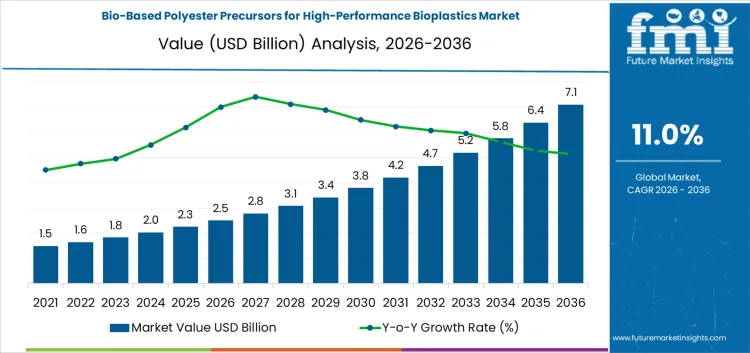
What is the Growth Forecast for the Bio-Based Polyester Precursors for High-Performance Bioplastics Market through 2036?
The absolute dollar opportunity for the bio-based polyester precursors for high-performance bioplastics market reflects significant growth potential over the 2026–2036 period. Starting at USD 2.5 billion in 2026, the market is projected to reach USD 7.1 billion by 2036, indicating an increase of USD 4.6 billion. This growth represents a substantial opportunity for manufacturers in industries such as automotive, electronics, and packaging, which increasingly require sustainable, high-performance materials. As industries seek alternatives to conventional petroleum-based plastics, the demand for bio-based polyester precursors is expected to rise, driven by both regulatory pressures and the growing consumer preference for eco-friendly products.
The absolute dollar opportunity reflects the ongoing shift toward sustainable practices and the development of more advanced bio-based material production technologies. With improvements in production efficiency and performance characteristics of bio-based polyester precursors, the market will become more competitive compared to traditional plastics. This will allow for widespread adoption across various sectors, providing ample growth potential. Over the forecast period, the market’s value will expand steadily, with the absolute dollar opportunity increasing year over year. The USD 4.6 billion opportunity represents not only the market’s growth but also the growing recognition of bio-based polyester precursors as key enablers of sustainability in high-performance applications, setting the stage for substantial long-term growth.
Bio-Based Polyester Precursors for High-Performance Bioplastics Market Key Takeaways
| Metric | Value |
|---|---|
| Industry Sales Value (2026) | USD 2.5 billion |
| Industry Forecast Value (2036) | USD 7.1 billion |
| Industry Forecast CAGR (2026-2036) | 11% |
What Is Driving the Demand for Bio-Based Polyester Precursors for High-Performance Bioplastics?
Historical demand for bio-based polyester precursors developed as conventional polyester production, largely reliant on fossil fuel-derived monomers, expanded across packaging, textiles, automotive, and consumer goods sectors during the late 20th and early 21st centuries. Traditional polyesters such as polyethylene terephthalate (PET) and related polymers dominated applications owing to established performance and cost structures. Over time, environmental concerns about plastic pollution and greenhouse gas emissions led researchers and manufacturers to explore sustainable alternatives derived from renewable feedstocks such as plant sugars, starches, and biomass. Fermentation-derived and chemically synthesised intermediates like bio-based lactic acid, succinic acid, and bio-ethylene emerged as building blocks for renewable polyesters including polylactic acid (PLA), polybutylene succinate (PBS), and other aliphatic and aromatic bio-polyesters. These developments were supported by advances in biotechnology, catalysis, and polymer chemistry that improved yields and material properties, enabling bio-based polyesters to approach the performance of their petrochemical counterparts in many applications. This historical transition set the stage for demand in precursors tailored to high-performance bioplastics.
Future demand for bio-based polyester precursors for high-performance bioplastics is expected to grow as sustainability mandates, regulatory pressures, and corporate commitments to reduce carbon footprint drive substitution of fossil feedstocks with renewable alternatives. The global bio-based polyester market is projected to expand at a significant rate through the late 2020s and into the early 2030s, supported by increasing use of eco-friendly, bio-based polymers in food packaging, textiles, automotive components, and technical applications. Growth factors include rising consumer preference for sustainable materials, stricter environmental regulations that limit single-use fossil plastics, and technological progress that improves cost-competitiveness and performance of renewable monomers. Expansion of production capacity for bio-based intermediates, improvements in feedstock diversity, and development of performance-enhanced biopolymers are important drivers. Challenges include higher production costs relative to petrochemical precursors, scalability of fermentation and bioprocess technologies, and variability in renewable feedstock supply, which require ongoing innovation and investment to address. Continued alignment of policy incentives, corporate sustainability goals, and material performance requirements is expected to shape market uptake of bio-based polyester precursors in high-performance bioplastic applications.
What are the Leading Segments in the Global Bio-Based Polyester Precursors for High-Performance Bioplastics Market?
The global bio-based polyester precursors for high-performance bioplastics market is segmented by key precursor type and end-use application. Among precursor types, lactic acid or PLA precursors lead the market, capturing 35% of the share, followed by FDCA & PEF monomers, bio-ethylene glycol (Bio-EG), and other bio-diacids or biopolyols. Lactic acid and PLA precursors are preferred due to their established role in producing biodegradable and high-performance plastics, particularly in packaging and other consumer applications. On the end-use application side, packaging & bottles dominate the market, holding 46% of the share, followed by textiles & fibers, automotive & transportation, consumer electronics & durables, and other industrial applications. Packaging and bottles are the largest sectors for bio-based polyester precursors due to the increasing demand for sustainable, high-performance bioplastics in packaging solutions.
What Drives the Growth of Lactic Acid or PLA Precursors in the Bio-Based Polyester Precursors for High-Performance Bioplastics Market?
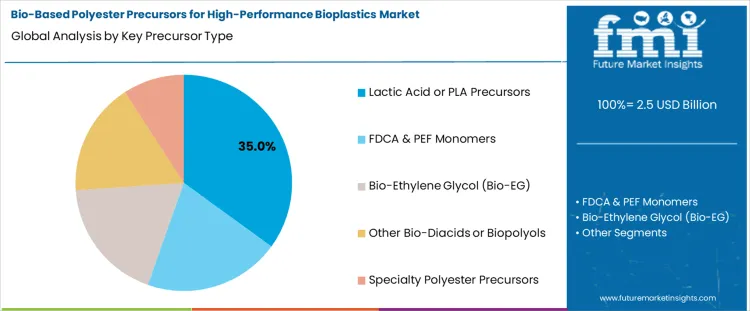
Lactic acid or PLA precursors are the leading precursor type in the bio-based polyester precursors for high-performance bioplastics market, holding 35% of the share. This demand is largely driven by the widespread adoption of polylactic acid (PLA) in various sustainable applications, particularly packaging. PLA offers a biodegradable alternative to traditional petroleum-based plastics, making it highly sought after in industries focused on reducing environmental impact. Lactic acid, as the primary precursor for PLA production, is favored for its renewable sourcing from plant-based feedstocks like corn and sugarcane. As the demand for sustainable materials grows, especially in packaging and bottles, lactic acid and PLA precursors are expected to maintain strong market presence. Additionally, the growing awareness of plastic pollution and the increasing regulatory pressure to reduce plastic waste further fuel the adoption of bio-based polyester materials derived from PLA. The ability of PLA to perform comparably to conventional plastics while being compostable makes lactic acid-based precursors critical to achieving sustainability goals in high-performance bioplastic applications.
What is Driving the Demand for Packaging & Bottles in the Bio-Based Polyester Precursors for High-Performance Bioplastics Market?
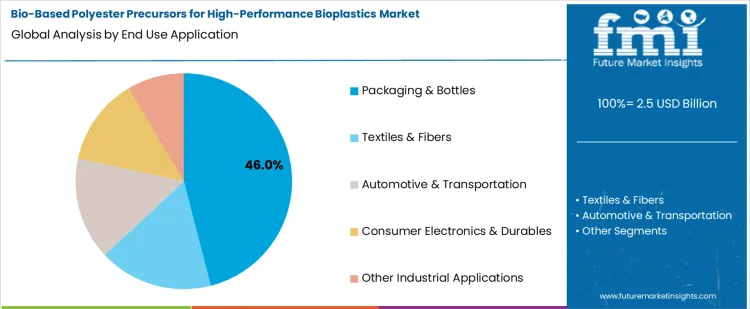
Packaging & bottles is the leading end-use application in the bio-based polyester precursors for high-performance bioplastics market, holding 46% of the share. This demand is driven by the increasing preference for sustainable packaging solutions across industries, particularly in the food and beverage sector. The growing awareness of environmental issues, such as plastic waste and pollution, has pushed companies to seek alternatives to traditional petroleum-based plastics. Bio-based polyester precursors, such as those derived from PLA, offer a high-performance, renewable option for producing packaging that is both functional and environmentally friendly. These bioplastics are biodegradable, reducing the long-term environmental impact of plastic waste in landfills and oceans. Furthermore, regulatory pressures around plastic usage and disposal are encouraging industries to switch to sustainable materials. As more companies prioritize sustainability in their packaging solutions, the demand for bio-based polyester precursors in packaging and bottles will continue to grow, ensuring its dominance in the market.
What are the Key Dynamics in the Bio-Based Polyester Precursors for High-Performance Bioplastics Market?
The bio-based polyester precursors market is shaped by the growing shift from fossil feedstocks to renewable sources for polymer production. Precursors such as bio-derived glycols and diacids serve as inputs for high-performance bioplastics used in packaging, textiles, and engineering applications. End users evaluate products on molecular purity, mechanical properties, and processing compatibility with existing manufacturing systems. Regulatory frameworks that encourage renewable content and limit greenhouse gas emissions influence adoption. Feedstock availability, biotechnology innovation, and processing infrastructure determine how precursors reach polymer producers. Market activity reflects interaction among sustainability goals, material performance requirements, and supply chain capacity.
What are the Main Drivers Supporting Growth in This Market?
Growth in the bio-based polyester precursors market is driven by regulatory emphasis on reducing dependence on petroleum and lowering carbon intensity of materials. Governments and standards bodies are promoting renewable content thresholds and incentives for bio-derived materials. Corporate commitments to reduce lifecycle emissions and meet environmental criteria in supply chains increase demand for bio-based inputs. Advances in fermentation and catalytic conversion technologies improve yields of key precursors and reduce production costs. Research into metabolic pathways and enzyme engineering expands the portfolio of viable bio-derived monomers. Rising use of high-performance bioplastics in durable applications supports demand for reliable precursor supply.
What Restraints Are Limiting Market Expansion?
High production costs relative to petrochemical precursors remain a constraint for broader uptake, particularly in cost-sensitive markets. Variability in biomass feedstock quality and supply creates challenges in consistent precursor production. Technical hurdles in scaling fermentation and conversion processes to industrial volumes can slow commercialization. Integration of bio-based precursors into existing polymerization processes may require adaptation of processing parameters, adding complexity for manufacturers. Differences in regulatory definitions and certification processes for bio-based content across regions add compliance complexity for global suppliers.
What Emerging Trends Are Shaping the Future of This Market?
Emerging trends include greater integration of biorefinery concepts that convert diverse biomass sources into multiple precursor streams. Metabolic engineering and synthetic biology are enhancing microbial production of specialty monomers with tailored properties for high-performance applications. Digital tools for process optimization and lifecycle assessment are supporting decisions on precursor selection and environmental impact. Collaboration among biotechnology firms, polymer manufacturers, and end users is increasing to align precursor specifications with performance needs. There is growing interest in hybrid precursor pathways that blend bio-based and recycled inputs to improve circularity and material efficiency.
What is the Country-Wise Analysis of the Bio-Based Polyester Precursors for High-Performance Bioplastics Market?
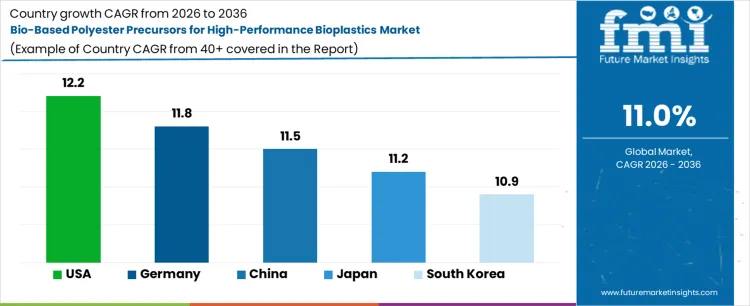
The bio-based polyester precursors for high-performance bioplastics market is growing due to increasing demand for sustainable materials in industries like packaging, automotive, electronics, and textiles. These bio-based precursors, derived from renewable resources, offer a eco-friendlier alternative to traditional petroleum-based polyester, reducing the environmental footprint of plastics. Developed markets like the USA, Germany, and Japan are seeing steady demand driven by stricter environmental regulations and increasing consumer demand for sustainable products. In emerging markets like China and South Korea, the market is also expanding rapidly as companies and governments focus on reducing plastic pollution and promoting green technologies. As the global push for sustainability and circular economy practices intensifies, the market for bio-based polyester precursors in high-performance bioplastics is expected to grow significantly.
| Country | CAGR (2026-2036) |
|---|---|
| USA | 12.2% |
| Germany | 11.8% |
| China | 11.5% |
| Japan | 11.2% |
| South Korea | 10.9% |
What is the Growth Outlook for the Bio-Based Polyester Precursors for High-Performance Bioplastics Market in the USA?
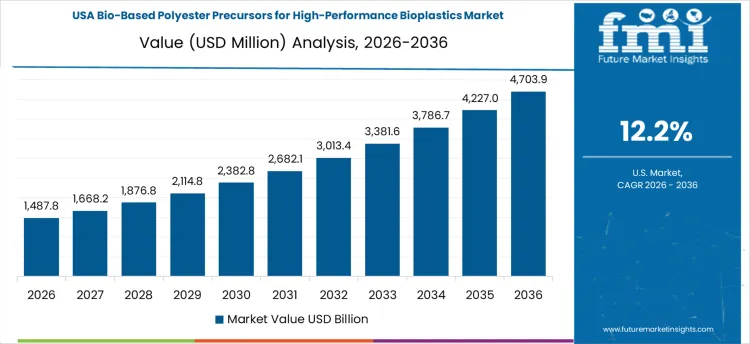
The bio-based polyester precursors for high-performance bioplastics market in the USA is expected to grow steadily, with a projected CAGR of 12.2% from 2026 to 2036. The U.S. is a global leader in sustainability and innovation, and the demand for bio-based materials in various industries is increasing as businesses and consumers prioritize eco-friendly solutions. The U.S. government’s support for green technologies and sustainability initiatives, combined with strong consumer demand for environmentally responsible products, is expected to drive the adoption of bio-based polyester precursors. As industries such as packaging, automotive, and electronics increasingly seek sustainable alternatives to conventional plastics, the market for bio-based polyester precursors in the USA is expected to continue growing steadily in the coming years.
What is the Market Outlook for the Bio-Based Polyester Precursors for High-Performance Bioplastics Market in Germany?
Germany is projected to see steady growth in the bio-based polyester precursors for high-performance bioplastics market, with a projected CAGR of 11.8% from 2026 to 2036. As a global leader in environmental sustainability and innovation, Germany is at the forefront of adopting sustainable materials and technologies. The German market for bio-based bioplastics is driven by government regulations aimed at reducing plastic waste and supporting circular economy practices. Bio-based polyester precursors, which offer a renewable alternative to petroleum-based materials, are gaining popularity in sectors like automotive, packaging, and textiles. With increasing consumer demand for eco-friendly products and a strong regulatory push for sustainability, the market for bio-based polyester precursors in Germany is expected to expand steadily in the coming years.
What is the Growth Forecast for the Bio-Based Polyester Precursors for High-Performance Bioplastics Market in China?
China is expected to experience strong growth in the bio-based polyester precursors for high-performance bioplastics market, with a projected CAGR of 11.5% from 2026 to 2036. China, as one of the world’s largest plastic producers and consumers, is increasingly focusing on reducing plastic waste and improving the sustainability of its manufacturing sector. The government’s push for green manufacturing and sustainable technologies is driving the adoption of bio-based materials, including polyester precursors derived from renewable resources. As industries in China look for eco-friendly alternatives to traditional plastics, the demand for bio-based polyester precursors is expected to rise. With increasing investments in sustainable technologies and the country’s growing commitment to reducing its environmental impact, the market for bio-based polyester precursors in China is expected to experience rapid growth.
What is the Market Outlook for the Bio-Based Polyester Precursors for High-Performance Bioplastics Market in Japan?
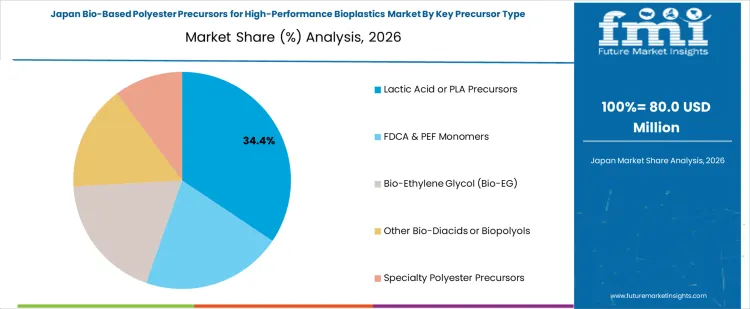
Japan is projected to experience steady growth in the bio-based polyester precursors for high-performance bioplastics market, with a projected CAGR of 11.2% from 2026 to 2036. Japan’s strong emphasis on sustainability and innovation in material science is driving the adoption of bio-based alternatives to traditional plastics. Bio-based polyester precursors, which offer high performance while reducing environmental impact, are gaining popularity in industries such as packaging, automotive, and textiles. The Japanese government’s support for sustainable technologies, coupled with increasing consumer awareness of the environmental effects of plastic pollution, is expected to drive the growth of this market. As Japan continues to lead in green technologies and eco-conscious manufacturing, the market for bio-based polyester precursors is expected to expand steadily in the coming years.
What are the Growth Prospects for the Bio-Based Polyester Precursors for High-Performance Bioplastics Market in South Korea?
South Korea is expected to experience steady growth in the bio-based polyester precursors for high-performance bioplastics market, with a projected CAGR of 10.9% from 2026 to 2036. South Korea is increasingly focusing on sustainability and green technologies, and the demand for bio-based materials is rising across various industries. As industries such as automotive, packaging, and electronics seek sustainable alternatives to petroleum-based plastics, the market for bio-based polyester precursors is expanding. South Korea’s government has introduced policies to promote green manufacturing and reduce plastic pollution, driving the adoption of sustainable materials. As consumer demand for eco-friendly products increases, the market for bio-based polyester precursors in South Korea is expected to grow steadily in the coming years.
What are the Growth Prospects for the Bio-Based Polyester Precursors for High-Performance Bioplastics Market Globally?
Globally, the bio-based polyester precursors for high-performance bioplastics market is set to grow rapidly, driven by the increasing demand for sustainable materials across various industries, including packaging, automotive, textiles, and electronics. As environmental concerns over plastic pollution intensify, there is a growing shift toward using bio-based alternatives to traditional petroleum-based plastics. Bio-based polyester precursors, which are derived from renewable resources, offer high performance while significantly reducing the carbon footprint of plastic production. As governments worldwide implement stricter environmental regulations and consumers demand eco-friendlier products, the market for bio-based polyester precursors is expected to expand significantly. Innovation in bioplastic technologies and the increasing focus on circular economy practices will further support the growth of this market globally.
What is the Competitive Landscape for the Bio-Based Polyester Precursors for High-Performance Bioplastics Market?
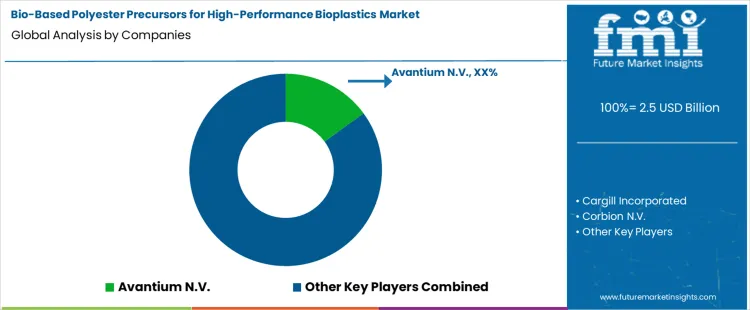
The bio-based polyester precursors for high-performance bioplastics market is expanding rapidly as the demand for sustainable alternatives to petroleum-based plastics continues to grow. Avantium N.V. leads the market with its cutting-edge bio-based polyester precursors, offering high-performance, eco-friendly solutions used in the production of high-performance bioplastics. Their focus on product innovation, sustainability, and circular economy principles has positioned them as a dominant player in the sector. Cargill Incorporated, Corbion N.V., and Braskem S.A. are key competitors, each offering sustainable solutions for producing bio-based polyester precursors. Cargill and Corbion N.V. focus on developing renewable, fermentation-derived building blocks for bioplastics, while Braskem S.A. provides advanced bio-based polyester solutions that reduce dependence on fossil fuels and support the transition to a circular economy.
DuPont de Nemours, Inc., Royal DSM N.V., and BASF SE further strengthen the competitive landscape by offering their own bio-based polyester precursors. DuPont specializes in high-performance materials, providing sustainable alternatives for a wide range of applications, while Royal DSM N.V. focuses on innovation in renewable materials for high-performance bioplastics. BASF SE delivers sustainable and versatile bioplastic solutions with a focus on improving both performance and environmental impact. Genomatica, Inc., Novozymes A/S, and Roquette Frères also contribute to the market by offering advanced bio-based solutions for high-performance polyester production. These companies compete by focusing on product innovation, sustainability, and meeting the growing demand for renewable, high-performance bioplastics. As the push for sustainable materials continues to gain momentum, the market for bio-based polyester precursors is expected to expand, driving further innovation and competition in the sector.
Key Players of the Bio-Based Polyester Precursors for High-Performance Bioplastics Market
- Avantium N.V.
- Cargill Incorporated
- Corbion N.V.
- Braskem S.A.
- DuPont de Nemours, Inc.
- Royal DSM N.V.
- BASF SE
- Genomatica, Inc.
- Novozymes A/S
- Roquette Frères
Scope of the Report
| Items | Values |
|---|---|
| Quantitative Units (2026) | USD Billion |
| Key Precursor Type | Lactic Acid or PLA Precursors, FDCA & PEF Monomers, Bio-Ethylene Glycol (Bio-EG), Other Bio-Diacids or Biopolyols, Specialty Polyester Precursors |
| End Use Application | Packaging & Bottles, Textiles & Fibers, Automotive & Transportation, Consumer Electronics & Durables, Other Industrial Applications |
| Companies | Avantium N.V., Cargill Incorporated, Corbion N.V., Braskem S.A., DuPont de Nemours, Inc., Royal DSM N.V., BASF SE, Genomatica, Inc., Novozymes A/S, Roquette Frères |
| Regions Covered | North America, Latin America, Western Europe, Eastern Europe, South Asia & Pacific, East Asia, Middle East & Africa |
| Countries Covered | United States, Canada, Mexico, Brazil, Argentina, Germany, France, United Kingdom, Italy, Spain, Netherlands, China, India, Japan, South Korea, ANZ, GCC Countries, South Africa |
| Additional Attributes | Dollar sales by key precursor type, end use application, and region. Includes analysis of market trends in bio-based polyester precursors for high-performance bioplastics, performance in end applications such as packaging, textiles, automotive, electronics, and specialty industries, cost and feedstock sourcing factors, regulatory and sustainability considerations influencing adoption of bio-based precursors, technology and process innovations, competitive positioning and market share of key companies, and evaluation of impact on product performance, environmental footprint, and value chain integration in bioplastics and high-performance materials. |
Bio-Based Polyester Precursors for High-Performance Bioplastics Market Segmentation
Key Precursor Type
- Lactic Acid or PLA Precursors
- FDCA & PEF Monomers
- Bio-Ethylene Glycol (Bio-EG)
- Other Bio-Diacids or Biopolyols
- Specialty Polyester Precursors
End Use Application
- Packaging & Bottles
- Textiles & Fibers
- Automotive & Transportation
- Consumer Electronics & Durables
- Other Industrial Applications
Region
- Asia Pacific
- China
- Japan
- South Korea
- India
- Australia & New Zealand
- ASEAN
- Rest of Asia Pacific
- Europe
- Germany
- United Kingdom
- France
- Italy
- Spain
- Nordic
- BENELUX
- Rest of Europe
- North America
- United States
- Canada
- Mexico
- Latin America
- Brazil
- Chile
- Rest of Latin America
- Middle East & Africa
- Kingdom of Saudi Arabia
- Other GCC Countries
- Turkey
- South Africa
- Other African Union
- Rest of Middle East & Africa
Frequently Asked Questions
How big is the bio-based polyester precursors for high-performance bioplastics market in 2026?
The global bio-based polyester precursors for high-performance bioplastics market is estimated to be valued at USD 2.5 billion in 2026.
What will be the size of bio-based polyester precursors for high-performance bioplastics market in 2036?
The market size for the bio-based polyester precursors for high-performance bioplastics market is projected to reach USD 7.1 billion by 2036.
How much will be the bio-based polyester precursors for high-performance bioplastics market growth between 2026 and 2036?
The bio-based polyester precursors for high-performance bioplastics market is expected to grow at a 11.0% CAGR between 2026 and 2036.
What are the key precursor types in the bio-based polyester precursors for high-performance bioplastics market?
The key precursor types in bio-based polyester precursors for high-performance bioplastics market are lactic acid or PLA precursors, FDCA & PEF monomers, bio‑ethylene glycol (bio‑EG), other bio‑diacids or biopolyols and specialty polyester precursors.
Which end use application segment to contribute significant share in the bio-based polyester precursors for high-performance bioplastics market in 2026?
In terms of end use application, packaging & bottles segment to command 46.0% share in the bio-based polyester precursors for high-performance bioplastics market in 2026.
Preview the report firsthand - request a free sample
Get SampleGet the brochure for pricing and purchase details.
Get PDFTable of Content
- Executive Summary
- Global Market Outlook
- Demand-side Trends
- Supply-side Trends
- Technology Roadmap Analysis
- Analysis and Recommendations
- Market Overview
- Market Coverage / Taxonomy
- Market Definition / Scope / Limitations
- Market Background
- Market Dynamics
- Drivers
- Restraints
- Opportunity
- Trends
- Scenario Forecast
- Demand in Optimistic Scenario
- Demand in Likely Scenario
- Demand in Conservative Scenario
- Opportunity Map Analysis
- Product Life Cycle Analysis
- Supply Chain Analysis
- Investment Feasibility Matrix
- Value Chain Analysis
- PESTLE and Porter’s Analysis
- Regulatory Landscape
- Regional Parent Market Outlook
- Production and Consumption Statistics
- Import and Export Statistics
- Market Dynamics
- Global Market Analysis 2021 to 2025 and Forecast, 2026 to 2036
- Historical Market Size Value (USD Million) Analysis, 2021 to 2025
- Current and Future Market Size Value (USD Million) Projections, 2026 to 2036
- Y-o-Y Growth Trend Analysis
- Absolute $ Opportunity Analysis
- Global Market Pricing Analysis 2021 to 2025 and Forecast 2026 to 2036
- Global Market Analysis 2021 to 2025 and Forecast 2026 to 2036, By Key Precursor Type
- Introduction / Key Findings
- Historical Market Size Value (USD Million) Analysis By Key Precursor Type , 2021 to 2025
- Current and Future Market Size Value (USD Million) Analysis and Forecast By Key Precursor Type , 2026 to 2036
- Lactic Acid or PLA Precursors
- FDCA & PEF Monomers
- Bio‑Ethylene Glycol (Bio‑EG)
- Other Bio‑Diacids or Biopolyols
- Specialty Polyester Precursors
- Lactic Acid or PLA Precursors
- Y-o-Y Growth Trend Analysis By Key Precursor Type , 2021 to 2025
- Absolute $ Opportunity Analysis By Key Precursor Type , 2026 to 2036
- Global Market Analysis 2021 to 2025 and Forecast 2026 to 2036, By End Use Application
- Introduction / Key Findings
- Historical Market Size Value (USD Million) Analysis By End Use Application, 2021 to 2025
- Current and Future Market Size Value (USD Million) Analysis and Forecast By End Use Application, 2026 to 2036
- Packaging & Bottles
- Textiles & Fibers
- Automotive & Transportation
- Consumer Electronics & Durables
- Other Industrial Applications
- Packaging & Bottles
- Y-o-Y Growth Trend Analysis By End Use Application, 2021 to 2025
- Absolute $ Opportunity Analysis By End Use Application, 2026 to 2036
- Global Market Analysis 2021 to 2025 and Forecast 2026 to 2036, By Region
- Introduction
- Historical Market Size Value (USD Million) Analysis By Region, 2021 to 2025
- Current Market Size Value (USD Million) Analysis and Forecast By Region, 2026 to 2036
- North America
- Latin America
- Western Europe
- Eastern Europe
- East Asia
- South Asia and Pacific
- Middle East & Africa
- Market Attractiveness Analysis By Region
- North America Market Analysis 2021 to 2025 and Forecast 2026 to 2036, By Country
- Historical Market Size Value (USD Million) Trend Analysis By Market Taxonomy, 2021 to 2025
- Market Size Value (USD Million) Forecast By Market Taxonomy, 2026 to 2036
- By Country
- USA
- Canada
- Mexico
- By Key Precursor Type
- By End Use Application
- By Country
- Market Attractiveness Analysis
- By Country
- By Key Precursor Type
- By End Use Application
- Key Takeaways
- Latin America Market Analysis 2021 to 2025 and Forecast 2026 to 2036, By Country
- Historical Market Size Value (USD Million) Trend Analysis By Market Taxonomy, 2021 to 2025
- Market Size Value (USD Million) Forecast By Market Taxonomy, 2026 to 2036
- By Country
- Brazil
- Chile
- Rest of Latin America
- By Key Precursor Type
- By End Use Application
- By Country
- Market Attractiveness Analysis
- By Country
- By Key Precursor Type
- By End Use Application
- Key Takeaways
- Western Europe Market Analysis 2021 to 2025 and Forecast 2026 to 2036, By Country
- Historical Market Size Value (USD Million) Trend Analysis By Market Taxonomy, 2021 to 2025
- Market Size Value (USD Million) Forecast By Market Taxonomy, 2026 to 2036
- By Country
- Germany
- UK
- Italy
- Spain
- France
- Nordic
- BENELUX
- Rest of Western Europe
- By Key Precursor Type
- By End Use Application
- By Country
- Market Attractiveness Analysis
- By Country
- By Key Precursor Type
- By End Use Application
- Key Takeaways
- Eastern Europe Market Analysis 2021 to 2025 and Forecast 2026 to 2036, By Country
- Historical Market Size Value (USD Million) Trend Analysis By Market Taxonomy, 2021 to 2025
- Market Size Value (USD Million) Forecast By Market Taxonomy, 2026 to 2036
- By Country
- Russia
- Poland
- Hungary
- Balkan & Baltic
- Rest of Eastern Europe
- By Key Precursor Type
- By End Use Application
- By Country
- Market Attractiveness Analysis
- By Country
- By Key Precursor Type
- By End Use Application
- Key Takeaways
- East Asia Market Analysis 2021 to 2025 and Forecast 2026 to 2036, By Country
- Historical Market Size Value (USD Million) Trend Analysis By Market Taxonomy, 2021 to 2025
- Market Size Value (USD Million) Forecast By Market Taxonomy, 2026 to 2036
- By Country
- China
- Japan
- South Korea
- By Key Precursor Type
- By End Use Application
- By Country
- Market Attractiveness Analysis
- By Country
- By Key Precursor Type
- By End Use Application
- Key Takeaways
- South Asia and Pacific Market Analysis 2021 to 2025 and Forecast 2026 to 2036, By Country
- Historical Market Size Value (USD Million) Trend Analysis By Market Taxonomy, 2021 to 2025
- Market Size Value (USD Million) Forecast By Market Taxonomy, 2026 to 2036
- By Country
- India
- ASEAN
- Australia & New Zealand
- Rest of South Asia and Pacific
- By Key Precursor Type
- By End Use Application
- By Country
- Market Attractiveness Analysis
- By Country
- By Key Precursor Type
- By End Use Application
- Key Takeaways
- Middle East & Africa Market Analysis 2021 to 2025 and Forecast 2026 to 2036, By Country
- Historical Market Size Value (USD Million) Trend Analysis By Market Taxonomy, 2021 to 2025
- Market Size Value (USD Million) Forecast By Market Taxonomy, 2026 to 2036
- By Country
- Kingdom of Saudi Arabia
- Other GCC Countries
- Turkiye
- South Africa
- Other African Union
- Rest of Middle East & Africa
- By Key Precursor Type
- By End Use Application
- By Country
- Market Attractiveness Analysis
- By Country
- By Key Precursor Type
- By End Use Application
- Key Takeaways
- Key Countries Market Analysis
- USA
- Pricing Analysis
- Market Share Analysis, 2025
- By Key Precursor Type
- By End Use Application
- Canada
- Pricing Analysis
- Market Share Analysis, 2025
- By Key Precursor Type
- By End Use Application
- Mexico
- Pricing Analysis
- Market Share Analysis, 2025
- By Key Precursor Type
- By End Use Application
- Brazil
- Pricing Analysis
- Market Share Analysis, 2025
- By Key Precursor Type
- By End Use Application
- Chile
- Pricing Analysis
- Market Share Analysis, 2025
- By Key Precursor Type
- By End Use Application
- Germany
- Pricing Analysis
- Market Share Analysis, 2025
- By Key Precursor Type
- By End Use Application
- UK
- Pricing Analysis
- Market Share Analysis, 2025
- By Key Precursor Type
- By End Use Application
- Italy
- Pricing Analysis
- Market Share Analysis, 2025
- By Key Precursor Type
- By End Use Application
- Spain
- Pricing Analysis
- Market Share Analysis, 2025
- By Key Precursor Type
- By End Use Application
- France
- Pricing Analysis
- Market Share Analysis, 2025
- By Key Precursor Type
- By End Use Application
- India
- Pricing Analysis
- Market Share Analysis, 2025
- By Key Precursor Type
- By End Use Application
- ASEAN
- Pricing Analysis
- Market Share Analysis, 2025
- By Key Precursor Type
- By End Use Application
- Australia & New Zealand
- Pricing Analysis
- Market Share Analysis, 2025
- By Key Precursor Type
- By End Use Application
- China
- Pricing Analysis
- Market Share Analysis, 2025
- By Key Precursor Type
- By End Use Application
- Japan
- Pricing Analysis
- Market Share Analysis, 2025
- By Key Precursor Type
- By End Use Application
- South Korea
- Pricing Analysis
- Market Share Analysis, 2025
- By Key Precursor Type
- By End Use Application
- Russia
- Pricing Analysis
- Market Share Analysis, 2025
- By Key Precursor Type
- By End Use Application
- Poland
- Pricing Analysis
- Market Share Analysis, 2025
- By Key Precursor Type
- By End Use Application
- Hungary
- Pricing Analysis
- Market Share Analysis, 2025
- By Key Precursor Type
- By End Use Application
- Kingdom of Saudi Arabia
- Pricing Analysis
- Market Share Analysis, 2025
- By Key Precursor Type
- By End Use Application
- Turkiye
- Pricing Analysis
- Market Share Analysis, 2025
- By Key Precursor Type
- By End Use Application
- South Africa
- Pricing Analysis
- Market Share Analysis, 2025
- By Key Precursor Type
- By End Use Application
- USA
- Market Structure Analysis
- Competition Dashboard
- Competition Benchmarking
- Market Share Analysis of Top Players
- By Regional
- By Key Precursor Type
- By End Use Application
- Competition Analysis
- Competition Deep Dive
- Avantium N.V.
- Overview
- Product Portfolio
- Profitability by Market Segments (Product/Age /Sales Channel/Region)
- Sales Footprint
- Strategy Overview
- Marketing Strategy
- Product Strategy
- Channel Strategy
- Cargill Incorporated
- Corbion N.V.
- Braskem S.A.
- DuPont de Nemours, Inc.
- Royal DSM N.V.
- BASF SE
- Genomatica, Inc.
- Novozymes A/S
- Roquette Frères
- Avantium N.V.
- Competition Deep Dive
- Assumptions & Acronyms Used
- Research Methodology


