

- Industry Size (2026)
- USD 2.3 Bn
- Forecast (2036)
- USD 5.2 Bn
- CAGR (2026 to 2036)
- 8.50%
ALD Precursors Market Forecast and Outlook 2026 to 2036
The ALD precursors market is expected to expand from USD 2.3 billion in 2026 to USD 5.2 billion by 2036, advancing at a CAGR of 8.50%. Growth quality in this market is shaped less by broad semiconductor cycles and more by deep application dependency within advanced device fabrication. Demand is highly concentrated in logic, memory, and power semiconductors where atomic layer deposition is essential for conformal films in high-aspect-ratio structures.
Each new device architecture increases the number of ALD steps per wafer, structurally lifting precursor consumption and stabilizing volumes even during periods of moderated wafer starts. End-use reliance on leading and near-leading nodes creates predictable, recurring demand once a precursor is qualified, as material changes are costly and risk-intensive. This locks suppliers into long production runs tied to specific applications rather than short product cycles. Between 2026 and 2036, market resilience will be defined by exposure to ALD-intensive processes and sustained usage per wafer, not by sheer fab count expansion.
Quick Stats for ALD Precursors Market
- ALD Precursors Market Value (2026): USD 2.3 Billion
- ALD Precursors Market Forecast Value (2036): USD 5.2 Billion
- ALD Precursors Market Forecast CAGR 2026 to 2036: 8.50%
- Leading Film Type in ALD Precursors Market: High-k Dielectric Films (32% share, driven by advanced transistor architectures)
- Key Growth Regions in ALD Precursors Market: Asia Pacific, North America, Europe, Latin America, Middle East & Africa
- Top Key Players in ALD Precursors Market: Air Liquide Advanced Materials, Linde plc, Entegris, Versum Materials (Merck), Dow, JSR Corporation, Mitsubishi Gas Chemical, SK Materials, Strem Chemicals (Thermo Fisher), TANAKA Precious Metals
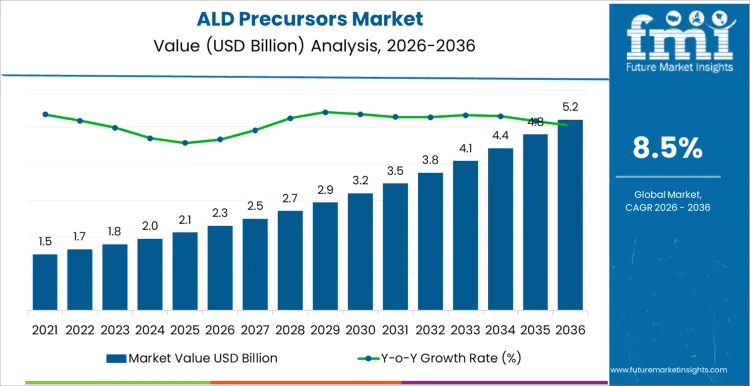
ALD Precursors Market Key Takeaways
| Metric | Value |
|---|---|
| ALD Precursors Market Value (2026) | USD 2.3 Billion |
| ALD Precursors Market Forecast Value (2036) | USD 5.2 Billion |
| ALD Precursors Market Forecast CAGR 2026 to 2036 | 8.50% |
How are Atomic-Level Control and Advanced Device Architectures Driving the ALD Precursors Market?
The ALD precursors market is expanding as semiconductor manufacturers depend on atomic-layer precision to enable advanced logic, memory, and power devices. ALD processes deliver conformal, pinhole-free films across high aspect-ratio features, making precursor chemistry a yield-critical variable rather than a commodity input. As gate-all-around transistors, 3D NAND, and advanced interconnect stacks proliferate, demand is increasingly tied to precursors that offer stable vapor pressure, clean reaction pathways, and predictable surface chemistry.
Process integration depth is shaping supplier selection. Fabs prioritize precursors that integrate seamlessly with existing ALD toolsets while supporting tighter temperature windows, faster cycle times, and reduced impurity incorporation. Metal, metal-oxide, and nitride precursors must balance reactivity with thermal stability to avoid parasitic reactions and particle generation. Suppliers that co-develop chemistries with tool OEMs-and provide node-specific data on film density, uniformity, and defectivity-are securing process-of-record positions earlier in development cycles.
Capacity alignment and global supply assurance are further reinforcing market growth. With new fabs coming online across Asia Pacific, North America, and Europe, buyers are emphasizing multi-site manufacturing, rigorous batch traceability, and resilient logistics for high-purity precursors. As ALD usage expands beyond leading-edge nodes into mature processes and adjacent industries, competitive advantage increasingly depends on chemistry precision, integration expertise, and dependable scale positioning ALD precursors as foundational enablers of next-generation device manufacturing.
How is the ALD Precursors Market Structured by Film Type and Precursor Chemistry?
The ald precursors market is segmented by film type and precursor chemistry, reflecting how deposition requirements and material performance targets influence precursor selection. By film type, high-k dielectric films represent the leading segment, as atomic layer deposition is widely used to achieve precise thickness control and conformality in advanced semiconductor devices. Other film types include metal gate and conductive films, barrier and liner films, and additional ald layers used in specialized device structures. By precursor chemistry, metal-organic precursors dominate usage, followed by halide precursors, plasma-enhanced or reactive precursors, and other chemistries tailored for specific deposition conditions.
Why Do High-k Dielectric Films Lead Film Type Adoption in the ALD Precursors Market?

High-k dielectric films account for 32% share of the ald precursors market because they are critical for controlling leakage current and maintaining capacitance in advanced transistor architectures. Ald enables uniform deposition of high-k materials on complex 3D structures such as finFETs and gate-all-around devices. Semiconductor manufacturers rely on ald precursors to achieve angstrom-level thickness control and consistent electrical properties across wafers. As device scaling continues, high-k layers are deposited repeatedly at multiple process stages, increasing precursor consumption. These precision-driven and volume-intensive requirements explain why high-k dielectric films remain the leading film type segment.
Why Do Metal-Organic Precursors Dominate Precursor Chemistry Adoption In The ALD Precursors Market?

Metal-organic precursors hold 38% share of the ald precursors market because they offer favorable volatility, controlled reactivity, and stable delivery during deposition cycles. These precursors enable uniform film growth with minimal particle generation, which is essential for defect control in advanced nodes. Metal-organic chemistries support a wide range of films, including high-k dielectrics, conductive layers, and barrier materials. Their compatibility with thermal and plasma-enhanced ald processes provides flexibility across different device architectures. Broad process window, predictable reaction behavior, and scalability across high-volume fabs explain why metal-organic precursors remain the most widely adopted chemistry.
What are the Key Dynamics of the ALD Precursors Market?
The ALD precursors market is driven by the growing adoption of atomic layer deposition (ALD) in semiconductor manufacturing, advanced packaging, memory, displays, and emerging applications such as micro-LEDs, power electronics, and MEMS. ALD enables precise, conformal thin films with atomic-level thickness control, which are critical for high-aspect-ratio structures and nanoscale architectures. For precursor producers and materials suppliers, molecular volatility, thermal stability, high purity, predictable surface chemistry, and minimal impurity profiles are essential performance attributes that influence qualification and long-term adoption. Vendor support with documentation, lot validation, and vendor consistency is also central to winning production contracts with semiconductor fabs and equipment manufacturers.
How do Semiconductor and Technology Trends Shape This Market?
Semiconductor and technology trends are strongly shaping the ALD precursors market as devices continue to scale and 3D structures proliferate. With advanced nodes moving below 7 nm and toward sub-3 nm, ALD has become indispensable for gate dielectrics, metal gates, and spacers, etch stops, barrier/liner layers, and high-k/metal-gate stacks. Increased deployment of 3D NAND, finFET/NSFET, and heterogeneous integration further elevates demand for ultrathin films with uniformity across complex topographies. Growth in high-bandwidth memory, logic, and next-generation packaging requires ALD materials with tight thickness control and excellent film quality. Suppliers that co-develop tailored precursor chemistries with equipment partners and fab integration teams gain early qualification advantages and stronger positioning in fab roadmaps.
Why do Purity Control and Qualification Barriers Restrain Market Growth?
Purity control and qualification barriers restrain growth in the ALD precursors market because semiconductor fabs require materials that meet exacting defectivity and contamination specifications. Precursor impurities such as metals, oxygen, carbon, or halogens-can degrade film performance, introduce leakage paths, or increase defect density, negatively affecting device yield and reliability. Qualification cycles for new precursors are extensive, involving wafer-level testing of film thickness, uniformity, electrical performance, thermal stability, and integration behavior with downstream processes. This extends time to production readiness and increases development cost for precursor suppliers. Strong traceability and consistency across lots are required, raising barriers to entry for smaller suppliers without established semiconductor qualification frameworks.
What is Driving Country-Level Expansion in the ALD Precursors Market?
The atomic layer deposition (ALD) precursors market is expanding as semiconductor manufacturers increasingly rely on ALD processes to achieve precise thickness control, conformality, and uniformity in advanced device structures. ALD precursors are critical for depositing high-k dielectrics, metal gates, barrier layers, and passivation films in logic, memory, power, and specialty semiconductors. Country-wise growth varies based on wafer fabrication investments, transition toward advanced nodes, and adoption of complex 3D architectures such as FinFETs, GAA transistors, and 3D NAND. High-growth markets benefit from aggressive fab expansion and advanced node migration, while mature regions emphasize material qualification, process stability, and long-term reliability.
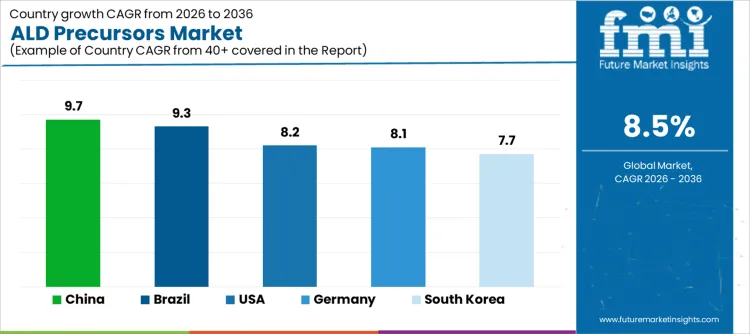
| Country | CAGR (%) |
|---|---|
| China | 9.7 |
| Brazil | 9.3 |
| United States | 8.2 |
| Germany | 8.1 |
| South Korea | 7.7 |
Why is China Leading the ALD Precursors Market?
Demand for ALD precursors in China is expanding at a CAGR of 9.7% during 2026 to 2036, driven by large-scale investments in domestic semiconductor fabrication and rapid adoption of advanced deposition technologies. Expansion of logic, memory, and power semiconductor fabs is increasing demand for ALD precursors used in high-k dielectrics, metal gates, diffusion barriers, and passivation layers. As device geometries shrink and aspect ratios rise, ALD becomes essential, directly increasing precursor consumption per wafer. Chinese fabs prioritize ALD precursors with stable vapor pressure, high reactivity control, and ultra-low impurity profiles to ensure repeatable film growth. Domestic chemical suppliers are scaling electronic-grade precursor production to support localization efforts and reduce import dependence. Integration with fab-adjacent chemical delivery systems further strengthens adoption. Procurement decisions emphasize purity certification, batch consistency, and qualification across multiple technology nodes.
Why is Brazil Emerging as a High-Growth Market for ALD Precursors?
Sale of ALD precursors in Brazil is growing at a CAGR of 9.3% during 2026 to 2036, supported by gradual expansion of semiconductor-related manufacturing, compound semiconductors, and advanced electronics production. While Brazil does not host leading-edge logic fabs, demand is increasing from specialty semiconductor lines, optoelectronics, sensors, and advanced packaging operations that rely on ALD for thin-film precision. Manufacturers value ALD precursors for enabling uniform coatings, defect reduction, and improved device reliability. Buyers prioritize formulation stability, safe handling, and compatibility with small- to mid-scale ALD tools. Adoption is supported by incremental upgrades in fabrication capabilities and growing localization of electronics manufacturing. Procurement decisions often favor suppliers with regional availability, technical support, and compliance with international semiconductor material standards.
What is Driving Demand for ALD Precursors in the United States?
The United States ALD precursors market is expanding at a CAGR of 8.2% during 2026 to 2036, driven by renewed investment in domestic semiconductor manufacturing and expansion of advanced logic and memory fabs. ALD is widely used in advanced nodes for gate stacks, interconnect barriers, and 3D device structures, making precursor supply critical. USA fabs emphasize precursor purity, reproducible growth behavior, and compatibility with high-volume ALD platforms. Buyers prioritize suppliers with strong technical collaboration capabilities and proven performance at advanced nodes. Procurement decisions focus on long-term supply agreements, robust quality documentation, and support for process integration. Market growth is reinforced by fab construction programs, increasing ALD steps per wafer, and continued adoption of advanced device architectures.
How is Germany Supporting Growth in the ALD Precursors Market?
Demand for ALD precursors in Germany is growing at a CAGR of 8.1% during 2026 to 2036, supported by demand from power semiconductors, automotive electronics, sensors, and industrial chips. German fabs emphasize precision, reliability, and long-term process stability, supporting steady adoption of ALD materials. ALD precursors are used for controlled deposition of dielectric and barrier layers in specialty semiconductor devices. Buyers prioritize reproducibility, traceability, and compliance with strict manufacturing standards. Procurement decisions favor suppliers with certified quality systems and the ability to support long qualification cycles. Market growth is reinforced by Germany’s leadership in automotive and industrial semiconductors.
How Is South Korea Expanding Use of ALD Precursors?
Sale of ALD precursors in South Korea is expanding at a CAGR of 7.7% during 2026 to 2036, driven by strong demand from memory semiconductor manufacturing and advanced logic production. High layer counts in 3D NAND and advanced DRAM significantly increase ALD intensity per wafer. South Korean fabs emphasize ultra-low impurity levels, consistent precursor delivery, and compatibility with high-throughput ALD tools. Buyers prioritize suppliers capable of delivering stable quality at scale. Procurement decisions are influenced by supplier reliability, rapid technical response, and alignment with global semiconductor manufacturing standards. Market growth is supported by continued investment in memory fabs and advanced node transitions.
How are Companies Competing in the ALD Precursors Market?
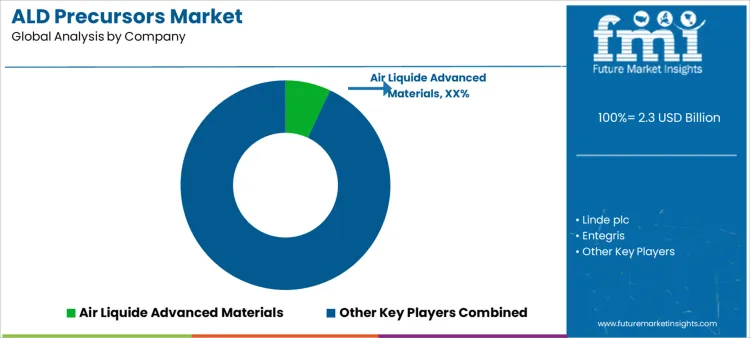
Competition in the ALD (Atomic Layer Deposition) precursors market is rooted in precursor volatility, thermal stability, and ultra-high purity parameters that directly affect film uniformity, conformality, and defectivity in cutting-edge logic, memory, and 3D device fabrication. As fabs adopt ALD for high-k/metal gate stacks, barrier layers, and advanced interconnects, suppliers differentiate through rigorous impurity control, robust supply chains, and deep process integration support.
Air Liquide Advanced Materials competes with a broad portfolio of metal and silicon precursors engineered for consistent vapor pressure and minimal residue, positioning its offerings for large-volume manufacturing across wafers and 3D structures. Linde plc differentiates through high-purity delivery solutions and global manufacturing scale, supporting customers with stringent documentation and supply reliability. Materials expertise and catalog breadth bring competitive strength. Entegris focuses on precursor packages paired with advanced purification and delivery systems, emphasizing impurity mitigation and system compatibility. Versum Materials (Merck legacy) and Dow offer tailored precursor chemistries with trace-level control, backed by fab-level technical support and qualification pathways.
Chemical diversity and niche specialization further distinguish competitors. JSR Corporation and Mitsubishi Gas Chemical emphasize precursors designed for specific ALD chemistries with stable thermal behavior and minimal CVD overlap. Strem Chemicals (Thermo Fisher brand) competes through specialty organometallic precursors and small-volume, high-precision compounds. SK Materials strengthens competition with high-purity precursors tuned for emerging process windows. TANAKA Precious Metals adds niche advantage with precious-metal ALD precursors used in advanced barrier and seed layers. Across the market, competitive advantage is defined by ultra-low impurity profiles, process compatibility, and qualification maturity rather than reagent cost alone.
Key Players in ALD Precursors Market
- Air Liquide Advanced Materials
- Linde plc
- Entegris
- Versum Materials (Merck)
- Dow
- JSR Corporation
- Strem Chemicals (Thermo Fisher)
- Mitsubishi Gas Chemical
- SK Materials
- TANAKA Precious Metals (ALD precursors)
Scope of Report
| Attribute | Details |
|---|---|
| Market Size Unit | USD Million |
| Film Type Covered | High-k Dielectric Films, Metal Gate & Conductive Films, Barrier & Liner Films, Other ALD-Deposited Films |
| Precursor Chemistry Covered | Metal-Organic Precursors, Halide Precursors, Plasma-Enhanced or Reactive Precursors, Other ALD Chemistries |
| Countries Covered | China, Japan, South Korea, India, Australia & New Zealand, ASEAN, Rest of Asia Pacific, Germany, United Kingdom, France, Italy, Spain, Nordic, BENELUX, Rest of Europe, United States, Canada, Mexico, Brazil, Chile, Rest of Latin America, Kingdom of Saudi Arabia, Other GCC Countries, Turkey, South Africa, Other African Union, Rest of Middle East & Africa |
| Regions Covered | Asia Pacific, Europe, North America, Latin America, Middle East & Africa |
| Key Companies Profiled | Air Liquide Advanced Materials, Linde plc, Entegris, Versum Materials (Merck), Dow, JSR Corporation, Strem Chemicals (Thermo Fisher), Mitsubishi Gas Chemical, SK Materials, TANAKA Precious Metals |
| Additional Attributes | Dollar sales by film type and precursor chemistry are analyzed across advanced and mature semiconductor nodes. The scope evaluates precursor volatility, purity control, thermal stability, and ALD process compatibility. Country-level assessment reflects logic and memory fab expansions, increasing ALD layer counts, and material adoption trends for sub-10 nm and advanced packaging applications. |
ALD Precursors Market by Key Segments
Film Type
- High-k Dielectrics
- Metal Gate & Conductive Films
- Barrier & Liner Films
- Other ALD Films
Precursor Chemistry
- Metal-Organic Precursors
- Halide Precursors
- Plasma-Enhanced or Reactive Precursors
- Other Chemistries
Region
- Asia Pacific
- China
- Japan
- South Korea
- India
- Australia & New Zealand
- ASEAN
- Rest of Asia Pacific
- Europe
- Germany
- United Kingdom
- France
- Italy
- Spain
- Nordic
- BENELUX
- Rest of Europe
- North America
- United States
- Canada
- Mexico
- Latin America
- Brazil
- Chile
- Rest of Latin America
- Middle East & Africa
- Kingdom of Saudi Arabia
- Other GCC Countries
- Turkey
- South Africa
- Other African Union
- Rest of Middle East & Africa
Bibliography
- International Roadmap for Devices and Systems. (2024). Advanced patterning, deposition, and materials requirements for sub‑5 nm nodes.
- Kim, H. (2024). High‑k dielectric thin films for advanced semiconductor devices. Journal of Vacuum Science & Technology A.
- European Commission Joint Research Centre. (2024). Advanced materials for semiconductor manufacturing and nanoelectronics.
- International Energy Agency. (2024). Semiconductor manufacturing, materials intensity, and advanced fabrication energy use
- Vandalon, V., & Kessels, W. M. M. (2024). Plasma‑enhanced atomic layer deposition for advanced semiconductor manufacturing.
Frequently Asked Questions
How big is the ald precursors market in 2026?
The global ald precursors market is estimated to be valued at USD 2.3 billion in 2026.
What will be the size of ald precursors market in 2036?
The market size for the ald precursors market is projected to reach USD 5.2 billion by 2036.
How much will be the ald precursors market growth between 2026 and 2036?
The ald precursors market is expected to grow at a 8.5% CAGR between 2026 and 2036.
What are the key product types in the ald precursors market?
The key product types in ald precursors market are high-k dielectrics, metal gate & conductive films, barrier & liner films and other ald films.
Which precursor chemistry segment to contribute significant share in the ald precursors market in 2026?
In terms of precursor chemistry, metal-organic precursors segment to command 38.0% share in the ald precursors market in 2026.
Preview the report firsthand - request a free sample
Get SampleGet the brochure for pricing and purchase details.
Get PDFTable of Content
- Executive Summary
- Global Market Outlook
- Demand-side Trends
- Supply-side Trends
- Technology Roadmap Analysis
- Analysis and Recommendations
- Market Overview
- Market Coverage / Taxonomy
- Market Definition / Scope / Limitations
- Market Background
- Market Dynamics
- Drivers
- Restraints
- Opportunity
- Trends
- Scenario Forecast
- Demand in Optimistic Scenario
- Demand in Likely Scenario
- Demand in Conservative Scenario
- Opportunity Map Analysis
- Product Life Cycle Analysis
- Supply Chain Analysis
- Investment Feasibility Matrix
- Value Chain Analysis
- PESTLE and Porter’s Analysis
- Regulatory Landscape
- Regional Parent Market Outlook
- Production and Consumption Statistics
- Import and Export Statistics
- Market Dynamics
- Global Market Analysis 2021 to 2025 and Forecast, 2026 to 2036
- Historical Market Size Value (USD Million) Analysis, 2021 to 2025
- Current and Future Market Size Value (USD Million) Projections, 2026 to 2036
- Y-o-Y Growth Trend Analysis
- Absolute $ Opportunity Analysis
- Global Market Pricing Analysis 2021 to 2025 and Forecast 2026 to 2036
- Global Market Analysis 2021 to 2025 and Forecast 2026 to 2036, By Film Type
- Introduction / Key Findings
- Historical Market Size Value (USD Million) Analysis By Film Type , 2021 to 2025
- Current and Future Market Size Value (USD Million) Analysis and Forecast By Film Type , 2026 to 2036
- High-k Dielectrics
- Metal Gate & Conductive Films
- Barrier & Liner Films
- Other ALD Films
- High-k Dielectrics
- Y-o-Y Growth Trend Analysis By Film Type , 2021 to 2025
- Absolute $ Opportunity Analysis By Film Type , 2026 to 2036
- Global Market Analysis 2021 to 2025 and Forecast 2026 to 2036, By Precursor Chemistry
- Introduction / Key Findings
- Historical Market Size Value (USD Million) Analysis By Precursor Chemistry, 2021 to 2025
- Current and Future Market Size Value (USD Million) Analysis and Forecast By Precursor Chemistry, 2026 to 2036
- Metal-Organic Precursors
- Halide Precursors
- Plasma-Enhanced or Reactive Precursors
- Other Chemistries
- Metal-Organic Precursors
- Y-o-Y Growth Trend Analysis By Precursor Chemistry, 2021 to 2025
- Absolute $ Opportunity Analysis By Precursor Chemistry, 2026 to 2036
- Global Market Analysis 2021 to 2025 and Forecast 2026 to 2036, By Region
- Introduction
- Historical Market Size Value (USD Million) Analysis By Region, 2021 to 2025
- Current Market Size Value (USD Million) Analysis and Forecast By Region, 2026 to 2036
- North America
- Latin America
- Western Europe
- Eastern Europe
- East Asia
- South Asia and Pacific
- Middle East & Africa
- Market Attractiveness Analysis By Region
- North America Market Analysis 2021 to 2025 and Forecast 2026 to 2036, By Country
- Historical Market Size Value (USD Million) Trend Analysis By Market Taxonomy, 2021 to 2025
- Market Size Value (USD Million) Forecast By Market Taxonomy, 2026 to 2036
- By Country
- USA
- Canada
- Mexico
- By Film Type
- By Precursor Chemistry
- By Country
- Market Attractiveness Analysis
- By Country
- By Film Type
- By Precursor Chemistry
- Key Takeaways
- Latin America Market Analysis 2021 to 2025 and Forecast 2026 to 2036, By Country
- Historical Market Size Value (USD Million) Trend Analysis By Market Taxonomy, 2021 to 2025
- Market Size Value (USD Million) Forecast By Market Taxonomy, 2026 to 2036
- By Country
- Brazil
- Chile
- Rest of Latin America
- By Film Type
- By Precursor Chemistry
- By Country
- Market Attractiveness Analysis
- By Country
- By Film Type
- By Precursor Chemistry
- Key Takeaways
- Western Europe Market Analysis 2021 to 2025 and Forecast 2026 to 2036, By Country
- Historical Market Size Value (USD Million) Trend Analysis By Market Taxonomy, 2021 to 2025
- Market Size Value (USD Million) Forecast By Market Taxonomy, 2026 to 2036
- By Country
- Germany
- UK
- Italy
- Spain
- France
- Nordic
- BENELUX
- Rest of Western Europe
- By Film Type
- By Precursor Chemistry
- By Country
- Market Attractiveness Analysis
- By Country
- By Film Type
- By Precursor Chemistry
- Key Takeaways
- Eastern Europe Market Analysis 2021 to 2025 and Forecast 2026 to 2036, By Country
- Historical Market Size Value (USD Million) Trend Analysis By Market Taxonomy, 2021 to 2025
- Market Size Value (USD Million) Forecast By Market Taxonomy, 2026 to 2036
- By Country
- Russia
- Poland
- Hungary
- Balkan & Baltic
- Rest of Eastern Europe
- By Film Type
- By Precursor Chemistry
- By Country
- Market Attractiveness Analysis
- By Country
- By Film Type
- By Precursor Chemistry
- Key Takeaways
- East Asia Market Analysis 2021 to 2025 and Forecast 2026 to 2036, By Country
- Historical Market Size Value (USD Million) Trend Analysis By Market Taxonomy, 2021 to 2025
- Market Size Value (USD Million) Forecast By Market Taxonomy, 2026 to 2036
- By Country
- China
- Japan
- South Korea
- By Film Type
- By Precursor Chemistry
- By Country
- Market Attractiveness Analysis
- By Country
- By Film Type
- By Precursor Chemistry
- Key Takeaways
- South Asia and Pacific Market Analysis 2021 to 2025 and Forecast 2026 to 2036, By Country
- Historical Market Size Value (USD Million) Trend Analysis By Market Taxonomy, 2021 to 2025
- Market Size Value (USD Million) Forecast By Market Taxonomy, 2026 to 2036
- By Country
- India
- ASEAN
- Australia & New Zealand
- Rest of South Asia and Pacific
- By Film Type
- By Precursor Chemistry
- By Country
- Market Attractiveness Analysis
- By Country
- By Film Type
- By Precursor Chemistry
- Key Takeaways
- Middle East & Africa Market Analysis 2021 to 2025 and Forecast 2026 to 2036, By Country
- Historical Market Size Value (USD Million) Trend Analysis By Market Taxonomy, 2021 to 2025
- Market Size Value (USD Million) Forecast By Market Taxonomy, 2026 to 2036
- By Country
- Kingdom of Saudi Arabia
- Other GCC Countries
- Turkiye
- South Africa
- Other African Union
- Rest of Middle East & Africa
- By Film Type
- By Precursor Chemistry
- By Country
- Market Attractiveness Analysis
- By Country
- By Film Type
- By Precursor Chemistry
- Key Takeaways
- Key Countries Market Analysis
- USA
- Pricing Analysis
- Market Share Analysis, 2025
- By Film Type
- By Precursor Chemistry
- Canada
- Pricing Analysis
- Market Share Analysis, 2025
- By Film Type
- By Precursor Chemistry
- Mexico
- Pricing Analysis
- Market Share Analysis, 2025
- By Film Type
- By Precursor Chemistry
- Brazil
- Pricing Analysis
- Market Share Analysis, 2025
- By Film Type
- By Precursor Chemistry
- Chile
- Pricing Analysis
- Market Share Analysis, 2025
- By Film Type
- By Precursor Chemistry
- Germany
- Pricing Analysis
- Market Share Analysis, 2025
- By Film Type
- By Precursor Chemistry
- UK
- Pricing Analysis
- Market Share Analysis, 2025
- By Film Type
- By Precursor Chemistry
- Italy
- Pricing Analysis
- Market Share Analysis, 2025
- By Film Type
- By Precursor Chemistry
- Spain
- Pricing Analysis
- Market Share Analysis, 2025
- By Film Type
- By Precursor Chemistry
- France
- Pricing Analysis
- Market Share Analysis, 2025
- By Film Type
- By Precursor Chemistry
- India
- Pricing Analysis
- Market Share Analysis, 2025
- By Film Type
- By Precursor Chemistry
- ASEAN
- Pricing Analysis
- Market Share Analysis, 2025
- By Film Type
- By Precursor Chemistry
- Australia & New Zealand
- Pricing Analysis
- Market Share Analysis, 2025
- By Film Type
- By Precursor Chemistry
- China
- Pricing Analysis
- Market Share Analysis, 2025
- By Film Type
- By Precursor Chemistry
- Japan
- Pricing Analysis
- Market Share Analysis, 2025
- By Film Type
- By Precursor Chemistry
- South Korea
- Pricing Analysis
- Market Share Analysis, 2025
- By Film Type
- By Precursor Chemistry
- Russia
- Pricing Analysis
- Market Share Analysis, 2025
- By Film Type
- By Precursor Chemistry
- Poland
- Pricing Analysis
- Market Share Analysis, 2025
- By Film Type
- By Precursor Chemistry
- Hungary
- Pricing Analysis
- Market Share Analysis, 2025
- By Film Type
- By Precursor Chemistry
- Kingdom of Saudi Arabia
- Pricing Analysis
- Market Share Analysis, 2025
- By Film Type
- By Precursor Chemistry
- Turkiye
- Pricing Analysis
- Market Share Analysis, 2025
- By Film Type
- By Precursor Chemistry
- South Africa
- Pricing Analysis
- Market Share Analysis, 2025
- By Film Type
- By Precursor Chemistry
- USA
- Market Structure Analysis
- Competition Dashboard
- Competition Benchmarking
- Market Share Analysis of Top Players
- By Regional
- By Film Type
- By Precursor Chemistry
- Competition Analysis
- Competition Deep Dive
- Air Liquide Advanced Materials
- Overview
- Product Portfolio
- Profitability by Market Segments (Product/Age /Sales Channel/Region)
- Sales Footprint
- Strategy Overview
- Marketing Strategy
- Product Strategy
- Channel Strategy
- Linde plc
- Entegris
- Versum Materials (Merck)
- Dow
- JSR Corporation
- Strem Chemicals (Thermo Fisher)
- Mitsubishi Gas Chemical
- SK Materials
- TANAKA Precious Metals (ALD precursors)
- Air Liquide Advanced Materials
- Competition Deep Dive
- Assumptions & Acronyms Used
- Research Methodology


