

- Industry Size (2026)
- USD 570.4 Mn
- Forecast (2036)
- USD 1413.6 Mn
- CAGR (2026 to 2036)
- 9.5%
Formaldehyde-Free Crosslinkers for Wood and Textiles Market Forecast and Outlook 2026 to 2036
The formaldehyde-free crosslinkers for wood and textiles market is projected to experience steady growth from 2026 to 2036. In 2026, the market value is expected to be USD 570.4 million, with steady growth anticipated, reaching USD 1,413.6 million by 2036. The compound annual growth rate (CAGR) for this market is forecasted at 9.5%, driven by increasing demand for environmentally friendly alternatives in both wood and textile industries. Formaldehyde-free crosslinkers are gaining popularity due to their ability to improve the durability and performance of wood and textile products while meeting stricter environmental and safety regulations.
The market is supported by growing awareness of the harmful effects of formaldehyde-based chemicals and the increasing push for sustainability across various industries. As consumer preferences shift towards eco-friendlier products, the demand for formaldehyde-free solutions in wood finishing, textiles, and other applications is expected to grow. Innovations in crosslinking technologies and the development of high-performance formaldehyde-free alternatives will contribute to the market’s expansion. Over the forecast period, the market is expected to experience continued growth as manufacturers in these industries seek safer, more sustainable materials.
Quick Stats of the Formaldehyde-Free Crosslinkers for Wood and Textiles Market
- Formaldehyde-Free Crosslinkers for Wood and Textiles Market Value (2026): USD 570.4 million
- Formaldehyde-Free Crosslinkers for Wood and Textiles Market Forecast Value (2036): USD 1,413.6 million
- Formaldehyde-Free Crosslinkers for Wood and Textiles Market Global Forecast CAGR (2026 to 2036): 9.5%
- Formaldehyde-Free Crosslinkers for Wood and Textiles Market Leading Segment: Application Substrate (Wood Panels & Engineered Wood) 34%
- Key Growth Regions in Formaldehyde-Free Crosslinkers for Wood and Textiles Market: India
- Top Players in Formaldehyde-Free Crosslinkers for Wood and Textiles Market: BASF SE, Dow Inc., Huntsman Corporation, Wacker Chemie, Archroma

What is the Growth Forecast for the Formaldehyde-Free Crosslinkers for Wood and Textiles Market through 2036?
The growth forecast for the formaldehyde-free crosslinkers for wood and textiles market shows consistent expansion, with a projected CAGR of 9.5%. Starting at USD 570.4 million in 2026, the market will experience steady growth, reaching USD 625 million in 2027, USD 684.2 million in 2028, and USD 748.7 million in 2029. By 2030, the market value is projected to rise to USD 819.2 million, continuing to grow steadily through the decade.
The peak-to-trough analysis of the market reveals periods of steady growth, followed by relatively mild fluctuations as the market matures. From 2031 to 2036, the market will continue to expand, reaching USD 896.8 million in 2031, USD 982.7 million in 2032, and USD 1,077.3 million in 2033. By 2034, the market is projected to reach USD 1,181.5 million, increasing to USD 1,289 million in 2035, and finally achieving USD 1,413.6 million by 2036. The market shows steady expansion with manageable fluctuations, driven by the increasing demand for formaldehyde-free alternatives in both wood and textile applications.
Formaldehyde-Free Crosslinkers for Wood and Textiles Market Key Takeaways
| Metric | Value |
|---|---|
| Industry Sales Value (2026) | USD 570.4 million |
| Industry Forecast Value (2036) | USD 1,413.6 million |
| Industry Forecast CAGR (2026 to 2036) | 9.5% |
What Is Driving the Demand for the Formaldehyde-Free Crosslinkers for Wood and Textiles Market Globally?
The global demand for formaldehyde-free crosslinkers for wood and textiles is being driven by increasing regulatory pressure, heightened health and safety expectations, and growing sustainability commitments across industries. Traditional crosslinking agents used in wood composites, laminates, and textile finishes often release formaldehyde, a volatile organic compound associated with respiratory irritation and classified as a health hazard in many jurisdictions. Regulations such as stringent building product emission standards, textile safety requirements, and chemical management frameworks in Europe, North America, and parts of Asia have compelled manufacturers to seek alternatives that deliver comparable performance without formaldehyde emissions. In wood products, formaldehyde-free crosslinkers support the manufacture of low-emission panels, flooring, and furniture that comply with indoor air quality criteria. In textiles, they are used to impart durable press, wrinkle resistance, and wash-fast properties while avoiding harmful residues that can affect sensitive skin or complicate certifications. Consumer demand for safer, eco-friendly products and transparent ingredient disclosures further reinforces this trend, as both brands and end users prioritise materials that align with health and environmental values. Industry adoption is also supported by sustainability standards and eco-labels that reward reduced hazardous content and improved product stewardship.
Future demand for formaldehyde-free crosslinkers is expected to grow as formulation science, market expectations, and regulatory frameworks continue evolving toward safer chemistry and circular material use. Advances in alternative crosslinking technologies—such as bio-based polycarboxylic acids, non-formaldehyde aldehydes, and advanced polymeric systems—are enhancing performance in terms of durability, wash and moisture resistance, and thermal stability, making them more attractive across wood and textile applications. Expansion of sustainable building programmes, green procurement policies, and extended producer responsibility schemes will reinforce the need for compliant materials that reduce hazardous emissions over product life cycles. Growth in modular and engineered wood construction and demand for technical textiles in apparel, home goods, and industrial fabrics will maintain pressure on suppliers to offer high-performance, formaldehyde-free solutions. Supply chains that prioritise traceability and chemical safety will continue to integrate these alternatives as part of broader environmental, social, and governance (ESG) strategies. As global markets embrace safer chemistries and elevate criteria for health, environmental impact, and recyclability, the formaldehyde-free crosslinkers market is expected to expand steadily, driven by both compliance and competitive differentiation.
What are the Leading Segments in the Global Formaldehyde-Free Crosslinkers for Wood and Textiles Market?
The global formaldehyde-free crosslinkers for wood and textiles market is segmented by chemistry type and application substrate. Among chemistry types, polycarboxylic acid (PCA) crosslinkers lead the market, accounting for 30% of the share, followed by polyurethane (PU) crosslinkers, silane-based crosslinkers, bio-based & natural crosslinkers, and other formaldehyde-free crosslinkers. PCA crosslinkers are widely used in both wood and textile applications due to their superior bonding capabilities. On the application substrate side, wood panels & engineered wood dominate the market, holding 34% of the share, followed by textile fabrics (apparel, home, tech), paper & fiber composites, nonwoven & hygiene materials, and specialty industrial materials. The demand for formaldehyde-free solutions is increasing across these industries due to their environmental benefits and the need for safer alternatives to traditional crosslinkers.
What Drives the Growth of Polycarboxylic Acid (PCA) Crosslinkers in the Formaldehyde-Free Crosslinkers Market?

Polycarboxylic acid (PCA) crosslinkers are the leading chemistry type in the formaldehyde-free crosslinkers market, capturing 30% of the share. These crosslinkers are particularly valued for their ability to form strong, durable bonds without releasing formaldehyde, a known carcinogen. PCA crosslinkers are highly effective in both wood and textile applications, providing superior strength and resistance to moisture and wear. Their non-toxic nature makes them increasingly attractive as industries, especially in furniture and textile manufacturing, focus on more sustainable and safe production processes. The growing preference for eco-friendly and health-conscious materials in consumer products further supports the demand for PCA crosslinkers, especially as regulations on formaldehyde emissions become stricter. The versatility of PCA crosslinkers, combined with their environmental benefits, ensures their continued dominance in the market.
What is Driving the Demand for Wood Panels & Engineered Wood in the Formaldehyde-Free Crosslinkers Market?
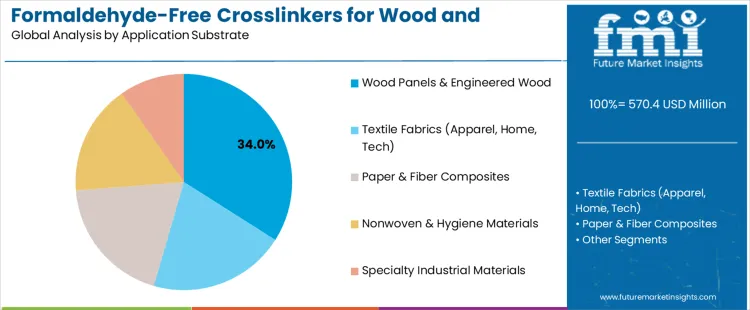
Wood panels & engineered wood are the leading application substrate in the formaldehyde-free crosslinkers market, holding 34% of the share. This growth is primarily driven by the increasing demand for safer, more sustainable building materials in the construction and furniture industries. Traditional wood products often use formaldehyde-based crosslinkers, which have raised health and environmental concerns. The demand for formaldehyde-free alternatives in wood panels and engineered wood is growing, as these products are used extensively in residential and commercial construction, as well as in furniture production. PCA and other formaldehyde-free crosslinkers ensure that these wood products remain durable, strong, and resistant to moisture without the harmful effects of formaldehyde. As consumers and regulatory bodies push for safer, non-toxic products, the demand for formaldehyde-free crosslinkers in wood panels & engineered wood is expected to continue growing, solidifying its position as the dominant application substrate in the market.
What are the Key Dynamics in the Global Formaldehyde-Free Crosslinkers for Wood and Textiles Market?
The global formaldehyde-free crosslinkers market is expanding as wood product and textile manufacturers adopt safer chemistries that meet stricter environmental, health and safety expectations. Crosslinkers improve durability, wash fastness, wrinkle resistance and dimensional stability without formaldehyde, which has recognized health concerns and regulatory restrictions. Growth reflects demand for sustainable materials, regulatory pressure on hazardous substances and consumer preference for low-emission products. Adoption spans interior wood panels, engineered wood components, apparel, home textiles and performance fabrics where formaldehyde-free performance aligns with evolving industry standards and brand commitments.
What are the Key Drivers for the Global Formaldehyde-Free Crosslinkers for Wood and Textiles Market?
Regulatory frameworks restricting formaldehyde emissions and exposure drive interest in alternative crosslinking technologies that support compliance and product safety. Architects, designers, brands and retailers are prioritizing products with lower hazardous chemical content to meet green building and eco-certification criteria. Rising consumer demand for sustainable home goods and apparel supports use of formaldehyde-free chemistries that maintain performance without compromising comfort or environmental claims. Advances in polymer and resin science enable viable non-formaldehyde crosslinkers that deliver strength and wash durability. Global supply chain transparency and responsible sourcing initiatives also encourage adoption of safer crosslinking agents in manufacturing.
What are the Restraints for the Global Formaldehyde-Free Crosslinkers for Wood and Textiles Market?
Technical complexity in formulating formaldehyde-free crosslinkers that match the performance of traditional agents can slow adoption or increase development cost. Some wood and textile applications demand high levels of durability and moisture resistance that are challenging to achieve without extensive optimization. Manufacturers may face higher raw material costs or require process modification to integrate new crosslinking systems, which influences economics in cost-sensitive segments. Limited awareness among smaller converters about the benefits of formaldehyde-free options affects uptake. Variability in regional testing standards and certification requirements for formaldehyde-free claims creates additional compliance planning for suppliers and brand owners.
What are the Key Trends in the Global Formaldehyde-Free Crosslinkers for Wood and Textiles Market?
A key trend is innovation in bio-based and reactive polymer systems that improve bonding and durability while reducing reliance on hazardous components. Suppliers are introducing next-generation crosslinkers tailored to specific substrate tensions, moisture conditions and processing needs. Integration of digital formulation tools accelerates design of formaldehyde-free chemistries that balance performance, cost and sustainability. Growth in eco-certification programs motivates brands to document and communicate reduced emissions and safer material profiles. Collaborative research among chemical developers, textile mills and wood product manufacturers supports validation of alternatives in real-world production, fostering broader market confidence and specification in sustainable product lines.
What is the Country-Wise Analysis of the Formaldehyde-Free Crosslinkers for Wood and Textiles Market?
The formaldehyde-free crosslinkers for wood and textiles market is projected to grow significantly, driven by increasing environmental concerns, regulations, and the rising demand for safer and more sustainable products. These crosslinkers, used in wood and textile applications to enhance durability and resistance without the harmful effects of formaldehyde, are gaining traction due to stricter regulations and growing consumer awareness regarding the toxicity of chemicals in manufacturing processes. High-growth markets such as India and China are experiencing strong demand due to rapid industrialization, an expanding manufacturing base, and increasing awareness about the harmful effects of formaldehyde in various products. Developed markets such as the USA, Germany, and South Korea are also witnessing steady growth, supported by stronger regulatory frameworks and a greater focus on sustainable production processes within the wood and textile industries.
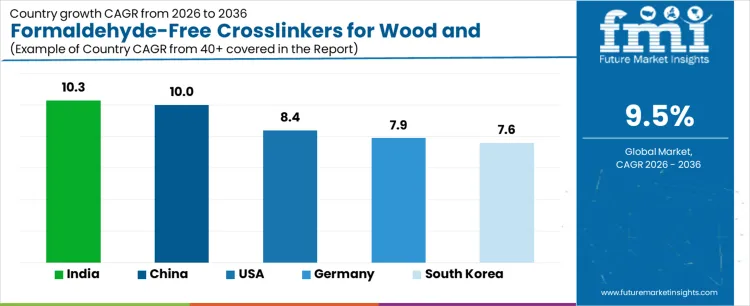
| Country | CAGR (2026 to 2036) |
|---|---|
| India | 10.3% |
| China | 10% |
| United States | 8.4% |
| Germany | 7.9% |
| South Korea | 7.6% |
What is the Growth Outlook for the Formaldehyde-Free Crosslinkers for Wood and Textiles Market in India?

The formaldehyde-free crosslinkers for wood and textiles market in India is expected to grow at the highest rate, with a projected CAGR of 10.3%. India’s rapidly expanding manufacturing sector, particularly in the textiles and wood industries, is driving the demand for safer and more sustainable production processes. As awareness about the harmful effects of formaldehyde increases and environmental regulations become stricter, manufacturers are seeking alternatives that are both effective and eco-friendly. India’s large textile production industry, which is one of the world’s largest, is increasingly adopting formaldehyde-free crosslinkers as part of efforts to improve the sustainability of its products. Additionally, as government initiatives push for cleaner and safer manufacturing processes, the demand for formaldehyde-free crosslinkers is expected to grow rapidly. The increasing emphasis on reducing chemical exposure and meeting international standards for environmental responsibility is further fueling the adoption of these crosslinkers in the country’s wood and textile industries.
What is the Market Outlook for the Formaldehyde-Free Crosslinkers for Wood and Textiles Market in China?
The formaldehyde-free crosslinkers for wood and textiles market in China is projected to grow steadily, with a projected CAGR of 10%. China, being a global leader in manufacturing and exports of textiles and wood products, is increasingly turning to safer, more sustainable production practices. With the growing awareness of the health risks associated with formaldehyde and the rising environmental regulations in the country, Chinese manufacturers are shifting towards formaldehyde-free alternatives. The market for formaldehyde-free crosslinkers is driven by the need to comply with both domestic and international environmental standards, as well as the rising consumer demand for safer products. As China’s focus on sustainability intensifies, the demand for these eco-friendly crosslinkers in textiles and wood products is expected to continue growing. Moreover, China’s active participation in global sustainability initiatives is likely to support the further adoption of formaldehyde-free technologies in its manufacturing sectors.
What is the Growth Forecast for the Formaldehyde-Free Crosslinkers for Wood and Textiles Market in the United States?
The formaldehyde-free crosslinkers for wood and textiles market in the United States is expected to grow steadily, with a projected CAGR of 8.4%. In the U.S., stricter regulations regarding chemical emissions and consumer demand for eco-friendly products are driving the adoption of formaldehyde-free crosslinkers in wood and textile manufacturing. The increasing emphasis on health and safety, coupled with growing concerns over indoor air quality and long-term exposure to harmful chemicals, has led manufacturers to seek non-toxic, sustainable alternatives. The market in the U.S. is also supported by regulatory bodies like the Environmental Protection Agency (EPA), which enforce stricter standards on the use of hazardous chemicals. As the U.S. market continues to focus on sustainability and reducing harmful chemical exposure, the demand for formaldehyde-free crosslinkers is expected to continue growing, especially in industries that prioritize environmental impact and consumer health.
What is the Market Outlook for the Formaldehyde-Free Crosslinkers for Wood and Textiles Market in Germany?
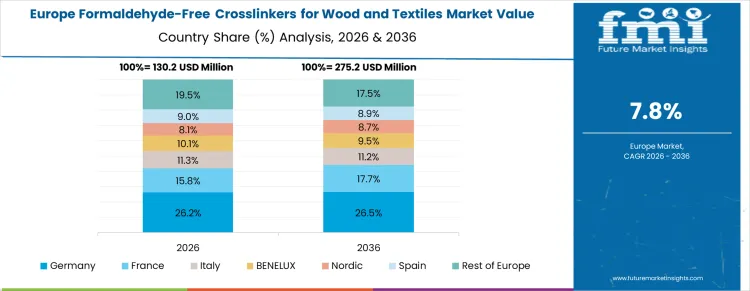
The formaldehyde-free crosslinkers for wood and textiles market in Germany is projected to grow at a moderate pace, with a projected CAGR of 7.9%. Germany’s strong commitment to sustainability, environmental responsibility, and high manufacturing standards is driving the demand for formaldehyde-free crosslinkers in its wood and textile industries. The growing awareness of environmental and health risks associated with the use of formaldehyde, combined with stringent European Union regulations, is encouraging German manufacturers to adopt safer alternatives. As consumers become more aware of the potential dangers of toxic chemicals in everyday products, demand for formaldehyde-free textiles and wood products is rising. The German market is expected to continue its steady growth as the country advances its eco-friendly initiatives and works toward meeting higher environmental standards in the production of wood and textile goods.
What are the Growth Prospects for the Formaldehyde-Free Crosslinkers for Wood and Textiles Market in South Korea?
The formaldehyde-free crosslinkers for wood and textiles market in South Korea is expected to grow at a steady pace, with a projected CAGR of 7.6%. South Korea’s growing focus on sustainability and environmental protection, coupled with increasing concerns over chemical exposure, is driving the adoption of formaldehyde-free crosslinkers in its textile and wood industries. As the country embraces eco-friendly production techniques and more stringent regulations are introduced, the demand for safer, non-toxic alternatives is rising. Additionally, the country’s high standards of quality and its participation in international environmental agreements further support the market growth for formaldehyde-free technologies. As South Korea’s manufacturing sectors increasingly shift towards greener practices, the market for formaldehyde-free crosslinkers is expected to continue expanding, supported by both local and global trends toward sustainability.
What is the Competitive Landscape for the Formaldehyde-Free Crosslinkers for Wood and Textiles Market?
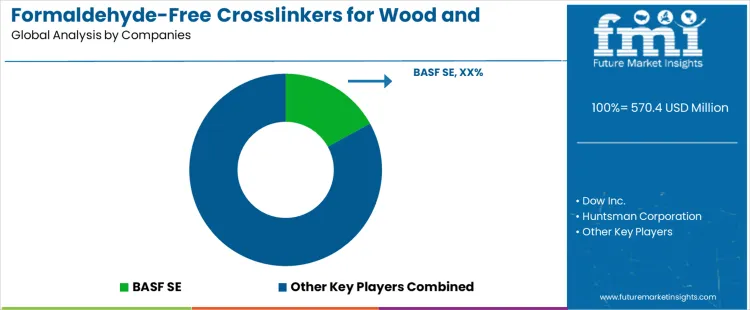
The formaldehyde-free crosslinkers for wood and textiles market is growing rapidly, driven by increasing demand for eco-friendly, sustainable solutions in the wood and textile industries. BASF SE leads the market with its innovative formaldehyde-free crosslinkers, offering high-performance solutions that improve the durability and performance of wood and textile products while eliminating the harmful effects of formaldehyde. Their focus on sustainability, product innovation, and regulatory compliance has positioned them as a dominant player in this market. Dow Inc., Huntsman Corporation, and Wacker Chemie are key competitors, providing specialized crosslinkers designed to improve the quality of wood and textile materials while ensuring environmental responsibility. Dow Inc. offers advanced solutions that focus on performance and sustainability, while Huntsman Corporation and Wacker Chemie specialize in creating formaldehyde-free products that meet industry demands for safer, more durable materials.
Archroma further contributes to the competitive landscape by offering eco-friendly, effective crosslinkers for textiles. Archroma emphasizes sustainability in its solutions, providing formaldehyde-free alternatives that improve textile durability and quality. These companies compete by focusing on product innovation, environmental impact reduction, and meeting the growing need for sustainable, non-toxic alternatives in wood and textile applications. As regulatory pressure and consumer demand for safer, greener products increase, the market is expected to continue evolving with a focus on eco-conscious solutions that meet the performance standards of the wood and textile industries.
Key Players of the Formaldehyde-Free Crosslinkers for Wood and Textiles Market
- BASF SE
- Dow Inc.
- Huntsman Corporation
- Wacker Chemie
- Archroma
Scope of the Report
| Items | Values |
|---|---|
| Quantitative Units (2026) | USD Million |
| Chemistry Type | Polycarboxylic Acid (PCA) Crosslinkers, Polyurethane (PU) Crosslinkers, Silane-Based Crosslinkers, Bio-Based & Natural Crosslinkers, Other Formaldehyde-Free Crosslinkers |
| Application Substrate | Wood Panels & Engineered Wood, Textile Fabrics (Apparel, Home, Tech), Paper & Fiber Composites, Nonwoven & Hygiene Materials, Specialty Industrial Materials |
| End-Use Industry | Furniture & Wood Products, Textile & Apparel Manufacturing, Construction & Interior Materials, Hygiene & Medical Textiles, Automotive & Industrial Materials |
| Companies | BASF SE, Dow Inc., Huntsman Corporation, Wacker Chemie, Archroma |
| Regions Covered | North America, Latin America, Western Europe, Eastern Europe, South Asia and Pacific, East Asia, Middle East & Africa |
| Countries Covered | United States, Canada, Mexico, Brazil, Argentina, Germany, France, United Kingdom, Italy, Spain, Netherlands, China, India, Japan, South Korea, ANZ, GCC Countries, South Africa |
| Additional Attributes | Dollar by sales by chemistry type, application substrate, end-use industry, and region. Includes market trends in formaldehyde-free crosslinkers, focusing on polycarboxylic acid, polyurethane, silane-based, and bio-based crosslinkers. Highlights the role of wood panels, textile fabrics, and nonwoven materials in furniture, textile, construction, and hygiene industries. Focus on sustainability, performance, regulatory compliance, and market share of key companies in the crosslinker market. |
Formaldehyde-Free Crosslinkers for Wood and Textiles Market Segmentation
Chemistry Type
- Polycarboxylic Acid (PCA) Crosslinkers
- Polyurethane (PU) Crosslinkers
- Silane-Based Crosslinkers
- Bio-Based & Natural Crosslinkers
- Other Formaldehyde-Free Crosslinkers
Application Substrate
- Wood Panels & Engineered Wood
- Textile Fabrics (Apparel, Home, Tech)
- Paper & Fiber Composites
- Nonwoven & Hygiene Materials
- Specialty Industrial Materials
End-Use Industry
- Furniture & Wood Products
- Textile & Apparel Manufacturing
- Construction & Interior Materials
- Hygiene & Medical Textiles
- Automotive & Industrial Materials
Region
- Asia Pacific
- China
- Japan
- South Korea
- India
- Australia & New Zealand
- ASEAN
- Rest of Asia Pacific
- Europe
- Germany
- United Kingdom
- France
- Italy
- Spain
- Nordic
- BENELUX
- Rest of Europe
- North America
- United States
- Canada
- Mexico
- Latin America
- Brazil
- Chile
- Rest of Latin America
- Middle East & Africa
- Kingdom of Saudi Arabia
- Other GCC Countries
- Turkey
- South Africa
- Other African Union
- Rest of Middle East & Africa
Frequently Asked Questions
How big is the formaldehyde-free crosslinkers for wood and textiles market in 2026?
The global formaldehyde-free crosslinkers for wood and textiles market is estimated to be valued at USD 570.4 million in 2026.
What will be the size of formaldehyde-free crosslinkers for wood and textiles market in 2036?
The market size for the formaldehyde-free crosslinkers for wood and textiles market is projected to reach USD 1,413.6 million by 2036.
How much will be the formaldehyde-free crosslinkers for wood and textiles market growth between 2026 and 2036?
The formaldehyde-free crosslinkers for wood and textiles market is expected to grow at a 9.5% CAGR between 2026 and 2036.
What are the key product types in the formaldehyde-free crosslinkers for wood and textiles market?
The key product types in formaldehyde-free crosslinkers for wood and textiles market are polycarboxylic acid (pca) crosslinkers, polyurethane (pu) crosslinkers, silane-based crosslinkers, bio-based & natural crosslinkers and other formaldehyde-free crosslinkers.
Which application substrate segment to contribute significant share in the formaldehyde-free crosslinkers for wood and textiles market in 2026?
In terms of application substrate, wood panels & engineered wood segment to command 34.0% share in the formaldehyde-free crosslinkers for wood and textiles market in 2026.
Preview the report firsthand - request a free sample
Get SampleGet the brochure for pricing and purchase details.
Get PDFTable of Content
- Executive Summary
- Global Market Outlook
- Demand-side Trends
- Supply-side Trends
- Technology Roadmap Analysis
- Analysis and Recommendations
- Market Overview
- Market Coverage / Taxonomy
- Market Definition / Scope / Limitations
- Market Background
- Market Dynamics
- Drivers
- Restraints
- Opportunity
- Trends
- Scenario Forecast
- Demand in Optimistic Scenario
- Demand in Likely Scenario
- Demand in Conservative Scenario
- Opportunity Map Analysis
- Product Life Cycle Analysis
- Supply Chain Analysis
- Investment Feasibility Matrix
- Value Chain Analysis
- PESTLE and Porter’s Analysis
- Regulatory Landscape
- Regional Parent Market Outlook
- Production and Consumption Statistics
- Import and Export Statistics
- Market Dynamics
- Global Market Analysis 2021 to 2025 and Forecast, 2026 to 2036
- Historical Market Size Value (USD Million) Analysis, 2021 to 2025
- Current and Future Market Size Value (USD Million) Projections, 2026 to 2036
- Y-o-Y Growth Trend Analysis
- Absolute $ Opportunity Analysis
- Global Market Pricing Analysis 2021 to 2025 and Forecast 2026 to 2036
- Global Market Analysis 2021 to 2025 and Forecast 2026 to 2036, By Chemistry Type
- Introduction / Key Findings
- Historical Market Size Value (USD Million) Analysis By Chemistry Type , 2021 to 2025
- Current and Future Market Size Value (USD Million) Analysis and Forecast By Chemistry Type , 2026 to 2036
- Polycarboxylic Acid (PCA) Crosslinkers
- Polyurethane (PU) Crosslinkers
- Silane-Based Crosslinkers
- Bio-Based & Natural Crosslinkers
- Other Formaldehyde-Free Crosslinkers
- Polycarboxylic Acid (PCA) Crosslinkers
- Y-o-Y Growth Trend Analysis By Chemistry Type , 2021 to 2025
- Absolute $ Opportunity Analysis By Chemistry Type , 2026 to 2036
- Global Market Analysis 2021 to 2025 and Forecast 2026 to 2036, By Application Substrate
- Introduction / Key Findings
- Historical Market Size Value (USD Million) Analysis By Application Substrate, 2021 to 2025
- Current and Future Market Size Value (USD Million) Analysis and Forecast By Application Substrate, 2026 to 2036
- Wood Panels & Engineered Wood
- Textile Fabrics (Apparel, Home, Tech)
- Paper & Fiber Composites
- Nonwoven & Hygiene Materials
- Specialty Industrial Materials
- Wood Panels & Engineered Wood
- Y-o-Y Growth Trend Analysis By Application Substrate, 2021 to 2025
- Absolute $ Opportunity Analysis By Application Substrate, 2026 to 2036
- Global Market Analysis 2021 to 2025 and Forecast 2026 to 2036, By End-Use Industry
- Introduction / Key Findings
- Historical Market Size Value (USD Million) Analysis By End-Use Industry, 2021 to 2025
- Current and Future Market Size Value (USD Million) Analysis and Forecast By End-Use Industry, 2026 to 2036
- Furniture & Wood Products
- Textile & Apparel Manufacturing
- Construction & Interior Materials
- Hygiene & Medical Textiles
- Automotive & Industrial Materials
- Furniture & Wood Products
- Y-o-Y Growth Trend Analysis By End-Use Industry, 2021 to 2025
- Absolute $ Opportunity Analysis By End-Use Industry, 2026 to 2036
- Global Market Analysis 2021 to 2025 and Forecast 2026 to 2036, By Region
- Introduction
- Historical Market Size Value (USD Million) Analysis By Region, 2021 to 2025
- Current Market Size Value (USD Million) Analysis and Forecast By Region, 2026 to 2036
- North America
- Latin America
- Western Europe
- Eastern Europe
- East Asia
- South Asia and Pacific
- Middle East & Africa
- Market Attractiveness Analysis By Region
- North America Market Analysis 2021 to 2025 and Forecast 2026 to 2036, By Country
- Historical Market Size Value (USD Million) Trend Analysis By Market Taxonomy, 2021 to 2025
- Market Size Value (USD Million) Forecast By Market Taxonomy, 2026 to 2036
- By Country
- USA
- Canada
- Mexico
- By Chemistry Type
- By Application Substrate
- By End-Use Industry
- By Country
- Market Attractiveness Analysis
- By Country
- By Chemistry Type
- By Application Substrate
- By End-Use Industry
- Key Takeaways
- Latin America Market Analysis 2021 to 2025 and Forecast 2026 to 2036, By Country
- Historical Market Size Value (USD Million) Trend Analysis By Market Taxonomy, 2021 to 2025
- Market Size Value (USD Million) Forecast By Market Taxonomy, 2026 to 2036
- By Country
- Brazil
- Chile
- Rest of Latin America
- By Chemistry Type
- By Application Substrate
- By End-Use Industry
- By Country
- Market Attractiveness Analysis
- By Country
- By Chemistry Type
- By Application Substrate
- By End-Use Industry
- Key Takeaways
- Western Europe Market Analysis 2021 to 2025 and Forecast 2026 to 2036, By Country
- Historical Market Size Value (USD Million) Trend Analysis By Market Taxonomy, 2021 to 2025
- Market Size Value (USD Million) Forecast By Market Taxonomy, 2026 to 2036
- By Country
- Germany
- UK
- Italy
- Spain
- France
- Nordic
- BENELUX
- Rest of Western Europe
- By Chemistry Type
- By Application Substrate
- By End-Use Industry
- By Country
- Market Attractiveness Analysis
- By Country
- By Chemistry Type
- By Application Substrate
- By End-Use Industry
- Key Takeaways
- Eastern Europe Market Analysis 2021 to 2025 and Forecast 2026 to 2036, By Country
- Historical Market Size Value (USD Million) Trend Analysis By Market Taxonomy, 2021 to 2025
- Market Size Value (USD Million) Forecast By Market Taxonomy, 2026 to 2036
- By Country
- Russia
- Poland
- Hungary
- Balkan & Baltic
- Rest of Eastern Europe
- By Chemistry Type
- By Application Substrate
- By End-Use Industry
- By Country
- Market Attractiveness Analysis
- By Country
- By Chemistry Type
- By Application Substrate
- By End-Use Industry
- Key Takeaways
- East Asia Market Analysis 2021 to 2025 and Forecast 2026 to 2036, By Country
- Historical Market Size Value (USD Million) Trend Analysis By Market Taxonomy, 2021 to 2025
- Market Size Value (USD Million) Forecast By Market Taxonomy, 2026 to 2036
- By Country
- China
- Japan
- South Korea
- By Chemistry Type
- By Application Substrate
- By End-Use Industry
- By Country
- Market Attractiveness Analysis
- By Country
- By Chemistry Type
- By Application Substrate
- By End-Use Industry
- Key Takeaways
- South Asia and Pacific Market Analysis 2021 to 2025 and Forecast 2026 to 2036, By Country
- Historical Market Size Value (USD Million) Trend Analysis By Market Taxonomy, 2021 to 2025
- Market Size Value (USD Million) Forecast By Market Taxonomy, 2026 to 2036
- By Country
- India
- ASEAN
- Australia & New Zealand
- Rest of South Asia and Pacific
- By Chemistry Type
- By Application Substrate
- By End-Use Industry
- By Country
- Market Attractiveness Analysis
- By Country
- By Chemistry Type
- By Application Substrate
- By End-Use Industry
- Key Takeaways
- Middle East & Africa Market Analysis 2021 to 2025 and Forecast 2026 to 2036, By Country
- Historical Market Size Value (USD Million) Trend Analysis By Market Taxonomy, 2021 to 2025
- Market Size Value (USD Million) Forecast By Market Taxonomy, 2026 to 2036
- By Country
- Kingdom of Saudi Arabia
- Other GCC Countries
- Turkiye
- South Africa
- Other African Union
- Rest of Middle East & Africa
- By Chemistry Type
- By Application Substrate
- By End-Use Industry
- By Country
- Market Attractiveness Analysis
- By Country
- By Chemistry Type
- By Application Substrate
- By End-Use Industry
- Key Takeaways
- Key Countries Market Analysis
- USA
- Pricing Analysis
- Market Share Analysis, 2025
- By Chemistry Type
- By Application Substrate
- By End-Use Industry
- Canada
- Pricing Analysis
- Market Share Analysis, 2025
- By Chemistry Type
- By Application Substrate
- By End-Use Industry
- Mexico
- Pricing Analysis
- Market Share Analysis, 2025
- By Chemistry Type
- By Application Substrate
- By End-Use Industry
- Brazil
- Pricing Analysis
- Market Share Analysis, 2025
- By Chemistry Type
- By Application Substrate
- By End-Use Industry
- Chile
- Pricing Analysis
- Market Share Analysis, 2025
- By Chemistry Type
- By Application Substrate
- By End-Use Industry
- Germany
- Pricing Analysis
- Market Share Analysis, 2025
- By Chemistry Type
- By Application Substrate
- By End-Use Industry
- UK
- Pricing Analysis
- Market Share Analysis, 2025
- By Chemistry Type
- By Application Substrate
- By End-Use Industry
- Italy
- Pricing Analysis
- Market Share Analysis, 2025
- By Chemistry Type
- By Application Substrate
- By End-Use Industry
- Spain
- Pricing Analysis
- Market Share Analysis, 2025
- By Chemistry Type
- By Application Substrate
- By End-Use Industry
- France
- Pricing Analysis
- Market Share Analysis, 2025
- By Chemistry Type
- By Application Substrate
- By End-Use Industry
- India
- Pricing Analysis
- Market Share Analysis, 2025
- By Chemistry Type
- By Application Substrate
- By End-Use Industry
- ASEAN
- Pricing Analysis
- Market Share Analysis, 2025
- By Chemistry Type
- By Application Substrate
- By End-Use Industry
- Australia & New Zealand
- Pricing Analysis
- Market Share Analysis, 2025
- By Chemistry Type
- By Application Substrate
- By End-Use Industry
- China
- Pricing Analysis
- Market Share Analysis, 2025
- By Chemistry Type
- By Application Substrate
- By End-Use Industry
- Japan
- Pricing Analysis
- Market Share Analysis, 2025
- By Chemistry Type
- By Application Substrate
- By End-Use Industry
- South Korea
- Pricing Analysis
- Market Share Analysis, 2025
- By Chemistry Type
- By Application Substrate
- By End-Use Industry
- Russia
- Pricing Analysis
- Market Share Analysis, 2025
- By Chemistry Type
- By Application Substrate
- By End-Use Industry
- Poland
- Pricing Analysis
- Market Share Analysis, 2025
- By Chemistry Type
- By Application Substrate
- By End-Use Industry
- Hungary
- Pricing Analysis
- Market Share Analysis, 2025
- By Chemistry Type
- By Application Substrate
- By End-Use Industry
- Kingdom of Saudi Arabia
- Pricing Analysis
- Market Share Analysis, 2025
- By Chemistry Type
- By Application Substrate
- By End-Use Industry
- Turkiye
- Pricing Analysis
- Market Share Analysis, 2025
- By Chemistry Type
- By Application Substrate
- By End-Use Industry
- South Africa
- Pricing Analysis
- Market Share Analysis, 2025
- By Chemistry Type
- By Application Substrate
- By End-Use Industry
- USA
- Market Structure Analysis
- Competition Dashboard
- Competition Benchmarking
- Market Share Analysis of Top Players
- By Regional
- By Chemistry Type
- By Application Substrate
- By End-Use Industry
- Competition Analysis
- Competition Deep Dive
- BASF SE
- Overview
- Product Portfolio
- Profitability by Market Segments (Product/Age /Sales Channel/Region)
- Sales Footprint
- Strategy Overview
- Marketing Strategy
- Product Strategy
- Channel Strategy
- Dow Inc.
- Huntsman Corporation
- Wacker Chemie
- Archroma
- BASF SE
- Competition Deep Dive
- Assumptions & Acronyms Used
- Research Methodology


