

- Industry Size (2026)
- USD 578 Mn
- Forecast (2036)
- USD 1641.2 Mn
- CAGR (2026 to 2036)
- 11.0%
rPET Quality Restoration Chain-Extension Agents Market Forecast and Outlook 2026 to 2036
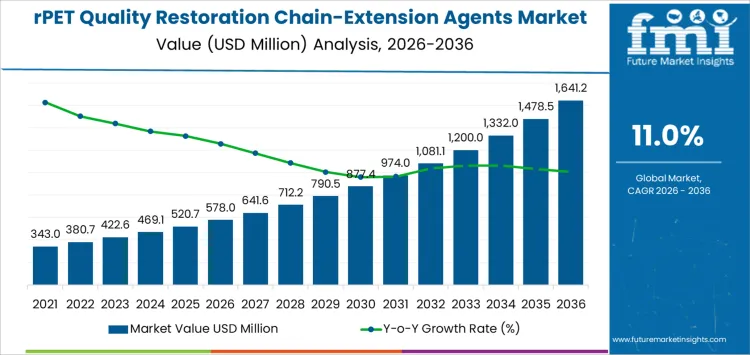
The rPET quality restoration chain-extension agents market is valued at USD 578 million in 2026 and is projected to reach USD 1,641.2 million by 2036, reflecting a CAGR of 11%. Growth from 2026 to 2031, rising from approximately USD 355 million to USD 967 million, is driven by increasing mechanical recycling and SSP upgrade applications. Epoxy-functional oligomers, anhydride-based extenders, and carbodiimide chemistries dominate early adoption, enhancing polymer chain length, improving bottle-grade and sheet-grade rPET properties, and enabling wider reuse in packaging and fibers.
From 2031 to 2036, the market accelerates from roughly USD 1,071 million to USD 1,641.2 million. Expansion is supported by the rising implementation of chemical recycling and hybrid recycling approaches, along with demand for higher-quality recycled polymers in consumer packaging, textiles, and industrial applications. Pellet and masterbatch formats dominate addition forms, while regulatory focus on circular economy adoption encourages uptake. Overall, technological advancements and process integration continue to drive structural value accumulation, supporting sustained market growth throughout the forecast period.
Quick Stats of the rPET Quality Restoration Chain-Extension Agents Market:
- rPET Quality Restoration Chain-Extension Agents Market Value (2026): USD 578 million
- rPET Quality Restoration Chain-Extension Agents Market Forecast Value (2036): USD 1,641.2 million
- rPET Quality Restoration Chain-Extension Agents Market Forecast CAGR (2026 to 2036): 11.0%
- Leading Chemistry in rPET Quality Restoration Chain-Extension Agents Market: Epoxy-functional oligomers (46%)
- Key Growth Regions in rPET Quality Restoration Chain-Extension Agents Market: China, Brazil, USA, Germany, UK
- Top Players in rPET Quality Restoration Chain-Extension Agents Market: BASF, Clariant, Sukano, Avient, Ampacet, Arkema, Evonik Industries, Dow, DuPont, Mitsubishi Chemical Group
What is the Growth Forecast for the rPET Quality Restoration Chain-Extension Agents Market through 2036?
From 2026 to 2031, the rPET quality restoration chain-extension agents market grows from USD 578 million to approximately USD 967 million, reflecting steady year-on-year gains driven by early adoption in recycled PET processing. Growth in this phase is concentrated in premium beverage, food, and packaging applications, where chain-extension agents improve molecular weight, mechanical performance, and barrier properties of recycled PET. Annual value additions increase gradually as processors validate product performance, optimize dosing protocols, and integrate agents into production lines without full-scale portfolio deployment.
Between 2031 and 2036, the market expands from roughly USD 967 million to USD 1,641.2 million, showing accelerated year-on-year growth. Later-stage expansion is driven by broader adoption across global rPET supply chains, including mass-market beverage, cosmetic, and food packaging applications. Annual increments widen as agents become standard for quality restoration, multi-batch blending, and performance consistency. Early growth relied on selective adoption and pilot validation, whereas later expansion is fueled by repeat procurement, portfolio-wide integration, and structural embedding of chain-extension agents into rPET production processes.
rPET Quality Restoration Chain Extension Agents Market Key Takeaways
| Metric | Value |
|---|---|
| Market Value (2026) | USD 578 million |
| Forecast Value (2036) | USD 1,641.2 million |
| Forecast CAGR (2026 to 2036) | 11.0% |
What Is Driving the Demand for the rPET Quality Restoration Chain-Extension Agents Market?
Demand for quality restoration chain-extension agents in rPET applications originated from inherent limitations in recycled polyethylene terephthalate materials processed through mechanical recycling. Mechanical recycling reduces the molecular weight and viscosity of PET due to heat and shear stresses, degrading mechanical strength and processability relative to virgin PET. Chain-extension agents were developed to chemically rebuild polymer chain length by reacting with terminal groups on degraded PET, restoring intrinsic viscosity and strengthening molecular architecture. This restoration enables recycled PET to approach performance levels required for applications such as packaging, films, and fibres that were previously unsuitable for lower quality rPET.
Future demand for chain-extension agents tailored to rPET quality restoration is expected to reflect regulatory mandates, recycled content targets, and the expansion of circular economy frameworks rather than incremental material performance improvements alone. Governments and industry standards are establishing requirements for minimum recycled content in plastic products, increasing reliance on high-quality rPET in consumer packaging and technical applications. This shift elevates the importance of additives that enable recycled materials to meet specifications traditionally reserved for virgin polymers. Advances in reactive extrusion processes and multifunctional chain extenders are improving restoration efficiency and broadening application scope.
What Factors Are Affecting the Demand for rPET Quality Restoration Chain Extension Agents Market in Terms of Chemistry and End Product?
Demand for rPET quality restoration chain extension agents is segmented by chemistry and end product across recycled polyester processing applications. Epoxy functional oligomers account for about 46% of total demand, making them the leading chemistry segment. Anhydride based, carbodiimide based, and isocyanate based chain extenders represent additional chemistries without disclosed share splits. These chemistries differ in reactivity, processing window, and impact on intrinsic viscosity recovery. End product segmentation reflects downstream performance requirements. Bottle grade rPET, sheet and thermoforming applications, fiber and textile uses, strapping, and filament applications require different viscosity and melt strength profiles. Together, these segments explain demand formation shaped by recyclate quality variability, processing stability, and end use performance thresholds rather than recycling volume growth alone.
What Drives Demand by Chemistry in the rPET Quality Restoration Chain Extension Agents Market?
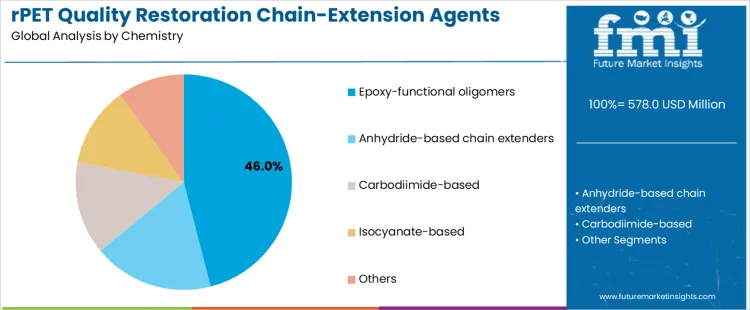
Epoxy functional oligomers lead demand with a 46% share due to broad compatibility with degraded rPET streams and predictable viscosity rebuilding. These agents react efficiently with carboxyl and hydroxyl end groups formed during recycling. Anhydride based chain extenders are used where controlled branching is required for sheet and thermoforming grades. Carbodiimide based chemistries address hydrolytic stability and moisture related degradation. Isocyanate based extenders are applied selectively due to handling and processing constraints. Adoption intensity aligns with recyclate contamination levels and extrusion conditions. Chemistry driven demand therefore reflects processing reliability and tolerance to variable feedstock rather than chemical novelty or cost minimization alone.
Chemistry selection remains stable because recyclers qualify formulations through repeated processing trials. Epoxy systems are favored for consistent performance across mixed waste streams. Anhydride and carbodiimide systems are applied where specific property tuning is required. Isocyanate use remains limited due to operational controls. These patterns limit short term substitution. Chemistry segmentation highlights dependence on predictable reaction behavior. Demand therefore aligns with recyclate quality management and extrusion process control rather than rapid experimentation with alternative chemistries.
How Does End Product Application Shape Demand for rPET Quality Restoration Chain Extension Agents Market?
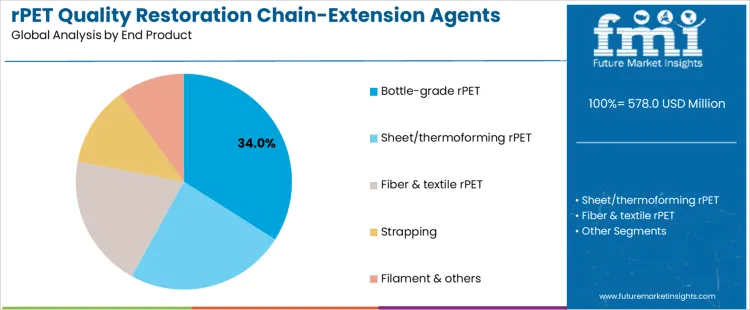
Bottle grade rPET accounts for about 34% of total demand, making it the leading end product application. This segment requires tight viscosity control and mechanical performance to meet packaging specifications. Sheet and thermoforming rPET applications use chain extenders to improve melt strength and dimensional stability. Fiber and textile rPET relies on viscosity rebuilding to support spinning consistency. Strapping applications require toughness and elongation performance. Filament and other applications adopt chain extenders where printability and flow control are required. End product selection depends on tolerance for branching and molecular weight distribution. Demand follows downstream performance requirements rather than recyclate availability alone.
Bottle grade applications maintain leadership due to strict performance standards and high production volumes. Thermoforming producers adjust chain extension to manage sag resistance. Fiber producers prioritize uniformity across runs. Strapping applications value durability over clarity. Filament uses adopt selectively based on processing stability. Producers avoid over extension to prevent gel formation. This constrains aggressive formulation changes. End product segmentation therefore stabilizes demand by reinforcing application specific performance targets. Demand growth reflects gradual expansion of high quality rPET applications rather than uniform growth across all recycled polyester end uses.
How Are rPET Quality Restoration Chain Extension Agents Being Applied Across Recycled PET Production?
Use appears in recycling operations where post-consumer PET (rPET) requires molecular weight restoration to meet performance specifications for food, beverage, and industrial packaging. rPET processors incorporate chain-extension agents to improve intrinsic viscosity, mechanical strength, and processability for bottles, trays, and thermoformed sheets. Beverage producers and converters adopt treated rPET to achieve barrier properties and durability comparable to virgin PET. These applications reflect operational and quality priorities rather than aesthetic objectives, with adoption driven by material performance, recyclate consistency, and regulatory compliance.
What Operational and Material Conditions Support Adoption of rPET Quality Restoration Chain Extension Agents?
Selection aligns with facilities processing rPET flakes or pellets where molecular degradation occurs during collection, sorting, and extrusion. Polymer engineers optimize dosage and mixing to achieve uniform chain extension without affecting color, clarity, or contaminant tolerance. Processing equipment, such as twin-screw extruders, is calibrated to accommodate the reactive additive. Brand owners require restored rPET to meet mechanical and barrier performance for bottling lines. These conditions emerge from quality assurance, recyclate standardization, and operational efficiency priorities in structured recycling workflows.
Which Practical Considerations Limit Wider Use of rPET Quality Restoration Chain Extension Agents?
Additive cost and dosing precision affect adoption in high volume, low margin recyclate streams. Compatibility with residual contaminants and additives in recycled feedstock must be evaluated to avoid gel formation or discoloration. Processing temperature and residence time require careful control to ensure uniform chain extension. Regulatory approval for food-contact applications may restrict certain chemistries. Equipment retrofitting may be needed in older extrusion lines. These factors result in selective deployment where performance restoration, recyclate quality, and process control outweigh cost and operational complexity.
What is the Demand for rPET Quality Restoration Chain Extension Agents by Country?
| Country | CAGR (%) |
|---|---|
| USA | 10.7% |
| Germany | 10.4% |
| China | 12.5% |
| UK | 10.2% |
| Brazil | 12.0% |
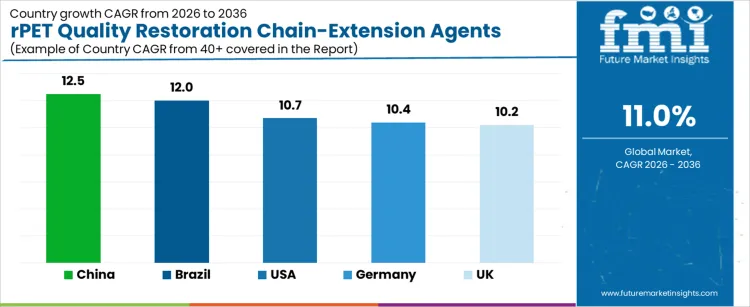
The demand for rPET quality restoration chain extension agents varies across countries, driven by recycling initiatives, sustainability goals, and increasing use of recycled PET in packaging. China leads with a 12.5% CAGR, supported by large scale recycling infrastructure, high demand for food and beverage packaging, and regulatory support for recycled content. Brazil follows at 12.0%, driven by growing PET recycling operations and adoption in beverage and consumer goods sectors. The USA grows at 10.7%, reflecting widespread use of rPET in packaging and efforts to maintain polymer quality. Germany records 10.4%, shaped by strict recycling standards, while the UK posts 10.2%, reflecting adoption in packaging applications and circular economy initiatives.
How Is rPET Quality Restoration Driving Growth in the United States?
In the United States, revenue from the rPET Quality Restoration Chain-Extension Agents Market is expanding at a CAGR of 10.7% through 2036, driven by adoption of chain-extension agents to restore mechanical and thermal properties of recycled PET (rPET) for beverage bottles, food containers, and industrial packaging. Manufacturers are integrating chemical additives to enhance molecular weight, improve processability, and maintain material performance. Demand is concentrated in beverage production, food packaging, and industrial applications. Domestic suppliers provide high-performance chain-extension agents compatible with extrusion, injection molding, and blow-molding processes. Regulatory compliance, sustainability initiatives, and recurring rPET usage cycles are sustaining predictable procurement nationwide.
- Beverage, food packaging, and industrial producers adopt rPET chain-extension agents
- Additives restore molecular weight, improve mechanical and thermal properties
- Domestic suppliers provide agents compatible with extrusion, injection, and blow-molding
- Recurring rPET usage cycles sustain predictable procurement
How Are Recycling and Environmental Standards Supporting Growth in Germany?
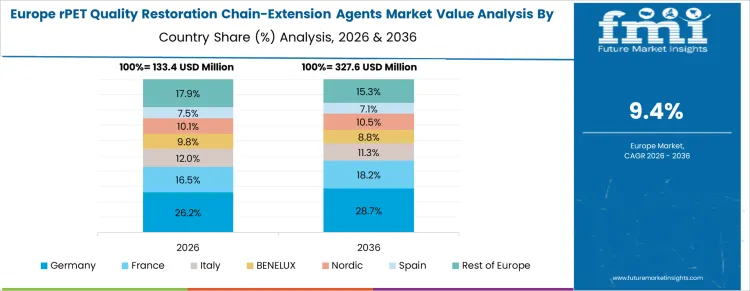
Germany continues to record steady growth in the rPET Quality Restoration Chain-Extension Agents Market at a CAGR of 10.4% through 2036, supported by stringent recycling regulations and sustainability targets. Manufacturers are using chain-extension agents to restore rPET for beverage bottles, food packaging, and industrial components while meeting mechanical and thermal performance requirements. Demand is concentrated in beverage production, retail packaging, and industrial operations. Domestic suppliers provide chemical agents engineered for high efficiency and compatibility with recycling extrusion processes. Compliance-driven procurement and consistent rPET processing volumes are sustaining measured adoption nationwide.
- Recycling and environmental regulations drive rPET chain-extension agent adoption
- Beverage bottles, food packaging, and industrial components anchor demand
- Domestic suppliers provide high-efficiency agents compatible with recycling processes
- Compliance-driven procurement sustains steady adoption
How Is Industrial rPET Manufacturing Accelerating Adoption in China?
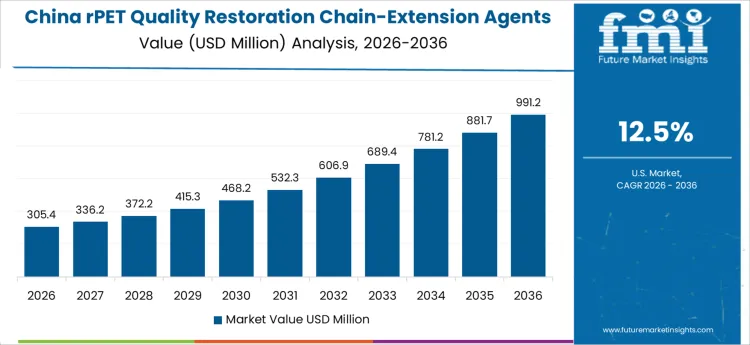
In China, revenue from the rPET Quality Restoration Chain-Extension Agents Market is growing at a CAGR of 12.5% through 2036, driven by rapid expansion of rPET production for beverage, food, and industrial packaging. Manufacturers are integrating chain-extension agents to restore material properties degraded during recycling, ensuring consistent product performance. Demand is strong across beverage, packaging, and industrial applications distributed through modern retail and e-commerce channels. Domestic suppliers are scaling production of chain-extension agent’s compatible with extrusion and molding processes. High rPET processing volumes and structured procurement programs are sustaining rapid adoption nationwide.
- rPET beverage, food, and industrial packaging production drives chain-extension agent adoption
- Agents restore mechanical and thermal properties degraded during recycling
- Domestic suppliers scale production compatible with extrusion and molding processes
- High rPET volumes sustain consistent adoption
How Is Smart Packaging and Recycling Supporting Growth in the United Kingdom?
In the United Kingdom, revenue from the rPET Quality Restoration Chain-Extension Agents Market is expanding at a CAGR of 10.2% through 2036, driven by adoption of chemical agents to restore rPET properties for beverage bottles, food containers, and industrial packaging. Manufacturers are integrating chain-extension additives to improve molecular weight, thermal resistance, and processability. Demand is concentrated in beverage production, industrial packaging, and retail packaging segments. Domestic suppliers provide high-quality chain-extension agents compatible with extrusion and blow-molding operations. Regulatory compliance, recycling targets, and recurring rPET processing are sustaining predictable procurement nationwide.
- Beverage bottles, food containers, and industrial packaging anchor chain-extension agent adoption
- Agents restore rPET molecular weight and thermal resistance
- Domestic suppliers provide additives compatible with extrusion and blow-molding
- Recycling targets and recurring rPET processing sustain procurement
How Is Circular Packaging Expansion Driving Adoption in Brazil?
Brazil is seeing strong growth in the rPET Quality Restoration Chain-Extension Agents Market at a CAGR of 12% through 2036, supported by increasing rPET use in beverage and food packaging and demand for circular economy solutions. Manufacturers are using chain-extension agents to restore rPET properties lost during recycling, ensuring product quality and processability. Demand is concentrated in beverage, industrial, and retail packaging operations. Domestic suppliers are expanding production of high-performance chain-extension agent’s compatible with extrusion and molding systems. Growth in rPET adoption, recycling programs, and recurring packaging production cycles are sustaining robust procurement nationwide.
- Beverage, industrial, and retail packaging drives adoption of rPET chain-extension agents
- Agents restore degraded rPET properties and improve processability
- Domestic suppliers provide high-performance additives compatible with extrusion and molding
- rPET recycling programs and recurring packaging cycles sustain procurement
Which Companies Are Shaping Competition in The rPET Quality Restoration Chain Extension Agents Market Across Packaging and Recycling Operations?
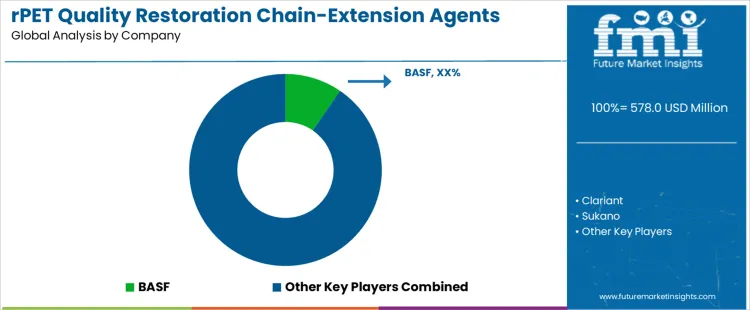
Competition in the rPET Quality Restoration Chain Extension Agents Market is defined by specialty chemical suppliers supporting mechanical recycling performance. BASF, Clariant, and Arkema influence this space through reactive additives designed to rebuild molecular weight and improve melt strength in recycled PET. Evonik Industries contributes chain modifying additives aligned with processing stability in extrusion and injection molding. Dow and DuPont participate through polymer additives and compatibilizer technologies applied within broader recycling formulations. Mitsubishi Chemical Group supports the market through polyester chemistry expertise and additive systems tailored for packaging grade rPET. Competitive positioning centers on reaction efficiency, processing window tolerance, and compatibility with varied recyclate quality rather than branded product differentiation.
Masterbatch and compound focused suppliers add depth to market structure. Sukano, Avient, and Ampacet participate through functional masterbatches that combine chain extension with color, stabilization, or process aids for recycled PET applications. These companies operate close to converters and recyclers, adapting formulations to equipment constraints and end use requirements. Collaboration with recyclers plays a critical role, as additive selection depends on feedstock variability and target performance levels. Competition is shaped by technical support capability, formulation flexibility, and consistency in performance across batches. Market entry depends on polymer chemistry expertise, customer qualification cycles, and alignment with food contact and packaging regulations rather than production scale alone.
Key Players in the rPET Quality Restoration Chain-Extension Agents Market
- BASF
- Clariant
- Sukano
- Avient
- Ampacet
- Arkema
- Evonik Industries
- Dow
- DuPont
- Mitsubishi Chemical Group
Scope of the Report
| Items | Values |
|---|---|
| Quantitative Units (2026) | USD million |
| Chemistry | Epoxy-functional oligomers; Anhydride-based chain extenders; Carbodiimide-based; Isocyanate-based; Others |
| End Product | Bottle-grade rPET; Sheet/thermoforming rPET; Fiber & textile rPET; Strapping; Filament & others |
| Addition Form | Pellet/masterbatch; Powder; Liquid; Other forms |
| Recycling Pathway | Mechanical recycling; SSP upgrades; Chemical recycling/upcycling; Hybrid systems |
| Region | Asia Pacific; Europe; North America; Latin America; Middle East & Africa |
| Countries Covered | China; Japan; South Korea; India; Australia & New Zealand; ASEAN; Germany; United Kingdom; France; Italy; Spain; Nordic; BENELUX; United States; Canada; Mexico; Brazil; Chile; Kingdom of Saudi Arabia; Other GCC Countries; Turkey; South Africa; Other African Union; Rest of Asia Pacific; Rest of Europe; Rest of Latin America; Rest of Middle East & Africa |
| Key Companies Profiled | BASF; Clariant; Sukano; Avient; Ampacet; Arkema; Evonik Industries; Dow; DuPont; Mitsubishi Chemical Group |
| Additional Attributes | Dollar by sales across chemistries, end products, addition forms, and recycling pathways; Epoxy-functional oligomers lead due to broad compatibility and consistent viscosity restoration; Bottle-grade rPET drives largest end-product segment due to strict performance requirements; Pellet and masterbatch addition forms dominate due to handling efficiency and dosage control; System adoption supported by mechanical recycling and SSP upgrade pathways, with chemical and hybrid recycling emerging; Regulatory frameworks for recycled content and circular economy adoption reinforce usage; Domestic and regional suppliers provide high-performance additives compatible with extrusion, injection, and blow-molding; Recurring procurement sustained by beverage, food, industrial packaging, and fiber applications; Market growth driven by polymer chain restoration, rPET quality consistency, and integration into production workflows. |
rPET Quality Restoration Chain-Extension Agents Market Segmentation
Chemistry:
- Epoxy-functional oligomers
- Anhydride-based chain extenders
- Carbodiimide-based
- Isocyanate-based
- Others
End Product:
- Bottle-grade rPET
- Sheet/thermoforming rPET
- Fiber & textile rPET
- Strapping
- Filament & others
Addition Form:
- Pellet/masterbatch
- Powder
- Liquid
- Other forms
Recycling Pathway:
- Mechanical recycling
- SSP upgrades
- Chemical recycling/upcycling
- Hybrid systems
Region
- Asia Pacific
- China
- Japan
- South Korea
- India
- Australia & New Zealand
- ASEAN
- Rest of Asia Pacific
- Europe
- Germany
- United Kingdom
- France
- Italy
- Spain
- Nordic
- BENELUX
- Rest of Europe
- North America
- United States
- Canada
- Mexico
- Latin America
- Brazil
- Chile
- Rest of Latin America
- Middle East & Africa
- Kingdom of Saudi Arabia
- Other GCC Countries
- Turkey
- South Africa
- Other African Union
- Rest of Middle East & Africa
Frequently Asked Questions
How big is the rPET quality restoration chain-extension agents market in 2026?
The global rPET quality restoration chain-extension agents market is estimated to be valued at USD 578.0 million in 2026.
What will be the size of rPET quality restoration chain-extension agents market in 2036?
The market size for the rPET quality restoration chain-extension agents market is projected to reach USD 1,641.2 million by 2036.
How much will be the rPET quality restoration chain-extension agents market growth between 2026 and 2036?
The rPET quality restoration chain-extension agents market is expected to grow at a 11.0% CAGR between 2026 and 2036.
What are the key product types in the rPET quality restoration chain-extension agents market?
The key product types in rPET quality restoration chain-extension agents market are epoxy-functional oligomers, anhydride-based chain extenders, carbodiimide-based, isocyanate-based and others.
Which end product segment to contribute significant share in the rPET quality restoration chain-extension agents market in 2026?
In terms of end product, bottle-grade rpet segment to command 34.0% share in the rPET quality restoration chain-extension agents market in 2026.
Preview the report firsthand - request a free sample
Get SampleGet the brochure for pricing and purchase details.
Get PDFTable of Content
- Executive Summary
- Global Market Outlook
- Demand-side Trends
- Supply-side Trends
- Technology Roadmap Analysis
- Analysis and Recommendations
- Market Overview
- Market Coverage / Taxonomy
- Market Definition / Scope / Limitations
- Market Background
- Market Dynamics
- Drivers
- Restraints
- Opportunity
- Trends
- Scenario Forecast
- Demand in Optimistic Scenario
- Demand in Likely Scenario
- Demand in Conservative Scenario
- Opportunity Map Analysis
- Product Life Cycle Analysis
- Supply Chain Analysis
- Investment Feasibility Matrix
- Value Chain Analysis
- PESTLE and Porter’s Analysis
- Regulatory Landscape
- Regional Parent Market Outlook
- Production and Consumption Statistics
- Import and Export Statistics
- Market Dynamics
- Global Market Analysis 2021 to 2025 and Forecast, 2026 to 2036
- Historical Market Size Value (USD Million) Analysis, 2021 to 2025
- Current and Future Market Size Value (USD Million) Projections, 2026 to 2036
- Y-o-Y Growth Trend Analysis
- Absolute $ Opportunity Analysis
- Global Market Pricing Analysis 2021 to 2025 and Forecast 2026 to 2036
- Global Market Analysis 2021 to 2025 and Forecast 2026 to 2036, By Chemistry
- Introduction / Key Findings
- Historical Market Size Value (USD Million) Analysis By Chemistry , 2021 to 2025
- Current and Future Market Size Value (USD Million) Analysis and Forecast By Chemistry , 2026 to 2036
- Epoxy-functional oligomers
- Anhydride-based chain extenders
- Carbodiimide-based
- Isocyanate-based
- Others
- Y-o-Y Growth Trend Analysis By Chemistry , 2021 to 2025
- Absolute $ Opportunity Analysis By Chemistry , 2026 to 2036
- Global Market Analysis 2021 to 2025 and Forecast 2026 to 2036, By End Product
- Introduction / Key Findings
- Historical Market Size Value (USD Million) Analysis By End Product, 2021 to 2025
- Current and Future Market Size Value (USD Million) Analysis and Forecast By End Product, 2026 to 2036
- Bottle-grade rPET
- Sheet/thermoforming rPET
- Fiber & textile rPET
- Strapping
- Filament & others
- Y-o-Y Growth Trend Analysis By End Product, 2021 to 2025
- Absolute $ Opportunity Analysis By End Product, 2026 to 2036
- Global Market Analysis 2021 to 2025 and Forecast 2026 to 2036, By Addition Form
- Introduction / Key Findings
- Historical Market Size Value (USD Million) Analysis By Addition Form, 2021 to 2025
- Current and Future Market Size Value (USD Million) Analysis and Forecast By Addition Form, 2026 to 2036
- Pellet/masterbatch
- Powder
- Liquid
- Other forms
- Y-o-Y Growth Trend Analysis By Addition Form, 2021 to 2025
- Absolute $ Opportunity Analysis By Addition Form, 2026 to 2036
- Global Market Analysis 2021 to 2025 and Forecast 2026 to 2036, By Recycling Pathway
- Introduction / Key Findings
- Historical Market Size Value (USD Million) Analysis By Recycling Pathway, 2021 to 2025
- Current and Future Market Size Value (USD Million) Analysis and Forecast By Recycling Pathway, 2026 to 2036
- Mechanical recycling
- SSP upgrades
- Chemical recycling/upcycling
- Hybrid systems
- Y-o-Y Growth Trend Analysis By Recycling Pathway, 2021 to 2025
- Absolute $ Opportunity Analysis By Recycling Pathway, 2026 to 2036
- Global Market Analysis 2021 to 2025 and Forecast 2026 to 2036, By Region
- Introduction
- Historical Market Size Value (USD Million) Analysis By Region, 2021 to 2025
- Current Market Size Value (USD Million) Analysis and Forecast By Region, 2026 to 2036
- North America
- Latin America
- Western Europe
- Eastern Europe
- East Asia
- South Asia and Pacific
- Middle East & Africa
- Market Attractiveness Analysis By Region
- North America Market Analysis 2021 to 2025 and Forecast 2026 to 2036, By Country
- Historical Market Size Value (USD Million) Trend Analysis By Market Taxonomy, 2021 to 2025
- Market Size Value (USD Million) Forecast By Market Taxonomy, 2026 to 2036
- By Country
- USA
- Canada
- Mexico
- By Chemistry
- By End Product
- By Addition Form
- By Recycling Pathway
- By Country
- Market Attractiveness Analysis
- By Country
- By Chemistry
- By End Product
- By Addition Form
- By Recycling Pathway
- Key Takeaways
- Latin America Market Analysis 2021 to 2025 and Forecast 2026 to 2036, By Country
- Historical Market Size Value (USD Million) Trend Analysis By Market Taxonomy, 2021 to 2025
- Market Size Value (USD Million) Forecast By Market Taxonomy, 2026 to 2036
- By Country
- Brazil
- Chile
- Rest of Latin America
- By Chemistry
- By End Product
- By Addition Form
- By Recycling Pathway
- By Country
- Market Attractiveness Analysis
- By Country
- By Chemistry
- By End Product
- By Addition Form
- By Recycling Pathway
- Key Takeaways
- Western Europe Market Analysis 2021 to 2025 and Forecast 2026 to 2036, By Country
- Historical Market Size Value (USD Million) Trend Analysis By Market Taxonomy, 2021 to 2025
- Market Size Value (USD Million) Forecast By Market Taxonomy, 2026 to 2036
- By Country
- Germany
- UK
- Italy
- Spain
- France
- Nordic
- BENELUX
- Rest of Western Europe
- By Chemistry
- By End Product
- By Addition Form
- By Recycling Pathway
- By Country
- Market Attractiveness Analysis
- By Country
- By Chemistry
- By End Product
- By Addition Form
- By Recycling Pathway
- Key Takeaways
- Eastern Europe Market Analysis 2021 to 2025 and Forecast 2026 to 2036, By Country
- Historical Market Size Value (USD Million) Trend Analysis By Market Taxonomy, 2021 to 2025
- Market Size Value (USD Million) Forecast By Market Taxonomy, 2026 to 2036
- By Country
- Russia
- Poland
- Hungary
- Balkan & Baltic
- Rest of Eastern Europe
- By Chemistry
- By End Product
- By Addition Form
- By Recycling Pathway
- By Country
- Market Attractiveness Analysis
- By Country
- By Chemistry
- By End Product
- By Addition Form
- By Recycling Pathway
- Key Takeaways
- East Asia Market Analysis 2021 to 2025 and Forecast 2026 to 2036, By Country
- Historical Market Size Value (USD Million) Trend Analysis By Market Taxonomy, 2021 to 2025
- Market Size Value (USD Million) Forecast By Market Taxonomy, 2026 to 2036
- By Country
- China
- Japan
- South Korea
- By Chemistry
- By End Product
- By Addition Form
- By Recycling Pathway
- By Country
- Market Attractiveness Analysis
- By Country
- By Chemistry
- By End Product
- By Addition Form
- By Recycling Pathway
- Key Takeaways
- South Asia and Pacific Market Analysis 2021 to 2025 and Forecast 2026 to 2036, By Country
- Historical Market Size Value (USD Million) Trend Analysis By Market Taxonomy, 2021 to 2025
- Market Size Value (USD Million) Forecast By Market Taxonomy, 2026 to 2036
- By Country
- India
- ASEAN
- Australia & New Zealand
- Rest of South Asia and Pacific
- By Chemistry
- By End Product
- By Addition Form
- By Recycling Pathway
- By Country
- Market Attractiveness Analysis
- By Country
- By Chemistry
- By End Product
- By Addition Form
- By Recycling Pathway
- Key Takeaways
- Middle East & Africa Market Analysis 2021 to 2025 and Forecast 2026 to 2036, By Country
- Historical Market Size Value (USD Million) Trend Analysis By Market Taxonomy, 2021 to 2025
- Market Size Value (USD Million) Forecast By Market Taxonomy, 2026 to 2036
- By Country
- Kingdom of Saudi Arabia
- Other GCC Countries
- Turkiye
- South Africa
- Other African Union
- Rest of Middle East & Africa
- By Chemistry
- By End Product
- By Addition Form
- By Recycling Pathway
- By Country
- Market Attractiveness Analysis
- By Country
- By Chemistry
- By End Product
- By Addition Form
- By Recycling Pathway
- Key Takeaways
- Key Countries Market Analysis
- USA
- Pricing Analysis
- Market Share Analysis, 2025
- By Chemistry
- By End Product
- By Addition Form
- By Recycling Pathway
- Canada
- Pricing Analysis
- Market Share Analysis, 2025
- By Chemistry
- By End Product
- By Addition Form
- By Recycling Pathway
- Mexico
- Pricing Analysis
- Market Share Analysis, 2025
- By Chemistry
- By End Product
- By Addition Form
- By Recycling Pathway
- Brazil
- Pricing Analysis
- Market Share Analysis, 2025
- By Chemistry
- By End Product
- By Addition Form
- By Recycling Pathway
- Chile
- Pricing Analysis
- Market Share Analysis, 2025
- By Chemistry
- By End Product
- By Addition Form
- By Recycling Pathway
- Germany
- Pricing Analysis
- Market Share Analysis, 2025
- By Chemistry
- By End Product
- By Addition Form
- By Recycling Pathway
- UK
- Pricing Analysis
- Market Share Analysis, 2025
- By Chemistry
- By End Product
- By Addition Form
- By Recycling Pathway
- Italy
- Pricing Analysis
- Market Share Analysis, 2025
- By Chemistry
- By End Product
- By Addition Form
- By Recycling Pathway
- Spain
- Pricing Analysis
- Market Share Analysis, 2025
- By Chemistry
- By End Product
- By Addition Form
- By Recycling Pathway
- France
- Pricing Analysis
- Market Share Analysis, 2025
- By Chemistry
- By End Product
- By Addition Form
- By Recycling Pathway
- India
- Pricing Analysis
- Market Share Analysis, 2025
- By Chemistry
- By End Product
- By Addition Form
- By Recycling Pathway
- ASEAN
- Pricing Analysis
- Market Share Analysis, 2025
- By Chemistry
- By End Product
- By Addition Form
- By Recycling Pathway
- Australia & New Zealand
- Pricing Analysis
- Market Share Analysis, 2025
- By Chemistry
- By End Product
- By Addition Form
- By Recycling Pathway
- China
- Pricing Analysis
- Market Share Analysis, 2025
- By Chemistry
- By End Product
- By Addition Form
- By Recycling Pathway
- Japan
- Pricing Analysis
- Market Share Analysis, 2025
- By Chemistry
- By End Product
- By Addition Form
- By Recycling Pathway
- South Korea
- Pricing Analysis
- Market Share Analysis, 2025
- By Chemistry
- By End Product
- By Addition Form
- By Recycling Pathway
- Russia
- Pricing Analysis
- Market Share Analysis, 2025
- By Chemistry
- By End Product
- By Addition Form
- By Recycling Pathway
- Poland
- Pricing Analysis
- Market Share Analysis, 2025
- By Chemistry
- By End Product
- By Addition Form
- By Recycling Pathway
- Hungary
- Pricing Analysis
- Market Share Analysis, 2025
- By Chemistry
- By End Product
- By Addition Form
- By Recycling Pathway
- Kingdom of Saudi Arabia
- Pricing Analysis
- Market Share Analysis, 2025
- By Chemistry
- By End Product
- By Addition Form
- By Recycling Pathway
- Turkiye
- Pricing Analysis
- Market Share Analysis, 2025
- By Chemistry
- By End Product
- By Addition Form
- By Recycling Pathway
- South Africa
- Pricing Analysis
- Market Share Analysis, 2025
- By Chemistry
- By End Product
- By Addition Form
- By Recycling Pathway
- USA
- Market Structure Analysis
- Competition Dashboard
- Competition Benchmarking
- Market Share Analysis of Top Players
- By Regional
- By Chemistry
- By End Product
- By Addition Form
- By Recycling Pathway
- Competition Analysis
- Competition Deep Dive
- BASF
- Overview
- Product Portfolio
- Profitability by Market Segments (Product/Age /Sales Channel/Region)
- Sales Footprint
- Strategy Overview
- Marketing Strategy
- Product Strategy
- Channel Strategy
- Clariant
- Sukano
- Avient
- Ampacet
- Arkema
- Evonik Industries
- Dow
- DuPont
- Mitsubishi Chemical Group
- BASF
- Competition Deep Dive
- Assumptions & Acronyms Used
- Research Methodology


