

- Industry Size (2025)
- USD 1.6 Bn
- Forecast (2035)
- USD 2.5 Bn
- CAGR (2025 to 2035)
- 4.4%
Coalescing Agents Market Size and Share Forecast Outlook 2025 to 2035
The Coalescing Agents Market is estimated to be valued at USD 1.6 billion in 2025 and is projected to reach USD 2.5 billion by 2035, registering a compound annual growth rate (CAGR) of 4.4% over the forecast period.
Quick Stats for Coalescing Agents Market
- Coalescing Agents Market Value (2025): USD 1.6 billion
- Coalescing Agents Market Forecast Value (2035): USD 2.5 billion
- Coalescing Agents Market Forecast CAGR: 4.4%
- Leading Segment in Coalescing Agents Market in 2025: Hydrophobic Coalescing Agents (35.6%)
- Key Growth Regions in Coalescing Agents Market: North America, Asia-Pacific, Europe
- Top Key Players in Coalescing Agents Market: BASF SE, Dow, Evonik Industries, Arkema, Eastman Chemical Company, Cargill Inc., Solvay S.A., Stepan Company, ACS Technical Products, ADDAPT Chemicals BV, Elementis Plc, Syensqo, eChem Ltd.
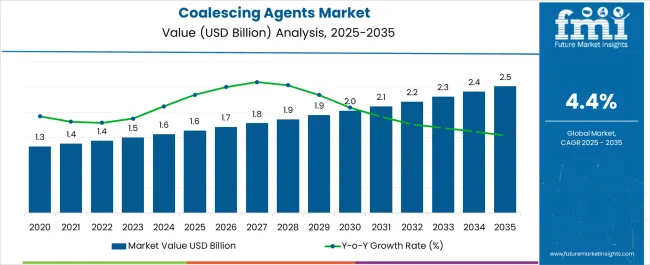
Coalescing Agents Market Key Takeaways
| Metric | Value |
|---|---|
| Coalescing Agents Market Estimated Value in (2025 E) | USD 1.6 billion |
| Coalescing Agents Market Forecast Value in (2035 F) | USD 2.5 billion |
| Forecast CAGR (2025 to 2035) | 4.4% |
Why is the Coalescing Agents Market Growing?
The Coalescing Agents market is witnessing steady growth, driven by increasing demand for high-performance coatings, adhesives, and polymer-based products across various industries. Growth is being supported by the rising need to improve formulation efficiency, enhance film formation, and optimize drying processes in waterborne systems. Innovations in chemical engineering have enabled the development of coalescing agents that offer superior compatibility with diverse polymer matrices while maintaining low environmental impact.
The market is further supported by expanding applications in construction, automotive, and industrial sectors, where durability, adhesion, and performance are critical. Regulatory emphasis on reducing volatile organic compound emissions has accelerated adoption of eco-friendly coalescing agents, prompting manufacturers to develop products that combine functionality with compliance.
Investments in research and development and growing industrial output are shaping market dynamics As industries continue to focus on high-quality formulations and sustainability, coalescing agents are expected to maintain robust demand, with opportunities emerging from advanced polymer systems and high-performance adhesive technologies.
Segmental Analysis
The coalescing agents market is segmented by type, application, end-use, and geographic regions. By type, coalescing agents market is divided into Hydrophobic Coalescing Agents, Hydrophilic Coalescing Agents, Water Soluble, and Partially Water Soluble. In terms of application, coalescing agents market is classified into Adhesives, Sealants, Paints, Inks, Coatings, and Others (Cosmetic Ingredient, Metal Working Fluids). Based on end-use, coalescing agents market is segmented into Construction, Marine, Automotive, Personal Care & Pharmaceuticals, and Others. Regionally, the coalescing agents industry is classified into North America, Latin America, Western Europe, Eastern Europe, Balkan & Baltic Countries, Russia & Belarus, Central Asia, East Asia, South Asia & Pacific, and the Middle East & Africa.
Insights into the Hydrophobic Coalescing Agents Type Segment
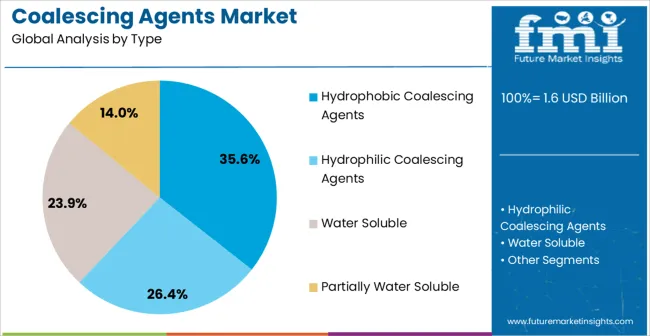
The hydrophobic coalescing agents segment is projected to hold 35.6% of the market revenue in 2025, establishing it as the leading type. Growth is being driven by its superior compatibility with water-repellent and hydrophobic polymer formulations, which are increasingly used in high-performance coatings and adhesives. These agents improve film formation, reduce cracking, and enhance durability, providing significant functional advantages in end-use applications.
Their ability to maintain performance in moisture-sensitive environments has reinforced preference among manufacturers. Continuous innovations in chemical composition and performance optimization have increased adoption across industrial and construction applications.
Hydrophobic coalescing agents also support environmentally compliant formulations, enabling manufacturers to meet stringent regulatory standards while delivering enhanced product performance As the demand for durable, high-quality coatings and adhesives grows globally, the hydrophobic coalescing agents segment is expected to retain market leadership, driven by technological advancements, operational efficiency, and regulatory alignment in high-performance polymer systems.
Insights into the Adhesives Application Segment
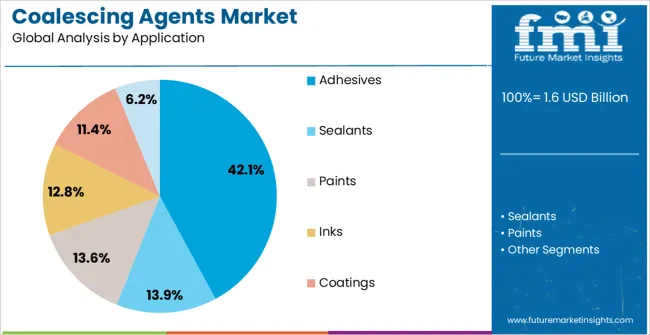
The adhesives application segment is anticipated to account for 42.1% of the market revenue in 2025, making it the leading application area. Growth in this segment is being driven by increasing demand for high-strength and durable bonding solutions across construction, automotive, and industrial applications. Coalescing agents enhance adhesive formulation by improving flow properties, film formation, and bonding efficiency, reducing defects and improving overall performance.
Regulatory compliance with low volatile organic compounds and environmental sustainability has further encouraged adoption in adhesives applications. Continuous development of advanced polymer systems and multi-functional adhesive formulations is increasing the reliance on coalescing agents to achieve high-performance characteristics.
Additionally, adhesives used in critical industrial applications require reliable performance under varying environmental conditions, reinforcing the importance of coalescing agents As the construction and industrial sectors continue to expand, the adhesives application segment is expected to remain the primary driver of market growth, supported by innovations in chemistry, process optimization, and enhanced formulation efficiency.
Insights into the Construction End-Use Segment
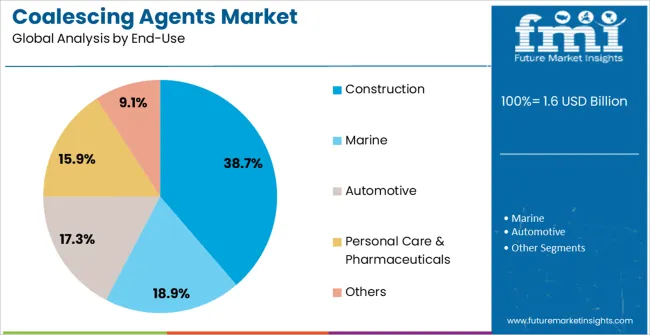
The construction end-use segment is expected to hold 38.7% of the market revenue in 2025, establishing it as the leading end-use industry. Growth is being driven by the increasing demand for durable, high-performance coatings, sealants, and adhesives that meet modern building standards and sustainability requirements. Coalescing agents enhance the mechanical and chemical properties of polymer-based construction materials, improving film formation, adhesion, and moisture resistance.
The adoption of eco-friendly and low volatile organic compound formulations has further reinforced growth in this segment, aligning with regulatory and environmental compliance standards. The increasing pace of urbanization, infrastructure development, and renovation projects is creating additional demand for high-quality construction materials.
Manufacturers are leveraging coalescing agents to optimize production efficiency and material performance, ensuring consistent quality in large-scale applications As investments in construction and smart building projects continue to rise globally, the construction segment is expected to maintain its market leadership, supported by technological advancements and increased focus on sustainability and long-term durability.
Market Overview
Coalescing Agents Market: Introduction
Coalescence is an integral part of the process of film formation in dispersion paints that includes and permits fusion, contact of the adjacent-located polymeric dispersion particles. Coalescing agents are generally used for optimizing the film formation mechanism of the polymeric binder particles.
Coalescing agents generally decrease the formation temperature and as a result, optimize film consistency, appearance and properties. Furthermore, coalescing agents are used to reduce the polymer particle surface area and also reduce the repulsive forces between the polymer particles during the diluent evaporation process.
Appropriate formation of film is an important part to imparting the corrosion resistance ability, low porosity and other numerous required attributes that are requisite in superior coatings. Previously, water-borne coatings have adopted numerous solvents as a coalescing aid to appropriately distribute the hydrophobic latex molecules.
Eliminating these supports is somehow probable but often the outcomes in the formation of the final film formation is soft, so in order to attain the requisite performance harder latexes have been formulated. These need a coalescing agent to unstiffen the whole system to be adequate to create a constant film throughout the drying mechanism.
In high-end applications where the process has been taken out in a HPHT (high pressure and high temperature environment) environment there is a need of high performance coatings that can withstand high temperatures for a long term.
Coalescing agent enables better mechanical properties, corrosion resistance, film impermeability, film appearance and resistance against harmful chemicals, these properties help the adoption of coatings in numerous number of applications and end-user industries. Coalescing agent can be added during the letdown stage of coating formulation and generally used in water-borne coatings.
Analysis of Coalescing Agents Market By Key Countries
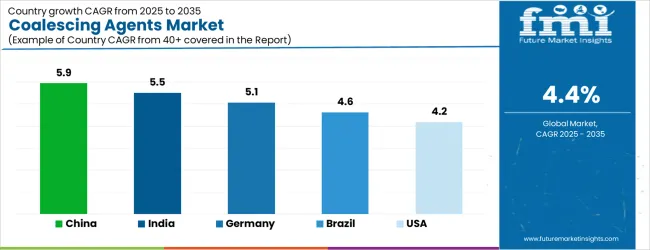
| Country | CAGR |
|---|---|
| China | 5.9% |
| India | 5.5% |
| Germany | 5.1% |
| Brazil | 4.6% |
| USA | 4.2% |
| UK | 3.7% |
| Japan | 3.3% |
Country-wise Analysis
The Coalescing Agents Market is expected to register a CAGR of 4.4% during the forecast period, exhibiting varied country level momentum. China leads with the highest CAGR of 5.9%, followed by India at 5.5%. Developed markets such as Germany, France, and the UK continue to expand steadily, while the USA is likely to grow at consistent rates. Japan posts the lowest CAGR at 3.3%, yet still underscores a broadly positive trajectory for the global Coalescing Agents Market. In 2024, Germany held a dominant revenue in the Western Europe market and is expected to grow with a CAGR of 5.1%. The USA Coalescing Agents Market is estimated to be valued at USD 574.3 million in 2025 and is anticipated to reach a valuation of USD 574.3 million by 2035. Sales are projected to rise at a CAGR of 0.0% over the forecast period between 2025 and 2035. While Japan and South Korea markets are estimated to be valued at USD 82.9 million and USD 47.9 million respectively in 2025.
Key Players in the Coalescing Agents Market
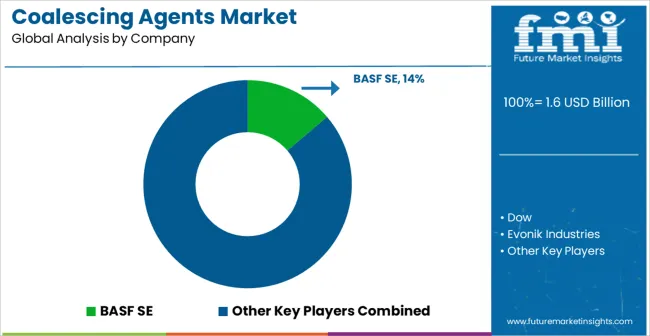
- BASF SE
- Dow
- Evonik Industries
- Arkema
- Eastman Chemical Company
- Cargill Inc.
- Solvay S.A.
- Stepan Company
- ACS Technical Products
- ADDAPT Chemicals BV
- Elementis Plc
- Syensqo
- eChem Ltd.
Scope of the Report
| Item | Value |
|---|---|
| Quantitative Units | USD 1.6 Billion |
| Type | Hydrophobic Coalescing Agents, Hydrophilic Coalescing Agents, Water Soluble, and Partially Water Soluble |
| Application | Adhesives, Sealants, Paints, Inks, Coatings, and Others (Cosmetic Ingredient, Metal Working Fluids) |
| End-Use | Construction, Marine, Automotive, Personal Care & Pharmaceuticals, and Others |
| Regions Covered | North America, Europe, Asia-Pacific, Latin America, Middle East & Africa |
| Country Covered | United States, Canada, Germany, France, United Kingdom, China, Japan, India, Brazil, South Africa |
| Key Companies Profiled | BASF SE, Dow, Evonik Industries, Arkema, Eastman Chemical Company, Cargill Inc., Solvay S.A., Stepan Company, ACS Technical Products, ADDAPT Chemicals BV, Elementis Plc, Syensqo, and eChem Ltd. |
Coalescing Agents Market by Segments
Type:
- Hydrophobic Coalescing Agents
- Hydrophilic Coalescing Agents
- Water Soluble
- Partially Water Soluble
Application:
- Adhesives
- Sealants
- Paints
- Inks
- Coatings
- Others (Cosmetic Ingredient, Metal Working Fluids)
End-Use:
- Construction
- Marine
- Automotive
- Personal Care & Pharmaceuticals
- Others
Region:
- North America
- USA
- Canada
- Mexico
- Latin America
- Brazil
- Chile
- Rest of Latin America
- Western Europe
- Germany
- UK
- Italy
- Spain
- France
- Nordic
- BENELUX
- Rest of Western Europe
- Eastern Europe
- Russia
- Poland
- Hungary
- Balkan & Baltic
- Rest of Eastern Europe
- East Asia
- China
- Japan
- South Korea
- South Asia and Pacific
- India
- ASEAN
- Australia & New Zealand
- Rest of South Asia and Pacific
- Middle East & Africa
- Kingdom of Saudi Arabia
- Other GCC Countries
- Turkiye
- South Africa
- Other African Union
- Rest of Middle East & Africa
Frequently Asked Questions
How big is the coalescing agents market in 2025?
The global coalescing agents market is estimated to be valued at USD 1.6 billion in 2025.
What will be the size of coalescing agents market in 2035?
The market size for the coalescing agents market is projected to reach USD 2.5 billion by 2035.
How much will be the coalescing agents market growth between 2025 and 2035?
The coalescing agents market is expected to grow at a 4.4% CAGR between 2025 and 2035.
What are the key product types in the coalescing agents market?
The key product types in coalescing agents market are hydrophobic coalescing agents, hydrophilic coalescing agents, water soluble and partially water soluble.
Which application segment to contribute significant share in the coalescing agents market in 2025?
In terms of application, adhesives segment to command 42.1% share in the coalescing agents market in 2025.
Preview the report firsthand - request a free sample
Get SampleGet the brochure for pricing and purchase details.
Get PDFTable of Content
- Executive Summary
- Global Market Outlook
- Demand-side Trends
- Supply-side Trends
- Technology Roadmap Analysis
- Analysis and Recommendations
- Market Overview
- Market Coverage / Taxonomy
- Market Definition / Scope / Limitations
- Market Background
- Market Dynamics
- Drivers
- Restraints
- Opportunity
- Trends
- Scenario Forecast
- Demand in Optimistic Scenario
- Demand in Likely Scenario
- Demand in Conservative Scenario
- Opportunity Map Analysis
- Product Life Cycle Analysis
- Supply Chain Analysis
- Investment Feasibility Matrix
- Value Chain Analysis
- PESTLE and Porter’s Analysis
- Regulatory Landscape
- Regional Parent Market Outlook
- Production and Consumption Statistics
- Import and Export Statistics
- Market Dynamics
- Global Market Analysis 2020 to 2024 and Forecast, 2025 to 2035
- Historical Market Size Value (USD Million) Analysis, 2020 to 2024
- Current and Future Market Size Value (USD Million) Projections, 2025 to 2035
- Y-o-Y Growth Trend Analysis
- Absolute $ Opportunity Analysis
- Global Market Pricing Analysis 2020 to 2024 and Forecast 2025 to 2035
- Global Market Analysis 2020 to 2024 and Forecast 2025 to 2035, By Type
- Introduction / Key Findings
- Historical Market Size Value (USD Million) Analysis By Type , 2020 to 2024
- Current and Future Market Size Value (USD Million) Analysis and Forecast By Type , 2025 to 2035
- Hydrophobic
- Hydrophilic
- Water Soluble
- Partially Water Soluble
- Y-o-Y Growth Trend Analysis By Type , 2020 to 2024
- Absolute $ Opportunity Analysis By Type , 2025 to 2035
- Global Market Analysis 2020 to 2024 and Forecast 2025 to 2035, By Application
- Introduction / Key Findings
- Historical Market Size Value (USD Million) Analysis By Application, 2020 to 2024
- Current and Future Market Size Value (USD Million) Analysis and Forecast By Application, 2025 to 2035
- Adhesives
- Sealants
- Paints
- Inks
- Coatings
- Others (Cosmetic Ingredient, Metal Working Fluids)
- Y-o-Y Growth Trend Analysis By Application, 2020 to 2024
- Absolute $ Opportunity Analysis By Application, 2025 to 2035
- Global Market Analysis 2020 to 2024 and Forecast 2025 to 2035, By End-Use
- Introduction / Key Findings
- Historical Market Size Value (USD Million) Analysis By End-Use, 2020 to 2024
- Current and Future Market Size Value (USD Million) Analysis and Forecast By End-Use, 2025 to 2035
- Construction
- Marine
- Automotive
- Personal Care & Pharmaceuticals
- Others
- Y-o-Y Growth Trend Analysis By End-Use, 2020 to 2024
- Absolute $ Opportunity Analysis By End-Use, 2025 to 2035
- Global Market Analysis 2020 to 2024 and Forecast 2025 to 2035, By Region
- Introduction
- Historical Market Size Value (USD Million) Analysis By Region, 2020 to 2024
- Current Market Size Value (USD Million) Analysis and Forecast By Region, 2025 to 2035
- North America
- Latin America
- Western Europe
- Eastern Europe
- East Asia
- South Asia and Pacific
- Middle East & Africa
- Market Attractiveness Analysis By Region
- North America Market Analysis 2020 to 2024 and Forecast 2025 to 2035, By Country
- Historical Market Size Value (USD Million) Trend Analysis By Market Taxonomy, 2020 to 2024
- Market Size Value (USD Million) Forecast By Market Taxonomy, 2025 to 2035
- By Country
- USA
- Canada
- Mexico
- By Type
- By Application
- By End-Use
- By Country
- Market Attractiveness Analysis
- By Country
- By Type
- By Application
- By End-Use
- Key Takeaways
- Latin America Market Analysis 2020 to 2024 and Forecast 2025 to 2035, By Country
- Historical Market Size Value (USD Million) Trend Analysis By Market Taxonomy, 2020 to 2024
- Market Size Value (USD Million) Forecast By Market Taxonomy, 2025 to 2035
- By Country
- Brazil
- Chile
- Rest of Latin America
- By Type
- By Application
- By End-Use
- By Country
- Market Attractiveness Analysis
- By Country
- By Type
- By Application
- By End-Use
- Key Takeaways
- Western Europe Market Analysis 2020 to 2024 and Forecast 2025 to 2035, By Country
- Historical Market Size Value (USD Million) Trend Analysis By Market Taxonomy, 2020 to 2024
- Market Size Value (USD Million) Forecast By Market Taxonomy, 2025 to 2035
- By Country
- Germany
- UK
- Italy
- Spain
- France
- Nordic
- BENELUX
- Rest of Western Europe
- By Type
- By Application
- By End-Use
- By Country
- Market Attractiveness Analysis
- By Country
- By Type
- By Application
- By End-Use
- Key Takeaways
- Eastern Europe Market Analysis 2020 to 2024 and Forecast 2025 to 2035, By Country
- Historical Market Size Value (USD Million) Trend Analysis By Market Taxonomy, 2020 to 2024
- Market Size Value (USD Million) Forecast By Market Taxonomy, 2025 to 2035
- By Country
- Russia
- Poland
- Hungary
- Balkan & Baltic
- Rest of Eastern Europe
- By Type
- By Application
- By End-Use
- By Country
- Market Attractiveness Analysis
- By Country
- By Type
- By Application
- By End-Use
- Key Takeaways
- East Asia Market Analysis 2020 to 2024 and Forecast 2025 to 2035, By Country
- Historical Market Size Value (USD Million) Trend Analysis By Market Taxonomy, 2020 to 2024
- Market Size Value (USD Million) Forecast By Market Taxonomy, 2025 to 2035
- By Country
- China
- Japan
- South Korea
- By Type
- By Application
- By End-Use
- By Country
- Market Attractiveness Analysis
- By Country
- By Type
- By Application
- By End-Use
- Key Takeaways
- South Asia and Pacific Market Analysis 2020 to 2024 and Forecast 2025 to 2035, By Country
- Historical Market Size Value (USD Million) Trend Analysis By Market Taxonomy, 2020 to 2024
- Market Size Value (USD Million) Forecast By Market Taxonomy, 2025 to 2035
- By Country
- India
- ASEAN
- Australia & New Zealand
- Rest of South Asia and Pacific
- By Type
- By Application
- By End-Use
- By Country
- Market Attractiveness Analysis
- By Country
- By Type
- By Application
- By End-Use
- Key Takeaways
- Middle East & Africa Market Analysis 2020 to 2024 and Forecast 2025 to 2035, By Country
- Historical Market Size Value (USD Million) Trend Analysis By Market Taxonomy, 2020 to 2024
- Market Size Value (USD Million) Forecast By Market Taxonomy, 2025 to 2035
- By Country
- Kingdom of Saudi Arabia
- Other GCC Countries
- Turkiye
- South Africa
- Other African Union
- Rest of Middle East & Africa
- By Type
- By Application
- By End-Use
- By Country
- Market Attractiveness Analysis
- By Country
- By Type
- By Application
- By End-Use
- Key Takeaways
- Key Countries Market Analysis
- USA
- Pricing Analysis
- Market Share Analysis, 2024
- By Type
- By Application
- By End-Use
- Canada
- Pricing Analysis
- Market Share Analysis, 2024
- By Type
- By Application
- By End-Use
- Mexico
- Pricing Analysis
- Market Share Analysis, 2024
- By Type
- By Application
- By End-Use
- Brazil
- Pricing Analysis
- Market Share Analysis, 2024
- By Type
- By Application
- By End-Use
- Chile
- Pricing Analysis
- Market Share Analysis, 2024
- By Type
- By Application
- By End-Use
- Germany
- Pricing Analysis
- Market Share Analysis, 2024
- By Type
- By Application
- By End-Use
- UK
- Pricing Analysis
- Market Share Analysis, 2024
- By Type
- By Application
- By End-Use
- Italy
- Pricing Analysis
- Market Share Analysis, 2024
- By Type
- By Application
- By End-Use
- Spain
- Pricing Analysis
- Market Share Analysis, 2024
- By Type
- By Application
- By End-Use
- France
- Pricing Analysis
- Market Share Analysis, 2024
- By Type
- By Application
- By End-Use
- India
- Pricing Analysis
- Market Share Analysis, 2024
- By Type
- By Application
- By End-Use
- ASEAN
- Pricing Analysis
- Market Share Analysis, 2024
- By Type
- By Application
- By End-Use
- Australia & New Zealand
- Pricing Analysis
- Market Share Analysis, 2024
- By Type
- By Application
- By End-Use
- China
- Pricing Analysis
- Market Share Analysis, 2024
- By Type
- By Application
- By End-Use
- Japan
- Pricing Analysis
- Market Share Analysis, 2024
- By Type
- By Application
- By End-Use
- South Korea
- Pricing Analysis
- Market Share Analysis, 2024
- By Type
- By Application
- By End-Use
- Russia
- Pricing Analysis
- Market Share Analysis, 2024
- By Type
- By Application
- By End-Use
- Poland
- Pricing Analysis
- Market Share Analysis, 2024
- By Type
- By Application
- By End-Use
- Hungary
- Pricing Analysis
- Market Share Analysis, 2024
- By Type
- By Application
- By End-Use
- Kingdom of Saudi Arabia
- Pricing Analysis
- Market Share Analysis, 2024
- By Type
- By Application
- By End-Use
- Turkiye
- Pricing Analysis
- Market Share Analysis, 2024
- By Type
- By Application
- By End-Use
- South Africa
- Pricing Analysis
- Market Share Analysis, 2024
- By Type
- By Application
- By End-Use
- USA
- Market Structure Analysis
- Competition Dashboard
- Competition Benchmarking
- Market Share Analysis of Top Players
- By Regional
- By Type
- By Application
- By End-Use
- Competition Analysis
- Competition Deep Dive
- BASF SE
- Overview
- Product Portfolio
- Profitability by Market Segments (Product/Age /Sales Channel/Region)
- Sales Footprint
- Strategy Overview
- Marketing Strategy
- Product Strategy
- Channel Strategy
- Dow
- Evonik Industries
- Arkema
- Eastman Chemical Company
- Cargill Inc.
- Solvay S.A.
- Stepan Company
- ACS Technical Products
- ADDAPT Chemicals BV
- Elementis Plc
- Syensqo
- eChem Ltd.
- BASF SE
- Competition Deep Dive
- Assumptions & Acronyms Used
- Research Methodology


