

- Industry Size (2026)
- USD 5327.0 Mn
- Forecast (2036)
- USD 11826.6 Mn
- CAGR (2026 to 2036)
- 8.3%
Firming Agents Market Size, Market Forecast and Outlook By FMI
In 2025, the firming agents market crossed a valuation of USD 4,922.2 million. Based on Future Market Insights’ analysis, demand for firming agents is estimated to grow to USD 5,327.0 million in 2026 and USD 11,826.6 million by 2036. FMI projects a CAGR of 8.3% during the forecast period.
Absolute dollar growth of USD 6,499.6 million over a decade signals procurement specification shifts. Formulation teams pivot away from single-salt reliance toward integrated stabilization matrices. According to FMI's estimates, rising agricultural processing volumes mandate exact dosing controls to maintain compliance. Buyers prioritize suppliers offering broad texturant toolkits.
Summary of Firming Agents Market
- Firming Agents Market Definition
- Research quantifies specialized ingredients maintaining cellular integrity across processed produce applications.
- Demand Drivers in Firming Agents Market
- Canning operations require structural preservation under high heat.
- Export regulations mandate standardized product consistencies.
- Brand owners seek clean-label alternatives to legacy mineral salts.
- Key Segments Analyzed in FMI Report
- Product Type: Calcium chloride (32.5% share in 2026) versus calcium lactate, pectin, and integrated hydrocolloid blends.
- Application: Canned fruits & vegetables (40.2% share) versus processed foods and other preservation segments.
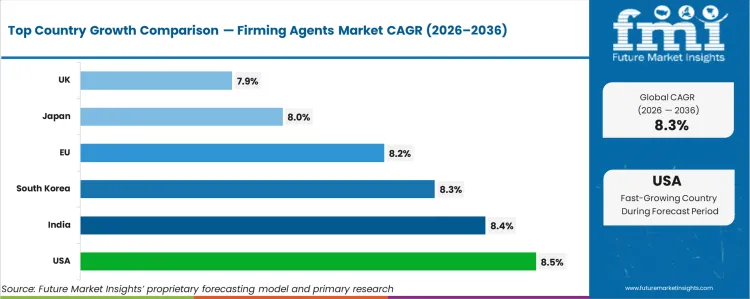
- Geography: High-growth Asia-Pacific (India 8.4%, South Korea 8.3%) versus regulatory-intensive mature markets in North America and Europe (USA 8.5%, EU 8.2%, UK 7.9%).
- Analyst Opinion at FMI
- Nandini Roy Choudhury, Principal Consultant for Food & Beverage, opines, "Strict regulatory caps on ion concentrations force procurement departments toward integrated texturizing blends."
- Strategic Implications/Executive Takeaways
- Build technical service centers near dominant agricultural processing hubs.
- Acquire specialized hydrocolloid portfolios to diversify product offerings.
- Develop import-lot variability playbooks to ensure batch consistency.
- Methodology
- Validated through first-hand corporate production and capacity data.
- Zero reliance on speculative third-party market research reports.
- Based on verifiable industrial benchmarks and verified sources.
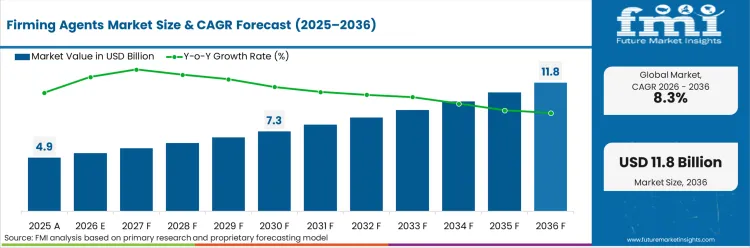
Firming Agents Market Key Takeaways
| Metric | Value |
|---|---|
| Industry Size (2026) | USD 5,327.0 Million |
| Industry Value (2036) | USD 11,826.6 Million |
| CAGR (2026-2036) | 8.3% |
Demand dispersion reveals rapid expansion across United States (8.5%), India (8.4%), South Korea (8.3%), European Union (8.2%), Japan (8.0%), and United Kingdom (7.9%). Advanced food processing infrastructure anchors volume growth in Western economies. Expanding export mandates compel Asian processors to adopt strict standardization frameworks.
Firming Agents Market Definition
Analysis covers ingredients specifically utilized to maintain or restore cellular tissue strength. Manufacturers deploy these compounds to prevent structural collapse during high-temperature sterilization. Vegetable canneries represent primary consumers of these specialized food additives.
Firming Agents Market Inclusions
Research captures mineral salts and specific hydrocolloids marketed explicitly for textural preservation. Volumes reflect consumption across commercial preservation lines. Revenue modeling accounts for long-term contract pricing and spot purchases.
Firming Agents Market Exclusions
Evaluations omit generic salt intended purely for flavoring purposes. Unprocessed agricultural produce sold directly to retail channels remains outside reporting boundaries. Speculative non-industrial laboratory applications are excluded.
Firming Agents Market Research Methodology
- Primary Research: Direct interviews with production managers verified current additive dosing rates.
- Desk Research: Ministry-level agricultural bulletins provided baseline horticulture output volumes.
- Market-Sizing and Forecasting: Analysts mapped mineral salt consumption against regional canning line capacities.
- Data Validation and Update Cycle: Econometric models underwent peer review against audited corporate disclosures.
Segmental Analysis
Firming Agents Market Analysis by Product Type
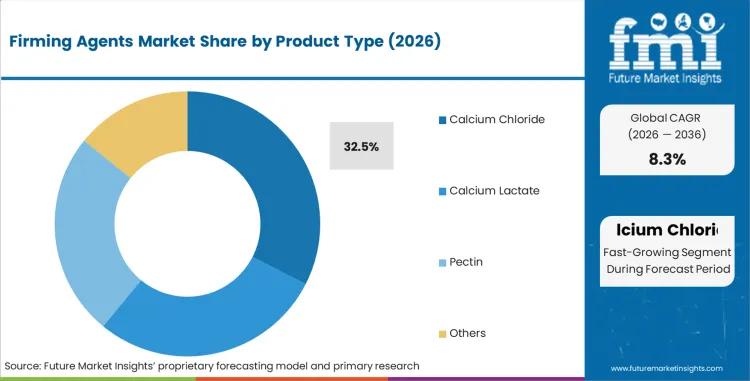
Calcium chloride captures a 32.5% segment share entering 2026, supported by superior performance in low-pH environments. Canning facilities favor mineral salt due to immediate ionic cross-linking with natural cellular components. As per FMI's projection, formulation teams increasingly combine mineral salts with botanical gums to achieve precise structural targets. Procurement managers balance commodity pricing volatility against specialized blend premiums.
- Procurement trigger: Tightening consumer scrutiny forces brands to minimize synthetic chemical labels. Processors pivot toward clean label pectin frameworks beginning in 2026, generating higher margin opportunities for natural ingredient processors.
- Technology shift: Advanced milling techniques produce ultra-fine powder formats delivering rapid dispersion rates. Operators upgrading blending lines achieve superior batch consistency, winning lucrative contracts from top-tier consumer packaged goods multinationals.
- Supply-side move: Conglomerates actively consolidate regional manufacturing assets to secure dominant supply positions. Tate & Lyle finalizing specific acquisitions expands structural formulation portfolios, allowing aggressive penetration into emerging Asian markets.
Firming Agents Market Analysis by Application
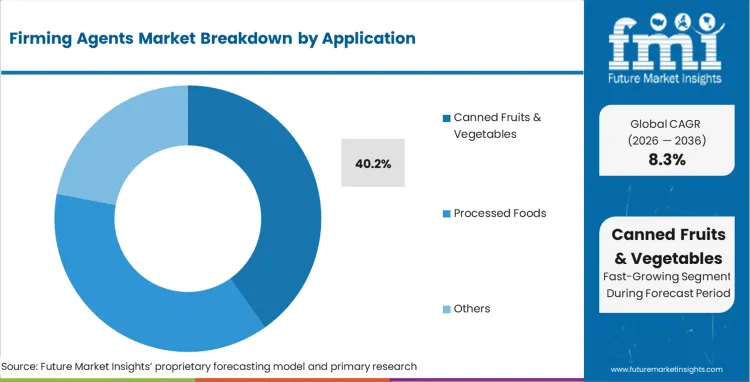
Canned fruits & vegetables represent an immense 40.2% market share. Thermal sterilization protocols inherently degrade plant cell walls, necessitating chemical intervention to prevent mushy textures. Total United States production for estimated vegetable and melon crops reached 758 million cwt in 2023, creating a vast baseline volume requiring stabilization. [1] FMI analysts opine that harvest variability forces facility managers to adjust additive dosing dynamically. Brands operating extensive international networks standardize recipes to maintain consistent retail experiences across borders.
- Procurement trigger: Retailer specifications demand prolonged shelf life without textural degradation. Cannery purchasing teams secure long-term supply agreements for required texturants, buffering operations against seasonal raw material cost fluctuations.
- Technology shift: Automated dosing equipment replaces manual batch addition across modern preservation facilities. Plant engineers installing precision sensors reduce ingredient waste, refining overall unit economics per container.
- Regulatory signal: Government agencies dictate strict permissible limits on residual chemical concentrations. Formulators continually adjust recipes to maintain structural integrity while staying well below mandated thresholds.
Firming Agents Market Drivers, Restraints, and Opportunities
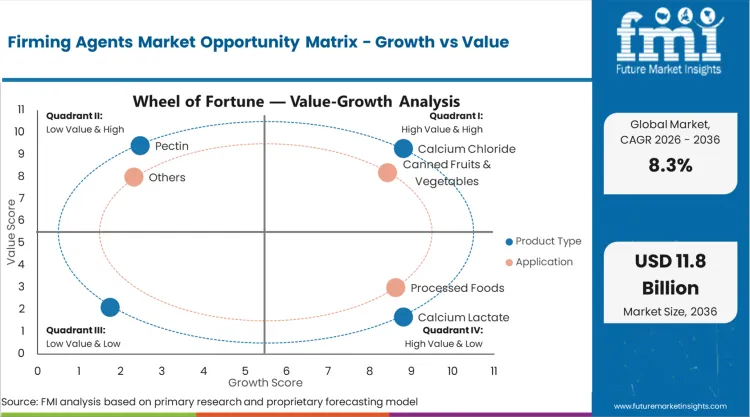
Surging global horticulture production forms an immense underlying demand catalyst. Industrial processing facilities must preserve vast agricultural yields to minimize post-harvest rot. Facility managers deploy chemical stabilizers to convert perishable crops into stable export commodities. According to FMI's estimates, rising middle-class demographics across emerging economies expedite consumption of convenient preserved meals. Chemical suppliers capture vast volume growth by targeting newly commissioned regional canning centers.
Stringent regulatory limits restrict formulation flexibility across dominant jurisdictions. Health authorities continually scrutinize dietary mineral intake, forcing processors to cap specific ion concentrations. Formulators struggle to achieve desired structural firmness without exceeding mandated legal thresholds. Product development teams mitigate compliance risks by adopting complex multi-ingredient matrices combining low-dose salts with natural food hydrocolloids.
- Emerging Processing Hubs: Asian food manufacturing sectors scale rapidly to service vast domestic populations. Multinational ingredient suppliers establishing local technical support teams capture high early market share.
- Clean Label Expansion: Retail consumers increasingly avoid products displaying complex chemical nomenclatures. Formulation houses launching natural botanical texturants capture premium pricing from elite organic food brands.
- Capacity Localization: Logistical bottlenecks disrupt global ingredient distribution networks. Chemical processors building dedicated regional blending facilities ensure reliable local supply, minimizing factory downtime for dependent customers.
Regional Analysis
Based on regional analysis, Firming Agents market is segmented into North America, Latin America, Europe, East Asia, South Asia, Oceania and Middle East & Africa across 40+ countries. Full report also offers market attractiveness analysis based on regional trends.
.webp "Top Country Growth Comparison Firming Agents Market Cagr (2026 2036)")
| Country | CAGR (2026 to 2036) |
|---|---|
| USA | 8.5% |
| India | 8.4% |
| South Korea | 8.3% |
| EU | 8.2% |
| Japan | 8.0% |
| UK | 7.9% |
Source: Future Market Insights (FMI) analysis, based on proprietary forecasting model and primary research
North America Firming Agents Analysis
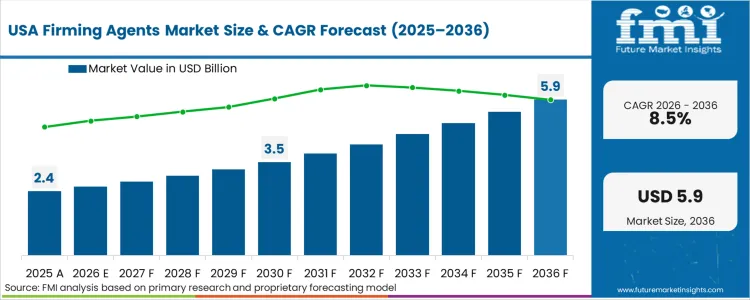
North American processing networks feature vast centralized canning infrastructure requiring immense chemical input volumes. Harvest seasons generate intense processing peaks where facility downtime proves catastrophic. As per FMI's projection, procurement departments prioritize vendor reliability and localized inventory buffering over raw commodity pricing. Jungbunzlauer announced a USD 200 million investment in a Canadian biogum facility during September 2024, expanding regional texturant capabilities. [9] Domestic vegetable availability directly dictates downstream stabilization requirements.
- USA: Growth tracks a CAGR of 8.5% as immense domestic agriculture yields flow into commercial preservation channels. Jungbunzlauer expanding regional production capacity refines North American supply of fermentation-based texturants used with structural blends, reducing processor dependency on international logistics.
FMI’s report includes an extensive evaluation of North American structural ingredient consumption. Canadian operators benefit from proximity to modernized United States agricultural zones. Mexican facilities focus heavily on standardizing export-bound preserved goods.
South Asia Firming Agents Analysis
South Asian consumption expands rapidly as governmental policies incentivize modernizing domestic food processing infrastructure. Unprecedented crop yields require scalable preservation formulations to minimize catastrophic post-harvest loss. FMI analysts opine that regional manufacturers initially favor basic commodity mineral salts before graduating toward sophisticated custom blends. India reported 367.72 million tonnes of total horticulture output, demonstrating a colossal addressable processing base. [2]
- India: Expansion at 8.4% CAGR is linked to vast agricultural processing capacity upgrades. Rising organized food manufacturing scales require codified limits and precise dosing, forcing procurement departments toward integrated texturizing products capable of meeting strict export standards.
Report includes deep structural evaluation covering South Asian supply chains. Bangladesh exhibits strong potential as domestic canning capabilities begin scaling. Sri Lankan operators seek refined texture blends for specialized tropical fruit exports.
East Asia Firming Agents Analysis
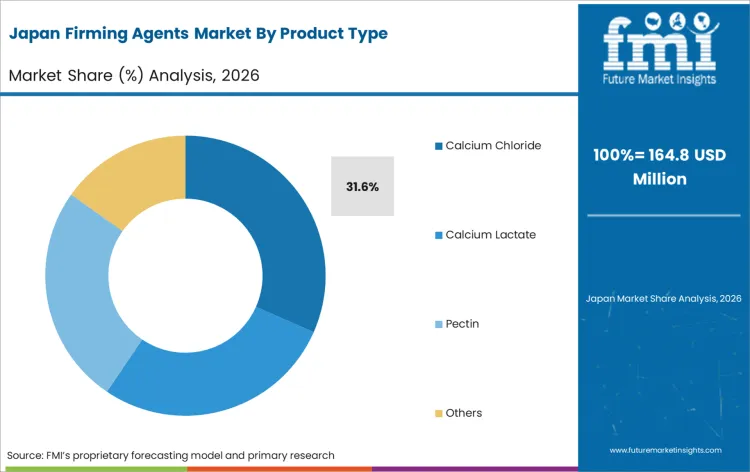
East Asian industrial networks dominate global processed food output through extreme manufacturing efficiency. Regional factories demand flawless ingredient performance to prevent costly line stoppages during high-speed thermal sterilization. According to FMI's estimates, intense competition compels facility managers to adopt highly advanced stabilization technologies. ICL opened a new specialty plant in China during September 2024 to serve regional demands. [7]
- South Korea: A CAGR of 8.3% reflects rapid adoption of sophisticated texture formulations. Importers and processors form alliances to ensure fast reformulation cycles, matching swift consumer trend swings.
- Japan: Growth tracks a CAGR of 8.0% as an advanced USD 182 billion food processing sector demands uncompromising ingredient quality. Processors co-develop process-robust firmness frameworks to survive aggressive retort sterilization environments, securing long-term supply contracts. [5]
Report includes comprehensive volume assessments spanning East Asian manufacturing centers. Taiwan represents a highly specialized processing market requiring bespoke formulation support. Chinese facilities consume vast texturant tonnages to support colossal domestic retail networks.
Europe Firming Agents Analysis
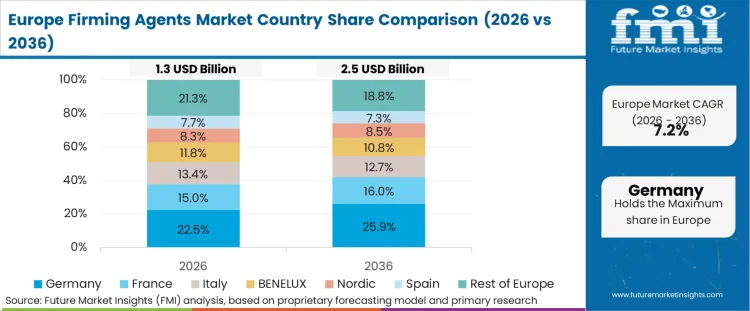
European regulatory environments strictly govern chemical additive usage, forcing rapid transition toward verified clean-label manufacturing paradigms. Formulators face intense pressure to eliminate synthetic salts, propelling vast investments into alternative botanical extraction networks. Total harvested fresh vegetables reached 62.2 million tonnes across European Union territories during 2024, providing a vast preservation baseline. [3] FMI analysts opine that premium quality expectations leave zero tolerance for textural failures.
- EU: At 8.2% CAGR, regional outlook is shaped by intense scrutiny on additive perception. Minimum effective dose strategies combining calcium salts with hydrocolloids expand rapidly, allowing dominant tomato and apple processors to maintain structural integrity while simplifying consumer labels.
- UK: Expansion at 7.9% CAGR is linked to high domestic consumption requiring vast import normalization. Total vegetable supply reached 4.5 million tonnes during 2024, pushing processors to utilize advanced stabilizers to correct texture variability across diverse origin lots. [4]
Report includes extensive coverage across European territories. German processors invest heavily in advanced food and beverages additives to differentiate premium retail offerings. French canneries maximize proprietary formulations to protect delicate vegetable structures during intensive processing.
Competitive Aligners for Market Players
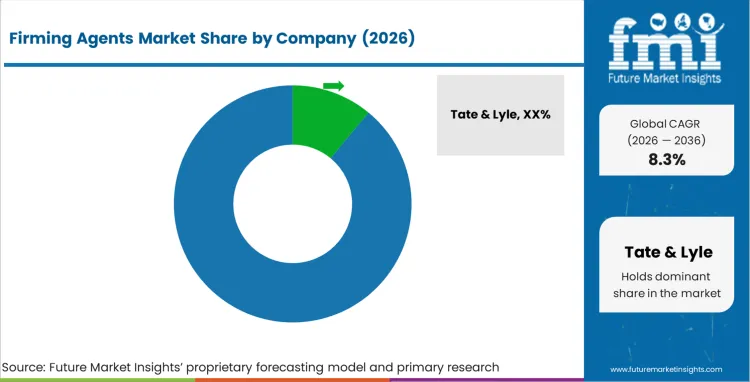
Market participants confront intense pressure to consolidate portfolios as consumer packaged goods giants mandate comprehensive formulation bundling. Independent chemical processors face severe competitive disadvantages without broad texturant capabilities. Strategic acquisitions bridge structural gaps, allowing dominant regional producers to offer globally competitive clean-labelled food additives.
Formulation purity remains a distinct competitive battleground as regulatory bodies tighten permissible chemical thresholds. Facilities deploying advanced milling infrastructure consistently achieve superior dispersion profiles, capturing lucrative contracts from risk-averse multinational brands. Specialized thermal processing applications demand exact dissolution rates to prevent localized structural defects.
Capital allocation strategies increasingly favor establishing localized blending facilities near dominant agricultural processing centers. Multinational conglomerates actively build regional infrastructure to slash extended global transit times. Remaining independent operators partner with specialized distribution networks to defend entrenched regional market shares.
Recent Developments
Report includes full coverage of key trends from competitive benchmarking. Some recent developments covered in reports:
- In November 2024, Tate & Lyle completed an acquisition of CP Kelco entities to expand texture portfolios. [6]
- In August 2024, Cargill opened a new blending facility in Indonesia emphasizing localized texturizer capabilities. [8]
Key Players in Firming Agents
- Tate & Lyle
- ICL Group
- Ingredion
- Cargill
- Jungbunzlauer
- IFF
- Kerry Group
- CP Kelco
Scope of the Report
| Metric | Value |
|---|---|
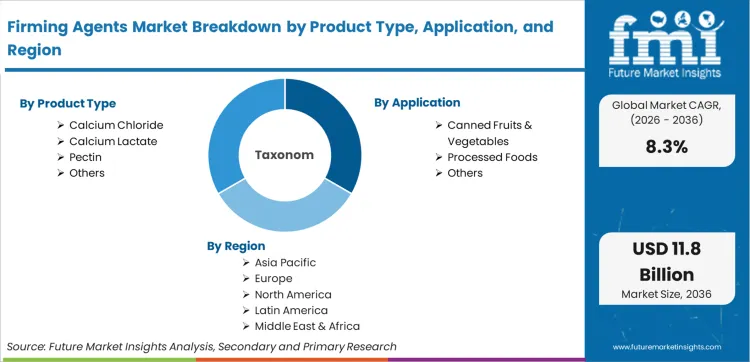
| Quantitative Units | USD 5,327.0 million (2026) to USD 11,826.6 million (2036), at a CAGR of 8.3% |
| Market Definition | Ingredients specifically utilized to maintain or restore cellular tissue strength during food processing. |
| Product Type Segmentation | Calcium Chloride, Calcium Lactate, Pectin, Others |
| Application Segmentation | Canned Fruits & Vegetables, Processed Foods, Others |
| Regions Covered | North America, Latin America, Europe, East Asia, South Asia, Oceania, Middle East & Africa |
| Countries Covered | USA, Canada, Mexico, Brazil, Argentina, Germany, France, United Kingdom, Italy, Spain, China, India, Japan, South Korea, Indonesia, Australia and 40+ countries |
| Key Companies Profiled | Tate & Lyle, ICL Group, Ingredion, Cargill, Jungbunzlauer, IFF, Kerry Group, CP Kelco |
| Forecast Period | 2026 to 2036 |
| Approach | Hybrid top-down and bottom-up modeling validated through primary interviews and agricultural output benchmarking |
Firming Agents Market Analysis by Segments
Product Type:
- Calcium Chloride
- Calcium Lactate
- Pectin
- Others
Application:
- Canned Fruits & Vegetables
- Processed Foods
- Others
Region:
- Asia Pacific
- India
- China
- Japan
- South Korea
- Indonesia
- Australia & New Zealand
- ASEAN
- Rest of Asia Pacific
- Europe
- Germany
- Italy
- France
- United Kingdom
- Spain
- Benelux
- Nordics
- Central & Eastern Europe
- Rest of Europe
- North America
- United States
- Canada
- Mexico
- Latin America
- Brazil
- Argentina
- Chile
- Rest of Latin America
- Middle East & Africa
- Kingdom of Saudi Arabia
- United Arab Emirates
- South Africa
- Turkey
- Rest of Middle East & Africa
Bibliography
- [1] USDA Economic Research Service. (2023). Total production for estimated vegetable & melon crops.
- [2] Press Information Bureau. (2024). India horticulture production.
- [3] European Commission. (2024). EU harvested fresh vegetables.
- [4] GOV.UK. (2024). UK total vegetable supply.
- [5] USDA Apps. (2023). Japan food processing industry size.
- [6] Tate & Lyle. (2024). Completed acquisition of CP Kelco entities.
- [7] ICL Group. (2024). Opened new food specialty plant in China.
- [8] Cargill. (2024). Opened new blending facility in Indonesia.
- [9] Jungbunzlauer. (2024). Announced investment in Canada.
This bibliography is provided for reader reference and is not exhaustive. The full report contains the complete reference list and detailed citations.
This Report Addresses
- Market intelligence to enable structured strategic decision making across mature and emerging ingredient economies.
- Market size estimation and 10-year revenue forecasts from 2026 to 2036, supported by validated capacity and trade benchmarks.
- Growth opportunity mapping across specific mineral salts and alternative hydrocolloid formulations.
- Segment and regional revenue forecasts covering major preserved vegetable and fruit processing applications.
- Competition strategy assessment including integration models, cost survivability positioning, and compliance capability benchmarking.
- Product reformulation tracking including clean label transitions and complex texture stabilization frameworks.
- Regulatory impact analysis covering maximum ionic concentration mandates and regional food safety thresholds.
- Market report delivery in PDF, Excel, PPT, and interactive dashboard formats for executive and operational use.
Frequently Asked Questions
How large is the demand for Firming Agents in the global market in 2026?
Demand for Firming Agents in global markets is estimated to be valued at USD 5,327.0 million in 2026.
What will be the market size of Firming Agents in the global market by 2036?
Sales are projected to reach USD 11,826.6 million by 2036.
What is the expected demand growth for Firming Agents in the global market between 2026 and 2036?
Consumption is expected to grow at a CAGR of 8.3% between 2026 and 2036.
Which Product Type is poised to lead global sales by 2026?
Calcium Chloride is expected to dominate, capturing approximately 32.5% of global market share due to efficient ionic cross-linking properties.
How significant is the role of Canned Fruits & Vegetables Application in driving Firming Agents adoption in 2026?
Canned fruits & vegetables represent a critical segment, projected to hold a substantial 40.2% share as canning operations require intense structural preservation.
What is driving demand in the USA?
Vast domestic agricultural yields flowing into commercial preservation channels propel intense stabilization requirements.
What compliance standards or regulations are referenced for the USA?
Strict limits on residual chemical concentrations dictate specific formulation boundaries for domestic processors.
What is the USA growth outlook in this report?
USA is projected to grow at a CAGR of 8.5% during 2026 to 2036.
Why is India described as a priority region in this report?
Vast horticulture output and expanding export mandates force unprecedented adoption of standardized preservation technologies.
What type of demand dominates in India?
Volume-driven consumption across newly commissioned commercial canning centers dictates regional purchasing trends.
What is India growth outlook in this report?
India is projected to expand at a CAGR of 8.4% during 2026 to 2036.
Does the report cover South Korea in its regional analysis?
South Korea is included within East Asia under regional scope analysis.
What are the sources referred to for analyzing South Korea?
Official statistics published by agricultural trade bodies covering processed vegetable imports are cited as primary reference sources.
What is the main demand theme linked to South Korea in its region coverage?
Rapid adoption of sophisticated texture formulations through tight alliances between local importers and processors.
Does the report cover EU in its regional analysis?
EU is included within Europe under regional coverage framework.
What is the main EU related demand theme in its region coverage?
Intense regulatory scrutiny forces rapid transitions toward clean-label botanical texturants.
Which product formats or configurations are strategically important for UK supply chains?
High-performance stabilization blends are critical to normalize textural variability across vast imported agricultural volumes.
What are Firming Agents and what are they mainly used for?
Specialized ingredients utilized to maintain or restore cellular tissue strength during intensive thermal food processing operations.
What do Firming Agents mean in this report?
Scope covers global production and industrial consumption of mineral salts and hydrocolloids utilized explicitly for textural preservation.
What is included in the scope of this Firming Agents report?
Coverage encompasses calcium-based salts, specific botanical gums, and applications across preserved fruits and vegetables.
What is excluded from the scope of this report?
Unprocessed raw agriculture and generic salts intended purely for flavoring are excluded from volume estimations.
What does market forecast mean on this page?
Forecast represents a model-based projection built on defined capacity and consumption assumptions.
How does FMI build and validate the Firming Agents forecast?
Projections utilize hybrid top-down and bottom-up modeling validated through direct industry interviews and agricultural benchmark data.
What does zero reliance on speculative third party market research mean here?
Primary interviews and verifiable public datasets are utilized instead of unverified syndicated estimates.
Preview the report firsthand - request a free sample
Get SampleGet the brochure for pricing and purchase details.
Get PDFTable of Content
- Executive Summary
- Global Market Outlook
- Demand-side Trends
- Supply-side Trends
- Technology Roadmap Analysis
- Analysis and Recommendations
- Market Overview
- Market Coverage / Taxonomy
- Market Definition / Scope / Limitations
- Research Methodology
- Chapter Orientation
- Analytical Lens and Working Hypotheses
- Market Structure, Signals, and Trend Drivers
- Desk Research Programme (Secondary Evidence)
- Company Annual and Sustainability Reports
- Peer-reviewed Journals and Academic Literature
- Corporate Websites, Product Literature, and Technical Notes
- Earnings Decks and Investor Briefings
- Statutory Filings and Regulatory Disclosures
- Technical White Papers and Standards Notes
- Trade Journals, Industry Magazines, and Analyst Briefs
- Conference Proceedings, Webinars, and Seminar Materials
- Government Statistics Portals and Public Data Releases
- Press Releases and Reputable Media Coverage
- Specialist Newsletters and Curated Briefings
- Sector Databases and Reference Repositories
- FMI Internal Proprietary Databases and Historical Market Datasets
- Subscription Datasets and Paid Sources
- Social Channels, Communities, and Digital Listening Inputs
- Additional Desk Sources
- Expert Input and Fieldwork (Primary Evidence)
- Primary Modes
- Qualitative Interviews and Expert Elicitation
- Quantitative Surveys and Structured Data Capture
- Blended Approach
- Why Primary Evidence is Used
- Field Techniques
- Interviews
- Surveys
- Focus Groups
- Observational and In-context Research
- Social and Community Interactions
- Stakeholder Universe Engaged
- C-suite Leaders
- Board Members
- Presidents and Vice Presidents
- R&D and Innovation Heads
- Technical Specialists
- Domain Subject-matter Experts
- Scientists
- Physicians and Other Healthcare Professionals
- Governance, Ethics, and Data Stewardship
- Research Ethics
- Data Integrity and Handling
- Primary Modes
- Tooling, Models, and Reference Databases
- Data Engineering and Model Build
- Data Acquisition and Ingestion
- Cleaning, Normalisation, and Verification
- Synthesis, Triangulation, and Analysis
- Quality Assurance and Audit Trail
- Market Background
- Market Dynamics
- Drivers
- Restraints
- Opportunity
- Trends
- Scenario Forecast
- Demand in Optimistic Scenario
- Demand in Likely Scenario
- Demand in Conservative Scenario
- Opportunity Map Analysis
- Product Life Cycle Analysis
- Supply Chain Analysis
- Investment Feasibility Matrix
- Value Chain Analysis
- PESTLE and Porter’s Analysis
- Regulatory Landscape
- Regional Parent Market Outlook
- Production and Consumption Statistics
- Import and Export Statistics
- Market Dynamics
- Global Market Analysis 2021 to 2025 and Forecast, 2026 to 2036
- Historical Market Size Value (USD Million) Analysis, 2021 to 2025
- Current and Future Market Size Value (USD Million) Projections, 2026 to 2036
- Y-o-Y Growth Trend Analysis
- Absolute $ Opportunity Analysis
- Global Market Pricing Analysis 2021 to 2025 and Forecast 2026 to 2036
- Global Market Analysis 2021 to 2025 and Forecast 2026 to 2036, By Product Type
- Introduction / Key Findings
- Historical Market Size Value (USD Million) Analysis By Product Type , 2021 to 2025
- Current and Future Market Size Value (USD Million) Analysis and Forecast By Product Type , 2026 to 2036
- Calcium Chloride
- Calcium Lactate
- Pectin
- Others
- Calcium Chloride
- Y-o-Y Growth Trend Analysis By Product Type , 2021 to 2025
- Absolute $ Opportunity Analysis By Product Type , 2026 to 2036
- Global Market Analysis 2021 to 2025 and Forecast 2026 to 2036, By Application
- Introduction / Key Findings
- Historical Market Size Value (USD Million) Analysis By Application, 2021 to 2025
- Current and Future Market Size Value (USD Million) Analysis and Forecast By Application, 2026 to 2036
- Canned Fruits & Vegetables
- Processed Foods
- Others
- Canned Fruits & Vegetables
- Y-o-Y Growth Trend Analysis By Application, 2021 to 2025
- Absolute $ Opportunity Analysis By Application, 2026 to 2036
- Global Market Analysis 2021 to 2025 and Forecast 2026 to 2036, By Region
- Introduction
- Historical Market Size Value (USD Million) Analysis By Region, 2021 to 2025
- Current Market Size Value (USD Million) Analysis and Forecast By Region, 2026 to 2036
- North America
- Latin America
- Western Europe
- Eastern Europe
- East Asia
- South Asia and Pacific
- Middle East & Africa
- Market Attractiveness Analysis By Region
- North America Market Analysis 2021 to 2025 and Forecast 2026 to 2036, By Country
- Historical Market Size Value (USD Million) Trend Analysis By Market Taxonomy, 2021 to 2025
- Market Size Value (USD Million) Forecast By Market Taxonomy, 2026 to 2036
- By Country
- USA
- Canada
- Mexico
- By Product Type
- By Application
- By Country
- Market Attractiveness Analysis
- By Country
- By Product Type
- By Application
- Key Takeaways
- Latin America Market Analysis 2021 to 2025 and Forecast 2026 to 2036, By Country
- Historical Market Size Value (USD Million) Trend Analysis By Market Taxonomy, 2021 to 2025
- Market Size Value (USD Million) Forecast By Market Taxonomy, 2026 to 2036
- By Country
- Brazil
- Chile
- Rest of Latin America
- By Product Type
- By Application
- By Country
- Market Attractiveness Analysis
- By Country
- By Product Type
- By Application
- Key Takeaways
- Western Europe Market Analysis 2021 to 2025 and Forecast 2026 to 2036, By Country
- Historical Market Size Value (USD Million) Trend Analysis By Market Taxonomy, 2021 to 2025
- Market Size Value (USD Million) Forecast By Market Taxonomy, 2026 to 2036
- By Country
- Germany
- UK
- Italy
- Spain
- France
- Nordic
- BENELUX
- Rest of Western Europe
- By Product Type
- By Application
- By Country
- Market Attractiveness Analysis
- By Country
- By Product Type
- By Application
- Key Takeaways
- Eastern Europe Market Analysis 2021 to 2025 and Forecast 2026 to 2036, By Country
- Historical Market Size Value (USD Million) Trend Analysis By Market Taxonomy, 2021 to 2025
- Market Size Value (USD Million) Forecast By Market Taxonomy, 2026 to 2036
- By Country
- Russia
- Poland
- Hungary
- Balkan & Baltic
- Rest of Eastern Europe
- By Product Type
- By Application
- By Country
- Market Attractiveness Analysis
- By Country
- By Product Type
- By Application
- Key Takeaways
- East Asia Market Analysis 2021 to 2025 and Forecast 2026 to 2036, By Country
- Historical Market Size Value (USD Million) Trend Analysis By Market Taxonomy, 2021 to 2025
- Market Size Value (USD Million) Forecast By Market Taxonomy, 2026 to 2036
- By Country
- China
- Japan
- South Korea
- By Product Type
- By Application
- By Country
- Market Attractiveness Analysis
- By Country
- By Product Type
- By Application
- Key Takeaways
- South Asia and Pacific Market Analysis 2021 to 2025 and Forecast 2026 to 2036, By Country
- Historical Market Size Value (USD Million) Trend Analysis By Market Taxonomy, 2021 to 2025
- Market Size Value (USD Million) Forecast By Market Taxonomy, 2026 to 2036
- By Country
- India
- ASEAN
- Australia & New Zealand
- Rest of South Asia and Pacific
- By Product Type
- By Application
- By Country
- Market Attractiveness Analysis
- By Country
- By Product Type
- By Application
- Key Takeaways
- Middle East & Africa Market Analysis 2021 to 2025 and Forecast 2026 to 2036, By Country
- Historical Market Size Value (USD Million) Trend Analysis By Market Taxonomy, 2021 to 2025
- Market Size Value (USD Million) Forecast By Market Taxonomy, 2026 to 2036
- By Country
- Kingdom of Saudi Arabia
- Other GCC Countries
- Turkiye
- South Africa
- Other African Union
- Rest of Middle East & Africa
- By Product Type
- By Application
- By Country
- Market Attractiveness Analysis
- By Country
- By Product Type
- By Application
- Key Takeaways
- Key Countries Market Analysis
- USA
- Pricing Analysis
- Market Share Analysis, 2025
- By Product Type
- By Application
- Canada
- Pricing Analysis
- Market Share Analysis, 2025
- By Product Type
- By Application
- Mexico
- Pricing Analysis
- Market Share Analysis, 2025
- By Product Type
- By Application
- Brazil
- Pricing Analysis
- Market Share Analysis, 2025
- By Product Type
- By Application
- Chile
- Pricing Analysis
- Market Share Analysis, 2025
- By Product Type
- By Application
- Germany
- Pricing Analysis
- Market Share Analysis, 2025
- By Product Type
- By Application
- UK
- Pricing Analysis
- Market Share Analysis, 2025
- By Product Type
- By Application
- Italy
- Pricing Analysis
- Market Share Analysis, 2025
- By Product Type
- By Application
- Spain
- Pricing Analysis
- Market Share Analysis, 2025
- By Product Type
- By Application
- France
- Pricing Analysis
- Market Share Analysis, 2025
- By Product Type
- By Application
- India
- Pricing Analysis
- Market Share Analysis, 2025
- By Product Type
- By Application
- ASEAN
- Pricing Analysis
- Market Share Analysis, 2025
- By Product Type
- By Application
- Australia & New Zealand
- Pricing Analysis
- Market Share Analysis, 2025
- By Product Type
- By Application
- China
- Pricing Analysis
- Market Share Analysis, 2025
- By Product Type
- By Application
- Japan
- Pricing Analysis
- Market Share Analysis, 2025
- By Product Type
- By Application
- South Korea
- Pricing Analysis
- Market Share Analysis, 2025
- By Product Type
- By Application
- Russia
- Pricing Analysis
- Market Share Analysis, 2025
- By Product Type
- By Application
- Poland
- Pricing Analysis
- Market Share Analysis, 2025
- By Product Type
- By Application
- Hungary
- Pricing Analysis
- Market Share Analysis, 2025
- By Product Type
- By Application
- Kingdom of Saudi Arabia
- Pricing Analysis
- Market Share Analysis, 2025
- By Product Type
- By Application
- Turkiye
- Pricing Analysis
- Market Share Analysis, 2025
- By Product Type
- By Application
- South Africa
- Pricing Analysis
- Market Share Analysis, 2025
- By Product Type
- By Application
- USA
- Market Structure Analysis
- Competition Dashboard
- Competition Benchmarking
- Market Share Analysis of Top Players
- By Regional
- By Product Type
- By Application
- Competition Analysis
- Competition Deep Dive
- Tate & Lyle
- Overview
- Product Portfolio
- Profitability by Market Segments (Product/Age /Sales Channel/Region)
- Sales Footprint
- Strategy Overview
- Marketing Strategy
- Product Strategy
- Channel Strategy
- ICL Group
- Ingredion
- Cargill
- Jungbunzlauer
- IFF
- Tate & Lyle
- Competition Deep Dive
- Assumptions & Acronyms Used


