

- Industry Size (2026)
- USD 329.3 Mn
- Forecast (2036)
- USD 839 Mn
- CAGR (2026 to 2036)
- 9.8%
Green Chelating Agents for Brownfield Redevelopment Market Forecast and Outlook 2026 to 2036
The green chelating agents for brownfield redevelopment market is valued at USD 329.3 million in 2026 and is projected to reach USD 839 million by 2036, with a compound annual growth rate (CAGR) of 9.8%. This market holds strategic importance as it directly supports the remediation and revitalization of contaminated brownfield sites, a critical component of urban development and environmental sustainability. As regulations surrounding site cleanup become stricter, the need for effective, eco-friendly solutions increases. Key control points in this market include regulatory compliance, cost-efficiency, and the ability to achieve long-term environmental impact. Buyers are highly dependent on vendors’ ability to demonstrate proven effectiveness in reducing contaminants while minimizing ecological harm. Strategic trade-offs arise between speed of remediation and cost constraints, with decision-makers balancing budget pressures against the need for reliable, sustainable results. These dynamics underscore the competitive weight of this category in broader urban renewal and environmental management strategies.
Quick Stats of the Green Chelating Agents for Brownfield Redevelopment Market
- Green Chelating Agents for Brownfield Redevelopment Market Value (2026): USD 329.3 million
- Green Chelating Agents for Brownfield Redevelopment Market Forecast Value (2036): USD 839 million
- Green Chelating Agents for Brownfield Redevelopment Market Global Forecast CAGR (2026-2036): 9.8%
- Green Chelating Agents for Brownfield Redevelopment Market Leading Segment: Contaminant Type (Heavy Metals – Pb, Cr, As, Hg, Cd) 38%
- Key Growth Regions in Green Chelating Agents for Brownfield Redevelopment Market: India
- Top Players in Green Chelating Agents for Brownfield Redevelopment Market: BASF SE, Nouryon, Solvay, Evonik, REGENESIS
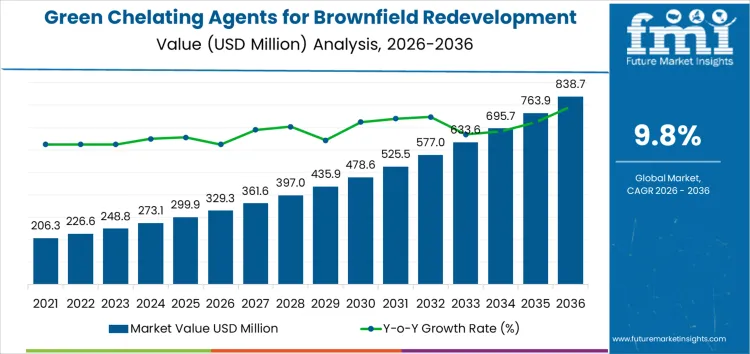
What is the Growth Forecast for the Green Chelating Agents for Brownfield Redevelopment Market through 2036?
The market share erosion or gain analysis for the green chelating agents for brownfield redevelopment market reflects steady adoption and incremental growth, with a slight gain in market share due to the growing focus on sustainable remediation practices. During the early years of the forecast period (2026-2031), the market is expected to experience an increase in market share due to the growing demand for green and eco-friendly remediation technologies. As governments, municipalities, and private developers focus more on sustainable redevelopment, green chelating agents will increasingly replace traditional methods, gaining a larger portion of the market. This is particularly evident in urban redevelopment projects and brownfield cleanups, where regulatory pressures and environmental concerns are driving the shift toward greener alternatives.
By the later years of the forecast period (2031-2036), the market will stabilize as the adoption of green chelating agents becomes more widespread. This period will see the market reach a maturity phase, with market share gains slowing down as the technology becomes more established. The market will continue to grow, but the rate of growth will moderate, leading to a more stable market share distribution. The market will still see steady demand, but the growth of green chelating agents will be tempered by existing competitors and alternative remediation technologies. The market will experience a period of accelerated growth and market share gain in the early years, followed by stabilization and steady demand in the latter years of the forecast period.
Chelating Agents for Brownfield Redevelopment Market Key Takeaways
| Metric | Value |
|---|---|
| Industry Sales Value (2026) | USD 329.3 million |
| Industry Forecast Value (2036) | USD 839 million |
| Industry Forecast CAGR (2026-2036) | 9.8% |
What Is Driving the Demand for the Green Chelating Agents for Brownfield Redevelopment Market Globally?
The global demand for green chelating agents in brownfield redevelopment is driven by growing emphasis on sustainable site cleanup, stricter regulatory requirements for hazardous metal remediation, and the desire to repurpose previously contaminated land for productive use. Brownfield sites often contain heavy metals such as lead, cadmium, arsenic, and chromium that pose risk to human health and the environment if left untreated. Traditional chelating agents such as EDTA and DTPA are effective at mobilizing these metals but can persist in the environment and mobilize contaminants beyond the target zone, raising concerns about secondary impacts. In response, developers, environmental consultants, and regulators are adopting green chelating agents that are more biodegradable, less toxic, and better aligned with environmental protection goals. These alternatives, often derived from natural organic acids, biodegradable polymers, or plant-based compounds, help extract or stabilise metals while reducing the likelihood of long-term ecological harm. Regulatory frameworks in the United States, Europe, and parts of Asia increasingly prioritise remediation solutions that meet stringent cleanup standards with minimal environmental footprint. At the same time, public and corporate sustainability commitments encourage the use of safer chemistries in redevelopment projects where long-term stewardship and community health are priorities.
Future demand for green chelating agents in brownfield redevelopment is expected to grow as advancements in formulation science and site management practices continue to evolve. Innovation in chelant design is improving selectivity, biodegradability, and performance under diverse soil and groundwater conditions, making these agents more competitive with conventional options. Integration of green chelating strategies with complementary remediation technologies such as phytoremediation, soil washing, and stabilization will broaden their applicability and effectiveness. Regulatory emphasis on life-cycle impacts, ecological risk reduction, and monitoring outcomes will further reinforce adoption because green chelants support compliance while reducing potential liabilities associated with persistent chemicals. As brownfield redevelopment continues to expand in urban and industrial regions, especially where land availability is limited, stakeholders will seek remediation solutions that balance cost, performance, and environmental responsibility. Continued investment in research, field validation, and training for site practitioners will help accelerate adoption, positioning green chelating agents as a key component of sustainable remediation workflows in global markets.
What are the Leading Segments in the Global Green Chelating Agents for Brownfield Redevelopment Market?
The global green chelating agents for brownfield redevelopment market is segmented by contaminant type and end-use sector. Among contaminant types, heavy metals (Pb, Cr, As, Hg, Cd) lead the market, capturing 38% of the share, followed by industrial chemicals & solvents, petroleum hydrocarbons & organics, mixed metal-organic pollutants, and other emerging contaminants. Heavy metals are a primary concern in brownfield redevelopment due to their persistence in soil and toxicity to human health and the environment. On the end-use sector side, environmental remediation firms dominate the market, holding 36% of the share, followed by brownfield redevelopment & real estate, industrial & manufacturing sites, government & municipal cleanup projects, and mining & metallurgical land reclamation. Environmental remediation firms are key players in managing the cleanup and restoration of contaminated sites, using green chelating agents to enhance the removal of pollutants and support sustainable redevelopment.
What Drives the Growth of Heavy Metals (Pb, Cr, As, Hg, Cd) in the Green Chelating Agents for Brownfield Redevelopment Market?
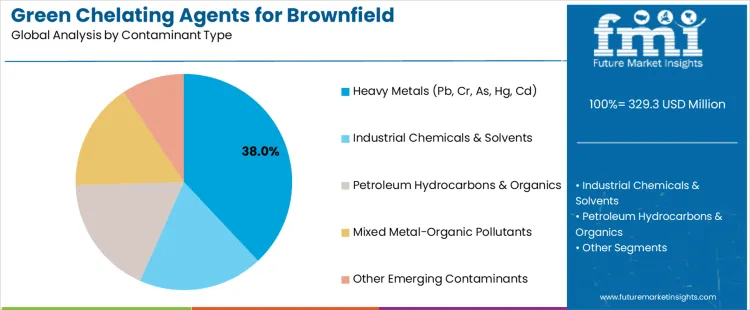
Heavy metals such as lead (Pb), chromium (Cr), arsenic (As), mercury (Hg), and cadmium (Cd) are the leading contaminants in the green chelating agents for brownfield redevelopment market, holding 38% of the share. These metals are among the most common and dangerous pollutants found in brownfield sites, often resulting from industrial activities like mining, manufacturing, and waste disposal. Their persistence in the soil and toxicity to both human health and wildlife make them a significant focus for environmental remediation. Green chelating agents, which are environmentally friendly alternatives to traditional chemical treatments, are highly effective in binding to heavy metals, making them easier to remove from contaminated sites. The growing emphasis on sustainable and non-toxic remediation solutions has driven the adoption of green chelating agents in the cleanup of heavy metal contamination. As stricter environmental regulations and the demand for eco-friendly remediation methods increase, the need for green chelating agents to address heavy metal contamination in brownfield redevelopment will continue to grow, ensuring their dominant position in the market.
What is Driving the Demand for Environmental Remediation Firms in the Green Chelating Agents for Brownfield Redevelopment Market?
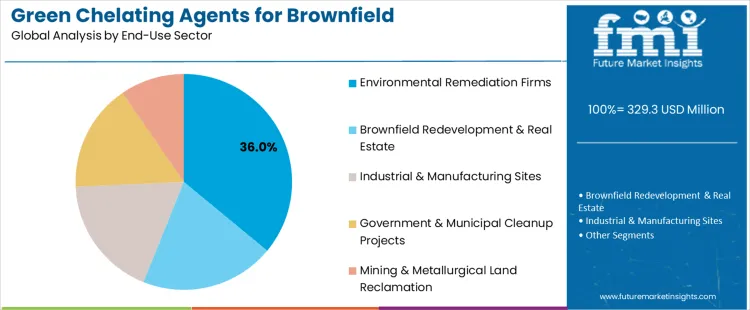
Environmental remediation firms are the leading end-use sector in the green chelating agents for brownfield redevelopment market, holding 36% of the share. These firms play a critical role in the remediation of contaminated sites, particularly brownfields, which require specialized treatment methods to address a range of pollutants. Environmental remediation companies increasingly rely on green chelating agents to clean up contaminated sites in a way that is both effective and environmentally sustainable. As environmental regulations become stricter and the focus on sustainability intensifies, these firms are under increasing pressure to adopt solutions that minimize environmental impact while maximizing the efficiency of the cleanup process. Green chelating agents, which help to safely extract contaminants like heavy metals, petroleum hydrocarbons, and industrial chemicals from the soil, are becoming a preferred tool in this sector. As the need for brownfield redevelopment grows, driven by urban expansion and land reclamation, the demand for environmental remediation firms and their use of green chelating agents will continue to increase, making them a key driver in the market.
What are the Key Dynamics in the Global Green Chelating Agents for Brownfield Redevelopment Market?
The global green chelating agents for brownfield redevelopment market is expanding as environmental and construction sectors adopt sustainable solutions to extract heavy metals and contaminants from soil and groundwater. Green chelating agents improve mobility of pollutants, enabling remediation technologies such as soil washing, stabilization and phytoextraction to work more effectively. Growth reflects rising redevelopment of former industrial and contaminated sites, stricter environmental standards for land reuse, and demand for low-toxicity, biodegradable chemistries that reduce ecological impact. Use spans municipal, industrial and commercial projects where safe site revitalization is a priority.
What are the Key Drivers for the Global Green Chelating Agents for Brownfield Redevelopment Market?
Heightened regulatory requirements for brownfield cleanup and redevelopment drive demand for green chelating agents that support compliance with soil and water quality criteria. Developers and remediation professionals prefer agents that deliver strong heavy metal removal while minimizing residual toxicity and avoiding secondary contamination risk. Advances in biodegradable organic chelators, such as plant-derived acids and engineered ligands, enhance treatment performance and environmental acceptance. Growth in urban revitalization, infrastructure expansion and sustainable land reuse initiatives increases investment in remediation technologies that align with corporate environmental goals and community expectations. Public and private sector funding for contaminated land transformation further supports market uptake.
What are the Restraints for the Global Green Chelating Agents for Brownfield Redevelopment Market?
One restraint is the technical challenge of selecting and optimizing green chelating agents for varied site conditions, contaminant profiles and soil types. Effectiveness can depend on pH, redox conditions and indigenous soil chemistry, which may require extensive site characterization and pilot testing to refine application. Cost considerations affect adoption where budget constraints lead stakeholders to choose conventional remediation methods that may have lower upfront expense. Limited long-term field performance data for some emerging green chelators contributes to cautious uptake among remediation firms focused on predictable outcomes. Variability in regional acceptance and regulatory recognition of novel chelating chemistries adds complexity to project planning and approval.
What are the Key Trends in the Global Green Chelating Agents for Brownfield Redevelopment Market?
A key trend is the development of tailored, eco-friendly chelating agents that combine strong contaminant binding with rapid biodegradation, reducing residual presence in the environment after treatment. Formulators are designing chelators that target specific heavy metals like lead, cadmium and arsenic while minimizing impact on beneficial soil nutrients and microbial communities. Integration of green chelating agents with complementary technologies such as electrokinetic remediation, phytoremediation and microbial stimulation enhances overall cleanup efficiency. Use of data-driven site assessment and modeling tools is helping practitioners predict performance and design more effective treatment plans. Collaboration between research institutions, remediation providers and regulators supports standardization and broader acceptance of green chelating solutions.
What is the Country-Wise Analysis of the Green Chelating Agents for Brownfield Redevelopment Market?
The green chelating agents for brownfield redevelopment market is experiencing steady growth, driven by the increasing focus on sustainable and environmentally friendly methods for cleaning up contaminated sites. Green chelating agents are used in soil and water remediation processes to bind with and mobilize toxic heavy metals, facilitating their removal and reducing environmental harm. High-growth markets such as India and China are witnessing strong demand due to rapid industrialization, urbanization, and the growing need for land reclamation and remediation. Developed markets like the United States, Germany, and Canada are also seeing steady growth, supported by stricter environmental regulations, government initiatives for brownfield redevelopment, and the rising emphasis on sustainability in urban planning.
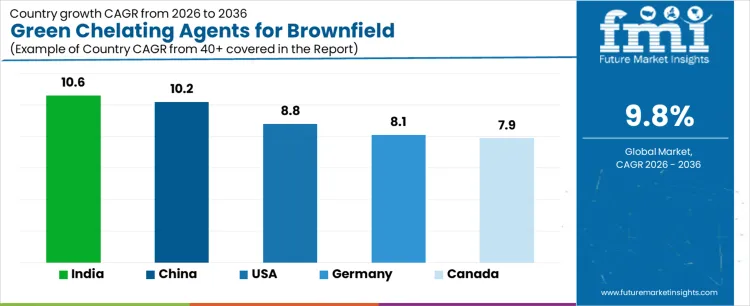
| Country | CAGR (2026 to 2036) |
|---|---|
| India | 10.6% |
| China | 10.2% |
| USA | 8.8% |
| Germany | 8.1% |
| Canada | 7.9% |
What is the Growth Outlook for the Green Chelating Agents for Brownfield Redevelopment Market in India?
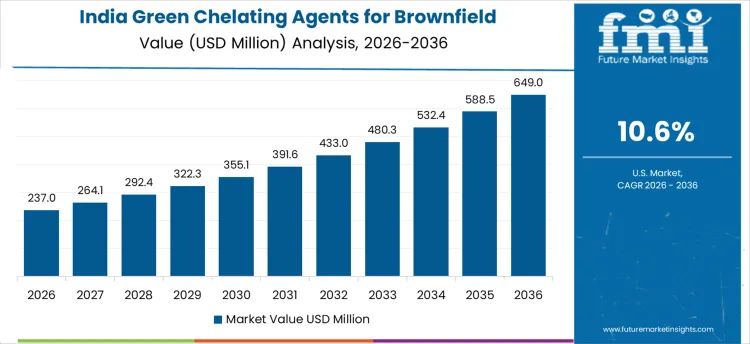
The green chelating agents for brownfield redevelopment market in India is expected to grow at the highest rate, with a projected CAGR of 10.6%. India’s rapid urbanization, industrial expansion, and growing concerns about environmental contamination are driving the demand for effective and sustainable brownfield remediation solutions. The need for land reclamation and redevelopment of industrial sites is particularly strong, as India faces challenges related to soil and water pollution. The Indian government’s focus on sustainable urban development and environmental protection is encouraging the adoption of green chelating agents as a safer alternative to traditional methods. As awareness of environmental sustainability continues to rise, India’s market for green chelating agents in brownfield redevelopment is set for significant growth.
What is the Market Outlook for the Green Chelating Agents for Brownfield Redevelopment Market in China?
The green chelating agents for brownfield redevelopment market in China is projected to grow steadily, with a projected CAGR of 10.2%. China’s rapid industrialization and urbanization have resulted in numerous contaminated sites that require effective remediation solutions. As the country strives to meet environmental sustainability goals and reduce pollution, there is increasing demand for green technologies such as chelating agents for soil and water cleanup. Government regulations aimed at improving environmental conditions and promoting land reclamation further support the adoption of green chelating agents. The market in China is driven by the growing need to revitalize brownfield sites and restore land for industrial and commercial use, making the demand for eco-friendly remediation methods, including green chelating agents, particularly strong.
What is the Growth Forecast for the Green Chelating Agents for Brownfield Redevelopment Market in the United States?
The green chelating agents for brownfield redevelopment market in the United States is expected to grow steadily, with a projected CAGR of 8.8%. The U.S. market is driven by a growing focus on environmental remediation and land reclamation projects. As brownfield redevelopment becomes an important aspect of sustainable urban planning, the demand for green chelating agents is rising due to their effectiveness in mobilizing and removing toxic contaminants from soil and water. Strict environmental regulations, including those from the Environmental Protection Agency (EPA), are encouraging industries and municipalities to adopt eco-friendly remediation technologies. The growing need to restore contaminated sites for residential, commercial, and industrial development further supports the steady growth of the U.S. market for green chelating agents in brownfield redevelopment.
What is the Market Outlook for the Green Chelating Agents for Brownfield Redevelopment Market in Germany?
The green chelating agents for brownfield redevelopment market in Germany is projected to grow at a steady pace, with a projected CAGR of 8.1%. Germany’s commitment to environmental sustainability and its strict regulatory frameworks are key drivers of demand for green remediation technologies. As part of its focus on brownfield redevelopment, Germany is increasingly turning to eco-friendly solutions, including green chelating agents, to treat and clean contaminated sites. The country’s well-established environmental policies, combined with rising public awareness of pollution and land reclamation needs, are further supporting the adoption of these technologies. With increasing investments in sustainable urban development and the growing need to manage contaminated sites, Germany’s market for green chelating agents is expected to continue expanding.
What are the Growth Prospects for the Green Chelating Agents for Brownfield Redevelopment Market in Canada?
The green chelating agents for brownfield redevelopment market in Canada is expected to grow steadily, with a projected CAGR of 7.9%. Canada’s emphasis on sustainable development and environmental remediation is driving the demand for innovative and eco-friendly solutions for brownfield redevelopment. As the country works to address contamination from industrial activities and improve land quality, there is a growing need for safe, effective remediation methods. Green chelating agents, which offer an environmentally friendly alternative to traditional methods, are gaining traction in the Canadian market as part of efforts to restore contaminated sites. Government initiatives supporting brownfield redevelopment and the increasing focus on environmental stewardship in urban planning are expected to drive steady market growth for green chelating agents in Canada.
What is the Competitive Landscape for the Green Chelating Agents for Brownfield Redevelopment Market?
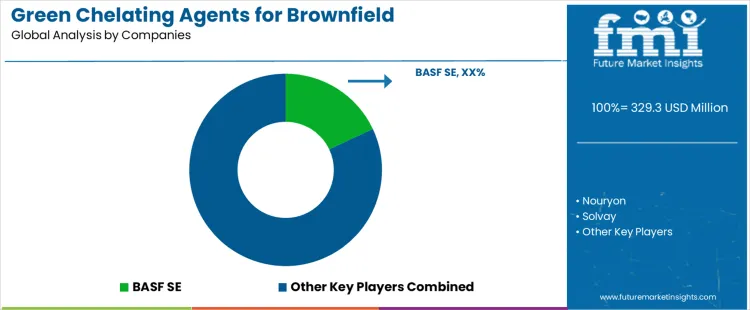
The green chelating agents for brownfield redevelopment market is growing rapidly as industries seek sustainable, eco-friendly solutions for soil remediation and land regeneration. BASF SE leads the market with its innovative green chelating agents, offering high-performance products that enhance the bioavailability of contaminants, making them easier to treat during brownfield redevelopment projects. Their strong focus on sustainability, regulatory compliance, and environmental responsibility has positioned them as a dominant player. Nouryon, Solvay, and Evonik are key competitors, each providing specialized green chelating agents designed to support environmental remediation efforts in brownfield sites. Nouryon offers eco-friendly chelating agents that help in soil decontamination, while Solvay and Evonik focus on providing high-quality, sustainable solutions for effective land restoration and pollution control.
REGENESIS further contributes to the competitive landscape by offering green chelating agents tailored specifically for brownfield redevelopment. REGENESIS specializes in developing environmentally responsible products that promote effective soil remediation and help transform contaminated sites into safe, usable land. These companies compete by focusing on product innovation, sustainability, and their ability to provide efficient, safe, and cost-effective solutions for brownfield redevelopment. As environmental concerns and regulations regarding land contamination increase, the demand for green chelating agents is expected to rise, driving further growth and innovation in this market.
Key Players of the Chelating Agents for Brownfield Redevelopment Market
- BASF SE
- Nouryon
- Solvay
- Evonik
- REGENESIS
Scope of the Report
| Items | Values |
|---|---|
| Quantitative Units (2026) | USD Million |
| Chelating Agent Type | GLDA & MGDA (Biodegradable Aminopolycarboxylates), IDS & EDDS (Readily Biodegradable Chelators), Plant-Based & Bio-Sourced Chelating Agents, Polymer-Assisted Chelation Systems, Other Eco-Friendly Chelators |
| Contaminant Type | Heavy Metals (Pb, Cr, As, Hg, Cd), Industrial Chemicals & Solvents, Petroleum Hydrocarbons & Organics, Mixed Metal-Organic Pollutants, Other Emerging Contaminants |
| End-Use Sector | Environmental Remediation Firms, Brownfield Redevelopment & Real Estate, Industrial & Manufacturing Sites, Government & Municipal Cleanup Projects, Mining & Metallurgical Land Reclamation |
| Companies | BASF SE, Nouryon, Solvay, Evonik, REGENESIS |
| Regions Covered | North America, Latin America, Western Europe, Eastern Europe, South Asia and Pacific, East Asia, Middle East & Africa |
| Countries Covered | United States, Canada, Mexico, Brazil, Argentina, Germany, France, United Kingdom, Italy, Spain, Netherlands, China, India, Japan, South Korea, ANZ, GCC Countries, South Africa |
| Additional Attributes | Dollar by sales by chelating agent type, contaminant type, end-use sector, and region. Includes market trends in green chelating agents for brownfield redevelopment, performance in heavy metal and industrial chemical site remediation, cost-effectiveness, sustainability practices, regulatory compliance, market share and competitive positioning of key companies, and the role of eco-friendly chelating agents in enhancing the cleanup and reclamation of contaminated land across various industries. |
Green Chelating Agents for Brownfield Redevelopment Market Segmentation
Chelating Agent Type
- GLDA & MGDA (Biodegradable Aminopolycarboxylates)
- IDS & EDDS (Readily Biodegradable Chelators)
- Plant-Based & Bio-Sourced Chelating Agents
- Polymer-Assisted Chelation Systems
- Other Eco-Friendly Chelators
Contaminant Type
- Heavy Metals (Pb, Cr, As, Hg, Cd)
- Industrial Chemicals & Solvents
- Petroleum Hydrocarbons & Organics
- Mixed Metal-Organic Pollutants
- Other Emerging Contaminants
End-Use Sector
- Environmental Remediation Firms
- Brownfield Redevelopment & Real Estate
- Industrial & Manufacturing Sites
- Government & Municipal Cleanup Projects
- Mining & Metallurgical Land Reclamation
Region
- Asia Pacific
- China
- Japan
- South Korea
- India
- Australia & New Zealand
- ASEAN
- Rest of Asia Pacific
- Europe
- Germany
- United Kingdom
- France
- Italy
- Spain
- Nordic
- BENELUX
- Rest of Europe
- North America
- United States
- Canada
- Mexico
- Latin America
- Brazil
- Chile
- Rest of Latin America
- Middle East & Africa
- Kingdom of Saudi Arabia
- Other GCC Countries
- Turkey
- South Africa
- Other African Union
- Rest of Middle East & Africa
Frequently Asked Questions
How big is the green chelating agents for brownfield redevelopment market in 2026?
The global green chelating agents for brownfield redevelopment market is estimated to be valued at USD 329.3 million in 2026.
What will be the size of green chelating agents for brownfield redevelopment market in 2036?
The market size for the green chelating agents for brownfield redevelopment market is projected to reach USD 838.7 million by 2036.
How much will be the green chelating agents for brownfield redevelopment market growth between 2026 and 2036?
The green chelating agents for brownfield redevelopment market is expected to grow at a 9.8% CAGR between 2026 and 2036.
What are the key product types in the green chelating agents for brownfield redevelopment market?
The key product types in green chelating agents for brownfield redevelopment market are glda & mgda (biodegradable aminopolycarboxylates), ids & edds (readily biodegradable chelators), plant-based & bio-sourced chelating agents, polymer-assisted chelation systems and other eco-friendly chelators.
Which contaminant type segment to contribute significant share in the green chelating agents for brownfield redevelopment market in 2026?
In terms of contaminant type, heavy metals segment to command 38.0% share in the green chelating agents for brownfield redevelopment market in 2026.
Preview the report firsthand - request a free sample
Get SampleGet the brochure for pricing and purchase details.
Get PDFTable of Content
- Executive Summary
- Global Market Outlook
- Demand-side Trends
- Supply-side Trends
- Technology Roadmap Analysis
- Analysis and Recommendations
- Market Overview
- Market Coverage / Taxonomy
- Market Definition / Scope / Limitations
- Market Background
- Market Dynamics
- Drivers
- Restraints
- Opportunity
- Trends
- Scenario Forecast
- Demand in Optimistic Scenario
- Demand in Likely Scenario
- Demand in Conservative Scenario
- Opportunity Map Analysis
- Product Life Cycle Analysis
- Supply Chain Analysis
- Investment Feasibility Matrix
- Value Chain Analysis
- PESTLE and Porter’s Analysis
- Regulatory Landscape
- Regional Parent Market Outlook
- Production and Consumption Statistics
- Import and Export Statistics
- Market Dynamics
- Global Market Analysis 2021 to 2025 and Forecast, 2026 to 2036
- Historical Market Size Value (USD Million) Analysis, 2021 to 2025
- Current and Future Market Size Value (USD Million) Projections, 2026 to 2036
- Y-o-Y Growth Trend Analysis
- Absolute $ Opportunity Analysis
- Global Market Pricing Analysis 2021 to 2025 and Forecast 2026 to 2036
- Global Market Analysis 2021 to 2025 and Forecast 2026 to 2036, By Chelating Agent Type
- Introduction / Key Findings
- Historical Market Size Value (USD Million) Analysis By Chelating Agent Type , 2021 to 2025
- Current and Future Market Size Value (USD Million) Analysis and Forecast By Chelating Agent Type , 2026 to 2036
- GLDA & MGDA (Biodegradable Aminopolycarboxylates)
- IDS & EDDS (Readily Biodegradable Chelators)
- Plant-Based & Bio-Sourced Chelating Agents
- Polymer-Assisted Chelation Systems
- Other Eco-Friendly Chelators
- GLDA & MGDA (Biodegradable Aminopolycarboxylates)
- Y-o-Y Growth Trend Analysis By Chelating Agent Type , 2021 to 2025
- Absolute $ Opportunity Analysis By Chelating Agent Type , 2026 to 2036
- Global Market Analysis 2021 to 2025 and Forecast 2026 to 2036, By Contaminant Type
- Introduction / Key Findings
- Historical Market Size Value (USD Million) Analysis By Contaminant Type, 2021 to 2025
- Current and Future Market Size Value (USD Million) Analysis and Forecast By Contaminant Type, 2026 to 2036
- Heavy Metals (Pb, Cr, As, Hg, Cd)
- Industrial Chemicals & Solvents
- Petroleum Hydrocarbons & Organics
- Mixed Metal-Organic Pollutants
- Other Emerging Contaminants
- Heavy Metals (Pb, Cr, As, Hg, Cd)
- Y-o-Y Growth Trend Analysis By Contaminant Type, 2021 to 2025
- Absolute $ Opportunity Analysis By Contaminant Type, 2026 to 2036
- Global Market Analysis 2021 to 2025 and Forecast 2026 to 2036, By End-Use Sector
- Introduction / Key Findings
- Historical Market Size Value (USD Million) Analysis By End-Use Sector, 2021 to 2025
- Current and Future Market Size Value (USD Million) Analysis and Forecast By End-Use Sector, 2026 to 2036
- Environmental Remediation Firms
- Brownfield Redevelopment & Real Estate
- Industrial & Manufacturing Sites
- Government & Municipal Cleanup Projects
- Mining & Metallurgical Land Reclamation
- Environmental Remediation Firms
- Y-o-Y Growth Trend Analysis By End-Use Sector, 2021 to 2025
- Absolute $ Opportunity Analysis By End-Use Sector, 2026 to 2036
- Global Market Analysis 2021 to 2025 and Forecast 2026 to 2036, By Region
- Introduction
- Historical Market Size Value (USD Million) Analysis By Region, 2021 to 2025
- Current Market Size Value (USD Million) Analysis and Forecast By Region, 2026 to 2036
- North America
- Latin America
- Western Europe
- Eastern Europe
- East Asia
- South Asia and Pacific
- Middle East & Africa
- Market Attractiveness Analysis By Region
- North America Market Analysis 2021 to 2025 and Forecast 2026 to 2036, By Country
- Historical Market Size Value (USD Million) Trend Analysis By Market Taxonomy, 2021 to 2025
- Market Size Value (USD Million) Forecast By Market Taxonomy, 2026 to 2036
- By Country
- USA
- Canada
- Mexico
- By Chelating Agent Type
- By Contaminant Type
- By End-Use Sector
- By Country
- Market Attractiveness Analysis
- By Country
- By Chelating Agent Type
- By Contaminant Type
- By End-Use Sector
- Key Takeaways
- Latin America Market Analysis 2021 to 2025 and Forecast 2026 to 2036, By Country
- Historical Market Size Value (USD Million) Trend Analysis By Market Taxonomy, 2021 to 2025
- Market Size Value (USD Million) Forecast By Market Taxonomy, 2026 to 2036
- By Country
- Brazil
- Chile
- Rest of Latin America
- By Chelating Agent Type
- By Contaminant Type
- By End-Use Sector
- By Country
- Market Attractiveness Analysis
- By Country
- By Chelating Agent Type
- By Contaminant Type
- By End-Use Sector
- Key Takeaways
- Western Europe Market Analysis 2021 to 2025 and Forecast 2026 to 2036, By Country
- Historical Market Size Value (USD Million) Trend Analysis By Market Taxonomy, 2021 to 2025
- Market Size Value (USD Million) Forecast By Market Taxonomy, 2026 to 2036
- By Country
- Germany
- UK
- Italy
- Spain
- France
- Nordic
- BENELUX
- Rest of Western Europe
- By Chelating Agent Type
- By Contaminant Type
- By End-Use Sector
- By Country
- Market Attractiveness Analysis
- By Country
- By Chelating Agent Type
- By Contaminant Type
- By End-Use Sector
- Key Takeaways
- Eastern Europe Market Analysis 2021 to 2025 and Forecast 2026 to 2036, By Country
- Historical Market Size Value (USD Million) Trend Analysis By Market Taxonomy, 2021 to 2025
- Market Size Value (USD Million) Forecast By Market Taxonomy, 2026 to 2036
- By Country
- Russia
- Poland
- Hungary
- Balkan & Baltic
- Rest of Eastern Europe
- By Chelating Agent Type
- By Contaminant Type
- By End-Use Sector
- By Country
- Market Attractiveness Analysis
- By Country
- By Chelating Agent Type
- By Contaminant Type
- By End-Use Sector
- Key Takeaways
- East Asia Market Analysis 2021 to 2025 and Forecast 2026 to 2036, By Country
- Historical Market Size Value (USD Million) Trend Analysis By Market Taxonomy, 2021 to 2025
- Market Size Value (USD Million) Forecast By Market Taxonomy, 2026 to 2036
- By Country
- China
- Japan
- South Korea
- By Chelating Agent Type
- By Contaminant Type
- By End-Use Sector
- By Country
- Market Attractiveness Analysis
- By Country
- By Chelating Agent Type
- By Contaminant Type
- By End-Use Sector
- Key Takeaways
- South Asia and Pacific Market Analysis 2021 to 2025 and Forecast 2026 to 2036, By Country
- Historical Market Size Value (USD Million) Trend Analysis By Market Taxonomy, 2021 to 2025
- Market Size Value (USD Million) Forecast By Market Taxonomy, 2026 to 2036
- By Country
- India
- ASEAN
- Australia & New Zealand
- Rest of South Asia and Pacific
- By Chelating Agent Type
- By Contaminant Type
- By End-Use Sector
- By Country
- Market Attractiveness Analysis
- By Country
- By Chelating Agent Type
- By Contaminant Type
- By End-Use Sector
- Key Takeaways
- Middle East & Africa Market Analysis 2021 to 2025 and Forecast 2026 to 2036, By Country
- Historical Market Size Value (USD Million) Trend Analysis By Market Taxonomy, 2021 to 2025
- Market Size Value (USD Million) Forecast By Market Taxonomy, 2026 to 2036
- By Country
- Kingdom of Saudi Arabia
- Other GCC Countries
- Turkiye
- South Africa
- Other African Union
- Rest of Middle East & Africa
- By Chelating Agent Type
- By Contaminant Type
- By End-Use Sector
- By Country
- Market Attractiveness Analysis
- By Country
- By Chelating Agent Type
- By Contaminant Type
- By End-Use Sector
- Key Takeaways
- Key Countries Market Analysis
- USA
- Pricing Analysis
- Market Share Analysis, 2025
- By Chelating Agent Type
- By Contaminant Type
- By End-Use Sector
- Canada
- Pricing Analysis
- Market Share Analysis, 2025
- By Chelating Agent Type
- By Contaminant Type
- By End-Use Sector
- Mexico
- Pricing Analysis
- Market Share Analysis, 2025
- By Chelating Agent Type
- By Contaminant Type
- By End-Use Sector
- Brazil
- Pricing Analysis
- Market Share Analysis, 2025
- By Chelating Agent Type
- By Contaminant Type
- By End-Use Sector
- Chile
- Pricing Analysis
- Market Share Analysis, 2025
- By Chelating Agent Type
- By Contaminant Type
- By End-Use Sector
- Germany
- Pricing Analysis
- Market Share Analysis, 2025
- By Chelating Agent Type
- By Contaminant Type
- By End-Use Sector
- UK
- Pricing Analysis
- Market Share Analysis, 2025
- By Chelating Agent Type
- By Contaminant Type
- By End-Use Sector
- Italy
- Pricing Analysis
- Market Share Analysis, 2025
- By Chelating Agent Type
- By Contaminant Type
- By End-Use Sector
- Spain
- Pricing Analysis
- Market Share Analysis, 2025
- By Chelating Agent Type
- By Contaminant Type
- By End-Use Sector
- France
- Pricing Analysis
- Market Share Analysis, 2025
- By Chelating Agent Type
- By Contaminant Type
- By End-Use Sector
- India
- Pricing Analysis
- Market Share Analysis, 2025
- By Chelating Agent Type
- By Contaminant Type
- By End-Use Sector
- ASEAN
- Pricing Analysis
- Market Share Analysis, 2025
- By Chelating Agent Type
- By Contaminant Type
- By End-Use Sector
- Australia & New Zealand
- Pricing Analysis
- Market Share Analysis, 2025
- By Chelating Agent Type
- By Contaminant Type
- By End-Use Sector
- China
- Pricing Analysis
- Market Share Analysis, 2025
- By Chelating Agent Type
- By Contaminant Type
- By End-Use Sector
- Japan
- Pricing Analysis
- Market Share Analysis, 2025
- By Chelating Agent Type
- By Contaminant Type
- By End-Use Sector
- South Korea
- Pricing Analysis
- Market Share Analysis, 2025
- By Chelating Agent Type
- By Contaminant Type
- By End-Use Sector
- Russia
- Pricing Analysis
- Market Share Analysis, 2025
- By Chelating Agent Type
- By Contaminant Type
- By End-Use Sector
- Poland
- Pricing Analysis
- Market Share Analysis, 2025
- By Chelating Agent Type
- By Contaminant Type
- By End-Use Sector
- Hungary
- Pricing Analysis
- Market Share Analysis, 2025
- By Chelating Agent Type
- By Contaminant Type
- By End-Use Sector
- Kingdom of Saudi Arabia
- Pricing Analysis
- Market Share Analysis, 2025
- By Chelating Agent Type
- By Contaminant Type
- By End-Use Sector
- Turkiye
- Pricing Analysis
- Market Share Analysis, 2025
- By Chelating Agent Type
- By Contaminant Type
- By End-Use Sector
- South Africa
- Pricing Analysis
- Market Share Analysis, 2025
- By Chelating Agent Type
- By Contaminant Type
- By End-Use Sector
- USA
- Market Structure Analysis
- Competition Dashboard
- Competition Benchmarking
- Market Share Analysis of Top Players
- By Regional
- By Chelating Agent Type
- By Contaminant Type
- By End-Use Sector
- Competition Analysis
- Competition Deep Dive
- BASF SE
- Overview
- Product Portfolio
- Profitability by Market Segments (Product/Age /Sales Channel/Region)
- Sales Footprint
- Strategy Overview
- Marketing Strategy
- Product Strategy
- Channel Strategy
- Nouryon
- Solvay
- Evonik
- REGENESIS
- BASF SE
- Competition Deep Dive
- Assumptions & Acronyms Used
- Research Methodology


