

- Industry Size (2026)
- USD 410.0 Mn
- Forecast (2036)
- USD 1082.9 Mn
- CAGR (2026 to 2036)
- 10.2%
J-Beauty Sheer Finish Pigment Systems for Layerable Color Cosmetics Market Forecast and Outlook 2026 to 2036
The J-Beauty sheer finish pigment systems for layerable color cosmetics market is valued at USD 410.0 million in 2026 and is projected to reach USD 1,082.9 million by 2036, registering a CAGR of 10.2%. Performance over this period reflects a shift toward formulation architectures where restraint, optical control, and repeatability determine commercial success. Sheer pigment systems generate value through precision rather than intensity, placing emphasis on particle transparency, dispersion fidelity, and tonal consistency at low loadings. Suppliers able to deliver ultra-fine pigments with predictable optical behavior capture disproportionate margin, since formulation tolerance for variability is limited. Pricing power concentrates around materials that preserve translucency across repeated layers while avoiding oxidation, muddiness, or texture buildup.
Quick Stats for J-Beauty Sheer Finish Pigment Systems for Layerable Color Cosmetics Market
- J-Beauty Sheer Finish Pigment Systems for Layerable Color Cosmetics Market Value (2026): USD 410.0 million
- J-Beauty Sheer Finish Pigment Systems for Layerable Color Cosmetics Market Forecast Value (2036): USD 1,082.9 million
- Forecast CAGR (2026-2036): 10.2%
- Leading Pigment System Type in Global Demand: Ultra-Transparent Mineral Pigments
- Fastest-Growing Countries: Japan, India, China, South Korea, USA
- Key Players in Global Demand: Sensient Technologies, Clariant AG, BASF SE, DSM-Firmenich, Sun Chemical
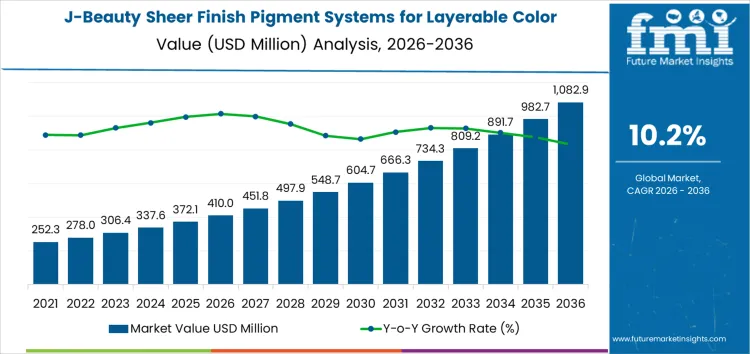
Commercial dynamics are shaped by buyer sensitivity to formulation risk and long-term portfolio coherence. Procurement teams prioritize pigments that support controlled layering without requiring corrective additives or reformulation across shades. Switching costs remain high because pigment changes alter visual balance, shade progression, and consumer perception of refinement. Regulatory expectations around purity and leave-on safety further narrow acceptable supply options, reinforcing reliance on established pigment platforms with validated performance histories. Growth is therefore anchored in consistency, documentation depth, and supplier capability to support subtle shade systems across regions. Value accumulation favors pigment systems that enable disciplined formulation execution, predictable scale-up, and alignment with minimalist aesthetic standards rather than rapid experimentation or aggressive color innovation.
J-Beauty Sheer Finish Pigment Systems for Layerable Color Cosmetics Market Key Takeaways
| Metric | Value |
|---|---|
| Market Value (2026) | USD 410.0 million |
| Market Forecast Value (2036) | USD 1,082.9 million |
| Forecast CAGR (2026-2036) | 10.2% |
Why is the Demand for J-Beauty Sheer Finish Pigment Systems for Layerable Color Cosmetics Market Growing?
Demand for J-Beauty sheer finish pigment systems for layerable color cosmetics is growing globally due to increasing consumer preference for natural, minimalist makeup that supports buildable coverage without heaviness. Sheer finish pigments provide soft, translucent color that allows multiple layers without masking skin texture, which aligns with J-Beauty principles that emphasize skin clarity, subtle enhancement, and effortless application. Cosmetic formulators integrate ultra-fine, high-dispersion pigments designed to deliver balanced hue and smooth gradient transitions across tints, balms, and lightweight foundations. Retail expansion of J-Beauty brands through specialty beauty stores, prestige counters, and online platforms increases accessibility for consumers seeking nuanced color expression that complements natural complexion.
Regulatory frameworks in multiple regions emphasize ingredient safety, purity, and transparent sourcing, which reinforces specification of pigment systems that meet leave-on cosmetic criteria while supporting gentle wear. Advances in dispersion technology and surface treatments improve pigment performance under varied environmental conditions while maintaining a breathable, weightless sensory profile. Social media and beauty trend cycles that highlight effortless, barely-there makeup looks further elevate demand for sheer finish systems. Brand strategies that emphasize layering versatility, refined aesthetics, and compatibility with skincare-infused makeup support continued adoption of J-Beauty influenced pigment systems in global color cosmetics portfolios.
How Is the J-Beauty Sheer Finish Pigment Systems for Layerable Color Cosmetics Market Structured?
Demand for J-beauty sheer finish pigment systems is driven by preference for subtle enhancement, layerable coverage, and lightweight skin appearance. Formulators focus on pigment transparency, dispersion uniformity, and texture control to support repeated application without buildup. Global demand reflects adoption of minimalist makeup routines where gradual color development, refined finish, and comfort across multiple layers define product acceptance in daily wear cosmetics.
Which Pigment System Type Holds the Largest Share of Global Demand?
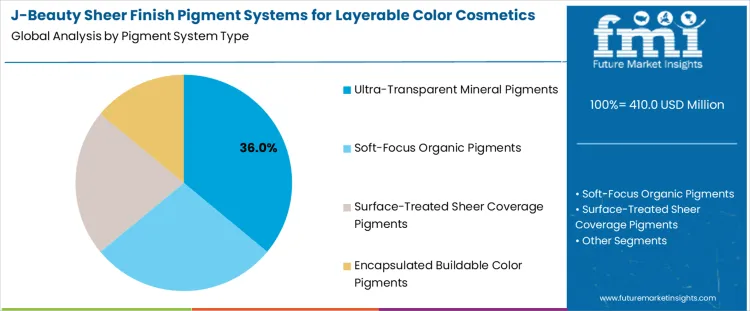
Ultra-transparent mineral pigments hold 36.0%, representing the largest share of global demand. These pigments enable soft color correction while preserving natural skin visibility across layered applications. Soft-focus organic pigments follow at 28.0%, supporting gentle blurring effects and low visual weight. Surface-treated sheer coverage pigments account for 22.0%, improving spreadability and consistency during repeated layering. Encapsulated buildable color pigments represent 14.0%, used where controlled intensity increase is required without texture compromise.
Key Points
- Transparent minerals lead due to natural sheer appearance
- Organic pigments support soft-focus visual refinement
- Encapsulation enables controlled color buildability
Which Layering Performance Attribute Drives the Highest Global Demand?
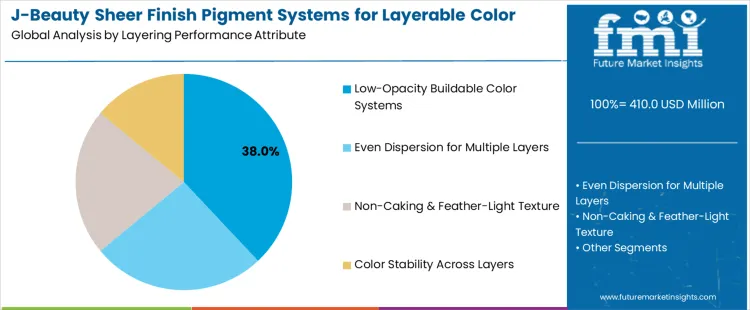
Low-opacity buildable color systems account for 38.0%, making them the leading layering performance attribute globally. These systems allow gradual color intensity increase without abrupt tone shifts. Even dispersion for multiple layers follows at 26.0%, ensuring uniform appearance during repeated application. Non-caking and feather-light texture represents 22.0%, addressing comfort and finish preservation. Color stability across layers holds 14.0%, supporting shade consistency throughout layering cycles.
Key Points
- Buildable opacity defines layerable makeup performance
- Even dispersion prevents patchiness across layers
- Texture control maintains lightweight feel
Which Application Segment Represents the Largest Share of Global Demand?
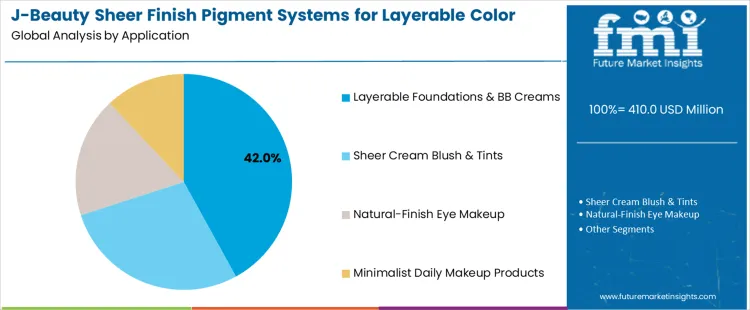
Layerable foundations and BB creams account for 42.0%, making them the largest application segment globally. These products rely on sheer pigments to support customizable coverage without heaviness. Sheer cream blush and tints follow at 28.0%, requiring pigments that blend seamlessly into skin. Natural-finish eye makeup represents 18.0%, emphasizing subtle definition. Minimalist daily makeup products hold 12.0%, reflecting streamlined routines focused on understated enhancement.
Key Points
- Foundations and BB creams dominate due to layering flexibility
- Blush and tints depend on seamless skin integration
- Daily makeup prioritizes subtle, repeatable application
What are the Key Dynamics in the J-Beauty Sheer Finish Pigment Systems for Layerable Color Cosmetics Market?
Global demand rises as cosmetic developers and beauty brands adopt J-Beauty sheer finish pigment systems that deliver lightweight, buildable color with a natural appearance. Sheer finish pigments support layering without heaviness, enabling consumers to tailor coverage from subtle to more visible effect. Adoption aligns with influence of Japanese beauty principles emphasizing skin health, minimalist aesthetics, and integration of skincare benefits into makeup. Usage spans foundations, tinted moisturizers, blushes, and complexion enhancers across North America, Europe, Asia-Pacific, and other regions where demand for refined texture and gentle performance is growing.
How do minimalist beauty trends and consumer preferences shape adoption?
Consumers increasingly prioritize complexion products that provide a natural, breathable look while enhancing skin appearance without mask-like finish. J-Beauty sheer finish pigment systems deliver controlled light reflection and soft color payoff that complement minimal makeup routines. Cosmetic formulators focus on balancing translucency, dispersion stability, and compatibility with hydrating base components to achieve consistent layerable performance. Retailers position products with sheer finish attributes to appeal to consumers seeking effortless everyday makeup and subtle enhancement for diverse skin tones. Digital content and influencer guidance amplify interest in cosmetics that support buildable color while preserving a skin-like feel. Performance criteria include smooth application, blendability, and retention of clarity under varied conditions.
How do formulation challenges, raw material cost, and regulatory compliance influence market scalability?
Sheer finish pigment systems require precise control of particle size distribution, surface treatment, and interaction with binders and emollients to ensure even dispersion and light modulation without patchiness or opacity issues. Specialized pigment technologies often involve higher raw material costs relative to conventional colorants, influencing formulation budgets and pricing strategies for finished products. Formulators must optimize combinations of pigments, base ingredients, and texture modifiers to maintain both aesthetic and functional performance. Regulatory frameworks in major markets enforce safety, purity, and labeling accuracy for cosmetic colorants, affecting pigment selection and quality documentation for global distribution. Variability in supply chain availability for high-quality pigments impacts planning and cost stability. Long-term market growth depends on continued innovation in layerable pigment systems, harmonization of safety standards, and formulation support that meets evolving consumer expectations for natural, sheer finish cosmetics worldwide.
How Is Demand for J-Beauty Sheer Finish Pigment Systems for Layerable Color Cosmetics Evolving?
Demand for J-Beauty sheer finish pigment systems for layerable color cosmetics is increasing globally due to preference for translucency, buildable coverage, and skin-natural aesthetics. Japan leads with an 11.4% CAGR, supported by refined base makeup traditions and emphasis on subtle enhancement. India follows at 10.9%, driven by adoption of lightweight, layer-friendly color products for daily wear. China records 10.6%, reflecting scale manufacturing and rising interest in minimalist makeup looks. South Korea posts a 10.3% CAGR, shaped by integration of sheer pigments into hybrid formats. USA records 9.9%, supported by clean beauty alignment and preference for flexible, low-coverage makeup. Growth reflects shift toward pigments enabling gradual color build without masking skin texture.
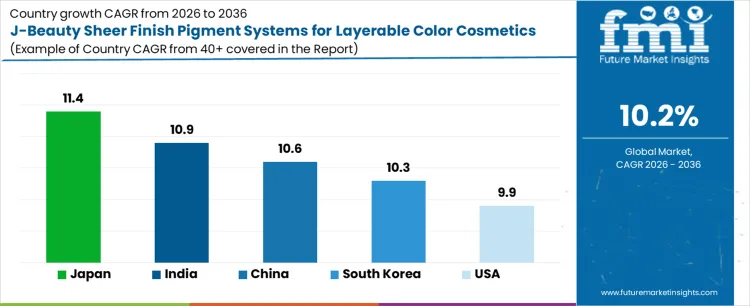
| Country | CAGR (%) |
|---|---|
| Japan | 11.4% |
| India | 10.9% |
| China | 10.6% |
| South Korea | 10.3% |
| USA | 9.9% |
What factors are driving strong adoption of sheer finish pigment systems in Japan?
Japan demand is driven by cultural preference for natural-looking makeup and precise control over color intensity. CAGR of 11.4% reflects use of ultra-fine pigments that disperse evenly and allow seamless layering. Consumers favor products that enhance skin tone while preserving texture and translucency. Brands integrate sheer pigments into blushes, lip tints, and base products designed for incremental application. Strict quality standards influence pigment purity and consistency. Growth remains formulation-led and quality-focused, aligned with Japan’s understated beauty philosophy and daily makeup routines.
- Preference for translucent, skin-natural finishes
- Emphasis on controlled, layerable color payoff
- Integration into daily-use color cosmetics
- Strong quality and formulation discipline
How is India sustaining high growth in sheer pigment adoption?
India demand reflects rising preference for lightweight makeup adaptable across occasions. CAGR of 10.9% is supported by adoption of sheer pigment systems that enable buildable color without heaviness. Consumers favor products compatible with warm climates and extended wear. Domestic brands expand layerable formats across mass and premium categories. Export-oriented manufacturers align formulations with global minimalist trends. Growth remains consumption-led and formulation-driven, aligned with evolving routines and increasing comfort-focused cosmetic choices.
- Demand for lightweight, adaptable makeup products
- Climate-driven preference for breathable formulations
- Expansion of layerable color formats
- Alignment with global minimalist beauty trends
What supports China’s strong growth in sheer finish pigment usage?
China demand reflects scale of cosmetic production and growing interest in natural, skin-focused makeup. CAGR of 10.6% is supported by integration of sheer pigments into tone-up products, tints, and soft-focus blushes. Brands emphasize smooth blending and adjustable intensity. E-commerce platforms promote layerable application techniques. Domestic pigment suppliers invest in particle size refinement and dispersion stability. Growth remains scale-driven and innovation-aligned, supported by rapid trend adoption and manufacturing capability.
- Large-scale production of minimalist color cosmetics
- Emphasis on blendability and adjustable coverage
- E-commerce-driven education on layering techniques
- Investment in refined pigment processing
What role does South Korea play in advancing sheer pigment systems?
South Korea demand reflects innovation in hybrid makeup formats combining skincare and color. CAGR of 10.3% is supported by use of sheer pigments in cushions, balms, and multi-use products. Brands focus on soft color diffusion and flexible layering. Export-oriented formulations adopt sheer systems to meet international preferences for natural finishes. Fast trend diffusion sustains demand across domestic and global markets. Growth remains technology-led and trend-driven, aligned with South Korea’s influence on adaptable makeup concepts.
- Integration into hybrid skincare makeup formats
- Focus on soft diffusion and layering flexibility
- Export-driven adoption of sheer pigment systems
- Rapid trend diffusion across markets
Why is the USA showing steady growth in layerable sheer pigment systems?
USA demand is shaped by clean beauty preferences, flexible makeup routines, and emphasis on skin authenticity. CAGR of 9.9% reflects reformulation of color cosmetics toward sheer, buildable finishes. Brands emphasize versatility, comfort, and reduced makeup weight. Retailers support products enabling customizable intensity. Professional and mass-market brands adopt sheer pigments across lip and cheek categories. Growth remains brand-led and compliance-focused, aligned with wellness-oriented and minimalist cosmetic consumption.
- Preference for customizable and flexible makeup
- Clean beauty alignment and reduced product weight
- Retail support for buildable color formats
- Adoption across professional and mass-market segments
What is the competitive landscape of demand for J-Beauty sheer finish pigment systems for layerable color cosmetics?
Demand for J-Beauty sheer finish pigment systems for layerable color cosmetics is driven by preference for translucency, precision application, and controlled color buildability. These products emphasize natural enhancement through thin layers rather than immediate opacity, requiring pigments with high transparency, narrow particle size distribution, and stable dispersion at low loadings. Buyers evaluate chromatic softness, uniform spread, oxidation resistance, and compatibility with low-viscosity emulsions, gels, and powder formats. Procurement teams prioritize suppliers with strong optical color science, reproducible batch quality, and documentation supporting minimalist formulations aligned with sensitive-skin expectations. Trend in the global market reflects continued influence of Japanese beauty routines emphasizing refinement, subtle correction, and formulation discipline.
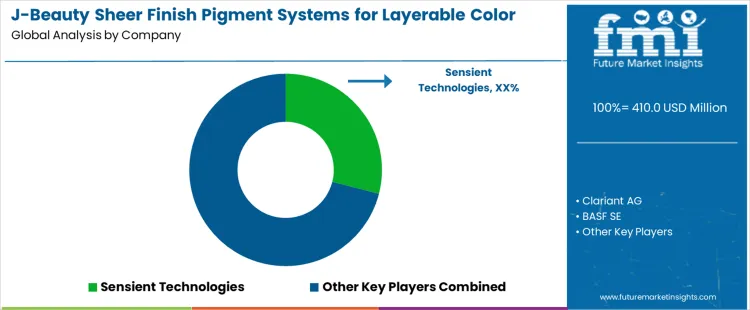
Sensient Technologies holds leading positioning through sheer pigment dispersions and optical color systems engineered for controlled layering and natural skin finish. Clariant AG supplies cosmetic pigment technologies optimized for translucency and stability in lightweight, buildable formulations. BASF SE contributes pigment platforms and formulation support enabling precise tone modulation and consistency across multiple application layers. DSM-Firmenich supports demand through color science expertise and sensory optimization aligned with refined aesthetic standards. Sun Chemical, part of DIC Group, provides scalable sheer pigment dispersions with consistent performance for global brands adopting J-Beauty inspired product architectures. Competitive differentiation depends on optical precision, dispersion control at low dosage, regulatory readiness, and ability to support subtle shade systems across regions.
Key Players in the J-Beauty Sheer Finish Pigment Systems for Layerable Color Cosmetics Market
- Sensient Technologies
- Clariant AG
- BASF SE
- DSM-Firmenich
- Sun Chemical (DIC Group)
Scope of the Report
| Items | Values |
|---|---|
| Quantitative Units | USD million |
| Pigment System Type | Ultra-Transparent Mineral Pigments; Soft-Focus Organic Pigments; Surface-Treated Sheer Coverage Pigments; Encapsulated Buildable Color Pigments |
| Layering Performance Attribute | Low-Opacity Buildable Color Systems; Even Dispersion for Multiple Layers; Non-Caking & Feather-Light Texture; Color Stability Across Layers |
| Application | Layerable Foundations & BB Creams; Sheer Cream Blush & Tints; Natural-Finish Eye Makeup; Minimalist Daily Makeup Products |
| Regions Covered | Asia Pacific, Europe, North America, Latin America, Middle East & Africa |
| Countries Covered | Japan, India, China, South Korea, USA, and 40+ countries |
| Key Companies Profiled | Sensient Technologies; Clariant AG; BASF SE; DSM-Firmenich; Sun Chemical (DIC Group) |
| Additional Attributes | Dollar sales by pigment system type and layering performance attribute; adoption trends for sheer, low-opacity pigments enabling controlled buildability in J-beauty formats; dispersion uniformity, layer adhesion, and color stability metrics across repeated applications; compatibility with lightweight emulsions, creams, and gels; texture perception, caking resistance, and feather-light sensory outcomes; cosmetic regulatory compliance and clean-label standards influencing sheer finish pigment system selection. |
J-Beauty Sheer Finish Pigment Systems for Layerable Color Cosmetics Market by Segment
Pigment System Type:
- Ultra-Transparent Mineral Pigments
- Soft-Focus Organic Pigments
- Surface-Treated Sheer Coverage Pigments
- Encapsulated Buildable Color Pigments
Layering Performance Attribute:
- Low-Opacity Buildable Color Systems
- Even Dispersion for Multiple Layers
- Non-Caking & Feather-Light Texture
- Color Stability Across Layers
Application:
- Layerable Foundations & BB Creams
- Sheer Cream Blush & Tints
- Natural-Finish Eye Makeup
- Minimalist Daily Makeup Products
Region:
- Asia Pacific
- China
- Japan
- South Korea
- India
- Australia & New Zealand
- ASEAN
- Rest of Asia Pacific
- Europe
- Germany
- United Kingdom
- France
- Italy
- Spain
- Nordic
- BENELUX
- Rest of Europe
- North America
- United States
- Canada
- Mexico
- Latin America
- Brazil
- Chile
- Rest of Latin America
- Middle East & Africa
- Kingdom of Saudi Arabia
- Other GCC Countries
- Turkey
- South Africa
- Other African Union
- Rest of Middle East & Africa
Frequently Asked Questions
How big is the j-beauty sheer finish pigment systems for layerable color cosmetics market in 2026?
The global j-beauty sheer finish pigment systems for layerable color cosmetics market is estimated to be valued at USD 410.0 million in 2026.
What will be the size of j-beauty sheer finish pigment systems for layerable color cosmetics market in 2036?
The market size for the j-beauty sheer finish pigment systems for layerable color cosmetics market is projected to reach USD 1,082.9 million by 2036.
How much will be the j-beauty sheer finish pigment systems for layerable color cosmetics market growth between 2026 and 2036?
The j-beauty sheer finish pigment systems for layerable color cosmetics market is expected to grow at a 10.2% CAGR between 2026 and 2036.
What are the key pigment system types in the j-beauty sheer finish pigment systems for layerable color cosmetics market?
The key pigment system types in j-beauty sheer finish pigment systems for layerable color cosmetics market are ultra-transparent mineral pigments, soft-focus organic pigments, surface-treated sheer coverage pigments and encapsulated buildable color pigments.
Which layering performance attribute segment will contribute significant share in the j-beauty sheer finish pigment systems for layerable color cosmetics market in 2026?
In terms of layering performance attribute, low-opacity buildable color systems segment to command 38.0% share in the j-beauty sheer finish pigment systems for layerable color cosmetics market in 2026.
Preview the report firsthand - request a free sample
Get SampleGet the brochure for pricing and purchase details.
Get PDFTable of Content
- Executive Summary
- Global Market Outlook
- Demand-side Trends
- Supply-side Trends
- Technology Roadmap Analysis
- Analysis and Recommendations
- Market Overview
- Market Coverage / Taxonomy
- Market Definition / Scope / Limitations
- Market Background
- Market Dynamics
- Drivers
- Restraints
- Opportunity
- Trends
- Scenario Forecast
- Demand in Optimistic Scenario
- Demand in Likely Scenario
- Demand in Conservative Scenario
- Opportunity Map Analysis
- Product Life Cycle Analysis
- Supply Chain Analysis
- Investment Feasibility Matrix
- Value Chain Analysis
- PESTLE and Porter’s Analysis
- Regulatory Landscape
- Regional Parent Market Outlook
- Production and Consumption Statistics
- Import and Export Statistics
- Market Dynamics
- Global Market Analysis 2021 to 2025 and Forecast, 2026 to 2036
- Historical Market Size Value (USD Million) Analysis, 2021 to 2025
- Current and Future Market Size Value (USD Million) Projections, 2026 to 2036
- Y-o-Y Growth Trend Analysis
- Absolute $ Opportunity Analysis
- Global Market Pricing Analysis 2021 to 2025 and Forecast 2026 to 2036
- Global Market Analysis 2021 to 2025 and Forecast 2026 to 2036, By Pigment System Type
- Introduction / Key Findings
- Historical Market Size Value (USD Million) Analysis By Pigment System Type , 2021 to 2025
- Current and Future Market Size Value (USD Million) Analysis and Forecast By Pigment System Type , 2026 to 2036
- Ultra-Transparent Mineral Pigments
- Soft-Focus Organic Pigments
- Surface-Treated Sheer Coverage Pigments
- Encapsulated Buildable Color Pigments
- Ultra-Transparent Mineral Pigments
- Y-o-Y Growth Trend Analysis By Pigment System Type , 2021 to 2025
- Absolute $ Opportunity Analysis By Pigment System Type , 2026 to 2036
- Global Market Analysis 2021 to 2025 and Forecast 2026 to 2036, By Layering Performance Attribute
- Introduction / Key Findings
- Historical Market Size Value (USD Million) Analysis By Layering Performance Attribute, 2021 to 2025
- Current and Future Market Size Value (USD Million) Analysis and Forecast By Layering Performance Attribute, 2026 to 2036
- Low-Opacity Buildable Color Systems
- Even Dispersion for Multiple Layers
- Non-Caking & Feather-Light Texture
- Color Stability Across Layers
- Low-Opacity Buildable Color Systems
- Y-o-Y Growth Trend Analysis By Layering Performance Attribute, 2021 to 2025
- Absolute $ Opportunity Analysis By Layering Performance Attribute, 2026 to 2036
- Global Market Analysis 2021 to 2025 and Forecast 2026 to 2036, By Application
- Introduction / Key Findings
- Historical Market Size Value (USD Million) Analysis By Application, 2021 to 2025
- Current and Future Market Size Value (USD Million) Analysis and Forecast By Application, 2026 to 2036
- Layerable Foundations & BB Creams
- Sheer Cream Blush & Tints
- Natural-Finish Eye Makeup
- Minimalist Daily Makeup Products
- Layerable Foundations & BB Creams
- Y-o-Y Growth Trend Analysis By Application, 2021 to 2025
- Absolute $ Opportunity Analysis By Application, 2026 to 2036
- Global Market Analysis 2021 to 2025 and Forecast 2026 to 2036, By Region
- Introduction
- Historical Market Size Value (USD Million) Analysis By Region, 2021 to 2025
- Current Market Size Value (USD Million) Analysis and Forecast By Region, 2026 to 2036
- North America
- Latin America
- Western Europe
- Eastern Europe
- East Asia
- South Asia and Pacific
- Middle East & Africa
- Market Attractiveness Analysis By Region
- North America Market Analysis 2021 to 2025 and Forecast 2026 to 2036, By Country
- Historical Market Size Value (USD Million) Trend Analysis By Market Taxonomy, 2021 to 2025
- Market Size Value (USD Million) Forecast By Market Taxonomy, 2026 to 2036
- By Country
- USA
- Canada
- Mexico
- By Pigment System Type
- By Layering Performance Attribute
- By Application
- By Country
- Market Attractiveness Analysis
- By Country
- By Pigment System Type
- By Layering Performance Attribute
- By Application
- Key Takeaways
- Latin America Market Analysis 2021 to 2025 and Forecast 2026 to 2036, By Country
- Historical Market Size Value (USD Million) Trend Analysis By Market Taxonomy, 2021 to 2025
- Market Size Value (USD Million) Forecast By Market Taxonomy, 2026 to 2036
- By Country
- Brazil
- Chile
- Rest of Latin America
- By Pigment System Type
- By Layering Performance Attribute
- By Application
- By Country
- Market Attractiveness Analysis
- By Country
- By Pigment System Type
- By Layering Performance Attribute
- By Application
- Key Takeaways
- Western Europe Market Analysis 2021 to 2025 and Forecast 2026 to 2036, By Country
- Historical Market Size Value (USD Million) Trend Analysis By Market Taxonomy, 2021 to 2025
- Market Size Value (USD Million) Forecast By Market Taxonomy, 2026 to 2036
- By Country
- Germany
- UK
- Italy
- Spain
- France
- Nordic
- BENELUX
- Rest of Western Europe
- By Pigment System Type
- By Layering Performance Attribute
- By Application
- By Country
- Market Attractiveness Analysis
- By Country
- By Pigment System Type
- By Layering Performance Attribute
- By Application
- Key Takeaways
- Eastern Europe Market Analysis 2021 to 2025 and Forecast 2026 to 2036, By Country
- Historical Market Size Value (USD Million) Trend Analysis By Market Taxonomy, 2021 to 2025
- Market Size Value (USD Million) Forecast By Market Taxonomy, 2026 to 2036
- By Country
- Russia
- Poland
- Hungary
- Balkan & Baltic
- Rest of Eastern Europe
- By Pigment System Type
- By Layering Performance Attribute
- By Application
- By Country
- Market Attractiveness Analysis
- By Country
- By Pigment System Type
- By Layering Performance Attribute
- By Application
- Key Takeaways
- East Asia Market Analysis 2021 to 2025 and Forecast 2026 to 2036, By Country
- Historical Market Size Value (USD Million) Trend Analysis By Market Taxonomy, 2021 to 2025
- Market Size Value (USD Million) Forecast By Market Taxonomy, 2026 to 2036
- By Country
- China
- Japan
- South Korea
- By Pigment System Type
- By Layering Performance Attribute
- By Application
- By Country
- Market Attractiveness Analysis
- By Country
- By Pigment System Type
- By Layering Performance Attribute
- By Application
- Key Takeaways
- South Asia and Pacific Market Analysis 2021 to 2025 and Forecast 2026 to 2036, By Country
- Historical Market Size Value (USD Million) Trend Analysis By Market Taxonomy, 2021 to 2025
- Market Size Value (USD Million) Forecast By Market Taxonomy, 2026 to 2036
- By Country
- India
- ASEAN
- Australia & New Zealand
- Rest of South Asia and Pacific
- By Pigment System Type
- By Layering Performance Attribute
- By Application
- By Country
- Market Attractiveness Analysis
- By Country
- By Pigment System Type
- By Layering Performance Attribute
- By Application
- Key Takeaways
- Middle East & Africa Market Analysis 2021 to 2025 and Forecast 2026 to 2036, By Country
- Historical Market Size Value (USD Million) Trend Analysis By Market Taxonomy, 2021 to 2025
- Market Size Value (USD Million) Forecast By Market Taxonomy, 2026 to 2036
- By Country
- Kingdom of Saudi Arabia
- Other GCC Countries
- Turkiye
- South Africa
- Other African Union
- Rest of Middle East & Africa
- By Pigment System Type
- By Layering Performance Attribute
- By Application
- By Country
- Market Attractiveness Analysis
- By Country
- By Pigment System Type
- By Layering Performance Attribute
- By Application
- Key Takeaways
- Key Countries Market Analysis
- USA
- Pricing Analysis
- Market Share Analysis, 2025
- By Pigment System Type
- By Layering Performance Attribute
- By Application
- Canada
- Pricing Analysis
- Market Share Analysis, 2025
- By Pigment System Type
- By Layering Performance Attribute
- By Application
- Mexico
- Pricing Analysis
- Market Share Analysis, 2025
- By Pigment System Type
- By Layering Performance Attribute
- By Application
- Brazil
- Pricing Analysis
- Market Share Analysis, 2025
- By Pigment System Type
- By Layering Performance Attribute
- By Application
- Chile
- Pricing Analysis
- Market Share Analysis, 2025
- By Pigment System Type
- By Layering Performance Attribute
- By Application
- Germany
- Pricing Analysis
- Market Share Analysis, 2025
- By Pigment System Type
- By Layering Performance Attribute
- By Application
- UK
- Pricing Analysis
- Market Share Analysis, 2025
- By Pigment System Type
- By Layering Performance Attribute
- By Application
- Italy
- Pricing Analysis
- Market Share Analysis, 2025
- By Pigment System Type
- By Layering Performance Attribute
- By Application
- Spain
- Pricing Analysis
- Market Share Analysis, 2025
- By Pigment System Type
- By Layering Performance Attribute
- By Application
- France
- Pricing Analysis
- Market Share Analysis, 2025
- By Pigment System Type
- By Layering Performance Attribute
- By Application
- India
- Pricing Analysis
- Market Share Analysis, 2025
- By Pigment System Type
- By Layering Performance Attribute
- By Application
- ASEAN
- Pricing Analysis
- Market Share Analysis, 2025
- By Pigment System Type
- By Layering Performance Attribute
- By Application
- Australia & New Zealand
- Pricing Analysis
- Market Share Analysis, 2025
- By Pigment System Type
- By Layering Performance Attribute
- By Application
- China
- Pricing Analysis
- Market Share Analysis, 2025
- By Pigment System Type
- By Layering Performance Attribute
- By Application
- Japan
- Pricing Analysis
- Market Share Analysis, 2025
- By Pigment System Type
- By Layering Performance Attribute
- By Application
- South Korea
- Pricing Analysis
- Market Share Analysis, 2025
- By Pigment System Type
- By Layering Performance Attribute
- By Application
- Russia
- Pricing Analysis
- Market Share Analysis, 2025
- By Pigment System Type
- By Layering Performance Attribute
- By Application
- Poland
- Pricing Analysis
- Market Share Analysis, 2025
- By Pigment System Type
- By Layering Performance Attribute
- By Application
- Hungary
- Pricing Analysis
- Market Share Analysis, 2025
- By Pigment System Type
- By Layering Performance Attribute
- By Application
- Kingdom of Saudi Arabia
- Pricing Analysis
- Market Share Analysis, 2025
- By Pigment System Type
- By Layering Performance Attribute
- By Application
- Turkiye
- Pricing Analysis
- Market Share Analysis, 2025
- By Pigment System Type
- By Layering Performance Attribute
- By Application
- South Africa
- Pricing Analysis
- Market Share Analysis, 2025
- By Pigment System Type
- By Layering Performance Attribute
- By Application
- USA
- Market Structure Analysis
- Competition Dashboard
- Competition Benchmarking
- Market Share Analysis of Top Players
- By Regional
- By Pigment System Type
- By Layering Performance Attribute
- By Application
- Competition Analysis
- Competition Deep Dive
- Sensient Technologies
- Overview
- Product Portfolio
- Profitability by Market Segments (Product/Age /Sales Channel/Region)
- Sales Footprint
- Strategy Overview
- Marketing Strategy
- Product Strategy
- Channel Strategy
- Clariant AG
- BASF SE
- DSM-Firmenich
- Sun Chemical (DIC Group)
- Sensient Technologies
- Competition Deep Dive
- Assumptions & Acronyms Used
- Research Methodology


