

- Industry Size (2026)
- USD 520.0 Mn
- Forecast (2036)
- USD 1450.1 Mn
- CAGR (2026 to 2036)
- 10.8%
K-Beauty Dewy Finish Pigment Systems for Skin Tints and Cushions Market Forecast and Outlook 2026 to 2036
The K-Beauty dewy finish pigment systems for skin tints and cushions market is valued at USD 520.0 million in 2026 and is projected to reach USD 1,450.1 million by 2036, registering a CAGR of 10.8%. Expansion across this period reflects structural shifts in complexion formulation priorities rather than simple category volume growth. Dewy finishes require pigment systems that balance translucency, optical diffusion, and chromatic stability within water-rich, low-coverage matrices. Suppliers capturing value are those able to engineer ultra-fine particles with controlled refractive behavior that remain stable in cushion reservoirs and serum-like bases. Pricing power concentrates around pigments that reduce formulation trade-offs between glow, shade accuracy, and oxidation control. Margin concentration favors systems that integrate reliably with hydrating carriers, SPF components, and skin-conditioning additives without destabilizing finish or wear.
Quick Stats for K-Beauty Dewy Finish Pigment Systems for Skin Tints and Cushions Market
- K-Beauty Dewy Finish Pigment Systems for Skin Tints and Cushions Market Value (2026): USD 520.0 million
- K-Beauty Dewy Finish Pigment Systems for Skin Tints and Cushions Market Forecast Value (2036): USD 1,450.1 million
- Forecast CAGR (2026-2036): 10.8%
- Leading Pigment System Type in Global Demand: Ultra-Fine Hydrated Mineral Pigments
- Fastest-Growing Countries: South Korea, India, China, USA, Japan
- Key Players in Global Demand: Sensient Technologies, Clariant AG, BASF SE, DSM-Firmenich, Sun Chemical
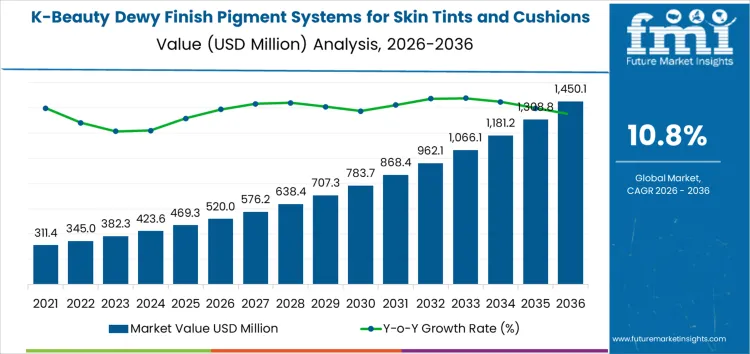
Demand dynamics are shaped by production and formulation constraints specific to K-Beauty influenced formats. Cushion compacts and skin tints impose limits on pigment load, dispersion tolerance, and pickup consistency, which narrows acceptable supplier options. Procurement decisions prioritize reproducibility, long-term dispersion stability, and compatibility with low-viscosity emulsions over visual novelty. Regulatory scrutiny on leave-on cosmetics further increases reliance on pigment systems with documented purity and predictable interaction profiles. Growth remains anchored in formulation risk reduction and performance consistency across high-volume launches. Commercial success depends on supplying pigments that maintain soft luminosity under repeated use while supporting scalable manufacturing and cross-regional compliance.
K-Beauty Dewy Finish Pigment Systems for Skin Tints and Cushions Market Key Takeaways
| Metric | Value |
|---|---|
| Market Value (2026) | USD 520.0 million |
| Market Forecast Value (2036) | USD 1,450.1 million |
| Forecast CAGR (2026-2036) | 10.8% |
Why is the Demand for K-Beauty Dewy Finish Pigment Systems for Skin Tints and Cushions Market Growing?
Demand for K-Beauty dewy finish pigment systems for skin tints and cushions is growing globally due to expanding consumer interest in luminous, skin-like makeup that balances aesthetic appeal with skincare benefits. K-Beauty influenced products emphasize hydrated, radiant finishes that mimic healthy skin, which increases reliance on pigment systems engineered to deliver soft luminosity, light diffusion, and seamless blendability. Cosmetic formulators integrate pigments with optimized reflectance, surface treatment, and microstructure that enhance dewy effects while maintaining stable color performance in skin tints, cushions, and lightweight foundations. Retail expansion of K-Beauty brands through specialty stores, mass market outlets, and digital channels increases accessibility for diverse consumer segments seeking radiant complexion products.
Regulatory frameworks in multiple regions emphasize safety, purity, and ingredient transparency for leave-on cosmetics, which reinforces formulation of pigment systems that meet stringent tolerance criteria while supporting desirable finish attributes. Advances in pigment dispersion, particle engineering, and combination with hydrating carriers improve compatibility with skincare-infused makeup formulations. Social media and influencer trends highlight luminous makeup looks, which elevates consumer awareness and preference for dewy finish products. Brand strategies that emphasize complexion enhancing, skincare hybrid benefits support continued adoption of K-Beauty dewy finish pigment systems across global skin tint and cushion portfolios.
How Is the K-Beauty Dewy Finish Pigment Systems for Skin Tints and Cushions Market Structured?
Demand for K-Beauty dewy finish pigment systems is driven by preference for hydrated appearance, light-reflective skin finish, and thin coverage layers. Formulators prioritize pigment fineness, optical diffusion, and compatibility with moisture-rich bases typical of cushion formats. Global demand reflects expansion of Korean-inspired complexion products where glow control, translucency, and skin-conditioning alignment determine pigment system selection across mass and premium beauty segments.
Which Pigment System Type Holds the Largest Share of Global Demand?
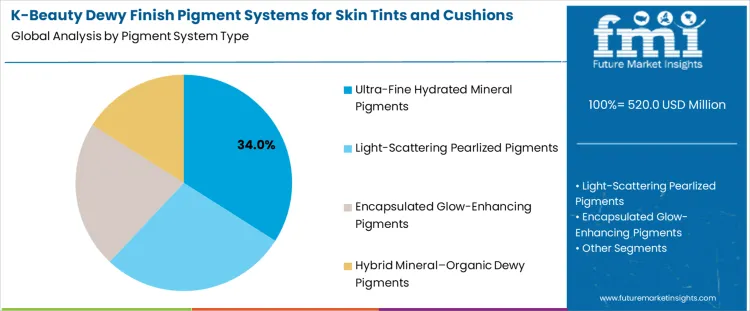
Ultra-fine hydrated mineral pigments hold 34.0%, representing the largest share of global demand. These pigments provide soft-focus diffusion and skin-like translucency while remaining stable in water-rich cushion formulations. Light-scattering pearlized pigments follow at 28.0%, supporting luminous finish and reflective glow associated with dewy aesthetics. Encapsulated glow-enhancing pigments account for 22.0%, improving radiance control and wear stability. Hybrid mineral-organic dewy pigments represent 16.0%, used where balanced glow and shade flexibility are required.
Key Points
- Hydrated mineral pigments lead due to translucency and water compatibility
- Pearlized systems enhance controlled light reflection
- Encapsulation improves glow durability and uniformity
Which Finish Engineering Approach Drives the Highest Global Demand?
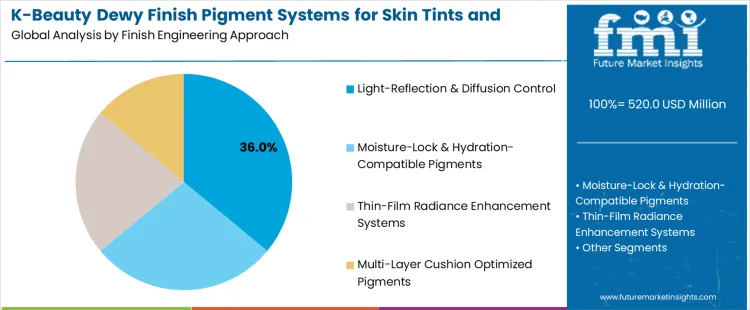
Light-reflection and diffusion control accounts for 36.0%, making it the leading finish engineering approach globally. Dewy complexion products rely on controlled optical scattering to create brightness without visible shimmer. Moisture-lock and hydration-compatible pigments follow at 28.0%, supporting prolonged comfort and skin-fresh appearance. Thin-film radiance enhancement systems represent 22.0%, enabling glow through minimal pigment layering. Multi-layer cushion optimized pigments hold 14.0%, addressing performance requirements specific to sponge-delivery formats.
Key Points
- Optical diffusion defines dewy finish performance
- Hydration compatibility supports extended wear comfort
- Thin-film systems maintain natural skin appearance
Which Application Segment Represents the Largest Share of Global Demand?
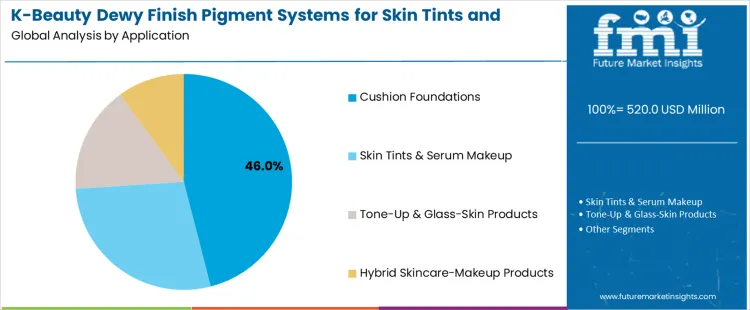
Cushion foundations account for 46.0%, making them the largest application segment globally. These products require pigments that disperse evenly, maintain glow, and remain stable in emulsion-saturated cushions. Skin tints and serum makeup follow at 28.0%, reflecting demand for lightweight, radiant coverage. Tone-up and glass-skin products represent 16.0%, emphasizing brightness and translucency. Hybrid skincare-makeup products hold 10.0%, integrating glow pigments with treatment-oriented formulations.
Key Points
- Cushion foundations dominate due to delivery-format requirements
- Skin tints favor lightweight radiant pigment systems
- Glass-skin products prioritize translucency and brightness
What are the Key Dynamics in the K-Beauty Dewy Finish Pigment Systems for Skin Tints and Cushions Market?
Global demand rises as cosmetic brands adopt K-Beauty dewy finish pigment systems that deliver luminous, hydrated appearance in skin tints and cushion compacts structured for natural glow. Dewy finish pigments enhance reflectance and dispersion qualities that complement light-diffusing and moisturizing bases. Adoption reflects sustained interest in K-Beauty trends emphasizing radiant, skin-like coverage and skincare integration within makeup. Usage spans foundations, cushion compacts, BB and CC formulations tailored to visible radiance and user comfort across varied global consumer segments.
How do beauty trend influences and performance expectations shape adoption?
Consumers worldwide increasingly seek complexion products that unify coverage with hydration and dewiness without looking heavy or cakey. K-Beauty dewy finish pigment systems provide subtle luminosity that softens texture and reflects light to create a youthful appearance. Cosmetic formulators integrate these systems with humectants, emollients, and light modulators to achieve consistent glow across skin tints and cushion products. Retailers highlight radiance and skin-friendly performance in product positioning to appeal to audiences influenced by Korean beauty culture, social media content, and dermatologist guidance. Performance criteria include balance of sheen without excessive greasiness, compatibility with diverse skin tones, and retention of dewiness under varied environmental conditions.
How do formulation complexity, cost factors, and regulatory requirements influence market scalability?
Dewy finish pigment systems require careful engineering of particle size, refractive index, and surface treatment to achieve hydration-enhancing effects without sacrificing wear or stability. Specialized pigments and associated additives often carry higher raw material cost relative to matte or standard systems. Formulators must optimize integration with base matrices that include moisture-binding components while preserving product longevity and minimizing slip. Regulatory frameworks in major markets enforce safety, purity, and labeling accuracy for cosmetic colorants, influencing pigment choice and documentation practices for global distribution. Supply chain variability in high-performance pigment availability affects planning and cost stability. Long-term growth depends on continued innovation in luminous pigment technology, harmonized safety standards, and formulation support that delivers consistent dewiness and broad shade compatibility in skin tints and cushion products worldwide.
How Is Demand for K-Beauty Dewy Finish Pigment Systems for Skin Tints and Cushions Evolving?
Demand for K-Beauty dewy finish pigment systems for skin tints and cushions is increasing globally due to preference for hydrated appearance, lightweight coverage, and skincare-infused makeup formats. South Korea leads with an 11.6% CAGR, supported by continuous innovation in cushion technology and dewy aesthetics. India follows at 11.2%, driven by rapid adoption of skin tint routines and climate-suited glow finishes. China records 10.9%, reflecting scale manufacturing and strong uptake of K-Beauty trends. USA posts a 10.4% CAGR, shaped by hybrid skincare makeup demand. Japan records 10.1%, supported by minimalist beauty preferences and refined base makeup standards. Growth reflects global convergence toward luminous, skin-comfort-first complexion products.
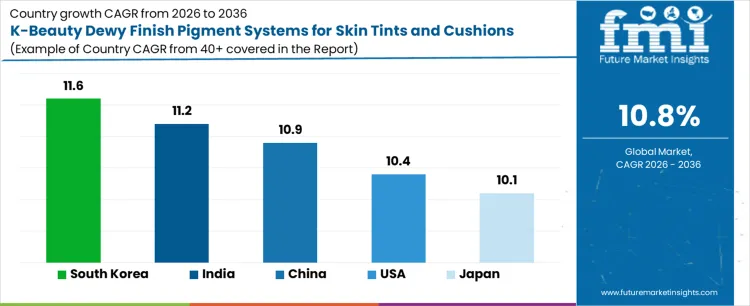
| Country | CAGR (%) |
|---|---|
| South Korea | 11.6% |
| India | 11.2% |
| China | 10.9% |
| USA | 10.4% |
| Japan | 10.1% |
What factors are driving strong adoption of dewy finish pigment systems in South Korea?
South Korea demand is driven by leadership in cushion foundation innovation and cultural preference for luminous skin aesthetics. CAGR of 11.6% reflects advanced pigment engineering that delivers translucency, light diffusion, and hydration-compatible performance. Brands integrate ultra-fine pigments with emollient systems to achieve uniform glow without heaviness. Rapid trend cycles and frequent product launches sustain demand. Export-oriented brands align formulations with global skin tint expectations. Growth remains technology-led and trend-driven, aligned with South Korea’s role as originator of dewy complexion standards.
- Leadership in cushion and skin tint innovation
- Preference for luminous and hydrated skin finish
- Advanced light-diffusing pigment engineering
- Export-driven formulation alignment
How is India sustaining high growth in dewy pigment system adoption?
India demand reflects growing preference for skin tints offering glow and breathability under warm climates. CAGR of 11.2% is supported by adoption of dewy finish pigments that balance radiance with lightweight feel. Consumers favor hybrid products combining makeup and skincare benefits. Domestic brands expand cushion and tint portfolios across mass and premium segments. Export-oriented manufacturers align pigment systems with global K-Beauty-inspired aesthetics. Growth remains consumption-led and formulation-driven, aligned with climate conditions and evolving beauty routines.
- Rising adoption of skin tints and glow finishes
- Climate-driven need for lightweight radiance
- Expansion of hybrid skincare makeup products
- Alignment with global K-Beauty aesthetics
What supports China’s strong growth in dewy finish pigment usage?
China demand reflects large-scale cosmetics manufacturing and strong consumer engagement with K-Beauty trends. CAGR of 10.9% is supported by integration of dewy pigments into cushions, liquid tints, and tone-up products. Brands emphasize glow consistency and smooth skin appearance. E-commerce platforms accelerate adoption of luminous complexion claims. Domestic pigment suppliers invest in dispersion stability and particle size optimization. Growth remains scale-driven and innovation-aligned, supported by fast product cycles and trend responsiveness.
- High demand for luminous complexion products
- Integration into cushion and liquid formats
- E-commerce-driven trend acceleration
- Investment in pigment dispersion technology
What factors shape demand growth in the USA for dewy finish pigment systems?
USA demand is shaped by preference for natural glow, skincare makeup convergence, and ingredient transparency. CAGR of 10.4% reflects reformulation of foundations and skin tints toward dewy finishes without greasy feel. Brands emphasize hydration, comfort, and light coverage. Retailers support products offering visible radiance with clean formulation positioning. Professional and mass-market brands adopt cushion-inspired textures. Growth remains brand-led and compliance-focused, aligned with wellness-oriented beauty consumption.
- Preference for natural glow over matte finishes
- Convergence of skincare and makeup routines
- Retail support for clean and luminous products
- Adoption of cushion-inspired textures
Why is Japan showing steady growth in dewy finish pigment systems?
Japan demand reflects minimalist beauty preferences and emphasis on refined skin appearance. CAGR of 10.1% is supported by use of dewy pigments delivering subtle luminosity without excessive shine. Brands prioritize smooth texture, even tone, and skin comfort. Regulatory alignment and quality standards influence pigment selection. Cushion and tint products adopt controlled glow formulations suitable for daily wear. Growth remains quality-driven and formulation-focused, supported by strong consumer trust in understated complexion enhancement.
- Preference for subtle and controlled luminosity
- Emphasis on skin comfort and smooth texture
- Adoption in daily-use cushion and tint products
- Strong quality and formulation standards
What is the competitive landscape of demand for K-Beauty dewy finish pigment systems for skin tints and cushion products?
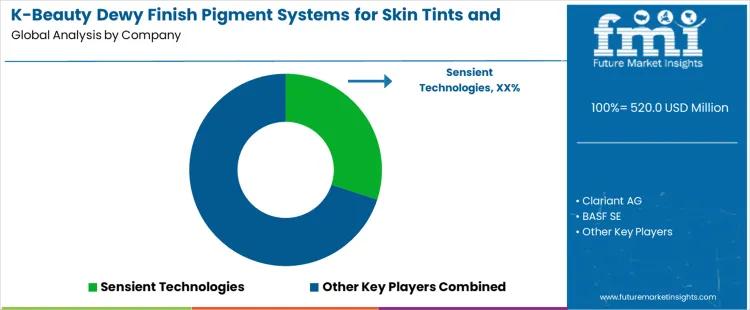
Demand for K-Beauty dewy finish pigment systems for skin tints and cushions is driven by preference for luminous skin appearance, lightweight coverage, and layered hydration aesthetics. These systems require pigments with high transparency, controlled light diffusion, and seamless integration with emollients, humectants, and SPF components common in cushion formats. Buyers evaluate dispersion stability, shade clarity, oxidation resistance, and performance under repeated tapping application. Procurement teams prioritize suppliers with proven expertise in Asian formulation styles, compatibility with low-viscosity emulsions, and compliance with global cosmetic safety standards. Trend in the global market reflects continued influence of Korean beauty routines, growth of cushion foundations outside Asia, and demand for breathable, skin-like complexion products.
Sensient Technologies maintains leading positioning through pigment dispersions engineered for dewy optical effects and cushion-compatible rheology. Clariant AG supplies cosmetic pigment systems optimized for translucency and smooth skin feel aligned with K-Beauty aesthetics. BASF SE contributes pigment technologies and formulation support enabling glow enhancement and color stability in skin tints. DSM-Firmenich supports demand through color science and sensory expertise relevant to hydration-focused complexion products. Sun Chemical, part of DIC Group, provides scalable pigment dispersions with consistent batch performance for global cushion and skin tint launches. Competitive differentiation depends on optical softness, dispersion performance, oxidation control, and ability to support high-volume cushion manufacturing.
Key Players in the K-Beauty Dewy Finish Pigment Systems for Skin Tints and Cushions Market
- Sensient Technologies
- Clariant AG
- BASF SE
- DSM-Firmenich
- Sun Chemical (DIC Group)
Scope of the Report
| Items | Values |
|---|---|
| Quantitative Units | USD million |
| Pigment System Type | Ultra-Fine Hydrated Mineral Pigments; Light-Scattering Pearlized Pigments; Encapsulated Glow-Enhancing Pigments; Hybrid Mineral–Organic Dewy Pigments |
| Finish Engineering Approach | Light-Reflection & Diffusion Control; Moisture-Lock & Hydration-Compatible Pigments; Thin-Film Radiance Enhancement Systems; Multi-Layer Cushion Optimized Pigments |
| Application | Cushion Foundations; Skin Tints & Serum Makeup; Tone-Up & Glass-Skin Products; Hybrid Skincare-Makeup Products |
| Regions Covered | Asia Pacific, Europe, North America, Latin America, Middle East & Africa |
| Countries Covered | South Korea, India, China, USA, Japan, and 40+ countries |
| Key Companies Profiled | Sensient Technologies; Clariant AG; BASF SE; DSM-Firmenich; Sun Chemical (DIC Group) |
| Additional Attributes | Dollar sales by pigment system type and finish engineering approach; adoption trends for dewy and glass-skin pigment technologies in cushion and skin tint formats; light diffusion, gloss retention, and hydration compatibility performance metrics; compatibility with cushion sponge delivery systems and serum-based formulations; film uniformity, pickup consistency, and oxidation resistance considerations; cosmetic regulatory compliance and clean-label standards influencing K-beauty dewy pigment system selection. |
K-Beauty Dewy Finish Pigment Systems for Skin Tints and Cushions Market by Segment
Pigment System Type:
- Ultra-Fine Hydrated Mineral Pigments
- Light-Scattering Pearlized Pigments
- Encapsulated Glow-Enhancing Pigments
- Hybrid Mineral–Organic Dewy Pigments
Finish Engineering Approach:
- Light-Reflection & Diffusion Control
- Moisture-Lock & Hydration-Compatible Pigments
- Thin-Film Radiance Enhancement Systems
- Multi-Layer Cushion Optimized Pigments
Application:
- Cushion Foundations
- Skin Tints & Serum Makeup
- Tone-Up & Glass-Skin Products
- Hybrid Skincare-Makeup Products
Region:
- Asia Pacific
- China
- Japan
- South Korea
- India
- Australia & New Zealand
- ASEAN
- Rest of Asia Pacific
- Europe
- Germany
- United Kingdom
- France
- Italy
- Spain
- Nordic
- BENELUX
- Rest of Europe
- North America
- United States
- Canada
- Mexico
- Latin America
- Brazil
- Chile
- Rest of Latin America
- Middle East & Africa
- Kingdom of Saudi Arabia
- Other GCC Countries
- Turkey
- South Africa
- Other African Union
- Rest of Middle East & Africa
Frequently Asked Questions
How big is the K-beauty dewy finish pigment systems for skin tints and cushions market in 2026?
The global K-beauty dewy finish pigment systems for skin tints and cushions market is estimated to be valued at USD 520.0 million in 2026.
What will be the size of K-beauty dewy finish pigment systems for skin tints and cushions market in 2036?
The market size for the K-beauty dewy finish pigment systems for skin tints and cushions market is projected to reach USD 1,450.1 million by 2036.
How much will be the K-beauty dewy finish pigment systems for skin tints and cushions market growth between 2026 and 2036?
The K-beauty dewy finish pigment systems for skin tints and cushions market is expected to grow at a 10.8% CAGR between 2026 and 2036.
What are the key pigment system types in the K-beauty dewy finish pigment systems for skin tints and cushions market?
The key pigment system types in K-beauty dewy finish pigment systems for skin tints and cushions market are ultra-fine hydrated mineral pigments, light-scattering pearlized pigments, encapsulated glow-enhancing pigments and hybrid mineral–organic dewy pigments.
Which finish engineering approach segment will contribute significant share in the K-beauty dewy finish pigment systems for skin tints and cushions market in 2026?
In terms of finish engineering approach, light-reflection & diffusion control segment to command 36.0% share in the K-beauty dewy finish pigment systems for skin tints and cushions market in 2026.
Preview the report firsthand - request a free sample
Get SampleGet the brochure for pricing and purchase details.
Get PDFTable of Content
- Executive Summary
- Global Market Outlook
- Demand-side Trends
- Supply-side Trends
- Technology Roadmap Analysis
- Analysis and Recommendations
- Market Overview
- Market Coverage / Taxonomy
- Market Definition / Scope / Limitations
- Market Background
- Market Dynamics
- Drivers
- Restraints
- Opportunity
- Trends
- Scenario Forecast
- Demand in Optimistic Scenario
- Demand in Likely Scenario
- Demand in Conservative Scenario
- Opportunity Map Analysis
- Product Life Cycle Analysis
- Supply Chain Analysis
- Investment Feasibility Matrix
- Value Chain Analysis
- PESTLE and Porter’s Analysis
- Regulatory Landscape
- Regional Parent Market Outlook
- Production and Consumption Statistics
- Import and Export Statistics
- Market Dynamics
- Global Market Analysis 2021 to 2025 and Forecast, 2026 to 2036
- Historical Market Size Value (USD Million) Analysis, 2021 to 2025
- Current and Future Market Size Value (USD Million) Projections, 2026 to 2036
- Y-o-Y Growth Trend Analysis
- Absolute $ Opportunity Analysis
- Global Market Pricing Analysis 2021 to 2025 and Forecast 2026 to 2036
- Global Market Analysis 2021 to 2025 and Forecast 2026 to 2036, By Pigment System Type
- Introduction / Key Findings
- Historical Market Size Value (USD Million) Analysis By Pigment System Type , 2021 to 2025
- Current and Future Market Size Value (USD Million) Analysis and Forecast By Pigment System Type , 2026 to 2036
- Ultra-Fine Hydrated Mineral Pigments
- Light-Scattering Pearlized Pigments
- Encapsulated Glow-Enhancing Pigments
- Hybrid Mineral–Organic Dewy Pigments
- Ultra-Fine Hydrated Mineral Pigments
- Y-o-Y Growth Trend Analysis By Pigment System Type , 2021 to 2025
- Absolute $ Opportunity Analysis By Pigment System Type , 2026 to 2036
- Global Market Analysis 2021 to 2025 and Forecast 2026 to 2036, By Finish Engineering Approach
- Introduction / Key Findings
- Historical Market Size Value (USD Million) Analysis By Finish Engineering Approach, 2021 to 2025
- Current and Future Market Size Value (USD Million) Analysis and Forecast By Finish Engineering Approach, 2026 to 2036
- Light-Reflection & Diffusion Control
- Moisture-Lock & Hydration-Compatible Pigments
- Thin-Film Radiance Enhancement Systems
- Multi-Layer Cushion Optimized Pigments
- Light-Reflection & Diffusion Control
- Y-o-Y Growth Trend Analysis By Finish Engineering Approach, 2021 to 2025
- Absolute $ Opportunity Analysis By Finish Engineering Approach, 2026 to 2036
- Global Market Analysis 2021 to 2025 and Forecast 2026 to 2036, By Application
- Introduction / Key Findings
- Historical Market Size Value (USD Million) Analysis By Application, 2021 to 2025
- Current and Future Market Size Value (USD Million) Analysis and Forecast By Application, 2026 to 2036
- Cushion Foundations
- Skin Tints & Serum Makeup
- Tone-Up & Glass-Skin Products
- Hybrid Skincare-Makeup Products
- Cushion Foundations
- Y-o-Y Growth Trend Analysis By Application, 2021 to 2025
- Absolute $ Opportunity Analysis By Application, 2026 to 2036
- Global Market Analysis 2021 to 2025 and Forecast 2026 to 2036, By Region
- Introduction
- Historical Market Size Value (USD Million) Analysis By Region, 2021 to 2025
- Current Market Size Value (USD Million) Analysis and Forecast By Region, 2026 to 2036
- North America
- Latin America
- Western Europe
- Eastern Europe
- East Asia
- South Asia and Pacific
- Middle East & Africa
- Market Attractiveness Analysis By Region
- North America Market Analysis 2021 to 2025 and Forecast 2026 to 2036, By Country
- Historical Market Size Value (USD Million) Trend Analysis By Market Taxonomy, 2021 to 2025
- Market Size Value (USD Million) Forecast By Market Taxonomy, 2026 to 2036
- By Country
- USA
- Canada
- Mexico
- By Pigment System Type
- By Finish Engineering Approach
- By Application
- By Country
- Market Attractiveness Analysis
- By Country
- By Pigment System Type
- By Finish Engineering Approach
- By Application
- Key Takeaways
- Latin America Market Analysis 2021 to 2025 and Forecast 2026 to 2036, By Country
- Historical Market Size Value (USD Million) Trend Analysis By Market Taxonomy, 2021 to 2025
- Market Size Value (USD Million) Forecast By Market Taxonomy, 2026 to 2036
- By Country
- Brazil
- Chile
- Rest of Latin America
- By Pigment System Type
- By Finish Engineering Approach
- By Application
- By Country
- Market Attractiveness Analysis
- By Country
- By Pigment System Type
- By Finish Engineering Approach
- By Application
- Key Takeaways
- Western Europe Market Analysis 2021 to 2025 and Forecast 2026 to 2036, By Country
- Historical Market Size Value (USD Million) Trend Analysis By Market Taxonomy, 2021 to 2025
- Market Size Value (USD Million) Forecast By Market Taxonomy, 2026 to 2036
- By Country
- Germany
- UK
- Italy
- Spain
- France
- Nordic
- BENELUX
- Rest of Western Europe
- By Pigment System Type
- By Finish Engineering Approach
- By Application
- By Country
- Market Attractiveness Analysis
- By Country
- By Pigment System Type
- By Finish Engineering Approach
- By Application
- Key Takeaways
- Eastern Europe Market Analysis 2021 to 2025 and Forecast 2026 to 2036, By Country
- Historical Market Size Value (USD Million) Trend Analysis By Market Taxonomy, 2021 to 2025
- Market Size Value (USD Million) Forecast By Market Taxonomy, 2026 to 2036
- By Country
- Russia
- Poland
- Hungary
- Balkan & Baltic
- Rest of Eastern Europe
- By Pigment System Type
- By Finish Engineering Approach
- By Application
- By Country
- Market Attractiveness Analysis
- By Country
- By Pigment System Type
- By Finish Engineering Approach
- By Application
- Key Takeaways
- East Asia Market Analysis 2021 to 2025 and Forecast 2026 to 2036, By Country
- Historical Market Size Value (USD Million) Trend Analysis By Market Taxonomy, 2021 to 2025
- Market Size Value (USD Million) Forecast By Market Taxonomy, 2026 to 2036
- By Country
- China
- Japan
- South Korea
- By Pigment System Type
- By Finish Engineering Approach
- By Application
- By Country
- Market Attractiveness Analysis
- By Country
- By Pigment System Type
- By Finish Engineering Approach
- By Application
- Key Takeaways
- South Asia and Pacific Market Analysis 2021 to 2025 and Forecast 2026 to 2036, By Country
- Historical Market Size Value (USD Million) Trend Analysis By Market Taxonomy, 2021 to 2025
- Market Size Value (USD Million) Forecast By Market Taxonomy, 2026 to 2036
- By Country
- India
- ASEAN
- Australia & New Zealand
- Rest of South Asia and Pacific
- By Pigment System Type
- By Finish Engineering Approach
- By Application
- By Country
- Market Attractiveness Analysis
- By Country
- By Pigment System Type
- By Finish Engineering Approach
- By Application
- Key Takeaways
- Middle East & Africa Market Analysis 2021 to 2025 and Forecast 2026 to 2036, By Country
- Historical Market Size Value (USD Million) Trend Analysis By Market Taxonomy, 2021 to 2025
- Market Size Value (USD Million) Forecast By Market Taxonomy, 2026 to 2036
- By Country
- Kingdom of Saudi Arabia
- Other GCC Countries
- Turkiye
- South Africa
- Other African Union
- Rest of Middle East & Africa
- By Pigment System Type
- By Finish Engineering Approach
- By Application
- By Country
- Market Attractiveness Analysis
- By Country
- By Pigment System Type
- By Finish Engineering Approach
- By Application
- Key Takeaways
- Key Countries Market Analysis
- USA
- Pricing Analysis
- Market Share Analysis, 2025
- By Pigment System Type
- By Finish Engineering Approach
- By Application
- Canada
- Pricing Analysis
- Market Share Analysis, 2025
- By Pigment System Type
- By Finish Engineering Approach
- By Application
- Mexico
- Pricing Analysis
- Market Share Analysis, 2025
- By Pigment System Type
- By Finish Engineering Approach
- By Application
- Brazil
- Pricing Analysis
- Market Share Analysis, 2025
- By Pigment System Type
- By Finish Engineering Approach
- By Application
- Chile
- Pricing Analysis
- Market Share Analysis, 2025
- By Pigment System Type
- By Finish Engineering Approach
- By Application
- Germany
- Pricing Analysis
- Market Share Analysis, 2025
- By Pigment System Type
- By Finish Engineering Approach
- By Application
- UK
- Pricing Analysis
- Market Share Analysis, 2025
- By Pigment System Type
- By Finish Engineering Approach
- By Application
- Italy
- Pricing Analysis
- Market Share Analysis, 2025
- By Pigment System Type
- By Finish Engineering Approach
- By Application
- Spain
- Pricing Analysis
- Market Share Analysis, 2025
- By Pigment System Type
- By Finish Engineering Approach
- By Application
- France
- Pricing Analysis
- Market Share Analysis, 2025
- By Pigment System Type
- By Finish Engineering Approach
- By Application
- India
- Pricing Analysis
- Market Share Analysis, 2025
- By Pigment System Type
- By Finish Engineering Approach
- By Application
- ASEAN
- Pricing Analysis
- Market Share Analysis, 2025
- By Pigment System Type
- By Finish Engineering Approach
- By Application
- Australia & New Zealand
- Pricing Analysis
- Market Share Analysis, 2025
- By Pigment System Type
- By Finish Engineering Approach
- By Application
- China
- Pricing Analysis
- Market Share Analysis, 2025
- By Pigment System Type
- By Finish Engineering Approach
- By Application
- Japan
- Pricing Analysis
- Market Share Analysis, 2025
- By Pigment System Type
- By Finish Engineering Approach
- By Application
- South Korea
- Pricing Analysis
- Market Share Analysis, 2025
- By Pigment System Type
- By Finish Engineering Approach
- By Application
- Russia
- Pricing Analysis
- Market Share Analysis, 2025
- By Pigment System Type
- By Finish Engineering Approach
- By Application
- Poland
- Pricing Analysis
- Market Share Analysis, 2025
- By Pigment System Type
- By Finish Engineering Approach
- By Application
- Hungary
- Pricing Analysis
- Market Share Analysis, 2025
- By Pigment System Type
- By Finish Engineering Approach
- By Application
- Kingdom of Saudi Arabia
- Pricing Analysis
- Market Share Analysis, 2025
- By Pigment System Type
- By Finish Engineering Approach
- By Application
- Turkiye
- Pricing Analysis
- Market Share Analysis, 2025
- By Pigment System Type
- By Finish Engineering Approach
- By Application
- South Africa
- Pricing Analysis
- Market Share Analysis, 2025
- By Pigment System Type
- By Finish Engineering Approach
- By Application
- USA
- Market Structure Analysis
- Competition Dashboard
- Competition Benchmarking
- Market Share Analysis of Top Players
- By Regional
- By Pigment System Type
- By Finish Engineering Approach
- By Application
- Competition Analysis
- Competition Deep Dive
- Sensient Technologies
- Overview
- Product Portfolio
- Profitability by Market Segments (Product/Age /Sales Channel/Region)
- Sales Footprint
- Strategy Overview
- Marketing Strategy
- Product Strategy
- Channel Strategy
- Clariant AG
- BASF SE
- DSM-Firmenich
- Sun Chemical (DIC Group)
- Sensient Technologies
- Competition Deep Dive
- Assumptions & Acronyms Used
- Research Methodology


