

- Industry Size (2025)
- USD 1.5 Bn
- Forecast (2035)
- USD 6.9 Bn
- CAGR (2025 to 2035)
- 16.5%
High-Gloss, Low-Mass Livery Paint Systems for Airline Branding Market Forecast and Outlook 2026 to 2036
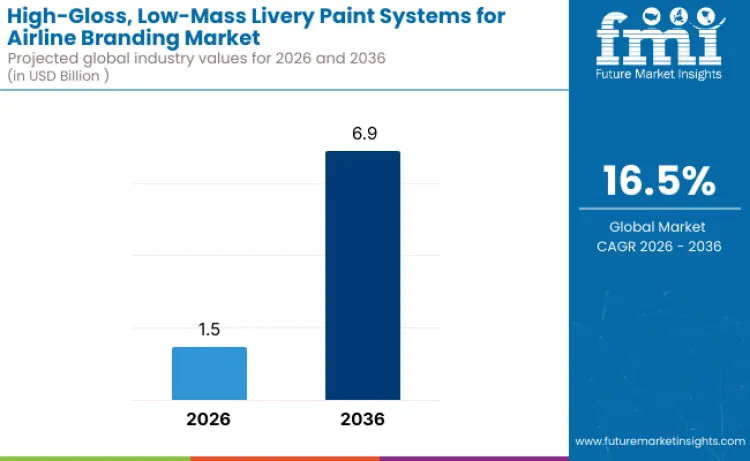
The high-gloss, low-mass livery paint systems for airline branding market is valued at USD 1.5 billion in 2026 and is projected to reach USD 6.9 billion by 2036, reflecting a CAGR of 16.5%. Demand increases as airlines pursue lighter coatings to reduce fuel burn and adopt premium finishes that enhance brand visibility. Fleet modernization, rising narrowbody utilization, and repainting cycles for leased aircraft reinforce adoption of advanced livery systems.
Ultra-lightweight high-gloss polyurethane systems lead coating-type usage because they provide strong UV resistance, smooth aerodynamic surfaces, and reduced mass relative to traditional multi-layer systems. Enhanced resin chemistries and optimized pigment dispersion produce long-lasting gloss retention and color depth. Rapid-cure technologies shorten maintenance downtime, supporting high aircraft availability in commercial fleets.
China, India, USA, and Japan act as major growth regions due to expanding airline fleets, strong MRO activity, and increased investment in brand-driven exterior design. AkzoNobel, PPG Aerospace, Mankiewicz, Sherwin-Williams Aerospace Coatings, and BASF lead competitive innovation with ultra-light coatings, integrated livery systems, and high-durability surface technologies tailored to long-term performance and fuel-efficiency goals.
Quick Stats for High-Gloss, Low-Mass Livery Paint Systems for Airline Branding Market
- Market Value (2026): USD 1.5 billion
- Market Forecast Value (2036): USD 6.9 billion
- Forecast CAGR (2026-2036): 16.5%
- Leading Coating Type in Global Demand: Ultra-lightweight high-gloss polyurethane systems
- Key Growth Regions in Global Demand: China, India, USA, Japan
- Top Players in Global Demand: AkzoNobel, PPG Aerospace, Mankiewicz, Sherwin-Williams Aerospace Coatings, BASF
High-Gloss, Low-Mass Livery Paint Systems for Airline Branding Market Key Takeaways
| Metric | Value |
|---|---|
| Market Value (2026) | USD 1.5 billion |
| Market Forecast Value (2036) | USD 6.9 billion |
| Forecast CAGR (2026-2036) | 16.5% |
How Are the Segments Classified in the High-Gloss, Low-Mass Livery Paint Systems for Airline Branding Market?
Demand for high-gloss, low-mass livery paint systems is shaped by requirements for aerodynamic efficiency, branding visibility, and weight reduction across commercial aircraft exteriors. Buyers evaluate coating durability, gloss retention, UV stability, and compatibility with composite and metallic airframes. Adoption patterns reflect airline interest in reducing fuel burn, improving repaint-cycle efficiency, and maintaining consistent brand appearance under harsh operational environments.
Which Coating Type Accounts for the Largest Share of Global Demand?
Ultra-lightweight high-gloss polyurethane systems hold 45.8%, making them the leading coating-type segment globally. These coatings offer high gloss, reduced film weight, and strong adhesion to composite and aluminum surfaces. Nano-enhanced high-gloss clearcoats support improved scratch resistance and long-term gloss retention. Fluoropolymer-based durable gloss coatings provide weathering resistance suitable for extended repaint intervals. Waterborne high-gloss airline livery coatings support VOC-reduction goals and compatibility with regulatory requirements. Coating-type distribution reflects preference for lightweight polyurethane systems that balance durability and aerodynamic efficiency.
Key Points:
- Polyurethane systems deliver high gloss with reduced mass.
- Nano-enhanced clearcoats improve long-term surface durability.
- Fluoropolymer coatings extend weathering and gloss stability.
- Waterborne systems support VOC and sustainability targets.
Which Functional Attribute Represents the Largest Share of Global Demand?
Low-mass aerodynamic paint systems hold 44.6%, making them the largest functional-attribute segment globally. These coatings minimize weight contribution and reduce drag penalties by enabling smoother aerodynamic surfaces. High-gloss UV-resistant systems maintain appearance and surface integrity under strong solar exposure. Corrosion-resistant exterior coatings support protection of metallic structures. Rapid-cure and productivity-optimized systems reduce maintenance downtime and accelerate repaint cycles. Functional-attribute distribution reflects emphasis on coatings that reduce mass while preserving long-term performance.
Key Points:
- Low-mass coatings support aerodynamic efficiency.
- UV-resistant systems maintain gloss and color stability.
- Corrosion-resistant coatings protect metal structures.
- Rapid-cure systems improve repaint productivity.
Which Application Area Accounts for the Largest Share of Global Demand?
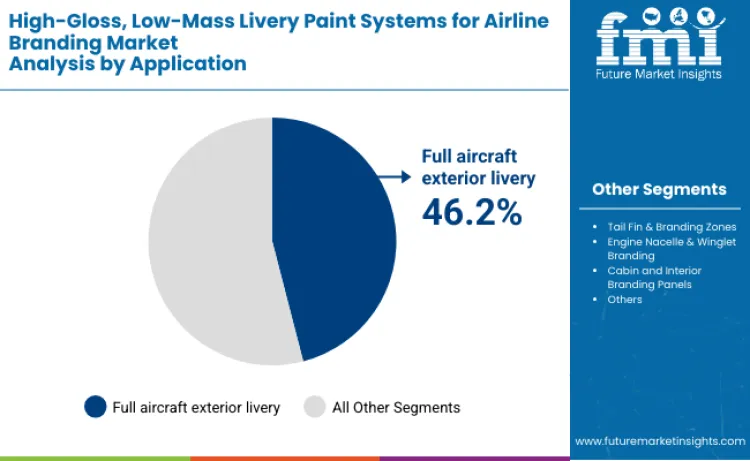
Full aircraft exterior livery holds 46.2%, making it the leading application-area segment globally. Complete fuselage and wing-surface coatings require durable, lightweight systems that maintain gloss and branding visibility across long operational intervals. Tail fin and branding zones rely on high-gloss coatings for distinctive airline identity. Engine nacelle and winglet branding uses coatings that withstand thermal cycling and airflow shear. Cabin and interior branding panels require lightweight, scuff-resistant finishes. Application-area distribution reflects high surface-area demand for full aircraft exteriors.
Key Points:
- Full exterior liveries require durable, lightweight gloss systems.
- Tail fins depend on high-visibility branding coatings.
- Nacelles and winglets need coatings resistant to thermal and aerodynamic stress.
- Interior panels rely on lightweight, scuff-resistant finishes.
What are the Key Dynamics in the High-Gloss, Low-Mass Livery Paint Systems for Airline Branding Market?
Global demand rises as airlines, OEMs, and maintenance providers adopt lightweight livery paint systems that reduce aircraft mass while maintaining gloss durability for branding. Coating suppliers develop formulations that improve reflectivity, weather resistance, and adhesion across composite and aluminium airframes. Airlines evaluate low-mass paint systems to support fuel efficiency goals and extend repaint intervals. Interest grows across fleets operating in varied climates where UV stability and erosion resistance influence long-term appearance.
How are fuel efficiency goals and branding durability needs shaping adoption of low-mass, high-gloss paint systems?
Airlines seek coatings that reduce total aircraft mass by minimizing layer thickness while preserving visual quality across long service intervals. High-gloss finishes support brand visibility and uniformity across fleets. Coatings must retain smoothness and colour stability despite exposure to UV radiation, temperature cycles, and runway particulate impacts. Composite-intensive airframes require specialized primers and topcoats that maintain adhesion without adding unnecessary mass. OEMs assess paint systems compatible with automated spray technologies. Airlines value extended gloss retention that limits repaint frequency. Growth in long-haul operations strengthens interest in coatings with improved resistance to erosion and environmental degradation.
How do certification need, application constraints, and maintenance requirements influence scalability?
Aviation authorities require validation of coating adhesion, flammability, thickness uniformity, and environmental durability, shaping qualification timelines. Application demands controlled curing, surface preparation, and moisture management to prevent defects that affect aerodynamic smoothness. MRO facilities integrate low-mass systems into existing repaint workflows, requiring training and equipment calibration. Variability in hangar climate control influences film formation and gloss consistency. Airlines evaluate total lifecycle costs, including labour, material consumption, and downtime. Harsh climates generate additional wear on high-gloss systems, influencing recoat planning. Regional differences in environmental regulations governing coating chemistry affect global deployment strategies.
How is Demand for High-Gloss, Low-Mass Livery Paint Systems for Airline Branding Market Evolving Across Key Countries?
Demand for the high-gloss, low-mass livery paint systems for airline branding market is rising due to stronger fuel-efficiency targets, interest in weight-reduction coatings, and increased airline investment in durable branding finishes. China records a CAGR of 17.6% supported by rapid fleet expansion. India shows a 17.0% CAGR driven by growing airline activity. USA posts a 15.8% CAGR supported by advanced aerospace-materials development. Japan holds a 14.9% CAGR linked with precision coating technology. UK records a 14.3% CAGR supported by aviation-efficiency programs and airline-modernization efforts.
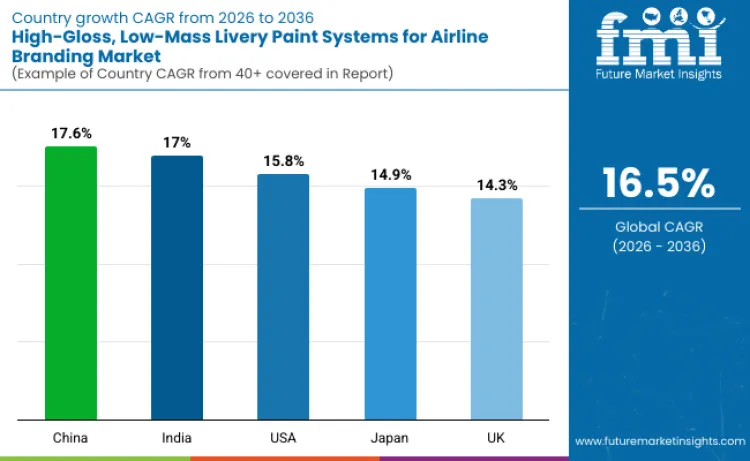
| Country | CAGR (%) |
|---|---|
| China | 17.6% |
| India | 17.0% |
| USA | 15.8% |
| Japan | 14.9% |
| UK | 14.3% |
How is China driving demand for High-Gloss, Low-Mass Livery Paint Systems for Airline Branding?
China drives demand due to rapid commercial-aviation growth, strong expansion of aircraft-manufacturing capacity, and increased interest in coatings that reduce mass while delivering high-durability finishes. The country’s CAGR of 17.6% reflects adoption of low-mass, high-gloss coatings improving aerodynamic smoothness and reducing overall paint weight. Manufacturers integrate advanced resin systems supporting long-term UV and abrasion resistance. Airlines adopt lightweight coating solutions to improve fuel efficiency across expanding fleets. Research programs develop optimized pigments and binders supporting vibrant branding with minimal mass. National aerospace initiatives reinforce investment in next-generation coating systems.
- Rapid expansion of commercial aviation
- Adoption of lightweight, fuel-efficient coating systems
- R&D activity improving pigment and binder performance
- Increased airline focus on durable, high-gloss branding
How is India driving demand for High-Gloss, Low-Mass Livery Paint Systems for Airline Branding?
India supports rising demand due to strong airline-fleet growth, increased focus on operational efficiency, and adoption of coatings reducing weight and maintenance cycles. The country’s CAGR of 17.0% reflects broader use of high-gloss, low-mass paint systems improving durability in varied climatic conditions. Coating manufacturers supply advanced formulations supporting vibrant branding while minimizing application thickness. Airlines evaluate lightweight coatings to improve fuel-burn performance on regional and narrow-body aircraft. MRO facilities expand integration of next-generation coatings to reduce repainting frequency. Growth in domestic aviation enhances long-term demand for performance-oriented finishes.
- Growing domestic airline-fleet size
- Increased use of lightweight coating technologies
- MRO integration of durable, low-mass paint systems
- Strong focus on branding visibility and fuel efficiency
How is the USA driving demand for High-Gloss, Low-Mass Livery Paint Systems for Airline Branding?
The USA drives demand through advanced aerospace-materials R&D, high operational standards, and airline emphasis on fuel and maintenance efficiency. The country’s CAGR of 15.8% reflects adoption of optimized coating formulations achieving brightness, reduced thickness, and resistance to environmental stress. Coating developers refine resin chemistries supporting UV stability and reduced erosion. Airlines adopt lightweight livery systems to reduce paint mass and improve long-range performance. MRO facilities use precision-application technologies to ensure uniform coating distribution. Aerospace research programs support development of high-gloss coatings compatible with composite airframes.
- Advanced aerospace-coating R&D
- Lightweight coating adoption improving fuel-burn efficiency
- Precision application in MRO facilities
- Development of composite-compatible high-gloss systems
How is Japan driving demand for High-Gloss, Low-Mass Livery Paint Systems for Airline Branding?
Japan drives demand due to precision engineering standards, strict durability expectations, and interest in coatings that maintain gloss and color stability across long service intervals. The country’s CAGR of 14.9% reflects adoption of multi-layer low-mass coating systems supporting reduced weight without compromising surface finish. Manufacturers engineer resin blends optimized for weathering resistance. Airlines incorporate advanced coatings to meet operational reliability requirements across coastal and winter conditions. Research institutes refine curing and application processes improving coating adhesion and longevity.
- Precision-engineered resin systems
- Adoption of low-mass multi-layer finishes
- Strong airline focus on coating longevity
- R&D improving adhesion and curing performance
How is the UK driving demand for High-Gloss, Low-Mass Livery Paint Systems for Airline Branding?
The UK supports demand through aviation-efficiency programs, strong MRO capability, and interest in coatings enabling fuel savings and brand differentiation. The country’s CAGR of 14.3% reflects adoption of lightweight livery coatings reducing aircraft mass and improving aerodynamic smoothness. Coating suppliers develop high-gloss, weather-resistant formulations suited for long-haul and variable-climate operations. Airlines consider thin-film coating systems to extend repaint cycles and reduce maintenance downtime. National sustainability and emissions-reduction frameworks reinforce movement toward weight-optimized finishes.
- MRO adoption of lightweight coating technologies
- High-gloss, weather-resistant formulations gaining traction
- Airlines reducing repaint cycles through durable systems
- Policy emphasis on efficiency supporting coating innovation
What is the competitive landscape of demand for high-gloss, low-mass livery paint systems for airline branding globally?
Demand for high-gloss, low-mass livery paint systems for airline branding grows as airlines seek reduced coating weight, longer repaint intervals, and improved exterior durability. Requirements center on gloss retention, UV stability, erosion resistance, and optimized film build that minimizes added mass on fuselage and nacelle surfaces. Buyers evaluate application consistency, curing behavior, adhesion to composite and metallic substrates, and compatibility with digital design workflows used in complex liveries. Procurement teams prioritize certification status, predictable maintenance cycles, and cost stability linked to airline fleet-wide repaint programs. Trend in the global market reflects wider interest in fuel-efficient coatings, reduced volatile emissions, and enhanced surface smoothness that supports aerodynamic cleanliness.
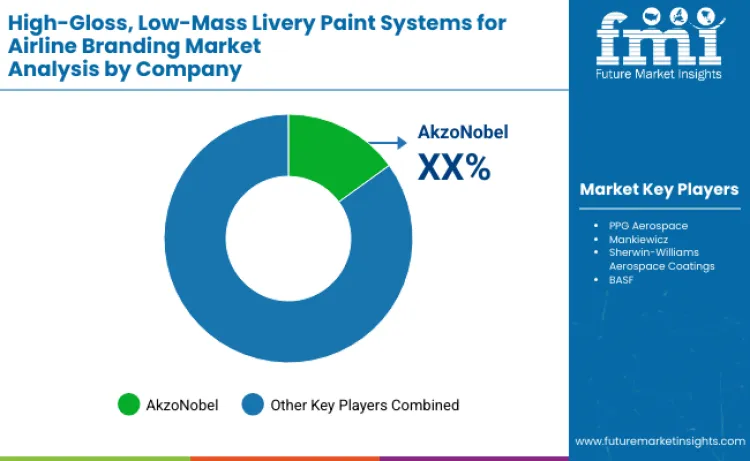
AkzoNobel holds an estimated 29.0% share. Position strengthens through specialized aviation topcoat systems engineered for high-gloss retention, low dry-film mass, and extended exterior service life. PPG Aerospace participates with lightweight urethane topcoats offering long-term durability and controlled film thickness for commercial fleets. Mankiewicz maintains visibility with aviation exterior coatings providing stable gloss, erosion resistance, and compatibility with complex airline branding schemes. Sherwin-Williams Aerospace Coatings contributes with high-solids paint systems designed for reduced mass and consistent appearance across composite and metal structures. BASF supports demand with polymer technologies and surface additive systems incorporated into lightweight aviation coatings. Competitive positioning globally reflects gloss stability, coating weight efficiency, weathering performance, and fleet maintenance compatibility supporting airline branding operations.
Key Players in the High-Gloss, Low-Mass Livery Paint Systems for Airline Branding Market
- AkzoNobel
- PPG Aerospace
- Mankiewicz
- Sherwin-Williams Aerospace Coatings
- BASF
Scope of the Report
| Items | Values |
|---|---|
| Quantitative Units | USD billion |
| Coating Type | Ultra-Lightweight High-Gloss Polyurethane Systems; Nano-Enhanced High-Gloss Clearcoat Systems; Fluoropolymer-Based Durable Gloss Coatings; Waterborne High-Gloss Airline Livery Coatings |
| Functional Attribute | Low-Mass Aerodynamic Paint Systems; High-Gloss UV-Resistant Systems; Corrosion-Resistant Exterior Coatings; Rapid-Cure & Productivity-Optimized Systems |
| Application Area | Full Aircraft Exterior Livery; Tail Fin & Branding Zones; Engine Nacelle & Winglet Branding; Cabin and Interior Branding Panels |
| End-User | Commercial Airline Operators; Aircraft OEMs; MRO & Repaint Facilities; Aerospace Coating Manufacturers |
| Regions Covered | Asia Pacific, Europe, North America, Latin America, Middle East & Africa |
| Countries Covered | India, China, USA, Germany, South Korea, Japan, Italy, and 40+ countries |
| Key Companies Profiled | AkzoNobel, PPG Aerospace, Mankiewicz, Sherwin-Williams Aerospace Coatings, BASF |
| Additional Attributes | Dollar sales by coating type and functional performance; adoption trends in lightweight aerodynamic paint systems; compatibility with composite aircraft exteriors; longevity and erosion-resistance metrics; OEM-approved livery coating specifications; advances in nano-gloss coatings and rapid-curing aviation paint technologies. |
High-Gloss, Low-Mass Livery Paint Systems for Airline Branding Market by Segment
By Coating Type:
- Ultra-Lightweight High-Gloss Polyurethane Systems
- Nano-Enhanced High-Gloss Clearcoat Systems
- Fluoropolymer-Based Durable Gloss Coatings
- Waterborne High-Gloss Airline Livery Coatings
By Functional Attribute:
- Low-Mass Aerodynamic Paint Systems
- High-Gloss UV-Resistant Systems
- Corrosion-Resistant Exterior Coatings
- Rapid-Cure & Productivity-Optimized Systems
By Application Area:
- Full Aircraft Exterior Livery
- Tail Fin & Branding Zones
- Engine Nacelle & Winglet Branding
- Cabin and Interior Branding Panels
By End-User:
- Commercial Airline Operators
- Aircraft OEMs
- MRO & Repaint Facilities
- Aerospace Coating Manufacturers
Region:
- Asia Pacific
- China
- Japan
- South Korea
- India
- Australia & New Zealand
- ASEAN
- Rest of Asia Pacific
- Europe
- Germany
- United Kingdom
- France
- Italy
- Spain
- Nordic
- BENELUX
- Rest of Europe
- North America
- United States
- Canada
- Mexico
- Latin America
- Brazil
- Chile
- Rest of Latin America
- Middle East & Africa
- Kingdom of Saudi Arabia
- Other GCC Countries
- Turkey
- South Africa
- Other African Union
- Rest of Middle East & Africa
Frequently Asked Questions
What is the size of the high-gloss, low-mass livery paint systems for airline branding market in 2026?
The market is valued at USD 1.5 billion in 2026 due to rising adoption of lightweight coating systems that reduce aircraft mass.
What will be the industry size by 2036?
Industry value will reach USD 6.9 billion by 2036 as airlines invest in advanced livery coatings that balance durability, aesthetics, and aerodynamic efficiency.
What is the CAGR for 2026-2036?
The high-gloss, low-mass livery paint systems for airline branding market expands at a 16.5% CAGR during the forecast period.
Which coating-type segment leads in 2026?
Ultra-lightweight high-gloss polyurethane systems hold 45.8% share due to their strong durability, gloss retention, and low-mass formulation benefits.
Which functional-attribute segment holds the highest share?
Low-mass aerodynamic paint systems lead with 44.6% share, supported by demand for coatings that reduce drag and contribute to fuel savings.
Preview the report firsthand - request a free sample
Get SampleGet the brochure for pricing and purchase details.
Get PDFTable of Content
- Executive Summary
- Market Overview
- Global Market Value, 2020-2026
- Global Market Forecast, 2026-2036
- Market Dynamics
- Drivers
- Restraints
- Opportunities
- Regulatory & Standards Landscape
- Technology & Coating Innovation Outlook
- Market Segmentation Analysis
- By Coating Type
- Ultra-Lightweight High-Gloss Polyurethane Systems
- Nano-Enhanced High-Gloss Clearcoat Systems
- Fluoropolymer-Based Durable Gloss Coatings
- Waterborne High-Gloss Airline Livery Coatings
- By Functional Attribute
- Low-Mass Aerodynamic Paint Systems
- High-Gloss UV-Resistant Systems
- Corrosion-Resistant Exterior Coatings
- Rapid-Cure & Productivity-Optimized Systems
- By Application Area
- Full Aircraft Exterior Livery
- Tail Fin & Branding Zones
- Engine Nacelle & Winglet Branding
- Cabin and Interior Branding Panels
- By Sales Channel
- Direct OEM Supply
- MRO & Repaint Facilities
- Aftermarket & Distributor Channels
- By Coating Type
- Regional Outlook
- North America
- Latin America
- Western Europe
- Eastern Europe
- South Asia & Pacific
- East Asia
- Middle East & Africa
- Country-Level Outlook
- United States
- Canada
- Mexico
- Brazil
- Argentina
- Germany
- France
- United Kingdom
- Italy
- Spain
- Netherlands
- China
- India
- Japan
- South Korea
- ANZ
- GCC Countries
- South Africa
- Competitive Landscape
- Market Structure Overview
- Company Positioning
- Strategic Initiatives
- Key Player Profiles
- Scope of the Report
- Research Methodology
- Assumptions & Acronyms


