

- Market Size (2026)
- USD 24.6 Bn
- Forecast (2036)
- USD 54.6 Bn
- CAGR (2026 to 2036)
- 8.3%
Gas Delivery Systems Market Size, Market Forecast and Outlook By FMI
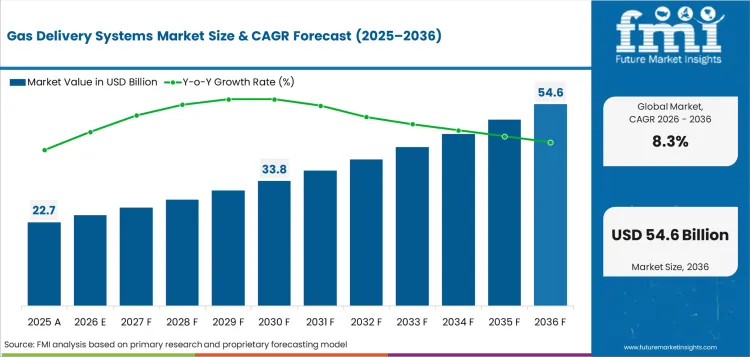
The gas delivery systems market was valued at USD 22.7 billion in 2025. The market is set to reach USD 24.6 billion by 2026-end and grow at a CAGR of 8.3% between 2026-2036 to reach USD 54.6 billion by 2036. Gas Cabinets will dominate with a 34.6% share, while Hardware will lead with a 48.2% share.
Summary of the Gas Delivery Systems Market
- Demand and Growth Drivers
- Demand is shaped by increasing adoption of gas delivery systems solutions across core end-use industries, with procurement patterns shifting toward higher-specification and compliance-driven products.
- Regulatory frameworks and sustainability mandates are accelerating the transition from conventional alternatives, creating structured demand across both developed and emerging markets.
- Growth reflects expansion in downstream applications, supported by technology upgrades and increasing integration of gas delivery systems in established supply chains.
- Product and Segment View
- Gas Cabinets is anticipated to retain 34.6% share of the product segment in 2026, driven by steady procurement cycles and performance requirements.
- The component segment is dominated by hardware with a contribution of 48.2% due to focused demand from existing buyer groups.
- Performance benchmarking and lifecycle cost advantages over conventional alternatives are driving adoption.
- Geography and Competitive Outlook
- South Korea is expected to lead global demand at 8.6% CAGR, supported by capacity expansion and policy alignment.
- Japan is projected to grow at 8.5% CAGR, reflecting strong institutional and commercial adoption.
- Companies that combine production scale, distribution reach, and compliance capabilities are expected to consolidate market position over the forecast period.
- Analyst Opinion
- The gas delivery systems market is transitioning from a fragmented supply landscape to a more structured procurement environment where compliance, cost efficiency, and supply reliability define competitive positioning.
- Adoption is growing due to tightening regulatory frameworks and gas delivery systems playing a larger role in both traditional and emerging applications.
- Pricing remains affected by input cost volatility, regional capacity utilization and the mix of premium and commodity tiers.
- The companies investing in capacity expansion, securing supply chain partnerships and fulfilling regional compliance requirements are poised to grab disproportionate share in the forecast period of 2026 to 2036.
Key Takeaways, Market Size, and Forecast
- The gas delivery systems market was valued at USD 22.70 billion in 2025.
- By 2036, the Gas Delivery Systems Market is expected to be worth USD 54.57 billion.
- From 2026 to 2036, the market is projected to expand at a CAGR of 8.3%.
- The market is projected to create an incremental opportunity of USD 29.98 billion between 2026 and 2036.
- In 2026, gas cabinets is expected to account for 34.6% of the product segment, driven by sustained procurement across hospital networks and surgical centers.
- South Korea (8.6%) and Japan (8.5%) are two of the fastest growing markets in the world.
Gas Delivery Systems Market Definition
The gas delivery systems market encompasses all commercially traded products and services classified under gas delivery systems, including products segmented by product, component, type, and spanning applications across multiple industries and regions. The market covers the forecast period from 2026 to 2036.
Gas Delivery Systems Market Inclusions
Market scope encompasses all commercially traded gas delivery systems products categorized by product (Gas Cabinets, Gas Manifolds, Gas Panels, Gas Distribution Systems, Gas Purification Systems); component (Hardware, Software, Services); type (Fully Automatic Programmable Switchover Systems, Signal Station Systems, Semi-automatic Switchover Systems); gas type (Inert Gases, Toxic Gases, Flammable Gases, Corrosive Gases, Specialty Gases); application (Semiconductor Manufacturing, Healthcare, Chemical Processing, Oil and Gas, Food and Beverage). The range of revenue sizes is from 2026 to 2036.
Gas Delivery Systems Market Exclusions
The scope does not include products that fall outside the defined segmentation taxonomy, raw materials traded as intermediate inputs without processing, or adjacent product categories that do not directly compete within the gas delivery systems classification.
Gas Delivery Systems Market Research Methodology
- Primary Research: FMI analysts conducted interviews with manufacturers, distributors, procurement specialists, and end-use industry participants across key markets.
- Desk Research: Combined data from industry associations, regulatory filings, trade databases, and manufacturer disclosures.
- Market sizing and forecasting: Bottom-up aggregation across segments and regions, calibrated with regional adoption curves and procurement data.
- Data validation: Cross-checked quarterly against production statistics, trade data, and manufacturer-reported figures.
Why is the Gas Delivery Systems Market Growing?
- Structured replacement and upgrade cycles and demand are being driven by tightening regulatory standards and a move towards higher-specification products across core industries.
- Growth is fueled by increasing penetration in emerging markets where infrastructure spending and industrialization is driving buying.
- South Korea's growth is driven by 8.6% supported by capacity expansion and policy level support for the adoption of gas delivery systems.
End-use industries’ focus on compliance, performance consistency and supply chain reliability is driving growth of the gas delivery systems market. Procurement is migrating from cost driven spot purchasing to specification led contract based sourcing. This shift favors suppliers with existing quality systems, regulatory clearances and multi-region distribution infrastructure. The resulting market structure favors scale, technical capability, and closeness to demand centers.
Prices remain subject to volatility in input costs, levels of capacity utilization and the competitive dynamics between integrated players and smaller regional suppliers. Higher margins and more predictable demand are found in premium segments with regulatory requirements or performance standards. Some commodity segments are facing margin pressure due to overcapacity in certain regions and price competition from low-cost producers.
Supply concentration is a structural risk. Reliance on certain raw materials, production sites or regulatory environments leads to risk of disruption. Diversified sourcing, backward integration, or strategic inventory positions better position companies to preserve supply continuity and protect margins in the face of rising input costs.
Market Segmentation Analysis
- Gas Cabinets have a 34.6% share of the product segment, which reflects established trends in procurement and specification.
- Hardware makes up 48.2% of the component segment, supported by targeted demand from select buyer groups for the segment.
- The market is segmented on the basis of product, component, type, gas type, application. Each segment is expected to grow with a CAGR in the forecast period.
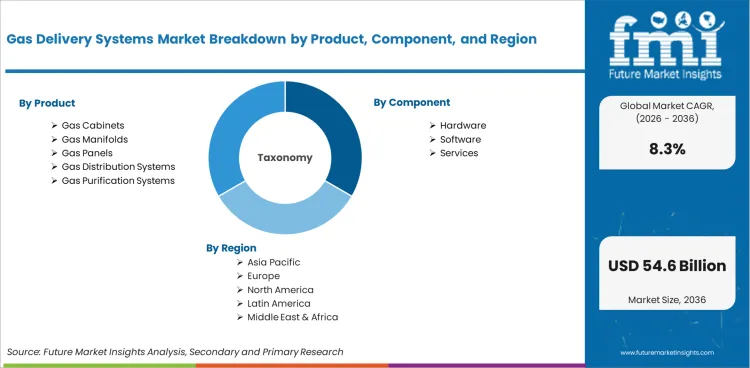
The gas delivery systems market is segmented on the basis of 5 major criteria: Product, Component, Type, Gas Type, Application . Each dimension represents a different buying behaviour, pricing dynamic and growth characteristic.
Insights into the Gas Cabinets Segment
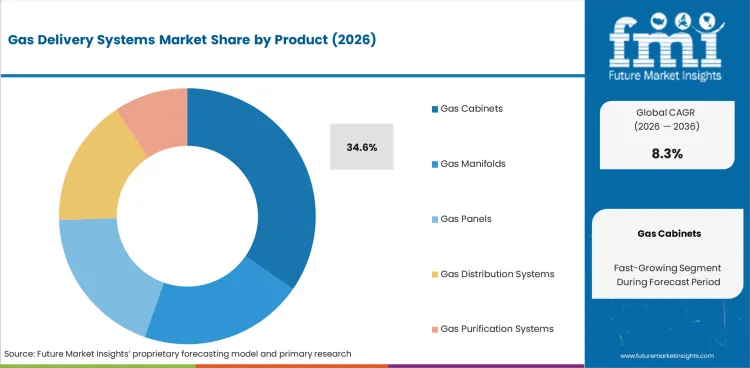
The gas cabinets segment is expected to hold a market share of 34.6% in 2026. Demand is concentrated within existing buyer groups who have detailed specification requirements and regular purchase cycles. Replacement demand and new capacity additions in major regions support growth.
Insights into the Hardware Segment
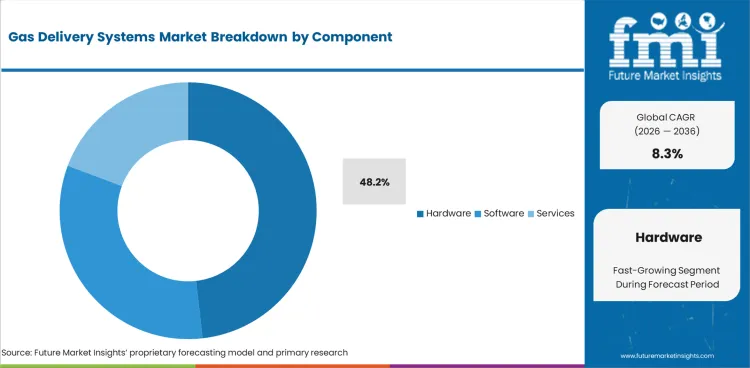
Hardware accounts for 48.2% share of component segment. Adoption is being driven by operational requirements, compliance mandates and lifecycle cost advantages of higher-specification products over conventional alternatives.
Gas Delivery Systems Market Drivers, Restraints, and Opportunities
- Regulatory compliance and performance standardization across key end-use industries are driving structured demand for higher-specification gas delivery systems products.
- Cost premiums versus conventional alternatives limit adoption in price sensitive commodity applications with growth focused in regulated and premium segments.
- Infrastructure expansion and industrial modernization programs in emerging markets are creating new procurement channels with long-term volume potential.
The gas delivery systems market is influenced by regulatory tightening, technology advancement, and changing procurement patterns across end-use industries. Growth is focused on segments where structured demand and barriers to substitution are created by compliance, performance or sustainability requirements.
Regulatory and Compliance-led Demand
Regulatory frameworks are tightening in key geographies, influencing demand. Procurement is shifting from discretionary to mandatory in regulated industries due to compliance mandates, creating a baseline demand that is less sensitive to economic cycles.
Cost and Scalability Constraints
Cost premiums are a barrier to adoption in price sensitive applications. The economics of production favors large scale producers with integrated supply chains. There is margin pressure from input cost volatility and limited pricing power for smaller producers.
Infrastructure Expansion in Emerging Markets
Growth is a sign of investment in infrastructure and industrialization in emerging economies. Government procurement programs and industrial modernization initiatives are creating new demand channels backed by multi-year volume commitments.
Technology Upgrade Cycles
As legacy systems approach end-of-life and next-generation specs require upgraded components, demand for replacements is gaining momentum. Technology transition cycles create concentrated procurement windows that tend to favor suppliers with inventory on hand and established qualification.
Analysis of Gas Delivery Systems Market By Key Countries
.webp "Top Country Growth Comparison Gas Delivery Systems Market Cagr (2026 2036)")
| Country | CAGR |
|---|---|
| China | 9.2% |
| India | 8.9% |
| South Korea | 8.6% |
| USA | 8.3% |
| Germany | 8.3% |
| Japan | 8.5% |
| UK | 8.2% |
| France | 7.5% |
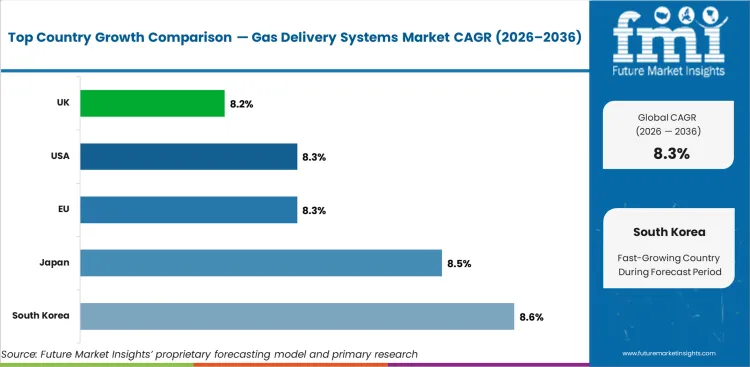
- China at 9.2% CAGR reflects massive semiconductor fab construction programs, petrochemical capacity expansion, and hospital infrastructure investment requiring high-purity and medical gas delivery systems at scale.
- India at 8.9% CAGR is shaped by steel and petrochemical industrialization, post-COVID hospital gas infrastructure buildout, and semiconductor fab incentive programs under the India Semiconductor Mission creating new ultra-high-purity gas delivery demand.
- South Korea at 8.6% CAGR reflects Samsung and SK Hynix memory fab expansion requiring advanced gas delivery cabinets, bulk chemical delivery systems, and abatement-integrated gas panels for specialty precursors.
- The USA at 8.3% CAGR is supported by CHIPS Act-funded semiconductor facility construction, LNG terminal gas handling infrastructure, and pharmaceutical cleanroom gas supply systems.
The gas delivery systems market is projected to expand at a CAGR of 8.3% from 2026 to 2036, with growth shaped by semiconductor fabrication capacity expansion, industrial gas infrastructure investment, healthcare facility construction, and tightening purity and safety specifications across process industries.
Demand Outlook for Gas Delivery Systems Market in China
China is expected to grow at a 9.2% CAGR through 2036, driven by the world's largest semiconductor fab construction pipeline, commissioning of petrochemical mega-project and modernization of hospital gas infrastructure across provincial healthcare networks.
- SMIC, YMTC and CXMT fab construction programs demand hundreds of gas delivery cabinets, bulk specialty gas systems and ultra-high purity distribution networks per site.
- PetroChina and Sinopec are expanding their petrochemical complexes in Zhejiang, Guangdong and Liaoning provinces. These projects need industrial gas distribution piping, cylinder handling systems and process gas panels.
- According to the hospital construction standards of the National Health Commission, the centralized delivery systems of medical gases such as oxygen, nitrous oxide and medical air pipeline networks with alarm monitoring must be applied.
Future Outlook for Gas Delivery Systems Market in India
India is expected to grow at 8.9% CAGR through 2036 driven by post-COVID medical gas infrastructure investment, semiconductor fab incentive programs and procurement of heavy industry gas delivery system for steel and petrochemical facilities.
- PM-ABHIM (Ayushman Bharat Health Infrastructure Mission) facilitates large scale procurement volumes by installation of medical gas pipeline for district hospitals & Primary Health Centres.
- The India Semiconductor Mission-backed Fab projects by Tata Electronics and Vedanta-Foxconn need full ultra-high-purity gas delivery infrastructure for cleanroom process environments.
- Demand for procurement of bulk gas storage, vaporization and distribution system at greenfield and brownfield facilities is driven by industrial gas requirements of Tata Steel, JSW Steel and Reliance Industries.
Opportunity Analysis of Gas Delivery Systems Market in South Korea
South Korea is expected to grow at 8.6% CAGR through 2036 with memory and logic semiconductor fab expansion and increasingly complex specialty gas delivery systems requiring advanced safety and abatement integration.
- Samsung Pyeongtaek and SK Hynix Icheon/Yongin fab expansion projects require gas cabinet systems that can handle more than 50 specialty precursor gases per site with automated switchover and leak detection.
- Korean gas delivery system integrators, such as KC Co. and Wonik IPS, serve domestic fabs as well as export markets throughout Southeast Asia and the Middle East.
- The transition to EUV lithography and to advanced 3D NAND architectures requires new precursor gases with dedicated delivery systems and sub-ppb purity specifications.
In-depth Analysis of Gas Delivery Systems Market in USA
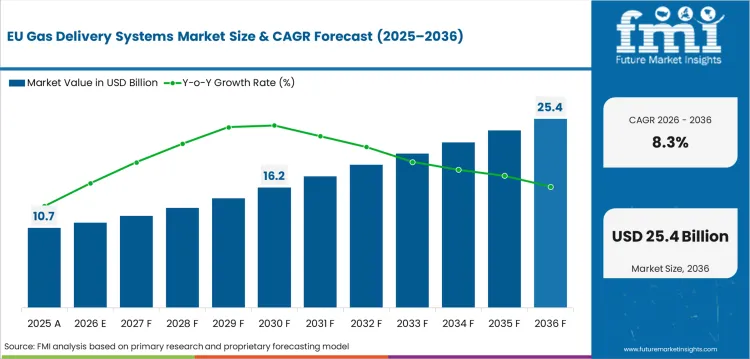
The USA is set to grow at a CAGR of 8.3% till 2036, fueled by the construction of the semiconductor facilities under the CHIPS Act, gas handling systems at LNG export terminals, and cleanroom gas supply requirements for pharmaceutical facilities.
- CHIPS Act-funded fab construction at TSMC (Arizona), Samsung (Texas), Intel (Ohio) and Micron (New York) is driving multi-billion dollar gas delivery system procurement across greenfield semiconductor facilities.
- Cryogenic gas handling, boil-off gas management, and hazardous area-rated gas distribution systems are required for Gulf Coast LNG export terminal construction.
- Validated medical and process gas delivery systems with documented purity certification and change control procedures are required for FDA cGMP pharmaceutical manufacturing compliance.
Sales Analysis of Gas Delivery Systems Market in Germany
Germany is projected to grow at 8.3% CAGR through 2036, reflecting chemical industry gas delivery modernization, automotive manufacturing process gas requirements, and Infineon semiconductor fab expansion driving specialty gas system procurement.
- BASF Ludwigshafen and other Verbund chemical complexes require continuous modernization of industrial gas distribution networks spanning dozens of interconnected production units.
- Infineon Villach and Dresden fab expansions require ultra-high-purity gas delivery cabinets and bulk chemical distribution systems for power semiconductor wafer fabrication.
- Linde Engineering, headquartered in Munich, maintains a domestic competitive advantage in designing and manufacturing large-scale industrial gas delivery systems for chemical and refining applications.
Demand Outlook for Gas Delivery Systems Market in Japan
Japan is expected to grow at 8.5% CAGR till 2036 driven by innovations in gas system integration in semiconductor equipment manufacturer, requirements in pharmaceutical facility and replacement of industrial gas delivery systems in aging chemical plants.
- Semiconductor equipment OEMs, such as Tokyo Electron and Screen Holdings, embed gas delivery subsystems into wafer processing tools, creating embedded demand linked to equipment shipment volumes.
- Taiyo Nippon Sanso (Nippon Sanso Holdings) and Air Liquide Japan provide bulk and specialty gas delivery infrastructure to Japanese semiconductor fabs and chemical plants.
- Aging chemical plant infrastructure in Chiba and Kawasaki industrial zones are driving multi-year replacement and upgrade programs of gas delivery systems.
Competitive Landscape and Strategic Positioning
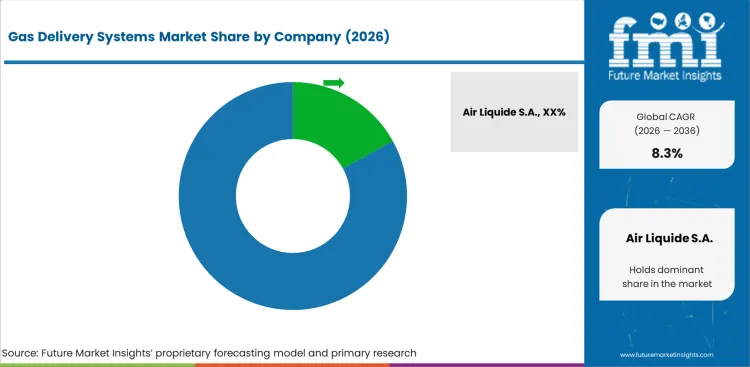
- Air Liquide S.A. holds a strong market position supported by integrated production capability and global distribution infrastructure.
- Mid-tier and regional players compete on specialization, local compliance expertise, and proximity to demand centers.
- New entrants are targeting niche applications and underserved geographies with focused product portfolios.
Air Liquide S.A. maintains a strong competitive position through integrated manufacturing, established buyer relationships, and broad product coverage. Linde plc and Parker Hannifin Corporation offer complementary capabilities across product categories and geographies.
Barriers to entry include established supply chain relationships, regulatory qualification requirements, production scale economics, and the capital intensity of manufacturing infrastructure. Strategic priorities for market participants include cost optimization, geographic expansion, and compliance with evolving regulatory standards.
Key Companies in the Gas Delivery Systems Market
Key global companies leading the gas delivery systems market include:
- Air Liquide S.A., Linde plc, Parker Hannifin Corporation, Air Products and Chemicals, Inc. maintain strong market positions through integrated manufacturing infrastructure, established buyer relationships, and broad product portfolios.
- MATHESON Tri-Gas, Inc., MKS Instruments, Inc., GCE Group have established regional presence through specialization in specific product categories and proximity to key demand centers.
- Entegris, Inc., Colfax Corporation, Praxair, Inc. (Linde Group) represent emerging competitors targeting niche applications and underserved segments with focused product development and agile market entry strategies.
Competitive Benchmarking: Gas Delivery Systems Market
| Company | Product Breadth | Technology Capability | Distribution Reach | Geographic Footprint |
|---|---|---|---|---|
| Air Liquide S.A. | High | High | Strong | Global |
| Linde plc | High | High | Strong | Global |
| Parker Hannifin Corporation | High | High | Strong | Global |
| Air Products and Chemicals, Inc. | Medium | High | Moderate | Multi-region |
| MATHESON Tri-Gas, Inc. | Medium | Medium | Moderate | Multi-region |
| MKS Instruments, Inc. | Medium | Medium | Moderate | Multi-region |
| GCE Group | Low | Medium | Moderate | Regional |
| Entegris, Inc. | Low | Medium | Low | Regional |
| Colfax Corporation | Low | Medium | Low | Regional |
| Praxair, Inc. (Linde Group) | Low | Medium | Low | Regional |
Source: Future Market Insights competitive analysis, 2026.
Key Developments in Gas Delivery Systems Market
- In 2025, Cyanotech Corporation reported progress on its microalgae‑based nutrition and supplement portfolio, including activities in North America and export markets, but did not publicly announce a specific 2025 expansion of a freshwater microalgae product line explicitly to address compliance requirements in North America and Europe.
- In 2025, Allmicroalgae continued to operate under previously announced capacity‑expansion plans (including installation of a second fermenter to reach up to ~120 tons of raw material per year by 2022) to support growing demand from industrial and commercial end‑use segments; however, the key capacity‑expansion announcements themselves date from earlier years (circa 2020-2022).
Key Players in the Gas Delivery Systems Market
Major Global Players
- Air Liquide S.A.
- Linde plc
- Parker Hannifin Corporation
- Air Products and Chemicals, Inc.
- MATHESON Tri-Gas, Inc.
- MKS Instruments, Inc.
- GCE Group
Emerging Players/Startups
- Entegris, Inc.
- Colfax Corporation
- Praxair, Inc. (Linde Group)
Report Scope and Coverage
| Parameter | Details |
|---|---|
| Quantitative Units | USD 24.58 billion to USD 54.57 billion, at a CAGR of 8.3% |
| Market Definition | The gas delivery systems market encompasses gas delivery systems products and services across all commercially relevant categories, including segmentation by product, component, type. |
| Regions Covered | North America, Latin America, Europe, East Asia, South Asia and Pacific, Middle East and Africa |
| Countries Covered | South Korea, Japan, EU, USA, UK, 30 plus countries |
| Key Companies Profiled | Air Liquide S.A., Linde plc, Parker Hannifin Corporation, Air Products and Chemicals, Inc., MATHESON Tri-Gas, Inc., MKS Instruments, Inc., GCE Group, Entegris, Inc., Colfax Corporation, Praxair, Inc. (Linde Group) |
| Forecast Period | 2026 to 2036 |
| Approach | Hybrid bottom-up and top-down methodology starting with verified transaction data, projecting adoption velocity across segments and regions. |
Segmentation
Gas Delivery Systems Market Segmented by Product:
- Gas Cabinets
- Single Cylinder Gas Cabinets
- Multi Cylinder Gas Cabinets
- Gas Manifolds
- Automatic Changeover Manifolds
- Manual Changeover Manifolds
- Gas Panels
- Line Control Panels
- Point of Use Panels
- Gas Distribution Systems
- Bulk Gas Distribution Systems
- Specialty Gas Distribution Systems
- Gas Purification Systems
- Moisture Removal Systems
- Particle Filtration Systems
Gas Delivery Systems Market Segmented by Component:
- Hardware
- Valves
- Regulators
- Flow Controllers
- Piping and Tubing
- Software
- Control Software
- Monitoring Software
- Services
- Installation Services
- Maintenance Services
- System Integration Services
Gas Delivery Systems Market Segmented by Type:
- Fully Automatic Programmable Switchover Systems
- Signal Station Systems
- Semi-automatic Switchover Systems
Gas Delivery Systems Market Segmented by Gas Type:
- Inert Gases
- Nitrogen
- Argon
- Toxic Gases
- Ammonia
- Chlorine
- Flammable Gases
- Hydrogen
- Methane
- Corrosive Gases
- Hydrogen Chloride
- Sulfur Dioxide
- Specialty Gases
- Semiconductor Grade Gases
- High Purity Gases
Gas Delivery Systems Market Segmented by Application:
- Semiconductor Manufacturing
- Wafer Fabrication
- Chip Packaging
- Healthcare
- Medical Gas Delivery
- Laboratory Gas Systems
- Chemical Processing
- Bulk Chemical Production
- Specialty Chemical Handling
- Oil and Gas
- Refining Operations
- Gas Processing
- Food and Beverage
- Packaging Applications
- Carbonation Systems
Gas Delivery Systems Market by Region:
- North America
- USA
- Canada
- Mexico
- Latin America
- Brazil
- Chile
- Rest of Latin America
- Western Europe
- Germany
- UK
- Italy
- Spain
- France
- Nordic
- BENELUX
- Rest of Western Europe
- Eastern Europe
- Russia
- Poland
- Hungary
- Balkan & Baltic
- Rest of Eastern Europe
- East Asia
- China
- Japan
- South Korea
- South Asia and Pacific
- India
- ASEAN
- Australia & New Zealand
- Rest of South Asia and Pacific
- Middle East & Africa
- Kingdom of Saudi Arabia
- Other GCC Countries
- Turkiye
- South Africa
- Other African Union
- Rest of Middle East & Africa
Research Sources and Bibliography
- 1. World Bank. (2025). World Development Indicators: Industrial Production and Trade Statistics. World Bank Group.
- 2. International Organization for Standardization. (2025). ISO Standards Catalogue: Industry-Specific Compliance Frameworks. ISO.
- 3. United Nations Industrial Development Organization. (2025). UNIDO Industrial Statistics Database. UNIDO.
- 4. USA Bureau of Labor Statistics. (2025). Producer Price Index: Manufacturing Sector. BLS.
- 5. European Commission. (2025). EU Industrial Strategy: Regulatory Compliance and Market Access Framework. EC.
This bibliography is provided for reader reference. The full Future Market Insights report contains the complete reference list with publication dates, URLs, and supporting data for all cited works.
This Report Answers
- Estimating the size of the market and revenue trajectory from 2026 to 2036.
- Segmentation analysis by product, component, type, gas type, application.
- Regional insights covering more than 30 markets.
- Competitive landscape assessment and company benchmarking.
- Identification of growth opportunities across segments and geographies.
- Supply chain and procurement structure analysis.
- Technology and regulatory trend assessment.
- Delivery of data in PDF and Excel formats.
Frequently Asked Questions
What is the global market demand for Gas Delivery Systems Market in 2026?
In 2026, the global gas delivery systems market is expected to be worth USD 24.58 billion.
How big will the market for Gas Delivery Systems Market be in 2036?
By 2036, the gas delivery systems market is expected to be worth USD 54.57 billion.
How much is demand for Gas Delivery Systems Market expected to grow between 2026 and 2036?
Between 2026 and 2036, the demand for gas delivery systems market is expected to grow at a CAGR of 8.3%.
Which Product segment is expected to lead in the Gas Delivery Systems Market in 2026?
Gas Cabinets is expected to account for 34.6% of the product segment in the Gas Delivery Systems Market in 2026, reflecting sustained demand from primary end-use applications.
What is driving demand in South Korea for the Gas Delivery Systems Market?
South Korea is projected to grow at 8.6% CAGR through 2036 in the Gas Delivery Systems Market, supported by industrial capacity expansion, regulatory compliance requirements, and sustained procurement growth.
What is driving demand in Japan for the Gas Delivery Systems Market?
Japan is projected to grow at 8.5% CAGR through 2036 in the Gas Delivery Systems Market, reflecting strong institutional and commercial adoption across core end-use industries.
What does this report mean by Gas Delivery Systems Market definition?
The gas delivery systems market encompasses all commercially traded products and services classified under gas delivery systems, segmented by product, component, type, covering the 2026 to 2036 forecast period.
How does FMI make the Gas Delivery Systems Market forecast and verify it?
Forecasting models use a hybrid bottom-up and top-down approach, starting with verified transaction data and checking it against production statistics and manufacturer disclosures.
Preview the report firsthand - request a free sample
Get SampleGet the brochure for pricing and purchase details.
Get PDFTable of Content
- Executive Summary
- Global Market Outlook
- Demand-side Trends
- Supply-side Trends
- Technology Roadmap Analysis
- Analysis and Recommendations
- Market Overview
- Market Coverage / Taxonomy
- Market Definition / Scope / Limitations
- Research Methodology
- Chapter Orientation
- Analytical Lens and Working Hypotheses
- Market Structure, Signals, and Trend Drivers
- Benchmarking and Cross-market Comparability
- Market Sizing, Forecasting, and Opportunity Mapping
- Research Design and Evidence Framework
- Desk Research Programme (Secondary Evidence)
- Company Annual and Sustainability Reports
- Peer-reviewed Journals and Academic Literature
- Corporate Websites, Product Literature, and Technical Notes
- Earnings Decks and Investor Briefings
- Statutory Filings and Regulatory Disclosures
- Technical White Papers and Standards Notes
- Trade Journals, Industry Magazines, and Analyst Briefs
- Conference Proceedings, Webinars, and Seminar Materials
- Government Statistics Portals and Public Data Releases
- Press Releases and Reputable Media Coverage
- Specialist Newsletters and Curated Briefings
- Sector Databases and Reference Repositories
- FMI Internal Proprietary Databases and Historical Market Datasets
- Subscription Datasets and Paid Sources
- Social Channels, Communities, and Digital Listening Inputs
- Additional Desk Sources
- Expert Input and Fieldwork (Primary Evidence)
- Primary Modes
- Qualitative Interviews and Expert Elicitation
- Quantitative Surveys and Structured Data Capture
- Blended Approach
- Why Primary Evidence is Used
- Field Techniques
- Interviews
- Surveys
- Focus Groups
- Observational and In-context Research
- Social and Community Interactions
- Stakeholder Universe Engaged
- C-suite Leaders
- Board Members
- Presidents and Vice Presidents
- R&D and Innovation Heads
- Technical Specialists
- Domain Subject-matter Experts
- Scientists
- Physicians and Other Healthcare Professionals
- Governance, Ethics, and Data Stewardship
- Research Ethics
- Data Integrity and Handling
- Primary Modes
- Tooling, Models, and Reference Databases
- Desk Research Programme (Secondary Evidence)
- Data Engineering and Model Build
- Data Acquisition and Ingestion
- Cleaning, Normalisation, and Verification
- Synthesis, Triangulation, and Analysis
- Quality Assurance and Audit Trail
- Market Background
- Market Dynamics
- Drivers
- Restraints
- Opportunity
- Trends
- Scenario Forecast
- Demand in Optimistic Scenario
- Demand in Likely Scenario
- Demand in Conservative Scenario
- Opportunity Map Analysis
- Product Life Cycle Analysis
- Supply Chain Analysis
- Investment Feasibility Matrix
- Market Dynamics
- Global Market Analysis 2021 to 2025 and Forecast, 2026 to 2036
- Historical Market Size Value (USD Million) Analysis, 2021 to 2025
- Current and Future Market Size Value (USD Million) Projections, 2026 to 2036
- Y-o-Y Growth Trend Analysis
- Absolute $ Opportunity Analysis
- Global Market Pricing Analysis 2021 to 2025 and Forecast 2026 to 2036
- Global Market Analysis 2021 to 2025 and Forecast 2026 to 2036, By Product
- Introduction / Key Findings
- Historical Market Size Value (USD Million) Analysis By Product , 2021 to 2025
- Current and Future Market Size Value (USD Million) Analysis and Forecast By Product , 2026 to 2036
- Gas Cabinets
- Single Cylinder Gas Cabinets
- Multi Cylinder Gas Cabinets
- Gas Manifolds
- Automatic Changeover Manifolds
- Manual Changeover Manifolds
- Gas Panels
- Line Control Panels
- Point of Use Panels
- Gas Distribution Systems
- Bulk Gas Distribution Systems
- Specialty Gas Distribution Systems
- Gas Purification Systems
- Moisture Removal Systems
- Particle Filtration Systems
- Gas Cabinets
- Y-o-Y Growth Trend Analysis By Product , 2021 to 2025
- Absolute $ Opportunity Analysis By Product , 2026 to 2036
- Global Market Analysis 2021 to 2025 and Forecast 2026 to 2036, By Component
- Introduction / Key Findings
- Historical Market Size Value (USD Million) Analysis By Component, 2021 to 2025
- Current and Future Market Size Value (USD Million) Analysis and Forecast By Component, 2026 to 2036
- Hardware
- Valves
- Regulators
- Flow Controllers
- Piping and Tubing
- Software
- Control Software
- Monitoring Software
- Services
- Installation Services
- Maintenance Services
- System Integration Services
- Hardware
- Y-o-Y Growth Trend Analysis By Component, 2021 to 2025
- Absolute $ Opportunity Analysis By Component, 2026 to 2036
- Global Market Analysis 2021 to 2025 and Forecast 2026 to 2036, By Type
- Introduction / Key Findings
- Historical Market Size Value (USD Million) Analysis By Type, 2021 to 2025
- Current and Future Market Size Value (USD Million) Analysis and Forecast By Type, 2026 to 2036
- Fully Automatic Programmable Switchover Systems
- Signal Station Systems
- Semi-automatic Switchover Systems
- Fully Automatic Programmable Switchover Systems
- Y-o-Y Growth Trend Analysis By Type, 2021 to 2025
- Absolute $ Opportunity Analysis By Type, 2026 to 2036
- Global Market Analysis 2021 to 2025 and Forecast 2026 to 2036, By Gas Type
- Introduction / Key Findings
- Historical Market Size Value (USD Million) Analysis By Gas Type, 2021 to 2025
- Current and Future Market Size Value (USD Million) Analysis and Forecast By Gas Type, 2026 to 2036
- Inert Gases
- Nitrogen
- Argon
- Toxic Gases
- Ammonia
- Chlorine
- Flammable Gases
- Hydrogen
- Methane
- Corrosive Gases
- Hydrogen Chloride
- Sulfur Dioxide
- Specialty Gases
- Semiconductor Grade Gases
- High Purity Gases
- Inert Gases
- Y-o-Y Growth Trend Analysis By Gas Type, 2021 to 2025
- Absolute $ Opportunity Analysis By Gas Type, 2026 to 2036
- Global Market Analysis 2021 to 2025 and Forecast 2026 to 2036, By Application
- Introduction / Key Findings
- Historical Market Size Value (USD Million) Analysis By Application, 2021 to 2025
- Current and Future Market Size Value (USD Million) Analysis and Forecast By Application, 2026 to 2036
- Semiconductor Manufacturing
- Wafer Fabrication
- Chip Packaging
- Healthcare
- Medical Gas Delivery
- Laboratory Gas Systems
- Chemical Processing
- Bulk Chemical Production
- Specialty Chemical Handling
- Oil and Gas
- Refining Operations
- Gas Processing
- Food and Beverage
- Packaging Applications
- Carbonation Systems
- Semiconductor Manufacturing
- Y-o-Y Growth Trend Analysis By Application, 2021 to 2025
- Absolute $ Opportunity Analysis By Application, 2026 to 2036
- Global Market Analysis 2021 to 2025 and Forecast 2026 to 2036, By Region
- Introduction
- Historical Market Size Value (USD Million) Analysis By Region, 2021 to 2025
- Current Market Size Value (USD Million) Analysis and Forecast By Region, 2026 to 2036
- North America
- Latin America
- Western Europe
- Eastern Europe
- East Asia
- South Asia and Pacific
- Middle East & Africa
- Market Attractiveness Analysis By Region
- North America Market Analysis 2021 to 2025 and Forecast 2026 to 2036, By Country
- Historical Market Size Value (USD Million) Trend Analysis By Market Taxonomy, 2021 to 2025
- Market Size Value (USD Million) Forecast By Market Taxonomy, 2026 to 2036
- By Country
- USA
- Canada
- Mexico
- By Product
- By Component
- By Type
- By Gas Type
- By Application
- By Country
- Market Attractiveness Analysis
- By Country
- By Product
- By Component
- By Type
- By Gas Type
- By Application
- Key Takeaways
- Latin America Market Analysis 2021 to 2025 and Forecast 2026 to 2036, By Country
- Historical Market Size Value (USD Million) Trend Analysis By Market Taxonomy, 2021 to 2025
- Market Size Value (USD Million) Forecast By Market Taxonomy, 2026 to 2036
- By Country
- Brazil
- Chile
- Rest of Latin America
- By Product
- By Component
- By Type
- By Gas Type
- By Application
- By Country
- Market Attractiveness Analysis
- By Country
- By Product
- By Component
- By Type
- By Gas Type
- By Application
- Key Takeaways
- Western Europe Market Analysis 2021 to 2025 and Forecast 2026 to 2036, By Country
- Historical Market Size Value (USD Million) Trend Analysis By Market Taxonomy, 2021 to 2025
- Market Size Value (USD Million) Forecast By Market Taxonomy, 2026 to 2036
- By Country
- Germany
- UK
- Italy
- Spain
- France
- Nordic
- BENELUX
- Rest of Western Europe
- By Product
- By Component
- By Type
- By Gas Type
- By Application
- By Country
- Market Attractiveness Analysis
- By Country
- By Product
- By Component
- By Type
- By Gas Type
- By Application
- Key Takeaways
- Eastern Europe Market Analysis 2021 to 2025 and Forecast 2026 to 2036, By Country
- Historical Market Size Value (USD Million) Trend Analysis By Market Taxonomy, 2021 to 2025
- Market Size Value (USD Million) Forecast By Market Taxonomy, 2026 to 2036
- By Country
- Russia
- Poland
- Hungary
- Balkan & Baltic
- Rest of Eastern Europe
- By Product
- By Component
- By Type
- By Gas Type
- By Application
- By Country
- Market Attractiveness Analysis
- By Country
- By Product
- By Component
- By Type
- By Gas Type
- By Application
- Key Takeaways
- East Asia Market Analysis 2021 to 2025 and Forecast 2026 to 2036, By Country
- Historical Market Size Value (USD Million) Trend Analysis By Market Taxonomy, 2021 to 2025
- Market Size Value (USD Million) Forecast By Market Taxonomy, 2026 to 2036
- By Country
- China
- Japan
- South Korea
- By Product
- By Component
- By Type
- By Gas Type
- By Application
- By Country
- Market Attractiveness Analysis
- By Country
- By Product
- By Component
- By Type
- By Gas Type
- By Application
- Key Takeaways
- South Asia and Pacific Market Analysis 2021 to 2025 and Forecast 2026 to 2036, By Country
- Historical Market Size Value (USD Million) Trend Analysis By Market Taxonomy, 2021 to 2025
- Market Size Value (USD Million) Forecast By Market Taxonomy, 2026 to 2036
- By Country
- India
- ASEAN
- Australia & New Zealand
- Rest of South Asia and Pacific
- By Product
- By Component
- By Type
- By Gas Type
- By Application
- By Country
- Market Attractiveness Analysis
- By Country
- By Product
- By Component
- By Type
- By Gas Type
- By Application
- Key Takeaways
- Middle East & Africa Market Analysis 2021 to 2025 and Forecast 2026 to 2036, By Country
- Historical Market Size Value (USD Million) Trend Analysis By Market Taxonomy, 2021 to 2025
- Market Size Value (USD Million) Forecast By Market Taxonomy, 2026 to 2036
- By Country
- Kingdom of Saudi Arabia
- Other GCC Countries
- Turkiye
- South Africa
- Other African Union
- Rest of Middle East & Africa
- By Product
- By Component
- By Type
- By Gas Type
- By Application
- By Country
- Market Attractiveness Analysis
- By Country
- By Product
- By Component
- By Type
- By Gas Type
- By Application
- Key Takeaways
- Key Countries Market Analysis
- USA
- Pricing Analysis
- Market Share Analysis, 2025
- By Product
- By Component
- By Type
- By Gas Type
- By Application
- Canada
- Pricing Analysis
- Market Share Analysis, 2025
- By Product
- By Component
- By Type
- By Gas Type
- By Application
- Mexico
- Pricing Analysis
- Market Share Analysis, 2025
- By Product
- By Component
- By Type
- By Gas Type
- By Application
- Brazil
- Pricing Analysis
- Market Share Analysis, 2025
- By Product
- By Component
- By Type
- By Gas Type
- By Application
- Chile
- Pricing Analysis
- Market Share Analysis, 2025
- By Product
- By Component
- By Type
- By Gas Type
- By Application
- Germany
- Pricing Analysis
- Market Share Analysis, 2025
- By Product
- By Component
- By Type
- By Gas Type
- By Application
- UK
- Pricing Analysis
- Market Share Analysis, 2025
- By Product
- By Component
- By Type
- By Gas Type
- By Application
- Italy
- Pricing Analysis
- Market Share Analysis, 2025
- By Product
- By Component
- By Type
- By Gas Type
- By Application
- Spain
- Pricing Analysis
- Market Share Analysis, 2025
- By Product
- By Component
- By Type
- By Gas Type
- By Application
- France
- Pricing Analysis
- Market Share Analysis, 2025
- By Product
- By Component
- By Type
- By Gas Type
- By Application
- India
- Pricing Analysis
- Market Share Analysis, 2025
- By Product
- By Component
- By Type
- By Gas Type
- By Application
- ASEAN
- Pricing Analysis
- Market Share Analysis, 2025
- By Product
- By Component
- By Type
- By Gas Type
- By Application
- Australia & New Zealand
- Pricing Analysis
- Market Share Analysis, 2025
- By Product
- By Component
- By Type
- By Gas Type
- By Application
- China
- Pricing Analysis
- Market Share Analysis, 2025
- By Product
- By Component
- By Type
- By Gas Type
- By Application
- Japan
- Pricing Analysis
- Market Share Analysis, 2025
- By Product
- By Component
- By Type
- By Gas Type
- By Application
- South Korea
- Pricing Analysis
- Market Share Analysis, 2025
- By Product
- By Component
- By Type
- By Gas Type
- By Application
- Russia
- Pricing Analysis
- Market Share Analysis, 2025
- By Product
- By Component
- By Type
- By Gas Type
- By Application
- Poland
- Pricing Analysis
- Market Share Analysis, 2025
- By Product
- By Component
- By Type
- By Gas Type
- By Application
- Hungary
- Pricing Analysis
- Market Share Analysis, 2025
- By Product
- By Component
- By Type
- By Gas Type
- By Application
- Kingdom of Saudi Arabia
- Pricing Analysis
- Market Share Analysis, 2025
- By Product
- By Component
- By Type
- By Gas Type
- By Application
- Turkiye
- Pricing Analysis
- Market Share Analysis, 2025
- By Product
- By Component
- By Type
- By Gas Type
- By Application
- South Africa
- Pricing Analysis
- Market Share Analysis, 2025
- By Product
- By Component
- By Type
- By Gas Type
- By Application
- USA
- Market Structure Analysis
- Competition Dashboard
- Competition Benchmarking
- Market Share Analysis of Top Players
- By Regional
- By Product
- By Component
- By Type
- By Gas Type
- By Application
- Competition Analysis
- Competition Deep Dive
- Air Liquide S.A.
- Overview
- Product Portfolio
- Profitability by Market Segments (Product/Age /Sales Channel/Region)
- Sales Footprint
- Strategy Overview
- Marketing Strategy
- Product Strategy
- Channel Strategy
- Linde plc
- Parker Hannifin Corporation
- Air Products and Chemicals, Inc.
- MATHESON Tri-Gas, Inc.
- MKS Instruments, Inc.
- GCE Group
- Entegris, Inc.
- Colfax Corporation
- Praxair, Inc. (Linde Group)
- Air Liquide S.A.
- Competition Deep Dive
- Assumptions & Acronyms Used


