

- Industry Size (2026)
- USD 3.9 Bn
- Forecast (2036)
- USD 21.6 Bn
- CAGR (2026 to 2036)
- 18.5%
Autonomous Side-Loading Van Delivery Systems Market Forecast and Outlook 2026 to 2036
The autonomous side-loading van delivery systems market is valued at USD 3.9 billion in 2026 and is projected to reach USD 21.6 billion by 2036, reflecting a CAGR of 18.5%. Demand expands as logistics operators adopt autonomous middle- and last-mile solutions to lower labor costs, enhance delivery reliability, and support high-density e-commerce distribution. Growing emphasis on emissions reduction and fleet electrification accelerates deployment of autonomous side-loading platforms.
Fully autonomous side-loading vans lead vehicle-type adoption because they enable precise curbside operations, automated compartment access, and efficient multi-stop delivery execution. Integrated sensor suites, lidar-based navigation, and dynamic route engines improve safety and operational continuity. Modular side-loading bays enable simultaneous deliveries, reduce dwell time, and enhance parcel-handling efficiency in constrained urban spaces.
Quick Stats for Autonomous Side-Loading Van Delivery Systems Market
- Market Value (2026): USD 3.9 billion
- Market Forecast Value (2036): USD 21.6 billion
- Forecast CAGR (2026 to 2036): 18.5%
- Leading Vehicle Type in Global Demand: Fully autonomous side-loading vans
- Key Growth Regions in Global Demand: China, India, USA, Japan, UK
- Top Players in Global Demand: Udelv, JD Logistics, Neolix, Einride, Yandex Self-Driving Group
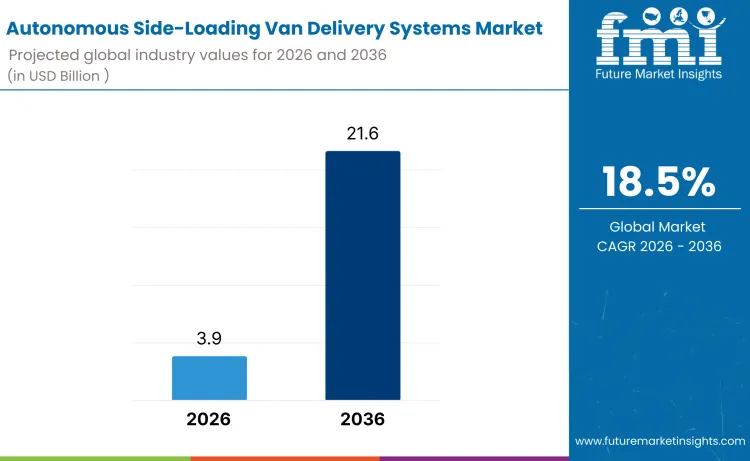
Autonomous Side-Loading Van Delivery Systems Market Key Takeaways
| Metric | Value |
|---|---|
| Market Value (2026) | USD 3.9 billion |
| Market Forecast Value (2036) | USD 21.6 billion |
| Forecast CAGR (2026 to 2036) | 18.5% |
How Are the Segments Classified in the Autonomous Side-Loading Van Delivery Systems Market?
Demand for autonomous side-loading van delivery systems is shaped by automated loading requirements, increasing parcel density, and interest in reducing labor dependency across last-mile and mid-mile transport. Buyers evaluate autonomy capability, loading-mechanism efficiency, and cargo-handling precision supporting e-commerce, retail replenishment, and industrial logistics. Adoption patterns reflect the shift toward automated vehicle platforms that streamline loading operations and improve delivery throughput in urban and controlled environments.
Which Vehicle Type Accounts for the Largest Share of Global Demand?
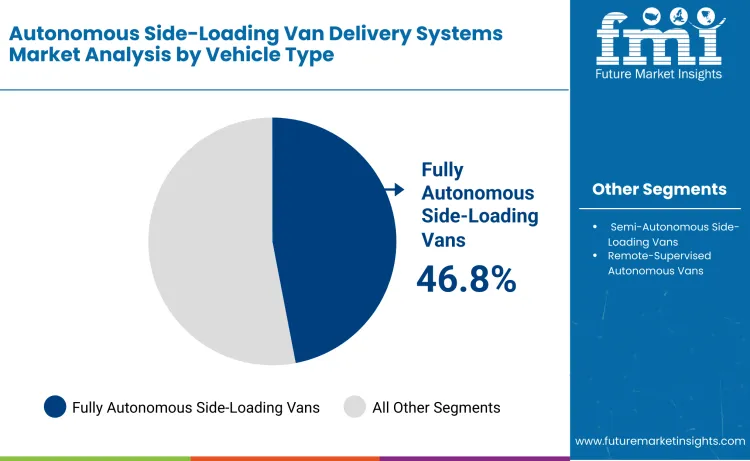
Fully autonomous side-loading vans hold 46.8%, making them the leading vehicle-type segment globally. These platforms support independent navigation, automated curb operations, and continuous delivery cycles with minimal human oversight. Semi-autonomous vans support partial autonomy with supervised navigation in complex environments. Remote-supervised autonomous vans operate autonomously with remote human intervention when needed. Vehicle-type distribution reflects the push toward full autonomy for cost reduction, operational continuity, and safety-validated navigation.
Key Points:
- Fully autonomous vans support continuous independent delivery cycles.
- Semi-autonomous vans operate with partial navigation automation.
- Remote-supervised vans rely on human oversight during exceptions.
- Distribution aligns with autonomy maturity and operational cost goals.
Which Loading Mechanism Represents the Largest Share of Global Demand?
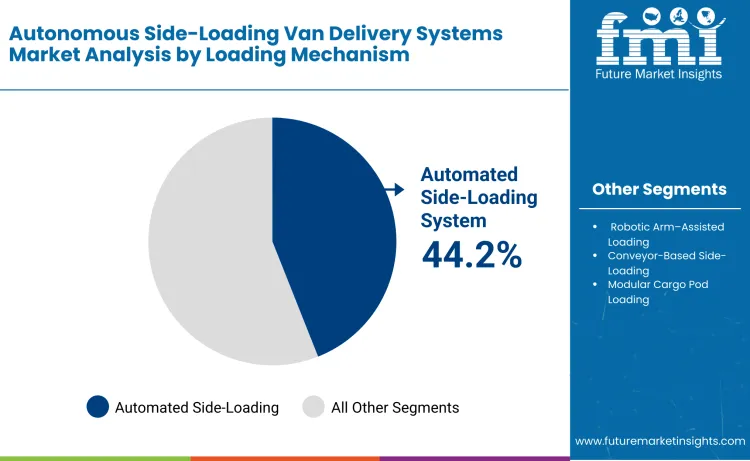
Automated side-loading systems hold 44.2%, making them the leading loading-mechanism segment globally. These systems support rapid curbside loading, consistent parcel handling, and reduced manual intervention for high-frequency delivery operations. Robotic arm-assisted loading supports precise package manipulation and variable cargo geometries. Conveyor-based side-loading supports continuous flow loading for bulk or repetitive parcels. Modular cargo pod loading supports pre-loaded pods transferred directly into vans to reduce dwell time. Mechanism distribution reflects speed, automation level, and parcel-volume characteristics.
Key Points:
- Automated side-loading supports fast, consistent curbside operations.
- Robotic arms handle variable-shaped parcels with precision.
- Conveyor systems support high-throughput bulk loading.
- Pod loading reduces dwell time through pre-configured cargo modules.
Which Application Accounts for the Largest Share of Global Demand?
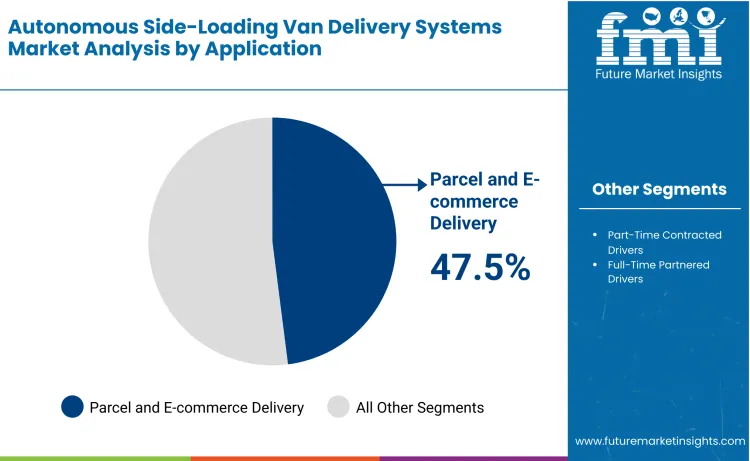
Parcel and e-commerce delivery holds 47.5%, making it the largest application segment globally. High parcel density, short delivery windows, and repetitive routes drive adoption of autonomous side-loading vans for automated handling and delivery optimization. Retail and store replenishment supports scheduled restocking and intra-day movements. B2B industrial deliveries support plant-to-warehouse transfers and component movement. Urban micro-fulfillment transport supports short-range movement of consolidated loads between hubs. Application distribution reflects automation demand in high-volume parcel networks and structured replenishment workflows.
Key Points:
- Parcel delivery dominates due to high-volume automated workflows.
- Retail replenishment supports scheduled multi-stop delivery.
- B2B deliveries benefit from predictable industrial routes.
- Micro-fulfillment transport supports short-range hub transfers.
What are the Key Dynamics in the Autonomous Side-Loading Van Delivery Systems Market?
Global demand rises as logistics operators evaluate autonomous vans equipped with side-loading mechanisms to improve route density, reduce labour dependence, and enhance parcel handoff efficiency in urban and suburban zones. Automated loading modules support structured compartment access, enabling precise drop sequences. Fleet platforms integrate navigation, safety monitoring, and cargo management. Retailers and carriers explore autonomous vans to stabilize delivery performance while meeting sustainability and operational continuity goals across high volume distribution corridors.
How are automation needs and route efficiency goals shaping adoption of autonomous side-loading vans?
Logistics networks experience rising parcel volumes, prompting interest in autonomous systems capable of delivering consistent performance across extended operating hours. Side-loading designs enable compartment based sequencing that aligns with high stop density routes. Operators value improved dwell time control enabled by automated doors and guided access points. Fleet managers integrate sensor based navigation tools to support safe manoeuvring in mixed traffic environments. Autonomous vans complement microhub operations by performing predictable trunk routes. Carriers evaluate systems that reduce labour exposure during peak seasons. Data driven routing engines enhance utilization by coordinating compartment assignments with zone based delivery patterns.
How do regulatory constraints, capital intensity, and operational integration challenges influence scalability?
Autonomous deployment depends on jurisdictional rules governing vehicle testing, remote monitoring, safety protocols, and commercial operation. High acquisition cost for autonomous platforms, perception sensors, and cargo automation modules affects investment planning. Integration with carrier systems requires alignment of routing engines, parcel identification workflows, and real time status updates. Weather variability influences sensor reliability and route predictability. Infrastructure gaps such as limited loading zones constrain adoption in dense districts. Mixed fleet coordination introduces complexities for dispatch teams managing both human driven and autonomous assets. Insurance and liability frameworks evolve slowly, shaping risk assessments for large scale rollout.
How is Demand for Autonomous Side-Loading Van Delivery Systems Market Evolving Across Key Countries?
Demand for the autonomous side-loading van delivery systems market is rising due to rapid automation across last-mile logistics, higher parcel density, and strong interest in reducing handling time through side-loading mechanisms. China records a CAGR of 19.7% supported by large-scale autonomous vehicle testing. India shows an 18.9% CAGR driven by growing delivery automation needs. USA posts a 17.8% CAGR supported by strong investment in autonomous logistics. Japan holds a 16.5% CAGR linked with structured mobility optimization. UK records a 15.7% CAGR supported by urban freight modernization and low-emission delivery initiatives.
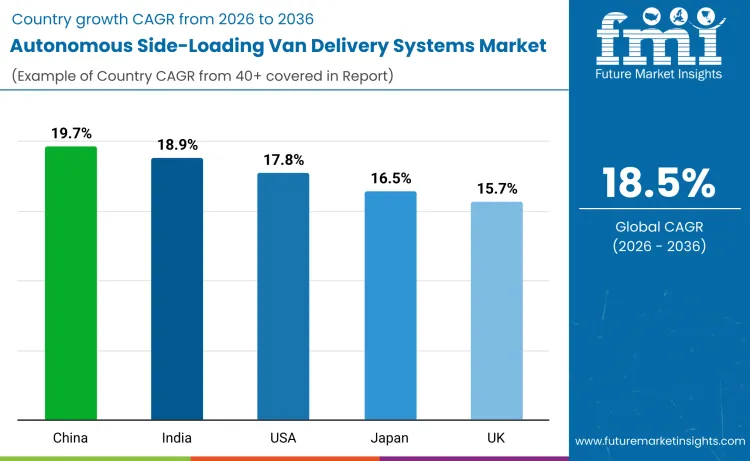
| Country | CAGR (%) |
|---|---|
| China | 19.7% |
| India | 18.9% |
| USA | 17.8% |
| Japan | 16.5% |
| UK | 15.7% |
How is China driving demand for Autonomous Side-Loading Van Delivery Systems?
China drives demand through accelerated autonomous-vehicle testing, high parcel throughput, and rapid deployment of advanced delivery technologies. The country’s CAGR of 19.7% reflects strong use of autonomous vans equipped with side-loading modules to reduce dwell time during parcel transfers. Logistics operators adopt side-loading systems to improve curbside efficiency in dense commercial areas. Technology firms develop integrated robotics and sensing systems supporting safe autonomous navigation. Urban pilot zones allow controlled trials optimizing loading performance and route scheduling. National initiatives promoting automated logistics strengthen continuous adoption across large delivery networks.
- Strong autonomous-vehicle R&D and deployment
- High parcel volumes requiring fast loading operations
- Urban pilot zones supporting advanced delivery automation
- Integration of robotics and sensing for curbside efficiency
How is India driving demand for Autonomous Side-Loading Van Delivery Systems?
India supports rising demand due to high urban congestion, rapid logistics digitization, and increased interest in autonomous delivery operations. The country’s CAGR of 18.9% reflects early adoption of side-loading vans to streamline parcel handling in dense cities. Logistics providers explore automation to reduce labor bottlenecks and support high-frequency deliveries. Technology firms test autonomous-navigation modules across controlled urban pathways. Retail networks consider autonomous systems for predictable intra-city transport. Side-loading configurations improve turnaround time in areas with limited curb access.
- Strong urban congestion accelerating automation adoption
- Pilot operations testing autonomous navigation
- Retail and logistics interest in predictable intra-city delivery
- Side-loading systems reducing curbside delays
How is the USA driving demand for Autonomous Side-Loading Van Delivery Systems?
USA drives demand through strong investment in autonomous logistics technology, high delivery frequency, and emphasis on operational efficiency. The country’s CAGR of 17.8% reflects steady trial deployment of autonomous vans using side-loading systems to accelerate parcel handling. Logistics firms integrate autonomous fleets into short-range delivery routes. Retailers adopt automated side-loading workflows to manage high-volume fulfilment. Technology companies develop advanced perception modules improving safety and curbside alignment. Urban-delivery strategies encourage low-impact autonomous vehicles that reduce congestion.
- Broad investment in autonomous logistics
- Retail and logistics deployment of side-loading systems
- Advanced perception and navigation module development
- Urban strategies supporting low-impact autonomous delivery
How is Japan driving demand for Autonomous Side-Loading Van Delivery Systems?
Japan drives demand due to its structured logistics ecosystem, compact cities, and emphasis on predictable delivery performance. The country’s CAGR of 16.5% reflects controlled trials of autonomous vans supporting time-sensitive fulfilment. Side-loading configurations enable efficient handling in narrow urban corridors. Logistics operators integrate autonomous scheduling tools to maintain punctuality. Municipal authorities collaborate with technology developers to test safe navigation protocols. Retail and parcel networks incorporate autonomous systems to manage workforce constraints.
- Compact urban environments requiring efficient loading
- Strong focus on punctuality in logistics operations
- Collaboration between municipalities and technology firms
- Controlled deployment supporting predictable delivery cycles
How is the UK driving demand for Autonomous Side-Loading Van Delivery Systems?
UK supports demand through clean-transport goals, urban-access regulations, and modernization of last-mile delivery networks. The country’s CAGR of 15.7% reflects growing interest in autonomous vans that support efficient loading within restricted-access zones. Logistics operators test autonomous units to maintain service reliability while reducing emissions. Side-loading systems improve performance where parking constraints limit rear-loading options. Retailers integrate autonomous workflows into urban-delivery pilots. National freight strategies encourage adoption of automation that minimizes road impact.
- Urban-access regulations supporting autonomous solutions
- Side-loading systems improving curbside operations
- Retail pilots testing autonomous delivery
- National strategies promoting low-impact logistics automation
What is the competitive landscape of demand for autonomous side-loading van delivery systems globally?
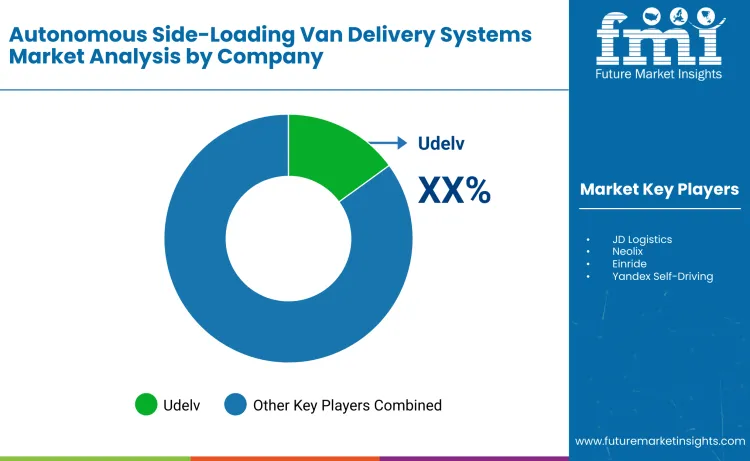
Demand for autonomous side-loading van delivery systems grows as retailers, parcel carriers, and urban logistics operators explore automated mid-capacity delivery assets suited for dense districts and controlled-access environments. Requirements center on reliable perception systems, side-bay loading mechanisms, secure compartment control, and fleet management software supporting dynamic routing. Buyers evaluate sensor redundancy, cargo modularity, remote assistance capability, and integration with existing fulfillment platforms. Procurement teams prioritize operational safety, regulatory readiness, and vehicle uptime across structured delivery corridors. Trend in the global market reflects rising interest in medium-format autonomous vehicles bridging the gap between sidewalk robots and full-scale autonomous trucks.
JD Logistics participates with autonomous delivery vehicles deployed across Chinese urban districts featuring side-access compartments and integrated parcel workflows. Neolix maintains visibility with autonomous vans used in commercial delivery programs and smart-city pilots involving structured curbside interactions. Einride supports demand with autonomous electric platforms configured for controlled-environment delivery operations where side-access cargo management is incorporated into logistics workflows. Yandex Self-Driving Group contributes medium-format autonomous delivery vehicles tested in select regions using compartmentalized cargo designs. Competitive positioning globally reflects safety architecture, compartment engineering, fleet orchestration capability, and regulatory integration supporting scalable autonomous delivery fleets.
Key Players in the Autonomous Side-Loading Van Delivery Systems Market
- Udelv
- JD Logistics
- Neolix
- Einride
- Yandex Self-Driving Group
Scope of the Report
| Items | Values |
|---|---|
| Quantitative Units | USD billion |
| Vehicle Type | Fully Autonomous Side-Loading Vans, Semi-Autonomous Side-Loading Vans, Remote-Supervised Autonomous Vans |
| Loading Mechanism | Automated Side-Loading Systems, Robotic Arm-Assisted Loading, Conveyor-Based Side-Loading, Modular Cargo Pod Loading |
| Application | Parcel & E-commerce Delivery, Retail & Store Replenishment, B2B Industrial Deliveries, Urban Micro-Fulfillment Transport |
| End-User | Logistics & Parcel Delivery Companies, Retail & E-commerce Operators, Third-Party Delivery Providers, Industrial & Manufacturing Enterprises |
| Regions Covered | Asia Pacific, Europe, North America, Latin America, Middle East & Africa |
| Countries Covered | India, China, USA, Germany, South Korea, Japan, Italy, and 40+ countries |
| Key Companies Profiled | Udelv, JD Logistics, Neolix, Einride, Yandex Self-Driving Group |
| Additional Attributes | Dollar sales by vehicle type, loading mechanism, and application; adoption trends across autonomous logistics fleets and urban delivery ecosystems; integration of robotic loading, AI navigation, and V2X-enabled delivery automation; infrastructure readiness and regulatory developments for autonomous commercial vehicles; competitive landscape involving autonomous van manufacturers, robotics integrators, and last-mile automation platforms; operational efficiency gains in micro-fulfillment, parcel routing, and industrial B2B delivery networks. |
Autonomous Side-Loading Van Delivery Systems Market by Segment
By Vehicle Type:
- Fully Autonomous Side-Loading Vans
- Semi-Autonomous Side-Loading Vans
- Remote-Supervised Autonomous Vans
By Loading Mechanism:
- Automated Side-Loading Systems
- Robotic Arm-Assisted Loading
- Conveyor-Based Side-Loading
- Modular Cargo Pod Loading
By Application:
- Parcel & E-commerce Delivery
- Retail & Store Replenishment
- B2B Industrial Deliveries
- Urban Micro-Fulfillment Transport
By End-User:
- Logistics & Parcel Delivery Companies
- Retail & E-commerce Operators
- Third-Party Delivery Providers
- Industrial & Manufacturing Enterprises
Region:
- Asia Pacific
- China
- Japan
- South Korea
- India
- Australia & New Zealand
- ASEAN
- Rest of Asia Pacific
- Europe
- Germany
- United Kingdom
- France
- Italy
- Spain
- Nordic
- BENELUX
- Rest of Europe
- North America
- United States
- Canada
- Mexico
- Latin America
- Brazil
- Chile
- Rest of Latin America
- Middle East & Africa
- Kingdom of Saudi Arabia
- Other GCC Countries
- Turkey
- South Africa
- Other African Union
- Rest of Middle East & Africa
Frequently Asked Questions
What is the size of the autonomous side-loading van delivery systems market in 2026?
The market is valued at USD 3.9 billion in 2026 due to early adoption of autonomous vehicle platforms with integrated loading modules.
What will be the industry size by 2036?
Industry value will reach USD 21.6 billion by 2036 as logistics operators scale autonomous van fleets and integrate automated loading systems.
What is the CAGR for 2026 to 2036?
The autonomous side-loading van delivery systems market expands at an 18.5% CAGR during the forecast period.
Which vehicle-type segment leads in 2026?
Fully autonomous side-loading vans hold 46.8% share, supported by advancements in perception systems and autonomous navigation.
Which loading-mechanism segment holds the highest share?
Automated side-loading systems lead with 44.2% share due to their role in accelerating parcel transfer and reducing manual intervention.
Preview the report firsthand - request a free sample
Get SampleGet the brochure for pricing and purchase details.
Get PDFTable of Content
- Executive Summary
- Market Overview
- Global Market Value, 2020 to 2026
- Global Market Forecast, 2026 to 2036
- Market Dynamics
- Drivers
- Restraints
- Opportunities
- Regulatory & Standards Landscape
- Technology & Autonomous Side-Loading System Innovation Outlook
- Market Segmentation Analysis
- By Vehicle Type
- Fully Autonomous Side-Loading Vans
- Semi-Autonomous Side-Loading Vans
- Remote-Supervised Autonomous Vans
- By Loading Mechanism
- Automated Side-Loading Systems
- Robotic Arm-Assisted Loading
- Conveyor-Based Side-Loading
- Modular Cargo Pod Loading
- By Application
- Parcel & E-commerce Delivery
- Retail & Store Replenishment
- B2B Industrial Deliveries
- Urban Micro-Fulfillment Transport
- By End-User
- Logistics & Parcel Delivery Companies
- Retail & E-commerce Operators
- Third-Party Delivery Providers
- Industrial & Manufacturing Enterprises
- By Vehicle Type
- Regional Outlook
- Asia Pacific
- Europe
- North America
- Latin America
- Middle East & Africa
- Country-Level Outlook
- China
- India
- USA
- Japan
- United Kingdom
- Germany
- South Korea
- Italy
- Australia & New Zealand
- ASEAN
- Brazil
- Chile
- Turkey
- South Africa
- Other GCC Countries
- Rest of Europe
- Rest of Latin America
- Rest of Middle East & Africa
- Competitive Landscape
- Market Structure Overview
- Company Positioning
- Strategic Initiatives
- Key Player Profiles
- Scope of the Report
- Research Methodology
- Assumptions & Acronyms


