

- Industry Size (2026)
- USD 809.0 Mn
- Forecast (2036)
- USD 1163.4 Mn
- CAGR (2026 to 2036)
- 3.7%
Delivery Van Sliding Door Rollers, Hinges and Latches Market Forecast and Outlook 2026 to 2036
The delivery van sliding door rollers, hinges and latches market is valued at USD 809.0 million in 2026 and is projected to reach USD 1,163.4 million by 2036 at a CAGR of 3.7%. Value realization is closely tied to mechanical wear exposure rather than feature-driven upgrade cycles. Demand concentration reflects intensive door usage in last-mile delivery fleets, where repeated opening, vibration, and alignment stress accelerate component fatigue. OEM fitment volumes remain structurally stable, while replacement demand is sustained by preventive maintenance programs linked to uptime targets and safety compliance. Component specification emphasizes dimensional accuracy, corrosion resistance, and tolerance to uneven load transfer during curbside operations.
Replacement behavior across the forecast period is governed by utilization intensity, maintenance discipline, and platform standardization rather than expansion in delivery van production. Higher stop density and compressed delivery routes increase cycle counts per vehicle, reinforcing predictable service-led consumption. Electrified delivery vans raise daily operating hours without proportionally extending component life, sustaining steady replacement intervals.
Quick Stats for Delivery Van Sliding Door Rollers, Hinges and Latches Market
- Delivery Van Sliding Door Rollers, Hinges and Latches Market Value (2026): USD 809.0 million
- Delivery Van Sliding Door Rollers, Hinges and Latches Market Forecast Value (2036): USD 1,163.4 million
- Delivery Van Sliding Door Rollers, Hinges and Latches Market Forecast CAGR 2026 to 2036: 3.7%
- Leading Component by Demand Share: Rollers or Carriages
- Fastest-Growing Countries: China, Brazil, USA, Germany, South Korea
- Top Players in Global Demand: Brose, Magna, Kiekert, AISIN, Shiroki, Inteva Products, U-Shin, GNS, Mitsui Kinzoku ACT, Huf
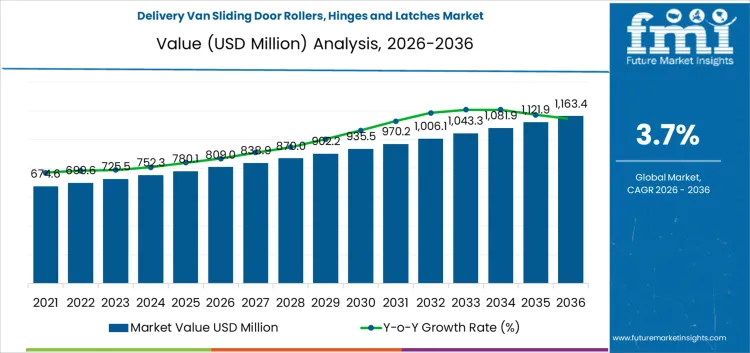
Design change remains incremental due to body-in-white constraints and installation labor sensitivity. Manufacturing scale depends on precision metal forming and bearing supply capacity, limiting aggressive cost compression. Demand progression remains stable, supported by urban delivery concentration, disciplined fleet maintenance practices, and structured aftermarket procurement patterns rather than rapid fleet growth.
Delivery Van Sliding Door Rollers, Hinges and Latches Market Key Takeaways
| Metric | Value |
|---|---|
| Market Value (2026) | USD 809.0 million |
| Market Forecast Value (2036) | USD 1,163.4 million |
| Forecast CAGR 2026 to 2036 | 3.7% |
Why is the Demand for Delivery Van Sliding Door Rollers, Hinges and Latches Growing?
Demand for delivery van sliding door rollers, hinges and latches is rising as logistics operations require durable components that support frequent access cycles in delivery van applications. Fleet managers specify sliding door rollers, hinges and latches with reliable performance under heavy use and varied road conditions to maintain cargo security and operator safety. Engineers assess material strength, corrosion resistance and tolerance to vibration when selecting hardware that aligns with vehicle design criteria. Procurement teams evaluate supplier support, part interchangeability and installation complexity to minimize downtime in service facilities.
Transit planners emphasize predictable wear behavior to support maintenance planning and reduce operational disruptions in last mile delivery. Growth in e commerce and parcel transport reinforces utilization of robust sliding door hardware that supports efficient loading and unloading activity. Component designers integrate precision bearings and reinforced latch mechanisms to ensure smooth door movement while resisting deformation and service failure. Service technicians coordinate with parts suppliers to maintain inventory of high quality rollers, hinges and latches that align with manufacturer specifications. These drivers contribute to sustained adoption of sliding door system components across delivery fleets and commercial vehicle networks.
How Are the Segments Classified in the Delivery Van Sliding Door Rollers, Hinges and Latches Market?
Demand for sliding door rollers, hinges and latches is shaped by high vehicle utilization, frequent door cycling, and durability expectations in last-mile logistics. Delivery operations require reliable door mechanisms supporting repeated opening and closing under time-sensitive conditions. Component selection prioritizes smooth motion, load tolerance, and resistance to wear. Growth in urban delivery fleets increases focus on maintenance efficiency and component longevity. Segment classification reflects differentiation by component function, vehicle application, and feature capability. Structure highlights how mechanical role, fleet usage intensity, and feature readiness influence specification priorities, replacement frequency, and adoption patterns across commercial delivery vehicles.
Which Component Represents the Largest Share of Demand?
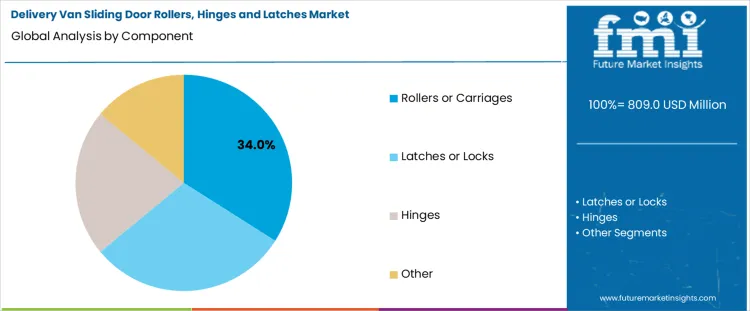
Rollers or carriages hold 34.0%, representing the largest share among sliding door components due to continuous load-bearing and motion guidance roles. These components support smooth horizontal movement of heavy sliding doors during frequent delivery stops. Wear exposure remains high due to vibration, dust ingress, and repeated cycling. Design emphasis includes low friction, alignment stability, and corrosion resistance. Latches and locks secure doors during transit and loading operations with high safety relevance. Hinges support pivoting functions in mixed door configurations. Component segmentation reflects higher replacement intensity and performance sensitivity associated with motion-guiding elements.
Key Points
- Rollers manage continuous load and movement stress.
- Frequent cycling increases wear and replacement needs.
- Other components support securing and pivoting functions.
Which Vehicle Type Accounts for the Highest Share of Demand?
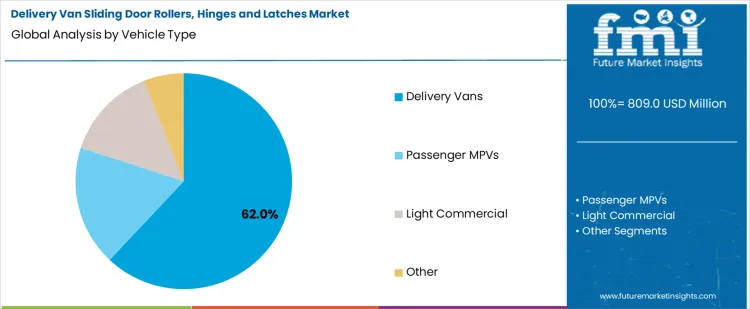
Delivery vans hold 62.0%, representing the largest share among vehicle types due to intensive last-mile logistics usage. High stop frequency and cargo access requirements drive repeated door operation. Sliding doors support efficient loading in constrained urban environments. Fleet operators emphasize component durability to reduce downtime and maintenance costs. Passenger MPVs and light commercial vehicles use sliding doors with lower cycle intensity. Other vehicle types contribute limited aggregate demand. Vehicle type segmentation reflects concentration of component usage within delivery-focused fleets where operational efficiency and reliability remain critical.
Key Points
- Delivery vans experience the highest door usage intensity.
- Urban logistics require frequent and rapid door operation.
- Other vehicles operate under lower duty cycles.
Which Feature Level Drives the Largest Share of Demand?
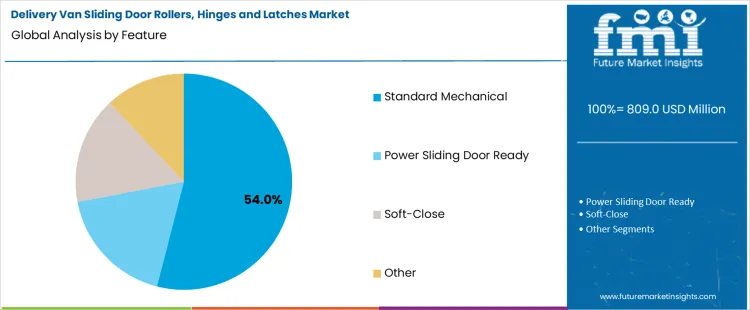
Standard mechanical systems hold 54.0%, representing the largest share among feature levels due to simplicity and reliability. Mechanical designs offer predictable performance with minimal electronic dependency. Maintenance familiarity supports widespread adoption across fleet operators. Cost control remains important for large fleet deployments. Power sliding door readiness and soft-close features support convenience and safety in premium or specialized applications. Other features address niche requirements. Feature segmentation reflects preference for proven mechanical solutions where durability, serviceability, and scalability align with high-utilization commercial delivery operations.
Key Points
- Mechanical systems offer reliability and service simplicity.
- Cost efficiency supports large fleet deployment.
- Advanced features serve convenience-focused applications.
What are the Key Dynamics in the Delivery Van Sliding Door Rollers, Hinges and Latches Market?
Demand for delivery van sliding door rollers, hinges and latches reflects operational need for reliable access, safety, and durability in high-frequency parcel handling environments. Adoption spans light commercial delivery vans used in e-commerce, postal services, and urban logistics fleets. Global scope aligns with rising stop density, vehicle utilization intensity, and fleet uptime priorities. Usage centers on mechanical components engineered for repeated cycling, load tolerance, and secure closure under varied operating conditions.
How do last-mile logistics intensity and fleet utilization patterns shape adoption?
Delivery operations require sliding door systems capable of thousands of open-close cycles without performance degradation. Demand increases as last-mile routes involve frequent stops, tight delivery windows, and manual handling of parcels. Rollers and hinges must support smooth lateral motion under load while minimizing operator effort. Latch reliability directly affects driver safety and cargo security during transit. Fleet operators prioritize components that reduce door jamming, misalignment, and vibration noise. Compatibility with automated locking and central locking systems strengthens adoption. Urban delivery conditions increase exposure to dust, moisture, and impact, reinforcing need for robust materials and protective coatings. Adoption reflects focus on operational continuity and driver productivity.
How do durability requirements and cost pressures influence market scalability?
Component wear accelerates under high-duty cycles, increasing replacement frequency and maintenance cost. Demand sensitivity rises where fleet operators evaluate total ownership cost rather than unit price alone. Material selection affects corrosion resistance and long-term dimensional stability. Integration constraints emerge across van platforms with differing door geometries and mounting standards. Quality variation among suppliers influences failure rates and warranty exposure. Installation labor cost affects aftermarket replacement economics. Noise and vibration regulations increase design tolerance requirements. Supply chain dependence on precision metal forming and bearing components constrains rapid scaling across high-volume fleet expansion programs.
How Is Demand for Delivery Van Sliding Door Rollers, Hinges and Latches Evolving Globally?
Demand for delivery van sliding door rollers, hinges and latches is expanding globally due to sustained parcel growth, urban delivery intensity, and maintenance-led replacement cycles. Component wear correlates with stop frequency, payload handling, and duty hours rather than new vehicle volume alone. Electrification and route optimization increase daily door cycles, raising durability requirements. Fleet operators prioritize uptime, noise reduction, and safety compliance in door hardware selection. Growth rates in China at 4.7%, Brazil at 4.6%, USA at 3.5%, Germany at 3.3%, and South Korea at 3.2% indicate steady expansion driven by operating intensity, preventive maintenance practices, and aftermarket demand.
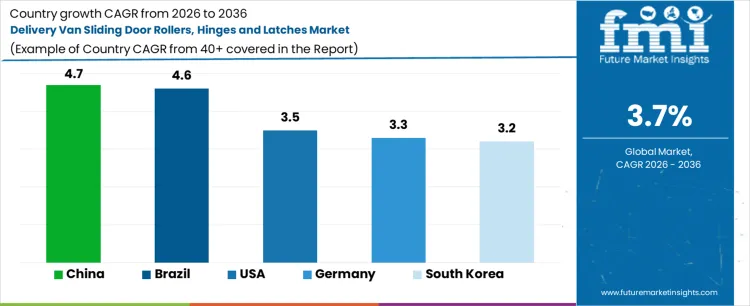
| Country | CAGR (%) |
|---|---|
| China | 4.7% |
| Brazil | 4.6% |
| USA | 3.5% |
| Germany | 3.3% |
| South Korea | 3.2% |
What Is Supporting Demand Growth for Delivery Van Door Hardware in China?
Urban logistics density underpins delivery van sliding door hardware demand in China, growing at a CAGR of 4.7%. High stop frequency in last-mile routes accelerates wear on rollers and latches. E-commerce fulfillment models emphasize rapid loading and unloading, increasing mechanical cycles per shift. Fleet electrification raises daily utilization, reinforcing replacement needs. Domestic van production supports OEM fitment volumes, while safety inspections prompt timely component swaps. Demand remains maintenance-led, reflecting high utilization and preventive service schedules across urban fleets.
- High stop frequency in dense urban delivery routes
- E-commerce-driven loading and unloading intensity
- Electrified fleets increasing daily utilization
- Safety inspection regimes supporting replacements
Why Is Brazil Seeing Steady Expansion in Sliding Door Component Demand?
Operating conditions shape delivery van sliding door component demand in Brazil, expanding at a CAGR of 4.6%. Long urban routes and uneven road surfaces elevate vibration and alignment stress on hinges and rollers. Parcel and grocery delivery growth increases door cycle counts. Warm climates and dust exposure influence material wear and lubrication intervals. Fleet aging contributes to aftermarket demand as operators prioritize uptime. Growth reflects operating environment stress and service-led replacement rather than rapid fleet expansion.
- Vibration and alignment stress from road conditions
- Rising parcel and grocery delivery activity
- Climate and dust affecting component wear
- Aging fleets driving aftermarket replacement
How Is the USA Sustaining Demand for Delivery Van Door Rollers and Latches?
Maintenance economics sustain delivery van door hardware demand in the USA at a CAGR of 3.5%. High-mileage routes and frequent curbside stops increase latch and roller fatigue. Fleet operators emphasize preventive replacement to reduce downtime costs. Expansion of electric delivery vans raises utilization without proportional fleet growth. Compliance with safety standards influences latch reliability specifications. Demand growth remains measured, aligned with disciplined maintenance programs across large national fleets.
- High-mileage routes with frequent stops
- Preventive maintenance to avoid downtime
- Electrified vans increasing utilization rates
- Safety compliance shaping hardware specifications
What Factors Are Shaping Demand in Germany?
Structured fleet management defines delivery van sliding door component demand in Germany, growing at a CAGR of 3.3%. Preventive maintenance schedules extend component life, moderating replacement frequency. Urban low-emission zones concentrate delivery activity, increasing localized wear. Engineering standards prioritize noise reduction and precise door alignment. OEM-quality replacements dominate procurement to maintain vehicle certification. Growth reflects predictable service cycles within mature logistics operations rather than increases in vehicle counts.
- Preventive maintenance extending component lifespan
- Concentrated urban delivery within low-emission zones
- Emphasis on noise reduction and alignment precision
- OEM-quality replacement preference
Why Does South Korea Show Controlled Growth in Door Hardware Demand?
Geographic compactness and operational discipline shape delivery van door hardware demand in South Korea, expanding at a CAGR of 3.2%. Shorter routes limit cumulative wear per vehicle. High delivery density increases door cycles, balanced by strong maintenance practices. Smart logistics platforms optimize routes, reducing unnecessary stops. Manufacturing and urban retail deliveries sustain steady utilization. Growth remains controlled, reflecting efficiency gains and scheduled servicing rather than accelerated fleet expansion.
- Shorter routes limiting cumulative wear
- High delivery density increasing cycle counts
- Route optimization reducing unnecessary stops
- Strong maintenance discipline across fleets
What is the competitive landscape of demand for delivery van sliding door rollers, hinges and latches globally?
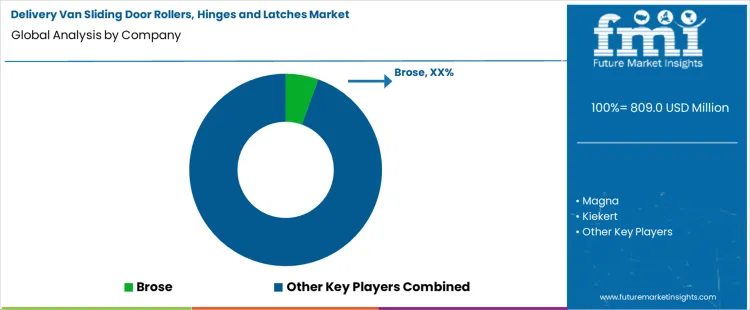
Demand for delivery van sliding door rollers, hinges and latches is driven by growth in last-mile logistics, commercial van production, and requirements for durability and smooth operation under frequent use. Buyers evaluate load capacity, wear resistance, corrosion protection, precision fit, and ease of assembly within body-in-white and final assembly operations. Procurement teams prioritize suppliers with proven OEM qualifications, global manufacturing and logistics networks, and ability to align component designs with diverse van architectures. Trend in the global market reflects rising e-commerce delivery fleets, emphasis on reducing total cost of ownership, and integration of components that support quieter, more reliable door movement.
Brose holds leading positioning through engineered sliding door systems, rollers, and latch mechanisms widely adopted by commercial vehicle OEMs supported by global production and technical support. Magna supports demand with sliding door components and hinge assemblies tailored for light commercial vehicles and last-mile platforms. Kiekert contributes door latch and locking systems with strong reliability credentials for commercial applications. AISIN participates with precision door hardware and hinge solutions integrated into vehicle body systems. Inteva Products supplies rollers, guides, and mechanical systems for sliding and hinged doors with design flexibility for multiple van platforms. Competitive differentiation depends on component endurance, precision engineering, integration with vehicle systems, and ability to meet OEM launch timing and quality standards.
Key Players in the Delivery Van Sliding Door Rollers, Hinges and Latches Market
- Brose
- Magna
- Kiekert
- AISIN
- Shiroki
- Inteva Products
- U-Shin
- GNS
- Mitsui Kinzoku ACT
- Huf
Scope of the Report
| Items | Values |
|---|---|
| Quantitative Units | USD million |
| Component | Rollers or Carriages; Latches or Locks; Hinges; Other |
| Vehicle Type | Delivery Vans; Passenger MPVs; Light Commercial; Other |
| Feature | Standard Mechanical; Power Sliding Door Ready; Soft-Close; Other |
| Sales Channel | OEM Line-Fit; Aftermarket; Dealer or OES; Other |
| Regions Covered | Asia Pacific, Europe, North America, Latin America, Middle East & Africa |
| Countries Covered | China, Brazil, USA, Germany, South Korea, and 40+ countries |
| Key Companies Profiled | Brose; Magna; Kiekert; AISIN; Shiroki; Inteva Products; U-Shin; GNS; Mitsui Kinzoku ACT; Huf |
| Additional Attributes | Dollar sales by component and sales channel; adoption trends for power-ready and soft-close sliding door hardware in last-mile delivery fleets; load capacity, wear life, and corrosion resistance performance metrics; noise and closing-force consistency requirements; compatibility with manual and motorized sliding door architectures; compliance with OEM durability targets, safety standards, and lifecycle cost expectations influencing component selection. |
Delivery Van Sliding Door Rollers, Hinges and Latches Market by Segment
Component:
- Rollers or Carriages
- Latches or Locks
- Hinges
- Other
Vehicle Type:
- Delivery Vans
- Passenger MPVs
- Light Commercial
- Other
Feature:
- Standard Mechanical
- Power Sliding Door Ready
- Soft-Close
- Other
Sales Channel:
- OEM Line-Fit
- Aftermarket
- Dealer or OES
- Other
Region:
- Asia Pacific
- China
- Japan
- South Korea
- India
- Australia & New Zealand
- ASEAN
- Rest of Asia Pacific
- Europe
- Germany
- United Kingdom
- France
- Italy
- Spain
- Nordic
- BENELUX
- Rest of Europe
- North America
- United States
- Canada
- Mexico
- Latin America
- Brazil
- Chile
- Rest of Latin America
- Middle East & Africa
- Kingdom of Saudi Arabia
- Other GCC Countries
- Turkey
- South Africa
- Other African Union
- Rest of Middle East & Africa
Bibliography
- International Organization of Motor Vehicle Manufacturers (OICA). (2024). Light commercial vehicle production trends and implications for body hardware component demand. OICA Statistical Publications.
- Society of Automotive Engineers International. (2023). Durability, wear, and noise considerations for sliding door rollers, hinges and latches in delivery vans. SAE Technical Papers.
- European Automobile Manufacturers’ Association (ACEA). (2024). Light commercial vehicle usage patterns, last-mile logistics intensity, and component lifecycle considerations. ACEA Industry Reports.
Frequently Asked Questions
How big is the delivery van sliding door rollers, hinges and latches market in 2026?
The global delivery van sliding door rollers, hinges and latches market is estimated to be valued at USD 809.0 million in 2026.
What will be the size of delivery van sliding door rollers, hinges and latches market in 2036?
The market size for the delivery van sliding door rollers, hinges and latches market is projected to reach USD 1,163.4 million by 2036.
How much will be the delivery van sliding door rollers, hinges and latches market growth between 2026 and 2036?
The delivery van sliding door rollers, hinges and latches market is expected to grow at a 3.7% CAGR between 2026 and 2036.
What are the key product types in the delivery van sliding door rollers, hinges and latches market?
The key product types in delivery van sliding door rollers, hinges and latches market are rollers or carriages, latches or locks, hinges and other.
Which vehicle type segment to contribute significant share in the delivery van sliding door rollers, hinges and latches market in 2026?
In terms of vehicle type, delivery vans segment to command 62.0% share in the delivery van sliding door rollers, hinges and latches market in 2026.
Preview the report firsthand - request a free sample
Get SampleGet the brochure for pricing and purchase details.
Get PDFTable of Content
- Executive Summary
- Global Market Outlook
- Demand-side Trends
- Supply-side Trends
- Technology Roadmap Analysis
- Analysis and Recommendations
- Market Overview
- Market Coverage / Taxonomy
- Market Definition / Scope / Limitations
- Market Background
- Market Dynamics
- Drivers
- Restraints
- Opportunity
- Trends
- Scenario Forecast
- Demand in Optimistic Scenario
- Demand in Likely Scenario
- Demand in Conservative Scenario
- Opportunity Map Analysis
- Product Life Cycle Analysis
- Supply Chain Analysis
- Investment Feasibility Matrix
- Value Chain Analysis
- PESTLE and Porter’s Analysis
- Regulatory Landscape
- Regional Parent Market Outlook
- Production and Consumption Statistics
- Import and Export Statistics
- Market Dynamics
- Global Market Analysis 2021 to 2025 and Forecast, 2026 to 2036
- Historical Market Size Value (USD Million) Analysis, 2021 to 2025
- Current and Future Market Size Value (USD Million) Projections, 2026 to 2036
- Y-o-Y Growth Trend Analysis
- Absolute $ Opportunity Analysis
- Global Market Pricing Analysis 2021 to 2025 and Forecast 2026 to 2036
- Global Market Analysis 2021 to 2025 and Forecast 2026 to 2036, By Component
- Introduction / Key Findings
- Historical Market Size Value (USD Million) Analysis By Component , 2021 to 2025
- Current and Future Market Size Value (USD Million) Analysis and Forecast By Component , 2026 to 2036
- Rollers or Carriages
- Latches or Locks
- Hinges
- Other
- Rollers or Carriages
- Y-o-Y Growth Trend Analysis By Component , 2021 to 2025
- Absolute $ Opportunity Analysis By Component , 2026 to 2036
- Global Market Analysis 2021 to 2025 and Forecast 2026 to 2036, By Vehicle Type
- Introduction / Key Findings
- Historical Market Size Value (USD Million) Analysis By Vehicle Type, 2021 to 2025
- Current and Future Market Size Value (USD Million) Analysis and Forecast By Vehicle Type, 2026 to 2036
- Delivery Vans
- Passenger MPVs
- Light Commercial
- Other
- Delivery Vans
- Y-o-Y Growth Trend Analysis By Vehicle Type, 2021 to 2025
- Absolute $ Opportunity Analysis By Vehicle Type, 2026 to 2036
- Global Market Analysis 2021 to 2025 and Forecast 2026 to 2036, By Feature
- Introduction / Key Findings
- Historical Market Size Value (USD Million) Analysis By Feature, 2021 to 2025
- Current and Future Market Size Value (USD Million) Analysis and Forecast By Feature, 2026 to 2036
- Standard Mechanical
- Power Sliding Door Ready
- Soft-Close
- Other
- Standard Mechanical
- Y-o-Y Growth Trend Analysis By Feature, 2021 to 2025
- Absolute $ Opportunity Analysis By Feature, 2026 to 2036
- Global Market Analysis 2021 to 2025 and Forecast 2026 to 2036, By Sales Channel
- Introduction / Key Findings
- Historical Market Size Value (USD Million) Analysis By Sales Channel, 2021 to 2025
- Current and Future Market Size Value (USD Million) Analysis and Forecast By Sales Channel, 2026 to 2036
- OEM Line-Fit
- Aftermarket
- Dealer or OES
- Other
- OEM Line-Fit
- Y-o-Y Growth Trend Analysis By Sales Channel, 2021 to 2025
- Absolute $ Opportunity Analysis By Sales Channel, 2026 to 2036
- Global Market Analysis 2021 to 2025 and Forecast 2026 to 2036, By Region
- Introduction
- Historical Market Size Value (USD Million) Analysis By Region, 2021 to 2025
- Current Market Size Value (USD Million) Analysis and Forecast By Region, 2026 to 2036
- North America
- Latin America
- Western Europe
- Eastern Europe
- East Asia
- South Asia and Pacific
- Middle East & Africa
- Market Attractiveness Analysis By Region
- North America Market Analysis 2021 to 2025 and Forecast 2026 to 2036, By Country
- Historical Market Size Value (USD Million) Trend Analysis By Market Taxonomy, 2021 to 2025
- Market Size Value (USD Million) Forecast By Market Taxonomy, 2026 to 2036
- By Country
- USA
- Canada
- Mexico
- By Component
- By Vehicle Type
- By Feature
- By Sales Channel
- By Country
- Market Attractiveness Analysis
- By Country
- By Component
- By Vehicle Type
- By Feature
- By Sales Channel
- Key Takeaways
- Latin America Market Analysis 2021 to 2025 and Forecast 2026 to 2036, By Country
- Historical Market Size Value (USD Million) Trend Analysis By Market Taxonomy, 2021 to 2025
- Market Size Value (USD Million) Forecast By Market Taxonomy, 2026 to 2036
- By Country
- Brazil
- Chile
- Rest of Latin America
- By Component
- By Vehicle Type
- By Feature
- By Sales Channel
- By Country
- Market Attractiveness Analysis
- By Country
- By Component
- By Vehicle Type
- By Feature
- By Sales Channel
- Key Takeaways
- Western Europe Market Analysis 2021 to 2025 and Forecast 2026 to 2036, By Country
- Historical Market Size Value (USD Million) Trend Analysis By Market Taxonomy, 2021 to 2025
- Market Size Value (USD Million) Forecast By Market Taxonomy, 2026 to 2036
- By Country
- Germany
- UK
- Italy
- Spain
- France
- Nordic
- BENELUX
- Rest of Western Europe
- By Component
- By Vehicle Type
- By Feature
- By Sales Channel
- By Country
- Market Attractiveness Analysis
- By Country
- By Component
- By Vehicle Type
- By Feature
- By Sales Channel
- Key Takeaways
- Eastern Europe Market Analysis 2021 to 2025 and Forecast 2026 to 2036, By Country
- Historical Market Size Value (USD Million) Trend Analysis By Market Taxonomy, 2021 to 2025
- Market Size Value (USD Million) Forecast By Market Taxonomy, 2026 to 2036
- By Country
- Russia
- Poland
- Hungary
- Balkan & Baltic
- Rest of Eastern Europe
- By Component
- By Vehicle Type
- By Feature
- By Sales Channel
- By Country
- Market Attractiveness Analysis
- By Country
- By Component
- By Vehicle Type
- By Feature
- By Sales Channel
- Key Takeaways
- East Asia Market Analysis 2021 to 2025 and Forecast 2026 to 2036, By Country
- Historical Market Size Value (USD Million) Trend Analysis By Market Taxonomy, 2021 to 2025
- Market Size Value (USD Million) Forecast By Market Taxonomy, 2026 to 2036
- By Country
- China
- Japan
- South Korea
- By Component
- By Vehicle Type
- By Feature
- By Sales Channel
- By Country
- Market Attractiveness Analysis
- By Country
- By Component
- By Vehicle Type
- By Feature
- By Sales Channel
- Key Takeaways
- South Asia and Pacific Market Analysis 2021 to 2025 and Forecast 2026 to 2036, By Country
- Historical Market Size Value (USD Million) Trend Analysis By Market Taxonomy, 2021 to 2025
- Market Size Value (USD Million) Forecast By Market Taxonomy, 2026 to 2036
- By Country
- India
- ASEAN
- Australia & New Zealand
- Rest of South Asia and Pacific
- By Component
- By Vehicle Type
- By Feature
- By Sales Channel
- By Country
- Market Attractiveness Analysis
- By Country
- By Component
- By Vehicle Type
- By Feature
- By Sales Channel
- Key Takeaways
- Middle East & Africa Market Analysis 2021 to 2025 and Forecast 2026 to 2036, By Country
- Historical Market Size Value (USD Million) Trend Analysis By Market Taxonomy, 2021 to 2025
- Market Size Value (USD Million) Forecast By Market Taxonomy, 2026 to 2036
- By Country
- Kingdom of Saudi Arabia
- Other GCC Countries
- Turkiye
- South Africa
- Other African Union
- Rest of Middle East & Africa
- By Component
- By Vehicle Type
- By Feature
- By Sales Channel
- By Country
- Market Attractiveness Analysis
- By Country
- By Component
- By Vehicle Type
- By Feature
- By Sales Channel
- Key Takeaways
- Key Countries Market Analysis
- USA
- Pricing Analysis
- Market Share Analysis, 2025
- By Component
- By Vehicle Type
- By Feature
- By Sales Channel
- Canada
- Pricing Analysis
- Market Share Analysis, 2025
- By Component
- By Vehicle Type
- By Feature
- By Sales Channel
- Mexico
- Pricing Analysis
- Market Share Analysis, 2025
- By Component
- By Vehicle Type
- By Feature
- By Sales Channel
- Brazil
- Pricing Analysis
- Market Share Analysis, 2025
- By Component
- By Vehicle Type
- By Feature
- By Sales Channel
- Chile
- Pricing Analysis
- Market Share Analysis, 2025
- By Component
- By Vehicle Type
- By Feature
- By Sales Channel
- Germany
- Pricing Analysis
- Market Share Analysis, 2025
- By Component
- By Vehicle Type
- By Feature
- By Sales Channel
- UK
- Pricing Analysis
- Market Share Analysis, 2025
- By Component
- By Vehicle Type
- By Feature
- By Sales Channel
- Italy
- Pricing Analysis
- Market Share Analysis, 2025
- By Component
- By Vehicle Type
- By Feature
- By Sales Channel
- Spain
- Pricing Analysis
- Market Share Analysis, 2025
- By Component
- By Vehicle Type
- By Feature
- By Sales Channel
- France
- Pricing Analysis
- Market Share Analysis, 2025
- By Component
- By Vehicle Type
- By Feature
- By Sales Channel
- India
- Pricing Analysis
- Market Share Analysis, 2025
- By Component
- By Vehicle Type
- By Feature
- By Sales Channel
- ASEAN
- Pricing Analysis
- Market Share Analysis, 2025
- By Component
- By Vehicle Type
- By Feature
- By Sales Channel
- Australia & New Zealand
- Pricing Analysis
- Market Share Analysis, 2025
- By Component
- By Vehicle Type
- By Feature
- By Sales Channel
- China
- Pricing Analysis
- Market Share Analysis, 2025
- By Component
- By Vehicle Type
- By Feature
- By Sales Channel
- Japan
- Pricing Analysis
- Market Share Analysis, 2025
- By Component
- By Vehicle Type
- By Feature
- By Sales Channel
- South Korea
- Pricing Analysis
- Market Share Analysis, 2025
- By Component
- By Vehicle Type
- By Feature
- By Sales Channel
- Russia
- Pricing Analysis
- Market Share Analysis, 2025
- By Component
- By Vehicle Type
- By Feature
- By Sales Channel
- Poland
- Pricing Analysis
- Market Share Analysis, 2025
- By Component
- By Vehicle Type
- By Feature
- By Sales Channel
- Hungary
- Pricing Analysis
- Market Share Analysis, 2025
- By Component
- By Vehicle Type
- By Feature
- By Sales Channel
- Kingdom of Saudi Arabia
- Pricing Analysis
- Market Share Analysis, 2025
- By Component
- By Vehicle Type
- By Feature
- By Sales Channel
- Turkiye
- Pricing Analysis
- Market Share Analysis, 2025
- By Component
- By Vehicle Type
- By Feature
- By Sales Channel
- South Africa
- Pricing Analysis
- Market Share Analysis, 2025
- By Component
- By Vehicle Type
- By Feature
- By Sales Channel
- USA
- Market Structure Analysis
- Competition Dashboard
- Competition Benchmarking
- Market Share Analysis of Top Players
- By Regional
- By Component
- By Vehicle Type
- By Feature
- By Sales Channel
- Competition Analysis
- Competition Deep Dive
- Brose
- Overview
- Product Portfolio
- Profitability by Market Segments (Product/Age /Sales Channel/Region)
- Sales Footprint
- Strategy Overview
- Marketing Strategy
- Product Strategy
- Channel Strategy
- Magna
- Kiekert
- AISIN
- Shiroki
- Inteva Products
- U-Shin
- GNS
- Mitsui Kinzoku ACT
- Huf
- Brose
- Competition Deep Dive
- Assumptions & Acronyms Used
- Research Methodology


