

- Market Size (2026)
- USD 0.61 Bn
- Forecast (2036)
- USD 3.36 Bn
- CAGR (2026 to 2036)
- 18.6%
Autonomous-Ready Lounge Seating Systems for Robotaxis Market Size, Market Forecast and Outlook By FMI
Autonomous-ready lounge seating systems for robotaxis were valued at USD 0.52 billion in 2025 and are projected to reach USD 0.61 billion in 2026. The market is forecast to reach USD 3.36 billion by 2036 at 18.6% CAGR. Purpose-built robotaxi pods are projected to lead vehicle platform demand with 46.0% share in 2026. Direct OEM programs are expected to hold 55.0% share by sales channel in 2026.
Summary of the Autonomous-Ready Lounge Seating Systems for Robotaxis Market
- Demand and Growth Drivers
- Robotaxi operators need lounge seats that make driverless rides feel safe during trips without a front driver.
- Regulators are reviewing new seating positions as automated vehicles remove the need for manual driving controls.
- Fleet uptime needs are pushing suppliers toward durable rails and integrated belts that reduce service interruptions.
- Passenger comfort is gaining weight as robotaxi operators compare cabin quality across repeat city rides.
- Product and Segment View
- Purpose-built robotaxi pods are projected to account for 46.0% share in 2026 as clean-sheet cabins need lounge layouts.
- Swivel lounge seats are expected to lead seat motion demand with 42.0% share in 2026 as fleets test flexible entry paths.
- Integrated restraint seats are forecast to hold 49.0% share in 2026 given the safety needs of rotated seating.
- Direct OEM programs are anticipated to capture 55.0% share in 2026 since robotaxi platforms need early seat integration.
- Urban robotaxis are estimated to account for 47.0% share in 2026 as city routes create the earliest fleet orders.
- Geography and Competitive Outlook
- The United Arab Emirates is projected to record 21.0% CAGR by 2036 as Dubai links robotaxi pilots with mobility targets.
- China is forecast at 20.1% CAGR by 2036 as local seating suppliers work near electric vehicle programs.
- Magna and Toyota Boshoku show clear product signals through reconfigurable seats and robotaxi cabin demonstrations.
- Adient and FORVIA compete with Lear and Yanfeng on comfort systems and seat structures. Rails and occupant sensing decide the next layer of supplier strength.
- Analyst Opinion
- Nikhil Kaitwade, FMI Principal Consultant says “The hard part of this market is not adding a premium seat to a vehicle. The hard part is proving that a rotated or reclined passenger stays protected in a driverless ride. Robotaxi operators will not buy lounge seating only for comfort. They are likely to buy systems that survive constant use and support fast cleaning.”
- Autonomous-Ready Lounge Seating Systems for Robotaxis Market Value Analysis
- Purpose-built robotaxis need seats that replace the traditional driver position with a passenger-facing cabin layout.
- Powered rails and swivel systems raise value per vehicle since the seat becomes a moving cabin module.
- Integrated belts and sensing features lift content value as rotated seating creates fresh restraint needs.
- Fleet service models favor durable trim and modular components that reduce downtime during high ride volume.
- Premium airport and city services can pay for lounge seating when ride comfort affects repeat use.
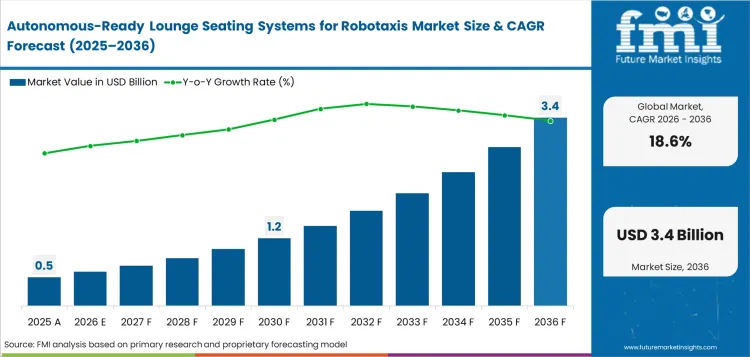
Key Takeaways, Market Size, and Forecast
- The autonomous-ready lounge seating systems for robotaxis market was valued at USD 0.52 billion in 2025.
- By 2036, the market is projected to reach USD 3.36 billion as robotaxi fleets move toward purpose-built cabin programs.
- From 2026 to 2036, the market is forecast to expand at 18.6% CAGR.
- The market is expected to create an incremental opportunity of USD 2.75 billion between 2026 and 2036.
- Purpose-built robotaxi pods are projected to account for 46.0% share of vehicle platform demand in 2026.
- Direct OEM programs are expected to account for 55.0% share of sales channel demand in 2026.
- The United Arab Emirates at 21.0% CAGR and China at 20.1% CAGR show faster demand outlook.
Robotaxi cabins are shifting from modified passenger vehicles to passenger‑first interior designs. The National Highway Traffic Safety Administration noted in March 2026 that automated driving systems introduce new occupant safety challenges, particularly as seats may recline or face rearward. Industry developments such as Magna’s 2024 reconfigurable seating award and Toyota Boshoku’s DiDi cabin concept demonstrate how suppliers are preparing for more flexible seating configurations. These trends indicate that proven restraint systems and seat motion capabilities are becoming critical factors in supplier selection, with shared‑ride durability emerging as an additional key requirement.
Autonomous-Ready Lounge Seating Systems for Robotaxis Market Definition
The autonomous-ready lounge seating systems for robotaxis market covers seat assemblies and cabin modules designed for driverless ride-hailing vehicles. Scope includes swivel seats and long-rail mechanisms. It also includes integrated belts and occupant sensing. Massage comfort and easy-clean trim are included when sold with the seat package. The market excludes standard passenger car seats and bus benches. Seating sold only for privately driven vehicles is not included. Revenue covers seat modules and seat motion hardware. Safety integration and OEM-ready cabin seating packages are also counted. Autonomous vehicles programs provide the parent platforms for the seating modules covered here.
Autonomous-Ready Lounge Seating Systems for Robotaxis Market Inclusions
Market scope covers autonomous‑ready lounge seating systems for robotaxis categorized by vehicle platform, including purpose‑built robotaxi pods and converted electric vehicles, core features, including seat sensing controls, integrated restraints, and easy‑clean surfaces, and commercialization pathways, including direct OEM programs, fleet retrofits, and regional robotaxi platform deployments. The scope also includes seating systems designed for integration within passenger‑focused autonomous cabins, where occupant safety, motion flexibility, and shared‑use durability operate as a unified interior system. Revenue scope covers modular seating assemblies, motion mechanisms, and integrated safety components supplied to robotaxi platforms and fleet operators.
Autonomous-Ready Lounge Seating Systems for Robotaxis Market Exclusions
Scope does not include standard front-row car seats and racing seats. Coach seats and office furniture are outside scope. Infotainment screens and steering systems are excluded. Robotaxi software sold without a seating module is not counted.
Autonomous-Ready Lounge Seating Systems for Robotaxis Market Research Methodology
- Primary Research: FMI analysts reviewed seat supplier capabilities and robotaxi platform needs. Fleet operator feedback and restraint validation requirements were checked in major automated mobility countries.
- Desk Research: The study used public data from safety regulators and transport departments. Vehicle production bodies and official company product releases were also reviewed.
- Market sizing and forecasting: Market size was estimated using a hybrid bottom-up and top-down method based on robotaxi fleet rollout, seat content value and platform timing. Automotive seating systems were used as a manufacturing reference for seat content and supplier base.
- Data validation: Forecast checks compared vehicle production depth and public robotaxi testing signals. Safety research and recent seating technology awards were used as supporting checks.
Why is the Autonomous-Ready Lounge Seating Systems for Robotaxis Market Growing?
- Driverless ride growth is creating demand for seats designed around passengers instead of a steering wheel.
- Federal safety research is pushing seat makers to test reclined and rear-facing occupant conditions.
- Robotaxi pilots are shifting cabins toward durable materials and easy-clean surfaces for shared use.
- OEM programs are moving lounge seats into the design phase before fleets order commercial vehicles.
Robotaxi cabins are being redesigned around the passenger experience. California's Department of Motor Vehicles reported 9,068,861 autonomous test miles in the 2022 to 2023 reporting cycle. That public road activity gives cabin engineers deeper exposure to passenger entry and ride comfort. Fleet service needs are becoming clearer as testing expands. The result is rising interest in seat systems that rotate and carry integrated belts. Shared-use durability becomes part of the seat specification.
Safety review is becoming a direct driver for seating system design. The National Highway Traffic Safety Administration said in March 2026 that vehicles with automated driving systems may use reclining seats or rear-facing arrangements, which creates new crash safety questions. That pushes suppliers to prove occupant response in positions that normal car seats were not designed to cover. The practical result is a shift from simple comfort seats toward tested seating modules with rails, belts and sensors. Automotive ADAS work remains adjacent because automated safety research affects sensing and restraint logic.
Market Segmentation Analysis
- Purpose-built robotaxi pods are projected to reach 46.0% share in 2026 as clean-sheet cabins need flexible seating space.
- With an estimated 42.0% share in 2026, swivel lounge seats are expected to lead seat motion demand for easier cabin access.
- Face-to-face four-seat layouts are forecast to account for 38.0% share in 2026 as shared trips need social seating space.
- Integrated restraint seats are projected to capture 49.0% share in 2026 since rotated seats need seat-mounted belts.
- Direct OEM programs are expected to represent 55.0% share in 2026 with cabin design moving earlier into vehicle planning.
- Urban robotaxis are estimated to hold 47.0% share in 2026 as city fleets create the earliest repeat orders.
The market is divided into six primary segment groups based on vehicle platform and seat motion. Seating layout and safety system form the second layer. Sales channel and mobility use show how suppliers move from concept cabins into fleet-ready production. Vehicle platform captures whether the seat system is designed for a purpose-built robotaxi pod or a converted electric vehicle. Seat motion and seating layout explain how passengers enter and sit during a ride. The broader automotive interior field shows why cabin layout and trim durability affect seat design.
Insights into the Purpose-Built Robotaxi Pods Vehicle Platform Segment
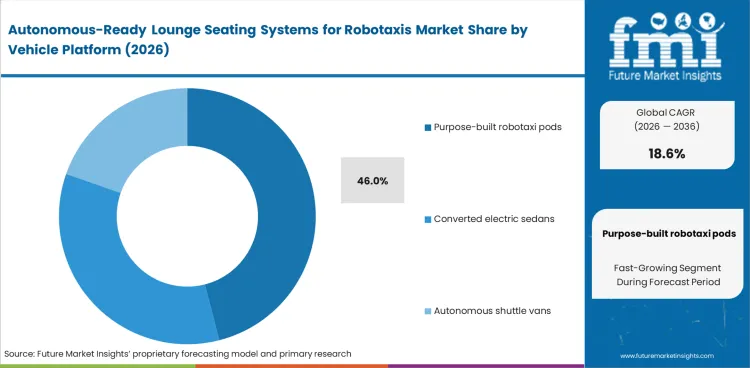
- Purpose-built robotaxi pods are projected to account for 46.0% share in 2026. Their cabin layout gives seat suppliers room to place face-to-face seating and large rail systems.
- Converted electric sedans will stay active in early fleets. Pods gain value when operators remove manual controls and redesign the floor around passengers.
Insights into the Swivel Lounge Seats Seat Motion Segment
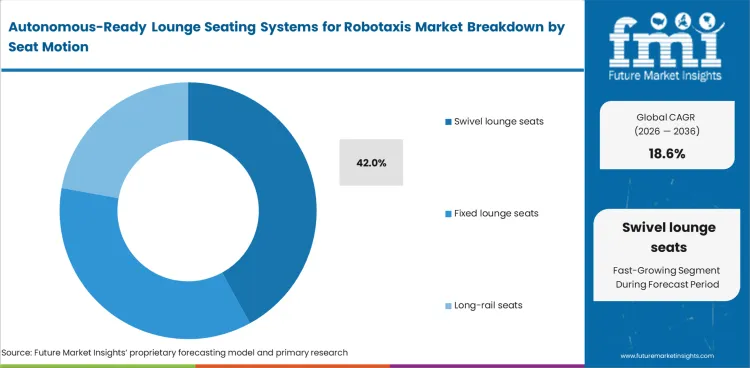
- Swivel lounge seats are expected to account for 42.0% share in 2026. Rotation supports easy entry and turns the front seat area into a shared ride zone. Seat control module demand helps explain powered adjustment and memory logic in lounge seats.
- Long-rail reconfigurable seats will gain attention in premium fleets. Fixed lounge seats remain useful when operators prefer simpler layouts and lower service risk.
Insights into the Face-to-Face Four-Seat Layout Segment
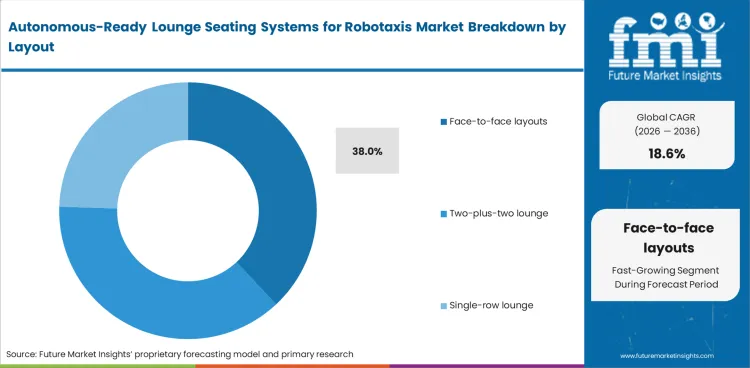
- Face-to-face four-seat layouts are forecast to account for 38.0% share in 2026. Shared robotaxi trips need social space and direct access from both sides.
- Two-plus-two lounge layouts work well for premium point-to-point trips. Single-row lounge layouts suit airport corridors where baggage space remains important.
Insights into the Integrated Restraint Seats Safety System Segment
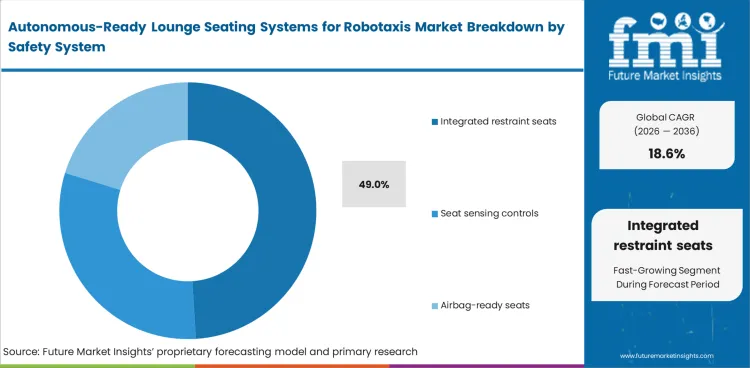
- Integrated restraint seats are projected to hold 49.0% share in 2026. Seat-mounted belts reduce dependence on fixed body pillars when seats rotate.
- Seat sensing controls will expand as cabins monitor passenger posture. Modular airbag-ready seats need more testing before fleet buyers accept wide use.
Insights into the Direct OEM Programs Sales Channel Segment
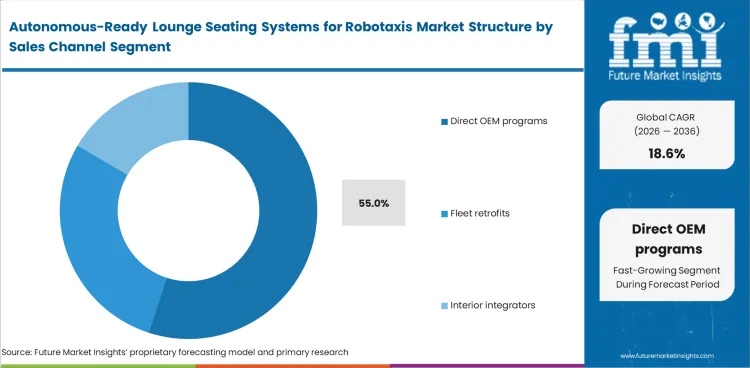
- Direct OEM programs are expected to capture 55.0% share of sales channel demand in 2026. Robotaxi seat systems must be designed into the vehicle platform early.
- Fleet retrofits will serve pilots and small city launches. Interior integrators help operators test layouts before a vehicle maker freezes the cabin design.
Insights into the Urban Robotaxis Mobility Use Segment
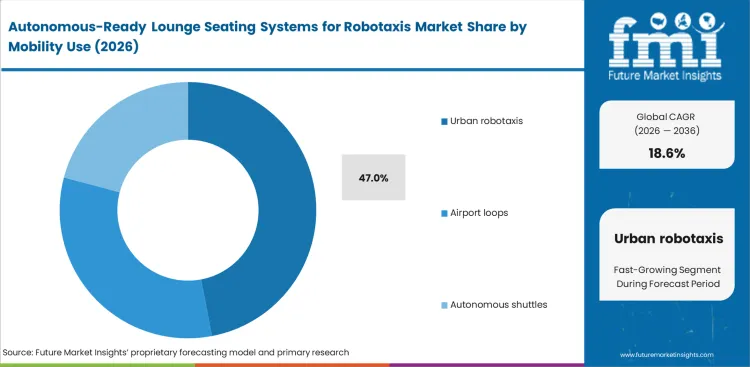
- Urban robotaxis are estimated to account for 47.0% share of mobility use demand in 2026. City rides create repeated passenger exposure to seat comfort and cabin safety.
- Airport and closed-loop routes will use lounge systems for premium service. Autonomous shuttle programs will adopt simpler modules where ride times are shorter.
Autonomous-Ready Lounge Seating Systems for Robotaxis Market Drivers, Restraints, and Opportunities
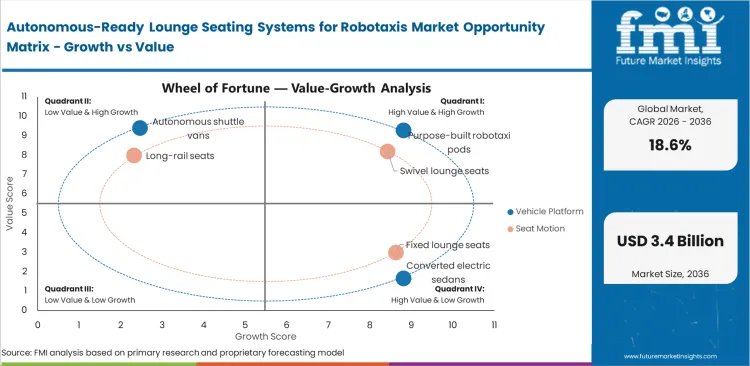
- Robotaxi fleet growth is raising demand for passenger-first seating with verified restraint performance.
- Safety validation slows adoption as rotated and reclined seats need proof under crash conditions.
- Integrated seat modules create opportunity as OEMs seek rails and belts from fewer suppliers. Sensing and trim complete the module package.
Robotaxi programs are moving seating choices earlier in the vehicle design cycle. The National Highway Traffic Safety Administration proposed AV STEP in December 2024 as a program for ADS-equipped vehicles that operate on public roads. The proposed oversight raises the value of seating evidence and documentation. Suppliers with tested seat motion and restraint packages can gain access before fleet vehicles are built. Connected vehicle technology supports fleet data and service feedback that robotaxi interiors can use.
Safety Validation Is Slowing Wider Cabin Redesign
A considerable growth restraint is proof under non-traditional seating positions. NHTSA's March 2026 report states that rear-facing and reclined arrangements need a re-evaluation of crash safety standards. Robotaxi operators cannot scale lounge seats until the restraint package is credible. This keeps adoption focused on suppliers that can combine mechanical design with occupant safety testing.
Integrated Modules Are Creating Supplier Value
Key opportunity for market expansion is in seating modules that arrive as a complete cabin package. It also included integrated belts. A packaged module reduces engineering work for a robotaxi platform team. It also gives fleet operators fewer failure points when vehicles run many short trips each day.
Analysis of Autonomous-Ready Lounge Seating Systems for Robotaxis Market by Key Countries
.webp "Top Country Growth Comparison Autonomous Ready Lounge Seating Systems For Robotaxis Market Cagr (2026 2036)")
| Country | CAGR |
|---|---|
| United States | 19.4% |
| China | 20.1% |
| Germany | 17.6% |
| Japan | 16.9% |
| South Korea | 18.2% |
| United Kingdom | 18.8% |
| United Arab Emirates | 21.0% |
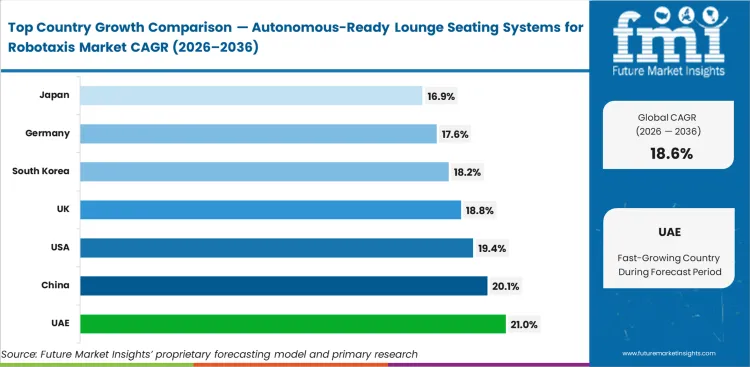
Source: Future Market Insights, 2026.
Autonomous-Ready Lounge Seating Systems for Robotaxis Market CAGR Analysis by Country
- The United Arab Emirates is projected to post 21.0% CAGR by 2036 as Dubai moves robotaxi trials toward public service.
- China is expected to record 20.1% CAGR by 2036 as local EV programs and seating suppliers shorten development cycles.
- The United States is forecast at 19.4% CAGR by 2036 as California and federal programs support robotaxi testing.
- The United Kingdom is projected to grow at 18.8% CAGR by 2036 as the automated vehicle legal route becomes clearer.
- South Korea is estimated to advance at 18.2% CAGR by 2036 as seating and electronics suppliers remain close to OEM programs.
Demand for autonomous-ready lounge seating systems for robotaxis is forecast to rise at 18.6% CAGR from 2026 to 2036. Country analysis covers markets where robotaxi pilots and vehicle output support early commercial orders. Regulation and seating supply depth shape which markets move first. Smaller pilot markets can record faster growth from a limited starting point. Large production countries can create steadier volume once platforms move into repeat builds.
Demand Outlook for Autonomous-Ready Lounge Seating Systems for Robotaxis Market in the United States
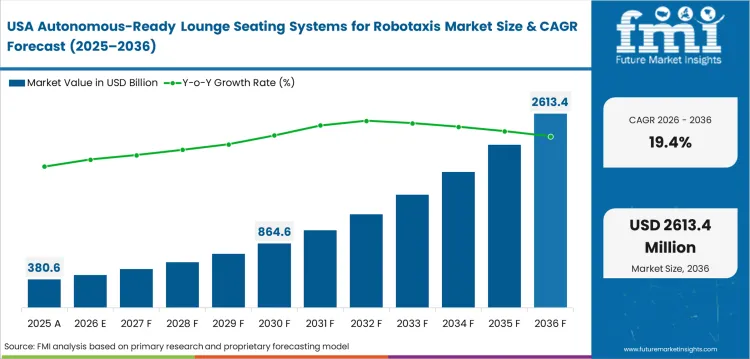
California testing activity gives the United States a clear route for robotaxi cabin validation. The California Department of Motor Vehicles reported 9,068,861 autonomous miles for the latest 2022 to 2023 reporting cycle in February 2024. The United States is projected to record 19.4% CAGR through 2036 as public road testing creates more feedback on passenger seating. Seat suppliers are expected to focus on integrated belts and easy-clean trim for fleets in Arizona and California.
- California permit holders give seating teams a test route for long-rail and swivel seat durability.
- Arizona robotaxi operations can create early demand for easy-clean surfaces and seat service kits.
- Nevada routes support purpose-built pods as airport and strip-area trips favor passenger-facing cabins.
Sales Analysis of Autonomous-Ready Lounge Seating Systems for Robotaxis Market in China
China combines large vehicle output with faster experimentation in autonomous mobility. The International Organization of Motor Vehicle Manufacturers reported 31,281,592 vehicles produced in China during 2024. Growth in China is expected at 20.1% CAGR through 2036 as EV makers and cabin suppliers work near robotaxi pilots. Local sourcing is set to help suppliers move from concept seats into repeat platform programs.
- Shanghai and Guangzhou programs can test lounge layouts close to local EV engineering centers.
- Wuhan robotaxi exposure gives suppliers a use case for durable shared-ride materials.
- Chinese seating plants can localize rail mechanisms and integrated restraints for fleet platforms.
Opportunity Analysis of Autonomous-Ready Lounge Seating Systems for Robotaxis Market in Germany
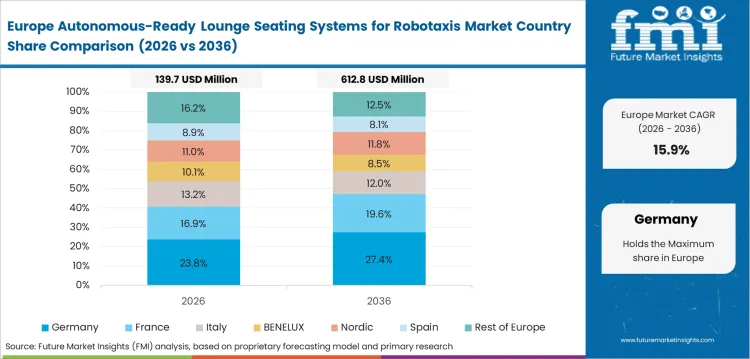
Germany's demand is attributable to premium cabin engineering and safety validation. The International Organization of Motor Vehicle Manufacturers reported 4,069,222 vehicles produced in Germany during 2024. Germany is forecast to expand at 17.6% CAGR through 2036 as engineering teams test rotated seating under strict safety reviews. Suppliers in Stuttgart and Munich are projected to gain from programs that need proof before fleet scale.
- Stuttgart suppliers can connect restraint engineering with premium autonomous cabin concepts.
- Munich vehicle makers can use lounge seating trials for high-value mobility concepts.
- Saxony production networks support seat mechanisms and electronics for automated vehicle programs.
Future Outlook for Autonomous-Ready Lounge Seating Systems for Robotaxis Market in Japan
Japan brings careful seat engineering into a market where mobility service pilots focus on reliability. The International Organization of Motor Vehicle Manufacturers reported 8,234,681 vehicles produced in Japan during 2024. With a projected 16.9% CAGR through 2036, Japan is driven by OEM validation discipline and urban mobility trials. Suppliers are anticipated to compete on quiet movement and low vibration. Restraint proof remains the final test before broader use.
- Tokyo mobility trials can use lounge seats for compact city ride pilots.
- Nagoya suppliers can connect seat structures with vehicle platform engineering.
- Fukuoka and other technology zones can test cabin sensing tied to passenger comfort.
Sales Analysis of Autonomous-Ready Lounge Seating Systems for Robotaxis Market in South Korea
South Korea's seating outlook is tied to its compact supplier network and electronics base. The International Organization of Motor Vehicle Manufacturers reported 4,127,252 vehicles produced in South Korea during 2024. Demand in South Korea is projected to rise at 18.2% CAGR through 2036 since seat makers can pair motion hardware with in-cabin sensing. This favors suppliers that coordinate trim and controls.
- Seoul-area mobility programs can test cabin layouts with connected passenger interfaces.
- Ulsan manufacturing depth gives seating teams access to vehicle program timing.
- Gyeonggi suppliers can pair seat comfort modules with sensor-based occupant functions.
Future Outlook for Autonomous-Ready Lounge Seating Systems for Robotaxis Market in the United Kingdom
The United Kingdom offers a regulatory path that can support early fleet specification work. The Department for Transport said in May 2024 that the automated vehicle sector could reach GBP 42 billion and support 38,000 jobs by 2035. The United Kingdom is forecast at 18.8% CAGR through 2036, supported by legal clarity and trial activity. Seat suppliers are predicted to target programs that need passenger trust and clear safety documentation.
- London trials can evaluate lounge seating in dense traffic and short trip patterns.
- Oxford developers can test cabin systems alongside autonomous driving software programs.
- Midlands suppliers can support seat frames and validation work for pilot vehicle builds.
Demand Outlook for Autonomous-Ready Lounge Seating Systems for Robotaxis Market in the United Arab Emirates
Dubai is using public transport targets to make robotaxi trials commercially visible. The Government of Dubai Media Office said in December 2025 that WeRide operated about 150 autonomous vehicles in the Middle East, including more than 100 robotaxis. The United Arab Emirates is forecast at 21.0% CAGR through 2036, supported by a small base and a clear public mobility target. Software defined vehicle architecture helps connect seat controls with over-the-air update planning.
- Dubai public pilots create a visible route for premium robotaxi cabin evaluation.
- Abu Dhabi technology zones can attract test programs for passenger comfort and cleaning cycles.
- Fleet operators need materials that handle heat exposure and frequent shared rides.
Competitive Landscape and Strategic Positioning
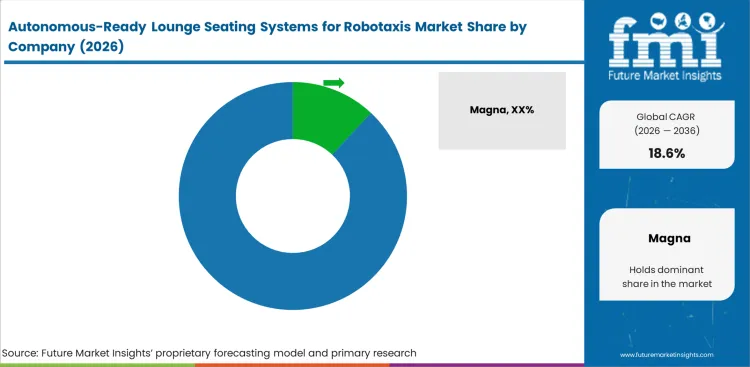
- Competition centers on seat motion hardware and integrated restraints. Comfort systems now matter more than basic seat assembly.
- Magna and Toyota Boshoku show clear readiness through rotating seats, long rails and robotaxi cabin work.
- FORVIA and Lear are positioned around comfort modules and seat structures. Adient adds production scale and global seat platform depth.
- Entry barriers include crash validation and fleet service life. Occupant sensing and proof for rotated seating positions form the next hurdle.
Supplier competition is moving toward cabin systems that combine motion and safety. FMI's analysis found that seat content remains a core automotive value pool. For example, Magna's 2024 reconfigurable seating award gives the clearest near-term signal for this segment. Its rotating seats and long rails match the seating flexibility that robotaxi platforms need.
Product readiness now depends on more than a visible concept seat. Toyota Boshoku fitted a DiDi autonomous vehicle with privacy audio headrests, motion sickness mitigation and seat vibration notification in 2024. Yanfeng's Hover Seat adds posture sensing and automatic support adjustment. These systems point to a cabin market where comfort and information cues are built into the seat. Automotive human-machine interface systems help add passenger prompts and information cues to seats.
Established seating firms retain an advantage because robotaxi seating still needs automotive-grade manufacturing. FORVIA's 2026 Luxeed award shows how zero-gravity seats and real-time adjustment are moving into premium electric programs. Lear and Adient add depth in thermal comfort, massage and trim systems that can improve shared-ride comfort. Automotive seating accessories remain relevant for cleanable covers and replaceable fleet trim.
Robotaxi operators will choose suppliers that can reduce risk over the service life of a vehicle. FMI's robotaxi outlook supports the link between fleet scale and higher cabin utilization. New entrants can secure pilots with a clever mechanism. Repeat orders are expected to favor firms that prove crash performance and part availability across multiple cities.
Key Companies in the Autonomous-Ready Lounge Seating Systems for Robotaxis Market
Competition is best read by role because seat motion, comfort and safety integration differ sharply.
- Reconfigurable seating leaders: Magna and Toyota Boshoku are strongest in flexible seating concepts for future mobility. Magna has a production-linked award for rotating seats and long rails. Toyota Boshoku has shown LOUNZE and a DiDi share-ride cabin concept. These suppliers are most relevant when a robotaxi platform needs seat movement and passenger-facing layouts together.
- Comfort and module specialists: FORVIA and Lear are positioned around complete seats and trim systems. Adient brings scale through global seat programs.
- Sensing and regional interior specialists: Yanfeng and Hyundai Transys add value around passenger sensing and self-driving cabin concepts.
Competitive Benchmarking: Autonomous-Ready Lounge Seating Systems for Robotaxis Market
| Company | Seat Motion Depth | Restraint Integration | Fleet Durability Support | Geographic Footprint |
|---|---|---|---|---|
| Magna | High | Strong | Strong | Global with China production readiness and reconfigurable seating award |
| Toyota Boshoku | High | Strong | Strong | Japan centered with China robotaxi concept work |
| FORVIA | High | Strong | Strong | Europe and China footprint with premium EV seat programs |
| Adient | High | Medium | Strong | Global seating footprint with comfort and trim depth |
| Lear | High | Strong | Medium | North America centered with thermal comfort systems |
| Yanfeng | Medium | Strong | Medium | China and North America presence with sensing seat concepts |
| Hyundai Transys | Medium | Medium | Medium | South Korea centered with self-driving interior concepts |
Source: Future Market Insights competitive analysis, 2026.
Key Developments in Autonomous-Ready Lounge Seating Systems for Robotaxis Market
- In January 2024, Yanfeng introduced its next-generation Hover Seat with Seat Sensing Posture ID. The system adjusts support based on body data.
- In February 2026, FORVIA won a multi-year Luxeed seating project in China. The package includes zero-gravity seats and real-time adjustments.
- In February 2025, Lear introduced ComfortMax Seat technology with General Motors. The system reduces heat and ventilation time-to-sensation by up to 40%.
Key Players in the Autonomous-Ready Lounge Seating Systems for Robotaxis Market
Reconfigurable Seating Leaders:
- Magna
- Toyota Boshoku
Comfort and Module Specialists:
- FORVIA
- Lear
- Adient
Sensing and Regional Interior Specialists:
- Yanfeng
- Hyundai Transys
Report Scope and Coverage
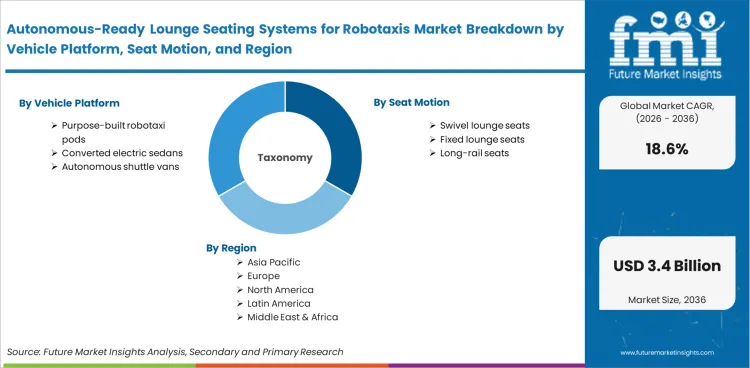
| Parameter | Details |
|---|---|
| Quantitative Units | USD 0.61 billion to USD 3.36 billion, at 18.6% CAGR |
| Market Definition | Lounge seat systems and cabin modules designed for robotaxi passenger cabins |
| Vehicle Platform | Purpose-built robotaxi pods, Converted electric sedans, Autonomous shuttle vans |
| Seat Motion | Swivel lounge seats, Fixed lounge seats, Long-rail seats |
| Seating Layout | Face-to-face layouts, Two-plus-two lounge, Single-row lounge |
| Safety System | Integrated restraint seats, Seat sensing controls, Airbag-ready seats |
| Sales Channel | Direct OEM programs, Fleet retrofits, Interior integrators |
| Regions Covered | North America, Latin America, Europe, East Asia, South Asia and Pacific, Middle East and Africa |
| Countries Covered | United States, China, Germany, Japan, South Korea, United Kingdom, United Arab Emirates, 30+ countries |
| Key Companies Profiled | Magna, Toyota Boshoku, FORVIA, Adient, Lear, Yanfeng, Hyundai Transys |
| Forecast Period | 2026 to 2036 |
| Approach | Hybrid bottom-up and top-down methodology |
Autonomous-Ready Lounge Seating Systems for Robotaxis Market Breakdown by Vehicle Platform, Seat Motion, Seating Layout, Safety System, Sales Channel, Mobility Use, and Region
Autonomous-Ready Lounge Seating Systems for Robotaxis Market by Vehicle Platform:
- Purpose-built robotaxi pods
- Converted electric sedans
- Autonomous shuttle vans
Autonomous-Ready Lounge Seating Systems for Robotaxis Market by Seat Motion:
- Swivel lounge seats
- Fixed lounge seats
- Long-rail seats
Autonomous-Ready Lounge Seating Systems for Robotaxis Market by Seating Layout:
- Face-to-face layouts
- Two-plus-two lounge
- Single-row lounge
Autonomous-Ready Lounge Seating Systems for Robotaxis Market by Safety System:
- Integrated restraint seats
- Seat sensing controls
- Airbag-ready seats
Autonomous-Ready Lounge Seating Systems for Robotaxis Market by Sales Channel:
- Direct OEM programs
- Fleet retrofits
- Interior integrators
Autonomous-Ready Lounge Seating Systems for Robotaxis Market by Mobility Use:
- Urban robotaxis
- Airport loops
- Autonomous shuttles
Autonomous-Ready Lounge Seating Systems for Robotaxis Market by Region:
- North America
- United States
- Canada
- Mexico
- Latin America
- Brazil
- Chile
- Rest of Latin America
- Western Europe
- Germany
- UK
- Italy
- Spain
- France
- Nordic
- BENELUX
- Rest of Western Europe
- Eastern Europe
- Russia
- Poland
- Hungary
- Balkan and Baltic
- Rest of Eastern Europe
- East Asia
- China
- Japan
- South Korea
- South Asia and Pacific
- India
- ASEAN
- Australia and New Zealand
- Rest of South Asia and Pacific
- Middle East and Africa
- Kingdom of Saudi Arabia
- Other GCC Countries
- Turkiye
- South Africa
- Other African Union
- Rest of Middle East and Africa
Research Sources and Bibliography
- 1. California Department of Motor Vehicles. (2024, February 2). Autonomous vehicle permit holders report a record 9 million test miles in California in 12 months.
- 2. Government of Dubai Media Office. (2025, December 11). RTA launches pilot autonomous robotaxi service in collaboration with WeRide and Uber.
- 3. International Organization of Motor Vehicle Manufacturers. (2025, October). World motor vehicle production by country/region and type.
- 4. International Organization of Motor Vehicle Manufacturers. (2026, April 23). Auto industry growth shifted east in 2025 amid global repositioning.
- 5. Magna International. (2024, June 18). Magna awarded reconfigurable seating business with Chinese OEM.
- 6. National Highway Traffic Safety Administration. (2026, March). NHTSA research and rulemaking activities on vehicles equipped with automated driving systems.
- 7. Toyota Boshoku Corporation. (2024, April 12). Toyota Boshoku to exhibit at Auto China 2024.
- 8. United Kingdom Department for Transport. (2024, May 20). Self-driving vehicles set to be on roads by 2026 as Automated Vehicles Act becomes law.
- 9. National Highway Traffic Safety Administration. (2024, December 20). NHTSA proposes national program for vehicles with automated driving systems.
- 10. Yanfeng. (2024, January 8). At CES Yanfeng introduces next generation of its Hover Seat that features occupant sensing.
- 11. FORVIA. (2026, February 18). FORVIA Seating wins major project with Chinese EV manufacturer Luxeed.
- 12. Lear Corporation. (2025, February 5). Lear integrates ComfortMax Seat engineering technology with General Motors.
Sources listed above include primary government and regulatory publications. Official trade body and company publications were used for market validation.
This Report Answers
- What is the current and future size of the autonomous-ready lounge seating systems for robotaxis market?
- How fast is the autonomous-ready lounge seating systems for robotaxis market forecast to expand between 2026 and 2036?
- Which vehicle platform is expected to lead autonomous-ready lounge seating systems demand in 2026?
- Which seat motion type is projected to hold the leading share in 2026?
- Why do integrated restraints affect supplier selection in robotaxi lounge seating systems?
- Which countries are projected to record faster expansion during the forecast period?
- Who are the main companies active in autonomous-ready lounge seating systems for robotaxis?
- How does FMI define the autonomous-ready lounge seating systems for robotaxis market scope?
- How does FMI estimate and validate the autonomous-ready lounge seating systems forecast?
Frequently Asked Questions
What is the global market demand for Autonomous-Ready Lounge Seating Systems for Robotaxis in 2026?
In 2026, the market is expected to reach USD 0.61 billion as purpose-built robotaxi cabins move into early fleet programs.
How big will the Autonomous-Ready Lounge Seating Systems for Robotaxis Market be in 2036?
By 2036, the market is projected to reach USD 3.36 billion as lounge cabin systems enter repeat robotaxi platform orders.
How much is Autonomous-Ready Lounge Seating Systems for Robotaxis demand expected to expand between 2026 and 2036?
Demand is forecast to expand at 18.6% CAGR from 2026 to 2036 as driverless fleets need passenger-first cabin layouts.
Which vehicle platform is expected to lead the Autonomous-Ready Lounge Seating Systems for Robotaxis Market by 2026?
Purpose-built robotaxi pods are projected to lead vehicle platform demand with 46.0% share in 2026 due to clean-sheet cabin design.
Which sales channel is expected to lead Autonomous-Ready Lounge Seating Systems for Robotaxis demand in 2026?
Direct OEM programs are expected to lead sales channel demand with 55.0% share in 2026 as seats are engineered into platforms early.
Which country is forecast to grow fastest in the Autonomous-Ready Lounge Seating Systems for Robotaxis Market?
The United Arab Emirates is forecast to grow fastest at 21.0% CAGR as Dubai links robotaxi pilots with public mobility targets.
What does the Autonomous-Ready Lounge Seating Systems for Robotaxis Market include?
The market includes swivel seats and long rails. Integrated restraints and sensing modules are also included. Easy-clean lounge materials are counted when used in robotaxi cabins.
How does FMI estimate the Autonomous-Ready Lounge Seating Systems for Robotaxis Market forecast?
FMI uses fleet rollout signals and vehicle production data. Seating supplier programs and regulatory checks validate the forecast path.
Why do robotaxis need lounge seating systems?
Robotaxis need lounge seating systems because the cabin is designed around passengers after manual driving controls lose their central role.
Are lounge seating systems for robotaxis different from normal car seats?
Lounge seating systems differ from normal seats because they use rotation and long rails. Integrated belts and sensor controls support shared driverless rides.
Which suppliers are active in autonomous-ready lounge seating systems for robotaxis?
Active suppliers include Magna and Toyota Boshoku. FORVIA and Adient add scale. Lear and Yanfeng compete with Hyundai Transys across seats and comfort systems.
What limits faster adoption of autonomous-ready lounge seating systems for robotaxis?
Adoption is limited by crash validation and rotated-seat restraint proof. Cleaning needs and slow driverless fleet rollout add further limits.
Preview the report firsthand - request a free sample
Get SampleGet the brochure for pricing and purchase details.
Get PDFTable of Content
- Executive Summary
- Global Market Outlook
- Demand-side Trends
- Supply-side Trends
- Technology Roadmap Analysis
- Analysis and Recommendations
- Market Overview
- Market Coverage / Taxonomy
- Market Definition / Scope / Limitations
- Research Methodology
- Chapter Orientation
- Analytical Lens and Working Hypotheses
- Market Structure, Signals, and Trend Drivers
- Benchmarking and Cross-market Comparability
- Market Sizing, Forecasting, and Opportunity Mapping
- Research Design and Evidence Framework
- Desk Research Programme (Secondary Evidence)
- Company Annual and Sustainability Reports
- Peer-reviewed Journals and Academic Literature
- Corporate Websites, Product Literature, and Technical Notes
- Earnings Decks and Investor Briefings
- Statutory Filings and Regulatory Disclosures
- Technical White Papers and Standards Notes
- Trade Journals, Industry Magazines, and Analyst Briefs
- Conference Proceedings, Webinars, and Seminar Materials
- Government Statistics Portals and Public Data Releases
- Press Releases and Reputable Media Coverage
- Specialist Newsletters and Curated Briefings
- Sector Databases and Reference Repositories
- FMI Internal Proprietary Databases and Historical Market Datasets
- Subscription Datasets and Paid Sources
- Social Channels, Communities, and Digital Listening Inputs
- Additional Desk Sources
- Expert Input and Fieldwork (Primary Evidence)
- Primary Modes
- Qualitative Interviews and Expert Elicitation
- Quantitative Surveys and Structured Data Capture
- Blended Approach
- Why Primary Evidence is Used
- Field Techniques
- Interviews
- Surveys
- Focus Groups
- Observational and In-context Research
- Social and Community Interactions
- Stakeholder Universe Engaged
- C-suite Leaders
- Board Members
- Presidents and Vice Presidents
- R&D and Innovation Heads
- Technical Specialists
- Domain Subject-matter Experts
- Scientists
- Physicians and Other Healthcare Professionals
- Governance, Ethics, and Data Stewardship
- Research Ethics
- Data Integrity and Handling
- Primary Modes
- Tooling, Models, and Reference Databases
- Desk Research Programme (Secondary Evidence)
- Data Engineering and Model Build
- Data Acquisition and Ingestion
- Cleaning, Normalisation, and Verification
- Synthesis, Triangulation, and Analysis
- Quality Assurance and Audit Trail
- Market Background
- Market Dynamics
- Drivers
- Restraints
- Opportunity
- Trends
- Scenario Forecast
- Demand in Optimistic Scenario
- Demand in Likely Scenario
- Demand in Conservative Scenario
- Opportunity Map Analysis
- Product Life Cycle Analysis
- Supply Chain Analysis
- Investment Feasibility Matrix
- Value Chain Analysis
- PESTLE and Porter’s Analysis
- Regulatory Landscape
- Regional Parent Market Outlook
- Production and Consumption Statistics
- Import and Export Statistics
- Market Dynamics
- Global Market Analysis 2021 to 2025 and Forecast, 2026 to 2036
- Historical Market Size Value (USD Million) Analysis, 2021 to 2025
- Current and Future Market Size Value (USD Million) Projections, 2026 to 2036
- Y-o-Y Growth Trend Analysis
- Absolute $ Opportunity Analysis
- Global Market Pricing Analysis 2021 to 2025 and Forecast 2026 to 2036
- Global Market Analysis 2021 to 2025 and Forecast 2026 to 2036, By Type
- Introduction / Key Findings
- Historical Market Size Value (USD Million) Analysis By Type , 2021 to 2025
- Current and Future Market Size Value (USD Million) Analysis and Forecast By Type , 2026 to 2036
- Molded seating foam
- Lamination foam
- Headrest foam
- Headliner substrate
- Acoustic foam
- Energy absorbing foam
- Molded seating foam
- Y-o-Y Growth Trend Analysis By Type , 2021 to 2025
- Absolute $ Opportunity Analysis By Type , 2026 to 2036
- Global Market Analysis 2021 to 2025 and Forecast 2026 to 2036, By Renewable Input
- Introduction / Key Findings
- Historical Market Size Value (USD Million) Analysis By Renewable Input, 2021 to 2025
- Current and Future Market Size Value (USD Million) Analysis and Forecast By Renewable Input, 2026 to 2036
- Plant-oil polyols
- Mass-balance polyols
- Bio-prepolymer MDI
- Bio-recycled hybrids
- CO2 polyols
- Plant-oil polyols
- Y-o-Y Growth Trend Analysis By Renewable Input, 2021 to 2025
- Absolute $ Opportunity Analysis By Renewable Input, 2026 to 2036
- Global Market Analysis 2021 to 2025 and Forecast 2026 to 2036, By Application
- Introduction / Key Findings
- Historical Market Size Value (USD Million) Analysis By Application, 2021 to 2025
- Current and Future Market Size Value (USD Million) Analysis and Forecast By Application, 2026 to 2036
- Seat cushions
- Seat backs
- Headrests
- Armrests
- Headliners
- Door pads
- Acoustic pads
- Seat cushions
- Y-o-Y Growth Trend Analysis By Application, 2021 to 2025
- Absolute $ Opportunity Analysis By Application, 2026 to 2036
- Global Market Analysis 2021 to 2025 and Forecast 2026 to 2036, By Vehicle Class
- Introduction / Key Findings
- Historical Market Size Value (USD Million) Analysis By Vehicle Class, 2021 to 2025
- Current and Future Market Size Value (USD Million) Analysis and Forecast By Vehicle Class, 2026 to 2036
- Passenger vehicles
- Light trucks
- Electric vehicles
- Commercial vans
- Buses
- Passenger vehicles
- Y-o-Y Growth Trend Analysis By Vehicle Class, 2021 to 2025
- Absolute $ Opportunity Analysis By Vehicle Class, 2026 to 2036
- Global Market Analysis 2021 to 2025 and Forecast 2026 to 2036, By Supply Route
- Introduction / Key Findings
- Historical Market Size Value (USD Million) Analysis By Supply Route, 2021 to 2025
- Current and Future Market Size Value (USD Million) Analysis and Forecast By Supply Route, 2026 to 2036
- Tier 1 suppliers
- Foam converters
- Chemical suppliers
- Direct OEM
- Aftermarket
- Tier 1 suppliers
- Y-o-Y Growth Trend Analysis By Supply Route, 2021 to 2025
- Absolute $ Opportunity Analysis By Supply Route, 2026 to 2036
- Global Market Analysis 2021 to 2025 and Forecast 2026 to 2036, By Certification Model
- Introduction / Key Findings
- Historical Market Size Value (USD Million) Analysis By Certification Model, 2021 to 2025
- Current and Future Market Size Value (USD Million) Analysis and Forecast By Certification Model, 2026 to 2036
- Mass-balance certified systems
- Mass-balance certified systems
- Y-o-Y Growth Trend Analysis By Certification Model, 2021 to 2025
- Absolute $ Opportunity Analysis By Certification Model, 2026 to 2036
- Global Market Analysis 2021 to 2025 and Forecast 2026 to 2036, By Region
- Introduction
- Historical Market Size Value (USD Million) Analysis By Region, 2021 to 2025
- Current Market Size Value (USD Million) Analysis and Forecast By Region, 2026 to 2036
- North America
- Latin America
- Western Europe
- Eastern Europe
- East Asia
- South Asia and Pacific
- Middle East & Africa
- Market Attractiveness Analysis By Region
- North America Market Analysis 2021 to 2025 and Forecast 2026 to 2036, By Country
- Historical Market Size Value (USD Million) Trend Analysis By Market Taxonomy, 2021 to 2025
- Market Size Value (USD Million) Forecast By Market Taxonomy, 2026 to 2036
- By Country
- USA
- Canada
- Mexico
- By Type
- By Renewable Input
- By Application
- By Vehicle Class
- By Supply Route
- By Certification Model
- By Country
- Market Attractiveness Analysis
- By Country
- By Type
- By Renewable Input
- By Application
- By Vehicle Class
- By Supply Route
- By Certification Model
- Key Takeaways
- Latin America Market Analysis 2021 to 2025 and Forecast 2026 to 2036, By Country
- Historical Market Size Value (USD Million) Trend Analysis By Market Taxonomy, 2021 to 2025
- Market Size Value (USD Million) Forecast By Market Taxonomy, 2026 to 2036
- By Country
- Brazil
- Chile
- Rest of Latin America
- By Type
- By Renewable Input
- By Application
- By Vehicle Class
- By Supply Route
- By Certification Model
- By Country
- Market Attractiveness Analysis
- By Country
- By Type
- By Renewable Input
- By Application
- By Vehicle Class
- By Supply Route
- By Certification Model
- Key Takeaways
- Western Europe Market Analysis 2021 to 2025 and Forecast 2026 to 2036, By Country
- Historical Market Size Value (USD Million) Trend Analysis By Market Taxonomy, 2021 to 2025
- Market Size Value (USD Million) Forecast By Market Taxonomy, 2026 to 2036
- By Country
- Germany
- UK
- Italy
- Spain
- France
- Nordic
- BENELUX
- Rest of Western Europe
- By Type
- By Renewable Input
- By Application
- By Vehicle Class
- By Supply Route
- By Certification Model
- By Country
- Market Attractiveness Analysis
- By Country
- By Type
- By Renewable Input
- By Application
- By Vehicle Class
- By Supply Route
- By Certification Model
- Key Takeaways
- Eastern Europe Market Analysis 2021 to 2025 and Forecast 2026 to 2036, By Country
- Historical Market Size Value (USD Million) Trend Analysis By Market Taxonomy, 2021 to 2025
- Market Size Value (USD Million) Forecast By Market Taxonomy, 2026 to 2036
- By Country
- Russia
- Poland
- Hungary
- Balkan & Baltic
- Rest of Eastern Europe
- By Type
- By Renewable Input
- By Application
- By Vehicle Class
- By Supply Route
- By Certification Model
- By Country
- Market Attractiveness Analysis
- By Country
- By Type
- By Renewable Input
- By Application
- By Vehicle Class
- By Supply Route
- By Certification Model
- Key Takeaways
- East Asia Market Analysis 2021 to 2025 and Forecast 2026 to 2036, By Country
- Historical Market Size Value (USD Million) Trend Analysis By Market Taxonomy, 2021 to 2025
- Market Size Value (USD Million) Forecast By Market Taxonomy, 2026 to 2036
- By Country
- China
- Japan
- South Korea
- By Type
- By Renewable Input
- By Application
- By Vehicle Class
- By Supply Route
- By Certification Model
- By Country
- Market Attractiveness Analysis
- By Country
- By Type
- By Renewable Input
- By Application
- By Vehicle Class
- By Supply Route
- By Certification Model
- Key Takeaways
- South Asia and Pacific Market Analysis 2021 to 2025 and Forecast 2026 to 2036, By Country
- Historical Market Size Value (USD Million) Trend Analysis By Market Taxonomy, 2021 to 2025
- Market Size Value (USD Million) Forecast By Market Taxonomy, 2026 to 2036
- By Country
- India
- ASEAN
- Australia & New Zealand
- Rest of South Asia and Pacific
- By Type
- By Renewable Input
- By Application
- By Vehicle Class
- By Supply Route
- By Certification Model
- By Country
- Market Attractiveness Analysis
- By Country
- By Type
- By Renewable Input
- By Application
- By Vehicle Class
- By Supply Route
- By Certification Model
- Key Takeaways
- Middle East & Africa Market Analysis 2021 to 2025 and Forecast 2026 to 2036, By Country
- Historical Market Size Value (USD Million) Trend Analysis By Market Taxonomy, 2021 to 2025
- Market Size Value (USD Million) Forecast By Market Taxonomy, 2026 to 2036
- By Country
- Kingdom of Saudi Arabia
- Other GCC Countries
- Turkiye
- South Africa
- Other African Union
- Rest of Middle East & Africa
- By Type
- By Renewable Input
- By Application
- By Vehicle Class
- By Supply Route
- By Certification Model
- By Country
- Market Attractiveness Analysis
- By Country
- By Type
- By Renewable Input
- By Application
- By Vehicle Class
- By Supply Route
- By Certification Model
- Key Takeaways
- Key Countries Market Analysis
- USA
- Pricing Analysis
- Market Share Analysis, 2025
- By Type
- By Renewable Input
- By Application
- By Vehicle Class
- By Supply Route
- By Certification Model
- Canada
- Pricing Analysis
- Market Share Analysis, 2025
- By Type
- By Renewable Input
- By Application
- By Vehicle Class
- By Supply Route
- By Certification Model
- Mexico
- Pricing Analysis
- Market Share Analysis, 2025
- By Type
- By Renewable Input
- By Application
- By Vehicle Class
- By Supply Route
- By Certification Model
- Brazil
- Pricing Analysis
- Market Share Analysis, 2025
- By Type
- By Renewable Input
- By Application
- By Vehicle Class
- By Supply Route
- By Certification Model
- Chile
- Pricing Analysis
- Market Share Analysis, 2025
- By Type
- By Renewable Input
- By Application
- By Vehicle Class
- By Supply Route
- By Certification Model
- Germany
- Pricing Analysis
- Market Share Analysis, 2025
- By Type
- By Renewable Input
- By Application
- By Vehicle Class
- By Supply Route
- By Certification Model
- UK
- Pricing Analysis
- Market Share Analysis, 2025
- By Type
- By Renewable Input
- By Application
- By Vehicle Class
- By Supply Route
- By Certification Model
- Italy
- Pricing Analysis
- Market Share Analysis, 2025
- By Type
- By Renewable Input
- By Application
- By Vehicle Class
- By Supply Route
- By Certification Model
- Spain
- Pricing Analysis
- Market Share Analysis, 2025
- By Type
- By Renewable Input
- By Application
- By Vehicle Class
- By Supply Route
- By Certification Model
- France
- Pricing Analysis
- Market Share Analysis, 2025
- By Type
- By Renewable Input
- By Application
- By Vehicle Class
- By Supply Route
- By Certification Model
- India
- Pricing Analysis
- Market Share Analysis, 2025
- By Type
- By Renewable Input
- By Application
- By Vehicle Class
- By Supply Route
- By Certification Model
- ASEAN
- Pricing Analysis
- Market Share Analysis, 2025
- By Type
- By Renewable Input
- By Application
- By Vehicle Class
- By Supply Route
- By Certification Model
- Australia & New Zealand
- Pricing Analysis
- Market Share Analysis, 2025
- By Type
- By Renewable Input
- By Application
- By Vehicle Class
- By Supply Route
- By Certification Model
- China
- Pricing Analysis
- Market Share Analysis, 2025
- By Type
- By Renewable Input
- By Application
- By Vehicle Class
- By Supply Route
- By Certification Model
- Japan
- Pricing Analysis
- Market Share Analysis, 2025
- By Type
- By Renewable Input
- By Application
- By Vehicle Class
- By Supply Route
- By Certification Model
- South Korea
- Pricing Analysis
- Market Share Analysis, 2025
- By Type
- By Renewable Input
- By Application
- By Vehicle Class
- By Supply Route
- By Certification Model
- Russia
- Pricing Analysis
- Market Share Analysis, 2025
- By Type
- By Renewable Input
- By Application
- By Vehicle Class
- By Supply Route
- By Certification Model
- Poland
- Pricing Analysis
- Market Share Analysis, 2025
- By Type
- By Renewable Input
- By Application
- By Vehicle Class
- By Supply Route
- By Certification Model
- Hungary
- Pricing Analysis
- Market Share Analysis, 2025
- By Type
- By Renewable Input
- By Application
- By Vehicle Class
- By Supply Route
- By Certification Model
- Kingdom of Saudi Arabia
- Pricing Analysis
- Market Share Analysis, 2025
- By Type
- By Renewable Input
- By Application
- By Vehicle Class
- By Supply Route
- By Certification Model
- Turkiye
- Pricing Analysis
- Market Share Analysis, 2025
- By Type
- By Renewable Input
- By Application
- By Vehicle Class
- By Supply Route
- By Certification Model
- South Africa
- Pricing Analysis
- Market Share Analysis, 2025
- By Type
- By Renewable Input
- By Application
- By Vehicle Class
- By Supply Route
- By Certification Model
- USA
- Market Structure Analysis
- Competition Dashboard
- Competition Benchmarking
- Market Share Analysis of Top Players
- By Regional
- By Type
- By Renewable Input
- By Application
- By Vehicle Class
- By Supply Route
- By Certification Model
- Competition Analysis
- Competition Deep Dive
- BASF SE
- Overview
- Product Portfolio
- Profitability by Market Segments (Product/Age /Sales Channel/Region)
- Sales Footprint
- Strategy Overview
- Marketing Strategy
- Product Strategy
- Channel Strategy
- Huntsman Corporation
- Dow Inc.
- Woodbridge
- Adient plc
- Magna International
- Lear Corporation
- BASF SE
- Competition Deep Dive
- Assumptions & Acronyms Used


