

- Market Size (2026)
- USD 29.0 Mn
- Forecast (2036)
- USD 154.4 Mn
- CAGR (2026 to 2036)
- 18.2%
Autonomous Shuttle 360-Degree Visibility Defogger Systems Market Size, Market Forecast and Outlook By FMI
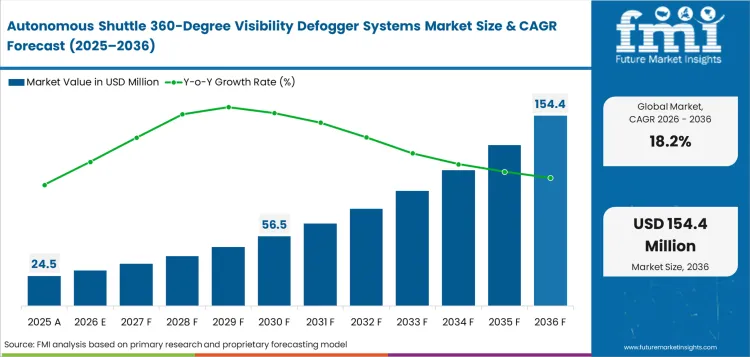
The autonomous shuttle 360-degree visibility defogger systems market was valued at USD 24.5 million in 2025 and is projected to reach USD 29.0 million in 2026. It is forecast to reach USD 154.4 million by 2036 at 18.2% CAGR. OEM integration is projected to lead sales model demand with 56.0% share. Low-speed shuttles are expected to hold 47.0% share by vehicle format in 2026.
Summary of the Autonomous Shuttle 360-Degree Visibility Defogger Systems Market
- Demand and Growth Drivers
- Demand is rising as shuttle operators need clear sensor views during rain and frost or humid cabin conditions.
- Market growth is supported by route-based autonomous services that need consistent uptime on public roads.
- Adoption is strongest where authorities permit autonomous bus-like pilots under defined operating zones.
- FMI analysis indicates that visibility clearing moves from accessory logic to safety logic during the forecast period.
- Product and Segment View
- OEM integration is projected to account for 56.0% share in 2026 as shuttle builders prefer factory-fitted sensor clearing.
- Low-speed shuttles are forecast to account for 47.0% share in 2026 as fixed-route services use compact vehicle platforms.
- Sensor lens clearing is expected to hold 41.0% share in 2026 as roof-mounted LiDAR and camera pods need direct treatment.
- Geography and Competitive Outlook
- China is expected to post 20.4% CAGR through 2036 as pilot cities expand vehicle-road-cloud corridors.
- South Korea is projected at 19.6% CAGR through 2036 as pilot zones support public mobility services.
- Key players such as Valeo and Continental shape the component pathway through sensor cleaning experience.
- May Mobility and Auve Tech influence fitment needs because shuttle design sets the available sensor envelope.
- Analyst Opinion
- Nikhil Kaitwade of FMI says, “Autonomous shuttle visibility is no longer a windshield-only question. I see the buying test shifting toward sensor uptime because shuttle operators lose service hours when cameras or LiDAR covers fog. Suppliers that combine heat and fluid clearing in one validated module are likely to gain more trust than those selling a single nozzle or film.”
- Autonomous Shuttle 360-Degree Visibility Defogger Systems Market Value Analysis
- The market is moving from retrofit trials into early OEM module placement for shuttle and robotaxi platforms.
- Cost is constrained by low vehicle volumes and custom routing around roof sensor pods.
- The clearest value pool is in combined heating and clearing modules that protect cameras and LiDAR surfaces.
- FMI analysts estimate the market using shuttle installation signals and driver assistance cleaning benchmarks.
Key Takeaways, Market Size, and Forecast
- The autonomous shuttle 360-degree visibility defogger systems market was valued at USD 24.5 million in 2025.
- By 2036, the autonomous shuttle 360-degree visibility defogger systems market is expected to be worth USD 154.4 million.
- From 2026 to 2036, the market is projected to expand at 18.2% CAGR.
- The market is projected to create an incremental opportunity of USD 125.4 million between 2026 and 2036.
- OEM integration is projected to account for 56.0% share of sales model demand in 2026.
- Low-speed shuttles are expected to account for 47.0% share of vehicle format demand in 2026.
- China at 20.4% CAGR and South Korea at 19.6% CAGR show stable adoption during the forecast period.
Autonomous shuttle visibility systems now extend beyond basic windshield defogging into full sensor clearing. The National Highway Traffic Safety Administration amended its automated vehicle crash reporting order in April 2025. The order keeps real-world operating performance under closer review. This review pressure favors heated sensor covers and washer nozzles. Air blowers keep cameras and LiDAR sensors clear during rain or frost.
Supplier interest is concentrated in supervised short-route services. For instance, Valeo lists LiDAR Cleaning as a dedicated system that can keep stable performance at speeds up to 140 km per hour. it also notes optional defrosting from start-up at minus 20 degrees Celsius in 3 minutes and 40 seconds. A blocked sensor can stop service. This makes the performance signal important for driverless shuttles.
Autonomous Shuttle 360-Degree Visibility Defogger Systems Market Definition
The autonomous shuttle 360-degree visibility defogger systems market covers hardware and control modules that keep external sensors and cabin glazing clear on driverless shuttle platforms. Scope includes heated covers and washer jets. It also includes air blowers and control units built for all-around perception. Revenue covers OEM-fit modules and validated retrofit kits. Service bundles sold for shuttle platforms are included when module value is identified.
Autonomous Shuttle 360-Degree Visibility Defogger Systems Market Inclusions
Market scope includes systems used on low-speed autonomous shuttles and robotaxi vans. Campus pods and public transit demonstration vehicles are included. Component scope includes heated sensor covers and washer nozzles. Air blowers and electronic control units are included when they clear sensor surfaces. The study includes technologies such as active cleaning systems for driver assistance and camera system.
Autonomous Shuttle 360-Degree Visibility Defogger Systems Market Exclusions
Scope excludes standard passenger car windshield defrosters sold outside autonomous shuttle use. It also excludes general bus heating systems and non-automotive camera cleaners. Software perception tools are excluded when no physical clearing function is sold. The study excludes full vehicle sales from autonomous vehicles and robotaxi services unless the visibility module value is identified separately.
Autonomous Shuttle 360-Degree Visibility Defogger Systems Market Research Methodology
- Primary Research: FMI analysts reviewed shuttle operator needs and component supplier portfolios. Pilot-route operating conditions were checked against fitment limits around sensor pods.
- Desk Research: The study used public data from transport agencies and regulator pages. Government mobility programs and company technical releases were also reviewed.
- Market sizing and forecasting: Market size was estimated through a bottom-up build using shuttle platform counts and module prices. Fitment intensity was checked by visibility zone.
- Data validation: Forecast checks compared washer system values and active safety hardware signals. Autonomous shuttle deployments were checked against country-level automated mobility programs.
Why is the Autonomous Shuttle 360-Degree Visibility Defogger Systems Market Growing?
- Shuttle operators are adding direct sensor clearing because one fogged perception surface can remove a vehicle from service.
- Public pilots need visible safety assurance as automated passenger vehicles move from closed campuses to mixed roads.
- OEM module buying is expanding as shuttle platforms integrate visibility control before final sensor packaging is frozen.
Autonomous shuttles need clear optical paths because the vehicle depends on cameras and LiDAR. Radar supports nearby movement tracking but does not remove the need for clear optical surfaces. The United States Department of Transportation announced USD 54 million in SMART grants for 34 projects across 21 states in December 2024. That public funding signal does not buy defogger modules directly. It does create more test corridors where visibility failure becomes an operating issue.
Stricter validation around automated driving supports the sector. The European Commission states that technical legislation covers fully driverless vehicles such as urban shuttles and robotaxis. The framework favors performance proof under defined operating conditions. In that setting, automotive washer systems and EV thermal systems become adjacent supply pools for shuttle-specific clearing modules.
Market Segmentation Analysis
- Sensor lens clearing is projected to reach 41.0% share in 2026 as 360-degree perception depends on clean optical surfaces.
- Heated covers are expected to represent 34.0% share in 2026 because cold-start visibility needs fast response.
- Low-speed shuttles are forecast to account for 47.0% share in 2026 due to fixed-route public trials.
- Front cabin visibility is estimated to account for 38.0% share in 2026 as windshield fogging affects rider acceptance.
- OEM integration is projected to capture 56.0% share in 2026 as factory packaging reduces field failures.
- Public transit is expected to hold 36.0% end-use share in 2026 as cities test automated bus-like services.
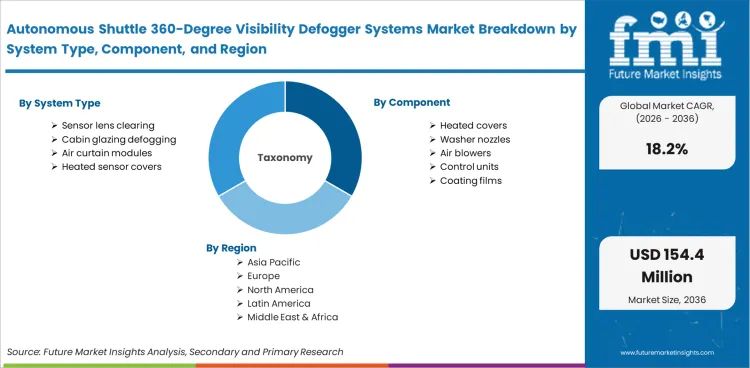
The market is divided by system type, component, vehicle format, visibility zone, sales model, and end use. System type is further segmented into sensor lens clearing and cabin glazing defogging, along with air curtain modules and heated sensor covers. Component segmentation includes heated covers, washer nozzles, air blowers, and control units, all of which support effective sensor-surface clearing. Vehicle format and visibility zone determine module placement, while sales model and end use outline the route to adoption among shuttle operators.
Insights into the Sensor Lens Clearing System Type Segment
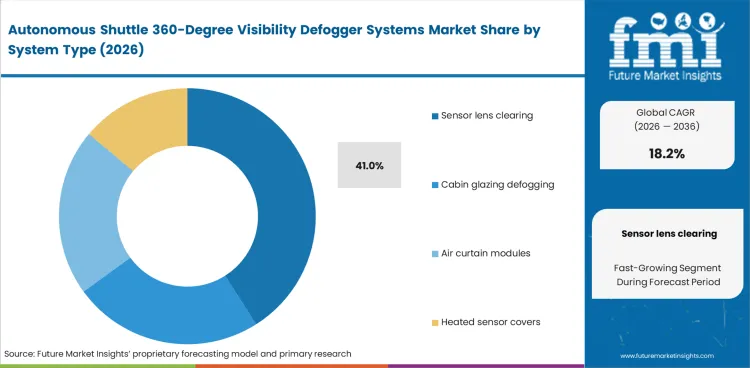
- Sensor lens clearing is projected to account for 41.0% share of system type demand in 2026. Roof cameras and LiDAR windows need active clearing because they sit in exposed positions.
- Cabin glazing defogging remains close behind because riders judge safety through visible glass. Sensor clearing gains more value when driverless supervision depends on continuous perception data.
Insights into the Heated Covers Component Segment
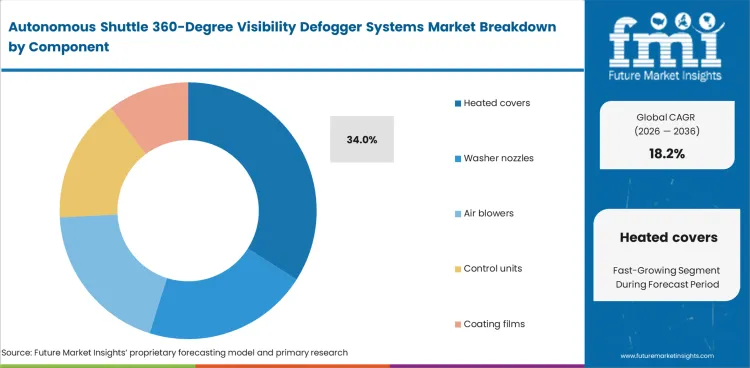
- Heated covers are expected to represent 34.0% share of component demand in 2026. Operators favor the component when frost or condensation can block sensor windows during cold starts.
- Washer nozzles and air blowers support wet-weather operation in lower-cost assemblies. Heated covers carry more value when winter routes need predictable start-up readiness.
Insights into the Low-Speed Shuttles Vehicle Format Segment
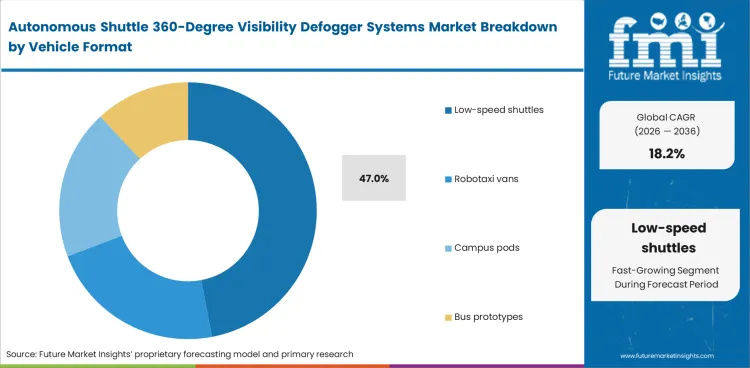
- Low-speed shuttles are forecast to account for 47.0% share of vehicle format demand in 2026. These vehicles operate on repeated routes where service stops are easy to record.
- Robotaxi vans need similar all-around clearing but follow a different duty cycle. Low-speed platforms lead as public agencies can test them under narrower route rules.
Insights into the Front Cabin Visibility Zone Segment
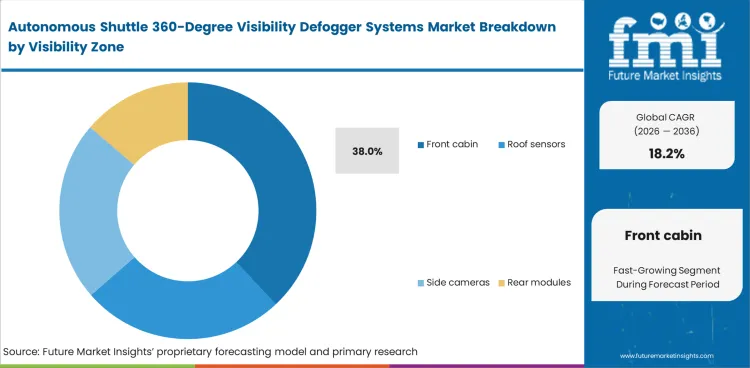
- Front cabin visibility is estimated to account for 38.0% share of visibility zone demand in 2026. Shuttle users need a clear forward view even when the vehicle drives itself.
- Roof sensors and side cameras gain share as 360-degree perception stacks expand. Front cabin modules still lead because passenger trust and remote supervision depend on clear glass.
Insights into the OEM Integration Sales Model Segment
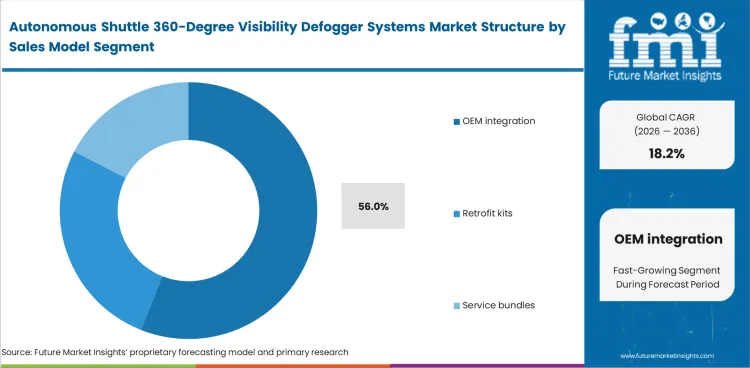
- OEM integration is projected to account for 56.0% share of sales model demand in 2026. Factory placement lowers wiring changes and improves validation before public service starts.
- Retrofit kits serve pilots and route expansions where existing vehicles need added visibility support. OEM integration keeps its lead because sensor pods are hard to modify later.
Insights into the Public Transit End Use Segment
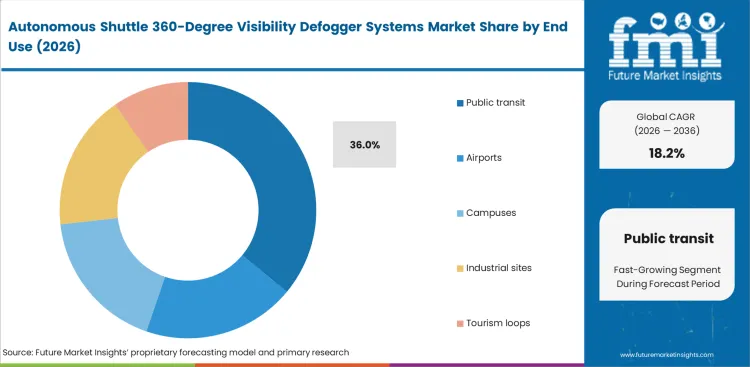
- Public transit is expected to hold 36.0% share of end-use demand in 2026. City-led pilots need clear uptime records before larger service contracts are approved.
- Airports and campuses form the next demand layer because routes are controlled and passenger volumes are steady. Tourism loops remain smaller because seasonal service lowers module payback.
Autonomous Shuttle 360-Degree Visibility Defogger Systems Market Drivers, Restraints, and Opportunities
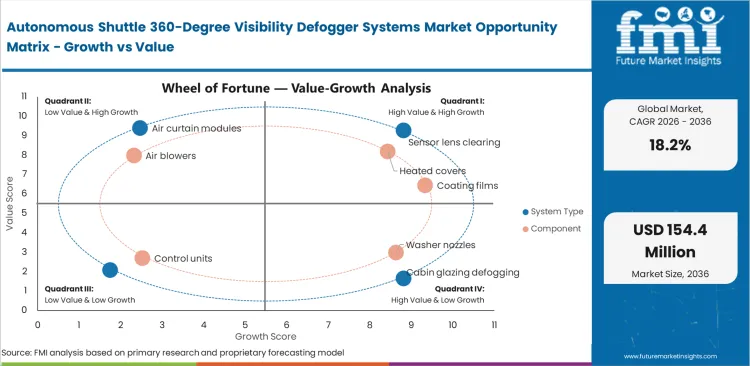
- Sensor uptime is raising demand for heated covers and cleaning nozzles on shuttle perception pods.
- Low shuttle volumes slow scale because each vehicle format uses different glass and sensor packaging.
- Combined heat-air-fluid modules create opportunity as operators seek one supplier for full visibility control.
Autonomous shuttle pilots are becoming more route-specific and that supports tailored visibility modules. China reported 20 pilot cities for vehicle-road-cloud integration in September 2025. The same release cited more than 35,000 kilometers of test and demonstration roads. Such programs widen duty cycles where rain and dust must be managed. Cabin humidity adds another service condition for defogger suppliers.
Custom Packaging Slows Scale
One significant restraint is uneven vehicle architecture. A shuttle roof pod and front windshield rarely match across platforms. Side camera clusters add another packaging difference. This forces suppliers to adjust ducts and heaters for each vehicle. Washer routing is also modified by vehicle design. Cost falls only when shuttle builders standardize sensor locations and power connections.
Module Bundles Create Service Value
An untapped opportunity is in packaged modules that combine heating and airflow. Fluid delivery adds value where rain or dirt exposure is high. Shuttle operators want fewer service points because downtime affects the route schedule directly. Suppliers that link clearing hardware with automotive autonomy model tools can help fleets predict which surfaces need service. T
Analysis of Autonomous Shuttle 360-Degree Visibility Defogger Systems Market by Key Countries
.webp "Top Country Growth Comparison Autonomous Shuttle 360 Degree Visibility Defogger Systems Market Cagr (2026 2036)")
| Country | CAGR |
|---|---|
| United States | 17.8% |
| China | 20.4% |
| Japan | 18.9% |
| Germany | 17.2% |
| South Korea | 19.6% |
| United Kingdom | 18.5% |
| France | 16.7% |
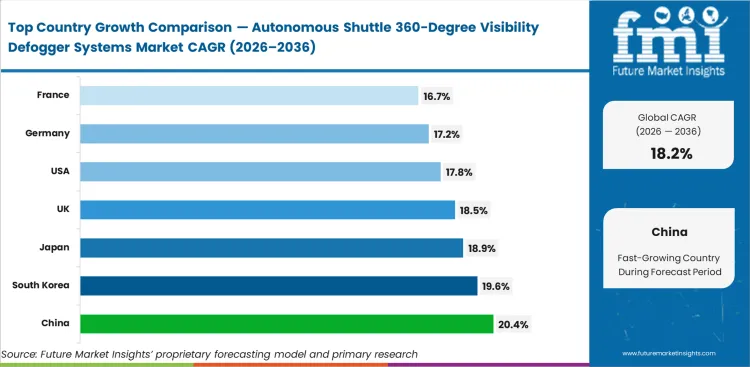
Source: Future Market Insights, 2026.
Autonomous Shuttle 360-Degree Visibility Defogger Systems Market CAGR Analysis by Country
- China is expected to post 20.4% CAGR by 2036 as pilot-city roads and vehicle-road-cloud infrastructure expand together.
- South Korea is projected to record 19.6% CAGR by 2036 as pilot zones support public shuttle and vulnerable-area services.
- Japan is forecast at 18.9% CAGR by 2036 as Level 4 route programs support transit automation.
- The United Kingdom is expected to advance at 18.5% CAGR by 2036 as self-driving bus-like pilots move toward spring 2026.
- The United States and Germany remain important volume countries, with 17.8% CAGR and 17.2% CAGR by 2036 based on public pilots and supplier depth.
Demand for autonomous shuttle 360-degree visibility defogger systems is forecast to rise at 18.2% CAGR from 2026 to 2036. Country-level analysis covers markets where automated mobility rules and shuttle pilots support early fitment. Component supply and transport agency programs add the commercial basis.
Demand Outlook for Autonomous Shuttle 360-Degree Visibility Defogger Systems Market in the United States
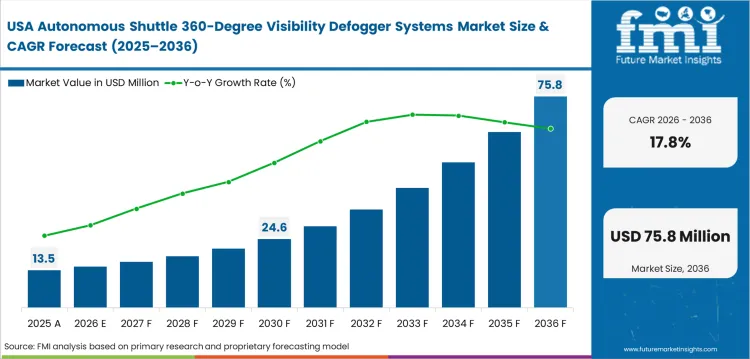
Transit agencies in the United States are testing automated mobility through grant-backed corridors and campus services. The United States is projected to record a 17.8% CAGR through 2036 as public pilots move from trials toward repeat services. The United States Department of Transportation reported USD 54 million in SMART grants for 34 projects across 21 states in December 2024. Suppliers are estimated to gain where they can support field service across different state climates.
- Florida shuttle pilots create demand for humidity control across front glazing and external camera covers.
- Georgia robotaxi and shuttle trials need 360-degree sensor clearing because mixed roads expose side cameras to spray.
- Michigan vehicle programs can test thermal modules with automotive active safety systems before larger shuttle contracts are signed.
Sales Analysis of Autonomous Shuttle 360-Degree Visibility Defogger Systems Market in China
China is moving automated mobility from testing lanes into city-scale operating zones. China is expected to expand at 20.4% CAGR through 2036 as vehicle-road-cloud pilots make fixed-route autonomous services easier to supervise. The State Council reported 20 pilot cities and more than 35,000 kilometers of test and demonstration roads in September 2025. This scale gives sensor cleaning suppliers a clearer route to multiple shuttle platforms.
- Shanghai plans more than 6 million Level 4 passenger trips by 2027 and this raises route uptime pressure.
- Wuhan and Shenzhen have large test-road networks where dust and rain exposure can shape clearing-module specifications.
- Local sensor suppliers can pair solid-state LiDAR sensors with heated covers before vehicle assembly is finalized.
Future Outlook for Autonomous Shuttle 360-Degree Visibility Defogger Systems Market in Japan
Japan links autonomous shuttles to public transport needs in towns with aging populations. The Ministry of Economy, Trade and Industry published its Mobility Digital Transformation Strategy in June 2025 and described the first domestic Level 4 automated mobility service launched in May 2023. The document also shows the Eiheiji route area at about 6 kilometers. Japan is forecast to grow at 18.9% CAGR through 2036 as transit automation needs dependable cold-weather visibility on defined routes.
- Fukui service experience helps suppliers understand slow-speed route operation with repeated stops.
- Hitachi bus rapid transit trials create a path for bus-sized defogger modules and front-zone airflow control.
- Japanese component makers can connect 1550 nm LiDAR pulsed fiber lasers with matched thermal covers for route vehicles.
Opportunity Analysis of Autonomous Shuttle 360-Degree Visibility Defogger Systems Market in Germany
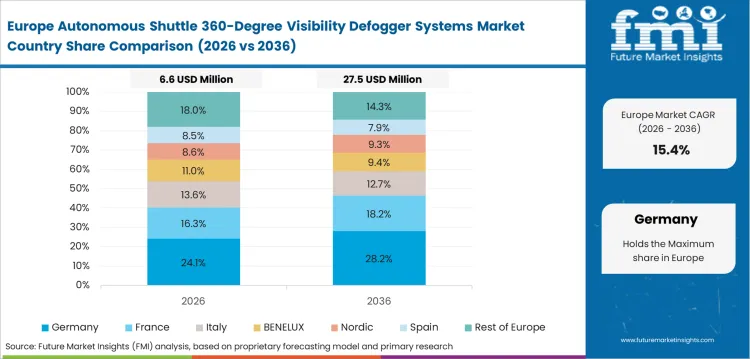
Germany has suppliers that can validate shuttle systems through automotive-grade testing. The German Federal Ministry for Digital and Transport published its strategy for autonomous driving in April 2025 and described the MINGA project in Munich. Several autonomous vehicles are planned for on-demand operation under that project. Germany is expected to advance at 17.2% CAGR through 2036 as component makers link safety validation with shuttle pilots.
- Munich on-demand pilots need sensor clearing modules that support repeated urban stops in mixed weather.
- Stuttgart suppliers can test heated covers alongside automotive radar sensors in perception validation work.
- Hamburg public transport programs create a buyer path for retrofit modules before factory adoption rises.
Sales Analysis of Autonomous Shuttle 360-Degree Visibility Defogger Systems Market in South Korea
South Korea uses pilot operation zones to test autonomous passenger services under public oversight. South Korea is projected to rise at 19.6% CAGR through 2036 as those zones support shuttle services for transport-vulnerable areas. The Ministry of Land, Infrastructure and Transport released a 2026 notice on autonomous driving vehicles for those communities. The sector favors suppliers able to support remote supervision and quick module replacement.
- Seoul routes need compact clearing systems because urban shuttles operate near pedestrians and curbside spray.
- Sejong and other pilot zones support fixed-route trials where repeat weather exposure can be logged.
- Korean electronics suppliers can pair intelligent driving technology solutions with sensor-cover thermal control.
Future Outlook for Autonomous Shuttle 360-Degree Visibility Defogger Systems Market in the United Kingdom
The United Kingdom is using legal readiness to move automated passenger services closer to public use. The United Kingdom is forecast at 18.5% CAGR through 2036 because self-driving taxi and bus-like services were brought forward to spring 2026. The government stated in June 2025 that the faster pilot route could support 38,000 jobs. Suppliers can win by addressing passenger glass clarity and external sensor reliability.
- Milton Keynes and other trial cities create demand for short-route visibility modules in mixed urban weather.
- Airport and campus operators need EV thermal systems that protect passenger comfort and front glass clarity.
- British supply-chain funding helps local integrators work on visibility packages before scaled service begins.
Demand Outlook for Autonomous Shuttle 360-Degree Visibility Defogger Systems Market in France
France has a defined framework for automated road mobility. The Ministry for the Ecological Transition states that rollout is made possible through national and European approval rules. The same page refers to 2025 addenda for safety management and remote management. Testing rules are part of the same approval path. France is expected to post 16.7% CAGR through 2036 as public transport pilots move under tighter approval steps.
- Paris-region pilots need visibility systems that can be documented within safety management files.
- Toulouse and Lyon supplier clusters can support control units tied to thermal management materials.
- French buyers may scale more slowly because approval evidence matters as much as module price.
Competitive Landscape and Strategic Positioning
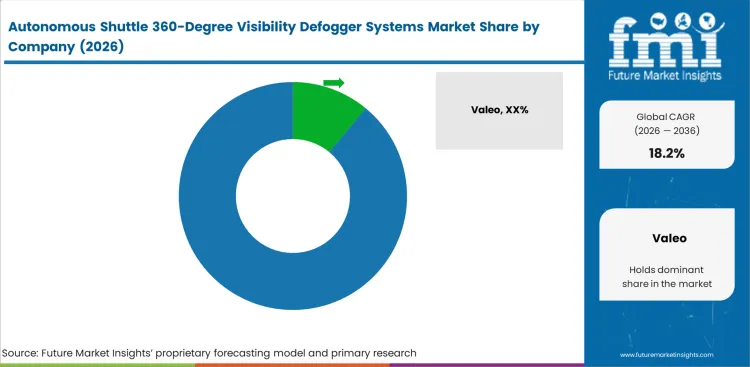
- Competition is concentrated around sensor clearing know-how and automotive-grade thermal control.
- Valeo and Continental influence the sensor-cleaning direction through camera cleaning and LiDAR cleaning experience.
- Bosch Mobility and Denso support system-level integration through controls and thermal logic. Safety hardware depth supports their position in shuttle platforms.
- Entry barriers include cold-start proof and water management. Sensor-package fit and route-level validation support also limit entry.
Component leadership is influencing the competitive outlook for autonomous shuttle visibility systems. Valeo states that LiDAR Cleaning is dedicated to LiDAR sensors and can add optional defrosting at minus 20 degrees Celsius. Roof sensors need clear surfaces before service starts. This affects shuttle builder decisions.
Shuttle builders shape demand in a different way. Auve Tech states that MiCa uses seven LiDAR sensors and multiple cameras for full 360-degree perception. May Mobility introduced a high-capacity electric autonomous minibus with Tecnobus in January 2025. These vehicle choices decide whether suppliers must design around roof pods or front glass. Side-camera clusters create another module path.
Integrator strength depends on field support instead of only product catalogs. EasyMile reports more than 300 deployments globally and over 1.5 million autonomous kilometers driven. This experience gives suppliers a clearer view of rain and dust. Condensation across repeated routes adds another design concern. FMI opines that suppliers with route feedback will improve module design faster than those relying on bench testing only.
Key Companies in the Autonomous Shuttle 360-Degree Visibility Defogger Systems Market
Competition is clearer by role because visibility modules combine fluid handling and heating. Optical protection and vehicle integration decide the final package.
- Sensor-Clearing Specialists: Valeo and Continental hold stronger positions in cleaning systems for camera and LiDAR surfaces. Their role is most relevant when shuttle builders need fluid delivery and air clearing. Heated sensor covers add value in cold routes.
- Thermal and Control Suppliers: Bosch Mobility and Denso can support heating logic and wiring. Webasto and FORVIA HELLA add automotive validation links. These companies work close to EV thermal systems and vehicle safety electronics.
- Shuttle Platform Influencers: May Mobility and Auve Tech do not compete mainly as component sellers. EasyMile adds route operation experience. Their vehicle architecture and route experience define the fitment rules that suppliers must follow.
Competitive Benchmarking: Autonomous Shuttle 360-Degree Visibility Defogger Systems Market
| Company | Sensor Clearing Depth | Thermal Integration Depth | Route Validation Support | Geographic Footprint |
|---|---|---|---|---|
| Valeo | High | Strong | Strong | Global with LiDAR cleaning and ADAS cleaning depth |
| Continental | High | Strong | Medium | Global with camera cleaning and surround-view capability |
| Bosch Mobility | Medium | Strong | Strong | Global with controls and vehicle safety system depth |
| Denso | Medium | Strong | Strong | Japan centered with global thermal and sensor electronics reach |
| Webasto | Medium | Strong | Medium | Europe centered with vehicle thermal and roof system access |
| FORVIA HELLA | Medium | Medium | Strong | Europe centered with lighting and sensor electronics depth |
| May Mobility | Low | Medium | Strong | North America centered with shuttle and minibus platform influence |
| Auve Tech | Low | Medium | Strong | Europe centered with MiCa shuttle deployments and public-road approval links |
| EasyMile | Low | Medium | Strong | Europe centered with industrial autonomy and route operation experience |
Source: Future Market Insights competitive analysis, 2026. Ratings reflect relative positioning based on sensor clearing depth and thermal integration depth. Route validation support is the third measure.
Key Developments in Autonomous Shuttle 360-Degree Visibility Defogger Systems Market
- In November 2025, Auve Tech launched its MiCa autonomous shuttle at Mizner Park in Boca Raton. The company stated that MiCa uses seven LiDAR sensors and multiple cameras for all-around perception.
- In April 2026, EasyMile reported 120 daily autonomous missions at Lufthansa Cargo Frankfurt. Repeated autonomous missions increase the value of dependable sensor visibility under industrial duty cycles.
Key Players in the Autonomous Shuttle 360-Degree Visibility Defogger Systems Market
Major Global Component Suppliers:
- Valeo
- Continental
- Bosch Mobility
- Denso
- Webasto
- FORVIA HELLA
- Gentex
Autonomous Shuttle and Platform Influencers:
- May Mobility
- Auve Tech
- EasyMile
- Beep
- Perrone Robotics
Report Scope and Coverage
| Parameter | Details |
|---|---|
| Quantitative Units | USD 29.0 million to USD 154.4 million at 18.2% CAGR |
| Market Definition | Visibility clearing and defogging systems for autonomous shuttle sensor and glazing surfaces |
| System Type | Sensor lens clearing, Cabin glazing defogging, Air curtain modules, Heated sensor covers |
| Component | Heated covers, Washer nozzles, Air blowers, Control units, Coating films |
| Vehicle Format | Low-speed shuttles, Robotaxi vans, Campus pods, Bus prototypes |
| Visibility Zone | Front cabin, Roof sensors, Side cameras, Rear modules |
| Sales Model | OEM integration, Retrofit kits, Service bundles |
| End Use | Public transit, Airports, Campuses, Industrial sites, Tourism loops |
| Regions Covered | North America, Latin America, Western Europe, Eastern Europe, East Asia, South Asia and Pacific, Middle East and Africa |
| Countries Covered | United States, China, Japan, Germany, South Korea, United Kingdom, France, and 30+ countries |
| Key Companies Profiled | Valeo, Continental, Bosch Mobility, Denso, Webasto, FORVIA HELLA, Gentex, May Mobility, Auve Tech, EasyMile |
| Forecast Period | 2026 to 2036 |
| Approach | Bottom-up module fitment model with country pilot and supplier-validation checks |
Autonomous Shuttle 360-Degree Visibility Defogger Systems Market Breakdown by Core Segments and Region
Autonomous Shuttle 360-Degree Visibility Defogger Systems Market Segmented by System Type:
- Sensor lens clearing
- Cabin glazing defogging
- Air curtain modules
- Heated sensor covers
Autonomous Shuttle 360-Degree Visibility Defogger Systems Market Segmented by Component:
- Heated covers
- Washer nozzles
- Air blowers
- Control units
- Coating films
Autonomous Shuttle 360-Degree Visibility Defogger Systems Market Segmented by Vehicle Format:
- Low-speed shuttles
- Robotaxi vans
- Campus pods
- Bus prototypes
Autonomous Shuttle 360-Degree Visibility Defogger Systems Market Segmented by Visibility Zone:
- Front cabin
- Roof sensors
- Side cameras
- Rear modules
Autonomous Shuttle 360-Degree Visibility Defogger Systems Market Segmented by Sales Model:
- OEM integration
- Retrofit kits
- Service bundles
Autonomous Shuttle 360-Degree Visibility Defogger Systems Market Segmented by End Use:
- Public transit
- Airports
- Campuses
- Industrial sites
- Tourism loops
Autonomous Shuttle 360-Degree Visibility Defogger Systems Market by Region:
- North America
- United States
- Canada
- Mexico
- Latin America
- Brazil
- Chile
- Rest of Latin America
- Western Europe
- Germany
- United Kingdom
- France
- Italy
- Spain
- Nordic
- BENELUX
- Rest of Western Europe
- Eastern Europe
- Poland
- Hungary
- Balkan and Baltic
- Rest of Eastern Europe
- East Asia
- China
- Japan
- South Korea
- South Asia and Pacific
- India
- ASEAN
- Australia and New Zealand
- Rest of South Asia and Pacific
- Middle East and Africa
- Kingdom of Saudi Arabia
- Other Gulf Cooperation Council countries
- Turkiye
- South Africa
- Other African Union
- Rest of Middle East and Africa
Research Sources and Bibliography
- United States Department of Transportation. (2026, April 3). SMART Grants Program.
- National Highway Traffic Safety Administration. (2025, April 24). Standing General Order 2021-01: Third amended order.
- European Commission. (2025). Vehicle safety and automated or connected vehicles.
- Department for Transport. (2025, June 10). Driving innovation: 38,000 jobs on the horizon as pilots of self-driving vehicles fast-tracked.
- State Council of the People’s Republic of China. (2025, September 24). China establishes full industrial chain for key intelligent connected vehicles.
- Ministry of Economy, Trade and Industry. (2025, June). Mobility digital transformation strategy.
- Federal Ministry for Digital and Transport. (2025, April 14). The future of driving is autonomous.
- Ministry for the Ecological Transition. (2025). Automated and connected road transport.
- Ministry of Land, Infrastructure and Transport. (2026, February 26). Autonomous driving vehicles to serve transportation-vulnerable areas.
- Valeo. (2024, September 2). LiDAR Cleaning: Sensor cleaning system.
- May Mobility. (2025, January 7). May Mobility unveils high-capacity electric autonomous vehicle with Tecnobus.
- Auve Tech. (2025, November 27). Auve Tech’s MiCa at Mizner Park, Boca Raton.
- EasyMile. (2026, April 7). EasyMile powers 120 daily autonomous missions at Lufthansa Cargo Frankfurt.
- Gentex Corporation. (2026, January 6). Gentex to highlight new automotive tech and demonstrate inroads into new markets at CES 2026.
This Report Answers
- What is the current and future size of the autonomous shuttle 360-degree visibility defogger systems market?
- How fast is the autonomous shuttle 360-degree visibility defogger systems market expected to expand between 2026 and 2036?
- Which system type is expected to lead autonomous shuttle 360-degree visibility defogger systems demand by 2026?
- Which sales model is projected to account for the largest autonomous shuttle 360-degree visibility defogger systems share in 2026?
- Why are sensor lens clearing and cabin defogging important for autonomous shuttle uptime?
- How do route pilots and approval rules affect visibility module adoption?
- Which countries are projected to record faster expansion during the forecast period?
- Who are the main companies active in autonomous shuttle 360-degree visibility defogger systems?
- How does FMI define the autonomous shuttle 360-degree visibility defogger systems market scope?
- How does FMI estimate and validate the autonomous shuttle 360-degree visibility defogger systems forecast?
Frequently Asked Questions
What is the global market demand for Autonomous Shuttle 360-Degree Visibility Defogger Systems in 2026?
In 2026, the global autonomous shuttle 360-degree visibility defogger systems market is expected to be worth USD 29.0 million.
How big will the Autonomous Shuttle 360-Degree Visibility Defogger Systems Market be in 2036?
By 2036, the autonomous shuttle 360-degree visibility defogger systems market is expected to be worth USD 154.4 million.
How much is demand for Autonomous Shuttle 360-Degree Visibility Defogger Systems expected to expand?
Between 2026 and 2036, demand is expected to expand at 18.2% CAGR as shuttle pilots move toward repeated routes.
Which system type is expected to lead the Autonomous Shuttle 360-Degree Visibility Defogger Systems Market by 2026?
Sensor lens clearing is projected to lead system type demand with 41.0% share in 2026 due to 360-degree perception needs.
Which sales model is expected to lead Autonomous Shuttle 360-Degree Visibility Defogger Systems demand in 2026?
OEM integration is expected to lead sales model demand with 56.0% share in 2026 because factory fitment lowers field failures.
Which country is forecast to grow fastest in the Autonomous Shuttle 360-Degree Visibility Defogger Systems Market?
China is expected to post 20.4% CAGR through 2036 as pilot-city roads and vehicle-road-cloud systems expand together.
What does the Autonomous Shuttle 360-Degree Visibility Defogger Systems Market include?
The market includes heated covers and washer nozzles. Coverage includes air blowers and control units for shuttle sensor surfaces.
How does FMI estimate the Autonomous Shuttle 360-Degree Visibility Defogger Systems Market forecast?
FMI uses shuttle platform counts and module price checks. Country pilot signals and supplier validation data support the forecast.
Are visibility defogger systems required for all autonomous shuttles?
They are not always mandated as one module, but reliable visibility is needed for safe perception and route uptime.
How do autonomous shuttle defogger systems work?
These systems use heating and airflow to keep glass and sensor covers clear. Fluid cleaning supports daily shuttle operation during rain.
Who uses autonomous shuttle 360-degree visibility defogger systems?
Early users include shuttle builders and transit agencies. Airport operators and campuses use fixed-route autonomous services.
Why does 360-degree visibility matter for autonomous shuttles?
Autonomous shuttles rely on cameras and LiDAR around the vehicle. Fog or dirt can reduce service reliability quickly.
Preview the report firsthand - request a free sample
Get SampleGet the brochure for pricing and purchase details.
Get PDFTable of Content
- Key Takeaways
- Market Size and CAGR
- Top Growth Driver
- Fastest Growing Segment
- Leading Region
- Key Companies
- Emerging Opportunities
- Executive Summary
- Global Market Outlook
- Demand-side Trends
- Supply-side Trends
- Technology Roadmap Analysis
- Analysis and Recommendations
- Analyst Perspective (What is happening? Why now? What should investors know?)
- Key Questions Answered
- How large is the market?
- What is the CAGR?
- What are key trends?
- Which region dominates?
- Who are the leaders?
- Market Overview
- Market Coverage / Taxonomy
- Market Definition / Scope / Limitations
- Research Methodology
- Chapter Orientation
- Analytical Lens and Working Hypotheses
- Market Structure, Signals, and Trend Drivers
- Benchmarking and Cross-market Comparability
- Market Sizing, Forecasting, and Opportunity Mapping
- Research Design and Evidence Framework
- Desk Research Programme (Secondary Evidence)
- Expert Input and Fieldwork (Primary Evidence)
- Tooling, Models, and Reference Databases
- Data Engineering and Model Build
- Quality Assurance and Audit Trail
- Market Background
- Market Dynamics (Drivers, Restraints, Opportunity, Trends)
- Scenario Forecast (Optimistic, Likely, Conservative)
- Impact Analysis
- AI Impact
- Sustainability Impact
- Regulatory Impact
- Technology Impact
- Consumer / Buyer Analysis
- Purchase Drivers
- Adoption Barriers
- Buyer Journey
- Opportunity Map Analysis
- Product Life Cycle Analysis
- Supply Chain Analysis
- Investment Feasibility Matrix
- Value Chain Analysis
- PESTLE and Porter's Analysis
- Regulatory Landscape
- Regional Parent Market Outlook
- Production and Consumption Statistics
- Import and Export Statistics
- Global Market Analysis and Forecast, 2021 to 2036
- Historical Market Size Value (USD Million) & Volume (Unit) Analysis, 2021 to 2025
- Current and Future Market Size Value (USD Million) & Volume (Unit) Projections, 2026 to 2036
- Y-o-Y Growth Trend Analysis
- Absolute $ Opportunity Analysis
- Global Market Pricing Analysis, 2021 to 2036
- Global Market Analysis and Forecast, By System Type, 2021 to 2036
- Introduction / Key Findings
- Historical Market Size Value (USD Million) & Volume (Unit) Analysis By System Type, 2021 to 2025
- Current and Future Market Size Value (USD Million) & Volume (Unit) Analysis and Forecast By System Type, 2026 to 2036
- Sensor Lens Clearing
- Cabin Glazing Defogging
- Air Curtain Modules
- Heated Sensor Covers
- Sensor Lens Clearing
- Y-o-Y Growth Trend Analysis By System Type, 2021 to 2025
- Absolute $ Opportunity Analysis By System Type, 2026 to 2036
- Global Market Analysis and Forecast, By Component, 2021 to 2036
- Introduction / Key Findings
- Historical Market Size Value (USD Million) & Volume (Unit) Analysis By Component, 2021 to 2025
- Current and Future Market Size Value (USD Million) & Volume (Unit) Analysis and Forecast By Component, 2026 to 2036
- Heated Covers
- Washer Nozzles
- Air Blowers
- Control Value (USD Million) & Volume (Unit)s
- Coating Films
- Heated Covers
- Y-o-Y Growth Trend Analysis By Component, 2021 to 2025
- Absolute $ Opportunity Analysis By Component, 2026 to 2036
- Global Market Analysis and Forecast, By Vehicle Format, 2021 to 2036
- Introduction / Key Findings
- Historical Market Size Value (USD Million) & Volume (Unit) Analysis By Vehicle Format, 2021 to 2025
- Current and Future Market Size Value (USD Million) & Volume (Unit) Analysis and Forecast By Vehicle Format, 2026 to 2036
- Low-Speed Shuttles
- Robotaxi Vans
- Campus Pods
- Bus Prototypes
- Low-Speed Shuttles
- Y-o-Y Growth Trend Analysis By Vehicle Format, 2021 to 2025
- Absolute $ Opportunity Analysis By Vehicle Format, 2026 to 2036
- Global Market Analysis and Forecast, By Visibility Zone, 2021 to 2036
- Introduction / Key Findings
- Historical Market Size Value (USD Million) & Volume (Unit) Analysis By Visibility Zone, 2021 to 2025
- Current and Future Market Size Value (USD Million) & Volume (Unit) Analysis and Forecast By Visibility Zone, 2026 to 2036
- Front Cabin
- Roof Sensors
- Side Cameras
- Rear Modules
- Front Cabin
- Y-o-Y Growth Trend Analysis By Visibility Zone, 2021 to 2025
- Absolute $ Opportunity Analysis By Visibility Zone, 2026 to 2036
- Global Market Analysis and Forecast, By Sales Model, 2021 to 2036
- Introduction / Key Findings
- Historical Market Size Value (USD Million) & Volume (Unit) Analysis By Sales Model, 2021 to 2025
- Current and Future Market Size Value (USD Million) & Volume (Unit) Analysis and Forecast By Sales Model, 2026 to 2036
- OEM Integration
- Retrofit Kits
- Service Bundles
- OEM Integration
- Y-o-Y Growth Trend Analysis By Sales Model, 2021 to 2025
- Absolute $ Opportunity Analysis By Sales Model, 2026 to 2036
- Global Market Analysis and Forecast, By End Use
- Introduction / Key Findings
- Historical Market Size Value (USD Million) & Volume (Unit) Analysis By End Use, 2021 to 2025
- Current and Future Market Size Value (USD Million) & Volume (Unit) Analysis and Forecast By End Use, 2026 to 2036
- Public Transit
- Airports
- Campuses
- Industrial Sites
- Tourism Loops
- Public Transit
- Y-o-Y Growth Trend Analysis By End Use, 2021 to 2025
- Absolute $ Opportunity Analysis By End Use, 2026 to 2036
- Global Market Analysis and Forecast, By Region, 2021 to 2036
- Introduction
- Historical Market Size Value (USD Million) & Volume (Unit) Analysis By Region, 2021 to 2025
- Current Market Size Value (USD Million) & Volume (Unit) Analysis and Forecast By Region, 2026 to 2036
- North America
- Latin America
- Western Europe
- Eastern Europe
- East Asia
- South Asia and Pacific
- Middle East & Africa
- Market Attractiveness Analysis By Region
- North America Market Analysis and Forecast, By Country, 2021 to 2036
- Historical Market Size Value (USD Million) & Volume (Unit) Trend Analysis By Market Taxonomy, 2021 to 2025
- Market Size Value (USD Million) & Volume (Unit) Forecast By Market Taxonomy, 2026 to 2036
- By Country
- USA
- Canada
- Mexico
- By System Type
- By Component
- By Vehicle Format
- By Visibility Zone
- By Sales Model
- By End Use
- By Country
- Market Attractiveness Analysis
- By Country
- By System Type
- By Component
- By Vehicle Format
- By Visibility Zone
- By Sales Model
- By End Use
- Key Takeaways
- Latin America Market Analysis and Forecast, By Country
- Historical Market Size Value (USD Million) & Volume (Unit) Trend Analysis By Market Taxonomy, 2021 to 2025
- Market Size Value (USD Million) & Volume (Unit) Forecast By Market Taxonomy, 2026 to 2036
- By Country
- Brazil
- Chile
- Rest of Latin America
- By System Type
- By Component
- By Vehicle Format
- By Visibility Zone
- By Sales Model
- By End Use
- By Country
- Market Attractiveness Analysis
- By Country
- By System Type
- By Component
- By Vehicle Format
- By Visibility Zone
- By Sales Model
- By End Use
- Key Takeaways
- Western Europe Market Analysis and Forecast, By Country
- Historical Market Size Value (USD Million) & Volume (Unit) Trend Analysis By Market Taxonomy, 2021 to 2025
- Market Size Value (USD Million) & Volume (Unit) Forecast By Market Taxonomy, 2026 to 2036
- By Country
- Germany
- UK
- Italy
- Spain
- France
- Nordic
- BENELUX
- Rest of Western Europe
- By System Type
- By Component
- By Vehicle Format
- By Visibility Zone
- By Sales Model
- By End Use
- By Country
- Market Attractiveness Analysis
- By Country
- By System Type
- By Component
- By Vehicle Format
- By Visibility Zone
- By Sales Model
- By End Use
- Key Takeaways
- Eastern Europe Market Analysis and Forecast, By Country
- Historical Market Size Value (USD Million) & Volume (Unit) Trend Analysis By Market Taxonomy, 2021 to 2025
- Market Size Value (USD Million) & Volume (Unit) Forecast By Market Taxonomy, 2026 to 2036
- By Country
- Russia
- Poland
- Hungary
- Balkan & Baltic
- Rest of Eastern Europe
- By System Type
- By Component
- By Vehicle Format
- By Visibility Zone
- By Sales Model
- By End Use
- By Country
- Market Attractiveness Analysis
- By Country
- By System Type
- By Component
- By Vehicle Format
- By Visibility Zone
- By Sales Model
- By End Use
- Key Takeaways
- East Asia Market Analysis and Forecast, By Country
- Historical Market Size Value (USD Million) & Volume (Unit) Trend Analysis By Market Taxonomy, 2021 to 2025
- Market Size Value (USD Million) & Volume (Unit) Forecast By Market Taxonomy, 2026 to 2036
- By Country
- China
- Japan
- South Korea
- By System Type
- By Component
- By Vehicle Format
- By Visibility Zone
- By Sales Model
- By End Use
- By Country
- Market Attractiveness Analysis
- By Country
- By System Type
- By Component
- By Vehicle Format
- By Visibility Zone
- By Sales Model
- By End Use
- Key Takeaways
- South Asia and Pacific Market Analysis and Forecast, By Country
- Historical Market Size Value (USD Million) & Volume (Unit) Trend Analysis By Market Taxonomy, 2021 to 2025
- Market Size Value (USD Million) & Volume (Unit) Forecast By Market Taxonomy, 2026 to 2036
- By Country
- India
- ASEAN
- Australia & New Zealand
- Rest of South Asia and Pacific
- By System Type
- By Component
- By Vehicle Format
- By Visibility Zone
- By Sales Model
- By End Use
- By Country
- Market Attractiveness Analysis
- By Country
- By System Type
- By Component
- By Vehicle Format
- By Visibility Zone
- By Sales Model
- By End Use
- Key Takeaways
- Middle East & Africa Market Analysis and Forecast, By Country
- Historical Market Size Value (USD Million) & Volume (Unit) Trend Analysis By Market Taxonomy, 2021 to 2025
- Market Size Value (USD Million) & Volume (Unit) Forecast By Market Taxonomy, 2026 to 2036
- By Country
- Kingdom of Saudi Arabia
- Other GCC Countries
- Türkiye
- South Africa
- Other African Union
- Rest of Middle East & Africa
- By System Type
- By Component
- By Vehicle Format
- By Visibility Zone
- By Sales Model
- By End Use
- By Country
- Market Attractiveness Analysis
- By Country
- By System Type
- By Component
- By Vehicle Format
- By Visibility Zone
- By Sales Model
- By End Use
- Key Takeaways
- Key Countries Market Analysis
- USA
- Pricing Analysis
- Market Share Analysis, 2025
- By System Type
- By Component
- By Vehicle Format
- By Visibility Zone
- By Sales Model
- By End Use
- Canada
- Pricing Analysis
- Market Share Analysis, 2025
- By System Type
- By Component
- By Vehicle Format
- By Visibility Zone
- By Sales Model
- By End Use
- Mexico
- Pricing Analysis
- Market Share Analysis, 2025
- By System Type
- By Component
- By Vehicle Format
- By Visibility Zone
- By Sales Model
- By End Use
- Brazil
- Pricing Analysis
- Market Share Analysis, 2025
- By System Type
- By Component
- By Vehicle Format
- By Visibility Zone
- By Sales Model
- By End Use
- Chile
- Pricing Analysis
- Market Share Analysis, 2025
- By System Type
- By Component
- By Vehicle Format
- By Visibility Zone
- By Sales Model
- By End Use
- Germany
- Pricing Analysis
- Market Share Analysis, 2025
- By System Type
- By Component
- By Vehicle Format
- By Visibility Zone
- By Sales Model
- By End Use
- UK
- Pricing Analysis
- Market Share Analysis, 2025
- By System Type
- By Component
- By Vehicle Format
- By Visibility Zone
- By Sales Model
- By End Use
- Italy
- Pricing Analysis
- Market Share Analysis, 2025
- By System Type
- By Component
- By Vehicle Format
- By Visibility Zone
- By Sales Model
- By End Use
- Spain
- Pricing Analysis
- Market Share Analysis, 2025
- By System Type
- By Component
- By Vehicle Format
- By Visibility Zone
- By Sales Model
- By End Use
- France
- Pricing Analysis
- Market Share Analysis, 2025
- By System Type
- By Component
- By Vehicle Format
- By Visibility Zone
- By Sales Model
- By End Use
- India
- Pricing Analysis
- Market Share Analysis, 2025
- By System Type
- By Component
- By Vehicle Format
- By Visibility Zone
- By Sales Model
- By End Use
- ASEAN
- Pricing Analysis
- Market Share Analysis, 2025
- By System Type
- By Component
- By Vehicle Format
- By Visibility Zone
- By Sales Model
- By End Use
- Australia & New Zealand
- Pricing Analysis
- Market Share Analysis, 2025
- By System Type
- By Component
- By Vehicle Format
- By Visibility Zone
- By Sales Model
- By End Use
- China
- Pricing Analysis
- Market Share Analysis, 2025
- By System Type
- By Component
- By Vehicle Format
- By Visibility Zone
- By Sales Model
- By End Use
- Japan
- Pricing Analysis
- Market Share Analysis, 2025
- By System Type
- By Component
- By Vehicle Format
- By Visibility Zone
- By Sales Model
- By End Use
- South Korea
- Pricing Analysis
- Market Share Analysis, 2025
- By System Type
- By Component
- By Vehicle Format
- By Visibility Zone
- By Sales Model
- By End Use
- Russia
- Pricing Analysis
- Market Share Analysis, 2025
- By System Type
- By Component
- By Vehicle Format
- By Visibility Zone
- By Sales Model
- By End Use
- Poland
- Pricing Analysis
- Market Share Analysis, 2025
- By System Type
- By Component
- By Vehicle Format
- By Visibility Zone
- By Sales Model
- By End Use
- Hungary
- Pricing Analysis
- Market Share Analysis, 2025
- By System Type
- By Component
- By Vehicle Format
- By Visibility Zone
- By Sales Model
- By End Use
- Kingdom of Saudi Arabia
- Pricing Analysis
- Market Share Analysis, 2025
- By System Type
- By Component
- By Vehicle Format
- By Visibility Zone
- By Sales Model
- By End Use
- Türkiye
- Pricing Analysis
- Market Share Analysis, 2025
- By System Type
- By Component
- By Vehicle Format
- By Visibility Zone
- By Sales Model
- By End Use
- South Africa
- Pricing Analysis
- Market Share Analysis, 2025
- By System Type
- By Component
- By Vehicle Format
- By Visibility Zone
- By Sales Model
- By End Use
- USA
- Market Structure Analysis
- Competition Dashboard
- Competition Benchmarking
- Market Share Analysis of Top Players
- By Regional
- By System Type
- By Component
- By Vehicle Format
- By Visibility Zone
- By Sales Model
- By End Use
- Emerging Startups
- Innovation Benchmarking
- Competition Analysis
- Competition Deep Dive
- Valeo
- Overview
- Product Portfolio
- Profitability by Market Segments (Product/Region/Sales Channel)
- Sales Footprint
- Strategy Overview
- Marketing Strategy
- Product Strategy
- Channel Strategy
- Continental
- Bosch Mobility
- Denso
- Webasto
- FORVIA HELLA
- Gentex
- May Mobility
- Auve Tech
- EasyMile
- Valeo
- Case Studies
- Success Stories
- Recent Developments
- Competition Deep Dive
- Assumptions & Acronyms Used


