

- Industry Size (2026)
- USD 3.04 Bn
- Forecast (2036)
- USD 8.87 Bn
- CAGR (2026 to 2036)
- 11.30%
Advanced Node Wafer Defect Inspection Systems Market Size, Market Forecast and Outlook By FMI
The advanced node wafer defect inspection systems market was valued at USD 2.73 billion in 2025. Revenue is poised to reach to USD 3.04 billion in 2026 at a CAGR of 11.30% during this forecast period. Continued investment carries total valuation to USD 8.87 billion through 2036 as gate-all-around transistor architectures force fabs to abandon statistical sampling for exhaustive inline scanning.
Process integration directors face a binary choice regarding yield learning at 3nm geometries. Relying on optical approximations costs months of yield ramp time, whereas implementing dense e-beam scanning bottlenecks wafer throughput severely. Delaying this capital expenditure leaves wafer defect inspection equipment buyers blind to sub-surface voids that render entire production lots worthless. Generalists assume resolution limits dictate purchases within the leading-edge wafer defect inspection market. Actually, throughput-per-scan dictates semiconductor inspection system selection.
Once automated classification algorithms accurately filter nuisance defects from killer defects without human review, adoption accelerates exponentially. Fab managers trigger this threshold when unyielding logic nodes destroy margin targets. Subsequent tool additions integrate smoothly into established software environments, reducing qualification times drastically.
Summary of Advanced Node Wafer Defect Inspection Systems Market
- Advanced Node Wafer Defect Inspection Systems Market Definition
- Hardware platforms utilizing advanced optical or electron-beam physics to identify nanoscale anomalies on silicon substrates. These tools capture pattern failures during extreme ultraviolet lithography steps inside logic and memory fabrication facilities.
- Demand Drivers in the Market
- Gate-all-around defect inspection complexity forces process integration engineers to evaluate hidden trenches previously ignored.
- EUV process defect inspection systems require yield managers to scan every lot for random micro-bridges driven by stochastics.
- Rising wafer costs push procurement directors to invest in inline detection preventing downstream packaging failures.
- Key Segments Analyzed in the FMI Report
- Optical inspection is set to hold 48.0% share in 2026, dominating optical wafer defect inspection for advanced nodes due to unmatched throughput advantages.
- Patterned wafers is expected to record 57.0% share through 2036, demanding continuous monitoring across dozens of sequential patterned wafer inspection systems passes.
- 3nm class is projected to capture 39.0% share, representing current volume production sweet spots for leading foundries.
- Foundries is estimated to account for 46.0% share, reflecting concentrated capital expenditure on pure-play leading-edge logic capacity.
- Inline monitoring is poised to garner 44.0% share, establishing inline defect inspection semiconductor fabs as standard procedure for drift correction.
- Taiwan 12.6% compound growth, sustained by unprecedented TSMC N2 yield-learning investments.
- Analyst Opinion at FMI
- Sudip Saha, Principal Analyst, Technology, at FMI, notes that "Standard defect metrics capture total particle counts perfectly. However, aggregate count data misses spatial distribution clustering entirely, which matters vastly more for 3nm logic yields. Fab managers assume upgrading optical resolution solves missing defect issues. Nuisance filtering algorithms determine true capability. A scanner finding every anomaly is useless if yield engineers spend three days classifying false positives. True competitive advantage sits inside automatic classification software, not just beam physics. Buyers underestimating computational requirements face extreme bottlenecking."
- Strategic Implications / Executive Takeaways
- Metrology directors must evaluate total cost per scan rather than base tool price to maintain favorable economics.
- Yield engineers face urgent requirements developing custom classification algorithms mapping specific extreme ultraviolet failures.
- Foundry procurement teams gain significant negotiating leverage by committing to multi-tool clustered configurations with key advanced wafer inspection systems suppliers early.
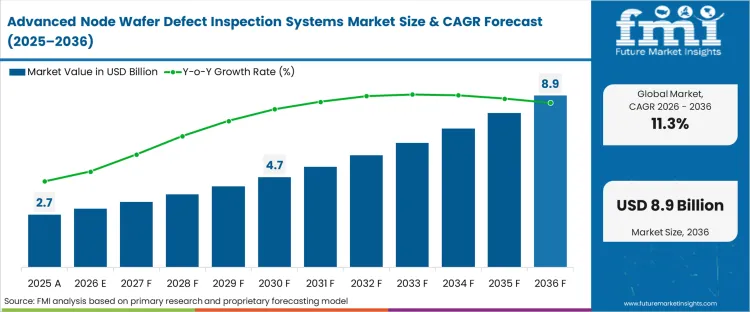
Key Takeaways
| Details | Metric |
|---|---|
| Industry Size (2026) | USD 3.04 billion |
| Industry Value (2036) | USD 8.87 billion |
| CAGR (2026 to 2036) | 11.30% |
Source: Future Market Insights (FMI) analysis, based on proprietary forecasting model and primary research
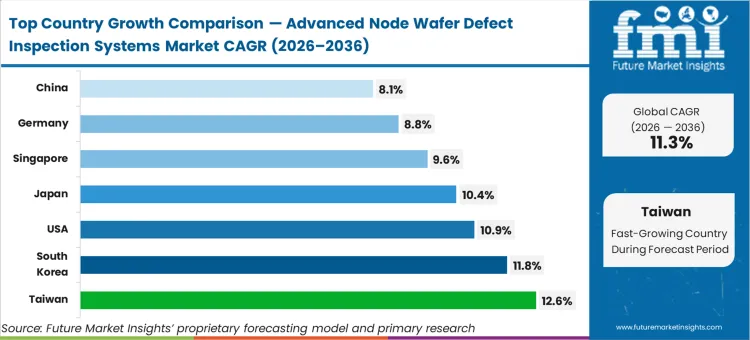
Taiwan leads globally at 12.6% as TSMC drives N2 into volume production, accelerating the Taiwan advanced wafer inspection industry. South Korea tracks closely at 11.8% because Samsung frames foundry expansion around advanced architectures. United States facilities grow at 10.9% supported by Intel 18A capacity ramp activities. Japan advances at 10.4% alongside Singapore capturing 9.6%. Germany expands at 8.8% while China maintains 8.1% constrained by export limitations restricting leading-edge tool access. Divergence separates regions, building local angstrom-era ecosystems from those restricted to trailing-edge optimisation.
Advanced Node Wafer Defect Inspection Systems Market Definition
Defining what are advanced node wafer defect inspection systems requires looking beyond legacy metrology; these are sub-5nm wafer inspection systems deployed specifically to locate, classify, and measure physical anomalies on semiconductor substrates. This category targets killer defects invisible to legacy metrology tools. Equipment isolates particle contamination, pattern collapse, and sub-surface voids during high-volume manufacturing.
Advanced Node Wafer Defect Inspection Systems Market Inclusions
Scope encompasses semiconductor wafer defect inspection systems, patterned logic wafer inspection system hardware, e-beam review stations, and dedicated defect classification software tied directly to primary hardware. Optical brightfield and darkfield tools configured for sub-5nm sensitivity fall within analysis boundaries.
Advanced Node Wafer Defect Inspection Systems Market Exclusions
Analysis omits general-purpose metrology tools measuring film thickness or critical dimensions. Standard 28nm optical scanners lack necessary resolution capability and fall outside scope. Standalone yield management software unconnected to specific proprietary scanning hardware produced by advanced node defect inspection equipment manufacturers remains excluded.
Advanced Node Wafer Defect Inspection Systems Market Research Methodology
- Primary Research: Procurement directors at Tier-1 foundries, process integration engineering leads, and metrology hardware product managers.
- Desk Research: Capital expenditure filings from pure-play foundries, SEMI equipment billings reports, and logic scaling roadmaps.
- Market-Sizing and Forecasting: Installed base estimates for extreme ultraviolet lithography layers requiring concurrent defect scanning density.
- Data Validation and Update Cycle: Vendor quarterly earnings call transcripts cross-referenced against foundry capital equipment depreciation schedules.
Segmental Analysis
Advanced Node Wafer Defect Inspection Systems Market Analysis by Technology Type
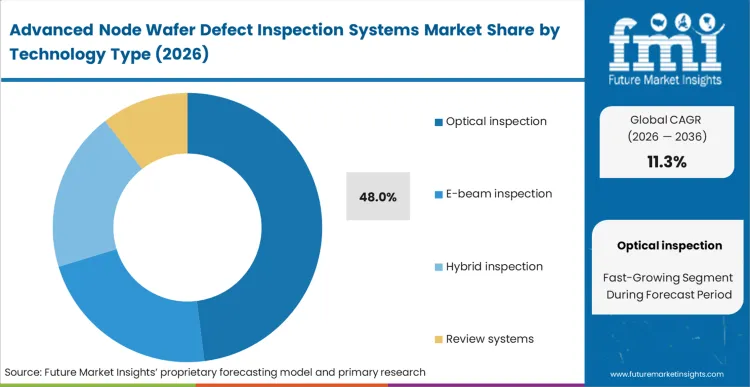
Unmatched throughput speeds keep optical hardware dominant during high-volume fab operations. Foundries cannot physically scan every substrate utilizing slow electron beams without stopping entire production lines. Optical brightfield configurations capture 48.0% share in 2026. FMI assesses that this figure reflects raw scanning velocity rather than absolute resolution superiority. Process engineering leads evaluate optical vs e-beam wafer inspection constantly, deploying optical platforms for rapid first-pass screening across non-critical layers. Optical wavelengths struggle to isolate sub-surface voids inside the gate-all-around structures. Hardware buyers continuously weigh optical false-positive rates against e-beam scanning times. What procurement executives rarely factor into unit-cost comparisons is that next-generation optical tools require massive liquid cooling infrastructure upgrades inside cleanrooms. Fabs misjudging this thermal load face severe facility retrofitting costs. Delaying hybrid semiconductor defect inspection equipment integration guarantees delayed yield learning cycles.
- Throughput screening: Optical light bounces rapidly across entire substrates identifying macro-level anomalies instantly. Metrology directors gain crucial real-time statistical process control data preventing massive batch excursions.
- Resolution limitations: Optical physics dictates hard limits regarding sub-nanometer particle detection. Process engineers face blind spots mapping specific extreme ultraviolet stochastic failures.
- Computational overhead: Advanced optical platforms require massive external server racks processing raw image data. Fab IT managers must upgrade localized data center capacity supporting these high-bandwidth inspection streams.
Advanced Node Wafer Defect Inspection Systems Market Analysis by Inspection mode
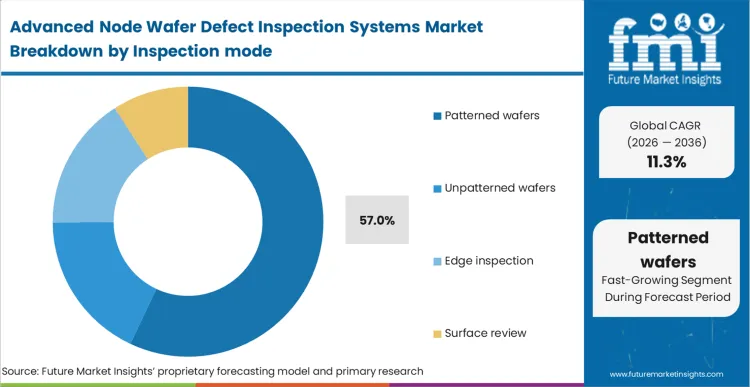
Pattern complexity multiplies exponentially below 5nm geometries creating unique topological challenges. Bare silicon scanning provides baseline qualification, but patterned environments dictate actual die yields. Patterned wafer configurations hold 57.0% share, forming the core of patterned wafer inspection systems deployments globally. According to FMI's estimates, this concentration stems from defect lethality multiplying across sequential lithography passes. Yield enhancement directors mandate rigorous patterned layer scanning after every critical extreme ultraviolet exposure. Sub-surface trenches hide fatal bridges invisible during top-down bare silicon checks. Surface measurements look stable, while actual 3D transistor structures collapse internally. FMI analysts note that patterned defect profiles change dynamically based on previous chemical-mechanical polishing steps, meaning static inspection recipes fail frequently. Facilities failing to update dynamic patterned recipes face massive false-positive classification avalanches.
- Initial baseline: Bare substrate scanning establishes incoming material cleanliness before processing begins. Procurement managers avoid processing fundamentally flawed raw silicon saving millions in wasted manufacturing hours.
- Sequential verification: Patterned semiconductor metrology and inspection occurs sequentially between individual deposition steps. Yield engineers isolate exact failure points rapidly rather than discovering issues during final electrical testing.
- Edge complexity: Bevel anomalies migrate toward active die areas during thermal cycling steps. Integration teams must deploy dedicated edge scanners preventing catastrophic cracking during subsequent packaging flows.
Advanced Node Wafer Defect Inspection Systems Market Analysis by Node focus
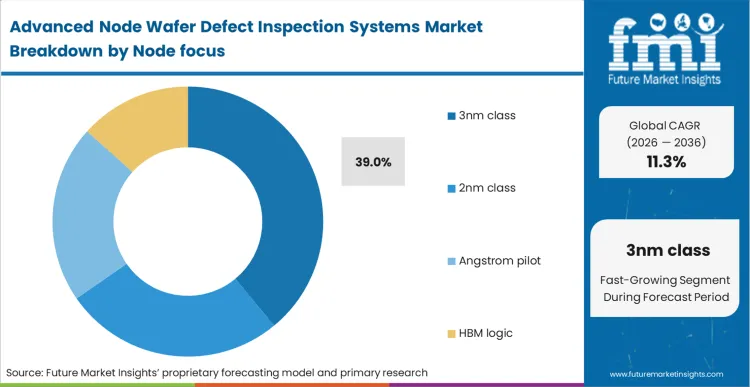
Current leading-edge foundry revenue centers heavily on specific geometries supporting mobile application processors. Transitioning architectures dictates capital expenditure heavily. Platforms targeting 3nm architectures capture 39.0% share. In FMI's view, this position reflects mature volume ramps achieving commercial viability simultaneously. Fab module leaders optimize specialized yield learning inspection tools specifically targeting 3nm finFET failure modes. Procurement teams securing 2nm wafer defect inspection equipment face severe hardware limitations locating sub-nanometer anomalies reliably. Consequently, e-beam wafer defect inspection for 2nm becomes absolutely critical for angstrom pilot lines. Interestingly, advanced node classification software trained on 3nm defects frequently misidentifies 2nm failures due to altered structural capacitance. R&D directors ignoring this algorithm retraining requirement burn critical months chasing phantom defects.
- Mobile processors: High-volume smartphone chip manufacturing dominates current 3nm fab capacity allocations. Operations directors secure guaranteed yields satisfying demanding consumer electronics launch schedules.
- Architectural shift: Gate-all-around transistor designs introduce entirely novel sub-surface defect profiles. Process integration managers must abandon legacy planar inspection logic entirely.
- Pilot line validation: Angstrom-era processes require exhaustive scanning characterizing unknown stochastic behaviors. Development engineers rely on specialized wafer processing equipment recipes to minimize nuisance defects.
Advanced Node Wafer Defect Inspection Systems Market Analysis by End user
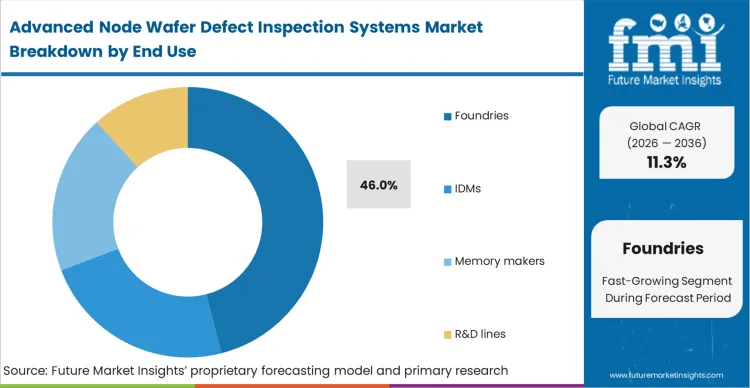
Concentrated capital expenditure among pure-play manufacturers defines leading-edge inspection adoption. Independent fabrication models centralize advanced node development risks. Foundries command 46.0% share currently, dominating the broader semiconductor metrology and inspection market. FMI observes that this dominance aligns perfectly with extreme ultraviolet lithography tool installation bases globally. Fab capacity planners allocate vast budgets ensuring external fabless clients receive guaranteed die yields. Memory manufacturers operate different cost structures prioritizing separate high-aspect-ratio hole inspection over logic routing defect capture. Foundries amortize multi-million dollar optical platforms across varied client portfolios effectively. Equipment suppliers secretly discount advanced wafer manufacturing equipment nodes for Tier-1 foundries specifically to harvest early machine-learning defect data for algorithm training. IDMs lacking this early data access struggle matching foundry yield curves initially.
- Client commitments: Fabless semiconductor designers demand strict defect density metrics before signing volume contracts. Foundry sales executives utilize comprehensive inline inspection data proving manufacturing stability.
- Cost amortization: IDMs building custom internal logic face difficult capital depreciation timelines regarding ultra-expensive e-beam tools. Financial controllers force IDM metrology teams toward lower-cost legacy sampling methods frequently.
- Memory specificities: High-bandwidth memory production requires distinct deep-trench void detection capabilities. Memory yield directors must purchase specialized hybrid platforms handling unique 3D stacking anomalies.
Advanced Node Wafer Defect Inspection Systems Market Analysis by Workflow stage
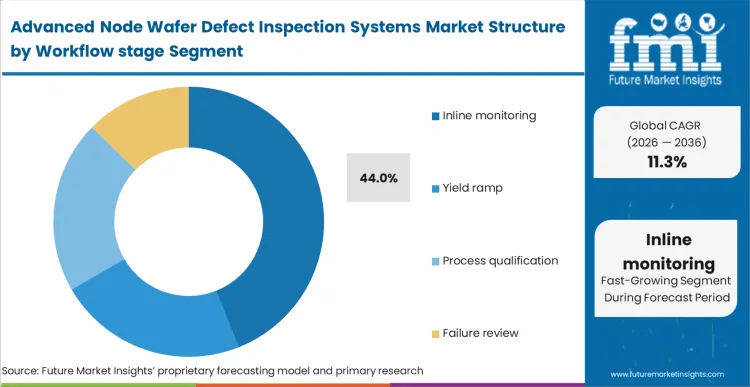
Real-time process control requires constant feedback loops preventing systemic excursions. Discovering errors during final electrical testing wastes entire fabrication cycles spanning months. Inline monitoring captures 44.0% share. Based on FMI's analysis, immediate drift correction drives inline defect inspection semiconductor fabs deployment. Process module owners integrate optical scanners directly into deposition tracking systems. Yield ramp stages require deeper e-beam analysis establishing baseline failure mechanisms initially. Inline strategies focus purely on detecting deviations from established golden paths. Yield baseline metrics look healthy while hidden stochastic defects compound silently downstream. FMI's analysis indicates integrated wafer cleaning equipment allows inline scanners to trigger automated re-cleaning steps without human intervention. Furthermore, process qualification inspection tools prevent severe delays bringing new capacity online.
- Excursion prevention: Constant inline optical scanning identifies abnormal particle spikes instantly. Module engineers halt contaminated chambers immediately saving millions in ruined silicon.
- Root cause isolation: Failure review stages deploy high-resolution electron beams characterizing specific defect chemical compositions. Device physics engineers determine exact contamination sources preventing future recurrences.
- Qualification bottlenecks: New tool installations require exhaustive patterned wafer inspection proving cleanliness. Equipment engineering directors face severe work-in-progress bottlenecks surrounding inspection clusters without dedicated scanners.
Advanced Node Wafer Defect Inspection Systems Market Drivers, Restraints, and Opportunities
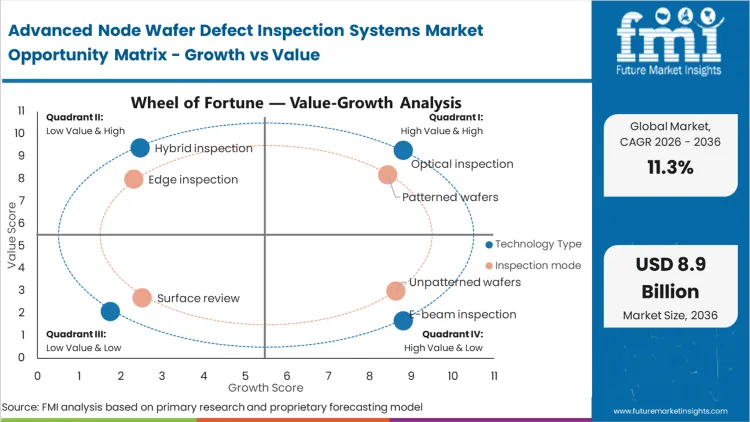
Gate-all-around transistor implementations force process integration engineers to inspect complex sub-surface trenches previously ignored during planar eras. Transitioning architectures fundamentally breaks legacy statistical sampling models. Relying on older optical tools guarantees missing fatal micro-bridges hiding beneath complex 3D structures. Fab managers cannot risk pushing unverified lots through expensive extreme ultraviolet lithography steps. Delaying upgraded inspection capital expenditures directly collapses die yields, rendering 2nm commercial production financially impossible.
Data processing bottlenecks severely constrain adoption rates despite urgent scanning requirements. Upgraded optical sensors generate petabytes of raw image data hourly. Traditional localized fab servers cannot classify this volume rapidly. Fab IT directors face massive infrastructure hurdles upgrading networks supporting real-time machine learning defect classification. Foundries implementing edge-computing inference servers partially mitigate this friction. However, localized thermal constraints inside cleanrooms restrict aggressive server rack deployments severely.
Opportunities in the Advanced Node Wafer Defect Inspection Systems Market
- Advanced logic wafer inspection trends: Nuisance defect filtering consumes massive engineering resources currently. Machine learning developers creating self-updating classification algorithms capture significant recurring software revenues.
- Backside power inspection systems: Transporting substrates and fabricating backside delivery networks introduces massive contamination risks. Hardware engineers designing specialized measurement capabilities for backside architectures unlock entirely new revenue streams.
- Clustered architectures: Transporting substrates between processing chambers risks particle contamination. Integrating specialized semiconductor manufacturing equipment clusters directly with multi-beam arrays unlocks exhaustive scanning without crippling fabrication velocity.
Regional Analysis
.webp "Top Country Growth Comparison Advanced Node Wafer Defect Inspection Systems Market Cagr (2026 2036)")
The regional assessment divides the Advanced Node Wafer Defect Inspection Systems market across more than 40 countries, grouped into North America, Latin America, Europe, East Asia, South Asia, Oceania, and the Middle East & Africa.
| Country | CAGR (2026 to 2036) |
|---|---|
| Taiwan | 12.6% |
| South Korea | 11.8% |
| United States | 10.9% |
| Japan | 10.4% |
| Singapore | 9.6% |
| Germany | 8.8% |
| China | 8.1% |
Source: Future Market Insights (FMI) analysis, based on proprietary forecasting model and primary research
Asia Pacific Advanced Node Wafer Defect Inspection Systems Market Analysis
Aggressive foundry capacity expansions driving N2 architectures dictate regional capital expenditure directly. Localized supply chains compress yield learning cycles drastically. FMI's analysis indicates extreme ultraviolet lithography tool concentration correlates perfectly with regional advanced scanning demand. Process integration teams deploy hybrid metrology platforms characterizing novel transistor materials. Sub-nanometer defect sensitivity determines competitive dominance among regional pure-play foundries.
- Taiwan: TSMC N2 volume production initiates unprecedented yield-learning investments immediately across localized fabrication hubs. Process integration engineers require massive e-beam capacity mapping initial gate-all-around anomalies, propelling the Taiwan advanced node wafer defect inspection systems industry forward rapidly. Revenue advances at 12.6%. Early equipment adopters secure dominant global foundry market share through superior defect densities, translating aggressive early capital expenditure directly into long-term commercial logic node manufacturing supremacy.
- South Korea: Samsung frames strategic foundry expansion specifically around advanced logic architectures combating offshore rivals. Metrology directors deploy massive optical scanning clusters accelerating yield ramps, surging South Korea advanced node wafer defect inspection systems demand. Sales are expected to track at 11.8%. Internal IDM metrology teams translate logic learning directly into high-bandwidth memory quality improvements, creating unique dual-purpose inspection workflows that maximize expensive hardware utilization across disparate semiconductor product categories.
- Japan: Material science supremacy supports localized inspection hardware development strongly amid global supply chain realignments. Operations directors leverage domestic optical engineering expertise building customized high-resolution review platforms. The Japan advanced node wafer defect inspection systems demand is forecast to reach 10.4%. Domestic suppliers command significant pricing power leveraging unique sub-surface optical interference technologies, allowing regional fabs to maintain critical yield advantages without relying entirely on imported extreme ultraviolet metrology tool architectures.
- China: China's advanced node wafer defect inspection systems revenue expands at 8.1%.Export controls restrict access regarding leading-edge sub-5nm scanning configurations completely for domestic manufacturers. Fab managers optimize legacy 28nm optical tools using aggressive AI upscaling algorithms instead of hardware upgrades. Regional engineers develop highly novel computational metrology software bypassing hardware limitations entirely, establishing an isolated but deeply innovative ecosystem focused entirely on algorithmic defect prediction rather than beam physics.
North America Advanced Node Wafer Defect Inspection Systems Market Analysis
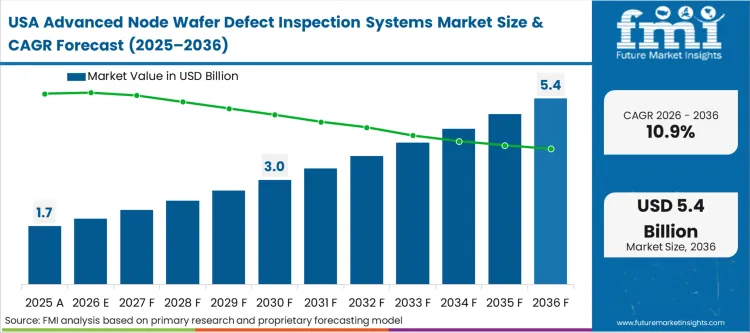
Subsidized capacity building initiatives accelerate domestic inspection hardware procurement. Strategic shifts toward onshore leading-edge logic manufacturing require entirely new metrology ecosystems. Based on FMI's assessment, IDMs resurrecting domestic foundry services depend entirely on matching offshore defect densities rapidly. Localized R&D facilities pilot angstrom-era recipes requiring exotic scanning configurations.
- United States: Intel 18A capacity ramp activities demand massive inline monitoring investments supporting subsidized fabrication hubs. Yield enhancement directors mandate rigorous patterned layer scanning across these facilities, expanding the United States advanced node inspection market. Revenue is poised to hit 10.9%. Domestic fabs establishing robust defect baselines early attract cautious fabless designers seeking diverse supply chains insulated from potential transpacific geopolitical logistics disruptions.
Europe Advanced Node Wafer Defect Inspection Systems Market Analysis
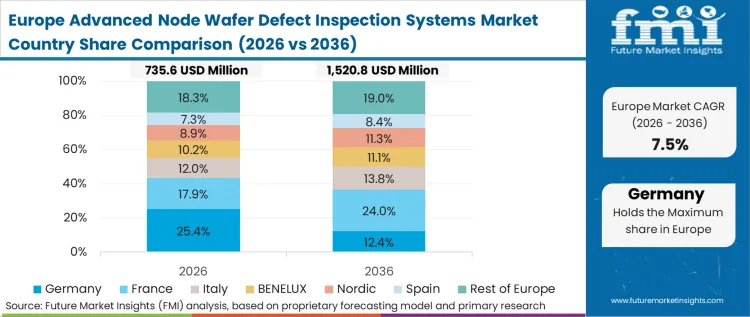
Automotive semiconductor demands shift regional focus toward zero-defect requirements. Trailing-edge optimization transitions toward specialized advanced packaging inspection locally. According to FMI's estimates, regional research institutes pioneer hybrid metrology characterizing novel power electronics substrates. Equipment suppliers target regional joint ventures building specialized automotive logic capacity.
- Germany: Germany’s advanced node wafer defect inspection systems revenue expands at 8.1%.Demand is set to advance at 8.8%. Automotive Tier-1 qualification standards force local fabs toward rigorous, exhaustive scanning protocols, minimising liability. Quality control directors reject statistical sampling completely, preferring 100% wafer screening to prevent field failures. Fabs guaranteeing zero-defect shipments command massive premium pricing across automotive supply chains, transforming intense inspection capital expenditure directly into defensible commercial advantages for European silicon suppliers.
FMI's report includes Singapore, France, and additional countries mapping specialized semiconductor foundry deployments. Global IDMs operating Singaporean facilities utilize local engineering talent developing custom defect classification algorithms avoiding centralized server bottlenecks.
Competitive Aligners for Market Players
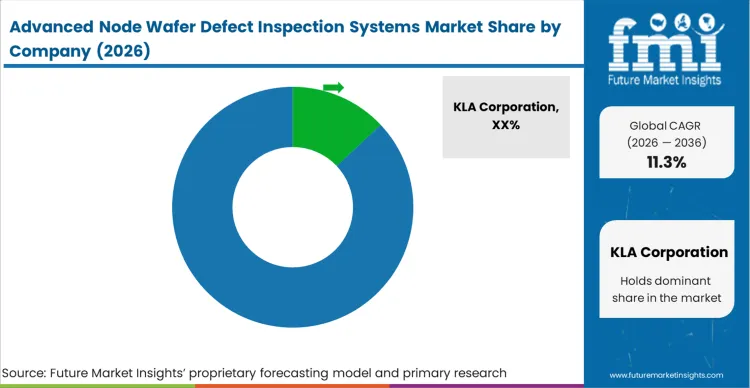
Extreme hardware development costs isolate leading-edge capability among exceptionally few advanced wafer inspection systems suppliers. Incumbents control optical and e-beam physics domains strictly through massive patent libraries. Process engineers specify specific configurations directly into process of record documents during R&D phases. Once specified, switching hardware vendors requires restarting complex yield learning algorithms from scratch. Foundries avoid this switching cost fiercely. Smaller players targeting angstrom-era logic face insurmountable barriers replicating decades of classified defect image libraries used training incumbent machine learning algorithms.
Dominant incumbents possess unique hybrid platform integration capabilities. Single vendors controlling both high-speed optical screening and high-resolution electron beam review synchronize coordinate systems perfectly. Evaluators constantly analyze KLA vs ASML HMI inspection systems to determine optimal throughput-to-resolution ratios. These vendors leverage synergy mapping specific defects across multiple lithography equipment layers. Metrology directors value this seamless coordinate transfer capability heavily. Challengers must build robust open-source software connectors proving their standalone tools integrate smoothly into existing proprietary data ecosystems. Lacking seamless data handoffs, challenger hardware sits isolated inside fabs.
Large foundry buyers resist single-vendor lock-in aggressively by funding alternative e-beam startups secretly. Procurement directors evaluating wafer inspection tool vendors for 2nm fabs mandate multi-tool qualification protocols forcing incumbents to match startup pricing occasionally. Fab IT managers strip proprietary metadata from inspection images preventing vendors from monopolizing defect classification algorithms. Looking ahead, hardware supremacy transitions toward algorithmic dominance. Suppliers controlling automated nuisance filtering logic dictate fab yield curves directly, rendering pure hardware physics secondary.
Key Players in Advanced Node Wafer Defect Inspection Systems Market
- KLA Corporation
- ASML Holding N.V.
- Applied Materials, Inc.
- Hitachi High-Tech Corporation
- Onto Innovation Inc.
- Lasertec Corporation
- SCREEN Semiconductor Solutions Co., Ltd.
Scope of the Report
| Metric | Value |
|---|---|
| Quantitative Units | USD 3.04 billion to USD 8.87 billion, at a CAGR of 11.30% |
| Market Definition | Hardware platforms utilizing advanced optical or electron-beam physics to identify nanoscale anomalies on silicon substrates. These tools capture pattern failures during extreme ultraviolet lithography steps inside logic and memory fabrication facilities. |
| Segmentation | Technology type, Inspection mode, Node focus, End user, Workflow stage, Wafer size, Integration level, Region |
| Regions Covered | North America, Latin America, Europe, East Asia, South Asia, Oceania, Middle East and Africa |
| Countries Covered | United States, Canada, Brazil, Mexico, Germany, United Kingdom, France, Spain, Italy, China, Japan, South Korea, Taiwan, India, Indonesia, Singapore, Australia, New Zealand, GCC Countries, South Africa, Israel |
| Key Companies Profiled | KLA Corporation, ASML Holding N.V., Applied Materials, Inc., Hitachi High-Tech Corporation, Onto Innovation Inc., Lasertec Corporation, SCREEN Semiconductor Solutions Co., Ltd. |
| Forecast Period | 2026 to 2036 |
| Approach | Installed base estimates for extreme ultraviolet lithography layers requiring concurrent defect scanning density. |
Source: Future Market Insights (FMI) analysis, based on proprietary forecasting model and primary research
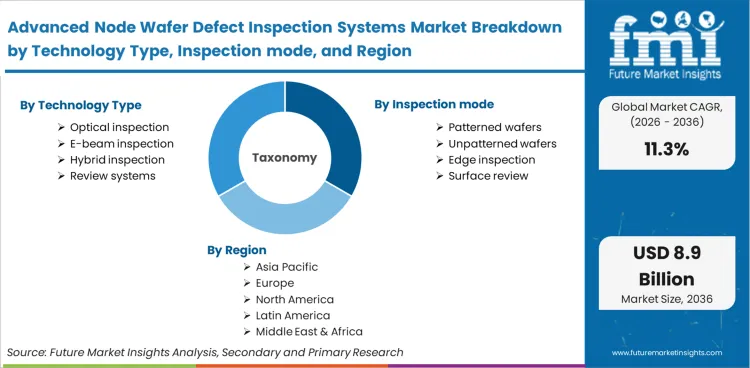
Advanced Node Wafer Defect Inspection Systems Market Analysis by Segments
Technology type
- Optical inspection
- E-beam inspection
- Hybrid inspection
- Review systems
Inspection mode
- Patterned wafers
- Unpatterned wafers
- Edge inspection
- Surface review
Node focus
- 3nm class
- 2nm class
- Angstrom pilot
- HBM logic
End user
- Foundries
- IDMs
- Memory makers
- R&D lines
Workflow stage
- Inline monitoring
- Yield ramp
- Process qualification
- Failure review
Wafer size
- 300mm
- 200mm
Integration level
- Standalone
- Clustered
- Software-linked
Region
- North America
- Latin America
- Europe
- East Asia
- South Asia
- Oceania
- Middle East and Africa
Bibliography
- Hitachi, Ltd. (2025, February 27). Hitachi has developed new image processing technology for semiconductor manufacturing processes, capable of high-sensitivity inspection of micro-defects of 10 nm or smaller.
- Onto Innovation Inc. (2026, March 16). Onto Innovation launches Dragonfly® G5 inspection system.
- Semiconductor Industry Association. (2025). 2025 state of the USA semiconductor industry.
- Samsung Electronics Co., Ltd. (2025). 2025 1Q interim report.
- Taiwan Semiconductor Manufacturing Company Limited. (2025, March). TSMC annual report 2024.
This bibliography is provided for reader reference. The full FMI report contains the complete reference list with primary source documentation.
This Report Addresses
- Analyzing what is the market size of advanced wafer inspection systems and mapping long-term growth projections globally.
- Detailing who are the top suppliers in advanced node wafer inspection and how concentrated is the market regarding patent control.
- Seeking to explain the advanced node wafer defect inspection market for 2026 to 2036 across complex regional trajectories.
- Gate-all-around sub-surface trench failure profiling methodologies impacting fab yield optimization.
- Multi-beam electron arrays shifting inline monitoring velocity expectations across angstrom pilot lines.
- Machine learning algorithm training bottlenecks limiting false-positive nuisance filtering.
- Edge computing server deployments mitigating localized cleanroom data transfer delays.
- Optical throughput screening economics impacting yield enhancement capital budgets.
Frequently Asked Questions
What is the market size of advanced wafer inspection systems?
Revenue crosses USD 3.04 billion initially in 2026. This baseline signals massive foundry commitments scaling sub-5nm extreme ultraviolet lithography layers globally.
Explain the advanced node wafer defect inspection market for 2026 to 2036 trajectory?
Total opportunity reaches USD 8.87 billion by 2036. Angstrom-era node commercialization forces facilities away from statistical sampling toward exhaustive inline defect scanning.
What are advanced node wafer defect inspection systems fundamentally?
These are hardware platforms utilizing advanced optical or electron-beam physics to identify nanoscale anomalies on silicon substrates, capturing killer defects invisible to legacy metrology tools.
Why do 2nm fabs need more defect inspection compared to legacy nodes?
Gate-all-around transistor implementations force process integration engineers to inspect complex sub-surface trenches. Defect lethality multiplies exponentially, rendering traditional sampling completely inadequate.
Which companies make advanced wafer inspection tools for leading-edge fabs?
Key suppliers include KLA Corporation, ASML Holding N.V., Applied Materials, Inc., Hitachi High-Tech Corporation, Onto Innovation Inc., and Lasertec Corporation.
Who are the top suppliers in advanced node wafer inspection and how concentrated is the market?
The supplier landscape is highly concentrated. KLA Corporation captures 41.0% share, with a handful of incumbents controlling optical and e-beam physics domains strictly through massive patent libraries.
Compare KLA and ASML HMI for advanced defect inspection capabilities?
KLA traditionally dominates high-throughput optical brightfield and darkfield screening. ASML HMI leverages deep electron-beam expertise, optimizing high-resolution review and multi-beam architectures integrated closely with its lithography systems.
Wafer inspection vs wafer review systems, what differentiates them?
Inspection systems scan entire substrates rapidly to locate anomalies using high-speed optical techniques. Review systems utilize high-resolution electron beams subsequently to revisit, image, and classify the specific defects identified during the initial inspection pass.
Why does optical inspection dominate technology types?
Raw scanning velocity determines dominance. Fabs require high-speed screening across non-critical layers, isolating macro-anomalies rapidly before deploying slower e-beam verification.
Why do patterned wafers lead inspection modes?
Defect lethality multiplies during sequential lithography exposures. Yield directors mandate rigorous patterned layer scanning detecting sub-surface bridges invisible on bare silicon.
Why does 3nm class lead node focus currently?
Volume production sweet spots center heavily on mobile application processors. Foundries optimize specialized scanning algorithms specifically targeting 3nm finFET failure modes before porting to 2nm architectures.
Why do foundries lead end users?
Pure-play manufacturers centralize leading-edge capital expenditure risks. Foundries amortize multi-million dollar optical platforms effectively across diverse fabless client portfolios.
Why does inline monitoring lead workflow stages?
Immediate drift correction drives adoption. Module engineers halt contaminated chambers instantly upon detecting particle spikes, saving millions in ruined silicon substrates.
Why does Taiwan grow faster than global averages?
TSMC drives N2 volume production aggressively. Regional process integration engineers require massive e-beam capacity mapping initial gate-all-around anomalies immediately.
How does South Korea compare?
Samsung frames foundry expansion specifically around advanced logic architectures. Domestic IDMs translate 3nm logic defect learning directly into high-bandwidth memory quality improvements.
What constraint limits Chinese adoption?
Export controls restrict access regarding sub-5nm scanning configurations completely. Local fabs optimize legacy 28nm optical tools using aggressive AI upscaling algorithms instead.
Preview the report firsthand - request a free sample
Get SampleGet the brochure for pricing and purchase details.
Get PDFTable of Content
- Executive Summary
- Global Market Outlook
- Demand-side Trends
- Supply-side Trends
- Technology Roadmap Analysis
- Analysis and Recommendations
- Market Overview
- Market Coverage / Taxonomy
- Market Definition / Scope / Limitations
- Research Methodology
- Chapter Orientation
- Analytical Lens and Working Hypotheses
- Market Structure, Signals, and Trend Drivers
- Benchmarking and Cross-market Comparability
- Market Sizing, Forecasting, and Opportunity Mapping
- Research Design and Evidence Framework
- Desk Research Programme (Secondary Evidence)
- Company Annual and Sustainability Reports
- Peer-reviewed Journals and Academic Literature
- Corporate Websites, Product Literature, and Technical Notes
- Earnings Decks and Investor Briefings
- Statutory Filings and Regulatory Disclosures
- Technical White Papers and Standards Notes
- Trade Journals, Industry Magazines, and Analyst Briefs
- Conference Proceedings, Webinars, and Seminar Materials
- Government Statistics Portals and Public Data Releases
- Press Releases and Reputable Media Coverage
- Specialist Newsletters and Curated Briefings
- Sector Databases and Reference Repositories
- FMI Internal Proprietary Databases and Historical Market Datasets
- Subscription Datasets and Paid Sources
- Social Channels, Communities, and Digital Listening Inputs
- Additional Desk Sources
- Expert Input and Fieldwork (Primary Evidence)
- Primary Modes
- Qualitative Interviews and Expert Elicitation
- Quantitative Surveys and Structured Data Capture
- Blended Approach
- Why Primary Evidence is Used
- Field Techniques
- Interviews
- Surveys
- Focus Groups
- Observational and In-context Research
- Social and Community Interactions
- Stakeholder Universe Engaged
- C-suite Leaders
- Board Members
- Presidents and Vice Presidents
- R&D and Innovation Heads
- Technical Specialists
- Domain Subject-matter Experts
- Scientists
- Physicians and Other Healthcare Professionals
- Governance, Ethics, and Data Stewardship
- Research Ethics
- Data Integrity and Handling
- Primary Modes
- Tooling, Models, and Reference Databases
- Desk Research Programme (Secondary Evidence)
- Data Engineering and Model Build
- Data Acquisition and Ingestion
- Cleaning, Normalisation, and Verification
- Synthesis, Triangulation, and Analysis
- Quality Assurance and Audit Trail
- Market Background
- Market Dynamics
- Drivers
- Restraints
- Opportunity
- Trends
- Scenario Forecast
- Demand in Optimistic Scenario
- Demand in Likely Scenario
- Demand in Conservative Scenario
- Opportunity Map Analysis
- Product Life Cycle Analysis
- Supply Chain Analysis
- Investment Feasibility Matrix
- Value Chain Analysis
- PESTLE and Porter’s Analysis
- Regulatory Landscape
- Regional Parent Market Outlook
- Production and Consumption Statistics
- Import and Export Statistics
- Market Dynamics
- Global Market Analysis 2021 to 2025 and Forecast, 2026 to 2036
- Historical Market Size Value (USD Million) Analysis, 2021 to 2025
- Current and Future Market Size Value (USD Million) Projections, 2026 to 2036
- Y-o-Y Growth Trend Analysis
- Absolute $ Opportunity Analysis
- Global Market Pricing Analysis 2021 to 2025 and Forecast 2026 to 2036
- Global Market Analysis 2021 to 2025 and Forecast 2026 to 2036, By Technology Type
- Introduction / Key Findings
- Historical Market Size Value (USD Million) Analysis By Technology Type , 2021 to 2025
- Current and Future Market Size Value (USD Million) Analysis and Forecast By Technology Type , 2026 to 2036
- Optical inspection
- E-beam inspection
- Hybrid inspection
- Review systems
- Optical inspection
- Y-o-Y Growth Trend Analysis By Technology Type , 2021 to 2025
- Absolute $ Opportunity Analysis By Technology Type , 2026 to 2036
- Global Market Analysis 2021 to 2025 and Forecast 2026 to 2036, By Inspection mode
- Introduction / Key Findings
- Historical Market Size Value (USD Million) Analysis By Inspection mode, 2021 to 2025
- Current and Future Market Size Value (USD Million) Analysis and Forecast By Inspection mode, 2026 to 2036
- Patterned wafers
- Unpatterned wafers
- Edge inspection
- Surface review
- Patterned wafers
- Y-o-Y Growth Trend Analysis By Inspection mode, 2021 to 2025
- Absolute $ Opportunity Analysis By Inspection mode, 2026 to 2036
- Global Market Analysis 2021 to 2025 and Forecast 2026 to 2036, By Node focus
- Introduction / Key Findings
- Historical Market Size Value (USD Million) Analysis By Node focus, 2021 to 2025
- Current and Future Market Size Value (USD Million) Analysis and Forecast By Node focus, 2026 to 2036
- 3nm class
- 2nm class
- Angstrom pilot
- HBM logic
- 3nm class
- Y-o-Y Growth Trend Analysis By Node focus, 2021 to 2025
- Absolute $ Opportunity Analysis By Node focus, 2026 to 2036
- Global Market Analysis 2021 to 2025 and Forecast 2026 to 2036, By End Use
- Introduction / Key Findings
- Historical Market Size Value (USD Million) Analysis By End Use, 2021 to 2025
- Current and Future Market Size Value (USD Million) Analysis and Forecast By End Use, 2026 to 2036
- Foundries
- IDMs
- Memory makers
- R&D lines
- Foundries
- Y-o-Y Growth Trend Analysis By End Use, 2021 to 2025
- Absolute $ Opportunity Analysis By End Use, 2026 to 2036
- Global Market Analysis 2021 to 2025 and Forecast 2026 to 2036, By Workflow stage
- Introduction / Key Findings
- Historical Market Size Value (USD Million) Analysis By Workflow stage, 2021 to 2025
- Current and Future Market Size Value (USD Million) Analysis and Forecast By Workflow stage, 2026 to 2036
- Inline monitoring
- Yield ramp
- Process qualification
- Failure review
- Inline monitoring
- Y-o-Y Growth Trend Analysis By Workflow stage, 2021 to 2025
- Absolute $ Opportunity Analysis By Workflow stage, 2026 to 2036
- Global Market Analysis 2021 to 2025 and Forecast 2026 to 2036, By Region
- Introduction
- Historical Market Size Value (USD Million) Analysis By Region, 2021 to 2025
- Current Market Size Value (USD Million) Analysis and Forecast By Region, 2026 to 2036
- North America
- Latin America
- Western Europe
- Eastern Europe
- East Asia
- South Asia and Pacific
- Middle East & Africa
- Market Attractiveness Analysis By Region
- North America Market Analysis 2021 to 2025 and Forecast 2026 to 2036, By Country
- Historical Market Size Value (USD Million) Trend Analysis By Market Taxonomy, 2021 to 2025
- Market Size Value (USD Million) Forecast By Market Taxonomy, 2026 to 2036
- By Country
- USA
- Canada
- Mexico
- By Technology Type
- By Inspection mode
- By Node focus
- By End Use
- By Workflow stage
- By Country
- Market Attractiveness Analysis
- By Country
- By Technology Type
- By Inspection mode
- By Node focus
- By End Use
- By Workflow stage
- Key Takeaways
- Latin America Market Analysis 2021 to 2025 and Forecast 2026 to 2036, By Country
- Historical Market Size Value (USD Million) Trend Analysis By Market Taxonomy, 2021 to 2025
- Market Size Value (USD Million) Forecast By Market Taxonomy, 2026 to 2036
- By Country
- Brazil
- Chile
- Rest of Latin America
- By Technology Type
- By Inspection mode
- By Node focus
- By End Use
- By Workflow stage
- By Country
- Market Attractiveness Analysis
- By Country
- By Technology Type
- By Inspection mode
- By Node focus
- By End Use
- By Workflow stage
- Key Takeaways
- Western Europe Market Analysis 2021 to 2025 and Forecast 2026 to 2036, By Country
- Historical Market Size Value (USD Million) Trend Analysis By Market Taxonomy, 2021 to 2025
- Market Size Value (USD Million) Forecast By Market Taxonomy, 2026 to 2036
- By Country
- Germany
- UK
- Italy
- Spain
- France
- Nordic
- BENELUX
- Rest of Western Europe
- By Technology Type
- By Inspection mode
- By Node focus
- By End Use
- By Workflow stage
- By Country
- Market Attractiveness Analysis
- By Country
- By Technology Type
- By Inspection mode
- By Node focus
- By End Use
- By Workflow stage
- Key Takeaways
- Eastern Europe Market Analysis 2021 to 2025 and Forecast 2026 to 2036, By Country
- Historical Market Size Value (USD Million) Trend Analysis By Market Taxonomy, 2021 to 2025
- Market Size Value (USD Million) Forecast By Market Taxonomy, 2026 to 2036
- By Country
- Russia
- Poland
- Hungary
- Balkan & Baltic
- Rest of Eastern Europe
- By Technology Type
- By Inspection mode
- By Node focus
- By End Use
- By Workflow stage
- By Country
- Market Attractiveness Analysis
- By Country
- By Technology Type
- By Inspection mode
- By Node focus
- By End Use
- By Workflow stage
- Key Takeaways
- East Asia Market Analysis 2021 to 2025 and Forecast 2026 to 2036, By Country
- Historical Market Size Value (USD Million) Trend Analysis By Market Taxonomy, 2021 to 2025
- Market Size Value (USD Million) Forecast By Market Taxonomy, 2026 to 2036
- By Country
- China
- Japan
- South Korea
- By Technology Type
- By Inspection mode
- By Node focus
- By End Use
- By Workflow stage
- By Country
- Market Attractiveness Analysis
- By Country
- By Technology Type
- By Inspection mode
- By Node focus
- By End Use
- By Workflow stage
- Key Takeaways
- South Asia and Pacific Market Analysis 2021 to 2025 and Forecast 2026 to 2036, By Country
- Historical Market Size Value (USD Million) Trend Analysis By Market Taxonomy, 2021 to 2025
- Market Size Value (USD Million) Forecast By Market Taxonomy, 2026 to 2036
- By Country
- India
- ASEAN
- Australia & New Zealand
- Rest of South Asia and Pacific
- By Technology Type
- By Inspection mode
- By Node focus
- By End Use
- By Workflow stage
- By Country
- Market Attractiveness Analysis
- By Country
- By Technology Type
- By Inspection mode
- By Node focus
- By End Use
- By Workflow stage
- Key Takeaways
- Middle East & Africa Market Analysis 2021 to 2025 and Forecast 2026 to 2036, By Country
- Historical Market Size Value (USD Million) Trend Analysis By Market Taxonomy, 2021 to 2025
- Market Size Value (USD Million) Forecast By Market Taxonomy, 2026 to 2036
- By Country
- Kingdom of Saudi Arabia
- Other GCC Countries
- Turkiye
- South Africa
- Other African Union
- Rest of Middle East & Africa
- By Technology Type
- By Inspection mode
- By Node focus
- By End Use
- By Workflow stage
- By Country
- Market Attractiveness Analysis
- By Country
- By Technology Type
- By Inspection mode
- By Node focus
- By End Use
- By Workflow stage
- Key Takeaways
- Key Countries Market Analysis
- USA
- Pricing Analysis
- Market Share Analysis, 2025
- By Technology Type
- By Inspection mode
- By Node focus
- By End Use
- By Workflow stage
- Canada
- Pricing Analysis
- Market Share Analysis, 2025
- By Technology Type
- By Inspection mode
- By Node focus
- By End Use
- By Workflow stage
- Mexico
- Pricing Analysis
- Market Share Analysis, 2025
- By Technology Type
- By Inspection mode
- By Node focus
- By End Use
- By Workflow stage
- Brazil
- Pricing Analysis
- Market Share Analysis, 2025
- By Technology Type
- By Inspection mode
- By Node focus
- By End Use
- By Workflow stage
- Chile
- Pricing Analysis
- Market Share Analysis, 2025
- By Technology Type
- By Inspection mode
- By Node focus
- By End Use
- By Workflow stage
- Germany
- Pricing Analysis
- Market Share Analysis, 2025
- By Technology Type
- By Inspection mode
- By Node focus
- By End Use
- By Workflow stage
- UK
- Pricing Analysis
- Market Share Analysis, 2025
- By Technology Type
- By Inspection mode
- By Node focus
- By End Use
- By Workflow stage
- Italy
- Pricing Analysis
- Market Share Analysis, 2025
- By Technology Type
- By Inspection mode
- By Node focus
- By End Use
- By Workflow stage
- Spain
- Pricing Analysis
- Market Share Analysis, 2025
- By Technology Type
- By Inspection mode
- By Node focus
- By End Use
- By Workflow stage
- France
- Pricing Analysis
- Market Share Analysis, 2025
- By Technology Type
- By Inspection mode
- By Node focus
- By End Use
- By Workflow stage
- India
- Pricing Analysis
- Market Share Analysis, 2025
- By Technology Type
- By Inspection mode
- By Node focus
- By End Use
- By Workflow stage
- ASEAN
- Pricing Analysis
- Market Share Analysis, 2025
- By Technology Type
- By Inspection mode
- By Node focus
- By End Use
- By Workflow stage
- Australia & New Zealand
- Pricing Analysis
- Market Share Analysis, 2025
- By Technology Type
- By Inspection mode
- By Node focus
- By End Use
- By Workflow stage
- China
- Pricing Analysis
- Market Share Analysis, 2025
- By Technology Type
- By Inspection mode
- By Node focus
- By End Use
- By Workflow stage
- Japan
- Pricing Analysis
- Market Share Analysis, 2025
- By Technology Type
- By Inspection mode
- By Node focus
- By End Use
- By Workflow stage
- South Korea
- Pricing Analysis
- Market Share Analysis, 2025
- By Technology Type
- By Inspection mode
- By Node focus
- By End Use
- By Workflow stage
- Russia
- Pricing Analysis
- Market Share Analysis, 2025
- By Technology Type
- By Inspection mode
- By Node focus
- By End Use
- By Workflow stage
- Poland
- Pricing Analysis
- Market Share Analysis, 2025
- By Technology Type
- By Inspection mode
- By Node focus
- By End Use
- By Workflow stage
- Hungary
- Pricing Analysis
- Market Share Analysis, 2025
- By Technology Type
- By Inspection mode
- By Node focus
- By End Use
- By Workflow stage
- Kingdom of Saudi Arabia
- Pricing Analysis
- Market Share Analysis, 2025
- By Technology Type
- By Inspection mode
- By Node focus
- By End Use
- By Workflow stage
- Turkiye
- Pricing Analysis
- Market Share Analysis, 2025
- By Technology Type
- By Inspection mode
- By Node focus
- By End Use
- By Workflow stage
- South Africa
- Pricing Analysis
- Market Share Analysis, 2025
- By Technology Type
- By Inspection mode
- By Node focus
- By End Use
- By Workflow stage
- USA
- Market Structure Analysis
- Competition Dashboard
- Competition Benchmarking
- Market Share Analysis of Top Players
- By Regional
- By Technology Type
- By Inspection mode
- By Node focus
- By End Use
- By Workflow stage
- Competition Analysis
- Competition Deep Dive
- KLA Corporation
- Overview
- Product Portfolio
- Profitability by Market Segments (Product/Age /Sales Channel/Region)
- Sales Footprint
- Strategy Overview
- Marketing Strategy
- Product Strategy
- Channel Strategy
- ASML Holding N.V.
- Applied Materials, Inc.
- Hitachi High-Tech Corporation
- Onto Innovation Inc.
- Lasertec Corporation
- SCREEN Semiconductor Solutions Co., Ltd.
- KLA Corporation
- Competition Deep Dive
- Assumptions & Acronyms Used


