

- Industry Size (2026)
- USD 185 Bn
- Forecast (2036)
- USD 360.5 Bn
- CAGR (2026 to 2036)
- 6.9%
Semiconductor Foundry Market Forecast and Outlook 2026 to 2036
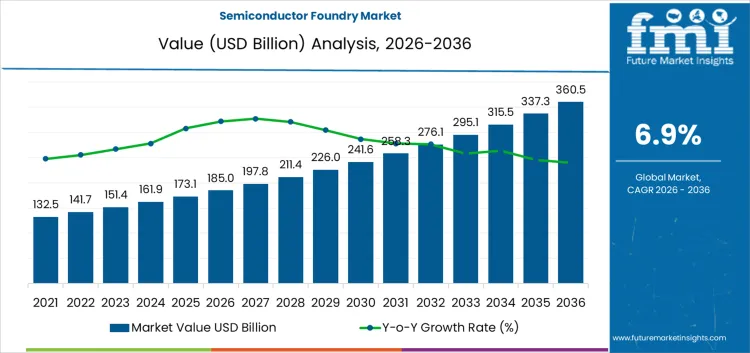
The semiconductor foundry market expands from USD 185 billion in 2026 to USD 360.5 billion by 2036, representing a CAGR of 6.90%. Economic performance in this sector is determined primarily by capital structure, yield management, and control over leading edge process nodes rather than by wafer volume alone. Depreciation of fabrication plants, equipment utilization rates, and learning curve effects dominate unit cost formation. Pricing authority concentrates among operators that sustain high yields at advanced nodes, since customers face limited substitution options once designs are qualified. Access to long term equipment supply agreements and priority tool deliveries further reinforces margin separation between leading and second tier producers.
Over the period, profit distribution remains highly uneven because capacity expansion is constrained by funding scale, permitting timelines, and equipment availability. Long term supply contracts and prepayments shift risk away from the largest operators while smaller foundries remain more exposed to cycle swings. Product mix also shapes returns, as advanced logic, high performance computing, and specialty processes carry different margin profiles. Geographic policy incentives influence investment location, yet do not materially change cost leadership hierarchies. The market grows substantially in value, though operating profits continue to concentrate among a small group of manufacturers with scale, technology control, and capital access.
Quick Stats of the Semiconductor Foundry Market
- Semiconductor Foundry Market Value (2026): USD 185 billion
- Semiconductor Foundry Forecast Value (2036): USD 360.5 billion
- Semiconductor Foundry Forecast CAGR 2026 to 2036: 6.9%
- Leading Business Model in Semiconductor Foundry Market: Pure-play Foundries (58 % share)
- Leading Process Node in Semiconductor Foundry Market: Advanced Logic Nodes (≤7 nm) (47 % share)
- Key Growth Regions in Semiconductor Foundry Market: India, China, Brazil, USA, UK
- Top Players in Semiconductor Foundry Market: TSMC, Samsung Foundry, GlobalFoundries, STMicroelectronics, UMC, SMIC, Powerchip Technology Corporation
What is the Growth Forecast for Semiconductor Foundry Market through 2036?
Between 2026 and 2031, the semiconductor foundry market is projected to expand from USD 185 billion along a path consistent with a 6.9% CAGR, shaped by the widening gap between chip design activity and manufacturing capacity rather than by end-device cycles alone. During this phase, demand is driven by logic, memory-adjacent specialty processes, and heterogeneous integration projects tied to AI accelerators, automotive electronics, and advanced connectivity hardware. Capacity additions are constrained by capital intensity and long tool lead times, which keeps utilization high and prioritizes allocation to customers with long-term commitments. Growth is therefore less about volume surges and more about mix, node migration, and pricing discipline. Purchasing decisions by fabless companies increasingly center on supply assurance and technology roadmaps rather than on short-term cost optimization.
From 2031 to 2036, the market is expected to reach USD 360.5 billion, with expansion shaped by the normalization of multi-fab, multi-region manufacturing strategies. Governments and large customers push for geographic diversification of supply chains, which increases total installed capacity even when demand growth moderates. Advanced packaging, chiplet architectures, and co-optimization between design and process technology raise the value content per wafer. The business becomes more capital- and partnership-intensive, with long planning horizons and high switching costs. Competitive positioning depends on yield learning speed, ecosystem integration, and execution reliability, making scale, financial strength, and technology depth more decisive than simple wafer pricing.
Semiconductor Foundry Market Key Takeaways
| Metric | Value |
|---|---|
| Market Value (2026) | USD 185 billion |
| Forecast Value (2036) | USD 360.5 billion |
| Forecast CAGR 2026 to 2036 | 6.9% |
How Is the Semiconductor Foundry Market Driving Global Chip Production?
The semiconductor foundry market is increasingly adopted to manufacture integrated circuits for a wide range of applications, including consumer electronics, automotive systems, and industrial equipment. Historically, semiconductor fabrication was dominated by vertically integrated companies managing both design and production, limiting scalability and specialization. Modern foundries focus on contract manufacturing, offering advanced process nodes, high-volume production, and design-for-manufacturability support to fabless semiconductor companies.
OEMs, chip designers, and technology providers prioritize process capability, yield optimization, and compliance with industry standards. Early adoption focused on mature nodes for standard applications, while current demand spans cutting-edge 3nm and 5nm technologies, driven by AI, IoT, and automotive electronics growth. Process precision, capacity scalability, and technological expertise influence supplier selection.
Rising demand for high-performance computing, mobile devices, and automotive electronics is shaping market growth. Compared with in-house manufacturing, foundry services emphasize specialized process expertise, reduced capital expenditure, and flexible production capacity.
Cost structures depend on fabrication technology, wafer yield, and operational efficiency, concentrating margins among suppliers capable of delivering advanced, high-volume semiconductor manufacturing. Chip designers and technology companies adopt foundry services to accelerate time-to-market, ensure manufacturing reliability, and scale production efficiently. By 2036, semiconductor foundries are expected to remain central to global chip production, supporting technological advancement, supply chain flexibility, and high-performance electronic applications across industries.
What Factors Are Shaping the Demand for Semiconductor Foundries by Operating Model and Process Technology in 2026?
The semiconductor foundry market in 2026 is segmented by business model and by process node. By operating model, demand is divided into pure play foundries, integrated device manufacturers, fabless foundry partnerships, and specialty or custom foundry services, each reflecting different approaches to capacity ownership, customer access, and risk sharing. By process technology, demand is organized around advanced logic nodes at or below 7 nm, mature logic above 7 nm, analog and mixed signal production, and specialized processes such as MEMS, power devices, and SiC or GaN. These segments reflect how customers balance performance needs, supply security, and cost while allocating designs across global fabrication capacity.
Why Do Pure Play Foundries Account for the Majority of Wafer Demand?
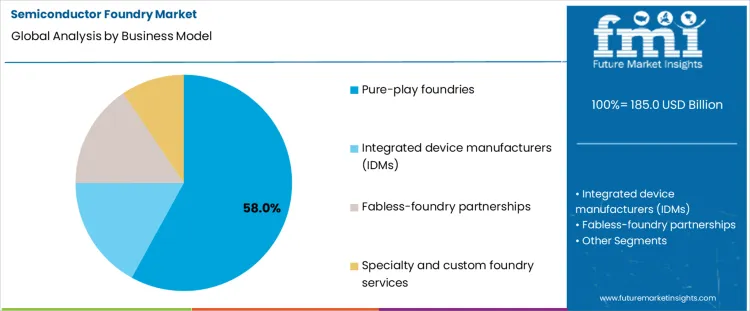
Pure play foundries account for about 58% of demand in 2026, reflecting their central role in serving the fabless semiconductor ecosystem. These companies focus entirely on manufacturing, which allows them to concentrate capital spending on process equipment, yield improvement, and capacity expansion without competing with customers in end markets. Their customer base spans smartphones, data centers, automotive, and industrial electronics, which smooths utilization across cycles. Access to multiple process nodes within one supplier also reduces qualification effort for customers. Long term supply agreements and prepayments further stabilize demand. This specialization in manufacturing scale and customer aggregation keeps pure play foundries as the primary destination for most outsourced wafer volume.
IDMs and partnership models serve different strategic goals. Integrated device manufacturers retain in house fabs to protect proprietary products and supply chains, yet they allocate only part of global demand. Fabless foundry partnerships are often tied to specific platforms or long term roadmaps rather than open capacity. Specialty and custom foundries focus on niche processes with lower volume but higher specificity. These models are important for resilience and technology diversity, yet they do not aggregate demand across as many customers or applications. As a result, their combined share remains below that of pure play foundries, which function as the main pooling mechanism for worldwide manufacturing demand.
Why Do Advanced Logic Nodes Command the Largest Share of Capacity Investment?
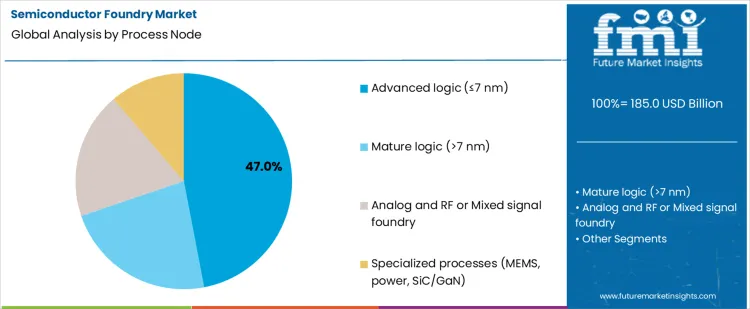
Advanced logic nodes at or below 7 nm represent about 47% of demand in 2026 because leading digital products depend on continued gains in performance and power efficiency. Smartphones, high performance computing, and AI accelerators require dense transistor integration that only these nodes can provide. Once a design is committed to an advanced node, migrating back is rarely practical, which locks in long production runs. The high cost of development and masks concentrates these projects among large customers, yet their wafer consumption is substantial. Foundries also prioritize these nodes because they anchor long term technology leadership and justify large scale capital investment programs.
Mature nodes, analog or mixed signal, and specialized processes follow different economics. Many automotive, industrial, and consumer products remain on older nodes where reliability, long life supply, and cost stability matter more than density. Analog and RF designs depend on device characteristics rather than scaling. MEMS, power, and SiC or GaN processes address specific functions and materials. These segments generate steady and profitable demand, yet their individual wafer volumes and capital intensity are lower. As a result, while they form a broad base of production, advanced logic nodes continue to absorb the largest share of capacity focus and strategic attention.
Why Are Strategic Capacity Control and Customer Roadmap Dependence Driving the Semiconductor Foundry Market through 2036?
Demand is shaped less by end device volume and more by who controls advanced process access. System companies now plan products around specific nodes and packaging options years in advance, which ties their roadmaps to a small number of foundry partners. Once a design is qualified on a process, switching becomes risky and expensive, locking in long term wafer demand. Governments and large customers also treat foundry capacity as strategic infrastructure, supporting multiyear supply agreements. Even in down cycles, leading edge lines remain loaded by committed programs. This makes the market follow technology roadmaps and capacity allocation decisions more than short term electronics sales swings.
What Capital Intensity, Yield Risk, and Geopolitical Exposure Are Constraining Faster or Broader Expansion?
The main limits come from scale and risk concentration. Each new fab generation requires tens of billions in investment before volume output is proven. Early yields are uncertain, and a few percentage points difference can decide profitability. Talent, equipment, and supplier ecosystems are also tightly constrained, making parallel build outs difficult. At the same time, geopolitical considerations influence where fabs can be built and who can be served, adding noncommercial constraints to capacity planning. Customers hesitate to rely on immature nodes, while foundries hesitate to overbuild. These forces keep expansion deliberate, lumpy, and focused on a small number of massive, high confidence projects.
How Are Packaging, Specialization, and Long Term Contracting Reshaping the Foundry Business Model?
The structure is shifting beyond pure wafer processing. Advanced packaging and chiplet integration are becoming part of the value proposition, blurring lines between foundry and assembly services. At the same time, mature nodes are being organized into specialty platforms for automotive, power, and analog rather than treated as generic capacity. Customers increasingly sign long term capacity reservation agreements to secure supply and influence investment timing. Some foundries build dedicated lines for anchor clients. The business is moving from a transactional, node by node sales model toward portfolio and partnership based relationships anchored in multiyear technology and volume commitments.
What is the Demand for Semiconductor Foundry by Country?
| Country | CAGR (%) |
|---|---|
| USA | 6.5% |
| UK | 6.2% |
| China | 7.5% |
| India | 7.8% |
| Brazil | 6.8% |
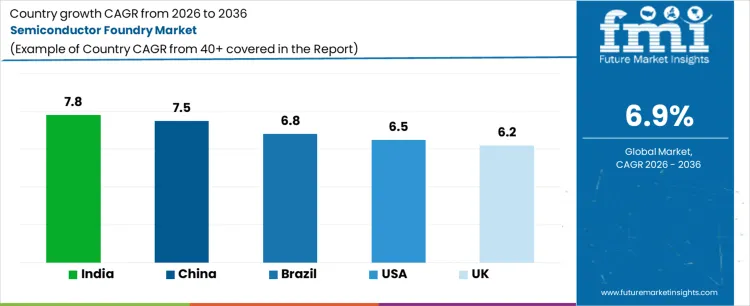
Demand for semiconductor foundries is rising as electronics manufacturers and technology companies invest in chip fabrication, production capacity, and advanced semiconductor technologies. India leads with a 7.8% CAGR, driven by growing domestic semiconductor design, government incentives for local manufacturing, and increasing demand from electronics and automotive sectors. China follows at 7.5%, supported by large-scale semiconductor fabrication, government-backed initiatives, and expansion of technology exports. Brazil records 6.8% growth, shaped by domestic electronics manufacturing and rising demand for chips in automotive and industrial applications. The USA grows at 6.5%, influenced by advanced chip fabrication, research and development, and integration into high-tech supply chains. The UK shows 6.2% CAGR, reflecting moderate adoption and expansion of semiconductor manufacturing capabilities.
How is the United States experiencing growth in the semiconductor foundry market?
United States is experiencing growth at a CAGR of 6.5%, driven by strong demand from fabless semiconductor companies and technology startups focusing on AI, high-performance computing, and 5G solutions. Foundries are optimized for advanced logic nodes, analog, and mixed-signal chips, offering high reliability, process precision, and integration with R&D centers. Demand is concentrated in California, Texas, and New York, where semiconductor design hubs and manufacturing support facilities are located. Investments focus on process optimization, yield enhancement, and compliance with federal standards. Growth reflects increasing outsourcing of wafer fabrication, technological upgrades, and expansion of domestic semiconductor supply chains.
- Fabless and AI-driven production drives adoption.
- Foundries optimize advanced logic and analog processes.
- California, Texas, and New York hubs concentrate demand.
- Process reliability and regulatory compliance guide investment.
How is the United Kingdom witnessing growth in the semiconductor foundry market?
United Kingdom is witnessing growth at a CAGR of 6.2%, supported by semiconductor R&D initiatives and demand for analog, RF, and custom chips in Cambridge, London, and Bristol. Foundries are optimized for precision manufacturing, process consistency, and integration with national research programs. Demand is concentrated in industrial clusters with high-tech manufacturing and design facilities. Investments prioritize equipment modernization, quality assurance, and compliance with UK and EU semiconductor standards. Growth reflects strategic adoption of domestic fabrication capabilities, collaboration with international fabless companies, and focus on niche semiconductor applications.
- R&D and high-tech manufacturing drive adoption.
- Foundries optimize analog, RF, and custom processes.
- Cambridge, London, and Bristol concentrate demand.
- Equipment modernization and standards compliance guide investment.
How is China experiencing growth in the semiconductor foundry market?
China is experiencing growth at a CAGR of 7.5%, fueled by government incentives, industrial expansion, and rising domestic semiconductor demand in regions such as Shanghai, Shenzhen, and Jiangsu. Foundries are optimized for advanced logic, high-volume production, and integration with fabless companies producing AI chips, mobile processors, and industrial electronics. Demand is concentrated in industrial parks and technology zones supporting large-scale fabrication. Investments focus on capacity expansion, yield improvement, and adherence to national semiconductor regulations. Growth reflects government-driven industrial policy, rising domestic chip consumption, and scaling of high-performance manufacturing.
- Domestic semiconductor expansion drives adoption.
- Foundries optimize high-volume and advanced logic processes.
- Industrial parks and technology zones concentrate demand.
- Capacity expansion and regulatory compliance guide investment.
How is India witnessing growth in the semiconductor foundry market?
India is witnessing growth at a CAGR of 7.8%, supported by increasing semiconductor design activity, expansion of industrial clusters in Bengaluru, Hyderabad, and Pune, and growing demand for mobile, automotive, and IoT chips. Foundries are optimized for analog, mixed-signal, and specialized process nodes, offering precision and reliability for domestic and export applications. Demand is concentrated in technology parks and industrial hubs with strong IT and electronics infrastructure. Investments focus on equipment modernization, yield improvement, and compliance with national semiconductor regulations. Growth reflects rising domestic chip design, investment in fabrication, and adoption of high-precision manufacturing processes.
- Semiconductor design and IT hubs drive adoption.
- Foundries optimize analog, mixed-signal, and specialized processes.
- Technology parks concentrate demand.
- Equipment modernization and regulatory compliance guide investment.
How is Brazil experiencing growth in the semiconductor foundry market?
Brazil is experiencing growth at a CAGR of 6.8%, driven by industrial automation, telecommunications, and consumer electronics demand in São Paulo, Rio de Janeiro, and Paraná. Foundries are optimized for mid-volume analog, power semiconductors, and specialized applications like industrial sensors. Demand is concentrated in industrial zones and electronics manufacturing clusters. Investments focus on process reliability, equipment quality, and compliance with national standards. Growth reflects increasing domestic electronics production, adoption of semiconductor technologies in industrial automation, and expansion of local fabrication capabilities.
- Industrial automation and consumer electronics drive adoption.
- Foundries optimize mid-volume analog and power processes.
- Industrial zones and electronics clusters concentrate demand.
- Process reliability and regulatory compliance guide investment.
Who Competes in the Semiconductor Foundry Market and What Defines Their Capabilities?
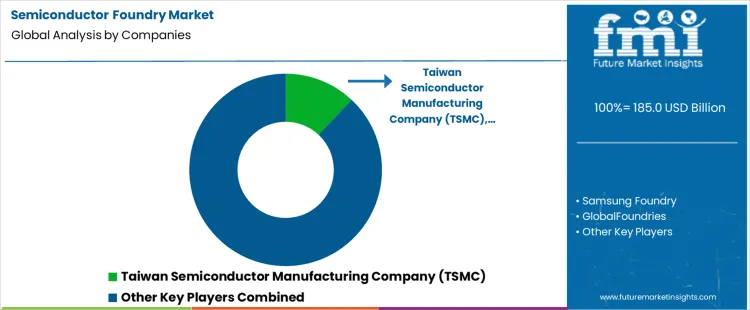
The semiconductor foundry market is defined by manufacturing node technology, capacity scale, and ecosystem support for fabless design partners. Taiwan Semiconductor Manufacturing Company (TSMC) operates advanced process nodes and high-volume fabs, attracting broad design wins across mobile, high-performance computing, and automotive. Samsung Foundry supplies leading-edge logic and memory foundry services, leveraging its own memory and logic integration capabilities. GlobalFoundries focuses on mature and specialty process technologies for automotive, industrial, and RF applications that do not require the smallest nodes. STMicroelectronics provides foundry services alongside its own integrated device manufacturing, with a focus on analog, MEMS, and power technologies. UMC (United Microelectronics Corporation) delivers a range of process technologies oriented to mainstream logic and specialty requirements at competitive cost points.
SMIC (Semiconductor Manufacturing International Corporation) serves domestic and regional customers with mature nodes and capacity in China, emphasizing local supply chain support. Powerchip Technology Corporation operates wafer fabrication facilities oriented to memory and specialty logic, contributing foundry capacity in selected process segments. Other regional and emerging foundries focus on niche process technologies, legacy nodes, or specialized packaging support. Foundry differentiation arises from process node availability, yield performance, capacity utilization, equipment ecosystem partnerships, and compliance with export control regimes and quality standards required by automotive and industrial customers. Success in this market depends on ability to match design requirements with process offerings, secure consistent supply, and support customers through design enablement, testing, and long lifecycle assurance across end markets such as consumer electronics, cloud computing, automotive, and Internet of Things devices.
Key Players in the Semiconductor Foundry Market
- Taiwan Semiconductor Manufacturing Company (TSMC)
- Samsung Foundry
- GlobalFoundries
- STMicroelectronics
- UMC (United Microelectronics Corporation)
- SMIC (Semiconductor Manufacturing International Corporation)
- Powerchip Technology Corporation
Scope of the Report
| Items | Values |
|---|---|
| Quantitative Units (2026) | USD billion |
| Business Model | Pure-play Foundries, Integrated Device Manufacturers (IDMs), Fabless-Foundry Partnerships, Specialty and Custom Foundry Services |
| Process Node | Advanced Logic (≤7 nm), Mature Logic (>7 nm), Analog and RF or Mixed Signal, Specialized Processes (MEMS, Power, SiC/GaN) |
| Regions Covered | Asia Pacific, Europe, North America, Latin America, Middle East & Africa |
| Countries Covered | China, Japan, South Korea, India, Australia & New Zealand, ASEAN, Germany, United Kingdom, France, Italy, Spain, Nordic, BENELUX, United States, Canada, Mexico, Brazil, Chile, Saudi Arabia, Turkey, South Africa, and other regional markets |
| Key Companies Profiled | Taiwan Semiconductor Manufacturing Company (TSMC), Samsung Foundry, GlobalFoundries, STMicroelectronics, UMC (United Microelectronics Corporation), SMIC (Semiconductor Manufacturing International Corporation), Powerchip Technology Corporation |
| Additional Attributes | Dollar sales by business model and process node, pure-play foundries forming the largest share of wafer demand due to aggregation of fabless customers, advanced logic nodes representing the largest share of capacity investment because of AI, high-performance computing, and smartphone requirements, market economics dominated by capital intensity, yield learning, and control of leading-edge nodes, profit concentration among operators with scale fabs, long-term equipment access, and high utilization, demand shaped by long-term capacity reservation agreements and multi-year customer roadmaps, increasing role of advanced packaging and chiplet integration in the foundry value proposition, geographic diversification of manufacturing driven by policy incentives, and competitive positioning based on yield performance, ecosystem integration, execution reliability, and technology depth rather than wafer pricing alone. |
Semiconductor Foundry Market Segmentation
By Business Model:
- Pure-play foundries
- Integrated device manufacturers (IDMs)
- Fabless-foundry partnerships
- Specialty and custom foundry services
By Process Node:
- Advanced logic (≤7 nm)
- Mature logic (>7 nm)
- Analog and RF or Mixed signal foundry
- Specialized processes (MEMS, power, SiC/GaN)
By Region
- Asia Pacific
- China
- Japan
- South Korea
- India
- Australia & New Zealand
- ASEAN
- Rest of Asia Pacific
- Europe
- Germany
- United Kingdom
- France
- Italy
- Spain
- Nordic
- BENELUX
- Rest of Europe
- North America
- United States
- Canada
- Mexico
- Latin America
- Brazil
- Chile
- Rest of Latin America
- Middle East & Africa
- Kingdom of Saudi Arabia
- Other GCC Countries
- Turkey
- South Africa
- Other African Union
- Rest of Middle East & Africa
Bibliography
- Semiconductor Industry Association. (2023). 2023 state of the U.S. semiconductor industry. Semiconductor Industry Association.
- World Semiconductor Trade Statistics. (2023). WSTS semiconductor market forecast: Fall 2023. World Semiconductor Trade Statistics.
- IEEE. (2023). International roadmap for devices and systems (IRDS): 2023 edition. IEEE.
Frequently Asked Questions
How big is the semiconductor foundry market in 2026?
The global semiconductor foundry market is estimated to be valued at USD 185.0 billion in 2026.
What will be the size of semiconductor foundry market in 2036?
The market size for the semiconductor foundry market is projected to reach USD 360.5 billion by 2036.
How much will be the semiconductor foundry market growth between 2026 and 2036?
The semiconductor foundry market is expected to grow at a 6.9% CAGR between 2026 and 2036.
What are the key product types in the semiconductor foundry market?
The key product types in semiconductor foundry market are pure-play foundries, integrated device manufacturers (idms), fabless-foundry partnerships and specialty and custom foundry services.
Which process node segment to contribute significant share in the semiconductor foundry market in 2026?
In terms of process node, advanced logic (≤7 nm) segment to command 47.0% share in the semiconductor foundry market in 2026.
Preview the report firsthand - request a free sample
Get SampleGet the brochure for pricing and purchase details.
Get PDFTable of Content
- Executive Summary
- Global Market Outlook
- Demand-side Trends
- Supply-side Trends
- Technology Roadmap Analysis
- Analysis and Recommendations
- Market Overview
- Market Coverage / Taxonomy
- Market Definition / Scope / Limitations
- Market Background
- Market Dynamics
- Drivers
- Restraints
- Opportunity
- Trends
- Scenario Forecast
- Demand in Optimistic Scenario
- Demand in Likely Scenario
- Demand in Conservative Scenario
- Opportunity Map Analysis
- Product Life Cycle Analysis
- Supply Chain Analysis
- Investment Feasibility Matrix
- Value Chain Analysis
- PESTLE and Porter’s Analysis
- Regulatory Landscape
- Regional Parent Market Outlook
- Production and Consumption Statistics
- Import and Export Statistics
- Market Dynamics
- Global Market Analysis 2021 to 2025 and Forecast, 2026 to 2036
- Historical Market Size Value (USD Million) Analysis, 2021 to 2025
- Current and Future Market Size Value (USD Million) Projections, 2026 to 2036
- Y-o-Y Growth Trend Analysis
- Absolute $ Opportunity Analysis
- Global Market Pricing Analysis 2021 to 2025 and Forecast 2026 to 2036
- Global Market Analysis 2021 to 2025 and Forecast 2026 to 2036, By Business Model
- Introduction / Key Findings
- Historical Market Size Value (USD Million) Analysis By Business Model, 2021 to 2025
- Current and Future Market Size Value (USD Million) Analysis and Forecast By Business Model, 2026 to 2036
- Pure-play foundries
- Integrated device manufacturers (IDMs)
- Fabless-foundry partnerships
- Specialty and custom foundry services
- Pure-play foundries
- Y-o-Y Growth Trend Analysis By Business Model, 2021 to 2025
- Absolute $ Opportunity Analysis By Business Model, 2026 to 2036
- Global Market Analysis 2021 to 2025 and Forecast 2026 to 2036, By Process Node
- Introduction / Key Findings
- Historical Market Size Value (USD Million) Analysis By Process Node, 2021 to 2025
- Current and Future Market Size Value (USD Million) Analysis and Forecast By Process Node, 2026 to 2036
- Advanced logic (≤7 nm)
- Mature logic (>7 nm)
- Analog and RF or Mixed signal foundry
- Specialized processes (MEMS, power, SiC/GaN)
- Advanced logic (≤7 nm)
- Y-o-Y Growth Trend Analysis By Process Node, 2021 to 2025
- Absolute $ Opportunity Analysis By Process Node, 2026 to 2036
- Global Market Analysis 2021 to 2025 and Forecast 2026 to 2036, By Region
- Introduction
- Historical Market Size Value (USD Million) Analysis By Region, 2021 to 2025
- Current Market Size Value (USD Million) Analysis and Forecast By Region, 2026 to 2036
- North America
- Latin America
- Western Europe
- Eastern Europe
- East Asia
- South Asia and Pacific
- Middle East & Africa
- Market Attractiveness Analysis By Region
- North America Market Analysis 2021 to 2025 and Forecast 2026 to 2036, By Country
- Historical Market Size Value (USD Million) Trend Analysis By Market Taxonomy, 2021 to 2025
- Market Size Value (USD Million) Forecast By Market Taxonomy, 2026 to 2036
- By Country
- USA
- Canada
- Mexico
- By Business Model
- By Process Node
- By Country
- Market Attractiveness Analysis
- By Country
- By Business Model
- By Process Node
- Key Takeaways
- Latin America Market Analysis 2021 to 2025 and Forecast 2026 to 2036, By Country
- Historical Market Size Value (USD Million) Trend Analysis By Market Taxonomy, 2021 to 2025
- Market Size Value (USD Million) Forecast By Market Taxonomy, 2026 to 2036
- By Country
- Brazil
- Chile
- Rest of Latin America
- By Business Model
- By Process Node
- By Country
- Market Attractiveness Analysis
- By Country
- By Business Model
- By Process Node
- Key Takeaways
- Western Europe Market Analysis 2021 to 2025 and Forecast 2026 to 2036, By Country
- Historical Market Size Value (USD Million) Trend Analysis By Market Taxonomy, 2021 to 2025
- Market Size Value (USD Million) Forecast By Market Taxonomy, 2026 to 2036
- By Country
- Germany
- UK
- Italy
- Spain
- France
- Nordic
- BENELUX
- Rest of Western Europe
- By Business Model
- By Process Node
- By Country
- Market Attractiveness Analysis
- By Country
- By Business Model
- By Process Node
- Key Takeaways
- Eastern Europe Market Analysis 2021 to 2025 and Forecast 2026 to 2036, By Country
- Historical Market Size Value (USD Million) Trend Analysis By Market Taxonomy, 2021 to 2025
- Market Size Value (USD Million) Forecast By Market Taxonomy, 2026 to 2036
- By Country
- Russia
- Poland
- Hungary
- Balkan & Baltic
- Rest of Eastern Europe
- By Business Model
- By Process Node
- By Country
- Market Attractiveness Analysis
- By Country
- By Business Model
- By Process Node
- Key Takeaways
- East Asia Market Analysis 2021 to 2025 and Forecast 2026 to 2036, By Country
- Historical Market Size Value (USD Million) Trend Analysis By Market Taxonomy, 2021 to 2025
- Market Size Value (USD Million) Forecast By Market Taxonomy, 2026 to 2036
- By Country
- China
- Japan
- South Korea
- By Business Model
- By Process Node
- By Country
- Market Attractiveness Analysis
- By Country
- By Business Model
- By Process Node
- Key Takeaways
- South Asia and Pacific Market Analysis 2021 to 2025 and Forecast 2026 to 2036, By Country
- Historical Market Size Value (USD Million) Trend Analysis By Market Taxonomy, 2021 to 2025
- Market Size Value (USD Million) Forecast By Market Taxonomy, 2026 to 2036
- By Country
- India
- ASEAN
- Australia & New Zealand
- Rest of South Asia and Pacific
- By Business Model
- By Process Node
- By Country
- Market Attractiveness Analysis
- By Country
- By Business Model
- By Process Node
- Key Takeaways
- Middle East & Africa Market Analysis 2021 to 2025 and Forecast 2026 to 2036, By Country
- Historical Market Size Value (USD Million) Trend Analysis By Market Taxonomy, 2021 to 2025
- Market Size Value (USD Million) Forecast By Market Taxonomy, 2026 to 2036
- By Country
- Kingdom of Saudi Arabia
- Other GCC Countries
- Turkiye
- South Africa
- Other African Union
- Rest of Middle East & Africa
- By Business Model
- By Process Node
- By Country
- Market Attractiveness Analysis
- By Country
- By Business Model
- By Process Node
- Key Takeaways
- Key Countries Market Analysis
- USA
- Pricing Analysis
- Market Share Analysis, 2025
- By Business Model
- By Process Node
- Canada
- Pricing Analysis
- Market Share Analysis, 2025
- By Business Model
- By Process Node
- Mexico
- Pricing Analysis
- Market Share Analysis, 2025
- By Business Model
- By Process Node
- Brazil
- Pricing Analysis
- Market Share Analysis, 2025
- By Business Model
- By Process Node
- Chile
- Pricing Analysis
- Market Share Analysis, 2025
- By Business Model
- By Process Node
- Germany
- Pricing Analysis
- Market Share Analysis, 2025
- By Business Model
- By Process Node
- UK
- Pricing Analysis
- Market Share Analysis, 2025
- By Business Model
- By Process Node
- Italy
- Pricing Analysis
- Market Share Analysis, 2025
- By Business Model
- By Process Node
- Spain
- Pricing Analysis
- Market Share Analysis, 2025
- By Business Model
- By Process Node
- France
- Pricing Analysis
- Market Share Analysis, 2025
- By Business Model
- By Process Node
- India
- Pricing Analysis
- Market Share Analysis, 2025
- By Business Model
- By Process Node
- ASEAN
- Pricing Analysis
- Market Share Analysis, 2025
- By Business Model
- By Process Node
- Australia & New Zealand
- Pricing Analysis
- Market Share Analysis, 2025
- By Business Model
- By Process Node
- China
- Pricing Analysis
- Market Share Analysis, 2025
- By Business Model
- By Process Node
- Japan
- Pricing Analysis
- Market Share Analysis, 2025
- By Business Model
- By Process Node
- South Korea
- Pricing Analysis
- Market Share Analysis, 2025
- By Business Model
- By Process Node
- Russia
- Pricing Analysis
- Market Share Analysis, 2025
- By Business Model
- By Process Node
- Poland
- Pricing Analysis
- Market Share Analysis, 2025
- By Business Model
- By Process Node
- Hungary
- Pricing Analysis
- Market Share Analysis, 2025
- By Business Model
- By Process Node
- Kingdom of Saudi Arabia
- Pricing Analysis
- Market Share Analysis, 2025
- By Business Model
- By Process Node
- Turkiye
- Pricing Analysis
- Market Share Analysis, 2025
- By Business Model
- By Process Node
- South Africa
- Pricing Analysis
- Market Share Analysis, 2025
- By Business Model
- By Process Node
- USA
- Market Structure Analysis
- Competition Dashboard
- Competition Benchmarking
- Market Share Analysis of Top Players
- By Regional
- By Business Model
- By Process Node
- Competition Analysis
- Competition Deep Dive
- Taiwan Semiconductor Manufacturing Company (TSMC)
- Overview
- Product Portfolio
- Profitability by Market Segments (Product/Age /Sales Channel/Region)
- Sales Footprint
- Strategy Overview
- Marketing Strategy
- Product Strategy
- Channel Strategy
- Samsung Foundry
- GlobalFoundries
- STMicroelectronics
- UMC (Value (USD Million)ed Microelectronics Corporation)
- SMIC (Semiconductor Manufacturing International Corporation)
- Powerchip Technology Corporation
- Taiwan Semiconductor Manufacturing Company (TSMC)
- Competition Deep Dive
- Assumptions & Acronyms Used
- Research Methodology


