

- Industry Size (2026)
- USD 294.7 Mn
- Forecast (2036)
- USD 852 Mn
- CAGR (2026 to 2036)
- 11.20%
Semiconductor Epoxy MOF Emissions Capture Market Forecast and Outlook 2026 to 2036
The global semiconductor epoxy MOF emissions capture market is expected to grow from USD 294.7 million in 2026 to USD 852 million by 2036, with a robust CAGR of 11.20%. This growth is fueled by the increasing demand for sustainable and effective emissions capture solutions in semiconductor manufacturing. As industries seek to meet stricter environmental regulations, epoxy-based Metal-Organic Frameworks (MOFs) are becoming crucial in capturing harmful gases like VOCs, NOx, and methane.
These MOFs, combined with epoxy resins, offer high surface area and selective adsorption properties, making them ideal for emissions capture in semiconductor production processes. The rising focus on eco-friendly manufacturing and the semiconductor industry’s push for cleaner production methods are driving the adoption of these materials. As technological advancements improve MOF performance and cost-effectiveness, the demand for these innovative solutions in emission reduction is expected to accelerate, supporting the growth of the semiconductor epoxy MOF emissions capture market.
Quick Stats for Semiconductor Epoxy MOF Emissions Capture Market
- Semiconductor Epoxy MOF Emissions Capture Market Value (2026): USD 294.7 Million
- Semiconductor Epoxy MOF Emissions Capture Market Forecast Value (2036): USD 852 Million
- Semiconductor Epoxy MOF Emissions Capture Market Forecast CAGR 2026 to 2036: 11.20%
- Leading MOF Type in Semiconductor Epoxy MOF Emissions Capture Market: Zirconium-Based MOFs
- Key Growth Regions in Semiconductor Epoxy MOF Emissions Capture Market: Asia Pacific, North America
- Top Key Players in Semiconductor Epoxy MOF Emissions Capture Market: BASF Advanced Materials (MOF Division), NuMat Technologies, MOFapps, Framergy Inc., Strem Chemicals (Ascensus MOF Unit)
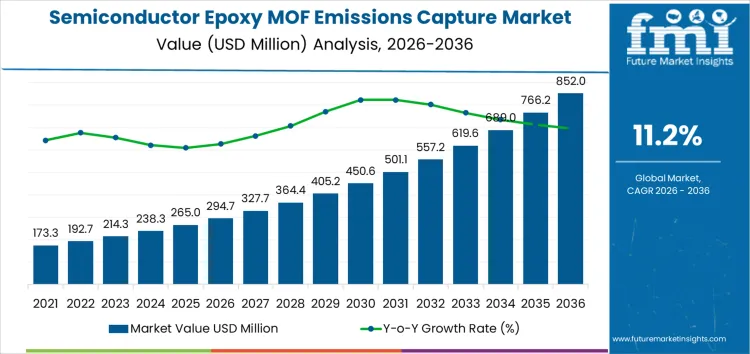
Semiconductor Epoxy MOF Emissions Capture Market Key Takeaways
| Metric | Value |
|---|---|
| Industry Value (2026) | USD 294.7 Million |
| Forecast Value (2036) | USD 852 Million |
| Forecast CAGR 2026 to 2036 | 11.20% |
How Is the Global Semiconductor Epoxy MOF Emissions Capture Market Advancing?
The global semiconductor epoxy MOF (Metal-Organic Framework) emissions capture market is experiencing robust growth, driven by the increasing demand for effective solutions to capture and reduce harmful emissions in semiconductor manufacturing and other industrial processes. Metal-Organic Frameworks, when combined with epoxy resins, offer a highly effective material for trapping gases, including carbon dioxide (CO2), nitrogen oxides (NOx), and other pollutants, which is crucial for meeting stringent environmental regulations. As industries worldwide seek to comply with emissions reduction goals, the need for advanced materials like semiconductor epoxy MOF composites is growing rapidly.
A major driver of the market is the semiconductor industry’s need for cleaner production methods. The manufacture of semiconductors involves the use of various chemicals and gases that can contribute to environmental pollution. Semiconductor epoxy MOF composites are being integrated into emissions capture systems to prevent the release of harmful substances into the atmosphere. The increasing focus on sustainability and environmental responsibility in the semiconductor and other industrial sectors is fueling the demand for innovative emissions capture technologies, driving the growth of the market.
Technological advancements in the development of more efficient and durable MOF materials are also contributing to market expansion. Researchers are exploring new MOF structures and epoxy formulations to improve the capture efficiency and longevity of these materials, making them more cost-effective and suitable for large-scale industrial applications. As environmental regulations tighten and industries move toward adopting greener technologies, the semiconductor epoxy MOF emissions capture market is poised for significant growth, offering a key solution for achieving emissions reduction targets while improving industrial sustainability.
What Is the Segment-Wise Analysis for the Semiconductor Epoxy MOF Emissions Capture Market?
The semiconductor epoxy MOF emissions capture market is segmented by emission source and MOF type. Epoxy resin processing & curing leads the emission source segment with a 42% share, followed by wafer bonding & packaging lines, chemical vapor handling units, waste gas treatment systems, and other sources. Epoxy resin processing and curing are major sources of emissions in semiconductor manufacturing that require efficient capture solutions. In terms of MOF type, zirconium-based MOFs lead with a 33% share, followed by copper-based MOFs, aluminum-based MOFs, hybrid or functionalized MOFs, and other types.
Why Does Epoxy Resin Processing & Curing Lead the Semiconductor Epoxy MOF Emissions Capture Market?
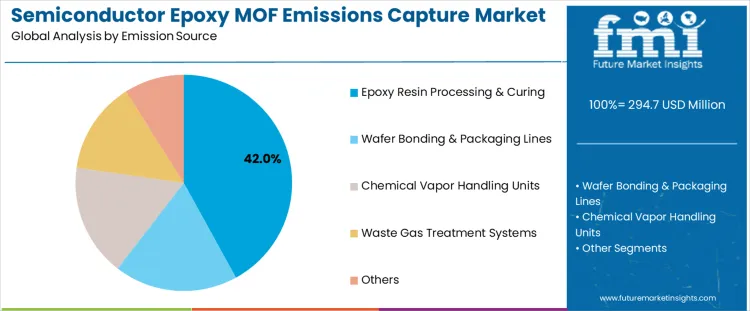
Epoxy resin processing & curing leads the semiconductor epoxy MOF emissions capture market with a 42% share due to its significant contribution to emissions during semiconductor manufacturing. The process of curing epoxy resins generates volatile organic compounds (VOCs) and other hazardous emissions that need to be efficiently captured to meet environmental regulations. The use of Metal-Organic Frameworks (MOFs) for emissions capture provides a high surface area and tunable properties, making them ideal for capturing these emissions. As semiconductor manufacturing continues to expand, the demand for efficient emissions capture systems for epoxy resin processing and curing grows, driving the dominance of this emission source in the market.
How Do Zirconium-Based MOFs Contribute to the Semiconductor Epoxy MOF Emissions Capture Market?
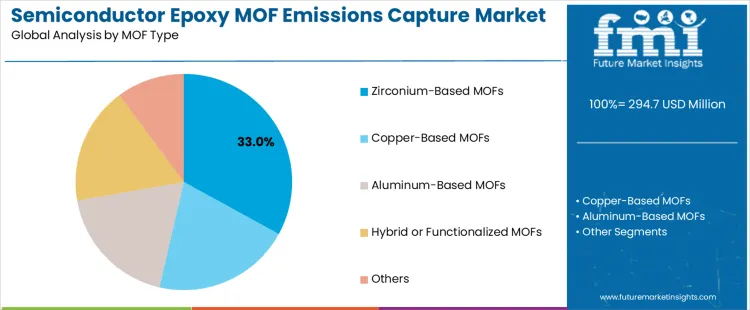
Zirconium-based MOFs account for 33% of the MOF type segment in the semiconductor epoxy MOF emissions capture market. These MOFs are particularly effective at capturing and storing gases due to their high surface area, stability, and selective adsorption properties. Zirconium-based MOFs are widely used in applications where the capture of volatile organic compounds (VOCs) and other hazardous gases is required, such as in epoxy resin processing and curing. Their ability to efficiently handle chemical emissions in semiconductor manufacturing processes makes them a preferred choice. As the need for cleaner manufacturing processes grows in the semiconductor industry, zirconium-based MOFs continue to play a significant role in emissions capture technologies.
What Are the Key Dynamics for the Semiconductor Epoxy MOF Emissions Capture Market?
The semiconductor epoxy mof emissions capture market is driven by the increasing need for advanced materials that can capture and reduce harmful emissions, particularly in the semiconductor and electronics industries. Metal-organic frameworks (MOFs) combined with semiconductor epoxy resins offer unique properties, including high surface area, porosity, and the ability to adsorb specific gases like CO2, NOx, and methane. These materials are being explored for use in emission capture systems in semiconductor manufacturing processes, which produce significant amounts of volatile compounds. The growing emphasis on sustainable manufacturing and stricter emission regulations is fueling the market for innovative emissions capture solutions using epoxy MOF materials.
Why Is the Semiconductor Epoxy MOF Emissions Capture Market Growing?
The market for semiconductor epoxy MOF emissions capture is growing due to increasing environmental regulations and the semiconductor industry's push towards more sustainable manufacturing processes. As semiconductor manufacturing generates a range of hazardous emissions, there is a growing need for effective capture technologies to mitigate their environmental impact. The unique properties of MOFs, such as high selectivity and efficiency in gas capture, combined with the versatility of epoxy resins, make them an ideal solution. The rise in environmental awareness and the increasing demand for clean technology are accelerating investments in emission capture solutions, further driving market growth.
How Are the Key Drivers Shaping the Semiconductor Epoxy MOF Emissions Capture Market?
Key drivers shaping the semiconductor epoxy MOF emissions capture market include increasing pressure on industries to meet stricter environmental and emissions regulations. Semiconductor manufacturing involves the release of various pollutants, making it a priority to implement effective emissions control technologies. The growing use of MOFs in industrial applications is enhancing their role in selective gas adsorption and capture, enabling more efficient emission reduction. Advancements in materials science are improving the performance of epoxy-MOF composites, increasing their applicability in high-efficiency emission capture systems. Industry adoption is further propelled by the need for cost-effective and scalable solutions to meet compliance standards.
What is the Growth Outlook for the Semiconductor Epoxy MOF Emissions Capture Market by Country?
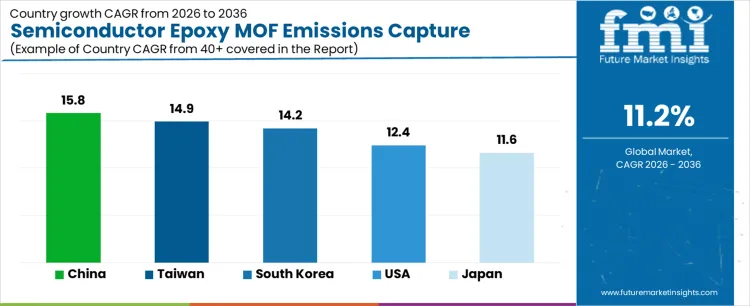
| Country | CAGR (%) |
|---|---|
| China | 15.8% |
| Taiwan | 14.9% |
| South Korea | 14.2% |
| USA | 12.4% |
| Japan | 11.6% |
The semiconductor epoxy MOF emissions capture market is experiencing robust growth across key regions. China leads at 15.8%, driven by its dominant semiconductor industry and commitment to environmental sustainability. Taiwan follows at 14.9%, supported by its leadership in semiconductor manufacturing and regulatory pressures for cleaner operations. South Korea grows at 14.2%, fueled by its advanced semiconductor sector and strong focus on eco-friendly production practices. The USA grows at 12.4%, supported by environmental regulations and a push for greener semiconductor manufacturing. Japan grows at 11.6%, backed by its emphasis on sustainability and emissions reduction in semiconductor production.
What is Driving the Growth of the Semiconductor Epoxy MOF Emissions Capture Market in China?
China’s semiconductor epoxy MOF emissions capture market is growing at 15.8%, driven by the country’s significant advancements in semiconductor manufacturing and its focus on environmental sustainability. China, as the world’s largest producer of semiconductors, is increasingly adopting epoxy-based metal-organic frameworks (MOFs) for emissions capture in semiconductor production to reduce carbon footprints and improve energy efficiency. The Chinese government’s stringent environmental regulations and the need for the semiconductor industry to meet global emissions standards are pushing manufacturers to implement innovative emissions control technologies. The rapid growth of China’s semiconductor industry, coupled with its commitment to green manufacturing, is further accelerating the adoption of semiconductor epoxy MOF emissions capture solutions. As China continues to prioritize environmental sustainability, the demand for effective emissions control solutions in semiconductor production will rise, driving market growth.
How is the Semiconductor Epoxy MOF Emissions Capture Market Expanding in Taiwan?
Taiwan’s semiconductor epoxy MOF emissions capture market is growing at 14.9%, fueled by the country’s position as a global leader in semiconductor manufacturing. Taiwan’s semiconductor industry is highly advanced, and there is a growing demand for efficient emissions capture solutions to meet environmental standards and reduce the ecological impact of semiconductor production. Semiconductor epoxy MOFs are increasingly being adopted in Taiwan’s semiconductor plants for their ability to effectively capture harmful emissions and improve overall energy efficiency. Taiwan’s focus on sustainable manufacturing and regulatory frameworks aimed at reducing industrial emissions are driving the market’s expansion. As Taiwan’s semiconductor industry continues to grow, the adoption of epoxy MOF emissions capture technologies will increase, supporting the market’s continued growth.
How is the Semiconductor Epoxy MOF Emissions Capture Market Expanding in South Korea?
South Korea’s semiconductor epoxy MOF emissions capture market is growing at 14.2%, driven by the country’s strong semiconductor industry and commitment to reducing environmental impact. As one of the leading semiconductor producers, South Korea is increasingly adopting innovative emissions control technologies, including epoxy MOFs, to ensure cleaner manufacturing processes and meet stringent environmental regulations. The need for improved air quality and sustainability in industrial practices is pushing South Korean semiconductor manufacturers to implement advanced materials for emissions capture. Government incentives and regulations promoting green technology further fuel the market’s growth. As South Korea continues to innovate in semiconductor manufacturing and expand its sustainability initiatives, the demand for semiconductor epoxy MOF emissions capture solutions will continue to rise.
What is Driving the Growth of the Semiconductor Epoxy MOF Emissions Capture Market in the USA?
The semiconductor epoxy MOF emissions capture market in the USA is growing at 12.4%, supported by the country’s focus on reducing industrial emissions and advancing sustainability in semiconductor manufacturing. As the USA semiconductor industry continues to expand, the need for efficient emissions capture technologies becomes more critical. Epoxy MOFs are increasingly being adopted due to their ability to trap harmful emissions during semiconductor production processes, which helps meet environmental standards and reduce energy consumption. The USA’s regulatory landscape, with increasing emphasis on carbon reduction and sustainability, is driving the demand for innovative solutions in semiconductor manufacturing. As the country prioritizes environmental responsibility and clean technology, the adoption of semiconductor epoxy MOF emissions capture technologies will continue to grow.
How is the Semiconductor Epoxy MOF Emissions Capture Market Expanding in Japan?
Japan’s semiconductor epoxy MOF emissions capture market is growing at 11.6%, driven by the country’s robust semiconductor industry and its commitment to environmental sustainability. Japan’s semiconductor manufacturers are adopting epoxy MOFs as part of their strategy to meet increasingly strict environmental regulations and reduce the carbon footprint of their operations. Epoxy-based MOFs offer an effective solution for emissions capture, enabling semiconductor plants to operate more efficiently while adhering to sustainability goals. Japan’s government support for green technologies and sustainability in manufacturing, combined with the rising global demand for eco-friendly semiconductor production practices, is accelerating the adoption of MOFs in the industry. As Japan continues to innovate in semiconductor technology and environmental solutions, the demand for epoxy MOF emissions capture solutions is expected to grow.
How Are Companies Competing in the Semiconductor Epoxy MOF Emissions Capture Market?
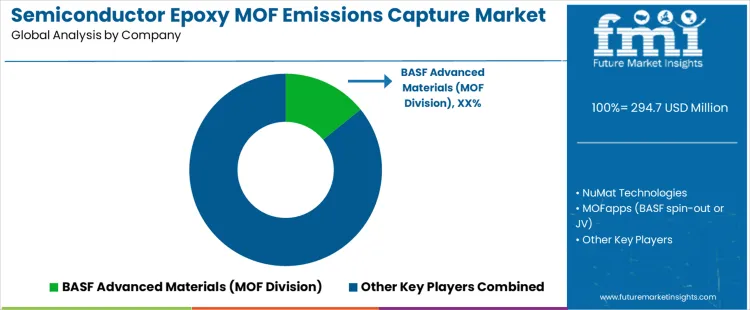
Competition in the Semiconductor Epoxy MOF Emissions Capture Market centers on adsorption efficiency, chemical stability under process conditions, integration with manufacturing workflows, and support for regulatory compliance in cleanroom and fab environments. BASF Advanced Materials (MOF Division) positions its metal organic framework (MOF) solutions with a focus on high surface area and selective capture of volatile organic compounds (VOCs) from epoxy cure and photolithography emissions. Its product materials emphasize robust performance and scalability, helping semiconductor manufacturers meet stringent air quality and safety standards.
NuMat Technologies competes by offering tailored MOF formulations that deliver rapid capture kinetics and high capacity for specific emission profiles associated with epoxy and related chemistries. Its brochures highlight modular adsorption systems and strong partnerships with fab operators to support pilot trials and scaling. MOFapps (a BASF spin out or joint venture) differentiates through application oriented MOF chemistries and delivery formats designed to integrate with existing exhaust and abatement systems, with documentation stressing ease of retrofit and long service life under continuous operation.
Emerging players such as Framergy Inc. and Strem Chemicals (or its Ascensus MOF Unit) bring innovative MOF synthesis platforms and advanced ligand designs that aim to improve selectivity and regeneration performance in emissions capture. Others contribute with niche MOF grades and specialty adsorbents tailored to unique process chemistries or local regulatory needs. Across all vendors, product materials underscore capture efficiency, thermal and chemical resilience, integration flexibility, and maintenance support as key differentiators that help semiconductor fabs achieve cleaner processes and safer work environments.
Key Players in Semiconductor Epoxy MOF Emissions Capture Market
- BASF Advanced Materials (MOF Division)
- NuMat Technologies
- MOFapps (BASF spin-out or JV)
- Framergy Inc.
- Strem Chemicals or Ascensus MOF Unit
- Others
Scope of Report
| Attributes | Description |
|---|---|
| Quantitative Unit (2026) | USD Million |
| Emission Source | Epoxy Resin Processing & Curing, Wafer Bonding & Packaging Lines, Chemical Vapor Handling Units, Waste Gas Treatment Systems, Others |
| MOF Type | Zirconium-Based MOFs, Copper-Based MOFs, Aluminum-Based MOFs, Hybrid or Functionalized MOFs, Others |
| End User | Logic & Memory Chip Manufacturers, Foundries, OSAT Providers, Research Institutes & Pilot Facilities |
| Regions Covered | Asia Pacific, Europe, North America, Latin America, Middle East & Africa |
| Countries Covered | China, Japan, South Korea, India, Australia & New Zealand, ASEAN, Rest of Asia Pacific, Germany, United Kingdom, France, Italy, Spain, Nordic, BENELUX, Rest of Europe, United States, Canada, Mexico, Brazil, Chile, Rest of Latin America, Kingdom of Saudi Arabia, Other GCC Countries, Turkey, South Africa, Other African Union, Rest of Middle East & Africa |
| Key Companies Profiled | BASF Advanced Materials (MOF Division), NuMat Technologies, MOFapps (BASF Spin-Out or JV), Framergy Inc., Strem Chemicals or Ascensus MOF Unit, Others |
| Additional Attributes | Dollar sales by emission source, MOF type, and end user; regional market size and forecast analysis; growth outlook across major regions; adoption trends of MOF-based epoxy emissions capture systems in semiconductor manufacturing; evaluation of regulatory pressure, process integration intensity, and demand patterns across fabs, foundries, and advanced packaging facilities. |
Semiconductor Epoxy MOF Emissions Capture Market by Key Segments
Emission Source
- Epoxy Resin Processing & Curing
- Wafer Bonding & Packaging Lines
- Chemical Vapor Handling Units
- Waste Gas Treatment Systems
- Others
MOF Type
- Zirconium-Based MOFs
- Copper-Based MOFs
- Aluminum-Based MOFs
- Hybrid or Functionalized MOFs
- Others
End User
- Logic & Memory Chip Manufacturers
- Foundries
- OSAT Providers
- Research Institutes & Pilot Facilities
Region
- Asia Pacific
- China
- Japan
- South Korea
- India
- Australia & New Zealand
- ASEAN
- Rest of Asia Pacific
- Europe
- Germany
- United Kingdom
- France
- Italy
- Spain
- Nordic
- BENELUX
- Rest of Europe
- North America
- United States
- Canada
- Mexico
- Latin America
- Brazil
- Chile
- Rest of Latin America
- Middle East & Africa
- Kingdom of Saudi Arabia
- Other GCC Countries
- Turkey
- South Africa
- Other African Union
- Rest of Middle East & Africa
Bibliography
- FAO – Food and Agriculture Organization of the United Nations. (2024). Cold chain logistics for food systems: temperature control, transport integrity, and spoilage reduction. FAO Publications.
- World Health Organization (WHO). (2024). Guidance on temperature‑controlled transport and storage for medical products (pharmaceutical cold chain). WHO Technical Report / guidance series.
- International Institute of Refrigeration (IIR). (2024). Refrigeration systems performance, secondary refrigerants, and low‑temperature heat‑transfer fluids in cold chains. IIR Publications.
- ISO – International Organization for Standardization. (2024). ISO 5149 (updated edition 2024): Refrigerating systems and heat pumps — Safety and environmental requirements. ISO.
- European Medicines Agency (EMA). (2024). Good Distribution Practice (GDP): temperature monitoring, transport requirements, and cold‑chain compliance expectations. EMA / EU GDP guidance updates.
Frequently Asked Questions
How big is the semiconductor epoxy mof emissions capture market in 2026?
The global semiconductor epoxy mof emissions capture market is estimated to be valued at USD 294.7 million in 2026.
What will be the size of semiconductor epoxy mof emissions capture market in 2036?
The market size for the semiconductor epoxy mof emissions capture market is projected to reach USD 852.0 million by 2036.
How much will be the semiconductor epoxy mof emissions capture market growth between 2026 and 2036?
The semiconductor epoxy mof emissions capture market is expected to grow at a 11.2% CAGR between 2026 and 2036.
What are the key product types in the semiconductor epoxy mof emissions capture market?
The key product types in semiconductor epoxy mof emissions capture market are epoxy resin processing & curing, wafer bonding & packaging lines, chemical vapor handling units, waste gas treatment systems and others.
Which mof type segment to contribute significant share in the semiconductor epoxy mof emissions capture market in 2026?
In terms of mof type, zirconium-based mofs segment to command 33.0% share in the semiconductor epoxy mof emissions capture market in 2026.
Preview the report firsthand - request a free sample
Get SampleGet the brochure for pricing and purchase details.
Get PDFTable of Content
- Executive Summary
- Global Market Outlook
- Demand-side Trends
- Supply-side Trends
- Technology Roadmap Analysis
- Analysis and Recommendations
- Market Overview
- Market Coverage / Taxonomy
- Market Definition / Scope / Limitations
- Market Background
- Market Dynamics
- Drivers
- Restraints
- Opportunity
- Trends
- Scenario Forecast
- Demand in Optimistic Scenario
- Demand in Likely Scenario
- Demand in Conservative Scenario
- Opportunity Map Analysis
- Product Life Cycle Analysis
- Supply Chain Analysis
- Investment Feasibility Matrix
- Value Chain Analysis
- PESTLE and Porter’s Analysis
- Regulatory Landscape
- Regional Parent Market Outlook
- Production and Consumption Statistics
- Import and Export Statistics
- Market Dynamics
- Global Market Analysis 2021 to 2025 and Forecast, 2026 to 2036
- Historical Market Size Value (USD Million) Analysis, 2021 to 2025
- Current and Future Market Size Value (USD Million) Projections, 2026 to 2036
- Y-o-Y Growth Trend Analysis
- Absolute $ Opportunity Analysis
- Global Market Pricing Analysis 2021 to 2025 and Forecast 2026 to 2036
- Global Market Analysis 2021 to 2025 and Forecast 2026 to 2036, By Emission Source
- Introduction / Key Findings
- Historical Market Size Value (USD Million) Analysis By Emission Source , 2021 to 2025
- Current and Future Market Size Value (USD Million) Analysis and Forecast By Emission Source , 2026 to 2036
- Epoxy Resin Processing & Curing
- Wafer Bonding & Packaging Lines
- Chemical Vapor Handling Value (USD Million)s
- Waste Gas Treatment Systems
- Others
- Epoxy Resin Processing & Curing
- Y-o-Y Growth Trend Analysis By Emission Source , 2021 to 2025
- Absolute $ Opportunity Analysis By Emission Source , 2026 to 2036
- Global Market Analysis 2021 to 2025 and Forecast 2026 to 2036, By MOF Type
- Introduction / Key Findings
- Historical Market Size Value (USD Million) Analysis By MOF Type, 2021 to 2025
- Current and Future Market Size Value (USD Million) Analysis and Forecast By MOF Type, 2026 to 2036
- Zirconium-Based MOFs
- Copper-Based MOFs
- Aluminum-Based MOFs
- Hybrid or Functionalized MOFs
- Others
- Zirconium-Based MOFs
- Y-o-Y Growth Trend Analysis By MOF Type, 2021 to 2025
- Absolute $ Opportunity Analysis By MOF Type, 2026 to 2036
- Global Market Analysis 2021 to 2025 and Forecast 2026 to 2036, By End User
- Introduction / Key Findings
- Historical Market Size Value (USD Million) Analysis By End User, 2021 to 2025
- Current and Future Market Size Value (USD Million) Analysis and Forecast By End User, 2026 to 2036
- Logic & Memory Chip Manufacturers
- Foundries
- OSAT Providers
- Research Institutes & Pilot Facilities
- Logic & Memory Chip Manufacturers
- Y-o-Y Growth Trend Analysis By End User, 2021 to 2025
- Absolute $ Opportunity Analysis By End User, 2026 to 2036
- Global Market Analysis 2021 to 2025 and Forecast 2026 to 2036, By Region
- Introduction
- Historical Market Size Value (USD Million) Analysis By Region, 2021 to 2025
- Current Market Size Value (USD Million) Analysis and Forecast By Region, 2026 to 2036
- North America
- Latin America
- Western Europe
- Eastern Europe
- East Asia
- South Asia and Pacific
- Middle East & Africa
- Market Attractiveness Analysis By Region
- North America Market Analysis 2021 to 2025 and Forecast 2026 to 2036, By Country
- Historical Market Size Value (USD Million) Trend Analysis By Market Taxonomy, 2021 to 2025
- Market Size Value (USD Million) Forecast By Market Taxonomy, 2026 to 2036
- By Country
- USA
- Canada
- Mexico
- By Emission Source
- By MOF Type
- By End User
- By Country
- Market Attractiveness Analysis
- By Country
- By Emission Source
- By MOF Type
- By End User
- Key Takeaways
- Latin America Market Analysis 2021 to 2025 and Forecast 2026 to 2036, By Country
- Historical Market Size Value (USD Million) Trend Analysis By Market Taxonomy, 2021 to 2025
- Market Size Value (USD Million) Forecast By Market Taxonomy, 2026 to 2036
- By Country
- Brazil
- Chile
- Rest of Latin America
- By Emission Source
- By MOF Type
- By End User
- By Country
- Market Attractiveness Analysis
- By Country
- By Emission Source
- By MOF Type
- By End User
- Key Takeaways
- Western Europe Market Analysis 2021 to 2025 and Forecast 2026 to 2036, By Country
- Historical Market Size Value (USD Million) Trend Analysis By Market Taxonomy, 2021 to 2025
- Market Size Value (USD Million) Forecast By Market Taxonomy, 2026 to 2036
- By Country
- Germany
- UK
- Italy
- Spain
- France
- Nordic
- BENELUX
- Rest of Western Europe
- By Emission Source
- By MOF Type
- By End User
- By Country
- Market Attractiveness Analysis
- By Country
- By Emission Source
- By MOF Type
- By End User
- Key Takeaways
- Eastern Europe Market Analysis 2021 to 2025 and Forecast 2026 to 2036, By Country
- Historical Market Size Value (USD Million) Trend Analysis By Market Taxonomy, 2021 to 2025
- Market Size Value (USD Million) Forecast By Market Taxonomy, 2026 to 2036
- By Country
- Russia
- Poland
- Hungary
- Balkan & Baltic
- Rest of Eastern Europe
- By Emission Source
- By MOF Type
- By End User
- By Country
- Market Attractiveness Analysis
- By Country
- By Emission Source
- By MOF Type
- By End User
- Key Takeaways
- East Asia Market Analysis 2021 to 2025 and Forecast 2026 to 2036, By Country
- Historical Market Size Value (USD Million) Trend Analysis By Market Taxonomy, 2021 to 2025
- Market Size Value (USD Million) Forecast By Market Taxonomy, 2026 to 2036
- By Country
- China
- Japan
- South Korea
- By Emission Source
- By MOF Type
- By End User
- By Country
- Market Attractiveness Analysis
- By Country
- By Emission Source
- By MOF Type
- By End User
- Key Takeaways
- South Asia and Pacific Market Analysis 2021 to 2025 and Forecast 2026 to 2036, By Country
- Historical Market Size Value (USD Million) Trend Analysis By Market Taxonomy, 2021 to 2025
- Market Size Value (USD Million) Forecast By Market Taxonomy, 2026 to 2036
- By Country
- India
- ASEAN
- Australia & New Zealand
- Rest of South Asia and Pacific
- By Emission Source
- By MOF Type
- By End User
- By Country
- Market Attractiveness Analysis
- By Country
- By Emission Source
- By MOF Type
- By End User
- Key Takeaways
- Middle East & Africa Market Analysis 2021 to 2025 and Forecast 2026 to 2036, By Country
- Historical Market Size Value (USD Million) Trend Analysis By Market Taxonomy, 2021 to 2025
- Market Size Value (USD Million) Forecast By Market Taxonomy, 2026 to 2036
- By Country
- Kingdom of Saudi Arabia
- Other GCC Countries
- Turkiye
- South Africa
- Other African Union
- Rest of Middle East & Africa
- By Emission Source
- By MOF Type
- By End User
- By Country
- Market Attractiveness Analysis
- By Country
- By Emission Source
- By MOF Type
- By End User
- Key Takeaways
- Key Countries Market Analysis
- USA
- Pricing Analysis
- Market Share Analysis, 2025
- By Emission Source
- By MOF Type
- By End User
- Canada
- Pricing Analysis
- Market Share Analysis, 2025
- By Emission Source
- By MOF Type
- By End User
- Mexico
- Pricing Analysis
- Market Share Analysis, 2025
- By Emission Source
- By MOF Type
- By End User
- Brazil
- Pricing Analysis
- Market Share Analysis, 2025
- By Emission Source
- By MOF Type
- By End User
- Chile
- Pricing Analysis
- Market Share Analysis, 2025
- By Emission Source
- By MOF Type
- By End User
- Germany
- Pricing Analysis
- Market Share Analysis, 2025
- By Emission Source
- By MOF Type
- By End User
- UK
- Pricing Analysis
- Market Share Analysis, 2025
- By Emission Source
- By MOF Type
- By End User
- Italy
- Pricing Analysis
- Market Share Analysis, 2025
- By Emission Source
- By MOF Type
- By End User
- Spain
- Pricing Analysis
- Market Share Analysis, 2025
- By Emission Source
- By MOF Type
- By End User
- France
- Pricing Analysis
- Market Share Analysis, 2025
- By Emission Source
- By MOF Type
- By End User
- India
- Pricing Analysis
- Market Share Analysis, 2025
- By Emission Source
- By MOF Type
- By End User
- ASEAN
- Pricing Analysis
- Market Share Analysis, 2025
- By Emission Source
- By MOF Type
- By End User
- Australia & New Zealand
- Pricing Analysis
- Market Share Analysis, 2025
- By Emission Source
- By MOF Type
- By End User
- China
- Pricing Analysis
- Market Share Analysis, 2025
- By Emission Source
- By MOF Type
- By End User
- Japan
- Pricing Analysis
- Market Share Analysis, 2025
- By Emission Source
- By MOF Type
- By End User
- South Korea
- Pricing Analysis
- Market Share Analysis, 2025
- By Emission Source
- By MOF Type
- By End User
- Russia
- Pricing Analysis
- Market Share Analysis, 2025
- By Emission Source
- By MOF Type
- By End User
- Poland
- Pricing Analysis
- Market Share Analysis, 2025
- By Emission Source
- By MOF Type
- By End User
- Hungary
- Pricing Analysis
- Market Share Analysis, 2025
- By Emission Source
- By MOF Type
- By End User
- Kingdom of Saudi Arabia
- Pricing Analysis
- Market Share Analysis, 2025
- By Emission Source
- By MOF Type
- By End User
- Turkiye
- Pricing Analysis
- Market Share Analysis, 2025
- By Emission Source
- By MOF Type
- By End User
- South Africa
- Pricing Analysis
- Market Share Analysis, 2025
- By Emission Source
- By MOF Type
- By End User
- USA
- Market Structure Analysis
- Competition Dashboard
- Competition Benchmarking
- Market Share Analysis of Top Players
- By Regional
- By Emission Source
- By MOF Type
- By End User
- Competition Analysis
- Competition Deep Dive
- BASF Advanced Materials (MOF Division)
- Overview
- Product Portfolio
- Profitability by Market Segments (Product/Age /Sales Channel/Region)
- Sales Footprint
- Strategy Overview
- Marketing Strategy
- Product Strategy
- Channel Strategy
- NuMat Technologies
- MOFapps (BASF spin-out or JV)
- Framergy Inc.
- Strem Chemicals or Ascensus MOF Value (USD Million)
- Others
- BASF Advanced Materials (MOF Division)
- Competition Deep Dive
- Assumptions & Acronyms Used
- Research Methodology


